Strategy Launches 'Digital Credit Capital Framework': Authorizes Sale of $12 Billion in Bitcoin, Ending the 'Never Sell' Script

marsbitPublished on 2026-06-29Last updated on 2026-06-29

Abstract

Strategic, the world’s largest corporate holder of Bitcoin (formerly MicroStrategy), has dramatically shifted its long-standing “never sell Bitcoin” strategy by announcing a new “Digital Credit Capital Framework” on June 29. This plan authorizes the sale of up to $1.25 billion worth of Bitcoin to raise cash, establishes a $2.55 billion USD reserve, increases the dividend rate on its STRG preferred shares to 12%, and authorizes up to $1 billion each for repurchases of its own digital credit securities and Class A common stock. This pivot comes amid severe financial pressure. The company’s STRG preferred shares are trading at a ~24% discount to their $100 face value, making new issuances difficult and stalling its buy-Bitcoin funding flywheel. Its annualized dividend obligation has surged to ~$1.2 billion. Meanwhile, its MSTR stock has plummeted 36% in eight days, erasing its traditional premium over its Bitcoin holdings per share. In recent weeks, Strategic has already shifted focus from accumulating Bitcoin to bolstering cash reserves by selling its own MSTR shares. The new framework formalizes this defensive turn, aiming to ensure liquidity, cover dividends, and support its securities prices through buybacks. However, the move risks triggering a “death spiral” if Bitcoin sales pressure the market, further devaluing the company’s core asset. The company also faces a potential securities investigation and carries significant debt, with Bitcoin’s current price below its avera...

Curry, Shenchao TechFlow

Shenchao Insights:

Strategy, which holds 847,000 Bitcoin, officially rewrote its four-year 'buy only, never sell' script on June 29 by launching a 'Digital Credit Capital Framework'. The new framework authorizes the sale of Bitcoin to raise up to $12.5 billion, establishes a $25.5 billion cash reserve, raises the STRC dividend rate to 12%, and authorizes up to $10 billion each for repurchasing its own securities. This comes against a backdrop where MSTR plunged 36% in eight days, the preferred stock STRC fell to about 24% below its face value, and the annual dividend obligation quadrupled in a year to $12 billion. For holders, this is a 'stop-loss plan', but whether it will work depends on the Bitcoin price.

Strategy (formerly MicroStrategy) has officially acknowledged that the flywheel of buying Bitcoin indefinitely by issuing preferred stock can no longer keep spinning.

On June 29, the world's largest corporate Bitcoin holder announced the launch of a 'Digital Credit Capital Framework', introducing a comprehensive set of cash reserves, repurchase, and Bitcoin sale mechanisms to provide a safety net for its nearly out-of-control capital structure. The framework consists of five components: a USD reserve policy, a revised STRC dividend policy, a Digital Credit Securities Repurchase Plan, a Class A Common Stock Repurchase Plan, and a Bitcoin Monetization Plan.

The most impactful item is this: the company's board has authorized the sale of Bitcoin to raise up to $12.5 billion, to be used to supplement the cash reserve, pay preferred stock dividends and interest, or repurchase its own securities. For a company that built its faith on 'never selling Bitcoin', this is akin to officially laying down the institutional runway for selling.

Founder Michael Saylor's wording in the statement has already shifted from the past. He said Bitcoin remains the company's 'primary treasury reserve asset,' but immediately admitted: 'Digital credit requires liquidity, discipline, and proactive capital management.'

Translated, it means holding Bitcoin alone can no longer support the $1.2 billion annual dividend bill.

STRC Dividend Rate Soars to 12%, Preferred Stock Falling Below Par is the Trigger

To understand this framework, one must first see how passive Strategy's situation has become.

The company simultaneously announced it is raising the annual dividend rate for its variable-rate Series A Perpetual Preferred Stock STRC from approximately 11.5% by 50 basis points to 12.00%, effective for record dates on or after July 1. Superficially, this offers increased returns to investors, but the essence is being forced by the market—the STRC price has fallen to around $75-$76, a discount of about 24% from its $100 face value, hitting a record low.

STRC falling below par strikes at the heart of Strategy's financing model. This preferred stock was the company's 'money printer': continuously issuing new shares at or above face value to raise funds for buying Bitcoin. Once the price is deeply discounted, new preferred shares cannot be issued at a favorable price, and the entire financing flywheel jams. Julio Moreno, Head of Research at on-chain analytics firm CryptoQuant, calculated in a report on June 23: Strategy's annualized dividend obligation has skyrocketed from about $300 million at the beginning of the year to about $12 billion, quadrupling in one year, while the dividend coverage period shrank from over seven years to about 14 months. He directly advised the company to pause Bitcoin purchases and rebuild its cash reserve to about $28 billion first.

For preferred stock holders, a 12% coupon sounds attractive, but only if the company can pay. The new framework requires the USD reserve to cover at least 12 months of preferred stock dividend and interest obligations, effectively writing the ability to 'pay on time' into a hard constraint.

$25.5 Billion Cash Reserve: Shifting from 'HODLing' to 'HODLing Cash'

Strategy's cash reserve is visibly swelling, in the opposite direction of its past strategy.

According to the company's 8-K filing, as of June 28, the USD reserve balance was $25.5 billion, including anticipated cash proceeds from Class A common stock ATM offerings that have not yet settled. This number shows a significant jump compared to $1.4 billion on June 21 and $1.44 billion when it was initially established in early December 2025. Where is the money coming from? The answer is selling its own stock, not buying Bitcoin.

Operations over the past three weeks have already hinted at the pivot. In the week of June 22, the company bought only 520 Bitcoin for approximately $34.9 million, one-third of the previous week; during the same period, it sold 2.71 million shares of MSTR common stock, raising $335.5 million, but allocated less than 11% into Bitcoin, with the remainder all going to the cash reserve.

Cointelegraph posted on June 29 that Strategy sold $1.2 billion worth of MSTR shares last week and did not buy any Bitcoin. If accurate, this indicates that the intensity of selling shares to replenish cash is increasing (Note: The $1.2 billion weekly sale figure is significantly higher than previously disclosed weekly data and should be verified against the company's latest filing prior to publication). The company currently holds 847,363 Bitcoin with a weighted average cost of approximately $75,651 per coin.

The cost of shifting to 'HODLing cash' is dilution. Issuing new shares when the MSTR stock price is below its per-share Bitcoin Net Asset Value dilutes the amount of Bitcoin backing each share. MSTR fell to around $82 this week, approaching a two-year low of $81.81; the 'premium' that fueled the flywheel's operation no longer exists.

$10 Billion Each for Repurchases: Trying to Buy Back the Discount

The framework also hides two 'repurchase knives': the Digital Credit Securities Repurchase Plan and the Class A Common Stock Repurchase Plan, each with an authorization ceiling of up to $10 billion.
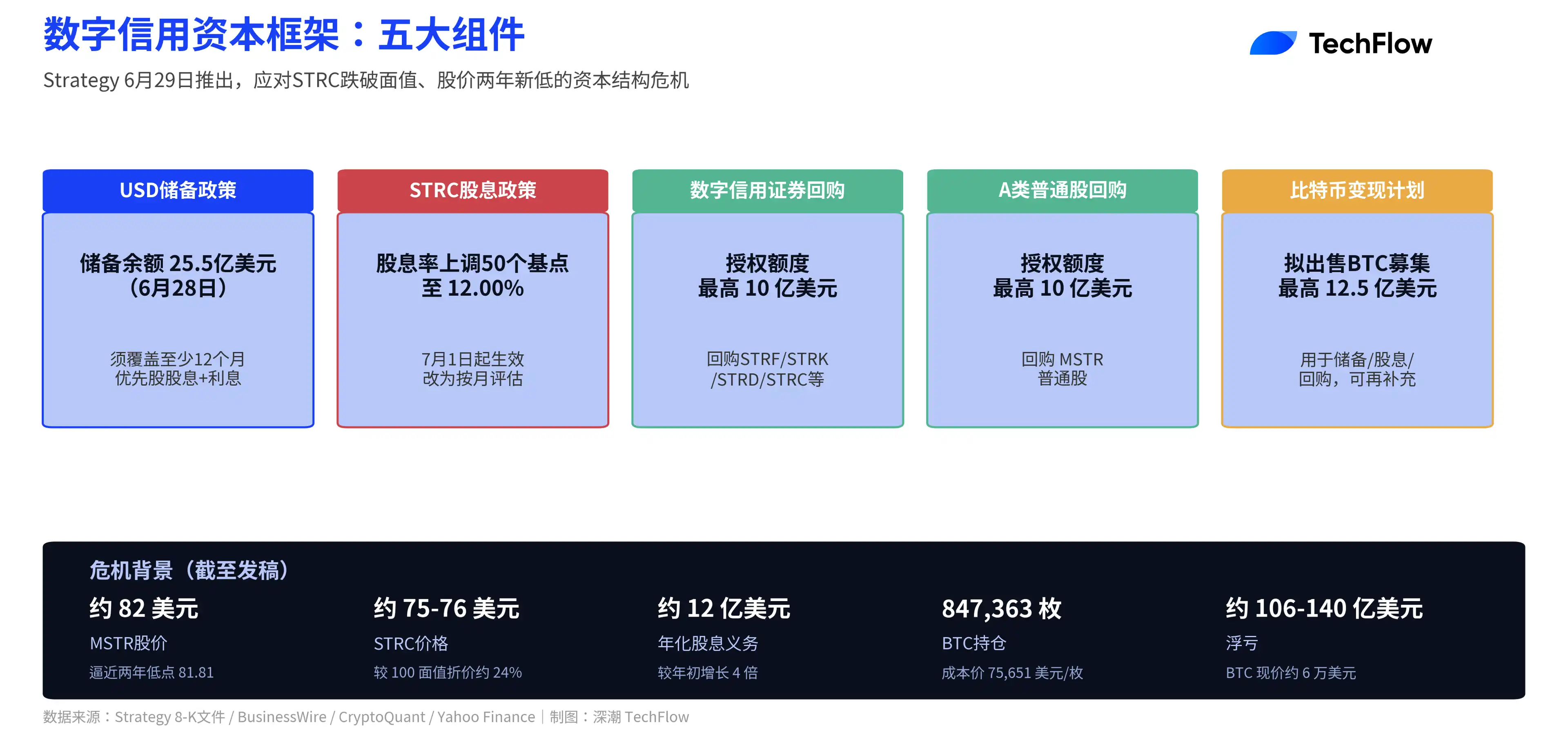
The logic isn't complicated. STRC and other preferred securities and MSTR common stock are trading at deep discounts. The company using cash (or proceeds from Bitcoin sales) to repurchase at low prices can theoretically narrow the discount and protect the price. Bitcoin critic Peter Schiff has repeatedly posted on X in recent days, saying Saylor's best option is to sell Bitcoin to repurchase shares and close the discount.

Now Strategy has written this suggestion into its formal framework, though Schiff simultaneously warned that forced Bitcoin sales could conversely crash the Bitcoin price, plunging the entire structure into a death spiral.

Whether the repurchases will work depends on how much cash the company has. For investors holding MSTR or preferred stock, the $10 billion authorization is just a ceiling, not a guarantee of full execution; the actual buying pace will depend on subsequent disclosures.

More Than Just Stopping the Bleeding: Legal Probes and Mounting Debt

This framework was hastily launched under multiple pressures; looking at financial numbers alone is insufficient.

On June 25, Rosen Law Firm disclosed it is investigating Strategy and Saylor, alleging they may have issued 'materially misleading information' to investors regarding Bitcoin holdings. The investigation covers all five of the company's securities: MSTR, STRF, STRC, STRK, and STRD. The probe is still in its early stages with no formal lawsuit yet, but the timing coincides with the continuous decline in stock price.

The debt situation is equally tight.

According to multiple media reports, Strategy's total debt on its balance sheet is about $8.2 billion. Since 2026, its cash reserve has shrunk by approximately 38%, and the company also conducted a debt buyback in May. With Bitcoin currently around $60,000, it has fallen below the cost basis of all Strategy's purchase batches from 2024 to 2026. Paper losses range between $10.6 billion and $14 billion (varies by source).

For investors on the sidelines, the key metric to watch now is the discount of the MSTR stock price relative to its per-share Bitcoin Net Asset Value. If the discount remains persistently deep, the ATM offering engine will stall. That is the outcome this framework truly aims to avoid—yet may not be able to prevent.


Trending Cryptos

Related Questions

QWhat is the new 'Digital Credit Capital Framework' announced by Strategy, and what major shift does it represent?

AStrategy announced a 'Digital Credit Capital Framework' to stabilize its capital structure. It includes five components: a USD reserve policy, a revised STRC dividend policy, a digital credit securities repurchase plan, a Class A common stock repurchase plan, and a Bitcoin monetization plan. The major shift is the authorization to sell up to $1.25 billion worth of Bitcoin to fund cash reserves and obligations, effectively ending its previous 'never sell' Bitcoin strategy and marking a turn towards active capital management.

QWhat was the immediate trigger for Strategy to implement this new capital framework?

AThe immediate trigger was the market pressure stemming from its STRC preferred stock trading at a significant discount. The STRC shares fell to approximately $75-76, a discount of about 24% from their $100 par value. This threatened the company's core funding model, which relied on issuing preferred shares near or above par value to buy Bitcoin. Furthermore, the annualized dividend obligation on these preferred shares had surged to around $1.2 billion, creating a critical liquidity strain.

QHow has Strategy's approach to its cash reserves changed recently, and what are the implications?

AStrategy has shifted from aggressively accumulating Bitcoin to aggressively building its USD cash reserves. The reserve balance grew to $2.55 billion by June 28, up from $1.4 billion in early December 2025. This growth is funded primarily by selling its own MSTR common stock through its ATM program, with a decreasing portion of the proceeds being used to buy Bitcoin. The implication is a strategic pivot from 'hoarding Bitcoin' to 'hoarding cash' to meet obligations, which comes at the cost of potential shareholder dilution when MSTR trades below its Bitcoin-per-share NAV.

QWhat are the two key repurchase plans included in the framework, and what is their intended purpose?

AThe framework authorizes two repurchase plans, each with a ceiling of $1 billion: a Digital Credit Securities Repurchase Plan (targeting preferred shares like STRC) and a Class A Common Stock Repurchase Plan (targeting MSTR stock). The intended purpose is to buy back these securities while they are trading at deep discounts to their par value or NAV. The goal is to support their market prices, narrow the discount gap, and restore investor confidence in the company's capital structure.

QWhat are some of the additional pressures, beyond financials, that Strategy is currently facing?

ABeyond the financial pressures, Strategy is facing a legal investigation and significant debt burdens. On June 25, Rosen Law Firm announced it is investigating the company and Michael Saylor for potentially issuing 'materially misleading' information to investors regarding its Bitcoin holdings. Additionally, the company carries approximately $8.2 billion in cumulative debt, and with Bitcoin's price below its average acquisition cost, the company is facing substantial paper losses estimated between $10.6 billion and $14 billion.

Related Reads

Lightning Fast Five-Whip Combo! Strategy's Self-Rescue Plan Officially Released

Strategy, amidst the STRC de-pegging crisis, has unveiled its "Digital Credit Capital Framework" self-rescue plan. The five-part framework includes: 1) **Cash Reserves**: Management of ~$2.55B in USD reserves, dedicated solely to covering ~17.4 months of preferred stock dividends and debt interest, with a 12-month minimum coverage floor. 2) **Dividend Policy**: STRC's dividend yield rises to 12% from July 1st, with monthly reviews. Strategy clarifies de-pegging does not automatically trigger further hikes. 3) **Preferred Stock Buyback**: A $1B authorization, prioritizing STRC repurchases to support its price, reduce future dividend obligations, and signal commitment, using funds separate from dividend reserves. 4) **Common Stock Buyback**: A separate $1B authorization for MSTR stock, aimed at creating shareholder value when the stock is deemed undervalued, establishing a two-way capital management mechanism. 5) **Bitcoin Monetization**: Formal authorization to sell BTC (up to $1.25B earmarked) to build USD reserves, cover dividends/interest, or fund buybacks, marking a strategic shift where BTC becomes a managed asset rather than a strictly "hold-only" reserve. Market reaction saw MSTR and STRC shares rise pre-market, while BTC remained stable. The plan aims to restore confidence in STRC, ensure dividend sustainability, and reopen Strategy's funding channels.

Odaily星球日报57m ago

Lightning Fast Five-Whip Combo! Strategy's Self-Rescue Plan Officially Released

Odaily星球日报57m ago

The Sword of Damocles Over the AI Bull Market: Not Just in South Korea, Leverage in U.S. Stocks Is Equally Staggering

Global equity markets are hitting new highs driven by the AI boom, but the fuel behind this rally is becoming increasingly dangerous. From the US to South Korea, margin debt and leveraged ETF assets have soared to historical extremes, with their pro-cyclical nature amplifying tail risks in market volatility. In the US, margin debt rose 54% year-over-year in May, reaching a record $1.4 trillion. Simultaneously, leveraged ETF assets nearly doubled in under 70 days to over $220 billion by early June, with intense focus on tech, semiconductor indices, and single stocks like NVIDIA and Tesla. A warning sign appeared in South Korea, where the KOSPI index experienced extreme volatility, plunging 10% to trigger a circuit breaker, then sharply rebounding before halting again, partly driven by concentrated, highly leveraged positions in chip stocks. Analysts are raising alarms. Barclays warns that leveraged funds have accumulated roughly $300 billion in equity-linked derivatives since late March, creating a major source of non-discretionary risk. Morgan Stanley notes an unprecedented reliance on leveraged financing by marginal buyers, with financing becoming more expensive and scarce. Charles Schwab has tightened margin requirements. The core risk lies in the mechanics: leveraged ETFs and derivatives can create a "tail wags the dog" effect, where fund flows force market makers to buy underlying stocks, amplifying gains. This process reverses in a downturn, triggering a self-reinforcing selling spiral as funds deleverage. Additionally, the cost of borrowing to buy stocks has spiked to multi-year highs. Morgan Stanley warns this sets up a nonlinear risk: high financing costs stall momentum, a price decline triggers forced deleveraging, and selling pressure is multiplied by leverage, potentially leading to outsized declines. The current market breadth is narrow, with gains heavily concentrated in tech, making the rally vulnerable to a pullback in leveraged positions. In summary, the AI-fueled bull market is increasingly propped up by record leverage. When this trend reverses, the deleveraging process could magnify losses, posing a significant threat to financial stability.

marsbit1h ago

The Sword of Damocles Over the AI Bull Market: Not Just in South Korea, Leverage in U.S. Stocks Is Equally Staggering

marsbit1h ago

Deforming the Transformer, LLMs Become Smarter

A new research paper proposes "Tapered Language Models (TLMs)," a method that improves large language model performance without adding any parameters. It challenges the standard Transformer design where each layer has the same number of parameters ("feed-forward network" width). Building on evidence that layers are not equally important—earlier layers handle foundational information like grammar, while later layers often reinforce existing judgments—the researchers suggest reallocating model capacity from later to earlier layers. The core idea is to make the layer width taper off monotonically from start to end, keeping total parameters and compute constant. Experiments compared linear, cosine, and sigmoid tapering curves on a 440M parameter model. The cosine curve (e.g., starting width 1.5x baseline, ending 0.5x) achieved the best result, reducing perplexity by 1.84 points compared to the uniform baseline—a significant gain at zero cost. This finding proved robust across four different model architectures (including gated attention and memory-augmented models) and at larger scales (760M and 1.3B parameters), consistently improving performance on commonsense reasoning and language modeling tasks without harming long-context retrieval ability. The work highlights a long-overlooked design dimension: optimal parameter allocation across depth. It offers a "free lever" for efficiency, potentially applicable beyond language models to vision Transformers and diffusion models. The study was conducted by researchers from Mila, Cornell University, and the University of Montreal.

marsbit1h ago

Deforming the Transformer, LLMs Become Smarter

marsbit1h ago

Trading

Spot

Hot Articles

What is $BITCOIN

DIGITAL GOLD ($BITCOIN): A Comprehensive Analysis Introduction to DIGITAL GOLD ($BITCOIN) DIGITAL GOLD ($BITCOIN) is a blockchain-based project operating on the Solana network, which aims to combine the characteristics of traditional precious metals with the innovation of decentralized technologies. While it shares a name with Bitcoin, often referred to as “digital gold” due to its perception as a store of value, DIGITAL GOLD is a separate token designed to create a unique ecosystem within the Web3 landscape. Its goal is to position itself as a viable alternative digital asset, although specifics regarding its applications and functionalities are still developing. What is DIGITAL GOLD ($BITCOIN)? DIGITAL GOLD ($BITCOIN) is a cryptocurrency token explicitly designed for use on the Solana blockchain. In contrast to Bitcoin, which provides a widely recognized value storage role, this token appears to focus on broader applications and characteristics. Notable aspects include: Blockchain Infrastructure: The token is built on the Solana blockchain, known for its capacity to handle high-speed and low-cost transactions. Supply Dynamics: DIGITAL GOLD has a maximum supply capped at 100 quadrillion tokens (100P $BITCOIN), although details regarding its circulating supply are currently undisclosed. Utility: While precise functionalities are not explicitly outlined, there are indications that the token could be utilized for various applications, potentially involving decentralized applications (dApps) or asset tokenization strategies. Who is the Creator of DIGITAL GOLD ($BITCOIN)? At present, the identity of the creators and development team behind DIGITAL GOLD ($BITCOIN) remains unknown. This situation is typical among many innovative projects within the blockchain space, particularly those aligning with decentralized finance and meme coin phenomena. While such anonymity may foster a community-driven culture, it intensifies concerns about governance and accountability. Who are the Investors of DIGITAL GOLD ($BITCOIN)? The available information indicates that DIGITAL GOLD ($BITCOIN) does not have any known institutional backers or prominent venture capital investments. The project seems to operate on a peer-to-peer model focused on community support and adoption rather than traditional funding routes. Its activity and liquidity are primarily situated on decentralized exchanges (DEXs), such as PumpSwap, rather than established centralized trading platforms, further highlighting its grassroots approach. How DIGITAL GOLD ($BITCOIN) Works The operational mechanics of DIGITAL GOLD ($BITCOIN) can be elaborated on based on its blockchain design and network attributes: Consensus Mechanism: By leveraging Solana’s unique proof-of-history (PoH) combined with a proof-of-stake (PoS) model, the project ensures efficient transaction validation contributing to the network's high performance. Tokenomics: While specific deflationary mechanisms have not been extensively detailed, the vast maximum token supply implies that it may cater to microtransactions or niche use cases that are still to be defined. Interoperability: There exists the potential for integration with Solana’s broader ecosystem, including various decentralized finance (DeFi) platforms. However, the details regarding specific integrations remain unspecified. Timeline of Key Events Here is a timeline that highlights significant milestones concerning DIGITAL GOLD ($BITCOIN): 2023: The initial deployment of the token occurs on the Solana blockchain, marked by its contract address. 2024: DIGITAL GOLD gains visibility as it becomes available for trading on decentralized exchanges like PumpSwap, allowing users to trade it against SOL. 2025: The project witnesses sporadic trading activity and potential interest in community-led engagements, although no noteworthy partnerships or technical advancements have been documented as of yet. Critical Analysis Strengths Scalability: The underlying Solana infrastructure supports high transaction volumes, which could enhance the utility of $BITCOIN in various transaction scenarios. Accessibility: The potential low trading price per token could attract retail investors, facilitating wider participation due to fractional ownership opportunities. Risks Lack of Transparency: The absence of publicly known backers, developers, or an audit process may yield skepticism regarding the project's sustainability and trustworthiness. Market Volatility: The trading activity is heavily reliant on speculative behavior, which can result in significant price volatility and uncertainty for investors. Conclusion DIGITAL GOLD ($BITCOIN) emerges as an intriguing yet ambiguous project within the rapidly evolving Solana ecosystem. While it attempts to leverage the “digital gold” narrative, its departure from Bitcoin's established role as a store of value underscores the need for a clearer differentiation of its intended utility and governance structure. Future acceptance and adoption will likely depend on addressing the current opacity and defining its operational and economic strategies more explicitly. Note: This report encompasses synthesised information available as of October 2023, and developments may have transpired beyond the research period.

512 Total ViewsPublished 2025.05.13Updated 2025.05.13

What is $BITCOIN

Discussions

Welcome to the HTX Community. Here, you can stay informed about the latest platform developments and gain access to professional market insights. Users' opinions on the price of BTC (BTC) are presented below.

活动图片