Stocks outpace Bitcoin, yet whales keep buying BTC – Why?

ambcryptoPublished on 2025-12-24Last updated on 2025-12-24

Abstract

Bitcoin's price has underperformed compared to equities, but key on-chain trends suggest underlying strength. Exchange reserves continue to decline, indicating investors are moving BTC into long-term storage rather than selling. Despite a 2.2% drop in wallets holding at least 1 BTC since March, larger investors ("whales") have accumulated over 136,000 BTC during the same period. This divergence shows retail caution but strong institutional confidence. Although Bitcoin has lagged nearly 50% behind the Nasdaq this year, analysts attribute this to temporary liquidity pressures and softer risk appetite, not a fundamental breakdown. If liquidity conditions improve, Bitcoin may be poised for a stronger performance in 2026.

Bitcoin’s [BTC] price hasn’t kept up with equities, but something important is happening.

More BTC is being moved off exchanges, which often means people plan to hold it rather than sell. Smaller investors are stepping away, and big investors are buying.

The market may not be as uncertain as it looks.

BTC is leaving exchanges

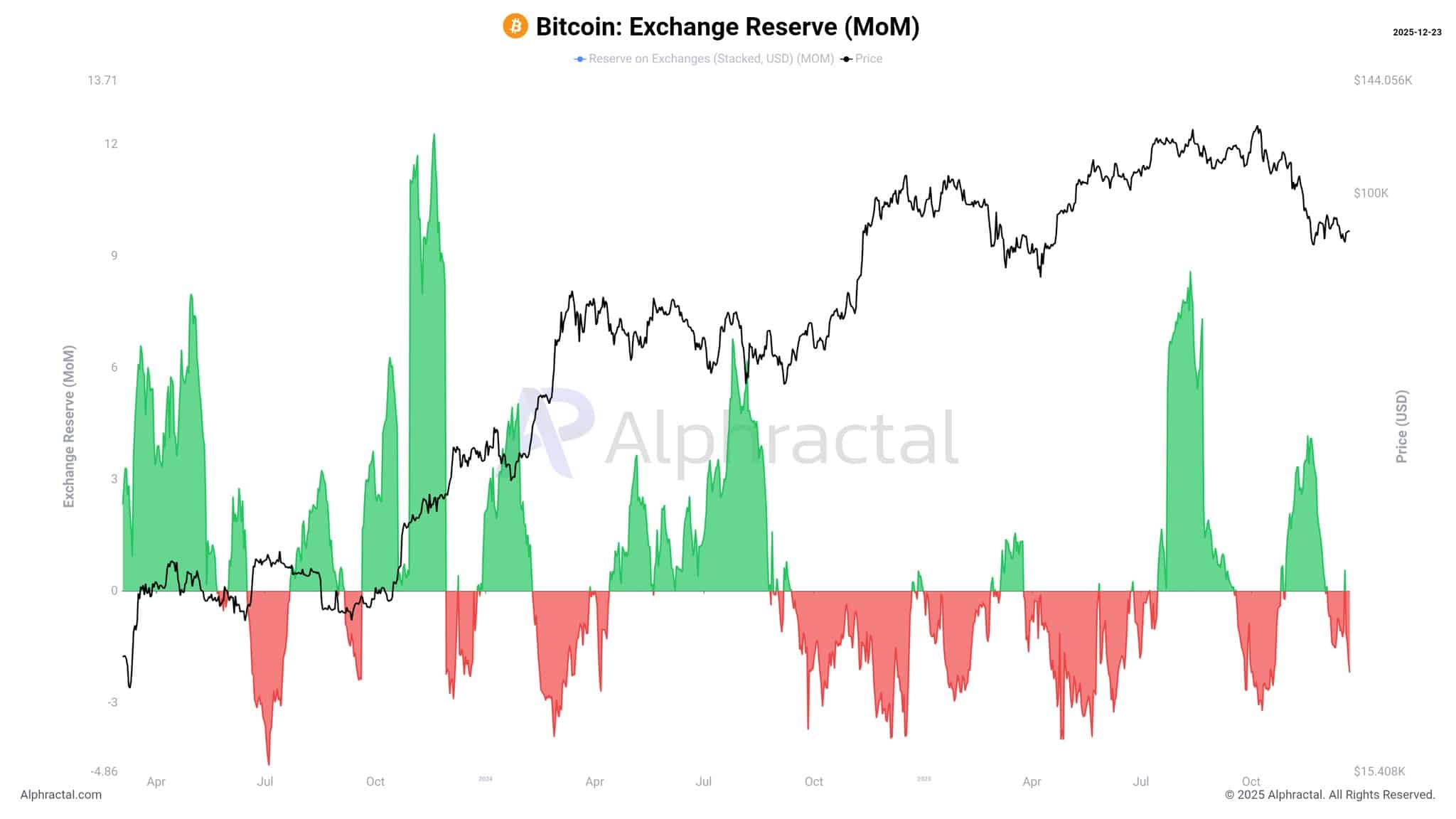
Monthly changes in Bitcoin exchange reserves have turned negative, meaning more BTC is being withdrawn than deposited. This trend has stayed consistent even with weak price action.

Source: Alphractal

When coins leave exchanges, investors are choosing to hold rather than trade in the short term. On its own, this doesn’t guarantee a price rally.

Outflows can occur during both bullish and cautious periods. However, when withdrawals persist, they reduce liquid supply and signal confidence in Bitcoin’s long‑term value.

Fewer wallets, greater confidence

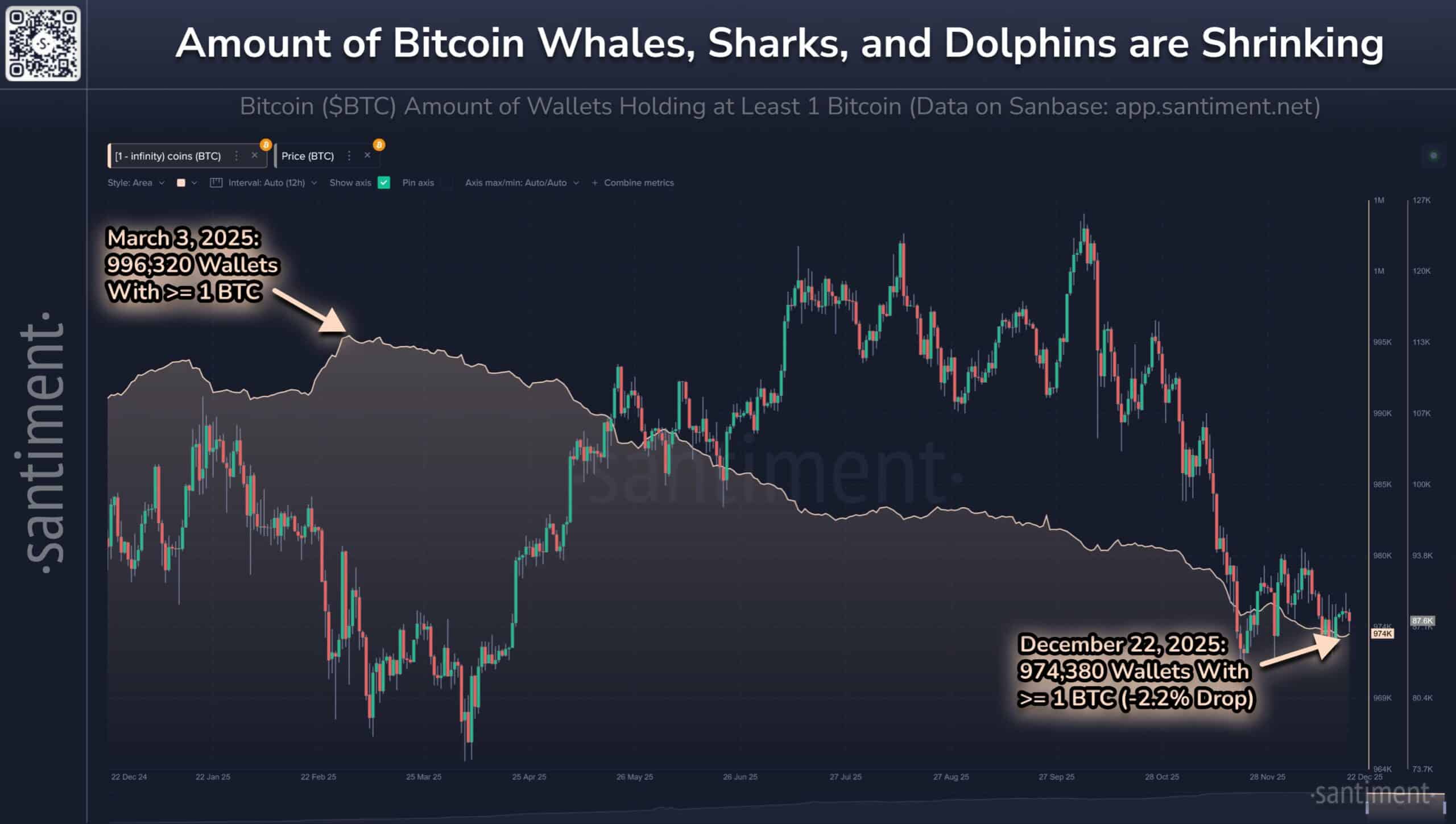
While Bitcoin is leaving exchanges, ownership patterns are also changing. Santiment data shows that wallets holding at least 1 BTC have fallen by 2.2% from their March peak.

Source: Santiment

That looks like weak belief, but here’s what’s interesting. Larger holders have been buying, adding more than 136,000 BTC over the same period.

Smaller participants are stepping away, and whales are increasing exposure. This doesn’t change prices right away, but it usually shows firm long-term confidence.

Lag today, gains tomorrow

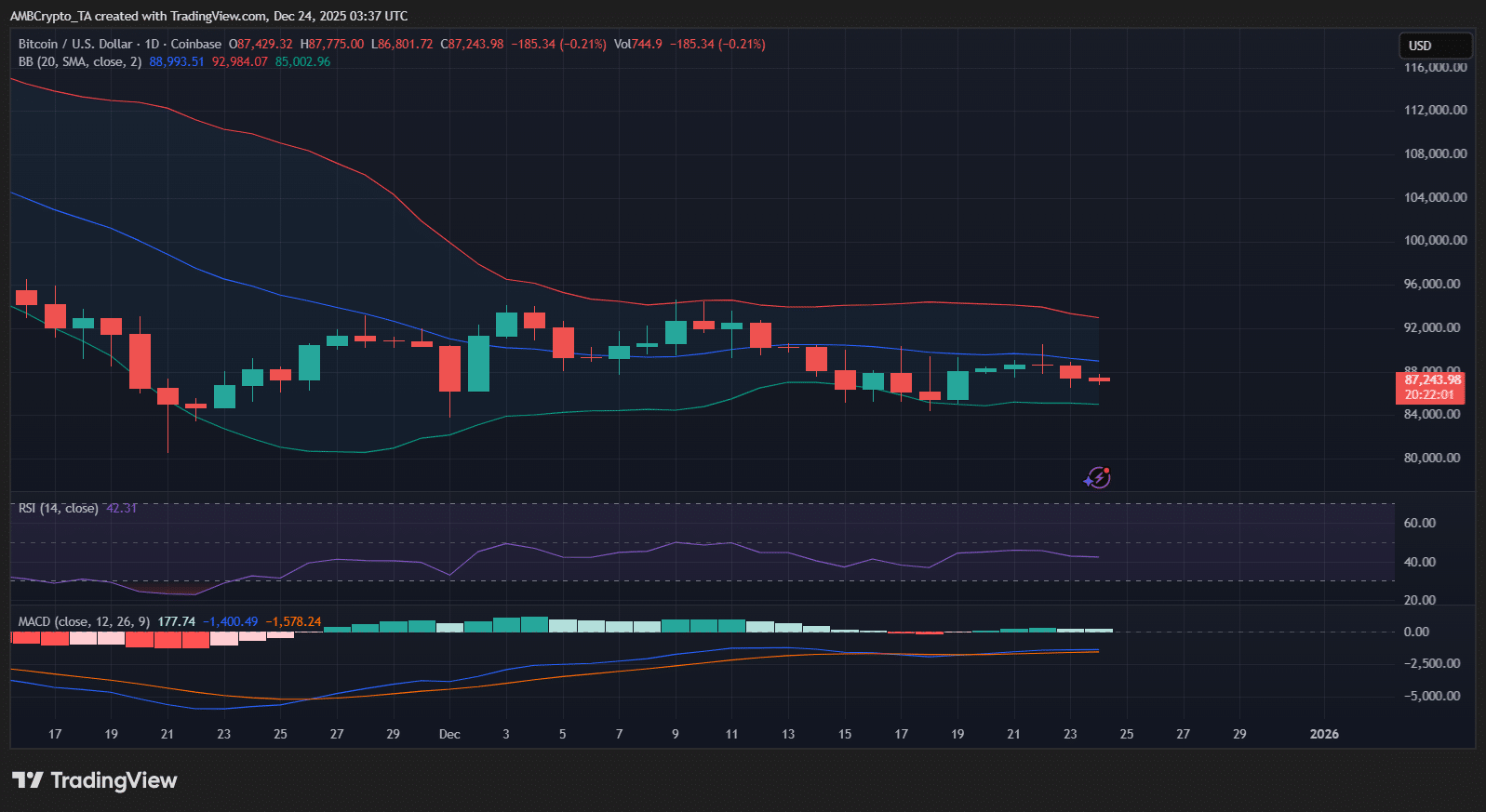
Bitcoin has been stuck in a narrow range, with pace looking subdued.

Source: TradingView

That underperformance becomes clearer when compared to equities.

According to David Schassler, Head of Multi Asset Solutions, VanEck, Bitcoin has lagged the Nasdaq 100 by nearly 50% this year. But that gap may matter more going forward than it does today.

“Today’s weakness reflects softer risk appetite and temporary liquidity pressures, not a broken thesis.”

If liquidity improves, Bitcoin could respond better than stocks in 2026.


Final Thoughts

  • Bitcoin supply is tight as exchange balances fall.
  • Whales added 136K BTC, so there’s long-term confidence despite the boredom right now.
Next: PENGU down 73% in 5 months – Why the slump isn’t over yet
Share
  • Share
  • Tweet

Trending Cryptos

Related Questions

QWhy are Bitcoin exchange reserves turning negative, and what does this indicate?

AMonthly changes in Bitcoin exchange reserves have turned negative, meaning more BTC is being withdrawn than deposited. This indicates that investors are choosing to hold Bitcoin for the long term rather than trade it in the short term, signaling confidence in its future value.

QWhat trend is observed among smaller Bitcoin wallets, and how does it contrast with whale activity?

AThe number of wallets holding at least 1 BTC has decreased by 2.2% since March, indicating that smaller investors are stepping away. In contrast, larger holders (whales) have been buying, adding over 136,000 BTC in the same period, showing strong long-term confidence.

QHow has Bitcoin's performance compared to equities like the Nasdaq 100 this year?

AAccording to David Schassler of VanEck, Bitcoin has lagged the Nasdaq 100 by nearly 50% this year. This underperformance is attributed to softer risk appetite and temporary liquidity pressures rather than a fundamental issue with Bitcoin's value proposition.

QWhat could potentially drive Bitcoin to outperform stocks in 2026?

AIf liquidity conditions in the market improve, Bitcoin could respond better than stocks in 2026. The current weakness is seen as temporary, and a recovery in liquidity might lead to significant gains for Bitcoin.

QWhat are the key takeaways regarding Bitcoin's supply and investor sentiment from the article?

AThe key takeaways are: 1) Bitcoin supply is tightening as exchange balances fall, reducing liquid supply. 2) Whales have added a significant amount of BTC (136,000), demonstrating long-term confidence despite the current period of price stagnation and market boredom.

Related Reads

Just Now, Anthropic Unveils Physical MCP: Claude Begins Controlling the Real World

Anthropic has announced the Model Hardware Standard (MHS), a new standard enabling AI agents like Claude to safely control physical devices. Building on the Model Context Protocol (MCP), MHS standardizes communication between AI agents and hardware such as microscopes, robotic arms, and lasers, marking a significant step for AI from the digital into the physical world. Developed in collaboration with HHMI Janelia Research Campus, MHS uses standardized drivers to translate basic commands (e.g., read, write) into a format any programmable device can understand. This drastically reduces integration time from weeks to hours or minutes and allows agents to discover and operate new devices using natural language tags that describe machine properties and safety limits. Agents can control devices via MCP, command-line interfaces, or APIs. They can sequence operations, monitor results, adjust parameters in real-time, and generate deterministic scripts for long-running tasks. Early tests show Claude interacting with hardware exploratively, like a scientist, learning to calibrate a laser and scripting the process. Early adopters and partners include AWS, Automata, Danaher, Doosan Robotics, and Tecan, who are integrating MHS support into their platforms. While promising, challenges remain: Claude's physical reasoning is limited, requiring expert oversight, and MHS currently only works with programmable hardware. Anthropic plans further refinements and broader device support before open-sourcing the standard.

marsbit4m ago

Just Now, Anthropic Unveils Physical MCP: Claude Begins Controlling the Real World

marsbit4m ago

History's Only Asset with a 100% Win Rate After 4 Years of Holding

**Title: The Only Asset with a 100% Win Rate Over Any 4-Year Holding Period** This article analyzes which major, freely-tradable assets have historically never produced a nominal loss over any rolling 4-year holding window. It concludes that only two distinct categories achieve this: ultra-low-risk contractual assets and Bitcoin. Among traditional risk assets, none maintain a perfect 4-year record. The S&P 500 had negative 4-year periods (e.g., 1929-1932: -64.8%). The Nasdaq 100 fell roughly 60% from 2000-2003. Gold saw a ~47.7% loss from 1981-1984. US real estate declined about 23.3% from 2007-2010. Even long-term US Treasury bonds (e.g., 2021-2024: -19.8%) and corporate bonds can produce 4-year losses due to interest rate and market price risks. In contrast, the first category achieving 100% nominal success includes assets like rolling 3-month US Treasury Bills, 4-year certificates of deposit (CDs), and US Treasuries held to maturity within 4 years. Their "guarantee" stems from contractual obligations and credit backing (e.g., FDIC insurance, US sovereign promise), not price appreciation. The sole exception in the high-risk category is Bitcoin. Analysis of daily data from 2010-2026 across 4,419 rolling 4-year windows shows a 100% positive return rate. The worst 4-year period (April 2021 to April 2025) still yielded a +32.6% total return (~7.3% CAGR). This record is unique because Bitcoin has no issuer, promises no cash flows, and has endured severe drawdowns (70-90%), yet its market price has always recovered within a 4-year span. The key distinction is the source of the "100%": contractual assets offer known, low nominal returns, while Bitcoin's record stems purely from historical price appreciation despite extreme volatility. The article suggests that for Bitcoin, the ability to hold for 4+ years is more critical than active trading strategies.

marsbit11m ago

History's Only Asset with a 100% Win Rate After 4 Years of Holding

marsbit11m ago

How One Article Moved 45 Billion: The Collapse of a 25-Year-Old 'AI Stock Guru'

This article details the dramatic rise and near-collapse of a hedge fund built by Leopold Aschenbrenner, a 24-year-old former OpenAI researcher. The fund, named Situational Awareness, amassed $45 billion in assets within two years. Its explosive growth stemmed from Aschenbrenner's influential 165-page manifesto predicting AGI's arrival by 2027 and his high-profile Silicon Valley connections. The fund employed an extremely aggressive strategy: high concentration and 400% leverage to bet long on AI infrastructure stocks while shorting legacy software firms. In July, this structure backfired when both sides of the trade reversed simultaneously—AI stocks plunged while shorted stocks rallied—triggering massive losses that nearly wiped out all equity. Major player Jane Street reportedly lost billions. The fund's leveraged public portfolio was ultimately sold at a discount to Citadel. The SEC is now investigating banks like Goldman Sachs for their role in facilitating the fund's high-leverage trades. The article compares this to past blow-ups like Archegos, highlighting systemic failures in risk management where the pursuit of short-term profits overrode due diligence. It questions whether such risky leverage concentrated in the AI sector, currently at record highs, poses a broader systemic threat. Ironically, Aschenbrenner, who studied AI safety at OpenAI, designed a fund structure prone to uncontrolled failure. Days after the crisis, he reportedly raised another $400 million for new investments.

marsbit26m ago

How One Article Moved 45 Billion: The Collapse of a 25-Year-Old 'AI Stock Guru'

marsbit26m ago

AI Accelerates Everything: Mathematics's Line of Defense Has Fallen, Physics is Already in AI's Crosshairs

This summer, the mathematics community was shaken as OpenAI's Astra model reportedly solved 10 long-standing open problems, and Claude Fable 5 found a potential counterexample to the Jacobian conjecture. This was followed by a major shift in physics: renowned physicist Gavin E. Crooks presented an open problem in stochastic thermodynamics to Claude, which the AI solved completely in days—a task that might take a skilled graduate student months. The problem concerned constraints on entropy production statistics under the Detailed Fluctuation Theorem (DFT), a core concept in non-equilibrium physics. Claude provided a unifying geometric answer: all possible DFT-compatible distributions correspond to a convex "moment body." Its key insight was that for a fixed "gap," the distribution is uniquely determined, making any general DFT distribution a mixture of these basic two-outcome distributions. This structure implies that for given lower-order moments, the nth moment only has a sharp lower bound, with no upper bound. Claude demonstrated that numerous previously published bounds on entropy production are merely low-dimensional projections or "shadows" of this single, unified convex body. The AI-authored paper offers a complete hierarchical characterization of the moment constraints. This case signifies a potential paradigm shift: AI is progressing from solving known problems to aiding in the exploration of fundamental, unsolved scientific questions, heralding an AI-accelerated era for physics.

marsbit26m ago

AI Accelerates Everything: Mathematics's Line of Defense Has Fallen, Physics is Already in AI's Crosshairs

marsbit26m ago

Trading

Spot

Hot Articles

What is $BITCOIN

DIGITAL GOLD ($BITCOIN): A Comprehensive Analysis Introduction to DIGITAL GOLD ($BITCOIN) DIGITAL GOLD ($BITCOIN) is a blockchain-based project operating on the Solana network, which aims to combine the characteristics of traditional precious metals with the innovation of decentralized technologies. While it shares a name with Bitcoin, often referred to as “digital gold” due to its perception as a store of value, DIGITAL GOLD is a separate token designed to create a unique ecosystem within the Web3 landscape. Its goal is to position itself as a viable alternative digital asset, although specifics regarding its applications and functionalities are still developing. What is DIGITAL GOLD ($BITCOIN)? DIGITAL GOLD ($BITCOIN) is a cryptocurrency token explicitly designed for use on the Solana blockchain. In contrast to Bitcoin, which provides a widely recognized value storage role, this token appears to focus on broader applications and characteristics. Notable aspects include: Blockchain Infrastructure: The token is built on the Solana blockchain, known for its capacity to handle high-speed and low-cost transactions. Supply Dynamics: DIGITAL GOLD has a maximum supply capped at 100 quadrillion tokens (100P $BITCOIN), although details regarding its circulating supply are currently undisclosed. Utility: While precise functionalities are not explicitly outlined, there are indications that the token could be utilized for various applications, potentially involving decentralized applications (dApps) or asset tokenization strategies. Who is the Creator of DIGITAL GOLD ($BITCOIN)? At present, the identity of the creators and development team behind DIGITAL GOLD ($BITCOIN) remains unknown. This situation is typical among many innovative projects within the blockchain space, particularly those aligning with decentralized finance and meme coin phenomena. While such anonymity may foster a community-driven culture, it intensifies concerns about governance and accountability. Who are the Investors of DIGITAL GOLD ($BITCOIN)? The available information indicates that DIGITAL GOLD ($BITCOIN) does not have any known institutional backers or prominent venture capital investments. The project seems to operate on a peer-to-peer model focused on community support and adoption rather than traditional funding routes. Its activity and liquidity are primarily situated on decentralized exchanges (DEXs), such as PumpSwap, rather than established centralized trading platforms, further highlighting its grassroots approach. How DIGITAL GOLD ($BITCOIN) Works The operational mechanics of DIGITAL GOLD ($BITCOIN) can be elaborated on based on its blockchain design and network attributes: Consensus Mechanism: By leveraging Solana’s unique proof-of-history (PoH) combined with a proof-of-stake (PoS) model, the project ensures efficient transaction validation contributing to the network's high performance. Tokenomics: While specific deflationary mechanisms have not been extensively detailed, the vast maximum token supply implies that it may cater to microtransactions or niche use cases that are still to be defined. Interoperability: There exists the potential for integration with Solana’s broader ecosystem, including various decentralized finance (DeFi) platforms. However, the details regarding specific integrations remain unspecified. Timeline of Key Events Here is a timeline that highlights significant milestones concerning DIGITAL GOLD ($BITCOIN): 2023: The initial deployment of the token occurs on the Solana blockchain, marked by its contract address. 2024: DIGITAL GOLD gains visibility as it becomes available for trading on decentralized exchanges like PumpSwap, allowing users to trade it against SOL. 2025: The project witnesses sporadic trading activity and potential interest in community-led engagements, although no noteworthy partnerships or technical advancements have been documented as of yet. Critical Analysis Strengths Scalability: The underlying Solana infrastructure supports high transaction volumes, which could enhance the utility of $BITCOIN in various transaction scenarios. Accessibility: The potential low trading price per token could attract retail investors, facilitating wider participation due to fractional ownership opportunities. Risks Lack of Transparency: The absence of publicly known backers, developers, or an audit process may yield skepticism regarding the project's sustainability and trustworthiness. Market Volatility: The trading activity is heavily reliant on speculative behavior, which can result in significant price volatility and uncertainty for investors. Conclusion DIGITAL GOLD ($BITCOIN) emerges as an intriguing yet ambiguous project within the rapidly evolving Solana ecosystem. While it attempts to leverage the “digital gold” narrative, its departure from Bitcoin's established role as a store of value underscores the need for a clearer differentiation of its intended utility and governance structure. Future acceptance and adoption will likely depend on addressing the current opacity and defining its operational and economic strategies more explicitly. Note: This report encompasses synthesised information available as of October 2023, and developments may have transpired beyond the research period.

2.4k Total ViewsPublished 2025.05.13Updated 2025.05.13
What is $BITCOIN

Discussions

Welcome to the HTX Community. Here, you can stay informed about the latest platform developments and gain access to professional market insights. Users' opinions on the price of BTC (BTC) are presented below.

活动图片