AI Accelerates Everything: Mathematics's Line of Defense Has Fallen, Physics is Already in AI's Crosshairs

marsbitPublished on 2026-08-28Last updated on 2026-08-28

Abstract

This summer, the mathematics community was shaken as OpenAI's Astra model reportedly solved 10 long-standing open problems, and Claude Fable 5 found a potential counterexample to the Jacobian conjecture. This was followed by a major shift in physics: renowned physicist Gavin E. Crooks presented an open problem in stochastic thermodynamics to Claude, which the AI solved completely in days—a task that might take a skilled graduate student months. The problem concerned constraints on entropy production statistics under the Detailed Fluctuation Theorem (DFT), a core concept in non-equilibrium physics. Claude provided a unifying geometric answer: all possible DFT-compatible distributions correspond to a convex "moment body." Its key insight was that for a fixed "gap," the distribution is uniquely determined, making any general DFT distribution a mixture of these basic two-outcome distributions. This structure implies that for given lower-order moments, the nth moment only has a sharp lower bound, with no upper bound. Claude demonstrated that numerous previously published bounds on entropy production are merely low-dimensional projections or "shadows" of this single, unified convex body. The AI-authored paper offers a complete hierarchical characterization of the moment constraints. This case signifies a potential paradigm shift: AI is progressing from solving known problems to aiding in the exploration of fundamental, unsolved scientific questions, heralding an AI-accelerated er...

This summer, the mathematics world was shaken by continuous shocks—

OpenAI's Astra model solved 10 long-standing unresolved mathematical problems at once (including the existence of non-sofic groups, new results on high-dimensional sphere packing, etc.); Claude Fable 5 found a counterexample to the nearly century-old Jacobian conjecture and later significantly advanced the Riemann Hypothesis!

This left Sidharth Hariharan, a mathematics graduate student at Carnegie Mellon University, even more confused.

Previously, after receiving an email from 2022 Fields Medalist Maryna Viazovska, he learned that his research had been preemptively published by the AI agent 'Gauss', and he wept.
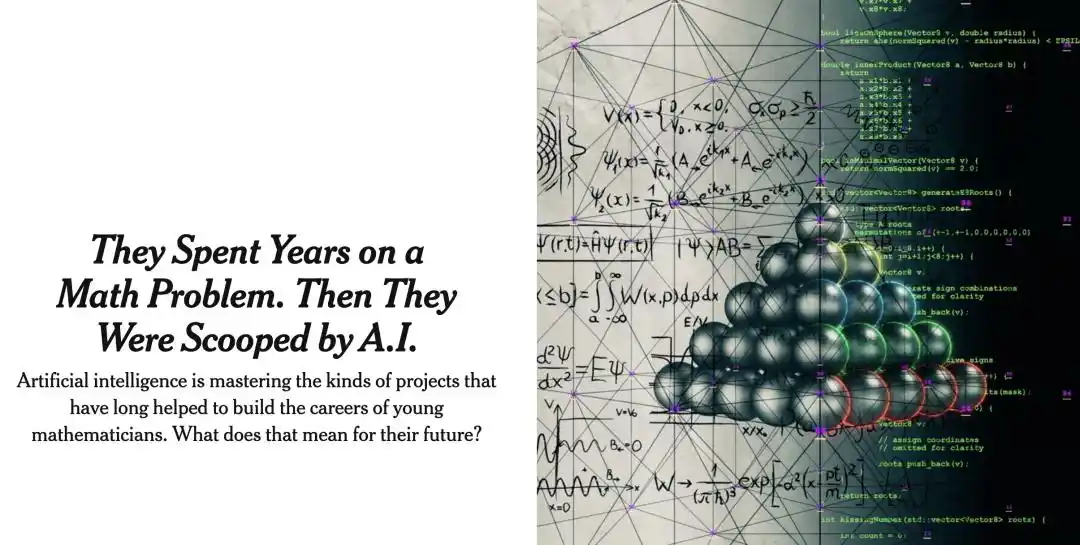
A year ago, you could still dismiss such progress as 'curiosity or hype, not very useful,' but the situation has changed. Even Fields Medalist Terence Tao admitted: Now, that argument no longer holds water.

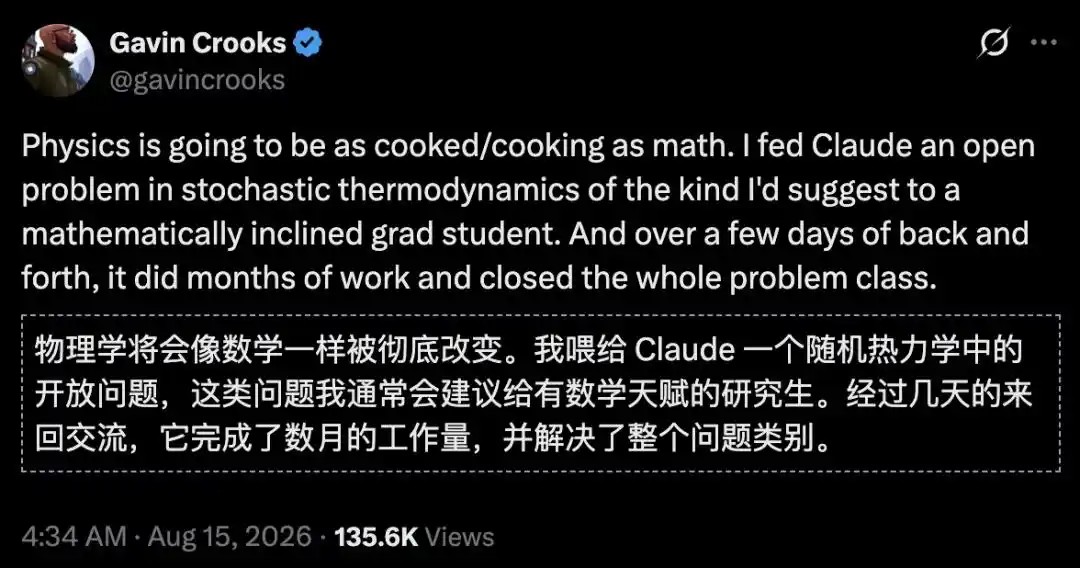
Just as the ripples in the mathematics community hadn't subsided, physicist Gavin E. Crooks tossed an open problem to Claude, and within days the entire problem was completely solved. Even a physics graduate student with solid mathematical skills might have taken months on this problem.

In physics, humans are also being dimensionally reduced by AI!

Against this backdrop, he, one of the founders of non-equilibrium statistical mechanics, asserted:

Physics will follow in mathematics's footsteps.
He acknowledged that academia is about to undergo a major transformation.

Academia has two roles: advancing knowledge and teaching/training/mentoring the next generation.

Science may soon develop at a pace humans cannot keep up with. And the other role also faces impact:

So, when any question I pose might be answered faster by Claude, how do we teach and train students?

What Exactly Was the Problem?

To understand the weight of this matter, one must return to Crooks himself. Gavin E. Crooks is highly esteemed in non-equilibrium thermodynamics and statistical mechanics.

In 1998–1999, while still a graduate student at Berkeley, he proposed the famous Crooks fluctuation theorem, which precisely relates non-equilibrium work to equilibrium free energy differences, becoming one of the cornerstones of stochastic thermodynamics.

A single 1999 paper alone has garnered thousands of citations.
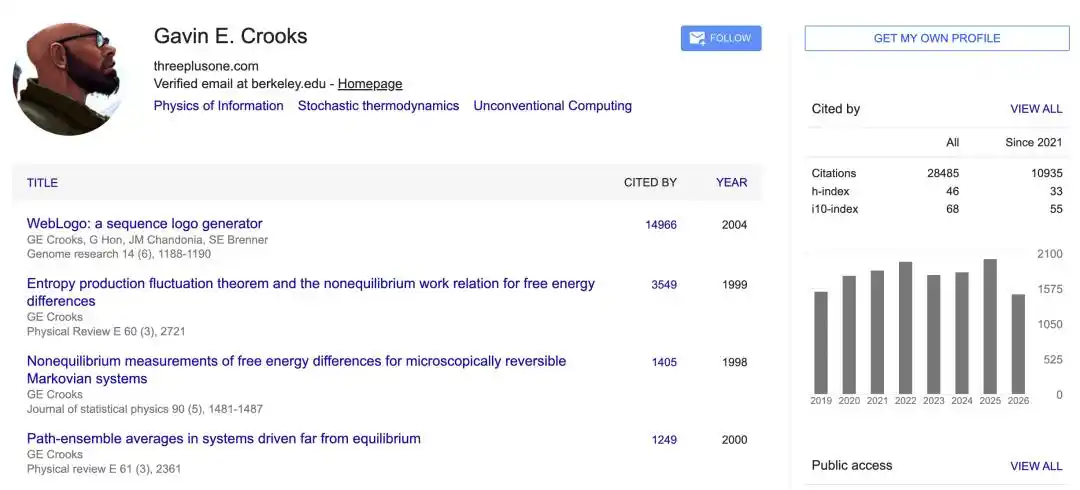
His long-term research traverses the intersection of thermodynamics, information theory, and computational science, profoundly influencing nanoscale thermodynamics, free energy estimation methods, and even the later formation of thermodynamic computing paradigms.

He received the Presidential Early Career Award for Scientists and Engineers (PECASE, one of the highest honors bestowed by the U.S. government on early-career researchers) and was elected a Fellow of the American Physical Society (APS Fellow) in 2019, enjoying high prestige in relevant academic circles.

This time, Claude solved a stochastic thermodynamics problem given by Crooks.

In the microscopic world, a system can occasionally briefly 'go against the second law of thermodynamics,' but the probability ratio of逆行事件 to normal events is not arbitrary; it is precisely controlled by entropy production and decreases exponentially rapidly.

This is described by the beautiful, symmetric Detailed Fluctuation Theorem (DFT)—
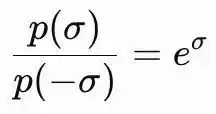
The problem: Under this functional constraint, what constraints exist for the statistics of entropy production?

This had already spawned a series of results.

Timpanaro et al.'s 2019 exchange TUR (exchange thermodynamic uncertainty relation) started from the exchange fluctuation theorem, giving a saturable bound in matrix form. Salazar's work continued to excavate tight bounds on skewness, tail probabilities, and information content from the DFT.

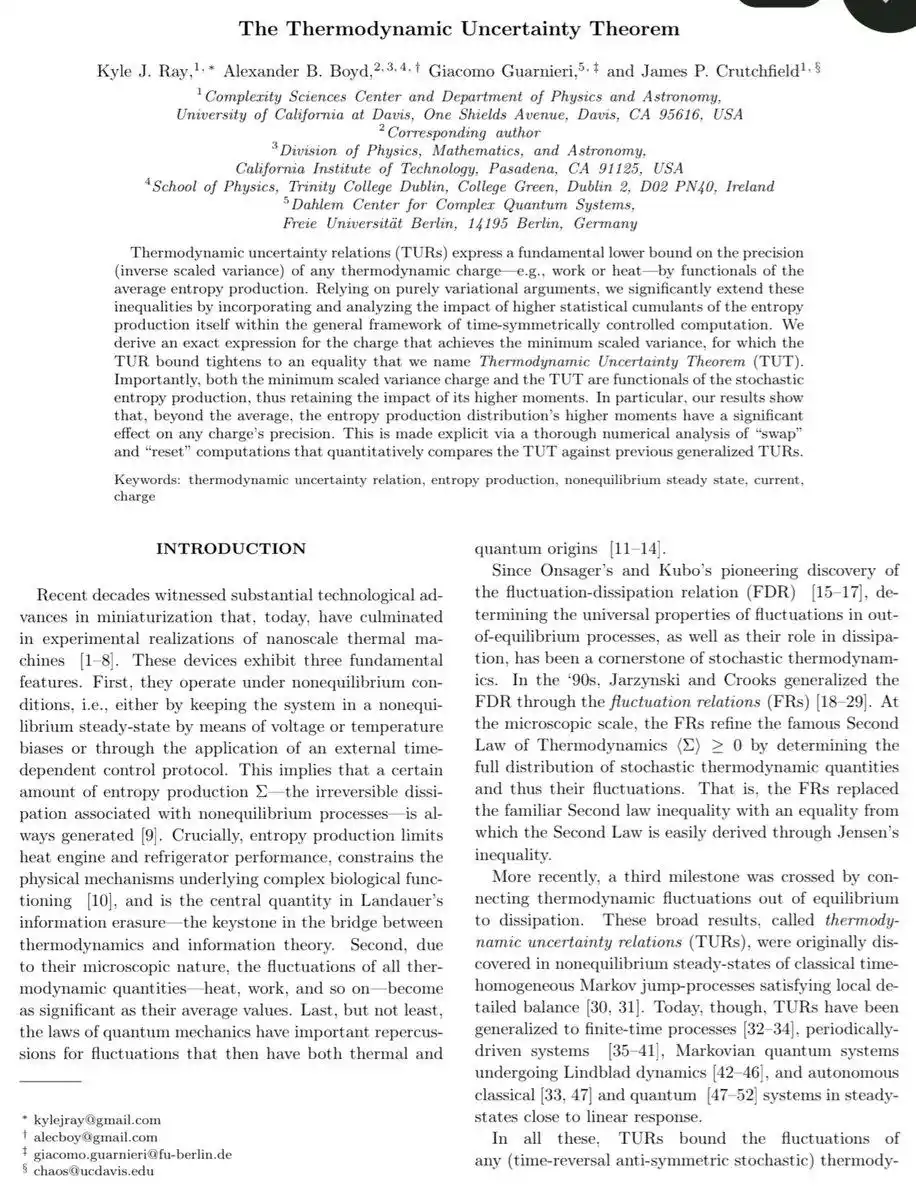
The 2023 TUT upgraded TUR from an inequality to a 'theorem,' clarifying the precise current achieving minimal scaled variance, and emphasized the influence of higher moments of entropy production.

They were unearthed one after another, yet a unified geometric picture was always missing.

Claude, however, identified all these local results as different projections of the same convex body and provided a complete hierarchical moment characterization.

The entire paper, from the abstract onward, was written by Claude.
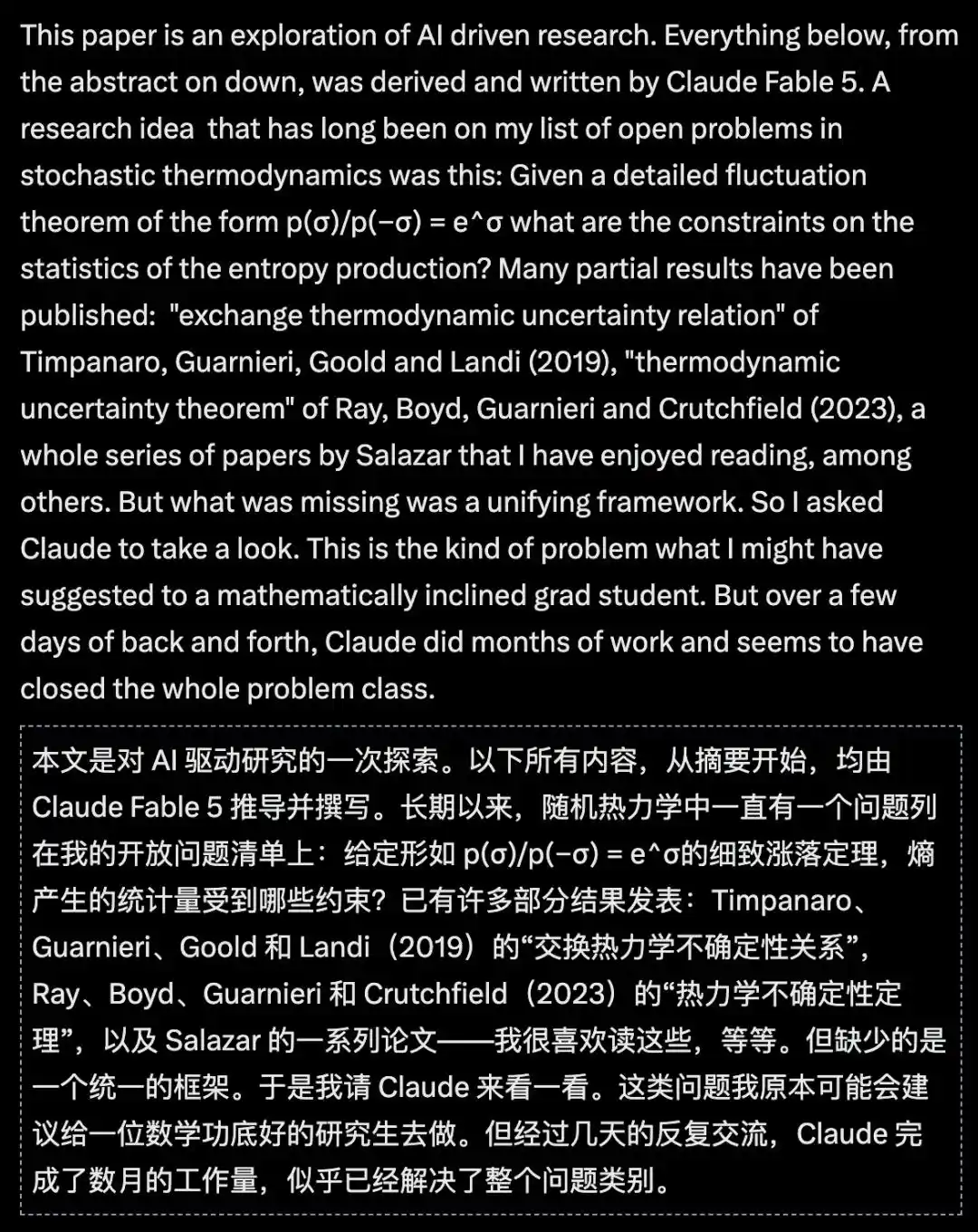
Claude's Unified Answer: A Convex Region, Only a Lower Bound

Claude's core insight is remarkably clean:

Every distribution satisfying the DFT uniquely corresponds to a 'gap distribution' ν (i.e., the distribution of |σ|).

For each fixed gap 'a', the distribution P_a has only two outcomes ±a, with weights strictly fixed by e^σ.

Therefore, any DFT distribution is a unique mixture of these two basic outcome distributions.

The joint reachable region of statistics is thus a convex body (moment body). More crucially, this convex body has an exact characterization at each order:

Given the first n−1 moments, the n-th moment can only take values in [some sharp lower bound, +∞), with no upper bound. The lower bound is achieved by a unique distribution with a finite number of symmetric outcome levels.

Every previously published DFT bound can be recovered as a low-dimensional projection of this unified convex region.

This also explains why the same distribution can nearly saturate all these bounds simultaneously.

This theory can also be generalized to the general two-distribution Crooks fluctuation theorem.

The mechanism stems from an overlooked structural fact: the mean function of DFT, a·tanh(a/2), can be written as a sum of simple relaxation terms with positive weights, with poles at odd squares.
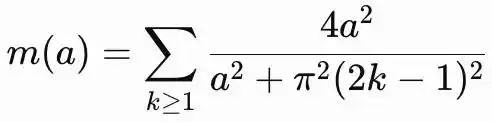
This directly maps the entire problem to the classical moment problem. Using precise identities involving Wronskian and Hankel determinants, all optimization falls onto a few atomic distributions.

The result: Nearly all published DFT bounds become low-dimensional projections (shadows) of this unified convex body. The same two-outcome distribution often saturates multiple different bounds simultaneously—because at a fixed mean, it is a vertex of the convex body.

For the general two-distribution Crooks fluctuation theorem, the symmetric channel (sum of forward and reverse moments) completely inherits the same hierarchy, while the asymmetric channel is almost unconstrained. This precisely explains why one-sided free energy estimators can be arbitrarily poor, while two-sided estimation is inherently necessary.

New Physics

The Thermodynamic Uncertainty Theorem itself was not a completely new discovery by Claude. The foundational version of this theorem was published in 2023 by Kyle J. Ray, Alexander B. Boyd, Giacomo Guarnieri, and James P. Crutchfield.
Claude placed all these 'projections' back into the same geometric object and proved that this object can be completely described.

The novel and fascinating aspect lies in the AI-driven research process.

Claude was not merely asked to explain an existing physics concept.

It was used to explore a difficult theoretical problem, connect existing ideas, and search for new mathematical structures.

This may become a story more significant than a single thermodynamic result:

AI is shifting from solving problems humans already know how to solve, to helping scientists explore problems we don't yet know how to solve.

Physics is entering its own AI-accelerated era.

References:

https://www.nytimes.com/2026/06/08/science/ai-scoop-young-mathematicians.html

https://x.com/SciTechera/status/2088872862254084449https://x.com/gavincrooks/status/2088643200038883830

https://x.com/gavincrooks/status/2088643200038883830

https://x.com/gavincrooks/status/2088590113463013582?s=20

This article is from the WeChat public account "新智元" (New Wisdom), author: ASI Revelation, editor: David


Related Questions

QAccording to the article, what significant impact did AI have on mathematics before its breakthrough in physics?

AAI models like OpenAI's Astra solved 10 long-standing open math problems, and Claude Fable 5 found a counterexample to the nearly century-old Jacobian conjecture and significantly advanced work on the Riemann hypothesis.

QWho is Gavin E. Crooks, and why is his perspective on AI significant in the article?

AGavin E. Crooks is a leading figure in non-equilibrium statistical mechanics, famous for the Crooks fluctuation theorem. His perspective is significant because he prompted the AI (Claude) to solve a complex problem in stochastic thermodynamics, leading to a breakthrough and his assertion that physics will follow mathematics into an AI-accelerated era.

QWhat was the core insight provided by Claude regarding the Detailed Fluctuation Theorem (DFT)?

AClaude's core insight was that every distribution satisfying the DFT uniquely corresponds to a 'gap distribution.' The joint reachable region for statistical moments forms a convex body where, for any given order, only a sharp lower bound exists, with no upper bound, unifying all previously known DFT bounds as low-dimensional projections of this convex body.

QHow does the article differentiate the new role of AI in scientific research from its previous role?

AThe article states that AI is shifting from solving problems humans already know how to solve to helping scientists explore problems we do not yet know how to solve, representing a move from a tool for execution to a partner in fundamental discovery.

QWhat are the two key roles of academia mentioned in the article, and how is AI challenging them?

AThe two roles are advancing knowledge and teaching/training/mentoring the next generation. AI challenges the first by potentially advancing science at a pace humans cannot follow and challenges the second by raising the question of how to teach students when AI can answer their questions faster than a human instructor.

Related Reads

Podcast Notes | After Watching 141 YouTube Investment Guru Videos, I Found Everyone's Bullish on These 5 Stocks

Podcast Summary: After analyzing 141 YouTube investment videos from 21 creators, five stocks were consistently highlighted: Alphabet (Google), Nvidia, Micron, CoreWeave, and Uber. However, the analysis reveals a key concentration: four of these (Google, Nvidia, Micron, CoreWeave) represent essentially the same AI-focused bet, with only Uber standing as an independent pick. The podcaster, Brian, provides his specific views and entry strategies for each. **Key Stocks & Brian's Stance:** - **Alphabet (Google):** Viewed as cheap based on profits but expensive based on sales. Brian is only buying a half-position via monthly investments at ~$362. - **Nvidia:** Models suggest it is undervalued (~$221 vs. a ~$290-330 fair value range), but significant client debt ($500B) raises risk. Brian holds a 12% position (his cap) and would not buy below $148. - **Micron:** Brian's model fair value is ~$1450, but it's a cyclical stock. He is buying only on schedule after it broke below its 50-day moving average (~$961), with a "story broken" line at $434. - **CoreWeave:** Has large contracts but faces scrutiny over demand sustainability, with Nvidia backing unsold capacity. Brian holds zero position due to limited history and structural concerns. - **Uber:** The only non-AI pick, valued cheaply on strong cash flow (~$100B annually). Brian's fair value is ~$109 (current price ~$67), and he is buying a full position. **Core Insight:** Most discussed topics (76/141 videos) were chips, cloud, and AI models. A portfolio built from such consensus may appear diversified but often constitutes a single, concentrated bet on AI. Brian concludes with a disciplined framework for any investment: compare to its own history, understand what the current price assumes, separate a good company from a good price, and pre-define your exit conditions.

marsbit4m ago

Podcast Notes | After Watching 141 YouTube Investment Guru Videos, I Found Everyone's Bullish on These 5 Stocks

marsbit4m ago

From 'Interest Rate Trading' to 'Dollar Debasement Trade', the Logic Behind Gold's Rise Has Changed

From "Rate Trade" to "Debasement Trade": The Logic Behind Gold's Rally Has Shifted Gold surged by 17% in August. According to UBS, the key development was a fundamental shift in the driving narrative mid-rally—from the traditional "rate trade" to a "debasement trade" focused on fiscal and dollar concerns. The bank breaks the summer rebound into two acts. The first was a technically-driven bounce from a solid base, supported by light positioning, resilient physical demand (especially from central banks like China's), and softening US economic data. The second act, triggered by the US Treasury's announcement to double long-term bond buybacks, marked a shift in gold's pricing logic. The market began viewing higher long-term yields as a sign of fiscal sustainability risks rather than economic strength, weakening gold's traditional inverse correlation with real rates. Gold's role evolved from an "opportunity cost" asset to a hedge against "fiscal credibility" and currency debasement, further aided by a weakening US dollar. UBS maintains a bullish outlook, noting rising upside risks to its long-term forecasts. While it lowered its 2026 year-end target to $4,675/oz, its 2027+ forecasts are unchanged, with an upside scenario target as high as $6,500/oz. The primary near-term risk is a hawkish Fed pivot, which could trigger a correction. However, UBS views any such dip as a buying opportunity, not a trend reversal, unless AI-driven growth allows for significantly higher rates. The report concludes that as gold is increasingly seen as a hedge against fiscal and currency risks, its strategic role in portfolios is changing. With overall gold allocations still low, there is significant room for further price appreciation if debt sustainability concerns drive sustained strategic buying.

marsbit5m ago

From 'Interest Rate Trading' to 'Dollar Debasement Trade', the Logic Behind Gold's Rise Has Changed

marsbit5m ago

Not Just Trading and Meme: These 5 Projects on Base Are Exploring New On-Chain Use Cases

Beyond Trading and Memes: 5 Projects Exploring New On-Chain Use Cases on Base While much of the crypto space is dominated by speculation, Base—Coinbase's Ethereum Layer 2 with over $5B TVL—is fostering innovative projects beyond the usual categories. Here are five notable examples: 1. **Hydrex**: A MetaDEX/AMM aggregator that pools native and external liquidity (e.g., from Uniswap, Morpho) to offer optimal swap rates. It features a ve(3,3)-style incentive model and single-signature transactions. 2. **SwapRoyale**: A fantasy trading competition app where users pay a fixed entry fee to trade with a virtual $100k portfolio in real-time contests. It gamifies trading with various tournament formats and has already distributed over $100k in prizes. 3. **BlockRun**: A permissionless AI gateway and payment layer for the on-chain agent economy. It allows autonomous systems to discover, pay for, and execute services using USDC on Base via the x402 micropayment standard, enabling pay-per-use AI. 4. **PixieChess**: A play-to-earn digital chess game where each piece is a collectible NFT with unique abilities that alter classic rules. Value is kept within the ecosystem, with a treasury funding real ETH prizes for winners. 5. **Tokensto**: A platform that lets users sell their unused AI API credits (e.g., from OpenRouter) for cash. It automatically prices credits and facilitates direct payouts to crypto wallets. These projects demonstrate that builders on Base are actively experimenting with consumer experiences, the agent economy, and novel gaming mechanics, suggesting the surface area for meaningful on-chain activity is broader than current narratives imply.

marsbit49m ago

Not Just Trading and Meme: These 5 Projects on Base Are Exploring New On-Chain Use Cases

marsbit49m ago

Trading

Spot
活动图片