StableChain launches mainnet with USDT gas fees, dedicated governance token

cointelegraphPublished on 2025-12-08Last updated on 2025-12-08

Abstract

StableChain, a Tether-backed protocol, has launched its mainnet as a new layer-1 blockchain designed specifically for stablecoin transactions. It uses USDT for gas fees, eliminating the need for volatile assets. The launch includes a new governance foundation and a native STABLE token, separating network security from payment flows. The project follows a $28 million seed round and a pre-deposit campaign that attracted over $2 billion. This expansion is part of a broader trend of building dedicated blockchains for stablecoin payments, as seen with other projects like Plasma and Circle's upcoming Arc network, driven by the stablecoin market's growth to over $308 billion.

Tether-backed Stable protocol has launched its USDT-powered blockchain, StableChain, alongside a new governance foundation and a native token.

According to the protocol, the new layer-1 network is designed for stablecoin transactions and relies on Tether’s (USDT) for gas fees payments, removing the need for volatile assets to process payments.

Alongside the mainnet debut, Stable introduced the Stable Foundation and the STABLE governance token on Monday, separating network security from payment flows settled in USDT.

The rollout follows a pre-deposit campaign that drew more than $2 billion from over 24,000 wallets. It also comes on the heels of a $28 million seed round backed by crypto exchange Bitfinex, Hack VC and other investors, including Tether CEO Paolo Ardoino, who is also listed as an adviser to the project.

The launch expands the stablecoin infrastructure footprint of Bitfinex and Tether, which share the iFinex parent company, and extends USDT’s utility as a core element of the network’s design.

Brian Mehler, CEO of Stable, told Cointelegraph that the company has “maintained frequent contact with governing bodies overseeing the implementation of stablecoin and payments guardrails worldwide.”

Related: Circle and Bybit deepen USDC partnership as stablecoin nears $80B

Stablecoins’ role in digital payments continues to expand

The rise of stablecoins — digital tokens designed to maintain a steady value, often pegged to the US dollar — has pushed banks, payment companies and remittance providers such as Western Union to explore new strategies.

However, most stablecoins still run on blockchains that were not built for fast, low-cost payments. For example, Ethereum, home of the majority of the stablecoin supply, can take around three minutes to finalize transactions.

These constraints have helped drive interest in blockchains engineered specifically for stablecoin settlement.

In February, stablecoin startup Plasma raised $24 million to build a new blockchain for USDT in a funding round led by Framework Ventures and backed by Bitfinex, Peter Thiel and Tether CEO Paolo Ardoino. Plasma’s mainnet beta went live on Sept. 25, launching alongside its native XPL token

In August, Circle announced plans to launch Arc, an EVM-compatible layer-1 blockchain designed for enterprise-grade stablecoin payments, FX and capital markets, later this year.

The following month, payment giant Stripe disclosed plans to launch a new layer-1 network called Tempo, after CEO Patrick Collison said that existing blockchains are “not optimized” to handle the growing stablecoin and crypto activity moving through Stripe’s platform.

According to DefiLlama data, the stablecoin market capitalization has grown to about $308.45 billion from $198.76 billion a year ago, a roughly 55% increase over the period.
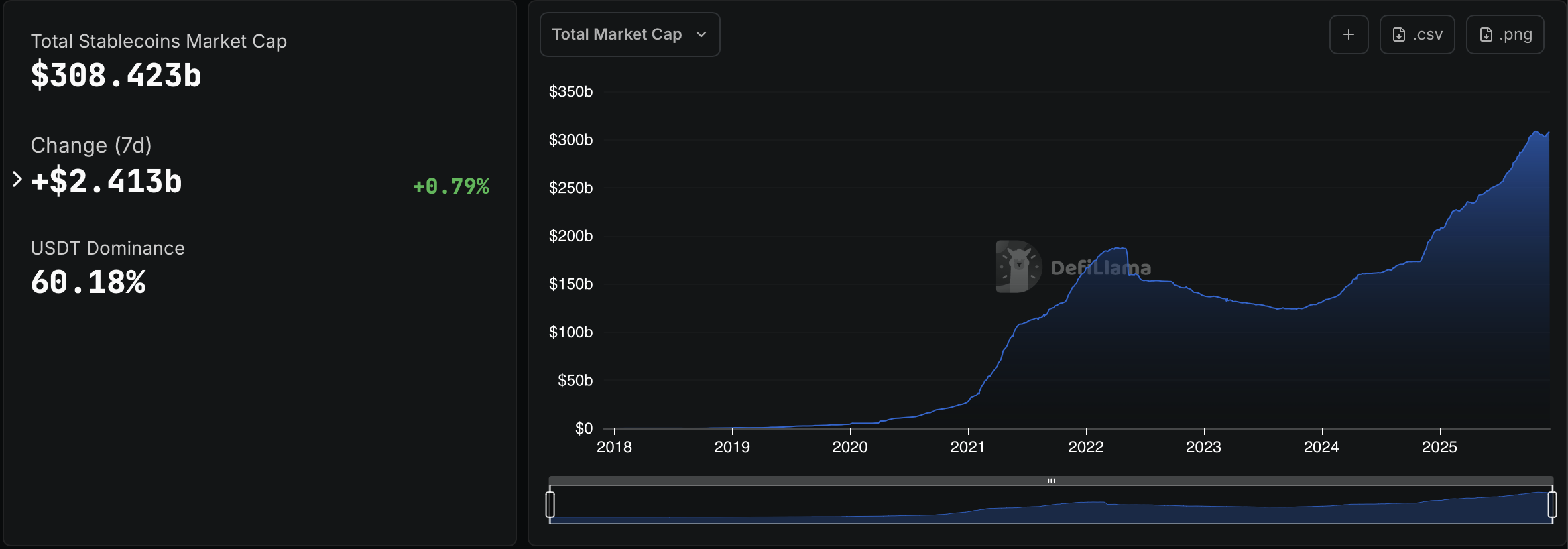
Stablecoin market capitalization. Source: DefiLlama

Magazine: 6 reasons Jack Dorsey is definitely Satoshi... and 5 reasons he’s not

Related Reads

WeChat Agent Issues a 'Heroic Summons,' Half of the Internet Responds

WeChat AI Agent is on the horizon. The WeChat Open Platform has issued a guide for developers, offering them ways to integrate into the WeChat AI ecosystem. This will enable mini-programs to be discovered and invoked by the AI. Meituan has already announced its integration, allowing users to access services like food delivery through WeChat AI. Other platforms like Ctrip and Tongcheng have followed suit. Furthermore, WeChat is collaborating with major smartphone manufacturers to enable their native AI assistants to perform actions within WeChat, such as initiating calls or sending messages, through a controlled protocol called Agent-to-Agent (A2A). Reports indicate the WeChat AI Agent will be accessible by swiping right on the main interface. It aims to understand user intent within the rich context of chats, groups, and past interactions, then automatically call upon relevant mini-programs to complete tasks like ordering coffee or booking restaurants. This positions it as a potential "super app" with direct access to WeChat's vast ecosystem of services, social connections, and payment systems. Technically, this is a complex endeavor. It requires advanced natural language understanding, a "world model" to predict interactions within mini-programs (UI-Oceanus), multi-model orchestration for cost efficiency, and careful coordination with millions of third-party service providers. Tencent's development follows a "Co-Design" approach, where product teams and the Hunyuan model team collaborate closely, allowing capabilities honed in other AI products (like Yuanbao for chat, ima for search, WorkBuddy for office tasks) to be transferred to the WeChat Agent. Tencent is strategically opting for the A2A protocol over GUI-based automation (which it has blocked in the past), maintaining control over its ecosystem. To manage the immense scale and cost of serving 1.4 billion monthly active users, Tencent is deepening its ties with DeepSeek, known for its cost-effective training, to secure a low-cost inference backbone. The ultimate goal is to solve practical, everyday problems for users within the WeChat ecosystem, moving beyond technical benchmarks to deliver real utility, which Tencent sees as the key to winning in the long-term AI game.

marsbit32m ago

WeChat Agent Issues a 'Heroic Summons,' Half of the Internet Responds

marsbit32m ago

Humanity Loses $31 Million in Attack, Token Price Plummets 90% Due to a Single Private Key

On June 9th, the digital identity project Humanity Protocol suffered a major security breach resulting in over $31 million in losses. According to on-chain analyst Specter, hundreds of wallets holding the project's H token were drained. The attack was confirmed by founder Terence Kwok to be caused by the compromise of a foundation member's private key. As a precaution, users are advised to avoid interacting with Humanity's cross-chain bridge or liquidity pools. The incident caused the H token price to crash over 90%, from around $0.70 to a low of $0.052, wiping its market cap from $2 billion to approximately $35.7 million. The attacker allegedly minted 100 million new H tokens and is selling them for BNB. This breach adds to existing controversies surrounding Humanity Protocol. Founded in 2024, it aimed to verify human users via palm-print biometrics and zero-knowledge proofs. However, a leaked conversation in 2025 revealed that only about 1 million of its 9 million claimed Human IDs had completed biometric verification, suggesting 88% might be bots. Furthermore, the project has faced allegations of being a repackaged product from a Chinese access control vendor, raising privacy and authenticity concerns. Founder Terence Kwok's previous venture, Tink Labs, a hotel smartphone startup that raised $170 million, failed and entered bankruptcy in 2020 after burning through its funding. The current attack highlights the persistent critical issue of private key management in crypto. Unlike smart contract exploits, a private key compromise bypasses all on-chain security mechanisms. With no user compensation plan announced yet, this $31 million breach may be a final blow to the project's credibility, already weakened by previous controversies and a heavily depreciated token.

marsbit1h ago

Humanity Loses $31 Million in Attack, Token Price Plummets 90% Due to a Single Private Key

marsbit1h ago

MicroStrategy Will Not Die in This Downturn: Reflexivity, STRC Anchoring Back to Par, and the Self-Rescue Logic of "Sell Stock, Not Bitcoin"

This article analyzes the recent sharp decline in Bitcoin and MicroStrategy (MSTR), framing it as a targeted "reflexivity" attack. The trigger was MSTR using its cash reserves to buy back convertible notes, raising market concerns about a liquidity crisis. The playbook follows George Soros's principle: market expectations can shape reality. Fears that MSTR might be forced to sell BTC caused panic selling, lowering BTC's price and worsening MSTR's financial ratios, thus reinforcing the negative narrative. The author argues that MSTR's Structured Convertible (STRC), while falling in price, is a floating-rate security that will eventually return to par value (100). The price drop reflects the market demanding a higher yield due to perceived risk, but as a floating-rate instrument, its coupon can adjust, naturally pulling the price back to par over time. This is crucial for MSTR's continued ability to raise funds. The core thesis is that MSTR's best move to counter the attack is to **issue new equity (sell shares)**, not sell its Bitcoin holdings. While selling BTC would solve the immediate cash crunch, it would destroy the company's core investment thesis and premium. It would dilute the BTC per share, likely erase the market premium over its net asset value (mNAV > 1), and worsen its debt-to-asset ratio. Issuing shares while mNAV is high (e.g., 1.25x) allows MSTR to raise cash for reserves without harming shareholder value or the "perpetual accumulation" narrative. It improves the debt ratio and reassures STRC holders, breaking the negative reflexivity cycle. In conclusion, while MSTR could survive this episode even by selling BTC, doing so would fundamentally alter its investment proposition and weaken it for future cycles. The optimal, value-preserving strategy is to sell equity to rebuild reserves and maintain the long-term growth flywheel.

marsbit1h ago

MicroStrategy Will Not Die in This Downturn: Reflexivity, STRC Anchoring Back to Par, and the Self-Rescue Logic of "Sell Stock, Not Bitcoin"

marsbit1h ago

Trading

Spot
Futures

Hot Articles

How to Buy GAS

Welcome to HTX.com! We've made purchasing GAS (GAS) simple and convenient. Follow our step-by-step guide to embark on your crypto journey.Step 1: Create Your HTX AccountUse your email or phone number to sign up for a free account on HTX. Experience a hassle-free registration journey and unlock all features.Get My AccountStep 2: Go to Buy Crypto and Choose Your Payment MethodCredit/Debit Card: Use your Visa or Mastercard to buy GAS (GAS) instantly.Balance: Use funds from your HTX account balance to trade seamlessly.Third Parties: We've added popular payment methods such as Google Pay and Apple Pay to enhance convenience.P2P: Trade directly with other users on HTX.Over-the-Counter (OTC): We offer tailor-made services and competitive exchange rates for traders.Step 3: Store Your GAS (GAS)After purchasing your GAS (GAS), store it in your HTX account. Alternatively, you can send it elsewhere via blockchain transfer or use it to trade other cryptocurrencies.Step 4: Trade GAS (GAS)Easily trade GAS (GAS) on HTX's spot market. Simply access your account, select your trading pair, execute your trades, and monitor in real-time. We offer a user-friendly experience for both beginners and seasoned traders.

2.8k Total ViewsPublished 2024.03.29Updated 2026.06.02

How to Buy GAS

Discussions

Welcome to the HTX Community. Here, you can stay informed about the latest platform developments and gain access to professional market insights. Users' opinions on the price of GAS (GAS) are presented below.

活动图片