SpaceX IPO Rush: A Capital Feast That Could Reshape the Landscape of AI and Crypto

marsbitPublished on 2026-05-20Last updated on 2026-05-20

Abstract

SpaceX's potential IPO is emerging as a pivotal event that could reshape the landscape for both AI and Crypto markets. Far more than a traditional aerospace offering, SpaceX represents the core of Musk's future-tech ecosystem, with its Starlink satellite network positioning it as a global digital infrastructure company. This shift could redefine the foundational layers of the internet, communication, and data flow. Historically, major tech capital market movements, like AI booms or Bitcoin ETF approvals, have profoundly influenced crypto cycles. The SpaceX IPO could trigger a similar "super-narrative" fusion, boosting investor sentiment toward future digital infrastructure. This is particularly relevant for Crypto, which aims to build decentralized versions of such global systems. Key crypto sectors likely to benefit include: * **DePIN (Decentralized Physical Infrastructure Networks):** Projects like Render, Filecoin, and Helium, which incentivize real-world infrastructure for compute, storage, and connectivity. * **AI Crypto:** Platforms such as Bittensor and Fetch.ai, which leverage blockchain for decentralized AI computation, data markets, and agent economies. * **On-chain Payments & SocialFi:** Ecosystems like Solana and Ton, which could gain traction if Musk's X platform integrates digital payments and stablecoins. Ultimately, the IPO symbolizes a broader capital re-evaluation of core digital-age assets—networks, AI, data, and decentralized systems—aligning clos...

Author: Climber, CryptoPulse Labs

Over the past few years, the crypto market has witnessed numerous cycles of trending themes. From DeFi, NFTs, and GameFi to AI, Memes, RWA, and modular public chains, market sentiment has been shifting at an increasingly rapid pace. However, the major events truly capable of altering the global flow of risk assets have consistently originated from the U.S. technology capital markets.

Recently, news of SpaceX's impending IPO has kept global capital markets abuzz with excitement. This is because the company heading for an Initial Public Offering is not merely a traditional aerospace firm; it's a core asset within Elon Musk's entire future technology universe.

Once SpaceX officially goes public, it is likely to become a landmark event for global capital to reprice the infrastructure of the future. And the crypto market might emerge as one of the biggest beneficiaries of this shift.

I. The Essence of the SpaceX IPO: Global Capital Betting on Future Digital Infrastructure

Many ordinary people still understand SpaceX primarily as a rocket launch company, but today's SpaceX is increasingly resembling a global-scale digital infrastructure enterprise.

Its true value no longer lies solely in its space launch business but increasingly in the underlying Starlink satellite internet system, global communication capabilities, military contracts, data transmission capacity, and its potential for integration with future AI and robotics ecosystems.
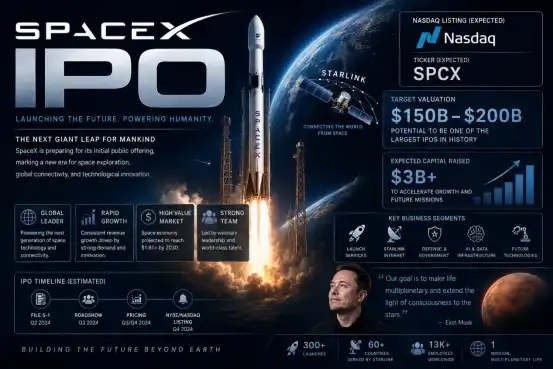
Starlink, in particular, is gradually constructing a global satellite network system. While the core competition of the past internet era was over who controlled terrestrial communication networks, the future of the global internet may evolve towards satellite-based connectivity. This implies that the foundational gateways for networks, data, communication, and AI could be redefined.

The connection between this development and the crypto industry runs deeper than many realize. The Web3 world has long emphasized globalization and decentralization, yet one of its biggest limitations has been the heavy reliance on traditional internet infrastructure for underlying physical networks.

The emergence of Starlink is essentially about rebuilding the way the world connects to the internet.

For regions traditionally difficult for ground-based networks to cover, satellite internet could even become the primary point of internet access in the future. Once global connectivity capabilities are further enhanced, on-chain payments, decentralized identity, AI Agents, on-chain social networks, and distributed node systems could all experience significantly greater growth potential.

More critically, the significance of the SpaceX IPO extends beyond fundraising; it represents the moment when global capital will formally begin reassessing the value of future digital civilization infrastructure.

In recent years, AI has been the most sought-after theme in the U.S. stock market. However, the market may gradually come to realize that AI, communication, data, and computing power are all inseparable from the underlying network infrastructure.

Crypto, coincidentally, also revolves around these elements. In a sense, SpaceX is building a centralized version of global infrastructure, while the crypto world is attempting to construct a decentralized counterpart.

This logical resonance might lead increasingly more traditional capital to refocus on the long-term value of Web3.

II. Narrative Upgrade: The SpaceX IPO Could Catalyze the Next Crypto Bull Run

Reviewing past bull cycles reveals that shifts in the U.S. technology capital market have often profoundly influenced the crypto market.

For instance, the global liquidity easing and surge in U.S. tech stocks in 2020 preceded Bitcoin's super bull run. The AI boom in 2023 saw the AI Crypto sector double rapidly. Following the approval of spot Bitcoin ETFs, the entire crypto industry entered a new phase of institutionalization.
Therefore, what's truly worth paying attention to this time with the SpaceX IPO is not just its valuation, but the potential super-narrative convergence it might bring about.

Elon Musk today no longer controls just a single company but is gradually forming a complete technological ecosystem. SpaceX handles aerospace and satellite networks, Starlink manages global communications, the X platform is transforming into a payments and social super-app, xAI is positioning itself in artificial intelligence, and Tesla controls robotics and energy systems.

If these businesses become increasingly integrated in the future, it essentially means the formation of a super-ecosystem encompassing AI, social media, communications, payments, robotics, and data.

The crypto market's inherent sensitivity lies in its natural aptitude for providing the financial settlement layer for such globalized digital ecosystems.

Consequently, the SpaceX IPO is likely to usher in a new market sentiment, where global capital begins to believe once again in the vast growth potential of the future tech world.

Whenever this sentiment emerges, the crypto market often becomes a gathering point for capital with the highest risk appetite. Sectors like AI Crypto, on-chain payments, decentralized social networks (DeSoc), DePIN (Decentralized Physical Infrastructure Networks), and computing power are highly likely to become focal points for speculative capital once again.

The most noteworthy among these is arguably DePIN, as its core logic involves using token incentives to build real-world infrastructure, including networks, communications, GPU computing power, wireless nodes, and data collection.

The rise of Starlink is actually helping the global market understand one thing: the most important future assets may not be traditional internet platforms, but the underlying infrastructure itself.

When the market starts revaluing networks, communications, computing power, and data, the long-term logic of infrastructure-related projects in the Crypto world will be reinforced.

Simultaneously, the SpaceX IPO could further strengthen market expectations for global payments and stablecoins. Musk has long expressed his desire for the X platform to evolve into a super-app akin to WeChat, Alipay, or an AI-powered equivalent.

If the X platform were to integrate stablecoins or even an on-chain payment system in the future, the valuation logic for the entire Crypto payments industry could undergo a dramatic change.

In other words, what the market is speculating on now is no longer just a pure space exploration concept, but a bet that the future global internet, AI, and financial systems will gradually migrate on-chain.

III. Potential Beneficiaries in the Crypto Space from the SpaceX IPO

If the SpaceX IPO successfully ignites sentiment among global technology investors, the most promising directions in the future crypto market will likely concentrate on two core narratives: infrastructure and AI.
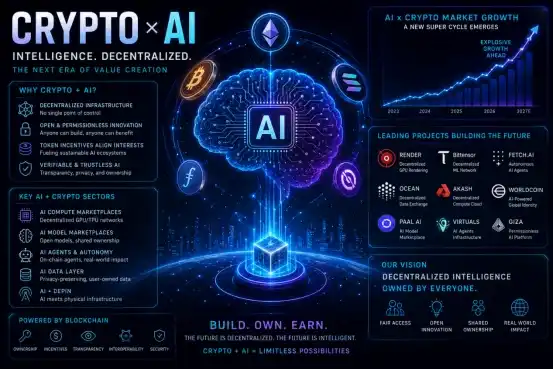
The first and most direct beneficiaries would remain in the DePIN sector.

This is because this track is essentially an "on-chain infrastructure revolution." Projects like Render, Akash Network, Filecoin, Helium, and Arweave represent core players in the "networks, storage, computing, communications" direction. While the market has previously favored short-term meme hype, future capital might return to infrastructure sectors that possess genuine long-term value.

Secondly, AI Crypto is highly likely to regain market spotlight. As competition intensifies among AI giants like xAI, OpenAI, and Google DeepMind, the market is increasingly realizing that the endgame of AI is, in fact, computing power, data, and energy.

Blockchain technology can play a role in distributed GPU networks, AI data marketplaces, and payment systems for AI Agents.

Therefore, AI Crypto projects like Bittensor, Fetch.ai, Virtuals Protocol, and io.net are likely to attract renewed capital attention. The direction of AI Agents, in particular, could very well become the strongest new narrative combining AI and Crypto.

Beyond that, on-chain payments and SocialFi (Decentralized Social Finance) are also worth close attention. If the X platform gradually integrates payments, stablecoins, and digital identity systems in the future, the entire logic of Web3 social finance could be rebooted.

Projects and ecosystems focused on consumer-facing applications, payments, and high performance, such as Toncoin, Solana, Internet Computer, and Aptos, could all receive heightened attention.

From a broader perspective, the greatest significance of the SpaceX IPO for the crypto market is not a short-term speculative wave, but its potential indication that global capital is repricing the core assets of the future digital civilization.

These core assets fundamentally revolve around several key themes: networks, AI, communications, data, payments, and decentralized systems.

Coincidentally, these are precisely the problems the crypto industry has been trying to solve for over a decade.

Thus, the SpaceX IPO might not just be another super U.S. stock market listing; it could potentially become a major turning point for the flow of technology capital back into the Crypto world in the coming years.

Conclusion

If the SpaceX IPO does materialize, its significance may already transcend the listing of a single company, instead serving as a signal for a shift in the next wave of technology narratives. As aerospace, AI, communications, social media, and payments gradually merge within one ecosystem, capital markets will simultaneously search for new anchors. And the crypto market has consistently been the most sensitive component during such narrative migrations.

Future uncertainties remain, but one thing is certain: when global technology begins retelling the story of integrated infrastructure, AI, and finance, the crypto market will never be absent.

Related Questions

QWhat is the core argument of the article regarding the significance of SpaceX's potential IPO for the crypto market?

AThe article argues that a SpaceX IPO is more than just a company listing; it represents a global capital event that could re-price future digital infrastructure. This could benefit the crypto market by shifting capital and narrative focus towards decentralized versions of the infrastructure (like networks, AI, data, and payments) that SpaceX is building in a centralized manner, potentially catalyzing the next crypto bull cycle.

QAccording to the article, how does Starlink relate to the development of Web3 and crypto?

AStarlink, as a global satellite internet system, is redefining the underlying physical network for internet connectivity. For Web3 and crypto, which emphasize global and decentralized access, Starlink's infrastructure could overcome limitations posed by traditional ground-based networks, especially in remote areas. This enhanced global connectivity could unlock greater growth potential for on-chain payments, decentralized identity, AI agents, and distributed node systems.

QWhich specific crypto sectors or narratives does the article identify as potential beneficiaries of a SpaceX IPO-driven market shift?

AThe article identifies several crypto sectors as potential beneficiaries: 1) DePIN (Decentralized Physical Infrastructure Networks) for network, storage, and compute (e.g., Render, Filecoin). 2) AI Crypto projects focused on distributed computing, data, and AI agents (e.g., Bittensor, Fetch.ai). 3) On-chain payment and SocialFi ecosystems, particularly if Elon Musk's X platform integrates crypto payments (benefiting chains like Solana, Ton). 4) Broader infrastructure and high-performance blockchain projects.

QWhat historical pattern does the article reference to support its prediction about the impact of U.S. tech capital markets on crypto?

AThe article references the pattern where major shifts in U.S. tech capital markets have historically influenced crypto bull cycles. Examples given include the 2020 liquidity-driven tech stock rally preceding Bitcoin's bull run, the 2023 AI stock boom sparking an AI Crypto rally, and the approval of Bitcoin ETFs accelerating institutional adoption in crypto.

QWhat is the broader thematic connection the article draws between Elon Musk's ecosystem (SpaceX, xAI, X, Tesla) and the crypto industry?

AThe article suggests that Elon Musk is building an integrated super-ecosystem spanning space, AI, social media, payments, robotics, and energy. Crypto, with its strengths in providing a global financial settlement layer and decentralized systems, is 'naturally adept' at serving as the financial infrastructure for such a future digital ecosystem. The potential fusion of these narratives could drive capital and innovation towards crypto.

Related Reads

Deep Dissection of the Anthropic Account Banning Storm: The Behind-the-Scenes of the Safety Religion, AI Civil War, and Claude's Dilemma Under US-China Decoupling

"Deconstructing Anthropic's Account Banning Storm: Safety Dogma, AI Civil War, and the Claude Dilemma Under US-China Decoupling" analyzes the aggressive user account suspension policies of Anthropic, particularly for its product Claude Code. The article attributes this to a multi-layered convergence of factors. The root cause is traced to founder Dario Amodei's personal "safety religion." Shaped by his father's illness and his exit from OpenAI over safety disagreements with Sam Altman, Amodei embedded this "zero-tolerance" philosophy into Anthropic's DNA. This manifests in technologies like Constitutional AI and a "preventive enforcement" approach to risk, prioritizing safety over user experience or growth. This stance defines Anthropic's position in the US "AI Civil War," pitting "safety-first" proponents like Amodei against "accelerationists" like Altman who prioritize rapid development and commercialization. Anthropic's strict model aligns with its business strategy targeting high-value, low-risk enterprise clients who pay a premium for security, unlike OpenAI's mass-market approach. Capital from Amazon and Google supports Anthropic but also creates a delicate balance, as these investors need its safety reputation without allowing overly restrictive policies to cripple its commercial viability. The conflict escalated when Anthropic refused a US Department of Defense contract requiring the removal of safety guardrails, leading to its placement on a "supply chain risk" blacklist—a key example of the public battle between the two AI factions. For Chinese users, the stringent bans are further compounded by US-China tech decoupling. Anthropic's policies act as a tool for compliance with US export controls, making Chinese users—who often circumvent regional blocks via VPNs or virtual cards—primary targets for "preventive" account terminations to avoid regulatory penalties. The article concludes that Anthropic's harsh account control measures are unlikely to loosen in the near future, being integral to its founding philosophy, business model, and geopolitical compliance needs, positioning it as a unique, security-obsessed player in the tripartite global AI competition involving US safety and acceleration factions and rising Chinese AI power.

marsbit2m ago

Deep Dissection of the Anthropic Account Banning Storm: The Behind-the-Scenes of the Safety Religion, AI Civil War, and Claude's Dilemma Under US-China Decoupling

marsbit2m ago

KUN and Pharos Network Forge Strategic Partnership to Jointly Drive Innovation in RealFi, RWA, and Cross-Border Payment Infrastructure

Hong Kong. Layer 1 infrastructure Pharos Network and licensed digital payment expert KUN have signed a strategic MoU. They will integrate Pharos's institutional blockchain with KUN's licensed global payment rails to drive the tokenization of supply chain credit assets and enable more efficient global settlement on-chain. **Background:** Emerging market SMEs face severe working capital challenges due to slow, costly traditional trade finance, often waiting 30-90 days for payment after delivery. While RWA tokenization is a focus, few projects effectively connect underlying infrastructure to real commerce and licensed payment networks. **Collaboration Focus:** The partnership aims to bridge this gap by bringing supply chain credit and B2B cross-border payments on-chain compliantly. Initial priorities include: * Tokenizing supply chain credit assets to unlock liquidity. * Enabling native on-chain settlement of digital assets. * Exploring enterprise virtual card solutions. * Providing compliant on-chain financial services for verticals like commodities, trade, B2B e-commerce, and Web3. **Executive Quotes:** * Wish Wu, Co-founder & CEO of Pharos Network, highlighted KUN's trusted, licensed payment network as a perfect fit for bringing supply chain assets and cross-border capital flows on-chain accessibly. * Dr. Louis Liu, Founder & CEO of KUN, stated that settlement certainty is RealFi's final hurdle. Bridging KUN's payment rails with Pharos's infrastructure will help convert on-chain assets into real-world liquidity with institutional-grade trust. They will also explore AI-driven optimization for global capital flows. Pharos mainnet is live with over 50 dApps. This partnership strengthens its position as RealFi infrastructure by linking licensed payment systems with on-chain finance.

marsbit1h ago

KUN and Pharos Network Forge Strategic Partnership to Jointly Drive Innovation in RealFi, RWA, and Cross-Border Payment Infrastructure

marsbit1h ago

Deconstructing Anthropic: The Best AI Company May Also Be an Organizational Invention

Anthropic has emerged as one of the most notable AI companies, distinguished by its strategic focus and unique organizational culture. Strategically, Anthropic demonstrated exceptional foresight by prioritizing coding early on, recognizing it as a critical path for model learning, commercial value, and accelerating AGI research. Unlike OpenAI's expansive, multi-front approach, Anthropic maintained rigorous focus on scaling language models and the coding vertical, avoiding distractions like multimodal development. This discipline stemmed partly from resource constraints but also from the conviction of its leadership, particularly co-founder Dario Amodei, who exhibits a strong, independent strategic vision. Organizationally, Anthropic’s culture is its “secret sauce.” It is characterized by a strong, mission-oriented focus on AI safety, high trust, low ego among employees, and a distinct humanistic ethos. This culture has resulted in remarkably low talent attrition and high retention rates. Key practices sustaining this culture include stringent cultural screening in hiring, high-context transparency and writing practices led by leadership, a founding structure of seven co-founders with equal equity to diffuse values, and a deliberate “one team” approach that minimizes internal silos and hierarchy. This culture is both a reaction to the political dynamics its founders experienced at previous companies and a functional necessity for the data-intensive, collaborative “dirty work” required to excel in coding and agentic AI. While OpenAI remains a formidable competitor with greater resources and exploration, Anthropic’s success illustrates how focus, cultural cohesion, and a steadfast mission can be powerful drivers in the AI race.

marsbit1h ago

Deconstructing Anthropic: The Best AI Company May Also Be an Organizational Invention

marsbit1h ago

Trading

Spot
Futures

Hot Articles

Discussions

Welcome to the HTX Community. Here, you can stay informed about the latest platform developments and gain access to professional market insights. Users' opinions on the price of AI (AI) are presented below.

活动图片