Solana TVL hits $8.6B six-month lows: Is $80 SOL price next?

cointelegraphPublished on 2025-12-17Last updated on 2025-12-17

Abstract

Solana's native token SOL has declined 52% from mid-September to late November, breaking key long-term support levels and signaling a potential drop below $100. The Total Value Locked (TVL) on Solana fell to a six-month low of $8.67 billion, down 34% from its September peak. Major DeFi protocols like Jito, Jupiter, and Raydium saw significant decreases in activity. On-chain metrics further indicate weakening demand, with network fees down 23% monthly and active addresses declining. Memecoin trading volume on Solana network collapsed by 95% from its peak, reflecting reduced ecosystem engagement. Technically, SOL is trading within a bear pennant pattern, with a breakdown projecting a potential 32% decline toward $86. While the 200-week EMA at $118 may provide temporary support, analysts suggest SOL could soon test the $90-$100 range.

Solana’s native token SOL (SOL) fell 52% between Sept. 18 and Nov. 21, following the broader altcoin market crash that saw Bitcoin hit a seven-month low of $80,000. As a result, SOL price has lost key long-term support levels, with onchain and technical data suggesting a deeper correction below $100.

Key takeaways:

  • Solana's total value dropped to a six-month low of $8.67 billion.

  • Solana’s memecoin weekly trading volume has collapsed by 95% in 2025.

  • A bear pennant projects SOL price to drop toward $86.

Solana’s TVL drops to June levels

The total value locked (TVL) on the Solana blockchain has dropped by over 34% to a six-month low $8.67 billion on Wednesday from its peak of $13.22 billion reached on Sept. 14. Solana’s TVL has remained below $10 billion over the last 30 days.
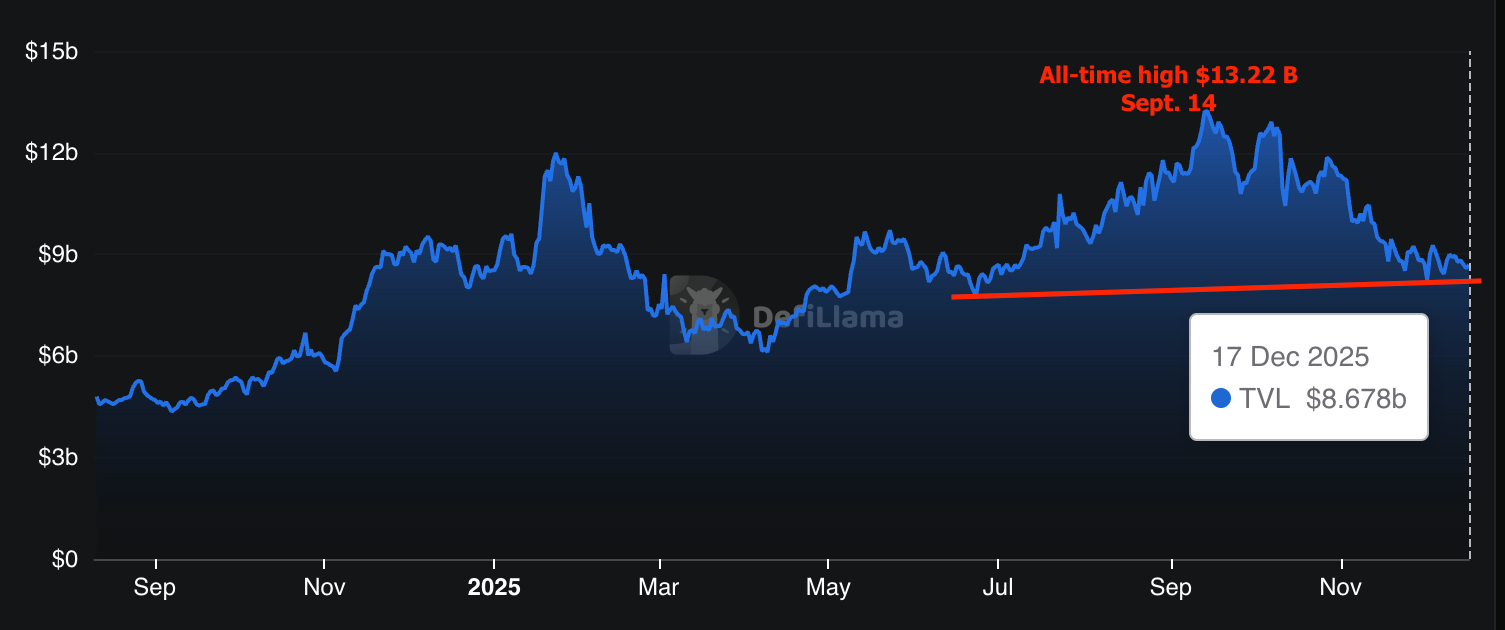
Solana TVL. Source: DefiLlama

Data from DefiLlama shows that the subsequent drop in TVL was led by Jito liquid staking, with a 53% decrease since mid-September. Other major decentralized applications, such as Jupiter DEX, Raydium and Sanctum protocol, registered 30%, 46% and 46% declines, respectively.

Related: Solana ETFs record 7-day inflow streak despite price slump

SOL’s potential to drop below $100 is supported by the decline in Solana’s network fees, active addresses and transaction count over the last seven days.
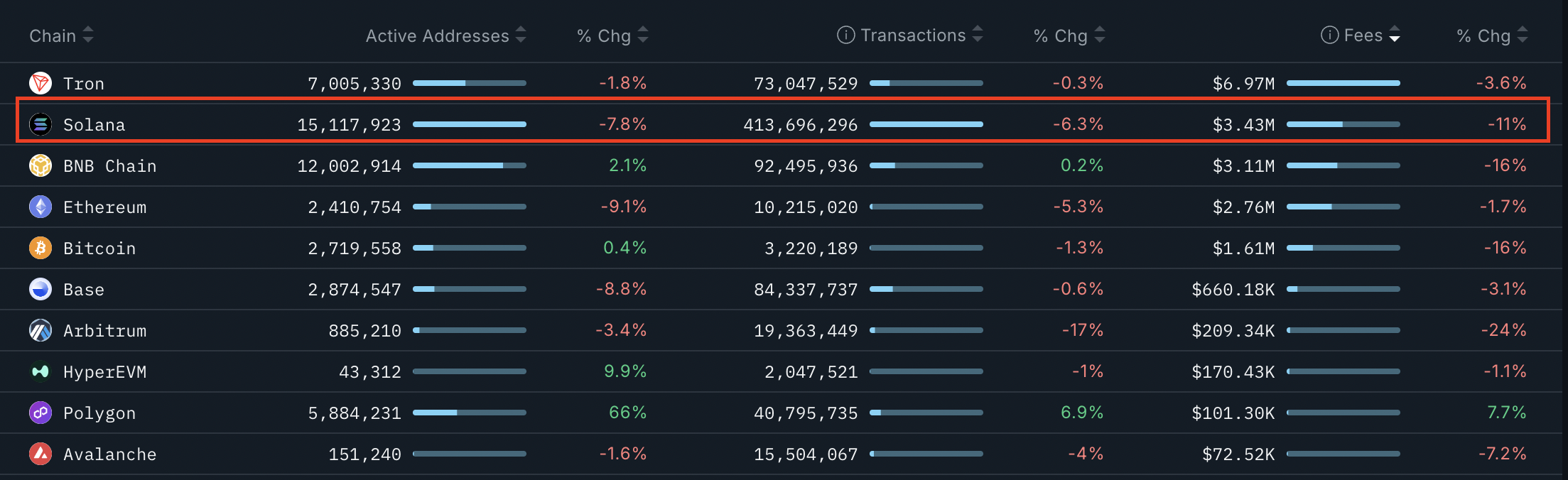
Blockchains ranked by 30-day fees, USD. Source: Nansen

Solana’s chain fees totaled $3.43 million over the past week, representing an 11% decrease from the previous week and a 23% drop from last month.

Similarly, the number of active addresses (AAs) on Solana’s base layer decreased by 7.8% over the same period, while the number of transactions decreased by 6.3% over seven days.

The drops in AAs, transaction count and network fees suggest reduced onchain demand for SOL, adding to the overhead pressure.

Solana memecoin volume collapses

The fall in Solana’s TVL mirrors the bearishness in Solana-based memecoins as these flashed red across the board.

Solana-based memecoins have posted double-digit losses on the weekly and monthly time frames, as shown in the figure below. A majority of these tokens are down 10% to 25% from local highs.
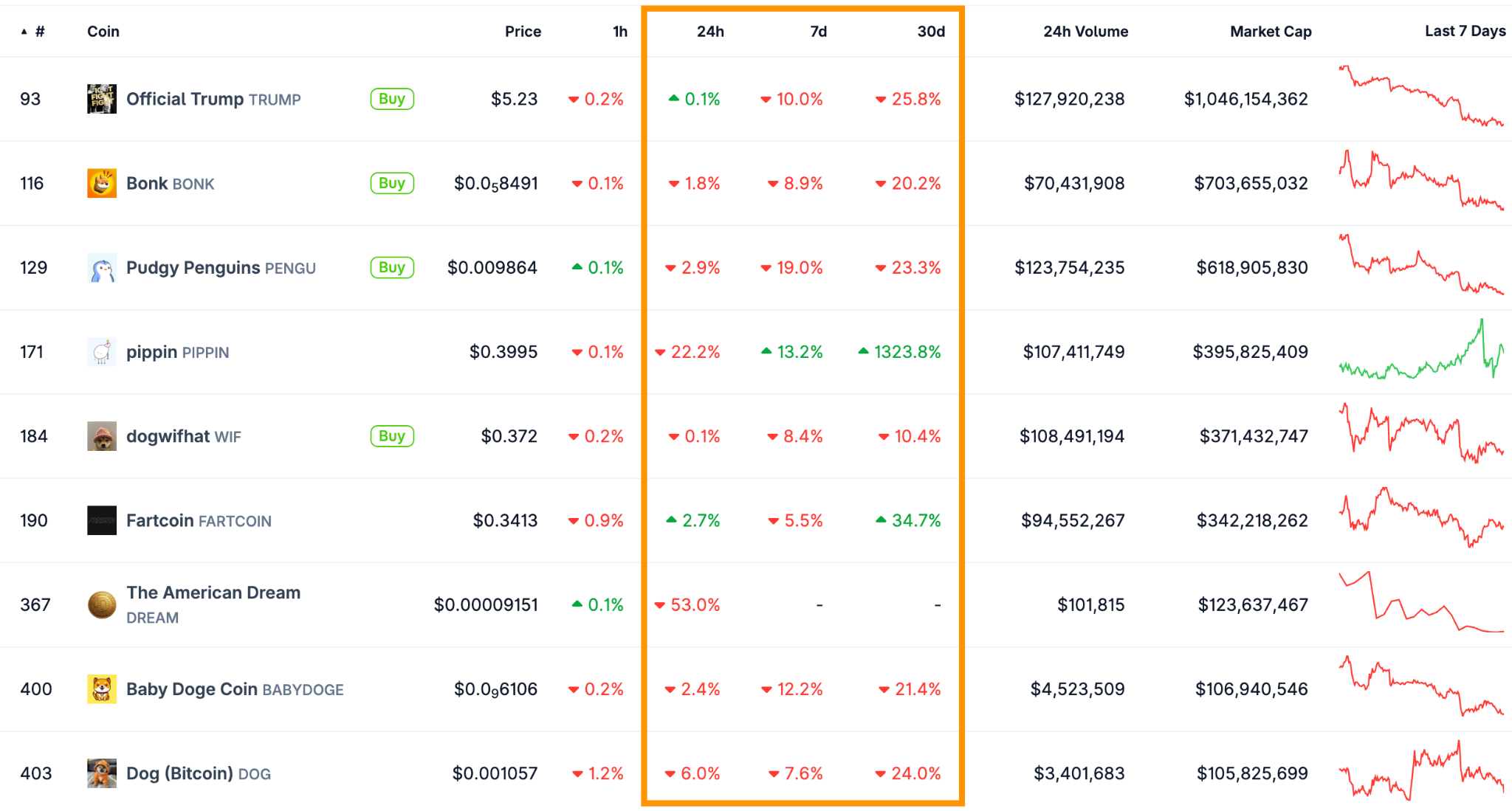
Solana-based memecoins performance. Source: CoinGecko

This drop in the prices of Solana-based memecoins was accompanied by a decrease in DEX activity on the layer-1 blockchain. The weekly DEX volume on Solana attributed to memecoins remains muted, having dropped 95% to $2.7 billion from its peak of $56 billion recorded in January, according to data from Blockworks Research.
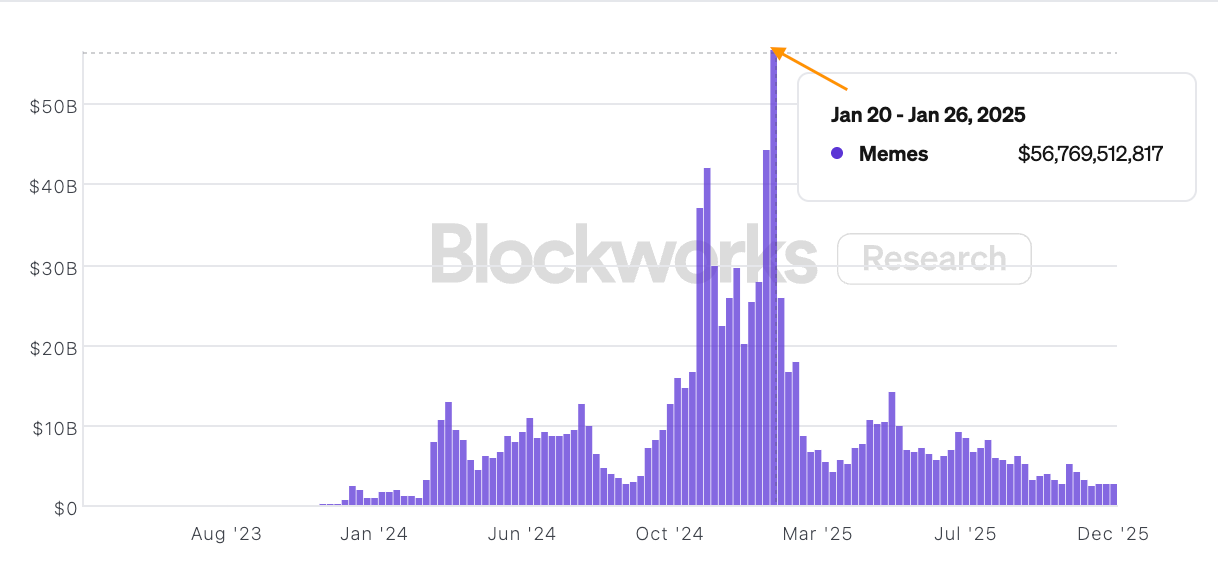
Memecoin trading volume on Solana. Source: Blockworks Research

The decline in memecoin activity on Solana indicates low network activity and waning usage, which negatively impacts demand and the SOL price.

SOL’s “bear pennant” targets $90,000

Data from Cointelegraph Markets Pro and TradingView indicate that SOL is trading below a bearish pennant, suggesting a risk of further downside.

A bear pennant is a downward continuation pattern that occurs after a significant drop, followed by a consolidation period at the lower end of the price range.

A break below the pennant’s support line at $135 last week cleared the path for the next leg down for the altcoin. The measured target of the bear pennant is at $86, or a 32% decline from its current price level.
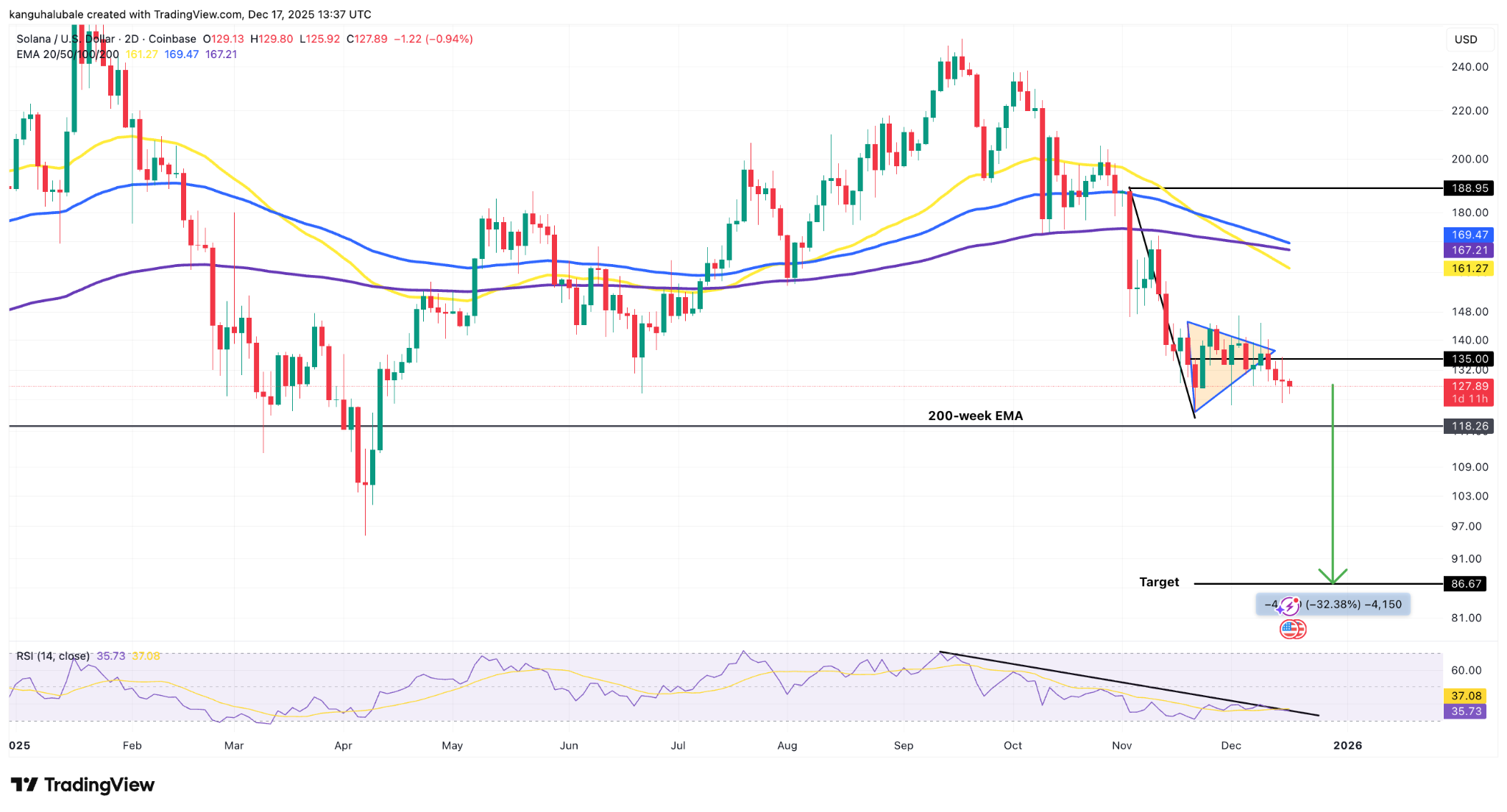
SOL/USD two-day chart. Source: Cointelegraph/TradingView

Before reaching this level, SOL could find support from the 200-week EMA at $118, where bulls are expected to mount aggressive defense.

“A bear pennant is forming on Solana’s four-hour chart,” said pseudonymous leverage trader Grim in an X post on Wednesday, adding:

“I would not be surprised to see Solana between $90 and $100 soon.”

As Cointelegraph reported, SOL price breaking below the support line of the symmetrical triangle at $126 would signal that the bears are in control, leading to a deeper correction toward $95.

This article does not contain investment advice or recommendations. Every investment and trading move involves risk, and readers should conduct their own research when making a decision. While we strive to provide accurate and timely information, Cointelegraph does not guarantee the accuracy, completeness, or reliability of any information in this article. This article may contain forward-looking statements that are subject to risks and uncertainties. Cointelegraph will not be liable for any loss or damage arising from your reliance on this information.


Trending Cryptos

Related Reads

Li Fei-Fei's Latest Long-Form Article: When Video Generation, Robotics, and NVIDIA All Call Themselves World Models, We Need a Taxonomy

In a new article, Dr. Fei-Fei Li addresses the widespread and often inconsistent use of the term "world model" in AI. She proposes a clear, functional taxonomy rooted in the classic Partially Observable Markov Decision Process (POMDP) loop (agent → action → state → observation → agent). According to this framework, current systems called "world models" are different projections of this loop, categorized by their primary output: 1. **Renderers**: Output observations (pixels). Their goal is visual fidelity for human consumption (e.g., video generation models like Sora). They are the most commercially mature but are limited by a focus on appearance over physical accuracy. 2. **Simulators**: Output states (geometric, physical, dynamic representations). They provide a structurally accurate world for both human professionals (e.g., architects) and computational agents (e.g., robots for training). Li argues simulators are the crucial, underappreciated bridge, as they can underpin both rendering and planning. 3. **Planners**: Output actions. Given an observation and a goal, they decide what an agent should do next (e.g., robotic action models). This area is highly promising but remains the least mature for real-world deployment. Li highlights a key trend: the boundaries between these three categories are beginning to blur, as they all rely on a shared underlying understanding of geometry, physics, and dynamics. The logical endpoint is a unified world foundation model capable of switching between rendering, simulation, and planning based on downstream needs. This convergence, she concludes, is central to advancing spatial intelligence—enabling machines not just to talk about the world, but to truly understand, imagine, and interact with it.

marsbit1h ago

Li Fei-Fei's Latest Long-Form Article: When Video Generation, Robotics, and NVIDIA All Call Themselves World Models, We Need a Taxonomy

marsbit1h ago

Forbes Feature: Stablecoin Cross-Border Payments Are Faster, But Not Yet Cheaper

A Forbes feature delves into the state of stablecoin-based cross-border payments, noting rapid growth but a key shortfall: while faster and more accessible, they are not yet cheaper. At a recent industry conference in Mexico City, optimism about technology, regulation, and volume was tempered by discussions with practitioners. The core issue is liquidity. Traditional FX brokers charge 60-70 basis points, and stablecoins promise to slash this to 2-5 basis points. However, this theoretical cost advantage cannot be realized until deep liquidity pools are established at scale, requiring significant institutional capital inflow. A major adoption barrier is trust. Businesses often rely on long-standing relationships with traditional brokers, valuing reliability over marginal cost savings. This shift will be gradual. Furthermore, successful companies in the space are not positioning themselves as replacements for legacy systems like SWIFT, but as complements. They leverage stablecoins for speed while using traditional rails for their standardization and reliability in ensuring accurate payment details—a critical factor for supplier payments to avoid customs issues. Companies like Caliza, experiencing high monthly growth, exemplify this hybrid approach. The industry anticipates consolidation, as long-term viability will depend on securing the essential trifecta: proper licensing, robust fiat on/off-ramps, and deep liquidity. Without these, firms risk being mere intermediaries rather than building sustainable businesses.

marsbit1h ago

Forbes Feature: Stablecoin Cross-Border Payments Are Faster, But Not Yet Cheaper

marsbit1h ago

Li Feifei's Latest Article: When Video Generation, Robotics, and NVIDIA All Claim to Have 'World Models,' We Need a Taxonomy

"World Model" has become a widely used yet ambiguous term in AI. Drawing from the classic POMDP framework (agent → action → state → observation), this article proposes a functional taxonomy to clarify the concept. It identifies three distinct types, categorized by their output in the perception-action loop: 1. **Renderers**: Output visual observations (pixels). These models, like advanced video generators, prioritize visual fidelity but often lack underlying physical accuracy. 2. **Simulators**: Output the state of the world (geometry, physics, dynamics). They provide a structurally accurate representation for professionals (e.g., architects) and serve as training environments for robots and AI agents. 3. **Planners**: Output actions. Given an observation and a goal, they determine what an agent should do next, closing the perception-action loop (e.g., vision-language-action models). While renderers are currently the most commercially mature and planners are the most aspirational, the article argues that **simulators are the crucial, underappreciated hub**. By working at the level of geometry and physics, a simulator can project upwards to create visuals for humans and downwards to predict action consequences for agents. The future lies in the convergence of these three functions. Emerging research and products, like World Labs' Marble model which outputs both visual splats and physical collision meshes, are beginning to blur these boundaries. The logical endpoint is a unified world foundation model capable of rendering, simulating, and planning based on a shared understanding of spatial and temporal structures—ultimately enabling machines to understand, imagine, and interact with the physical world.

链捕手2h ago

Li Feifei's Latest Article: When Video Generation, Robotics, and NVIDIA All Claim to Have 'World Models,' We Need a Taxonomy

链捕手2h ago

Trading

Spot

Hot Articles

Discussions

Welcome to the HTX Community. Here, you can stay informed about the latest platform developments and gain access to professional market insights. Users' opinions on the price of SOL (SOL) are presented below.

活动图片