Solana ($SOL) Price Prediction 2026 Turns Bearish: Can It Recover, Or Should We Look at SUBBD Token?

bitcoinistPublished on 2026-02-06Last updated on 2026-02-06

Abstract

Solana (SOL) is facing a bearish outlook in 2026, currently trading near the critical $80 support level. Technical indicators show a 'Strong Sell' bias, with momentum remaining weak despite oversold signals. A decisive break below $70 could confirm a deeper bearish trend, while a recovery would require reclaiming the low $90s. The broader crypto market's weakness, led by Bitcoin's decline, is adding significant pressure. As an alternative, the article highlights the SUBBD Token presale as a high-risk, high-reward narrative for traders seeking diversification. SUBBD, which has raised approximately $1.47 million, focuses on AI-powered tools for the creator economy, offering features like AI voice cloning and a fixed 20% APY for early supporters. It is presented as a speculative side bet uncorrelated to large-cap volatility, though it carries substantial execution and regulatory risks. The piece concludes by emphasizing the importance of independent research and cautious position sizing.

Trusted Editorial content, reviewed by leading industry experts and seasoned editors. Ad Disclosure

Quick Facts:

  • ➡️ SOL is hovering near $79–$81, and the $80 zone is the immediate battlefield.
  • ➡️ Technical dashboards show a ‘Strong Sell’ bias; momentum is weak despite oversold signals.
  • ➡️ A clean loss of $70 would confirm the bearish case; reclaiming the low $90s is the first step to recovery.
  • ➡️ SUBBD Token offers a separate, high-risk narrative (AI + creator economy) for traders looking outside the large-cap chop.

Solana is back in the danger zone. With $SOL hovering between $79 and $81, that psychological $80 handle is no longer acting as support, it’s a live stress test.

CoinMarketCap currently pegs Solana at $81.01, and the intraday range tells a story that makes even long-term spot holders uneasy, stretching from a $68.69 low to a $92.90 high.

The bigger issue is context. Crypto market structure has been heavy across the board, with Bitcoin drifting near $66K after rolling over hard from its 2025 peak.

When Bitcoin sneezes, altcoins usually catch pneumonia, and Solana is no exception. Liquidity has turned defensive, forcing high-throughput layer-1s like Solana to rotate from a long-term growth narrative into a ‘sell now, reassess later’ trade. In environments like this, throughput metrics and ecosystem headlines take a back seat to pure positioning.

There are some positives, but they’re muted. Spot ETF flow data from February 5 shows net inflows of roughly $2.82M. That’s directionally constructive, yet nowhere near large enough to reverse a breakdown if the broader market continues deleveraging.

Right now, traders are treating SOL as a short-term volatility vehicle rather than a conviction hold, which caps upside follow-through even on green days.

The comes SUBBD Token ($SUBBD), currently in a fast-growing presale.

Read more about $SUBBD here.

Bears Control Until SOL Reclaims Key Levels

Many analysts now see the $80 level as a line in the sand. If SOL fails to reclaim it decisively, the next logical downside pocket sits in the $72 to $75 range, where prior demand previously stepped in.

What often gets overlooked is the mechanical side of price action. Losing a round number like $80 doesn’t just affect sentiment, it triggers systematic behavior. Stop losses get swept, perpetual funding flips, and leverage unwinds before fundamentals even enter the conversation.

By the time on-chain narratives resurface, price discovery has already moved lower.

Looking ahead into 2026, the bearish framework centers on a few clear zones.

Near-term support lives around $70 to $72, which aligns with recent range lows and the next visible demand cluster.

A decisive break below $70 would open the door to a deeper sweep, reinforcing the broader pattern of lower highs and lower lows. On the upside, recovery isn’t about a $1 bounce or a relief wick, it requires reclaiming the mid-range, roughly the low $90s, to shift structure back toward neutral.

Catalysts exist, but they may not save the chart immediately. ETF inflows are positive in principle, yet the current magnitude simply isn’t enough to overpower macro-driven selling pressure.

On the network side, Solana’s Firedancer upgrade continues to fuel a strong resilience narrative, but markets have a habit of staying irrational longer than technical improvements take to roll out, which remains a frustrating reality for developers and long-term believers alike.

Scenario Outlook: What Has to Happen Next

  • In a bullish scenario, Solana successfully defends the $70 to $80 zone while ETF inflows accelerate beyond headline-sized numbers, restoring confidence and bid depth.
  • The base case looks far less exciting, with choppy consolidation between roughly $70 and $93 while Bitcoin continues to dictate direction.
  • The bearish case is straightforward: a clean loss of $70 that transforms this dip from a temporary shakeout into a structural drawdown.

For now, the $80 and $70 levels remain the market’s decision points. How price behaves around them will determine whether this is just another volatility flush or the start of a longer corrective phase.

$SUBBD is available here.

Why Some Traders Also Consider SUBBD Token as a Side Bet

When large-cap tokens get stuck in macro-driven chop, capital often rotates into presales. The appeal is simple: the return profile isn’t tightly coupled to daily Bitcoin swings.

That doesn’t make presales safer, in many cases, it’s the opposite, but it does make them less correlated in the short term.

This is where SUBBD Token comes into focus. It isn’t positioning itself as a Solana killer or a layer-1 competitor. Instead, it’s a higher-beta bet on AI-powered creator tooling.

SUBBD Token ($SUBBD) aims to merge Web3 payments with features such as an AI personal assistant, AI voice cloning, and AI-driven influencer creation, targeting the rapidly evolving creator economy.

According to the official presale page, SUBBD has raised approximately $1.47 million so far, with the current token price set at $0.0574925.
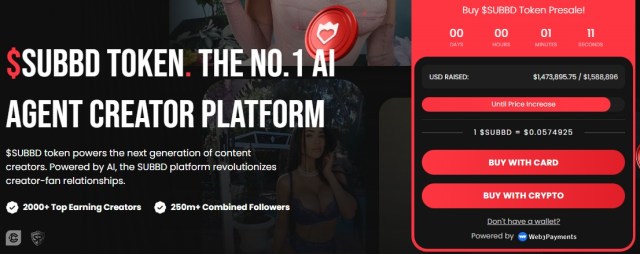
The value proposition is intentionally straightforward, offering a fixed 20% APY for the first year alongside XP multipliers designed to reward early supporters. It’s a very crypto-native incentive structure that appeals to yield-focused participants looking beyond large-cap stagnation.

That said, the risks are real and worth respecting. Presale tokens are illiquid, meaning there’s no easy exit if sentiment turns. Execution risk always looms large, as shipping working code is far more difficult than publishing a whitepaper.

Regulatory conditions around creator monetization and AI tooling can also change quickly, adding another layer of uncertainty.

For traders who are bearish on Solana’s near-term structure, researching SUBBD Token may offer a diversification angle rather than a replacement trade, as long as expectations stay grounded and position sizing reflects the risk profile.

Get your $SUBBD here.

This article is not financial advice. Independent research is essential, especially when factoring in volatility, liquidity constraints, and regulatory uncertainty.

Editorial Process for bitcoinist is centered on delivering thoroughly researched, accurate, and unbiased content. We uphold strict sourcing standards, and each page undergoes diligent review by our team of top technology experts and seasoned editors. This process ensures the integrity, relevance, and value of our content for our readers.

patrubogdan

Follow

Full Profile

Related Posts

RWA Perpetuals Record $15B in Volume, Putting LiquidChain’s $LIQUID Presale in Focus

$2.1B in Bitcoin Options Expire Today as Traders Watch Volatility And $BMIC’s Presale Narrative Builds

Metaplanet Will Keep Buying Bitcoin, Says Gerovich, as $HYPER Hits $31M Presale Milestone

Bitcoin ETFs See $434M in Outflows as $BTC Tests $60K Support – Can Bitcoin Hyper Take Over?

Peter Brandt Says Bitcoin is Heading to $42K – Has $SUBBD’s Time Arrived?

Bitcoin’s Crash Triggered IBIT’s Biggest Trading Day, as $HYPER Keeps Pumping

Related Questions

QWhat is the current price range and key battle zone for Solana (SOL) according to the article?

ASolana is hovering near $79-$81, and the $80 zone is the immediate battlefield.

QWhat does the technical dashboard indicate about Solana's market bias and momentum?

ATechnical dashboards show a 'Strong Sell' bias, and momentum is weak despite oversold signals.

QWhat are the critical price levels that would confirm a bearish case or signal a recovery for SOL?

AA clean loss of $70 would confirm the bearish case, while reclaiming the low $90s is the first step to recovery.

QWhat is the SUBBD Token and what is its value proposition as described in the article?

ASUBBD Token ($SUBBD) is a presale token that aims to merge Web3 payments with AI-powered features like a personal assistant, voice cloning, and influencer creation, targeting the creator economy.

QWhat amount has the SUBBD Token raised in its presale and what is its current token price?

ASUBBD Token has raised approximately $1.47 million in its presale, with the current token price set at $0.0574925.

Related Reads

The Recursive AI Anthropic Warned About: Tian Yuandong's New Company Has Just Taken the "First Step"

Anthropic recently highlighted the rapid progress toward "recursive self-improvement," where AI systems autonomously design and train their successors. In response, Recursive Superintelligence, a new company co-founded by former Meta researcher Tian Yuan Dong, has publicly demonstrated its first step toward automating AI research. The company released a system designed to autonomously execute the full AI research cycle: generating ideas, implementing code, running experiments, and learning from results. It validated this approach by achieving state-of-the-art results on three diverse benchmarks: 1. **NanoChat Autoresearch:** Optimizing a small language model's validation loss under a fixed 5-minute GPU budget, improving upon the community's best result. 2. **NanoGPT Speedrun:** Reducing the time to train a GPT model to a specific loss on 8 H100 GPUs from 79.7 seconds to 77.5 seconds, beating a highly optimized, human-driven community effort. 3. **SOL-ExecBench:** Improving the overall score on NVIDIA's suite of 235 GPU kernel optimization tasks by 18%, closing the gap to the hardware limit. The system discovered novel optimizations in this highly specialized domain without direct human expertise. Recursive's system operates as a general framework, capable of parallel exploration and cross-task knowledge transfer while incorporating safeguards against reward hacking. The company, backed by $650M in funding and a star-studded team including Richard Socher and Alexey Dosovitskiy, aims to create AI that recursively enhances its own research capabilities. This development represents an early but concrete move toward a new paradigm where AI accelerates its own advancement. It occurs alongside Anthropic's warnings about the need for industry coordination and potential pauses when recursive self-improvement thresholds are reached, highlighting the dual trajectory of rapid technical progress and growing calls for careful stewardship.

marsbit4m ago

The Recursive AI Anthropic Warned About: Tian Yuandong's New Company Has Just Taken the "First Step"

marsbit4m ago

The Gold Buy-on-the-Dip Guide: Watch Interest Rates, Not Just War

"Gold Buying Guide: Focus on Interest Rates, Not Just War" Four months ago, gold buyers likely didn't anticipate buying at a peak that even a war couldn't sustain. After hitting a record high of $5,596 on January 29, gold entered a bear market just 91 days later, its fastest decline since 2008. A key trigger was the Fed's hawkish shift, highlighting that monetary policy, not geopolitics, is the primary driver. The article argues that the traditional "buy gold in turmoil" script has changed. While the US-Iran conflict initially boosted prices, the sustained rally in oil prices heightened inflation fears, forcing central banks to maintain or consider tighter policy. Since gold yields no interest, higher rates increase its opportunity cost, eroding its appeal. This dynamic was evident when gold fell sharply on May 18 despite positive peace talks, as lower oil prices eased inflation and thus rate hike pressures. The recent sell-off is also part of a broader market deleveraging. Correlations between gold, Nasdaq, and Bitcoin spiked as leveraged investors sold liquid assets to cover losses, creating a synchronized downturn. Historically, gold bottoms align with policy shifts, not conflict resolutions. The 2008 and 2022 bear markets ended with shifts to extreme easing and peak inflation expectations, respectively. For potential buyers, the author suggests monitoring three signals: 1) Peak interest rate hike expectations, 2) Reopening of the Strait of Hormuz (to ease oil/inflation pressure), and 3) A return to net inflows for Gold ETFs, indicating the end of forced selling. While predicting the exact bottom is impossible, the author's personal strategy involves scaling into a position across price levels like $4000, $3700, and $3500, committing no more than 30% of the intended total allocation initially, and adding the remainder only if key signals emerge. The core conclusion: In turbulent times, watching interest rates is more crucial than watching wars.

marsbit10m ago

The Gold Buy-on-the-Dip Guide: Watch Interest Rates, Not Just War

marsbit10m ago

Recent On-Chain Review: No Clear Narrative Under U.S. Stock Market Pressure, Just Hype

This article analyzes the current state of the Solana meme coin and community token ecosystem, highlighting a market caught between two dominant forces: attention-based PvP and a gradual return to community-centric projects. The first part explores the "Attention PvP" dynamic, where success is driven by celebrity endorsements, viral events, and speed. Examples include $JOTCHUA, which surged after its meme creator's social media activity, and $WORLDCUP, which outperformed a similar Base chain project ($PITCH) largely due to influencer support. The recent "pump.fun GO" feature, allowing bounty tasks for token promotion, is critiqued for fostering sensationalist and often negative stunts—like people getting token tickers tattooed on their bodies for rewards—reminiscent of old internet shock content. In contrast, the article points to a resurgence of organic, community-driven tokens that survive market volatility through strong holder bases and shared ideology, not just hype. Influencer Ansem is cited, arguing that durable meme coins rely on communities willing to endure losses and promote their core message daily. Examples given are older tokens like $neet (anti-work ethos), $troll, $buttcoin, and $triplet, which have maintained relative price stability. A prime example of this community-build model is the new project $KINS, the token for the browser-based MMORPG Kintara. Its success stems not from advanced graphics but from consistently delivering updates, fostering player trust, and creating genuine engagement (e.g., in-game economies, events, property auctions). It has attracted a growing player base and even notable KOLs as participants, demonstrating that sustainable growth can come from building trust rather than orchestrating pumps. The article concludes by questioning whether the market is ultimately a game of mutual trust or mutual deception, expressing hope that such reflection might lead to a healthier ecosystem.

marsbit10m ago

Recent On-Chain Review: No Clear Narrative Under U.S. Stock Market Pressure, Just Hype

marsbit10m ago

On-Chain Scene on Opening Day: $20 Billion Already Staked, How Do On-Chain Contracts Know Who Wins?

On the opening day of the 2026 World Cup, over $2 billion had already been wagered on just the "tournament winner" contracts on platforms like Polymarket and Kalshi. This article explores how these blockchain-based prediction markets actually function once the games begin. It breaks down the massive volume and explains how single-game and tournament-long contracts are priced, with values moving between 1-99 cents to reflect implied probabilities. A key mechanism highlighted is "elimination zeroing," where a team's "champion yes" contract immediately settles to zero once they are mathematically eliminated. The core technical question answered is: how does a smart contract "know" who won a real-world match? The answer lies in oracles. The article details two primary paradigms: UMA's "optimistic oracle" (used by most of Polymarket), which allows a challenge period after a proposed result, and Chainlink's multi-source data aggregation (used by FIFA partners like ADI Predictstreet), which automates settlement with minimal dispute windows. Finally, the article injects a note of caution, citing research estimating that a significant portion of historical trading volume on these platforms might be "wash trading" to inflate numbers. It concludes by contrasting the legal status of these "event contracts" under CFTC rules in the U.S. versus traditional, state-regulated sports betting. As the tournament progresses, the real-time operation of this multi-billion dollar machine—its settlements, eliminations, and underlying mechanisms—becomes a story as compelling as the football itself.

marsbit26m ago

On-Chain Scene on Opening Day: $20 Billion Already Staked, How Do On-Chain Contracts Know Who Wins?

marsbit26m ago

Trading

Spot
Futures

Hot Articles

Discussions

Welcome to the HTX Community. Here, you can stay informed about the latest platform developments and gain access to professional market insights. Users' opinions on the price of SOL (SOL) are presented below.

活动图片















