Solana Emerges As The Most Active Blockchain Ahead Of Major Chains By Daily Transactions

bitcoinistPublished on 2026-03-03Last updated on 2026-03-03

Abstract

Solana has emerged as the most active blockchain by daily transaction volume, significantly outperforming other major chains. As the SOL price rebounded toward $90, the network processed approximately 108.8 million daily transactions—nearly ten times more than its closest competitor, BNB Chain, which recorded 13.0 million. Other networks, including Base, TRON, Polygon, and Ethereum, trailed further behind. This surge is attributed to Solana’s high-speed infrastructure, low fees, and growing activity in DeFi, NFTs, and consumer applications. Additionally, Solana dominated in decentralized exchange (DEX) volume throughout February and continued strongly into March, with over $200 billion in DEX volume recorded in just the first two days. This reflects deeper on-chain strength and sustained user engagement, signaling a shift in liquidity toward faster and more cost-effective blockchain networks.

As Monday drew to a close, the Solana price witnessed a bounce, bringing it closer to the $90 mark, which has ignited bullish sentiment among investors. The SOL’s price rebound coincides with a significant uptick in the network’s activity and performance, with SOL emerging as the No. 1 blockchain among all major chains.

Daily Transaction Count Puts Solana On Top

Solana’s price action and network performance appear to be moving in a similar direction, with the price briefly bouncing as network activity explodes. Once again, the network has proven its position as a leader in the blockchain sector, becoming the most go-to chain in the sector on a daily basis.

Founder and Chief Executive Officer (CEO) of Sensei Holding and Namaste Group, Solana Sensei, shared on X that the SOL network has surged ahead of competition in terms of transaction volume. The report shows that SOL tops the charts in daily on-chain transactions count across all major blockchain networks.

Fueled by its high-speed infrastructure, cheap fees, and growing activity across DeFi, NFTs, and consumer-facing applications, Solana is processing more transactions per day than its closest competitors. SOL’s dominance in this area marks a notable achievement, highlighting the network’s expanding role as a high-throughput hub for on-chain operations.
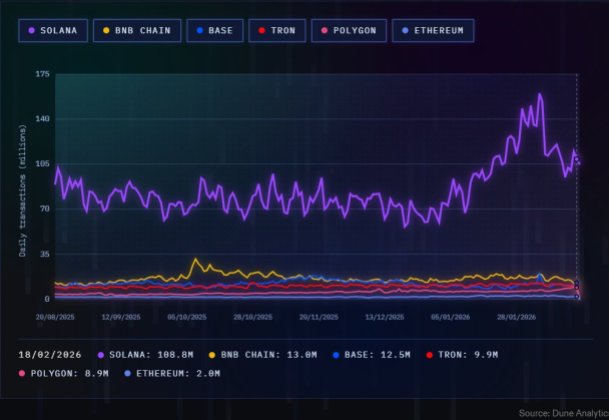
Source: Chart from Solana Sensei on X

Solana Sensei highlighted that the SOL network is currently processing nearly 10 times or more transactions than other major chains, reflecting sustained user engagement and increasing ecosystem maturity. Taking a look at the chart, SOL recorded daily transactions of approximately 108.8 million, with BNB Chain coming in second position with over 13.0 million daily transfers.

Meanwhile, leading networks like Base, TRON, Polygon, and Ethereum recorded 12.5 million, 9.9 million, 8.9 million, and 2.8 million, respectively. As developers continue to release new apps and users migrate to more affordable platforms, SOL’s transaction leadership demonstrates a wider change in where blockchain activity is concentrating in the current market cycle.

SOL DEX Volume Expands Beyond Other Chains

In another X post, Solana Sensei revealed that SOL is rapidly asserting dominance in the decentralized trading arena. According to the expert, SOL’s DEX volume has skyrocketed beyond that of competing blockchain networks. The increase in decentralized exchange activity is indicative of a larger shift in liquidity toward quicker, more affordable networks.

In the entire month of February, the SOL network dominated all major chains to secure the top spot in DEX volume. Such an increase in DEX volume indicates deeper on-chain strength, market infrastructure, and ongoing user participation rather than just transient speculation.

This notable DEX performance from SOL is starting to unfold this new month. Just 2 days into the month of March, the total Solana DEX volume has exceeded $200 billion, further reinforcing the network’s leading role in the evolving on-chain financial landscape.

SOL trading at $85 on the 1D chart | Source: SOLUSDT on Tradingview.com

Related Questions

QAccording to the article, which blockchain has the highest number of daily on-chain transactions?

ASolana has the highest number of daily on-chain transactions, with approximately 108.8 million.

QWhat are the key factors mentioned that are fueling Solana's high transaction volume?

AThe key factors are its high-speed infrastructure, cheap fees, and growing activity across DeFi, NFTs, and consumer-facing applications.

QHow does Solana's daily transaction count compare to its closest competitor, BNB Chain?

ASolana's daily transaction count of 108.8 million is nearly 10 times that of BNB Chain, which recorded over 13.0 million.

QWhat achievement did Solana secure in the decentralized exchange (DEX) volume for the month of February?

ASolana secured the top spot in DEX volume among all major chains for the entire month of February.

QWhat was the total Solana DEX volume just two days into the month of March, as stated in the article?

AThe total Solana DEX volume exceeded $200 billion just two days into the month of March.

Related Reads

The World Cup is Here: The Battle for Entry into Prediction Markets Has Begun

The 2026 FIFA World Cup has begun, and alongside the on-field competition, a new off-field battleground is emerging: prediction markets. These blockchain-based platforms, which convert crowd wisdom into tradable probabilities, are gaining significant traction. However, their complexity—involving wallets, gas fees, and smart contracts—has historically limited participation to crypto-native users. Centralized exchanges (CEXs), like Gate, are tackling this adoption barrier. By integrating with leading prediction market protocol Polymarket, Gate simplifies the user experience. Users can participate directly with their exchange account and USDT, bypassing complex Web3 steps. Gate offers a streamlined "Prediction Mode" for casual users and a professional "Trading Mode" with advanced tools. Key features include two-way trading (allowing users to buy or sell positions before event resolution), support for diverse markets (sports, crypto, macroeconomics), and a suite of information tools like a "Smart Money" leaderboard, wallet tracking, and AI-powered insights. For the World Cup, Gate launched a dedicated hub aggregating schedules, standings, and relevant markets. This allows fans to seamlessly follow games and trade on outcomes, transforming passive viewing into active participation where they can monetize their predictions and trade on shifting consensus throughout a match. The article argues that prediction markets have proven their value in event forecasting. The next challenge is mass adoption. The competition is shifting from building effective protocols to creating accessible user entry points. By lowering technical barriers and building a complete ecosystem for information and trading, platforms like Gate aim to transition prediction markets from a niche crypto tool to a mainstream platform for expressing and trading on collective intelligence.

Odaily星球日报12m ago

The World Cup is Here: The Battle for Entry into Prediction Markets Has Begun

Odaily星球日报12m ago

Spain Held to a Draw by Cape Verde, Jucom Prediction Market Witnesses Historic Upset

In a major upset at the 2026 FIFA World Cup, tournament favorites Spain were held to a surprising 0-0 draw by debutants Cape Verde in their Group H opener on June 16, Beijing time. Despite dominating possession (74%) and recording 27 shots with an expected goals figure of 2.16, Spain failed to break down a resilient Cape Verde defense, with their 40-year-old goalkeeper Vozinha making 7 saves to earn Man of the Match. Pre-match predictions on the Jucom prediction market had heavily favored Spain, assigning them a 92% win probability. The actual result, a goalless draw, triggered significant volatility across related prediction markets. This outcome forces a market-wide reassessment of several key probabilities, including Spain's likelihood of winning the group and the tournament itself, while Cape Verde's previously near-zero chance of advancing is now being re-evaluated. The event highlights both the efficiency and the inherent limitations of prediction markets. While prices aggregate known information, football's low-scoring, high-variance nature means unquantifiable in-game factors can lead to unlikely results. The core value of such markets lies not in perfect foresight but in their ability to dynamically reflect how new information is incorporated into collective expectations. Platforms like Jucom, which track outcomes from single matches to the final champion, provide a real-time lens into how global consensus evolves with each game.

链捕手15m ago

Spain Held to a Draw by Cape Verde, Jucom Prediction Market Witnesses Historic Upset

链捕手15m ago

Standard Chartered Bank Places a 40x 'Bet', Calls for UNI to Rise to $100

Standard Chartered Bank’s digital asset research head, Geoff Kendrick, initiated coverage on Uniswap with a highly bullish long-term price target of $100 for its UNI token by 2030—a roughly 40-fold increase from its ~$2.60 trading price at the time of the report. The bank’s thesis hinges on the exponential growth of tokenized real-world assets (RWA), projected to surge from ~$340 billion to $4 trillion by 2028. It expects the share of these assets deployed in DeFi to rise from 3.5% to 30%, driving total DeFi TVL to around $2.7 trillion. As the leading decentralized exchange (DEX), Uniswap is positioned to capture a significant portion of this liquidity influx. A key catalyst is Uniswap’s “fee switch,” activated in late 2024, which directs a portion of protocol fees to UNI token buybacks and burns. This transforms UNI from a pure governance token into a yield-generating, deflationary asset, narrowing its valuation gap with centralized exchanges like Coinbase. The report draws an analogy: Coinbase operates like Netflix (centralized, high-cost), while Uniswap functions like YouTube (open, user-generated, network-effect driven). Despite its dominant market share and recent institutional adoption—such as BlackRock’s BUIDL fund and Fidelity’s stablecoin using Uniswap for liquidity—the path faces challenges. Competition from Solana-based DEXs and aggregators threatens user mindshare, while regulatory delays or setbacks in RWA adoption could slow the projected growth. Furthermore, UNI remains down over 92% from its 2021 peak, reflecting persistent market skepticism. Ultimately, Standard Chartered’s report signals a shift in traditional finance’s perception of DeFi, valuing network effects and cash flow potential. However, realizing the $100 target depends on Uniswap successfully navigating intense competition, regulatory hurdles, and the multi-year timeline for massive tokenized asset adoption.

marsbit40m ago

Standard Chartered Bank Places a 40x 'Bet', Calls for UNI to Rise to $100

marsbit40m ago

Trading

Spot
Futures

Hot Articles

Discussions

Welcome to the HTX Community. Here, you can stay informed about the latest platform developments and gain access to professional market insights. Users' opinions on the price of SOL (SOL) are presented below.

活动图片















