Hassabis Predicts: AI's 'Move 37' in Mathematics is Only a Matter of Time

marsbitPublished on 2026-08-10Last updated on 2026-08-10

Abstract

Demis Hassabis, the co-founder of DeepMind, predicts that AI achieving a "Move 37" level breakthrough in mathematics—solving a major unsolved problem like a Millennium Prize problem—is only a matter of time. He draws a parallel to the pivotal "Move 37" in the 2016 AlphaGo vs. Lee Sedol match, where AI's unconventional play challenged human understanding. Conversely, Lee Sedol's "Move 78" victory highlighted human resilience and the potential for human-AI collaboration. The article details AI's rapid progress in mathematics. Starting from basic arithmetic errors in 2023, AI systems like AlphaProof and Gemini Deep Think reached gold-medal levels in the International Mathematical Olympiad by 2025. The shift from problem-solving to genuine research began in 2025, with AI (e.g., GPT-5, Claude Fable 5) contributing key ideas to solve or refute long-standing conjectures like the Erdős problem 848 and the Jacobian conjecture. In 2026, AI achieved breakthroughs such as OpenAI's solution to the plane unit-distance problem and DeepMind's Aletheia agent autonomously tackling multiple open problems. Hassabis envisions a "centaur" era of science, where human intuition guides AI in complex, less-verifiable fields like biology and drug discovery. While AI can enhance human creativity and efficiency, as seen in post-AlphaGo围棋, there is a risk of over-reliance diminishing human judgment. The core challenge is for humanity to find its own "Move 78"—leveraging AI while maintaining critical ins...

AI in Mathematics, Ushering in a 'Slap-in-the-Face Moment' Similar to What the Go World Experienced a Decade Ago.

Holding a similar view is none other than Demis Hassabis, co-founder of DeepMind, who spearheaded the AlphaGo project ten years ago.

Although Hassabis recently underwent a series of role changes—transitioning from CEO of DeepMind to Google's Chief Scientist and Chairman of DeepMind.

When it comes to how AI is changing human cognition, he remains one of the most authoritative voices.
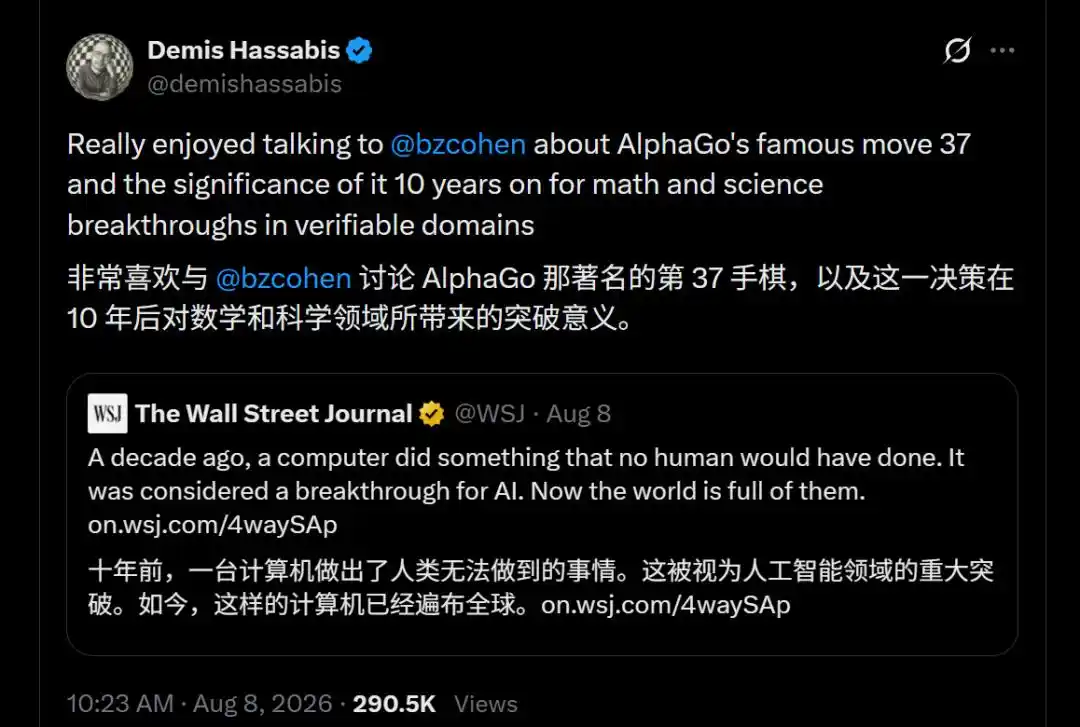
A decade ago, he witnessed AlphaGo's earth-shattering Move 37 defeat legendary Go player Lee Sedol.

A decade later, now at the forefront of AI's push into mathematics and scientific frontiers, he offers another new assessment:

If AI can solve one of the Millennium Prize Problems in mathematics, that would be a 'Move 37-level' breakthrough. At present, it seems to be only a matter of time before AI reaches that level, I see no reason why it wouldn't happen.

Move 37, a moment representing the first time humanity was collectively humbled by AI, is thus remembered by the world.

But few remember that Move 37 was not the only answer left by that man-machine battle.

Two matches later, after losing three games in a row, Lee Sedol played Move 78.

This move also had a probability of only one in ten thousand of being played by a human, yet it successfully disrupted AlphaGo, helping Lee Sedol secure the only human victory in the five-match series.

Looking back at this man-machine battle ten years later, one can't help but marvel:

The relationship between humans and AI is precisely like these two numbers.

One made humanity recognize AI anew, the other made humanity recognize itself anew.

The Face-Slapping Move 37

Turning back the clock to March 2016, the five-match series between AlphaGo and Lee Sedol was taking place in Seoul, South Korea.

In the first game, Lee Sedol lost to AlphaGo, an inauspicious start.

Arriving at the second game, the whole world awaited a counterattack from this legendary player.

Midway through the game, Lee Sedol temporarily left the board, had a cigarette to calm his nerves. But when he returned to the board, a black stone had already been placed.

Move 37.

Lee Sedol did not sit down immediately. He stood there staring at the board, hardly able to believe his eyes.

The reason was simple: this move was too inhuman.

AlphaGo placed the stone on the fifth line, deviating from centuries of positional intuition held by professional players. In conventional human Go understanding, stones should occupy higher positions to control the board, but AlphaGo placed it in an area with no immediate fighting.

The live commentators initially even suspected AlphaGo had made a mistake.

Professional 9-dan Michael Redmond, serving as commentator, stared at the black stone for a long time, unable to judge, could only say:

I don't know if this is good or bad, it's very strange.

His co-commentator was more direct:

I thought it was a mistake.

The DeepMind team later calculated the probability of a human player choosing this move at one in ten thousand.

But as the game progressed, people gradually realized this was not a bad move; it was a brilliant move that changed the course of the battle on a larger scale.

About 100 moves later, this seemingly misplaced black stone became the key to AlphaGo's victory in the second game.

Later, this moment of collective human misjudgment was gradually dubbed the 'Slap-in-the-Face Moment'

Originally thinking AI was wrong, but in the end, it was humans themselves who were wrong.

Beyond the slap, this move also made the world realize for the first time that AI could not only mimic human play, but also make moves humans had never considered.

And just ten years later, 'Move 37' indeed re-emerged, and this time it's linked to an ancient discipline:

Mathematics.

For AI, Go and mathematics share a major commonality: verifiability.

Because the logic and rules of these fields are sufficiently clear, AI can repeatedly run a simple process:

Try an idea, test it, learn from the results, then try again until it succeeds (the reinforcement learning approach).

This mechanism also explains why mathematics is the first discipline to be 'bombarded' by AI's 'Move 37'.

In fields like drug discovery, biology, etc., whether an idea works often requires lengthy experiments to verify.

Mathematics is different; a proof can be checked step by step, right or wrong, so AI can tirelessly search.

And so, as AI capabilities grow stronger, change began accelerating on a yearly basis.

Starting with ChatGPT's birth in 2023, large models still stumbled on basic arithmetic problems; flubs like "Which is larger, 9.11 or 9.9?" once caused amusement.

But by 2024, DeepMind's AlphaProof and AlphaGeometry 2 had already stormed into the International Mathematical Olympiad (IMO).

The two systems solved 4 out of 6 problems, scoring 28 points, reaching silver medal level (just 1 point short of that year's gold medal threshold).

And merely a year later, Gemini Deep Think solved 5 problems within the official contest's 4.5-hour limit, scoring 35 points, reaching IMO gold medal level.

In two years, AI advanced from novice to IMO gold medalist—astonishing speed.

But this was just the exam hall.

What really made the mathematical community feel the tide rushing in was AI starting to move from 'problem-solving' to 'research'.

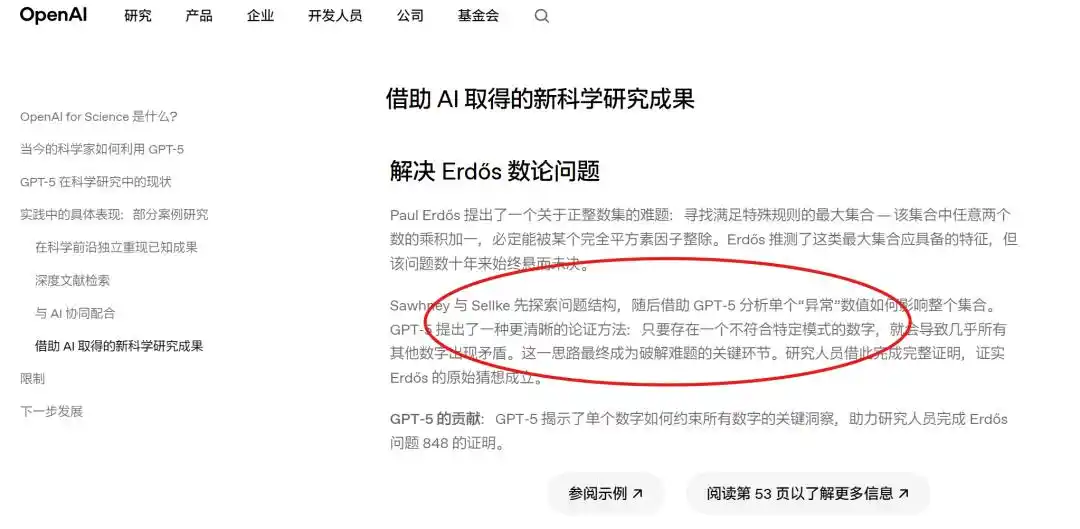
In 2025, GPT-5 participated in solving Erdős Problem 848, proposing a key estimate required for the proof.

Mathematicians refined and tightened it, ultimately completing the full proof.
The same year, UCLA mathematician Ernest Ryu used GPT-5 to find a breakthrough for an open problem that had puzzled optimization theory for 40 years.
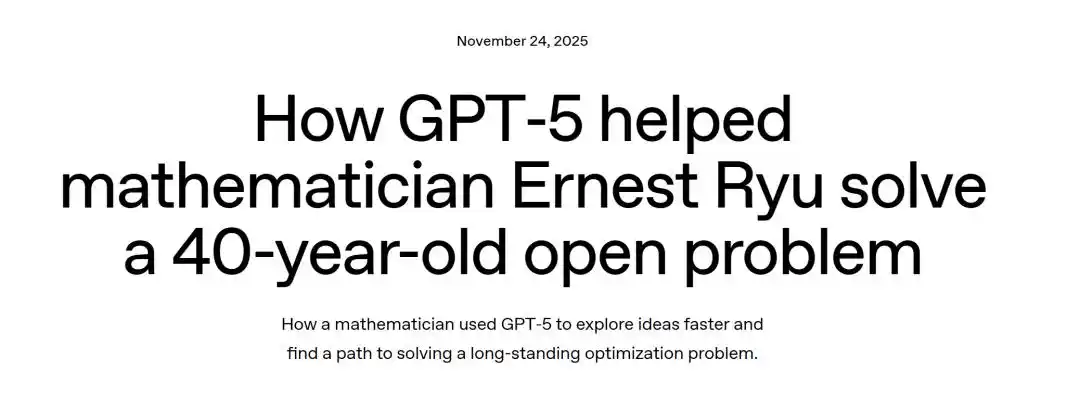
At this stage, AI was no longer just calculating answers; it began contributing key ideas.

Then, as time came to 2026, a series of major mathematical problems began to see breakthroughs.

Leading the charge with a bombshell was again OpenAI.

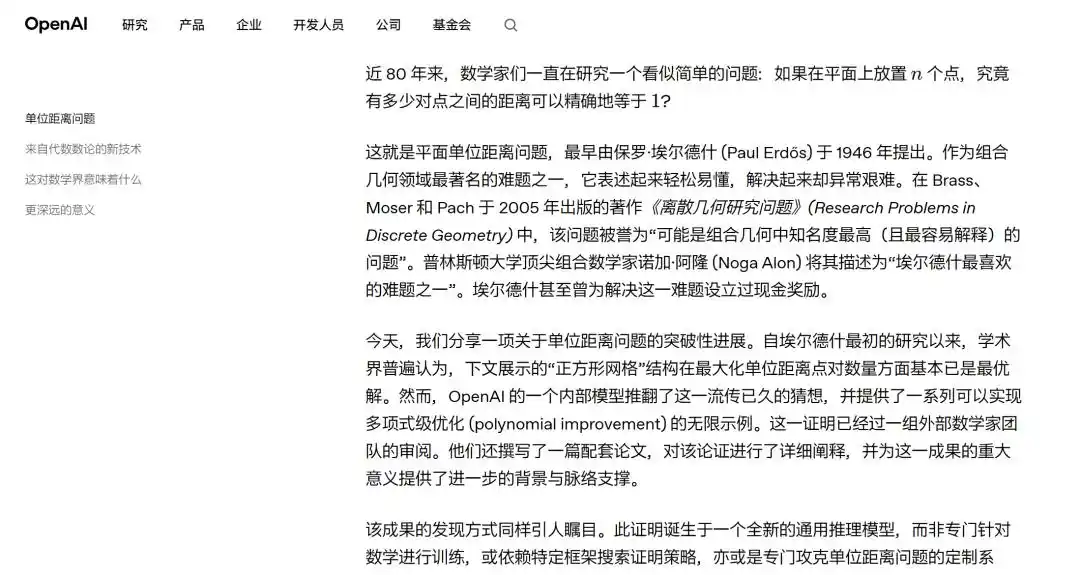
An internal general-purpose reasoning model set its sights on the Unit Distance Problem in the plane. Posed by mathematician Paul Erdős in 1946, it asks: given n points placed on a plane, what is the maximum number of pairs of points exactly distance 1 apart.

For nearly 80 years, the mathematical consensus was that constructions like square grids were near-optimal.

But the AI directly borrowed a set of tools from seemingly unrelated algebraic number theory, constructing an entirely new set of points, overturning this long-held conjecture.

The entire proof was subsequently verified by external mathematicians.

OpenAI stated that this was the first time a general-purpose AI autonomously solved an open problem of significant standing in a mathematical subfield.
Following closely, Anthropic also made its move.

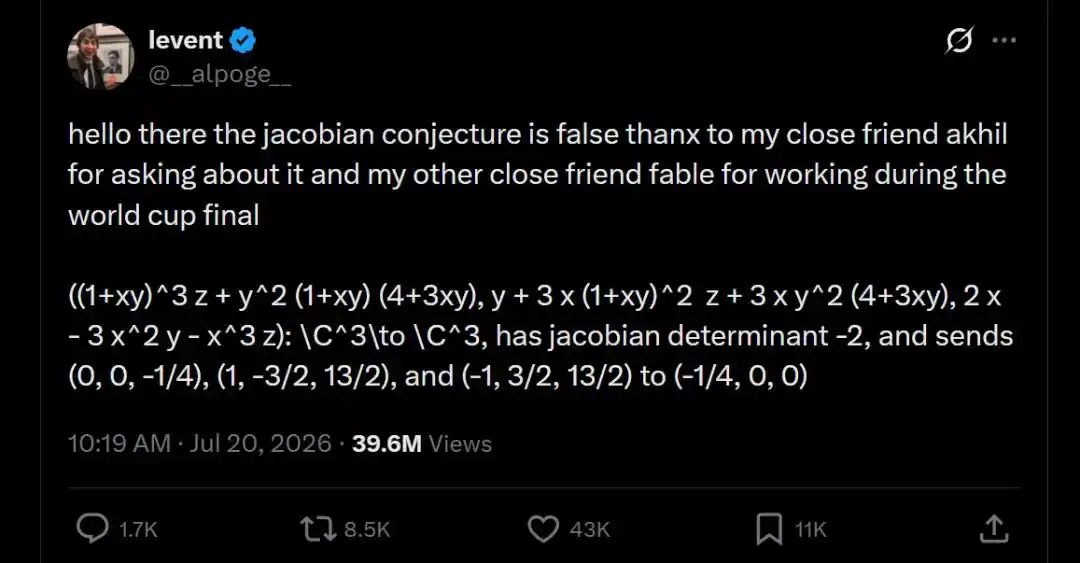
In July 2026, Anthropic mathematician Levent Alpöge, using Claude Fable 5, found an explicit counterexample to the Jacobian Conjecture.

A conjecture that had puzzled mathematicians for 87 years was thus disproven by AI overnight.
There were even instances of OpenAI and Anthropic joining forces.

Just a couple of days ago, GPT-5.6 and Fable 5 teamed up to solve a mathematical puzzle that had been open for 25 years.

(There are plenty of similar stories...)

But perhaps the most astonishing is Google, as DeepMind is turning such breakthroughs into an assembly line.

Its mathematical agent, Aletheia, no longer just generates one answer; it repeatedly proposes proofs, checks for flaws, refutes itself, and then searches for new paths.

DeepMind used it to scan 700 open problems in the Erdős conjecture database.

Among them, AI autonomously solved 4 unsolved problems and contributed to multiple mathematical results of publishable quality.

This attempt demonstrates that AI has begun systematically exploring the blank spaces in the mathematical world.

So it's not hard to imagine:

AI solving more major mathematical problems is truly just a matter of time.

From problem-solving to research, from reiterating known knowledge to proposing unknown answers, Move 37 in mathematics is being played one after another.

Searching for Humanity's Move 78

And facing this moment that is most likely approaching, humanity will undoubtedly confront a soul-searching question:

If AI will keep making novel moves humans have never considered, what should humanity do?

Move 78 from that decade-ago match might be the answer.

In the fourth match of the five-game series, Lee Sedol, having already lost three in a row, wedged a white stone into the center of AlphaGo's formation.

This move was also unconventional; AlphaGo estimated the probability of a human playing it at one in ten thousand.

Subsequently, the machine lost its composure.

Lee Sedol ultimately secured the only human victory, and Move 78 was thus dubbed the 'Hand of God' move.

This victory did not mean humans had overcome AI again.

But it at least showed that humans, after understanding the machine, could find a next step the machine did not anticipate.

This is precisely the lesson Move 78 leaves for today.

As AI becomes increasingly adept at providing answers, human value will shift more towards asking questions, judging direction, and deciding which answers are truly worth seeking.

Borrowing the concept of 'centaur chess' from chess, where human players cooperate with computer engines.

p.s. After IBM's 'Deep Blue' defeated human world champion Garry Kasparov in 1997, Kasparov advocated and organized the first 'Advanced Chess' (Centaur) tournament in 1998 to explore the potential of human-AI collaboration.

Hassabis believes science is entering a similar 'Centaur Era':

We are entering an era of collaboration between humans and computers. I don't know how long this cycle will last. But for very complex fields, it might be quite long. For instance, in drug discovery, biology, chemistry, etc., these fields are highly complex, dynamic, and not everything can be verified. That's where human intuition and insight are needed to decide the direction forward.

Subsequent developments in Go have proven this point.

After AlphaGo emerged, AI quickly became a review tool for professional players. Players could use AI to re-examine past joseki, discover which experiences were actually unreliable, and study new moves once deemed unreasonable.

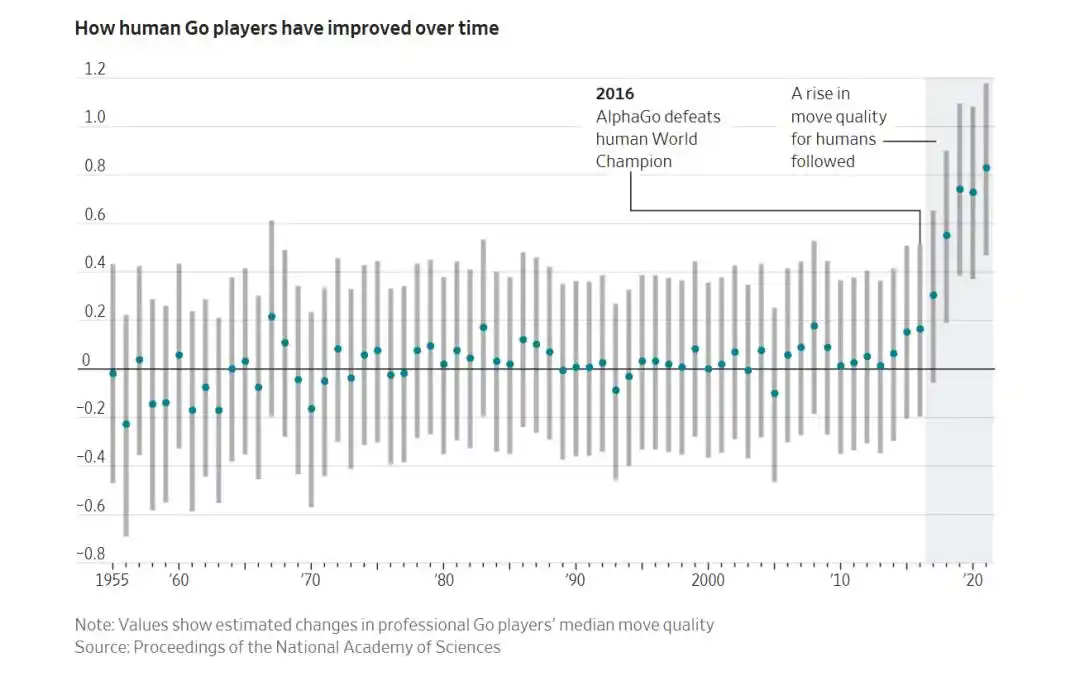
An analysis of over 5.8 million professional move decisions found:

After the advent of superhuman AI, the quality of human players' moves significantly improved, and novel moves also became more frequent.
However, there's another side to the story, namely:

People began relying on AI for answers, gradually losing the ability to judge the answers themselves.

As Lee Sedol said upon retiring, facing an undefeatable opponent made it hard for him to continue enjoying the Go he once loved.

This might be the most cautionary issue in the AI era.

As more fields beyond mathematics are impacted by AI, will more powerful systems make us more creative, efficient, and more human?

Or will they cause people to give up striving?

In the future, AI will keep playing Move 37.

The remaining question is, can humanity find its own Move 78.

Reference links:

[1]https://www.wsj.com/tech/ai/move-37-ai-demis-hassabis-google-deepmind-alphago-ec832a41?st=9XMAjn&reflink=desktopwebshare_permalink

[2]https://x.com/demishassabis/status/2085914742414061886

This article is from the WeChat public account "QbitAI", author: Focus on Frontier Technology

Trending Cryptos

Related Questions

QWhat is the significance of 'Move 37' in the context of AI development according to Demis Hassabis?

A'Move 37' refers to a groundbreaking move made by AlphaGo during its 2016 match against Lee Sedol, which defied centuries of established human intuition in Go. According to Demis Hassabis, it represents the moment AI demonstrated it could find novel solutions beyond human thinking, and he believes a similar level of breakthrough is imminent in mathematics, where AI could solve a Millennium Prize Problem.

QWhat major shift in AI's role in mathematics does the article describe between 2024 and 2026?

AThe article describes a shift from AI 'solving problems' (like achieving IMO gold-level performance) to AI 'conducting research' and contributing key novel ideas to solve long-standing open conjectures. Examples include AI disproving the Jacobian Conjecture in 2026 and autonomously tackling significant problems like the planar unit distance problem.

QWhat does the 'Move 78' from the AlphaGo-Lee Sedol match symbolize in the human-AI relationship?

A'Move 78', the unexpected move by Lee Sedol that led to his sole victory in the match, symbolizes the human ability to find novel paths even after understanding AI's capabilities. It represents the hope that humans, by collaborating with and learning from AI, can maintain their creative and strategic value by asking the right questions and finding unexpected solutions.

QWhat concept does Demis Hassabis use to describe the future of scientific discovery with AI?

ADemis Hassabis describes the future as entering a 'centaur era' for science, drawing a parallel to chess. This concept refers to an era of human-computer collaboration, where human intuition and insight are crucial for guiding direction in complex, less verifiable fields like drug discovery and biology, while AI handles vast computation and pattern recognition.

QAccording to the article, what is a potential risk of increasing reliance on powerful AI systems?

AA potential risk is that humans might become overly reliant on AI for answers, leading to a loss of independent judgment and the ability to critically evaluate solutions. The article cites Lee Sedol's retirement sentiment, where the dominance of an unbeatable AI opponent diminished his enjoyment of Go, illustrating how reliance could potentially stifle human motivation and creativity.

Related Reads

Stock Price Doubles Within the Year, Plummets 20% After Resumption, Baolai Medical's 'Chip Backdoor Listing' Script Ends

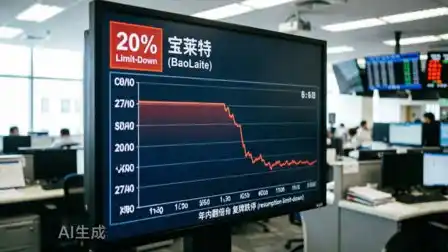
On August 10, 2026, BPL (300246.SZ) resumed trading after a nearly week-long suspension and immediately fell by a 20% limit-down. This plunge was triggered by the termination of a planned controlling stake transfer, dashing earlier market speculation. In January 2026, Zhejiang Quwei Zhihe Partnership entered as a significant shareholder, sparking hopes. Investors speculated that its backer, Weigu Information—a specialized "little giant" company in high-reliability solid-state storage chips—might be seeking a backdoor listing through BPL. This "cross-industry restructuring" expectation fueled a strong rally, with BPL's stock price more than doubling in 2026 prior to the halt. However, the deal was called off on August 7, directly causing the sharp sell-off. Underlying BPL's vulnerability is its fundamentally weak business. The company, a medical device firm, is mired in losses, having reported three consecutive years of net losses totaling over 200 million yuan. Its core hemodialysis business is squeezed by government procurement price cuts, while growth in its patient monitor segment has stalled. Furthermore, BPL faces imminent debt pressure with convertible bonds worth approximately 218 million yuan due in September 2026, and its current stock price is far below the conversion price. The failed control transfer may represent a delayed release of negative news, but BPL's core challenges remain: reversing operational losses and addressing its urgent liquidity crisis.

marsbit41m ago

Stock Price Doubles Within the Year, Plummets 20% After Resumption, Baolai Medical's 'Chip Backdoor Listing' Script Ends

marsbit41m ago

Moore Threads, Having Just Raised 8 Billion, Is Already Planning a Hong Kong IPO

On August 9th, Moore Threads announced plans for a Hong Kong IPO alongside a strong first-half 2026 earnings report. Listed on the Shanghai STAR Market in December 2025 as the "first domestic GPU stock," the company raised 8 billion yuan. Its stock price initially surged but has since fallen 40% from its peak. This decline followed market concerns over its use of substantial idle raised funds for low-risk financial products instead of promised projects. The company's H1 2026 revenue reached 1.74 billion yuan, a 147.4% year-over-year increase, already surpassing its full-year 2025 revenue. This growth is attributed to strong demand for AI and full-feature GPUs, particularly its Kuae AI computing clusters. Despite the revenue surge, Moore Threads remains unprofitable on a non-GAAP basis, with a net loss of 115 million yuan after adjustments. R&D and sales expenses grew significantly. The proposed Hong Kong listing aims to support its global strategy, attract international talent, and improve corporate governance, following the path of other Chinese tech firms pursuing dual listings. However, its港股 IPO valuation may face challenges as international investors could benchmark it against peers like Biren Technology, potentially demanding a discount. In summary, while Moore Threads is expanding rapidly and strategically seeking a港股 listing for global growth, it continues to face profitability challenges amid high costs and market skepticism about its capital allocation and valuation.

marsbit1h ago

Moore Threads, Having Just Raised 8 Billion, Is Already Planning a Hong Kong IPO

marsbit1h ago

Trading

Spot

Hot Articles

What is SONIC

Sonic: Pioneering the Future of Gaming in Web3 Introduction to Sonic In the ever-evolving landscape of Web3, the gaming industry stands out as one of the most dynamic and promising sectors. At the forefront of this revolution is Sonic, a project designed to amplify the gaming ecosystem on the Solana blockchain. Leveraging cutting-edge technology, Sonic aims to deliver an unparalleled gaming experience by efficiently processing millions of requests per second, ensuring that players enjoy seamless gameplay while maintaining low transaction costs. This article delves into the intricate details of Sonic, exploring its creators, funding sources, operational mechanics, and the timeline of significant events that have shaped its journey. What is Sonic? Sonic is an innovative layer-2 network that operates atop the Solana blockchain, specifically tailored to enhance the existing Solana gaming ecosystem. It accomplishes this through a customised, VM-agnostic game engine paired with a HyperGrid interpreter, facilitating sovereign game economies that roll up back to the Solana platform. The primary goals of Sonic include: Enhanced Gaming Experiences: Sonic is committed to offering lightning-fast on-chain gameplay, allowing players and developers to engage with games at previously unattainable speeds. Atomic Interoperability: This feature enables transactions to be executed within Sonic without the need to redeploy Solana programmes and accounts. This makes the process more efficient and directly benefits from Solana Layer1 services and liquidity. Seamless Deployment: Sonic allows developers to write for Ethereum Virtual Machine (EVM) based systems and execute them on Solana’s SVM infrastructure. This interoperability is crucial for attracting a broader range of dApps and decentralised applications to the platform. Support for Developers: By offering native composable gaming primitives and extensible data types - dining within the Entity-Component-System (ECS) framework - game creators can craft intricate business logic with ease. Overall, Sonic's unique approach not only caters to players but also provides an accessible and low-cost environment for developers to innovate and thrive. Creator of Sonic The information regarding the creator of Sonic is somewhat ambiguous. However, it is known that Sonic's SVM is owned by the company Mirror World. The absence of detailed information about the individuals behind Sonic reflects a common trend in several Web3 projects, where collective efforts and partnerships often overshadow individual contributions. Investors of Sonic Sonic has garnered considerable attention and support from various investors within the crypto and gaming sectors. Notably, the project raised an impressive $12 million during its Series A funding round. The round was led by BITKRAFT Ventures, with other notable investors including Galaxy, Okx Ventures, Interactive, Big Brain Holdings, and Mirana. This financial backing signifies the confidence that investment foundations have in Sonic’s potential to revolutionise the Web3 gaming landscape, further validating its innovative approaches and technologies. How Does Sonic Work? Sonic utilises the HyperGrid framework, a sophisticated parallel processing mechanism that enhances its scalability and customisability. Here are the core features that set Sonic apart: Lightning Speed at Low Costs: Sonic offers one of the fastest on-chain gaming experiences compared to other Layer-1 solutions, powered by the scalability of Solana’s virtual machine (SVM). Atomic Interoperability: Sonic enables transaction execution without redeployment of Solana programmes and accounts, effectively streamlining the interaction between users and the blockchain. EVM Compatibility: Developers can effortlessly migrate decentralised applications from EVM chains to the Solana environment using Sonic’s HyperGrid interpreter, increasing the accessibility and integration of various dApps. Ecosystem Support for Developers: By exposing native composable gaming primitives, Sonic facilitates a sandbox-like environment where developers can experiment and implement business logic, greatly enhancing the overall development experience. Monetisation Infrastructure: Sonic natively supports growth and monetisation efforts, providing frameworks for traffic generation, payments, and settlements, thereby ensuring that gaming projects are not only viable but also sustainable financially. Timeline of Sonic The evolution of Sonic has been marked by several key milestones. Below is a brief timeline highlighting critical events in the project's history: 2022: The Sonic cryptocurrency was officially launched, marking the beginning of its journey in the Web3 gaming arena. 2024: June: Sonic SVM successfully raised $12 million in a Series A funding round. This investment allowed Sonic to further develop its platform and expand its offerings. August: The launch of the Sonic Odyssey testnet provided users with the first opportunity to engage with the platform, offering interactive activities such as collecting rings—a nod to gaming nostalgia. October: SonicX, an innovative crypto game integrated with Solana, made its debut on TikTok, capturing the attention of over 120,000 users within a short span. This integration illustrated Sonic’s commitment to reaching a broader, global audience and showcased the potential of blockchain gaming. Key Points Sonic SVM is a revolutionary layer-2 network on Solana explicitly designed to enhance the GameFi landscape, demonstrating great potential for future development. HyperGrid Framework empowers Sonic by introducing horizontal scaling capabilities, ensuring that the network can handle the demands of Web3 gaming. Integration with Social Platforms: The successful launch of SonicX on TikTok displays Sonic’s strategy to leverage social media platforms to engage users, exponentially increasing the exposure and reach of its projects. Investment Confidence: The substantial funding from BITKRAFT Ventures, among others, emphasizes the robust backing Sonic has, paving the way for its ambitious future. In conclusion, Sonic encapsulates the essence of Web3 gaming innovation, striking a balance between cutting-edge technology, developer-centric tools, and community engagement. As the project continues to evolve, it is poised to redefine the gaming landscape, making it a notable entity for gamers and developers alike. As Sonic moves forward, it will undoubtedly attract greater interest and participation, solidifying its place within the broader narrative of blockchain gaming.

2.3k Total ViewsPublished 2024.04.04Updated 2024.12.03

What is SONIC

What is $S$

Understanding SPERO: A Comprehensive Overview Introduction to SPERO As the landscape of innovation continues to evolve, the emergence of web3 technologies and cryptocurrency projects plays a pivotal role in shaping the digital future. One project that has garnered attention in this dynamic field is SPERO, denoted as SPERO,$$s$. This article aims to gather and present detailed information about SPERO, to help enthusiasts and investors understand its foundations, objectives, and innovations within the web3 and crypto domains. What is SPERO,$$s$? SPERO,$$s$ is a unique project within the crypto space that seeks to leverage the principles of decentralisation and blockchain technology to create an ecosystem that promotes engagement, utility, and financial inclusion. The project is tailored to facilitate peer-to-peer interactions in new ways, providing users with innovative financial solutions and services. At its core, SPERO,$$s$ aims to empower individuals by providing tools and platforms that enhance user experience in the cryptocurrency space. This includes enabling more flexible transaction methods, fostering community-driven initiatives, and creating pathways for financial opportunities through decentralised applications (dApps). The underlying vision of SPERO,$$s$ revolves around inclusiveness, aiming to bridge gaps within traditional finance while harnessing the benefits of blockchain technology. Who is the Creator of SPERO,$$s$? The identity of the creator of SPERO,$$s$ remains somewhat obscure, as there are limited publicly available resources providing detailed background information on its founder(s). This lack of transparency can stem from the project's commitment to decentralisation—an ethos that many web3 projects share, prioritising collective contributions over individual recognition. By centring discussions around the community and its collective goals, SPERO,$$s$ embodies the essence of empowerment without singling out specific individuals. As such, understanding the ethos and mission of SPERO remains more important than identifying a singular creator. Who are the Investors of SPERO,$$s$? SPERO,$$s$ is supported by a diverse array of investors ranging from venture capitalists to angel investors dedicated to fostering innovation in the crypto sector. The focus of these investors generally aligns with SPERO's mission—prioritising projects that promise societal technological advancement, financial inclusivity, and decentralised governance. These investor foundations are typically interested in projects that not only offer innovative products but also contribute positively to the blockchain community and its ecosystems. The backing from these investors reinforces SPERO,$$s$ as a noteworthy contender in the rapidly evolving domain of crypto projects. How Does SPERO,$$s$ Work? SPERO,$$s$ employs a multi-faceted framework that distinguishes it from conventional cryptocurrency projects. Here are some of the key features that underline its uniqueness and innovation: Decentralised Governance: SPERO,$$s$ integrates decentralised governance models, empowering users to participate actively in decision-making processes regarding the project’s future. This approach fosters a sense of ownership and accountability among community members. Token Utility: SPERO,$$s$ utilises its own cryptocurrency token, designed to serve various functions within the ecosystem. These tokens enable transactions, rewards, and the facilitation of services offered on the platform, enhancing overall engagement and utility. Layered Architecture: The technical architecture of SPERO,$$s$ supports modularity and scalability, allowing for seamless integration of additional features and applications as the project evolves. This adaptability is paramount for sustaining relevance in the ever-changing crypto landscape. Community Engagement: The project emphasises community-driven initiatives, employing mechanisms that incentivise collaboration and feedback. By nurturing a strong community, SPERO,$$s$ can better address user needs and adapt to market trends. Focus on Inclusion: By offering low transaction fees and user-friendly interfaces, SPERO,$$s$ aims to attract a diverse user base, including individuals who may not previously have engaged in the crypto space. This commitment to inclusion aligns with its overarching mission of empowerment through accessibility. Timeline of SPERO,$$s$ Understanding a project's history provides crucial insights into its development trajectory and milestones. Below is a suggested timeline mapping significant events in the evolution of SPERO,$$s$: Conceptualisation and Ideation Phase: The initial ideas forming the basis of SPERO,$$s$ were conceived, aligning closely with the principles of decentralisation and community focus within the blockchain industry. Launch of Project Whitepaper: Following the conceptual phase, a comprehensive whitepaper detailing the vision, goals, and technological infrastructure of SPERO,$$s$ was released to garner community interest and feedback. Community Building and Early Engagements: Active outreach efforts were made to build a community of early adopters and potential investors, facilitating discussions around the project’s goals and garnering support. Token Generation Event: SPERO,$$s$ conducted a token generation event (TGE) to distribute its native tokens to early supporters and establish initial liquidity within the ecosystem. Launch of Initial dApp: The first decentralised application (dApp) associated with SPERO,$$s$ went live, allowing users to engage with the platform's core functionalities. Ongoing Development and Partnerships: Continuous updates and enhancements to the project's offerings, including strategic partnerships with other players in the blockchain space, have shaped SPERO,$$s$ into a competitive and evolving player in the crypto market. Conclusion SPERO,$$s$ stands as a testament to the potential of web3 and cryptocurrency to revolutionise financial systems and empower individuals. With a commitment to decentralised governance, community engagement, and innovatively designed functionalities, it paves the way toward a more inclusive financial landscape. As with any investment in the rapidly evolving crypto space, potential investors and users are encouraged to research thoroughly and engage thoughtfully with the ongoing developments within SPERO,$$s$. The project showcases the innovative spirit of the crypto industry, inviting further exploration into its myriad possibilities. While the journey of SPERO,$$s$ is still unfolding, its foundational principles may indeed influence the future of how we interact with technology, finance, and each other in interconnected digital ecosystems.

345 Total ViewsPublished 2024.12.17Updated 2024.12.17

What is $S$

What is AGENT S

Agent S: The Future of Autonomous Interaction in Web3 Introduction In the ever-evolving landscape of Web3 and cryptocurrency, innovations are constantly redefining how individuals interact with digital platforms. One such pioneering project, Agent S, promises to revolutionise human-computer interaction through its open agentic framework. By paving the way for autonomous interactions, Agent S aims to simplify complex tasks, offering transformative applications in artificial intelligence (AI). This detailed exploration will delve into the project's intricacies, its unique features, and the implications for the cryptocurrency domain. What is Agent S? Agent S stands as a groundbreaking open agentic framework, specifically designed to tackle three fundamental challenges in the automation of computer tasks: Acquiring Domain-Specific Knowledge: The framework intelligently learns from various external knowledge sources and internal experiences. This dual approach empowers it to build a rich repository of domain-specific knowledge, enhancing its performance in task execution. Planning Over Long Task Horizons: Agent S employs experience-augmented hierarchical planning, a strategic approach that facilitates efficient breakdown and execution of intricate tasks. This feature significantly enhances its ability to manage multiple subtasks efficiently and effectively. Handling Dynamic, Non-Uniform Interfaces: The project introduces the Agent-Computer Interface (ACI), an innovative solution that enhances the interaction between agents and users. Utilizing Multimodal Large Language Models (MLLMs), Agent S can navigate and manipulate diverse graphical user interfaces seamlessly. Through these pioneering features, Agent S provides a robust framework that addresses the complexities involved in automating human interaction with machines, setting the stage for myriad applications in AI and beyond. Who is the Creator of Agent S? While the concept of Agent S is fundamentally innovative, specific information about its creator remains elusive. The creator is currently unknown, which highlights either the nascent stage of the project or the strategic choice to keep founding members under wraps. Regardless of anonymity, the focus remains on the framework's capabilities and potential. Who are the Investors of Agent S? As Agent S is relatively new in the cryptographic ecosystem, detailed information regarding its investors and financial backers is not explicitly documented. The lack of publicly available insights into the investment foundations or organisations supporting the project raises questions about its funding structure and development roadmap. Understanding the backing is crucial for gauging the project's sustainability and potential market impact. How Does Agent S Work? At the core of Agent S lies cutting-edge technology that enables it to function effectively in diverse settings. Its operational model is built around several key features: Human-like Computer Interaction: The framework offers advanced AI planning, striving to make interactions with computers more intuitive. By mimicking human behaviour in tasks execution, it promises to elevate user experiences. Narrative Memory: Employed to leverage high-level experiences, Agent S utilises narrative memory to keep track of task histories, thereby enhancing its decision-making processes. Episodic Memory: This feature provides users with step-by-step guidance, allowing the framework to offer contextual support as tasks unfold. Support for OpenACI: With the ability to run locally, Agent S allows users to maintain control over their interactions and workflows, aligning with the decentralised ethos of Web3. Easy Integration with External APIs: Its versatility and compatibility with various AI platforms ensure that Agent S can fit seamlessly into existing technological ecosystems, making it an appealing choice for developers and organisations. These functionalities collectively contribute to Agent S's unique position within the crypto space, as it automates complex, multi-step tasks with minimal human intervention. As the project evolves, its potential applications in Web3 could redefine how digital interactions unfold. Timeline of Agent S The development and milestones of Agent S can be encapsulated in a timeline that highlights its significant events: September 27, 2024: The concept of Agent S was launched in a comprehensive research paper titled “An Open Agentic Framework that Uses Computers Like a Human,” showcasing the groundwork for the project. October 10, 2024: The research paper was made publicly available on arXiv, offering an in-depth exploration of the framework and its performance evaluation based on the OSWorld benchmark. October 12, 2024: A video presentation was released, providing a visual insight into the capabilities and features of Agent S, further engaging potential users and investors. These markers in the timeline not only illustrate the progress of Agent S but also indicate its commitment to transparency and community engagement. Key Points About Agent S As the Agent S framework continues to evolve, several key attributes stand out, underscoring its innovative nature and potential: Innovative Framework: Designed to provide an intuitive use of computers akin to human interaction, Agent S brings a novel approach to task automation. Autonomous Interaction: The ability to interact autonomously with computers through GUI signifies a leap towards more intelligent and efficient computing solutions. Complex Task Automation: With its robust methodology, it can automate complex, multi-step tasks, making processes faster and less error-prone. Continuous Improvement: The learning mechanisms enable Agent S to improve from past experiences, continually enhancing its performance and efficacy. Versatility: Its adaptability across different operating environments like OSWorld and WindowsAgentArena ensures that it can serve a broad range of applications. As Agent S positions itself in the Web3 and crypto landscape, its potential to enhance interaction capabilities and automate processes signifies a significant advancement in AI technologies. Through its innovative framework, Agent S exemplifies the future of digital interactions, promising a more seamless and efficient experience for users across various industries. Conclusion Agent S represents a bold leap forward in the marriage of AI and Web3, with the capacity to redefine how we interact with technology. While still in its early stages, the possibilities for its application are vast and compelling. Through its comprehensive framework addressing critical challenges, Agent S aims to bring autonomous interactions to the forefront of the digital experience. As we move deeper into the realms of cryptocurrency and decentralisation, projects like Agent S will undoubtedly play a crucial role in shaping the future of technology and human-computer collaboration.

1.0k Total ViewsPublished 2025.01.14Updated 2025.01.14

What is AGENT S

Discussions

Welcome to the HTX Community. Here, you can stay informed about the latest platform developments and gain access to professional market insights. Users' opinions on the price of S (S) are presented below.

活动图片