Russia’s Largest Bank To Offer Crypto-Backed Loans For Corporate Clients – Report

bitcoinistPublished on 2026-02-07Last updated on 2026-02-07

Abstract

Russia's largest bank, Sberbank, is preparing to offer crypto-backed loans to corporate clients following a successful pilot project in December 2025. The bank is finalizing the necessary infrastructure and methodology for scaling this service and is engaging with the Central Bank of Russia (CBR) to develop appropriate regulations. This move comes amid strong corporate interest and follows similar services by global institutions. The expansion of such lending will depend on the development of the regulatory environment. Meanwhile, domestic rival Sovkombank has also begun offering Bitcoin-backed loans. These developments coincide with Russia's efforts to implement a comprehensive digital assets framework by July, which will allow retail and qualified investors to purchase digital assets through licensed platforms, with certain investment limits and testing requirements.

As Russia moves to establish a comprehensive digital assets framework this year, the country’s largest bank is reportedly planning to issue crypto-backed loans to corporate clients following a successful pilot conducted in December.

Sberbank Ready To Expand Crypto-Backed Loans

On Thursday, Reuters reported that Russia’s largest bank by assets, Sberbank, is preparing to offer crypto-backed loans to corporate clients amid strong corporate interest in the digital asset sector.

Sberbank is finalizing the necessary infrastructure and methodology for the potential scaling of crypto-backed lending, a spokesperson told news media outlets, and is ready to work with the Central Bank of Russia (CBR) to develop regulations.

“We are ready to engage in dialogue with the Central Bank to develop appropriate regulatory solutions for the launch of such services. Our work with clients whose activities are related to cryptocurrencies is carried out in several areas and is based on a deep understanding of their business models and risk profiles,” the bank shared with news media agency RIA Novosti.

The bank affirmed that interest from corporate clients is a good opportunity, but noted that clear regulation is necessary. It explained that a transition to a permanent regime of lending secured by digital assets and its mass implementation will depend on the development of the regulatory environment.

In December 2025, Sberbank conducted a successful pilot crypto‐backed loan to a crypto mining company, offering a loan against the digital assets the firm had mined. Now, Russia’s largest bank aims to expand its services to companies holding digital assets, following similar moves by global institutions such as JPMorgan and Wells Fargo.

“Sberbank has already conducted one pilot project on lending secured by cryptocurrency,” the statement explained. “Its main goal was to test the technological aspects of working with this type of collateral. We are currently analyzing its results and finalizing the necessary infrastructure and methodology for the potential scaling of such products.”

Sberbank’s domestic rival, Sovkombank, recently affirmed that it was the first Russian lender to start issuing crypto-backed loans. In a Thursday statement, Russia’s ninth-largest bank revealed it had begun offering Bitcoin-backed loans to individuals and corporations who legally own digital assets.

“Sovcombank sees the potential for partnerships with all participants in the crypto industry — from miners and data center operators to crypto exchanges and exchangers,” said Marina Burdonova, the bank’s compliance director, in a statement. “We are developing specialized products for each segment, such as cash management services with special features and conditions, loans and project financing, as well as risk management tools.”

Russia’s Upcoming Framework

These developments come as Russia works to implement its upcoming digital assets framework, which is expected to take effect by July. In December, the CBR unveiled its comprehensive regulatory proposals to enable retail and qualified investors to buy digital assets through licensed platforms in the country.

Under the central bank’s new rules, non-qualified investors will be allowed to purchase up to 300,000 rubles in the most liquid digital assets annually, following a knowledge test. Meanwhile, qualified investors will be able to acquire unlimited amounts of any digital asset after passing a risk-awareness test.

Notably, Russia’s leading stock exchanges, the Moscow Exchange (MOEX) and SPB Exchange, have shared their support for the CBR’s proposed framework. The institutions recently confirmed they are ready to launch crypto trading services as soon as the framework is enacted.

In addition, the Committee on State Building and Legislation at the State Duma, the lower house of the Federal Assembly of Russia, has also advanced a bill to complement the upcoming rules.

As reported by Bitcoinist, the ruling political party in Russia, the All-Russian Political Party United Russia, revealed that legislation to regulate the seizure of crypto assets in criminal proceedings was recommended for adoption in its upcoming third reading.

If approved, the bill would reduce the risks associated with the use of cryptocurrencies in criminal activities, such as money laundering, corruption, and terrorist financing.
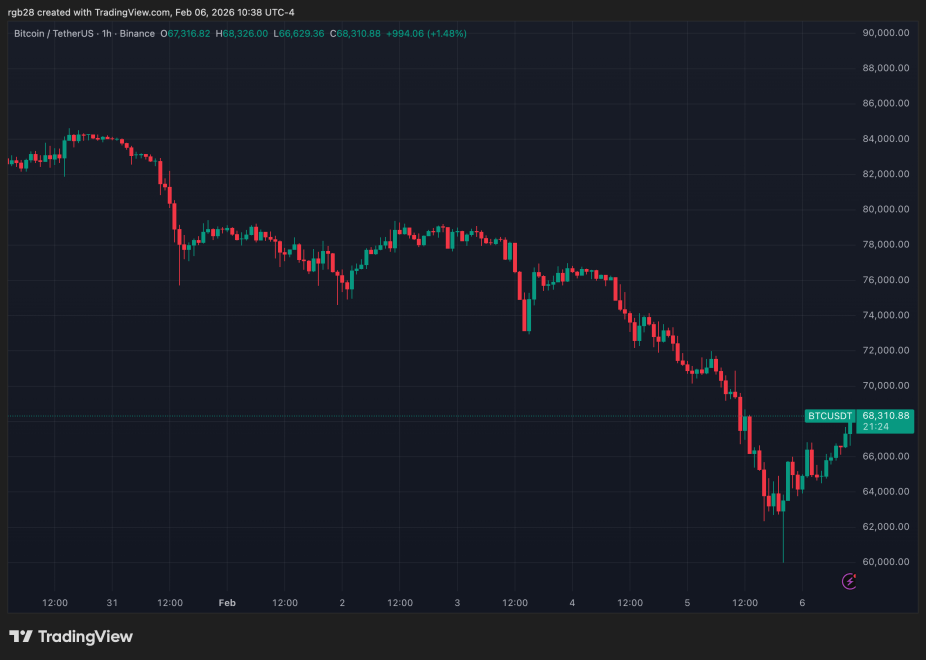
Bitcoin (BTC) trades at $68,310 in the one-week chart. Source: BTCUSDT on TradingView


Trending Cryptos

Related Questions

QWhat is Sberbank planning to offer to its corporate clients, according to the report?

ASberbank is planning to offer crypto-backed loans to its corporate clients.

QWhen did Sberbank conduct a successful pilot for a crypto-backed loan, and with what type of company?

ASberbank conducted a successful pilot crypto-backed loan in December 2025 with a crypto mining company.

QWhich other Russian bank has also started issuing crypto-backed loans, and to whom?

ASovkombank, Russia's ninth-largest bank, has started issuing Bitcoin-backed loans to individuals and corporations who legally own digital assets.

QWhat is the proposed annual limit for non-qualified investors in Russia to purchase the most liquid digital assets under the new framework?

ANon-qualified investors will be allowed to purchase up to 300,000 rubles worth of the most liquid digital assets annually.

QWhat is the main goal of the new Russian bill that was recommended for adoption regarding crypto assets?

AThe main goal of the bill is to reduce the risks associated with the use of cryptocurrencies in criminal activities, such as money laundering, corruption, and terrorist financing, by regulating the seizure of crypto assets in criminal proceedings.

Related Reads

Report Interpretation: J.P. Morgan Details Micron's Pre-Earnings Sentiment, Current Hardware Sector Dynamics

Morgan Stanley analyst Joshua Meyers' report (June 21, 2026) highlights key trends in the hardware and semiconductor sector ahead of Micron's earnings. The core takeaways are: 1. **Micron & Memory:** Memory remains a high-conviction long theme, driven by strong AI demand and rising ASPs. However, investor focus is shifting to the sustainability of Micron's >80% gross margins and the specifics of potential new long-term supply agreements (SCAs). 2. **Hardware Supply Chain:** AI-related demand for servers, networking, and storage remains robust, but company performance is diverging. Celestica (CLS) shows improved margin confidence, Western Digital and Seagate benefit from pricing, Fabrinet (FN) sees predictable AI optics growth, and Teradyne (TER) anticipates a new Google customer. 3. **AI Capex & WFE Forecasts:** JPMorgan increased its Wafer Fab Equipment (WFE) market growth forecasts to 28% in 2026 and 29% in 2027. AI infrastructure financing is evolving, with higher project-level debt reducing constraints on capex expansion. The report signals that while the AI-driven hardware cycle is strong, the market is entering a phase focused on execution verification (e.g., Micron's SCA details, Fabrinet's ramp with Amazon) and valuation sustainability. Key near-term signals include Micron's guidance, Arista Networks' outlook, and the pace of demand normalization post potential tariff-related pull-ins.

marsbit3h ago

Report Interpretation: J.P. Morgan Details Micron's Pre-Earnings Sentiment, Current Hardware Sector Dynamics

marsbit3h ago

Research Report Analysis: The Fed's New Chair's Debut – New Leader, But Same Script?

Report Analysis: Federal Reserve's New Chair Debut – A New Captain, But the Same Script? Morgan Stanley's chief global economist Seth B. Carpenter analyzes the first FOMC meeting under new Fed Chair Kevin Warsh in a June 21 report. Warsh deliberately avoided providing forward guidance on interest rates, aligning with his philosophy. However, market expectations for a rate hike this year were reinforced. Key signals lie elsewhere: inflation may fall more than expected, and quantitative tightening (QT) could be more aggressive than anticipated. The FOMC's "dot plot" suggests only one rate hike in 2026. Carpenter argues that if inflation undershoots forecasts, the logic for even a single hike weakens, especially as projections indicate potential rate cuts in 2027. On QT, Warsh's stance is clear. Carpenter notes that measures like halving the Treasury's account balance could shrink the Fed's balance sheet by around $500 billion with minimal market impact. Combined with adjustments to reserve interest and liquidity rules, the ultimate QT scale may exceed expectations, though its market effect might be less disruptive unless the Fed actively sells Mortgage-Backed Securities (MBS). While Warsh initiated a review of the Fed's policy framework, the 2% inflation target remains intact for now. The report concludes that the market may be overestimating the significance of reduced forward guidance and the near-term rate hike risk, while potentially underestimating the scope and manageable nature of the coming balance sheet reduction. The key debates will hinge on upcoming core PCE data, the specifics of the QT path, and the framework review's findings.

marsbit3h ago

Research Report Analysis: The Fed's New Chair's Debut – New Leader, But Same Script?

marsbit3h ago

Critical Game Week: BTC Retracement Confirmation vs. HYPE Support Battle | Guest Analysis

This weekly analysis outlines a critical juncture for BTC and HYPE markets, focusing on key price level confirmations. **BTC Analysis:** BTC is at a pivotal point after a five-wave rally from the June 5th low of $59,100. The price has broken below a short-term rising channel's lower boundary, with the current move seen as a pullback to test this breakdown. Failure to reclaim this level could lead to a retest of the $59,000-$60,000 support zone. The core scenario hinges on this channel retest outcome. * **Key Levels:** Resistance at $64,500-$65,000 (channel boundary) and $69,500-$70,500. Support at $59,000-$60,000 and $55,000. * **Strategy:** A core bearish stance is maintained (20% short from last week), with short-term plans for tactical trades. Three detailed contingency plans (A/B/C) are provided for short positions on resistance tests or breakdowns, emphasizing strict stop-loss discipline. **HYPE Analysis:** HYPE shows strong momentum but is currently in a corrective phase after hitting a new high of $76.94. The price is retesting the crucial $64-$66 support area. * **Key Levels:** Resistance near $77 and $80-$82. Support at $64-$66 and $52-$54. * **Strategy:** The short-term approach is "buy on dips, avoid chasing rallies." A long position is considered only if clear stabilization signals appear at the $64-$66 or deeper $52-$54 support zones, with tight risk controls. **General Risk Management:** A standardized trailing stop-loss protocol is emphasized: set initial stop, breakeven at +1% profit, then trail stops upward to lock in gains. *Disclaimer: All analysis is presented as a personal trading framework, not investment advice. Market conditions are complex and require dynamic adjustment.*

marsbit4h ago

Critical Game Week: BTC Retracement Confirmation vs. HYPE Support Battle | Guest Analysis

marsbit4h ago

Trading

Spot
Futures

Hot Articles

What is $BANK

Bank AI: A Revolutionary Step in the Future of Banking Introduction In an era marked by rapid advancements in technology, Bank AI stands at the intersection of artificial intelligence (AI) and banking services. This innovative project seeks to redefine the financial landscape, enhancing operational efficiency, security measures, and customer experiences through the power of AI. As we embark on this exploration of Bank AI, we will delve into what the project entails, its operational dynamics, its historical context, and significant milestones. What is Bank AI? At its core, Bank AI represents a transformative initiative aimed at integrating artificial intelligence into various banking operations. This project harnesses the capabilities of AI to automate processes, improve risk management protocols, and enhance customer interaction through personalised services. The primary objectives of Bank AI include: Automation of Banking Functions: By leveraging AI technologies, Bank AI aims to automate routine tasks, reducing the burden on human resources and enhancing efficiency. Enhanced Risk Management: The project utilises AI algorithms to predict and identify risks, thereby fortifying security measures against fraud and other threats. Personalisation of Banking Services: Bank AI focuses on offering tailored financial products and services by analysing customer data and behaviours. Improving Customer Experience: The implementation of AI-driven solutions, such as chatbots and virtual assistants, aims to provide users with more human-like interactions, revolutionising the way customers engage with banks. With these goals, Bank AI positions itself as a crucial player in rendering banking more efficient, secure, and user-centric. Who is the Creator of Bank AI? Details regarding the creator of Bank AI remain unknown. As such, no specific individual or organisation has been identified in the available information. The anonymity surrounding the project's inception raises questions but does not detract from its ambitious vision and objectives. Who are the Investors of Bank AI? Similar to the project's creator, specific information regarding the investors or supporting organisations of Bank AI has not been disclosed. Without this information, it is challenging to outline the financial backing and institutional support that might be propelling the project forward. Nevertheless, the importance of having a robust investment foundation is pivotal for sustaining development in such an innovative field. How Does Bank AI Work? Bank AI operates on several innovative fronts, focusing on unique factors that differentiate it from traditional banking frameworks. Below are key operational features: Automation: By applying machine learning algorithms, Bank AI automates various manual processes within banks. This results in reduced operational costs and allows human workers to redirect their efforts towards more strategic activities. Advanced Risk Management: The integration of AI into risk management practices equips banks with tools to accurately predict potential threats such as fraud, ensuring that customer information and assets remain secure. Tailored Financial Recommendations: Through continuous learning from customer interactions, the AI systems develop a nuanced understanding of user needs, enabling them to offer tailored advice on financial decisions. Enhanced Customer Interactions: Utilizing chatbots and virtual assistants powered by AI, Bank AI enables a more engaging customer experience, allowing users to have their queries resolved quickly, thus reducing wait times and improving satisfaction levels. Together, these operational features position Bank AI as a pioneer in the banking sector, establishing new benchmarks for service delivery and operational excellence. Timeline of Bank AI Understanding the trajectory of Bank AI requires a look at its historical context. Below is a timeline highlighting important milestones and developments: Early 2010s: The conceptualisation of AI integration into banking services began to gain attention as banking institutions recognised the potential benefits. 2018: A marked increase in the implementation of AI technologies occurred when banks started using AI tools like chatbots for basic customer service and risk management systems for improved security handling. 2023: The sophistication of AI continued to advance, with generative AI being introduced for more complex tasks such as document processing and real-time investment analysis. This year marked a significant leap in the capabilities afforded to banks by AI technology. 2024-Current Status: As of this year, Bank AI is on an upward trajectory, with ongoing research and developments poised to further enhance capabilities in banking operations. Continued exploration of AI applications hints at exciting developments yet to come. Key Points About Bank AI Integration of AI in Banking: Bank AI focuses on adopting artificial intelligence to streamline banking processes and improve user experiences. Automation and Risk Management Focus: The project strongly emphasises these areas, aiming to shift the burden of routine tasks while enhancing security frameworks through predictive analytics. Personalised Banking Solutions: By harnessing customer data, Bank AI enables tailored banking services that cater to individual user needs. Commitment to Development: Bank AI remains committed to ongoing research and development efforts, ensuring its adaptability and ongoing relevance as technology continues to evolve. Conclusion In summary, Bank AI exemplifies a crucial step forward in the banking industry, leveraging artificial intelligence to reshape operational paradigms, enhance security, and promote customer satisfaction. Despite gaps in information surrounding the creator and investors, the clear objectives and functional mechanisms of Bank AI provide a strong foundation for its ongoing evolution. As AI technology continues to advance and merge with the banking sector, Bank AI is well-positioned to significantly impact the future of financial services, enhancing the way we understand and interact with banking.

166 Total ViewsPublished 2024.04.06Updated 2024.12.03

What is $BANK

Discussions

Welcome to the HTX Community. Here, you can stay informed about the latest platform developments and gain access to professional market insights. Users' opinions on the price of BANK (BANK) are presented below.

活动图片