RootData Transparency Bounty Activities Report for Rounds 3 and 4

marsbitPublished on 2026-02-12Last updated on 2026-02-12

Abstract

RootData Transparency Bounty Program Reports for Rounds 3 and 4 From January 30 to February 8, 2026, RootData, a Web3 asset data platform, conducted its third and fourth transparency bounty programs. The initiatives focused on due diligence around recently listed projects on major exchanges, covering key financial metrics such as funding structure, team background, token unlocks, and major timelines. The programs reviewed two main categories: Binance-listed projects from the past year and projects listed on major exchanges in 2026. Over 160 users participated, contributing to 190 tag optimizations, 364 token unlock data updates, 235 key calendar entries, and 396 general information improvements. Notably, the overall approval rate was below 30%, reflecting structural challenges in Web3 project transparency. Common issues included incomplete unlock schedules, denial of historical documentation by official sources, complex inflationary token models, and unverified AI-generated content. To date, RootData has hosted four rounds of bounty programs, covering 526 unique projects. Some, like River and Audiera, were repeatedly submitted, showing sustained community interest and gradual transparency improvement. RootData emphasizes that transparency is an ongoing process rather than a one-time goal. The platform remains committed to factual, neutral, and third-party validated data disclosure, avoiding value judgments. It aims to enhance Web3's data infrastructure through community-...

Source: RootData

From January 30 to February 8, 2026, Web3 asset data platform RootData officially launched the Transparency Bounty Activities for Rounds 3 and 4. This event continued the previous mechanism, focusing on热门 projects recently listed on mainstream exchanges. It invited the community to participate in information verification and supplementation around core financial data such as funding structure, team information, token unlocking, and key timeline milestones.

This event featured two main thematic directions: "In-Depth Look at the Transparency of Binance Listing Projects from the Past Year" and "Reviewing the Transparency of Mainstream Exchange Listing Projects in 2026".

Prior to this, RootData had already consecutively held 2 rounds of transparency bounty activities,持续 focusing on verifying information for the most market-attended trading assets. This round not only continued the previous data co-construction mechanism but also further expanded the review scope, placing the discussion focus on the core industry issue of "the completeness of information for projects listed on exchanges".

Approval Rate Below 30%, Exposing Structural Issues

During the 10-day event period, over 160 users participated in submissions. After multiple rounds of review and cross-verification, this event resulted in 190 tag optimizations,364 token unlock data additions and corrections,235 key calendar information additions,and 396 basic information improvements.
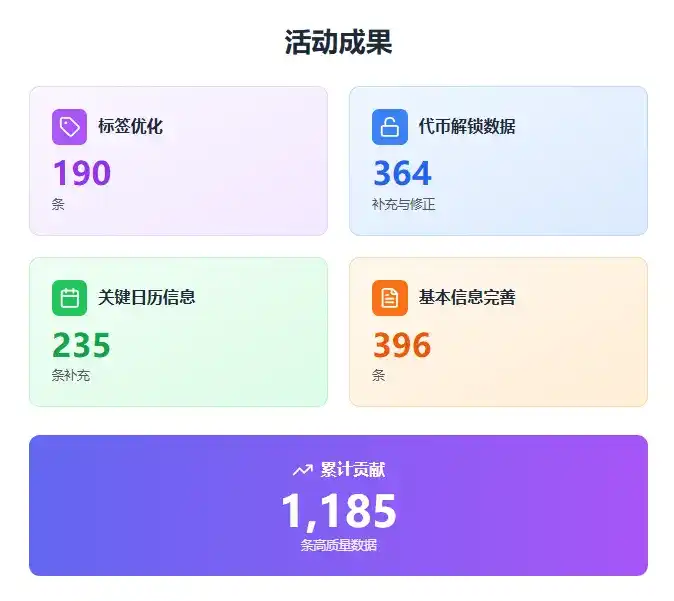
The overall average approval rate for this event was less than 30%. This is not due to lack of participation enthusiasm but rather reflects the many objective obstacles in the current disclosure structure of Web3 projects. During the review process, RootData identified the following typical issues:

1、Incomplete Unlock Data Disclosure

Some project official documents only disclose部分 token allocation components, for example, only公开 the schedule for 3 out of 5 allocation categories, making it impossible to accurately record the overall release structure.

2、Official Information Denies or Avoids Historical Documents

After community members submitted original documents,个别 project parties denied their validity or did not provide clear clarification regarding historical version information, leaving the data sources in a gray area.

3、Complex Structure of Inflationary Token Models

Projects using continuous inflation mechanisms, due to their non-linear, non-fixed cycle release methods, make it difficult to standardize the录入 of traditional unlock structures, increasing data processing difficulty.

4、AI-Generated Data Lacks Factual Support

In key calendar data, the review team found multiple instances of疑似 AI-generated content, lacking clear source links or verifiable evidence. In this regard, RootData explicitly advocates: Leverage AI tools to improve efficiency, but must adhere to a rigorous, verifiable data attitude."Reasonable inference" without factual links is not equivalent to valid information.

Cumulative Observations from Bounty Activities: Transparency is a Process, Not a Conclusion

As of now, RootData has held 4 rounds of transparency bounty activities, primarily focusing on热门 exchange assets, conducting持续 scrutiny on the funding structure, team background, and token release mechanisms of the underlying projects.

The cumulative record total reached 719 entries, involving 526 unique projects. Among them, 361 projects appeared once, and 165 projects appeared repeatedly, with a repetition rate of approximately 31.4%.

This data indicates that some projects have been repeatedly submitted and verified at different stages and in different activities, showing the community's持续关注 on their information completeness.

It is worth noting that ,River and Audiera were submitted and repeatedly verified in every round of activities. Their relevant data transparency has significantly improved after multiple rounds of supplementation, becoming typical cases of transparency improvement under the community co-construction mechanism.

Even after multiple rounds of verification, the transparency improvement for some projects remains limited. This phenomenon further confirms that transparency is not something that can be completed with a single supplement but rather a process requiring持续 verification and dynamic updates.

A Sustainable Mechanism for Co-building Data Transparency

In the process of promoting transparency, RootData adheres to the following principles:

1、Transparency Only Does "Fact Disclosure", Not "Value Judgment"

RootData does not make subjective evaluations of project quality, risk level, etc. The platform only presents whether the information is complete, verifiable, and持续 updated.

2、Transparency Has a "Layered" Phenomenon; Cannot View Exchange Listing Transparency with a "One-Size-Fits-All" Approach

Information disclosure has差异性. RootData uses data status labeling and structured entry to allow users to understand the information completeness of different projects, rather than simply labeling them as "good" or "bad".

3、The Executing Body of Transparency Must Be a Third Party

Exchanges and project parties themselves find it difficult to simultaneously play the roles of discloser and evaluator. As an independent data platform, RootData's responsibility is to record, verify, and公开 information status, not to participate in investment decisions.

In summary, Web3, as a highly market-driven financial environment, lacks a unified mandatory disclosure system. In this context, the improvement of transparency indispensably relies on community participation and third-party持续 recording. RootData will continue to advance the transparent infrastructure of the Web3 data ecosystem through public bounties, data disclosure, and community co-construction mechanisms, providing the community with verifiable, traceable information records for the market.


Trending Cryptos

Related Questions

QWhat was the overall average approval rate for submissions in RootData's 3rd and 4th Transparency Bounty events?

AThe overall average approval rate was less than 30%.

QWhat were the two main thematic focuses of the 3rd and 4th Transparency Bounty events?

AThe two focuses were 'Digging into the Transparency of Binance Listing Projects in the Past Year' and 'Reviewing the Transparency of 2026 Mainstream Exchange Listing Projects'.

QWhat are two examples of projects that were repeatedly submitted and verified across all the bounty events, showing improved transparency?

AThe projects River and Audiera were repeatedly submitted and verified, and their data transparency significantly improved through multiple rounds of community contributions.

QAccording to the report, what is one of the key principles RootData adheres to in promoting transparency efforts?

AOne key principle is that transparency only involves 'fact disclosure' and does not make 'value judgments' about a project's quality or risk.

QWhat was one of the typical problems identified during the audit process that contributed to the low approval rate?

AOne typical problem was incomplete disclosure of unlocking data, where official documents only revealed the unlock schedules for some token allocation categories but not all, making it impossible to accurately record the overall release structure.

Related Reads

9.42 Million Retail Investors Compete for Changxin Technology, Who Got Allotted?

Evergreen Technology's IPO subscription results are now available. On July 20, the domestic memory chip giant announced the offline preliminary allotment results and online lottery results for its IPO. A total of approximately 9.43 million retail investors participated in the online subscription, generating 770,000 winning lots with a final winning rate of about 0.4714%, setting a record for new shares on the STAR Market. After triggering a clawback mechanism from institutional to retail investors, the online retail allocation was significantly increased to 3.851 billion shares. Simultaneously, 285 institutional investors participated in the offline subscription, ultimately receiving 2.173 billion shares at an allotment rate of approximately 0.1756%. Leading insurers and public funds were among the major recipients. Notably, Liang Wenfeng, founder of the major AI model company DeepSeek, through his quantitative investment firms Ningbo Huanfang Quantitative and Zhejiang Jiuzhang Asset, secured the largest share among private funds, with a total allotment worth approximately 175 million yuan. Estimates suggest potential profits could reach 730 million yuan if Evergreen Technology's market capitalization reaches 3 trillion yuan post-listing. The company is expected to list on July 27 and could become the highest-valued tech stock on the A-share market, with various brokerages providing valuations ranging from 1 trillion to over 4 trillion yuan. However, recent significant corrections in global tech stocks may impact its post-listing performance. (Character count: 1,196)

marsbit40m ago

9.42 Million Retail Investors Compete for Changxin Technology, Who Got Allotted?

marsbit40m ago

L2 'Recalibration': When L1 Becomes Its Own Rollup, What Is Ethereum's Endgame?

The article discusses the evolving relationship between Ethereum's Layer 1 (L1) and Layer 2 (L2) solutions, moving beyond the initial "L2 for scaling" model. As Ethereum L1 itself scales (increasing Gas Limit, statelessness, zkEVM), the unique value proposition of L2s shifts from merely providing cheap execution to offering differentiated features like application-specific optimization, privacy, and flexible governance. The piece explores three key themes: 1. **L2's New Role:** L2s are transitioning from a pure scaling technology to a spectrum of execution environments with varying degrees of security inheritance from Ethereum L1. 2. **Interoperability as State Trust:** Solving L2 fragmentation is less about cross-chain bridges and more about enabling faster, trust-minimized state verification between environments. This involves initiatives like faster L1 finality, intent-based architectures (Open Intents Framework), and native account abstraction. 3. **Blurring Layers:** With the potential integration of zk-proofs into L1 validation (making L1 akin to its own "Rollup") and the concept of "Native Rollups," the rigid boundary between L1 and L2 may fade. The future could be a unified system with multiple execution domains (for DeFi, gaming, privacy, etc.) sharing a common security, settlement, and state framework. In conclusion, Ethereum's goal is not to abandon L2s or re-centralize everything on L1, but to re-integrate the fragmented user experience—liquidity, accounts, applications—while preserving the scaling benefits of a multi-environment ecosystem. The endgame is a cohesive "one chain" feeling for users, powered by diverse but securely interconnected execution layers.

marsbit1h ago

L2 'Recalibration': When L1 Becomes Its Own Rollup, What Is Ethereum's Endgame?

marsbit1h ago

Trading

Spot

Hot Articles

How to Buy 4

Welcome to HTX.com! We've made purchasing 4 (4) simple and convenient. Follow our step-by-step guide to embark on your crypto journey.Step 1: Create Your HTX AccountUse your email or phone number to sign up for a free account on HTX. Experience a hassle-free registration journey and unlock all features.Get My AccountStep 2: Go to Buy Crypto and Choose Your Payment MethodCredit/Debit Card: Use your Visa or Mastercard to buy 4 (4) instantly.Balance: Use funds from your HTX account balance to trade seamlessly.Third Parties: We've added popular payment methods such as Google Pay and Apple Pay to enhance convenience.P2P: Trade directly with other users on HTX.Over-the-Counter (OTC): We offer tailor-made services and competitive exchange rates for traders.Step 3: Store Your 4 (4)After purchasing your 4 (4), store it in your HTX account. Alternatively, you can send it elsewhere via blockchain transfer or use it to trade other cryptocurrencies.Step 4: Trade 4 (4)Easily trade 4 (4) on HTX's spot market. Simply access your account, select your trading pair, execute your trades, and monitor in real-time. We offer a user-friendly experience for both beginners and seasoned traders.

4.8k Total ViewsPublished 2025.10.20Updated 2026.06.02

How to Buy 4

Discussions

Welcome to the HTX Community. Here, you can stay informed about the latest platform developments and gain access to professional market insights. Users' opinions on the price of 4 (4) are presented below.

活动图片