Renren Skill Officially Launched: An AI Skill Store Tailored for Chinese Users

marsbitPublished on 2026-03-27Last updated on 2026-03-27

Abstract

RenrenSkill officially launched in China on March 27, 2026, as an AI skill store specifically designed for Chinese users. The platform enables both beginners and advanced users to easily access, use, and create custom AI skills without any technical background. It aims to make AI practical and accessible for everyday tasks in work, life, and learning. Tailored for the Chinese market, RenrenSkill offers a fully localized experience with a Chinese interface, natural language interaction, and region-specific content. It provides a wide range of ready-to-use skills for tasks like writing articles, processing spreadsheets, generating video scripts, and travel planning. The platform also includes a community-driven skill store where users can browse, install, and rate skills across categories such as office productivity, content creation, and education. A key feature is its user-friendly skill creation tool, allowing anyone to build and publish their own AI skills. The platform supports community interaction through forums and tutorials, fostering a collaborative environment. Future plans include skill bundles for specific use cases and a monetization system for creators. RenrenSkill is now in public beta and available at rrskill.ai.

Renren Skill officially announced its launch in the Chinese market on March 27, 2026. This is an AI skill (Skill) store specifically designed for Chinese users. Whether you are a beginner or an advanced user of AI, you can use the Skills included in the store with zero barriers to entry. You can also freely create and publish your own Skills, making AI a true super assistant for everyone's work, life, and learning. In today's rapidly popularizing AI technology, many Chinese users often face the pain point that "AI can chat, but it can't really get work done." The mission of Renren Skill is to break this barrier: AI skills should not belong only to programmers or tech elites; they should be accessible, usable, and creatable by everyone. In these past few months, various tools have emerged one after another, but most are cumbersome to operate, still deterring ordinary users. Renren Skill's platform is positioned as the most user-friendly AI Skill application store for Chinese users, providing a complete experience for browsing, installing, using, sharing, and creating, fully adapted to the Chinese environment.

Why Choose Renren Skill?

  • Optimized for Chinese Users: Full Chinese interface, natural language operation, a vast selection of localized practical skills, and dedicated tutorials that best understand Chinese expression habits. Fast access speed, smooth experience, no need for VPN.
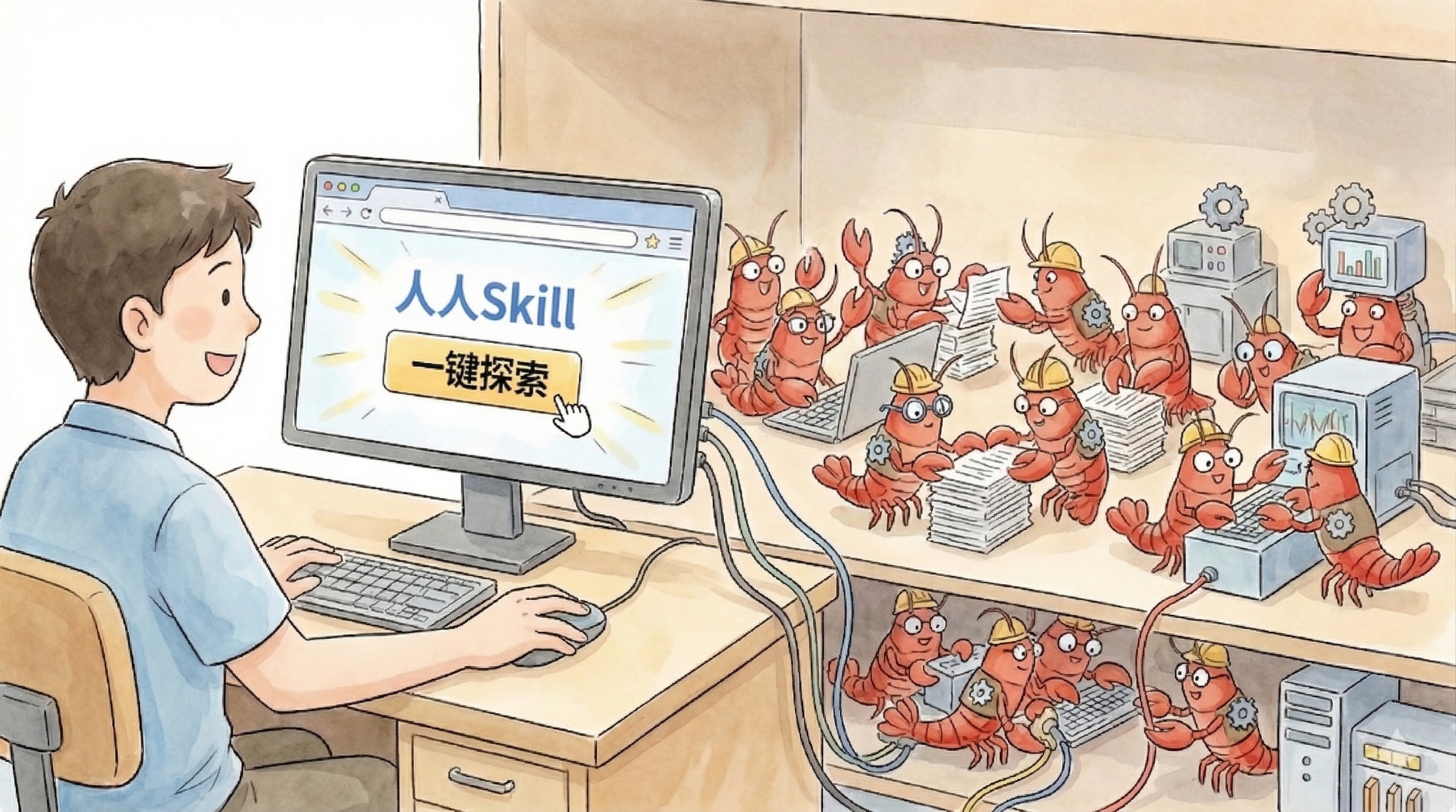
  • Easy to Get Started with Zero Foundation: No programming knowledge required. Through simple and easy-to-understand graphic displays, you can immediately search, install, and use various practical Skills. For example, with one click, have AI help you write public account articles, organize Excel reports, generate short video scripts, create travel guides, etc.
  • Massive Skill Store: The platform gathers a wealth of Skills contributed by the community, covering high-frequency scenarios such as office efficiency, content creation, education and learning, finance, and daily life. Discover and acquire high-quality Skills as easily as browsing Taobao, and see real user reviews and feedback.
  • Everyone is a Creator: Built-in super user-friendly Chinese creation features, allowing even beginners to quickly build their own Skills. After creation, publish to the store with one click for tens of millions of Chinese users to use, and potentially receive community rewards and recognition.
  • Warm Community Ecosystem: Features Chinese forums, tutorial sections, etc., where users can exchange improvement suggestions and participate in co-creation, forming a warm community atmosphere of "everyone contributes, everyone benefits."

"The future of AI lies in inclusivity, not exclusivity," the team stated. "We hope that through this platform, everyone can experience AI, use AI, encapsulate complex code logic into simple 'skill packages,' and return technology to its essence of serving people."

Platform Core Highlights
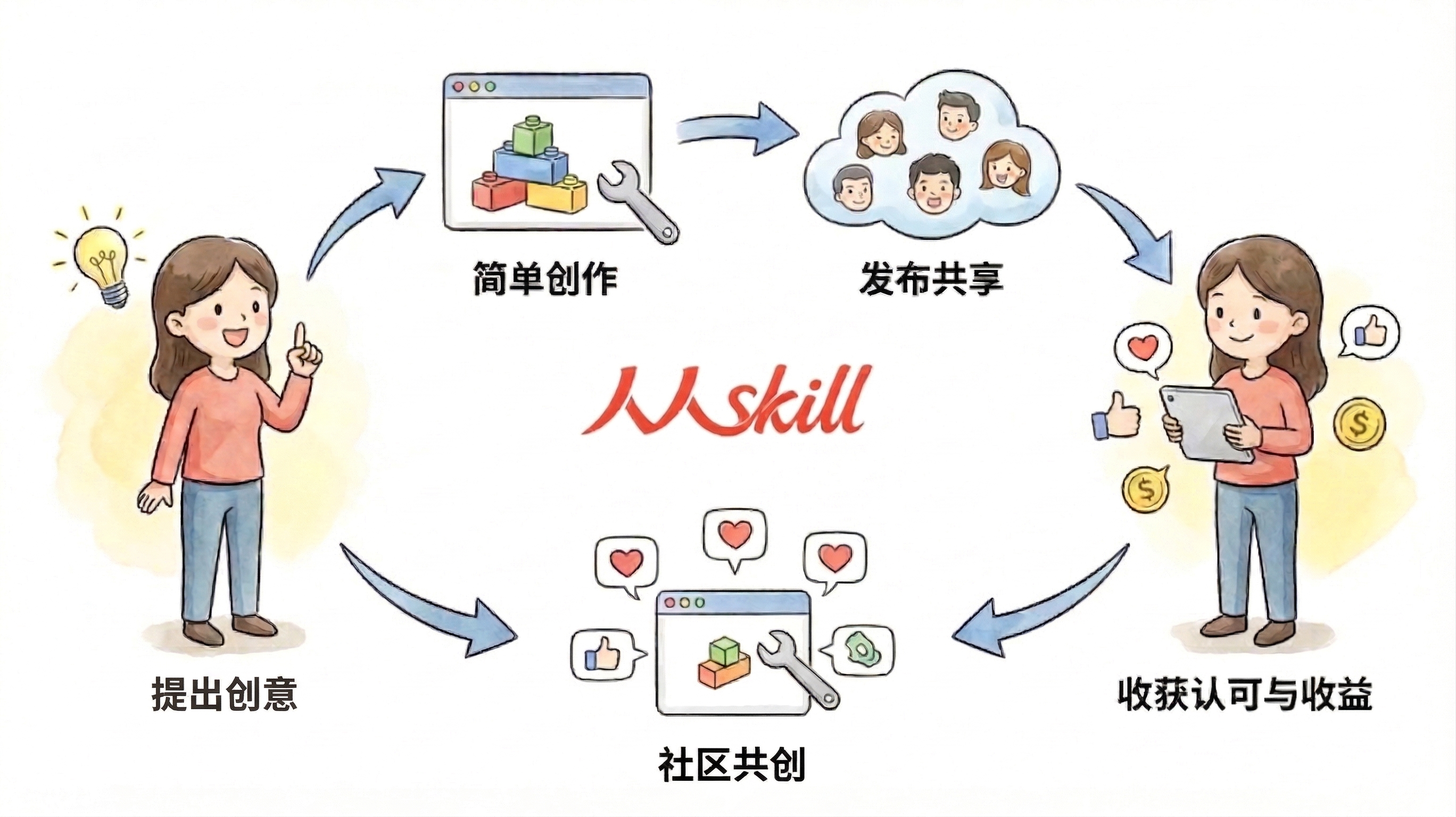
  • Skill Store: Categorized by scenario (office efficiency, content creation, data search, image processing, etc.), hot recommendations, user real evaluation system.
  • Step-by-Step Guides: With three dedicated sections—"Easy Start," "Advanced Player," and "Hardcore Geek"—providing detailed guides from basic operations to complex command writing.
  • One-Click Installation and Use: Directly copy prompt words, install via chat interface, effective in seconds.
  • Community and Learning Center: Beginner tutorials, advanced sharing, interactive exchanges, helping users quickly grow from "newbies" to "Skill masters."
  • Future Plans: Scenario-based thematic collections, creating out-of-the-box collection packages for different groups. For example, "We-Media Matrix Operation Pack," "Financial Data Automated Cleaning Pack," or "Development Troubleshooting Toolbox," complete with保姆级 (nanny-level) usage guides. Also planning to launch skill reward mechanisms, allowing excellent Skills to truly monetize.

Renren Skill is now open for public beta to Chinese users. All friends interested in AI are welcome to register and experience it for free. Whether you want to quickly solve work pain points, use ready-made Skills, or hope to share ideas and become a Skill creator, this is your best starting point. Join Renren Skill Now: Visit www.rrskill.ai, or follow the WeChat Official Account: Renren Skill, start your journey to becoming an AI expert with one click, and together, let's define the lifestyle of the future!
How to Find Us—Official Website: https://rrskill.ai/ WeChat Official Account: rrskill Twitter: rrskill_ai Xiaohongshu: Renren Skill (rrskill.ai)


Related Questions

QWhat is the main purpose of the '人人skill' platform launched in China?

AThe main purpose of the '人人skill' platform is to serve as an AI skill store specifically designed for Chinese users, allowing everyone, from beginners to advanced players, to use, create, and share AI skills without any technical barriers, making AI a true super assistant for work, life, and learning.

QWhat are some key features that make '人人skill' user-friendly for Chinese audiences?

AKey user-friendly features include a fully Chinese interface, natural language operation, localized practical skills, tutorials tailored to Chinese expression habits, fast access without the need for VPN, and an easy-to-use creation function for building and publishing skills without programming knowledge.

QHow does '人人skill' address the common pain point of 'AI can chat but not actually work'?

AIt addresses this by providing a platform where users can easily browse, install, and use a wide range of practical AI skills for high-frequency scenarios like office productivity, content creation, and education, encapsulating complex code logic into simple 'skill packages' that are ready to use.

QWhat community and learning support does '人人skill' offer to its users?

AThe platform features a Chinese forum, tutorial sections, and interactive exchange areas where users can share improvement ideas, participate in co-creation, and access step-by-step guides from basic operations to advanced command writing, helping them grow from beginners to 'Skill masters'.

QWhat are the future plans for the '人人skill' platform as mentioned in the article?

AFuture plans include launching scenario-based thematic collections (e.g., 'self-media matrix package' or 'financial data automation cleaning package') with beginner-friendly guides, as well as introducing mechanisms like skill tipping to allow excellent skills to monetize and gain recognition.

Related Reads

In-Depth Report on the On-Chain Lending Market: When Off-Chain Credit Meets On-Chain Liquidation

The on-chain lending market has evolved from a peripheral DeFi niche into core financial infrastructure. As of early 2026, total value locked (TVL) in on-chain lending protocols has reached $64.3 billion, accounting for 53.54% of total DeFi TVL, making it the largest and most mature vertical within decentralized finance. Aave dominates the sector with approximately $32.9 billion in TVL, commanding nearly half of the market—a leadership position that is unlikely to be challenged in the foreseeable future. However, the path of on-chain lending forward is not without risk. Liquidation cascades, credit defaults, and cross-chain vulnerabilities remain systemic threats hanging over the industry. At the same time, a deeper structural transformation is underway: on-chain lending is shifting from a “leverage tool for crypto-native users” to a “compliant gateway for institutional capital”. The scale of RWA (Real World Asset) lending has surpassed $18.5 billion, with U.S. Treasuries and government securities increasingly serving as core collateral. Institutional capital inflows are reshaping both the user base and risk appetite of the sector. This report systematically analyzes the evolution of on-chain lending definitions, competitive dynamics, core risks, and future trends, providing a comprehensive industry outlook for investors and trade practitioners. Key findings suggest that the “one dominant player with several strong challengers” structure will persist in the short term, while fixed-rate lending, compliant collateral, and institutional credit underwriting will define the next phase of competition. For investors focused on DeFi infrastructure, three key opportunity tracks stand out, namely, the Aave ecosystem (Morpho, Spark), RWA lending protocols (Ondo, Maple) and fixed-rate innovation (Notional, Pendle).

HTX Learn36m ago

In-Depth Report on the On-Chain Lending Market: When Off-Chain Credit Meets On-Chain Liquidation

HTX Learn36m ago

Fu Peng's First Public Speech in 2026: What Exactly Are Crypto Assets? Why Did I Join the Crypto Asset Industry?

Fu Peng, a renowned macroeconomist and now Chief Economist at New火 Group, delivered his first public speech of 2026 at the Hong Kong Web3 Festival. He explained his perspective on crypto assets and why he joined the industry, framing it within the context of macroeconomic trends and financial evolution. Fu emphasized that crypto assets are transitioning from an early, belief-driven phase to a mature, institutionally integrated asset class. He drew parallels to the 1970s-80s, when technological advances (like computing) revolutionized traditional finance, leading to the rise of FICC (Fixed Income, Currencies, and Commodities). Similarly, current advancements in AI, data, and blockchain are reshaping finance, with crypto assets becoming part of a new "FICC + C" (C for Crypto) framework. He noted that institutional capital, including traditional hedge funds, avoided early crypto due to its speculative nature but are now engaging as regulatory clarity emerges (e.g., stablecoin laws, CFTC classifying crypto as a commodity). Fu predicted that 2025-2026 marks a turning point where crypto becomes a standardized, financially viable asset for diversified portfolios, akin to commodities or derivatives in traditional finance. Fu defined Bitcoin not as "digital gold" in a simplistic sense but as a value-preserving, financially tradable asset. He highlighted that crypto's future lies in regulated, institutional adoption, moving away from retail-dominated trading. His entry into crypto signals this maturation, where traditional finance integrates crypto into mainstream asset management.

marsbit1h ago

Fu Peng's First Public Speech in 2026: What Exactly Are Crypto Assets? Why Did I Join the Crypto Asset Industry?

marsbit1h ago

Justin Sun Sues Trump Family: What $75 Million Bought Was Only a Blacklist

Justin Sun, founder of Tron, has filed a lawsuit in federal court against World Liberty Financial (WLF), alleging he was made the "primary target of a fraudulent scheme" after investing $75 million. Sun claims the investment secured him an advisor title and WLFI tokens, which were later frozen by WLF, causing "hundreds of millions in losses." The dispute began in late 2024 when Sun's investment helped revive WLF's struggling token sale, which ultimately raised $550 million. Shortly after, the SEC dropped its lawsuit against Sun following Donald Trump's inauguration. However, relations soured when Sun refused WLF's demands for additional funding. In August 2025, WLF added a "blacklist" function to its smart contract, allowing it to unilaterally freeze tokens. Sun's holdings, worth approximately $107 million, were frozen, and he was threatened with token destruction. The lawsuit highlights WLF's structure, which directs 75% of token sale profits to the Trump family, who had earned $1 billion by December 2025. WLF's CEO is Zach Witkoff, son of U.S. Middle East envoy Steve Witkoff. The project faces scrutiny for opaque operations, including a controversial loan arrangement on the Dolomite platform, co-founded by a WLF advisor. Despite Sun's history with the SEC, the case underscores centralization risks within DeFi, as WLF controls governance and holds powers to freeze assets arbitrarily. Sun's tokens remain frozen as legal proceedings begin.

marsbit1h ago

Justin Sun Sues Trump Family: What $75 Million Bought Was Only a Blacklist

marsbit1h ago

Trading

Spot
Futures

Hot Articles

Discussions

Welcome to the HTX Community. Here, you can stay informed about the latest platform developments and gain access to professional market insights. Users' opinions on the price of AI (AI) are presented below.

活动图片