Cardano Gets Filecoin-Backed Storage Upgrade

bitcoinistPublished on 2026-04-23Last updated on 2026-04-23

Abstract

Cardano's ecosystem has integrated a significant storage upgrade through a collaboration between Blockfrost and Filecoin. This new premium storage tier offers Cardano builders a decentralized, verifiable backup solution without requiring any changes to their existing workflows. The integration, which was initially announced in late 2024, has now been productized, providing enhanced data resilience for applications on Cardano. Charles Hoskinson endorsed the move, welcoming Filecoin as "one of the OGs" to the ecosystem. The service leverages Filecoin's decentralized storage network to strengthen app reliability and underscores a commitment to decentralization by coordinating two major layer-1 blockchain ecosystems.

A new storage offering is moving from partnership language to product language inside the Cardano stack. Filecoin said Blockfrost has added a premium storage tier for developers backed by Filecoin, giving builders a distributed, verifiable backup layer without requiring changes to existing workflows.

Hoskinson Backs Filecoin Move Into Cardano

Cardano developers using Blockfrost already rely on the API provider to avoid running their own infrastructure. Filecoin posted via X: “Blockfrost added a premium storage tier for Cardano developers backed by Filecoin. Distributed across independent providers, verifiable, with no infrastructure overhead. For data-driven apps on Cardano, that’s a reliability upgrade with no workflow changes required.”

Charles Hoskinson amplified the announcement with a short but pointed endorsement, calling Filecoin “one of the OGs” and welcoming it to the Cardano ecosystem. The comment was brief, but it gave the rollout added visibility across Cardano circles and framed the integration as more than a quiet backend feature.

Philip DiSarro, the founder and CEO of Anastasia Labs, a Cardano-focused smart contract development and security firm, added via X: “This is a beast of a collaboration / announcement.”

The older press release behind the announcement fills in what the product actually does. In December 2024, Filecoin Foundation and Blockfrost said they were collaborating to integrate Filecoin as a decentralized storage backup layer for apps built with Blockfrost. At the time, the framing centered on redundancy, quality assurance and decentralization. The new development is that those ideas now appear to have been packaged into a “premium storage tier” for developers rather than remaining a general infrastructure collaboration.

A premium tier implies a concrete service offering developers can select as part of their stack, with clearer user value: preserve data across a decentralized storage network, keep access seamless, and do it without forcing teams to rework their application flow.

Filecoin’s wording around the launch was explicit: “For data-driven apps on Cardano, that’s a reliability upgrade with no workflow changes required.” That is the core pitch. Not a new chain, not a migration, not another middleware maze. Just a harder-to-break storage layer sitting behind the tools many builders already use.

The original release also made clear why Filecoin was the chosen layer. “By archiving its IPFS Gateway clusters on Filecoin, the world’s largest decentralized storage network, Blockfrost will introduce a new service tier for builders that includes both IPFS and Filecoin storage. This integration not only strengthens the resilience of future Cardano apps but also highlights a commitment to decentralization by prioritizing the coordination of two leading layer-1 blockchain ecosystems.”

At press time, ADA traded at $0.2555.
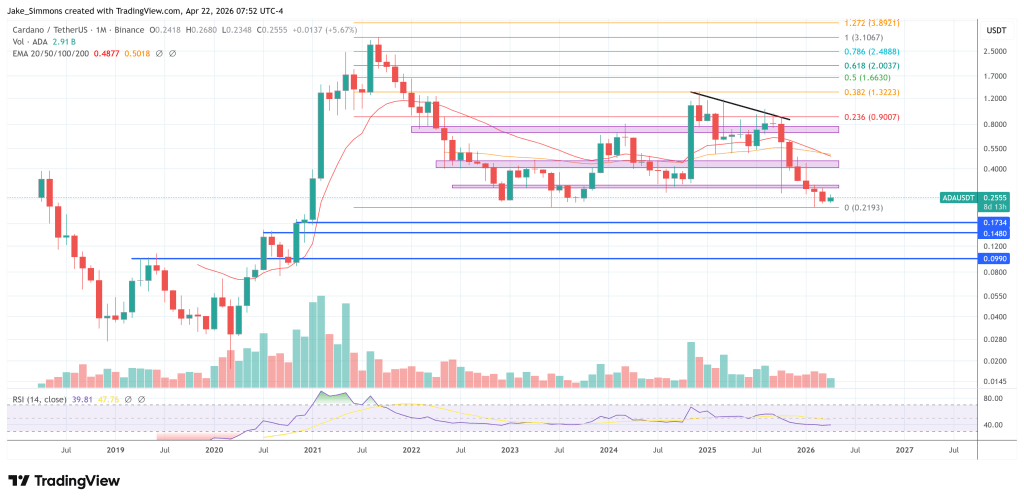
ADA remains below key resistance, 1-monthly chart | Source: ADAUSDT on TradingView.com

Related Questions

QWhat is the new storage offering for Cardano developers announced by Filecoin and Blockfrost?

ABlockfrost has added a premium storage tier for Cardano developers backed by Filecoin, providing a distributed, verifiable backup layer without requiring changes to existing workflows.

QHow did Charles Hoskinson respond to Filecoin's integration into the Cardano ecosystem?

ACharles Hoskinson gave a short but pointed endorsement, calling Filecoin 'one of the OGs' and welcoming it to the Cardano ecosystem, which increased the visibility of the rollout.

QWhat are the key benefits of the Filecoin-backed premium storage tier for Cardano developers?

AThe key benefits include distributed storage across independent providers, verifiability, no infrastructure overhead, enhanced reliability for data-driven apps, and no required workflow changes.

QWhy was Filecoin chosen as the storage layer for Blockfrost's integration?

AFilecoin was chosen because it is the world's largest decentralized storage network, and integrating it with Blockfrost's IPFS Gateway clusters strengthens the resilience of Cardano apps and highlights a commitment to decentralization by coordinating two leading layer-1 blockchain ecosystems.

QWhat was the price of ADA at the time of the article's publication?

AAt press time, ADA traded at $0.2555.

Related Reads

Has the 'Digital Gold' Narrative for BTC Failed?

**Title: Has the "Digital Gold" Narrative for Bitcoin Failed?** The article argues that Bitcoin's "digital gold" narrative remains valid despite a recent sharp price decline (from a peak near $126k in Oct 2025 to briefly under $61k in Feb 2026). It presents a long-term investment framework based on three core points: **1. Viewing Bitcoin as an Asset:** Bitcoin is presented as a superior potential store of value compared to gold. Key arguments are its absolute scarcity (21 million cap), superior portability, and transparent auditability via its public ledger. While acknowledging its current use in early, volatile stages (~3-4% global adoption), the author draws parallels to the early, disruptive phases of the internet and e-commerce. **2. Understanding the Recent Downturn:** The current ~50% correction is framed as a predictable, consensus-driven cycle following its post-halving peak (the 2024 halving preceded the Oct 2025 high). A crucial factor is a historic "changing of hands": the influx of new institutional buyers via ETFs allowed early, low-cost holders (miners, OG believers) to take profits. The author notes that while severe, Bitcoin's historical drawdowns (e.g., 93% in 2011, 77% in 2021-22) have been progressively smaller, suggesting maturing holder structure and decreasing volatility over time. **3. The Long-Term Perspective:** The long-term thesis hinges on Bitcoin capturing a portion of gold's market value. With Bitcoin's market cap at ~$1.4 trillion (at $70k) versus gold's ~$20 trillion, significant upside potential exists if the "digital gold" narrative is partially realized. However, the author strongly cautions that short-term risks remain, the bottom is unpredictable, and high volatility is inherent. The real risk is not Bitcoin failing but poor personal position management (over-leverage, wrong capital) and a lack of deep understanding, which can force investors out during severe downturns. The conclusion uses Amazon's 95% crash post-2000 dot-com bubble and subsequent 42x recovery as an analogy. The ultimate question is not if Bitcoin's price will rise, but if an investor's strategy and conviction can withstand the volatility to see the long-term play out. The recent divergence (gold up, Bitcoin down) is posed not as a narrative failure, but as potential evidence of this ongoing, painful transition from a speculative asset to a mainstream allocation.

marsbit26m ago

Has the 'Digital Gold' Narrative for BTC Failed?

marsbit26m ago

Has BTC's 'Digital Gold' Narrative Failed?

The article discusses Bitcoin's "digital gold" narrative, its recent price drop, and long-term outlook through the perspective of "Jason". It argues the narrative is not a failure but that Bitcoin represents a superior, new asset class due to its fixed supply (21 million), portability, and auditability. The piece compares its current ~3-4% global adoption rate to early internet/e-commerce, suggesting significant growth potential. Regarding the 2025-2026 price decline (from ~$126k to briefly under $61k), the author views it as a predictable, consensus-driven sell-off within Bitcoin's ~4-year cycle post-halving, exacerbated by a major "handover" from early, low-cost holders to new institutional buyers via ETFs. A key observation is that historical peak-to-trough drawdowns have lessened over time (e.g., 93% in 2011 to ~50% in 2026), indicating maturing volatility as holder structure changes. For the long term, the author uses a simple framework: Bitcoin's total market cap (~$1.4T at $70k) is only about 7% of gold's (~$20T). Even capturing 30-50% of gold's value would imply substantial upside. However, the article strongly cautions against viewing this as investment advice, emphasizing extreme volatility and the critical importance of risk management, position sizing, and deep fundamental understanding to survive severe drawdowns. It concludes by drawing a parallel to Amazon's 95% crash in 2000 and subsequent 42x recovery, stressing that the key is surviving market cycles to realize long-term potential.

链捕手36m ago

Has BTC's 'Digital Gold' Narrative Failed?

链捕手36m ago

From Code to Cognition: A Ten-Thousand-Word Guide to the Evolution of the Robot Brain

"From Code to Cognition: The Evolution of Robot Brains" The journey of robotic intelligence has shifted dramatically from manually coded systems to AI-driven brains. For decades, robots relied on layered software stacks—perception, state estimation, planning, control—each handcrafted. While predictable, they lacked adaptability. The 2010s saw deep learning revolutionize perception (e.g., object detection) and control (via reinforcement learning), but learned skills remained narrow. The arrival of Large Language Models (LLMs) marked a turning point. LLMs acted as high-level planners, interpreting natural language instructions and generating sequences of actions for traditional robotic systems to execute. However, true integration came with Visual-Language-Action (VLA) models, which fused vision, language, and motion prediction into a single network. Pioneered by models like RT-2 and open-source projects like OpenVLA, VLAs enable robots to reason and act directly from visual input and commands. The most advanced humanoid robots now employ a "dual-brain" architecture: a slow-thinking, large VLA (System 2) for reasoning and planning, and a fast-reacting, small network (System 1) for high-frequency motion control, sometimes with an even lower-level System 0 for balance. This split balances cognition with the physics of real-time movement. Computation is split between onboard hardware (e.g., NVIDIA Jetson) for safety-critical control loops and cloud/edge servers for non-critical tasks like learning and interfaces. A crucial driver is the open-source ecosystem—models like GR00T and OpenVLA allow startups to build upon pre-trained brains and fine-tune them with their own data, accelerating development. Despite progress, current systems struggle with recovery from errors, sample inefficiency, and long-horizon tasks. This has spurred the rise of **World Models**—neural networks that predict the consequences of actions. By simulating possible futures before acting (like NVIDIA Cosmos or Meta V-JEPA), robots can plan, recover, and generalize better. This represents the next frontier: shifting intelligence from learned reactions to an internal model of physics and cause-and-effect. The field is rapidly evolving. While not yet at its "ChatGPT moment," the convergence of cheaper hardware, scalable simulation, and world models points toward robots that are increasingly capable, adaptive, and useful. The question is shifting from "what can robots do?" to "what *should* they do?"

marsbit1h ago

From Code to Cognition: A Ten-Thousand-Word Guide to the Evolution of the Robot Brain

marsbit1h ago

AI Bubble Is Bursting

The AI Bubble is Bursting: A Necessary Purge on the Path to Ubiquitous Intelligence Market volatility has reignited debates about an AI bubble, with figures like Ray Dalio pointing to high valuations. However, this parallels the dot-com bubble, which, despite its crash, laid the physical infrastructure for today's internet era. The current AI investment frenzy, with tech giants planning trillions in infrastructure spending far outstripping current AI application revenues, appears similarly imbalanced. This 'bubble' is seen as an inevitable phase for a disruptive technology, paying the "innovation tax." Critically, AI inference costs have plummeted over 99.7% since 2023, making intelligence nearly free at the margin. This hasn't reduced spending but has instead unlocked massive new demand, as seen in enterprise AI cloud expenditure tripling. This follows the Jevons Paradox: efficiency gains lead to greater total consumption. The market is now entering a cleansing phase, weeding out speculative ventures lacking real moats. The deeper shift is a move from capital expenditure (CapEx) on hardware to value creation in operational expenditure (OpEx) through AI applications that solve real industry problems. While infrastructure valuations are high, rapid earnings growth from widespread AI adoption across sectors—from manufacturing and finance to law and healthcare—may digest these valuations over time. Ultimately, this creative destruction will leave behind robust infrastructure and optimized models, cheaply powering an AI-augmented future for all industries, much as the internet became indispensable after its own bubble burst. The core productive potential remains undiminished.

链捕手1h ago

AI Bubble Is Bursting

链捕手1h ago

Trading

Spot
Futures

Hot Articles

Discussions

Welcome to the HTX Community. Here, you can stay informed about the latest platform developments and gain access to professional market insights. Users' opinions on the price of ADA (ADA) are presented below.

活动图片