Reddit Weekly Hot Stock Watch: RKLB/LUNR/ASTS Plunge Collectively, Is the Space Sector Still Worth Considering?

marsbitPublished on 2026-06-08Last updated on 2026-06-08

Abstract

Reddit's stock communities witnessed a concentrated surge in discussion around space stocks last week, with SPCE, RKLB, LUNR, and ASTS leading the chatter. This often signals an underlying catalyst for investor attention. However, despite being grouped as "space plays," these companies have vastly different fundamentals and recent performances. While SPCE (Virgin Galactic) saw a 22% single-day surge—potentially fueled by short covering and fallout from Blue Origin's rocket test anomaly—the other three stocks declined sharply. RKLB dropped 15%, LUNR fell 13%, and ASTS was down 7%. This divergence highlights they are not a monolithic sector. The downturn for RKLB, LUNR, and ASTS stemmed from multiple headwinds converging: Blue Origin's New Glenn rocket explosion (directly impacting ASTS's launch plans), anticipation of SpaceX's massive IPO drawing funds away from these "alternative" public space stocks, and insider selling at RKLB after significant rallies. A closer look reveals key differences: RKLB stands out with substantial, growing revenue ($113.9M in Q1) and a $2.2B backlog, though its high valuation (~80x Forward P/S) prices in success for its upcoming Neutron rocket. LUNR's reported revenue growth is largely acquisition-driven, with its core moon landing business facing a crucial test with the upcoming IM-3 mission. ASTS has a large potential market in space-based cellular connectivity but faces significant execution risk, especially after the Blue Origin launch setb...

Author: David, Deep Tide TechFlow
On Reddit's stock subreddit communities, stocks with skyrocketing discussion volume aren't necessarily worth buying, but they are definitely getting attention because there's usually a catalyst behind the discussions.

Our monitoring tools scan daily changes in discussion volume and sentiment distribution across several major stock communities on Reddit, fishing out abnormal signals for further analysis.

Last week's hot discussion signals were concentrated in the space sector:

SPCE (Virgin Galactic) topped the hot list with 2,828 discussion threads in 24 hours; meanwhile, RKLB (Rocket Lab) discussion volume surged 3.3 times, and LUNR (Intuitive Machines) and ASTS (AST SpaceMobile) also appeared frequently in the hot discussion zone.
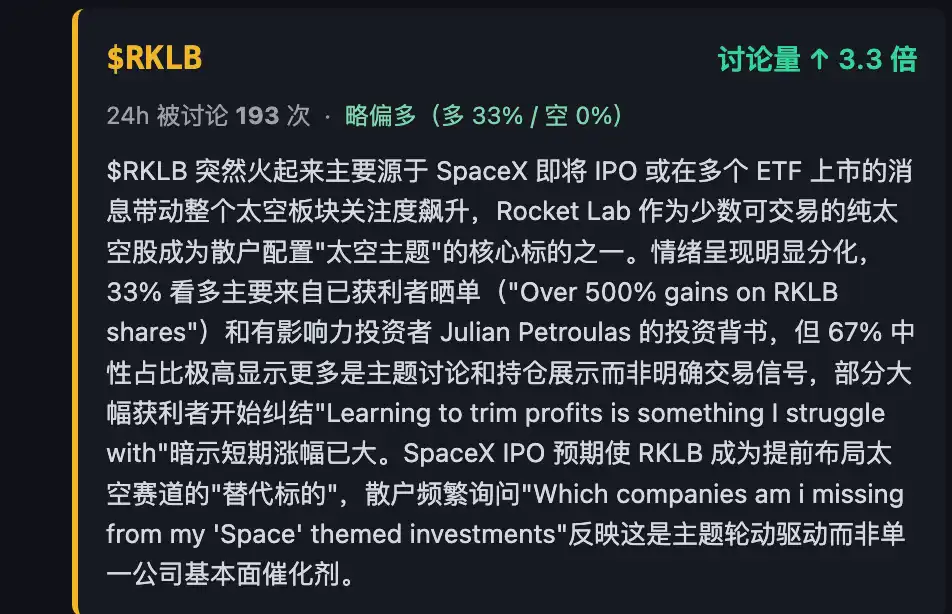
These four stocks are often bundled together on Reddit because they are among the few pure-play space stocks accessible to retail investors. In the years before SpaceX goes public, these are the substitutes for retail investors to allocate to a 'space theme'.

Currently, common discussions in Reddit's US stock communities include "Which companies am I missing from my space themed investments?", which to some extent reflects the spillover effect of SpaceX sentiment and the expectation among foreign retail investors that it will ignite the space concept, prompting them to position themselves early.

Looking at the current trends of these stocks, they have moved in completely opposite directions within the same sector: SPCE soared 22% in a single day, while RKLB fell 15%, LUNR fell 13%, and ASTS fell 7%.

Therefore, in the current hot discussions, SPCE attracted new attention due to its profit-making effect, while RKLB/LUNR/ASTS generated discussions from existing holders due to price declines or loss anxiety.

If you are also watching the space sector or have corresponding holdings, the following analysis of the recent developments of these 4 US stocks might provide some assistance for decision-making.
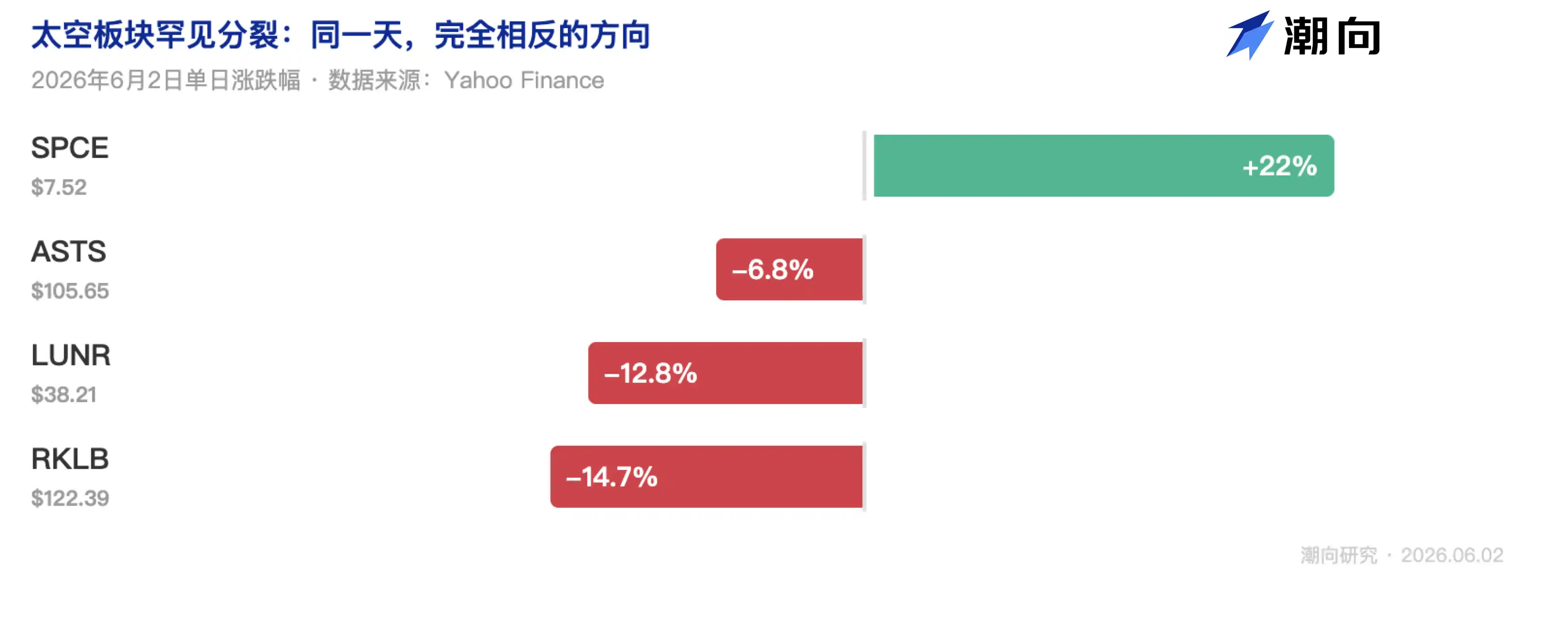
Most Space Stocks Fell, Impacted by Overlapping Negative Events

Except for $SPCE, this wave of decline in space stocks involved at least 3 negative events that happened to coincide in the same week.

Blue Origin Rocket Explosion.

Blue Origin is the space company founded by Amazon's Jeff Bezos. Its New Glenn heavy-lift rocket competes in the same market as SpaceX's Falcon Heavy and Rocket Lab's Neutron, which is under development. On May 29, during a static fire test at Cape Canaveral, the New Glenn rocket exploded, prompting the FAA (Federal Aviation Administration, which must approve all commercial launches) to immediately ground it.

This event had the biggest impact on $ASTS:

The company plans to launch 45-60 satellites into orbit before the end of the year, and Blue Origin is one of its primary launch suppliers. The grounding directly eliminates one launch pathway.

$RKLB itself doesn't use New Glenn for launches, but its own Neutron under development is a competitor. The explosion reminded investors that building rockets really can lead to explosions. Another space stock, $LUNR, was affected more by sector-wide sentiment spillover.

However, $SPCE actually benefited. Virgin Galactic operates suborbital space tourism, directly competing with Blue Origin's New Shepard business. After the New Glenn explosion, market funds flowed out of Blue Origin-related stocks, with some moving into SPCE. Additionally, SPCE has a relatively smaller market cap, making its price more prone to volatile swings.

SpaceX IPO Pricing Could Happen as Early as June 11.

SpaceX confidentially submitted its S-1 filing in April, targeting a valuation of $1.8 trillion and raising up to $75 billion, potentially the largest IPO in Wall Street history. Over the past few years, RKLB, LUNR, and ASTS were popular partly because SpaceX wasn't public, making them the only entry points for retail investors into space. Now that the main player is arriving, some capital will naturally move out of these substitutes to make room for SpaceX.

Insiders Themselves Are Selling.

Public data shows RKLB's CEO Peter Beck sold approximately 2.51 million shares over the past 6 months, cashing out about $142 million. The President, COO, and General Counsel also recently reduced their holdings, totaling about $18 million.

Some of this was part of pre-arranged 10b5-1 plans (a preset trading arrangement for compliant CEO selling), but the timing was chosen near historical highs. Over the past year, RKLB rose 412%, ASTS rose 437%, and LUNR rose 267%, so profit-taking pressure was already relatively loose.

The Four 'Space Companies' Are Not Doing the Same Thing

Retail investors tend to treat SPCE, RKLB, LUNR, and ASTS as one sector and trade them together, but these four companies have completely different businesses, revenue stages, and risk profiles.
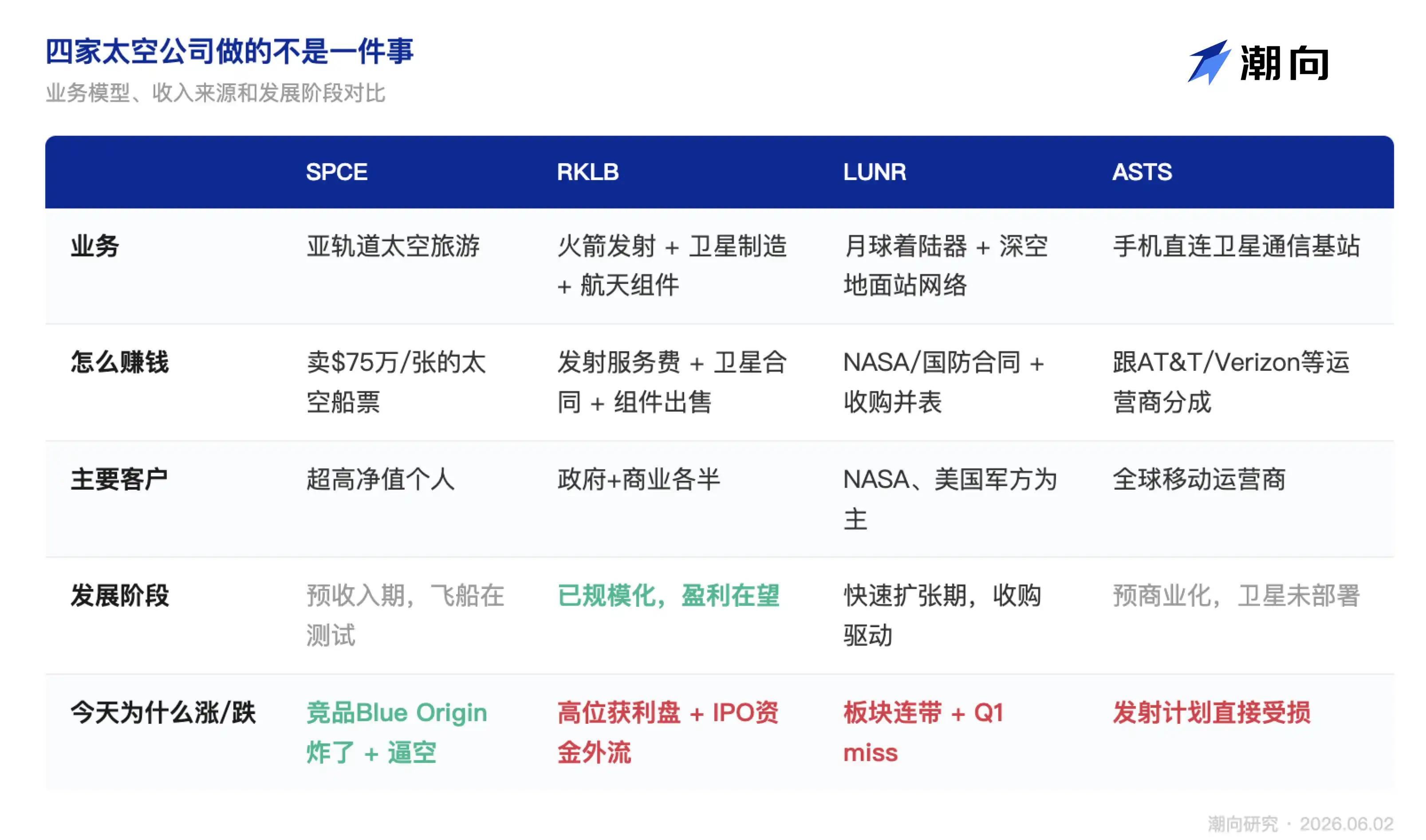
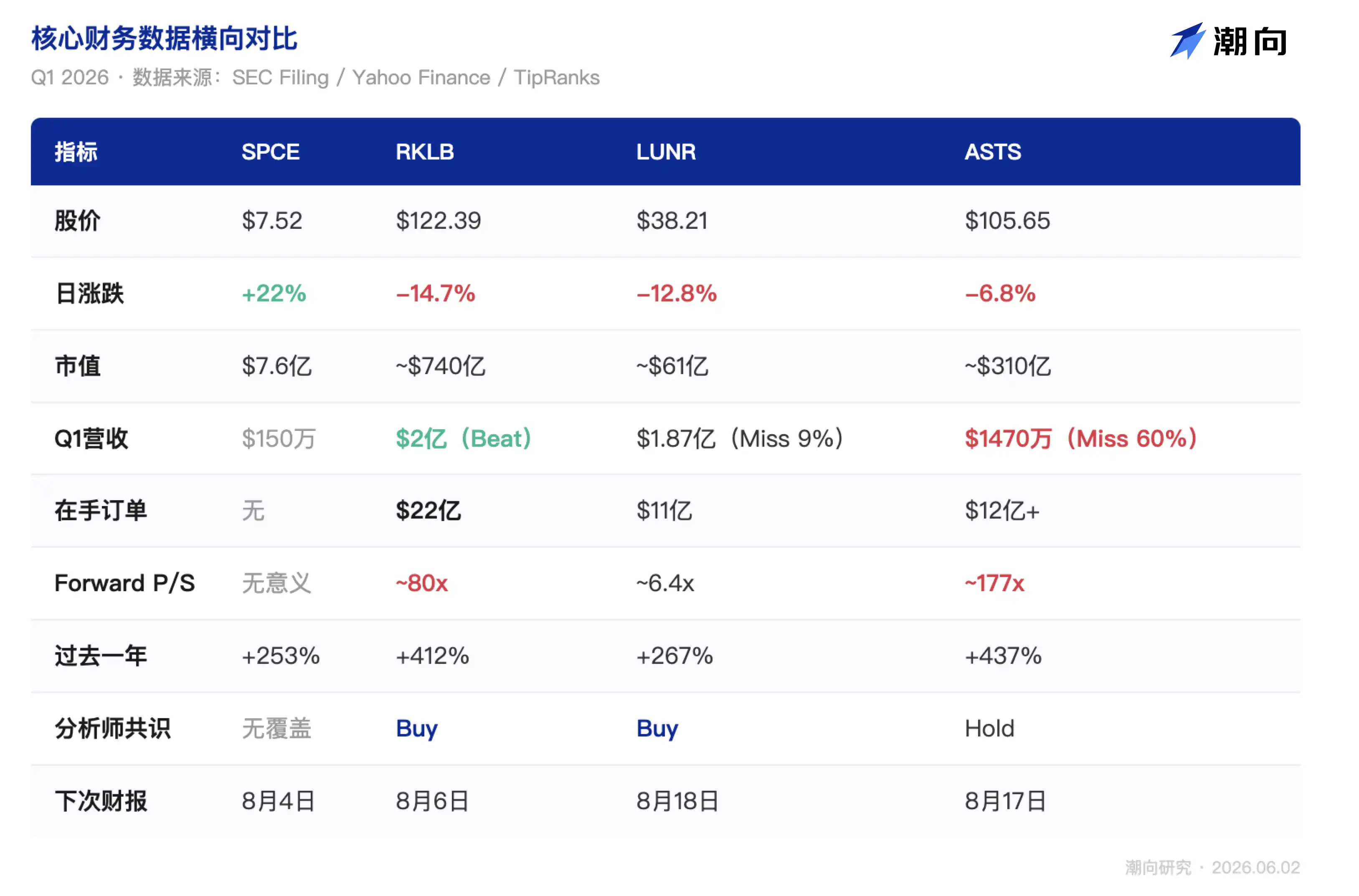
From the table above, RKLB is the only one among the four with substantial and accelerating revenue.

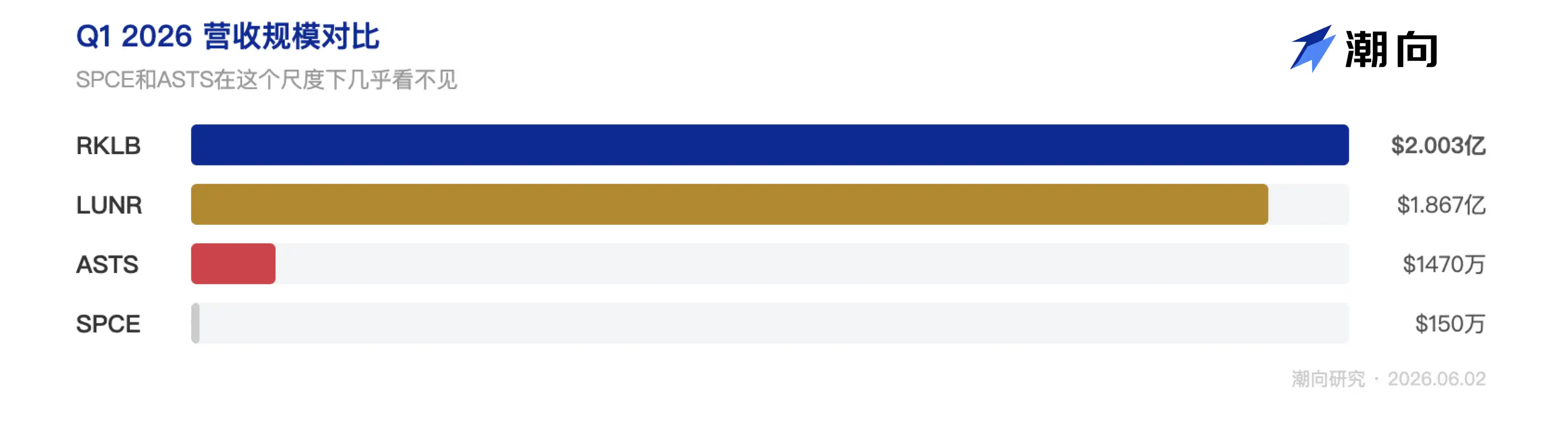
Looking at this year's Q1 revenue for these companies, RKLB's revenue was earned deal by deal, increasing 63.5% year-over-year, beating analyst expectations. LUNR's number is similar in size, but a large portion comes from consolidating the revenue of Lanteris, a company it acquired for $800 million this year. Excluding that part, its organic growth is less dramatic, and its final revenue still missed analyst expectations by 9%.

ASTS and SPCE's revenue bars are almost invisible in this chart; their revenue scale is negligible compared to the first two.
RKLB: The Only One with Accelerating Fundamentals, But $122 Is No Longer Cheap

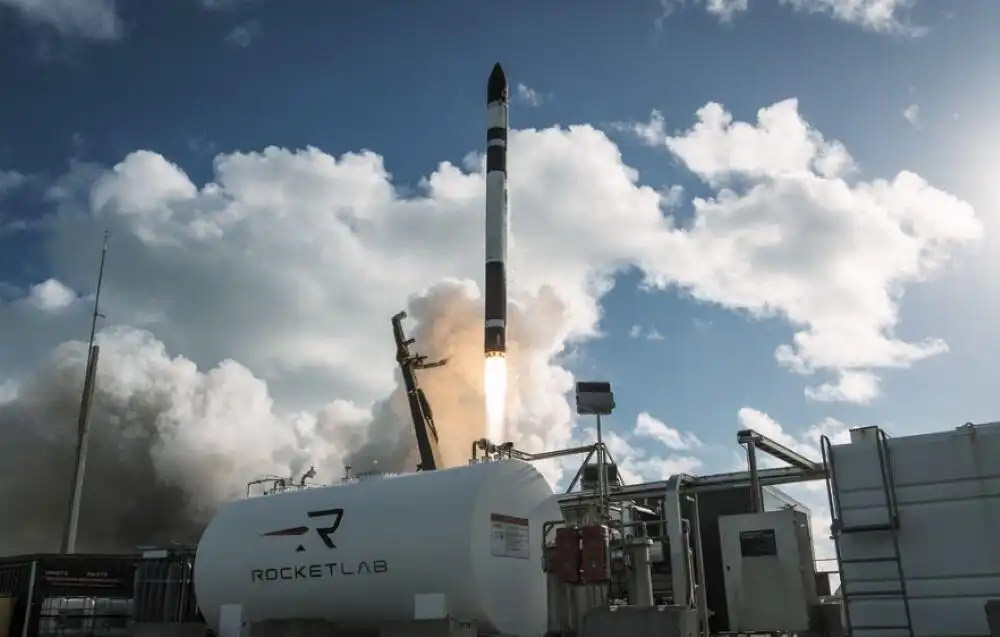
Rocket Lab is the second-largest US rocket company. Its self-developed Electron small rocket has completed over 50 launches, while also building satellite platforms and space components sold to NASA, the Department of Defense, and commercial customers. Government and commercial revenues are roughly split, making its customer base much more diversified than the other three.

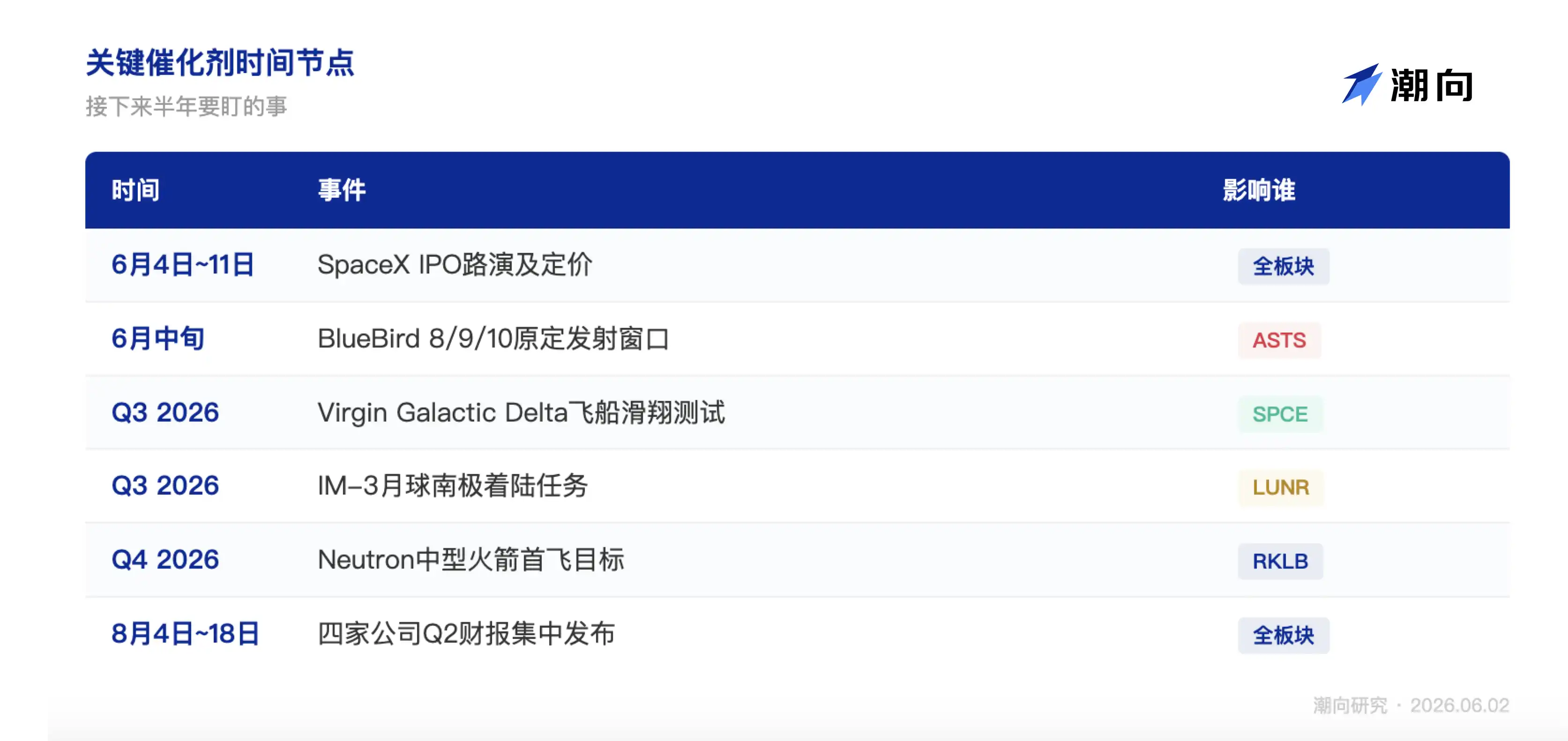
The company's biggest variable is the Neutron medium-lift launch vehicle currently under development. Neutron is positioned as a direct competitor to SpaceX's Falcon 9. If its maiden flight succeeds, RKLB would upgrade from a 'small launch service provider' to 'the only listed company besides SpaceX capable of launching medium payloads.' The target for the first flight is Q4 2026, but it has been delayed twice before (due to a first-stage tank test failure causing schedule adjustments). This also means valuations differ vastly between success and failure scenarios.
Regarding this company's Q1 financial figures, they are visible in the charts later. Here are three things the table doesn't show:

First, within its $2.2 billion backlog, there's an $816 million SDA (Space Development Agency) satellite contract, the largest single order in Rocket Lab's history, indicating the company is transitioning from a launch service provider to a 'full-stack space supplier.'

Second, Q1 saw the signing of 5 exclusive Neutron launch contracts, meaning customers booked flights before the rocket even flew, showing increasing market confidence in Neutron.

Third, CEO Peter Beck cashed out $142 million over the past six months. Although part of a 10b5-1 plan, this level of selling is not insignificant within the aerospace industry.

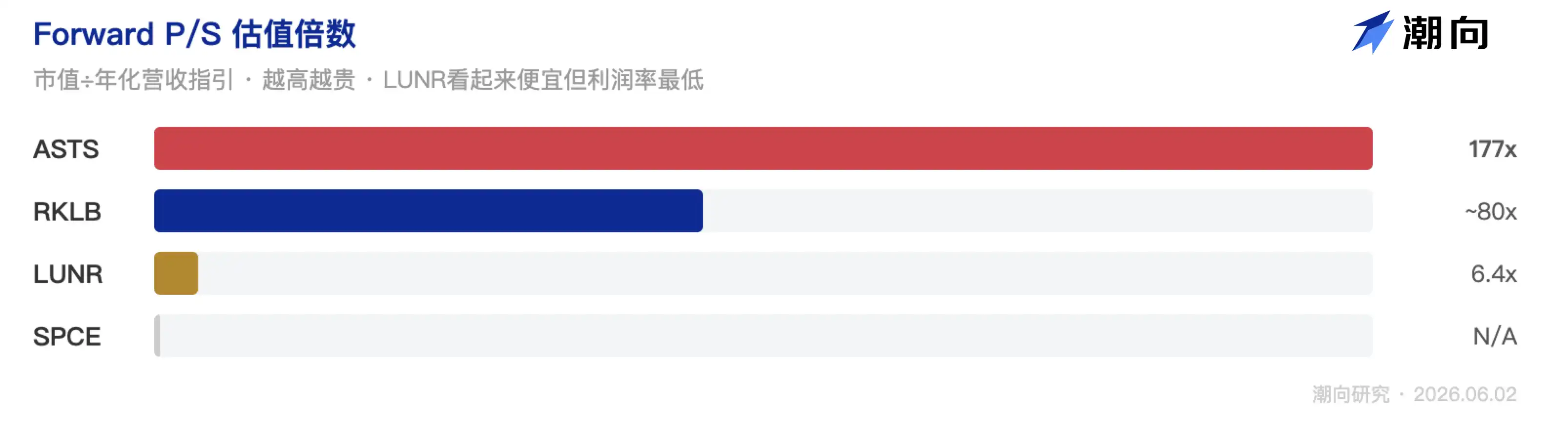
In terms of valuation, the company's Forward P/S is around 80x. This multiple embeds three assumptions: Neutron's success, continued growth in defense contracts, and further gross margin expansion. Any failure to meet these could challenge sustaining this valuation.

Overall, the current price of $122 has already priced in good news relatively fully. A return to the $96~$102 range (near the 50-day moving average) would offer a much better risk-reward ratio.

Tide Direction Judgment: Leaning bullish, but waiting for a better price is advisable. Core catalysts are Q4 Neutron maiden flight progress and the Q2 earnings report on August 6.

The Other Three: Need to Wait for More Catalysts, Beware of Squeeze Rallies

We can pull the core financial metrics of these 4 hot space stocks together for a more intuitive view:
LUNR: $187M Revenue Tripled, But Mainly from Acquisitions

Intuitive Machines delivers NASA equipment to the lunar surface and is a core contractor for NASA's CLPS (Commercial Lunar Payload Services) program. The Q1 revenue tripling looks impressive, but the $800 million acquisition of Lanteris and its consolidation was the primary contributor; organic growth is far from the stated 199%.

On the other hand, revenue missed expectations by 9%, and EPS missed by four times.

The IM-3 lunar landing mission in the second half of the year is the decisive milestone. The previous IM-1 lander tipped over, and IM-2 landed but had limited communication. If IM-3 can achieve a soft landing at the lunar South Pole, follow-on NASA contracts are likely; failure would significantly discount the whole story.

A Forward P/S of 6.4x appears the cheapest, but gross margin is only 19%, so a low P/S doesn't equal undervaluation. The analyst target price is $40.78, and the current $38.21 is already close.

Tide Direction Judgment: Neutral to slightly bearish. Wait for IM-3 results.

ASTS: The Biggest Story, But Blue Origin Grounding Directly Disrupts the Script

AST SpaceMobile is building a space-based cellular network, allowing standard phones to connect directly to satellites for internet without modification. The 4 billion people worldwide without signal are the potential market. AT&T and Verizon have signed cooperation agreements, and the FCC has issued licenses.
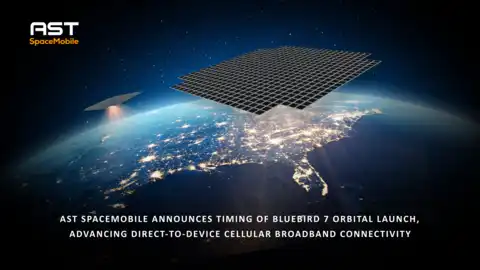
The story framework is not the problem; the issue may lie in the execution timeline. To achieve meaningful coverage, it needs to launch 45-60 BlueBird satellites into orbit before year-end, but Blue Origin's grounding directly eliminated one launch pathway.

Satellite analyst Tim Farrar warned that realistically only 3-5 Falcon 9 launches might be available this year. Deutsche Bank has already downgraded its rating to Hold. The average analyst target price is $82.24, 22% lower than the current price.

The company holds $3.5 billion in cash, so it's not short on funds in the near term. However, a Forward P/S of 177x prices in all satellites launching on time.

Tide Direction Judgment: High risk. Wait for Blue Origin's return-to-flight schedule to become clear before considering.

SPCE: The Most Discussed on Reddit, Beware of Short Squeeze

Virgin Galactic operates suborbital space tourism, with tickets costing $750,000. After pausing commercial flights in 2024 to focus on developing the Delta spacecraft, Q3 plans include glide tests and Q4 power tests. Q1 revenue was $1.5 million (not billion), with a market cap of $760 million.

The driving forces behind this surge are: Blue Origin competitor's incident + short interest of 23.2% triggering a short squeeze + retail FOMO. Trading volume reached 12 times the daily average, triggering a volatility halt intraday.

The RSI has reached 90 (this indicator fluctuates between 0 and 100; exceeding 70 is considered overbought, and 90 is an extreme state...).

Tide Direction Judgment: Avoid. No revenue support, no profitability timeline. Highest Reddit discussion volume does not equal the highest investment value.
Has It Fallen into a Golden Pit? Still Too Early to Say

Answering the article's title question: We believe it's not a golden pit yet, but if the decline continues, RKLB might be approaching a reasonable entry range.

The Blue Origin explosion is a material negative (directly impacting ASTS's launch plans). The SpaceX IPO is a short-term capital flow shock (sector attention might actually rise post-listing). High-level profit-taking itself is healthy.

The long-term logic for the sector isn't broken, but short-term pricing has indeed run ahead of fundamentals.

If we must rank these four. RKLB is the only one worth seriously tracking. With its $2.2 billion backlog, 43% gross margin, and continuous beats, its scarcity as the 'only listed full-stack space company' might actually become more pronounced after SpaceX goes public.

But the current $122 is probably still expensive; $96~$102 looks more like a reasonable range.
-----
This article is based on public information and independent analysis, for reference only, and does not constitute investment advice. Investing involves risks, caution is advised when entering the market.

Data Sources: Yahoo Finance · SEC Filing · TradingView · Reddit/ApeWisdom · Stocktwits · CNBC · TipRanks · Simply Wall St

Tide Research · TideResearch · June 2, 2026

Related Questions

QAccording to the article, what were the three main negative events that impacted the space stocks RKLB, LUNR, and ASTS in the same week?

AThe three main negative events were: 1) The explosion and subsequent FAA grounding of Blue Origin's New Glenn rocket, which is a launch supplier for ASTS. 2) The impending SpaceX IPO, which could draw capital away from these 'substitute' space stocks. 3) Insider selling, particularly by RKLB's CEO Peter Beck, which raised concerns among investors.

QHow does the business model and revenue stage of Rocket Lab (RKLB) differ from the other three space companies (SPCE, LUNR, ASTS) discussed in the article?

ARocket Lab (RKLB) is fundamentally different as it is the only one with substantial and accelerating revenue, primarily from launch services and aerospace components for government and commercial clients. The other three are in earlier, more speculative revenue stages: SPCE has negligible revenue from space tourism, LUNR's recent revenue surge is largely from an acquisition, and ASTS is pre-revenue, focused on building a satellite-to-phone network.

QWhat is the single biggest upcoming catalyst and risk factor for Rocket Lab (RKLB), as highlighted in the article?

AThe biggest upcoming catalyst and risk factor for Rocket Lab is the first launch of its medium-lift Neutron rocket, targeted for Q4 2026. Success would elevate RKLB to the only other public company capable of medium payload launches alongside SpaceX, greatly increasing its valuation potential. However, failure or further delays could jeopardize this valuation. Its current high Forward P/S ratio of around 80 heavily depends on this success.

QWhy does the article advise caution regarding Virgin Galactic (SPCE) despite its recent 22% surge in price?

AThe article advises caution regarding Virgin Galactic because its recent surge is primarily driven by a short squeeze (23.2% short interest), spillover from Blue Origin's competitor failure, and retail FOMO, not fundamental business strength. With negligible revenue ($1.5M in Q1), no clear timeline for profitability, and technical indicators like RSI reaching 90 (extreme overbought), the stock lacks a fundamental basis for the rally.

QWhat is the article's overall conclusion about the current investment attractiveness of the space sector, specifically regarding whether a 'golden buying opportunity' has emerged?

AThe article concludes it is not yet a 'golden buying opportunity' for the space sector overall. While the long-term logic remains intact, short-term prices have outpaced fundamentals due to the recent negative events. Among the four stocks, RKLB is considered the most worthy of tracking, but its current price of $122 is seen as expensive. The article suggests a more reasonable entry point for RKLB would be in the $96-$102 range. For the others, it advises waiting for more definitive catalysts.

Related Reads

Farewell to Traditional Bull and Bear Markets, Deciphering the Logic of Today's Bubble Rotation

"Farewell to Traditional Bulls and Bears: Understanding Today's Market Logic of Bubble Rotation" The article draws a parallel between modern financial markets and a meteorological chain of thunderstorms, contrasting it with the past's slower-moving, more predictable 'layered cloud' systems of long bull/bear cycles and gradual sector rotations. The author argues that today's market has undergone a permanent structural shift, creating an environment where discrete, intense thematic bubbles (e.g., AI, GLP-1 drugs, crypto, robotics, quantum tech) sequentially form, swell, and burst. These 'storm cells' are triggered when capital fleeing a dying bubble acts like a meteorological 'cold air wedge,' forcing the warm, moist capital of latent interest in a new sector to rapidly rise and condense into the next speculative frenzy. This new 'convective' market regime is driven by eight fundamental changes: 1. Democratization of speculation via zero-commission trading, gamified apps, and heavy retail participation in instruments like 0DTE options. 2. Permanent, price-insensitive buying pressure from defined-contribution retirement plans (e.g., 401(k)s). 3. Passive investing creating inelastic market participants that amplify momentum, especially into mega-cap stocks. 4. The dominance of multi-strategy funds and high-frequency trading (HFT), weakening price discovery and creating fragile microstructure prone to synchronized sell-offs. 5. Artificially suppressed volatility that eventually erupts in violent spikes. 6. A transformed market index heavily weighted toward long-duration, narrative-driven tech companies instead of stable, cyclical industrials. 7. The total elimination of information delay, accelerating fear-of-missing-out (FOMO) and herd behavior. 8. A persistently loose fiscal and monetary policy environment. These structural shifts are deemed irreversible. The article outlines the common lifecycle of these thematic bubbles: latency, catalyzing event, narrative formation, peak divergence, and rupture—with outflowing capital seeding the next bubble. In this environment, two investor archetypes can thrive: deep domain experts who understand underlying technologies and business models, and disciplined trend-followers. The author concludes that while emotionally challenging, recognizing this new "climate" is crucial. The key is to elevate one's perspective above the immediate storm to see the cyclical chain of bubbles, avoiding being swept away by the emotions of any single thematic frenzy.

Foresight News19m ago

Farewell to Traditional Bull and Bear Markets, Deciphering the Logic of Today's Bubble Rotation

Foresight News19m ago

Michael Saylor's Latest Article: Bitcoin Must Find Balance Between Uniqueness and Universal Value

Michael Saylor outlines four key Bitcoin ideologies shaping its future: * **Bitcoin Maximalists** see Bitcoin as the dominant digital monetary network and a breakthrough in economic empowerment, emphasizing its superior property rights and role as a sound money solution. * **Bitcoin Capitalists** focus on integration, believing Bitcoin must embed into the global economy—through institutions, capital markets, and financial products—to reach its full potential as digital capital. * **Bitcoin Technologists** advocate for continuous protocol improvements in scalability, privacy, and security to adapt to evolving needs and threats, while acknowledging the high bar for change. * **Bitcoin Fundamentalists** guard Bitcoin's core principles of self-custody, decentralization, and censorship resistance, warning against dilution from institutions or risky modifications. Saylor argues that a healthy Bitcoin ecosystem requires a balance of these perspectives. Bitcoin's path forward involves disciplined expansion: preserving its immutable core (Fundamentalist insight), recognizing its dominant status (Maximalist view), integrating with the global economy (Capitalist drive), and enabling careful innovation, primarily in higher layers (Technologist role). The challenge is to maintain Bitcoin's unique properties while making it useful for the world, ensuring it remains Bitcoin as it grows.

Foresight News51m ago

Michael Saylor's Latest Article: Bitcoin Must Find Balance Between Uniqueness and Universal Value

Foresight News51m ago

Why Does Crypto Always Build 'Casinos', But Rarely Creates 'Indispensable Products'?

The article explores why cryptocurrency has primarily fostered speculation rather than essential, "sticky" consumer products. It introduces the concept of "sofalarity"—the point where a platform's convenience becomes so ingrained that leaving feels unthinkable. While Big Tech creates this lock-in through ecosystem control and data harvesting, crypto lacks equivalent everyday utility. Its appeal hinges on the variable rewards of price volatility, akin to gambling, which drives engagement but not dependency. The author argues crypto's core promise—fixing opaque backend systems like correspondent banking—solves problems most people never see or feel, failing to deliver a tangible "aha moment" of improved daily life. This need for explanation hinders mass adoption. Meanwhile, platforms like Google and Meta monetize vast behavioral data, a treasure trove crypto's transparent ledgers (recording only financial transactions) cannot match for predictive insight. The piece further questions whether crypto's potential lies in consumer super-apps or, more plausibly, in becoming enterprise-grade infrastructure—modern settlement rails. It concludes with a critical look at Real-World Asset (RWA) tokenization, suggesting it may merely digitize and accelerate corporate extraction (e.g., in housing or healthcare) rather than democratize access, as the technology itself is a neutral tool. True disruption, the author implies, requires building sovereign systems outside exploitative platforms.

marsbit1h ago

Why Does Crypto Always Build 'Casinos', But Rarely Creates 'Indispensable Products'?

marsbit1h ago

Trading

Spot
Futures

Hot Articles

What is SONIC

Sonic: Pioneering the Future of Gaming in Web3 Introduction to Sonic In the ever-evolving landscape of Web3, the gaming industry stands out as one of the most dynamic and promising sectors. At the forefront of this revolution is Sonic, a project designed to amplify the gaming ecosystem on the Solana blockchain. Leveraging cutting-edge technology, Sonic aims to deliver an unparalleled gaming experience by efficiently processing millions of requests per second, ensuring that players enjoy seamless gameplay while maintaining low transaction costs. This article delves into the intricate details of Sonic, exploring its creators, funding sources, operational mechanics, and the timeline of significant events that have shaped its journey. What is Sonic? Sonic is an innovative layer-2 network that operates atop the Solana blockchain, specifically tailored to enhance the existing Solana gaming ecosystem. It accomplishes this through a customised, VM-agnostic game engine paired with a HyperGrid interpreter, facilitating sovereign game economies that roll up back to the Solana platform. The primary goals of Sonic include: Enhanced Gaming Experiences: Sonic is committed to offering lightning-fast on-chain gameplay, allowing players and developers to engage with games at previously unattainable speeds. Atomic Interoperability: This feature enables transactions to be executed within Sonic without the need to redeploy Solana programmes and accounts. This makes the process more efficient and directly benefits from Solana Layer1 services and liquidity. Seamless Deployment: Sonic allows developers to write for Ethereum Virtual Machine (EVM) based systems and execute them on Solana’s SVM infrastructure. This interoperability is crucial for attracting a broader range of dApps and decentralised applications to the platform. Support for Developers: By offering native composable gaming primitives and extensible data types - dining within the Entity-Component-System (ECS) framework - game creators can craft intricate business logic with ease. Overall, Sonic's unique approach not only caters to players but also provides an accessible and low-cost environment for developers to innovate and thrive. Creator of Sonic The information regarding the creator of Sonic is somewhat ambiguous. However, it is known that Sonic's SVM is owned by the company Mirror World. The absence of detailed information about the individuals behind Sonic reflects a common trend in several Web3 projects, where collective efforts and partnerships often overshadow individual contributions. Investors of Sonic Sonic has garnered considerable attention and support from various investors within the crypto and gaming sectors. Notably, the project raised an impressive $12 million during its Series A funding round. The round was led by BITKRAFT Ventures, with other notable investors including Galaxy, Okx Ventures, Interactive, Big Brain Holdings, and Mirana. This financial backing signifies the confidence that investment foundations have in Sonic’s potential to revolutionise the Web3 gaming landscape, further validating its innovative approaches and technologies. How Does Sonic Work? Sonic utilises the HyperGrid framework, a sophisticated parallel processing mechanism that enhances its scalability and customisability. Here are the core features that set Sonic apart: Lightning Speed at Low Costs: Sonic offers one of the fastest on-chain gaming experiences compared to other Layer-1 solutions, powered by the scalability of Solana’s virtual machine (SVM). Atomic Interoperability: Sonic enables transaction execution without redeployment of Solana programmes and accounts, effectively streamlining the interaction between users and the blockchain. EVM Compatibility: Developers can effortlessly migrate decentralised applications from EVM chains to the Solana environment using Sonic’s HyperGrid interpreter, increasing the accessibility and integration of various dApps. Ecosystem Support for Developers: By exposing native composable gaming primitives, Sonic facilitates a sandbox-like environment where developers can experiment and implement business logic, greatly enhancing the overall development experience. Monetisation Infrastructure: Sonic natively supports growth and monetisation efforts, providing frameworks for traffic generation, payments, and settlements, thereby ensuring that gaming projects are not only viable but also sustainable financially. Timeline of Sonic The evolution of Sonic has been marked by several key milestones. Below is a brief timeline highlighting critical events in the project's history: 2022: The Sonic cryptocurrency was officially launched, marking the beginning of its journey in the Web3 gaming arena. 2024: June: Sonic SVM successfully raised $12 million in a Series A funding round. This investment allowed Sonic to further develop its platform and expand its offerings. August: The launch of the Sonic Odyssey testnet provided users with the first opportunity to engage with the platform, offering interactive activities such as collecting rings—a nod to gaming nostalgia. October: SonicX, an innovative crypto game integrated with Solana, made its debut on TikTok, capturing the attention of over 120,000 users within a short span. This integration illustrated Sonic’s commitment to reaching a broader, global audience and showcased the potential of blockchain gaming. Key Points Sonic SVM is a revolutionary layer-2 network on Solana explicitly designed to enhance the GameFi landscape, demonstrating great potential for future development. HyperGrid Framework empowers Sonic by introducing horizontal scaling capabilities, ensuring that the network can handle the demands of Web3 gaming. Integration with Social Platforms: The successful launch of SonicX on TikTok displays Sonic’s strategy to leverage social media platforms to engage users, exponentially increasing the exposure and reach of its projects. Investment Confidence: The substantial funding from BITKRAFT Ventures, among others, emphasizes the robust backing Sonic has, paving the way for its ambitious future. In conclusion, Sonic encapsulates the essence of Web3 gaming innovation, striking a balance between cutting-edge technology, developer-centric tools, and community engagement. As the project continues to evolve, it is poised to redefine the gaming landscape, making it a notable entity for gamers and developers alike. As Sonic moves forward, it will undoubtedly attract greater interest and participation, solidifying its place within the broader narrative of blockchain gaming.

1.6k Total ViewsPublished 2024.04.04Updated 2024.12.03

What is SONIC

What is $S$

Understanding SPERO: A Comprehensive Overview Introduction to SPERO As the landscape of innovation continues to evolve, the emergence of web3 technologies and cryptocurrency projects plays a pivotal role in shaping the digital future. One project that has garnered attention in this dynamic field is SPERO, denoted as SPERO,$$s$. This article aims to gather and present detailed information about SPERO, to help enthusiasts and investors understand its foundations, objectives, and innovations within the web3 and crypto domains. What is SPERO,$$s$? SPERO,$$s$ is a unique project within the crypto space that seeks to leverage the principles of decentralisation and blockchain technology to create an ecosystem that promotes engagement, utility, and financial inclusion. The project is tailored to facilitate peer-to-peer interactions in new ways, providing users with innovative financial solutions and services. At its core, SPERO,$$s$ aims to empower individuals by providing tools and platforms that enhance user experience in the cryptocurrency space. This includes enabling more flexible transaction methods, fostering community-driven initiatives, and creating pathways for financial opportunities through decentralised applications (dApps). The underlying vision of SPERO,$$s$ revolves around inclusiveness, aiming to bridge gaps within traditional finance while harnessing the benefits of blockchain technology. Who is the Creator of SPERO,$$s$? The identity of the creator of SPERO,$$s$ remains somewhat obscure, as there are limited publicly available resources providing detailed background information on its founder(s). This lack of transparency can stem from the project's commitment to decentralisation—an ethos that many web3 projects share, prioritising collective contributions over individual recognition. By centring discussions around the community and its collective goals, SPERO,$$s$ embodies the essence of empowerment without singling out specific individuals. As such, understanding the ethos and mission of SPERO remains more important than identifying a singular creator. Who are the Investors of SPERO,$$s$? SPERO,$$s$ is supported by a diverse array of investors ranging from venture capitalists to angel investors dedicated to fostering innovation in the crypto sector. The focus of these investors generally aligns with SPERO's mission—prioritising projects that promise societal technological advancement, financial inclusivity, and decentralised governance. These investor foundations are typically interested in projects that not only offer innovative products but also contribute positively to the blockchain community and its ecosystems. The backing from these investors reinforces SPERO,$$s$ as a noteworthy contender in the rapidly evolving domain of crypto projects. How Does SPERO,$$s$ Work? SPERO,$$s$ employs a multi-faceted framework that distinguishes it from conventional cryptocurrency projects. Here are some of the key features that underline its uniqueness and innovation: Decentralised Governance: SPERO,$$s$ integrates decentralised governance models, empowering users to participate actively in decision-making processes regarding the project’s future. This approach fosters a sense of ownership and accountability among community members. Token Utility: SPERO,$$s$ utilises its own cryptocurrency token, designed to serve various functions within the ecosystem. These tokens enable transactions, rewards, and the facilitation of services offered on the platform, enhancing overall engagement and utility. Layered Architecture: The technical architecture of SPERO,$$s$ supports modularity and scalability, allowing for seamless integration of additional features and applications as the project evolves. This adaptability is paramount for sustaining relevance in the ever-changing crypto landscape. Community Engagement: The project emphasises community-driven initiatives, employing mechanisms that incentivise collaboration and feedback. By nurturing a strong community, SPERO,$$s$ can better address user needs and adapt to market trends. Focus on Inclusion: By offering low transaction fees and user-friendly interfaces, SPERO,$$s$ aims to attract a diverse user base, including individuals who may not previously have engaged in the crypto space. This commitment to inclusion aligns with its overarching mission of empowerment through accessibility. Timeline of SPERO,$$s$ Understanding a project's history provides crucial insights into its development trajectory and milestones. Below is a suggested timeline mapping significant events in the evolution of SPERO,$$s$: Conceptualisation and Ideation Phase: The initial ideas forming the basis of SPERO,$$s$ were conceived, aligning closely with the principles of decentralisation and community focus within the blockchain industry. Launch of Project Whitepaper: Following the conceptual phase, a comprehensive whitepaper detailing the vision, goals, and technological infrastructure of SPERO,$$s$ was released to garner community interest and feedback. Community Building and Early Engagements: Active outreach efforts were made to build a community of early adopters and potential investors, facilitating discussions around the project’s goals and garnering support. Token Generation Event: SPERO,$$s$ conducted a token generation event (TGE) to distribute its native tokens to early supporters and establish initial liquidity within the ecosystem. Launch of Initial dApp: The first decentralised application (dApp) associated with SPERO,$$s$ went live, allowing users to engage with the platform's core functionalities. Ongoing Development and Partnerships: Continuous updates and enhancements to the project's offerings, including strategic partnerships with other players in the blockchain space, have shaped SPERO,$$s$ into a competitive and evolving player in the crypto market. Conclusion SPERO,$$s$ stands as a testament to the potential of web3 and cryptocurrency to revolutionise financial systems and empower individuals. With a commitment to decentralised governance, community engagement, and innovatively designed functionalities, it paves the way toward a more inclusive financial landscape. As with any investment in the rapidly evolving crypto space, potential investors and users are encouraged to research thoroughly and engage thoughtfully with the ongoing developments within SPERO,$$s$. The project showcases the innovative spirit of the crypto industry, inviting further exploration into its myriad possibilities. While the journey of SPERO,$$s$ is still unfolding, its foundational principles may indeed influence the future of how we interact with technology, finance, and each other in interconnected digital ecosystems.

54 Total ViewsPublished 2024.12.17Updated 2024.12.17

What is $S$

What is AGENT S

Agent S: The Future of Autonomous Interaction in Web3 Introduction In the ever-evolving landscape of Web3 and cryptocurrency, innovations are constantly redefining how individuals interact with digital platforms. One such pioneering project, Agent S, promises to revolutionise human-computer interaction through its open agentic framework. By paving the way for autonomous interactions, Agent S aims to simplify complex tasks, offering transformative applications in artificial intelligence (AI). This detailed exploration will delve into the project's intricacies, its unique features, and the implications for the cryptocurrency domain. What is Agent S? Agent S stands as a groundbreaking open agentic framework, specifically designed to tackle three fundamental challenges in the automation of computer tasks: Acquiring Domain-Specific Knowledge: The framework intelligently learns from various external knowledge sources and internal experiences. This dual approach empowers it to build a rich repository of domain-specific knowledge, enhancing its performance in task execution. Planning Over Long Task Horizons: Agent S employs experience-augmented hierarchical planning, a strategic approach that facilitates efficient breakdown and execution of intricate tasks. This feature significantly enhances its ability to manage multiple subtasks efficiently and effectively. Handling Dynamic, Non-Uniform Interfaces: The project introduces the Agent-Computer Interface (ACI), an innovative solution that enhances the interaction between agents and users. Utilizing Multimodal Large Language Models (MLLMs), Agent S can navigate and manipulate diverse graphical user interfaces seamlessly. Through these pioneering features, Agent S provides a robust framework that addresses the complexities involved in automating human interaction with machines, setting the stage for myriad applications in AI and beyond. Who is the Creator of Agent S? While the concept of Agent S is fundamentally innovative, specific information about its creator remains elusive. The creator is currently unknown, which highlights either the nascent stage of the project or the strategic choice to keep founding members under wraps. Regardless of anonymity, the focus remains on the framework's capabilities and potential. Who are the Investors of Agent S? As Agent S is relatively new in the cryptographic ecosystem, detailed information regarding its investors and financial backers is not explicitly documented. The lack of publicly available insights into the investment foundations or organisations supporting the project raises questions about its funding structure and development roadmap. Understanding the backing is crucial for gauging the project's sustainability and potential market impact. How Does Agent S Work? At the core of Agent S lies cutting-edge technology that enables it to function effectively in diverse settings. Its operational model is built around several key features: Human-like Computer Interaction: The framework offers advanced AI planning, striving to make interactions with computers more intuitive. By mimicking human behaviour in tasks execution, it promises to elevate user experiences. Narrative Memory: Employed to leverage high-level experiences, Agent S utilises narrative memory to keep track of task histories, thereby enhancing its decision-making processes. Episodic Memory: This feature provides users with step-by-step guidance, allowing the framework to offer contextual support as tasks unfold. Support for OpenACI: With the ability to run locally, Agent S allows users to maintain control over their interactions and workflows, aligning with the decentralised ethos of Web3. Easy Integration with External APIs: Its versatility and compatibility with various AI platforms ensure that Agent S can fit seamlessly into existing technological ecosystems, making it an appealing choice for developers and organisations. These functionalities collectively contribute to Agent S's unique position within the crypto space, as it automates complex, multi-step tasks with minimal human intervention. As the project evolves, its potential applications in Web3 could redefine how digital interactions unfold. Timeline of Agent S The development and milestones of Agent S can be encapsulated in a timeline that highlights its significant events: September 27, 2024: The concept of Agent S was launched in a comprehensive research paper titled “An Open Agentic Framework that Uses Computers Like a Human,” showcasing the groundwork for the project. October 10, 2024: The research paper was made publicly available on arXiv, offering an in-depth exploration of the framework and its performance evaluation based on the OSWorld benchmark. October 12, 2024: A video presentation was released, providing a visual insight into the capabilities and features of Agent S, further engaging potential users and investors. These markers in the timeline not only illustrate the progress of Agent S but also indicate its commitment to transparency and community engagement. Key Points About Agent S As the Agent S framework continues to evolve, several key attributes stand out, underscoring its innovative nature and potential: Innovative Framework: Designed to provide an intuitive use of computers akin to human interaction, Agent S brings a novel approach to task automation. Autonomous Interaction: The ability to interact autonomously with computers through GUI signifies a leap towards more intelligent and efficient computing solutions. Complex Task Automation: With its robust methodology, it can automate complex, multi-step tasks, making processes faster and less error-prone. Continuous Improvement: The learning mechanisms enable Agent S to improve from past experiences, continually enhancing its performance and efficacy. Versatility: Its adaptability across different operating environments like OSWorld and WindowsAgentArena ensures that it can serve a broad range of applications. As Agent S positions itself in the Web3 and crypto landscape, its potential to enhance interaction capabilities and automate processes signifies a significant advancement in AI technologies. Through its innovative framework, Agent S exemplifies the future of digital interactions, promising a more seamless and efficient experience for users across various industries. Conclusion Agent S represents a bold leap forward in the marriage of AI and Web3, with the capacity to redefine how we interact with technology. While still in its early stages, the possibilities for its application are vast and compelling. Through its comprehensive framework addressing critical challenges, Agent S aims to bring autonomous interactions to the forefront of the digital experience. As we move deeper into the realms of cryptocurrency and decentralisation, projects like Agent S will undoubtedly play a crucial role in shaping the future of technology and human-computer collaboration.

717 Total ViewsPublished 2025.01.14Updated 2025.01.14

What is AGENT S

Discussions

Welcome to the HTX Community. Here, you can stay informed about the latest platform developments and gain access to professional market insights. Users' opinions on the price of S (S) are presented below.

活动图片













