Rare Sight: Gold's 30-Day Volatility Surges to 44%, Exceeding Bitcoin and Hitting Highest Level Since 2008

华尔街日报Published on 2026-02-02Last updated on 2026-02-02

Abstract

The gold market is experiencing its most extreme price volatility since the 2008 financial crisis, with its 30-day volatility surging to over 44%, surpassing even that of Bitcoin, which stands at around 39%. This marks a significant role reversal, as gold is typically viewed as a more stable safe-haven asset compared to the notoriously volatile cryptocurrency. The surge in gold's volatility follows a record-breaking rally driven by economic uncertainty, geopolitical risks, and strong investor inflows, including significant retail participation. However, the rapid ascent was followed by a sharp correction, with spot gold plunging nearly $1,000 in just two trading sessions. Meanwhile, Bitcoin has not benefited from the same factors driving gold's rally. Instead, it fell to a 10-month low, down more than 40% from its October peak. Despite the turbulence in traditional markets, Bitcoin has not seen a rotation of funds from gold, making gold the more volatile asset in the short term. Nevertheless, gold has significantly outperformed Bitcoin over the past 12 months, rising about 66% compared to Bitcoin’s 21% decline.

The gold market is experiencing its most intense price volatility since the 2008 financial crisis, with its volatility rate now surpassing that of Bitcoin—known for its wild swings—highlighting how this traditional safe-haven asset has entered a period of intense fluctuation after a rapid rally.

According to data compiled by Bloomberg, the 30-day volatility of gold has climbed to over 44%, the highest level since the 2008 financial crisis. This figure exceeds Bitcoin's volatility of around 39%, which is often referred to as "digital gold."

This marks an unusual role reversal. Gold is typically seen as a more stable store of value than cryptocurrencies, which are known for being susceptible to speculation. Since Bitcoin's inception 17 years ago, gold's volatility has exceeded Bitcoin's on only two occasions, the most recent being in May of last year when former U.S. President Donald Trump's tariff threats escalated trade tensions.

Safe-Haven Demand Drives Gold to Record Highs

Economic uncertainty has pushed precious metal prices to record highs that have stunned even seasoned market participants. Earlier this year, an already hot rally accelerated sharply, as investors flocked in due to renewed concerns over geopolitical risks, currency devaluation, and the Federal Reserve's independence. A wave of retail buying further inflated the market bubble.

Some traders say the previous rally had gone too far, too fast, followed by a dramatic reversal. In just two trading sessions, spot gold plummeted by as much as $1,000, briefly approaching the $4,400 mark.
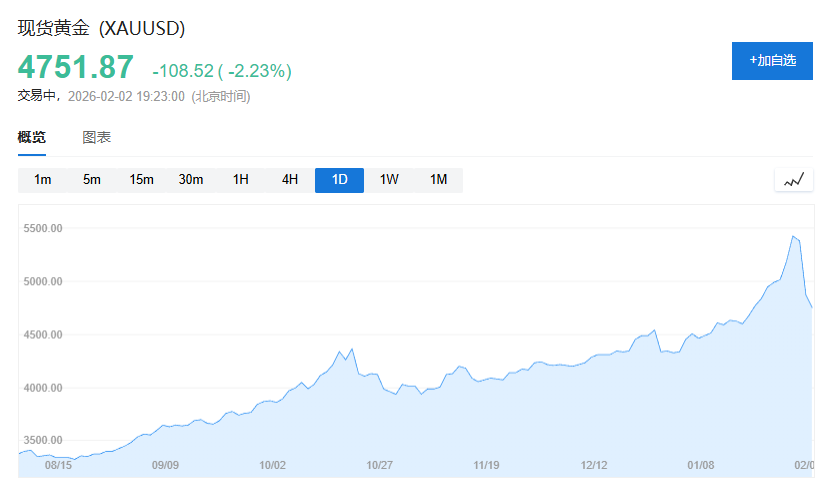
Bitcoin has failed to benefit from the same forces driving gold higher. The token fell to a 10-month low on Monday, extending its weekend sell-off, with a cumulative decline of over 40% since its October peak. Despite facing geopolitical pressures, a weaker U.S. dollar, and extreme volatility in the metals market, Bitcoin has not seen a rotation of funds from precious metals, making gold the more volatile investment for now.

Nevertheless, gold maintains its status as the superior safe-haven asset. Over the past 12 months, gold has risen by about 66%, while Bitcoin has fallen by 21%.


Related Questions

QWhat is the 30-day volatility of gold and why is it significant?

AThe 30-day volatility of gold has climbed to over 44%, marking its highest level since the 2008 financial crisis. This is significant because it has surpassed the volatility of Bitcoin (around 39%), which is unusual as gold is considered a more stable store of value compared to the typically speculative cryptocurrency.

QHow does the current volatility of gold compare to Bitcoin's historical volatility?

AGold's current 30-day volatility of over 44% is higher than Bitcoin's volatility of about 39%. This represents a rare role reversal, as gold's volatility has only exceeded Bitcoin's twice since Bitcoin's inception 17 years ago, with the last occurrence being in May of last year due to trade tensions.

QWhat factors have driven gold prices to record highs recently?

AGold prices have been driven to record highs by economic uncertainty, including concerns over geopolitical risks, currency devaluation, and the Federal Reserve's independence. A surge in investor inflows, particularly from retail buyers, further accelerated the rally and created a market bubble.

QHow has Bitcoin performed compared to gold amid recent market volatility?

ABitcoin has underperformed compared to gold, falling to a 10-month low and declining over 40% from its October peak. Despite similar market pressures, it did not benefit from the same safe-haven demand that boosted gold, and no significant capital rotation from precious metals into Bitcoin occurred.

QWhat has been the 12-month performance difference between gold and Bitcoin?

AOver the past 12 months, gold has risen approximately 66%, while Bitcoin has fallen 21%, reinforcing gold's status as the superior safe-haven asset despite its recent increase in volatility.

Related Reads

Public Version of Mythos Officially Launched: Analyzing the Advantages and Limitations of AI Smart Contract Auditing

Publicly available Mythos, Anthropic's AI model, has officially launched, demonstrating both significant potential and limitations in smart contract security auditing. The article analyzes its capabilities through real-world cases. AI excels in identifying subtle, low-level vulnerabilities through pattern recognition and large-scale code screening. A key example is detecting a storage slot collision between a custom rewards mapping and a third-party library's ReentrancyGuard, a vulnerability easily missed in manual audits. In the recent Zcash incident, AI also rapidly discovered a critical soundness bug that had remained hidden for years. However, AI currently struggles with complex, interconnected scenarios. When tested on the Curve LlamaLend sDOLA exploit, which involved manipulating prices across multiple protocols (Curve pools, lending markets) to trigger liquidations, Fable 5 failed to identify the core cross-protocol attack vector. These scenarios require a deep understanding of DeFi economic models and multi-contract interactions. In conclusion, while AI tools like Mythos significantly boost efficiency in finding standardized, syntactic vulnerabilities, they cannot yet replace expert analysis for complex, business-logic, and cross-protocol attacks. An effective audit workflow combines AI's speed for initial screening with human expertise for in-depth, holistic analysis.

marsbit2m ago

Public Version of Mythos Officially Launched: Analyzing the Advantages and Limitations of AI Smart Contract Auditing

marsbit2m ago

Trade.xyz's Rebase Refusal Sparks Controversy, On-Chain Pre-IPO Market Faces Major Pricing Test

The debate surrounding Trade.xyz's refusal to adjust its SPCX (SpaceX pre-IPO) perpetual contract pricing amid updated share count revelations highlights a key challenge for on-chain pre-IPO markets. While several centralized exchanges (CEXs) paused and repriced their contracts after SpaceX's filing showed a ~10% increase in total shares, Trade.xyz maintained its market-driven pricing logic, which tracks expected per-share price sentiment rather than fundamental valuation metrics like market cap. This discrepancy triggered cross-platform arbitrage and caused leveraged long positions on Trade.xyz to suffer significant losses, as the platform's HIP-3 architecture lacks a native "Rebase" mechanism to neutrally adjust all user positions following such corporate actions. The incident underscores the difficulty for decentralized perpetual exchanges (Perp DEXs) to implement Rebase—a process CEXs handle by centrally pausing markets and adjusting ledger data. On-chain, this requires complex smart contract modifications, increasing gas costs, complexity, and potential attack surfaces. While some DEXs have managed similar adjustments, Trade.xyz's current design does not natively support it, though the team is reportedly exploring solutions for future events like stock splits. Ultimately, the controversy serves as a critical case study for the nascent on-chain pre-IPO sector, raising questions about price discovery reliability, transparent rule disclosure, and the readiness of DeFi infrastructures to handle traditional corporate actions as real-world assets (RWAs) gain traction.

marsbit10m ago

Trade.xyz's Rebase Refusal Sparks Controversy, On-Chain Pre-IPO Market Faces Major Pricing Test

marsbit10m ago

The 'Middle Eastern Prince' Swindles a Wealthy Woman: Renting Planes and Rolls-Royces, Scamming 120 Million Over Three Years

Two brothers who posed as "Middle Eastern princes" have been sentenced in the United States to 24 and 23 years in prison, respectively, and ordered to pay over $21.2 million in restitution and back taxes. Over three years, they fraudulently obtained approximately $21 million, primarily by promoting fictitious investment projects, including a non-existent cryptocurrency mining operation in a former General Electric industrial park in East Cleveland. The brothers, aged 42 and 33, created elaborate personas: one claimed to be a wealthy royal family heir and the city's "International Economic Advisor," while the other posed as a hedge fund manager with expertise from watching the TV show *Billions*. They bolstered their image by renting luxury cars and private jets and cultivating a relationship with a local mayor's chief of staff, who provided official-looking documents and government event access. A significant portion of the victims' funds, about $18 million, came from a single Chinese investor, a woman from Sichuan with experience in Bitcoin mining. The brothers also defrauded several women, including one former girlfriend. Their scheme unraveled when the primary investor discovered her $6 million worth of mining equipment had been sold off. The case highlights a trend of impostors using fabricated "Middle Eastern royal" identities to target wealthy individuals. Similar incidents include a "Dubai prince" who recently promoted a $500 million family office in Hong Kong and a Colombian man who impersonated a Saudi prince for decades in the US before being caught and sentenced in 2019.

marsbit24m ago

The 'Middle Eastern Prince' Swindles a Wealthy Woman: Renting Planes and Rolls-Royces, Scamming 120 Million Over Three Years

marsbit24m ago

a16z Partner: Being in the Flow of Capital Is the True Moat

A16z Partner: Standing in the Cash Flow is the True Moat Historically, many of the strongest companies built their moats by positioning themselves within "cash flows"—facilitating value creation and transfer in a network and taking a cut. The more value flows, the larger they grow. Crypto is the first modern technology natively built for this. With open ledgers, programmable settlement, and stablecoins enabling internet-speed global value transfer, it allows startups to inherit network effects from day one. Well-designed tokens align users, developers, and the protocol towards network growth, distributing value to contributors. This model isn't new (e.g., railroads, Visa, Google, AWS) but Crypto democratizes it. It lets entrepreneurs target areas with high inefficiency and profit extraction—like traditional finance's payments, custody, FX, and settlement—to compress costs, increase speed, and redistribute value by standing in the new flow. The opportunity extends beyond finance to emerging markets like GPU/compute, AI training data, energy, and space, where new, programmable infrastructure can be built without legacy constraints. Key questions for founders: Are you already in the cash flow? Does your revenue scale 10x with network activity? Where is profit extraction highest relative to value created in your market? The strategy is clear: compress the old cost structure, position yourself in the new value stream, and let the network compound.

marsbit52m ago

a16z Partner: Being in the Flow of Capital Is the True Moat

marsbit52m ago

Trading

Spot
Futures

Hot Articles

What is $BITCOIN

DIGITAL GOLD ($BITCOIN): A Comprehensive Analysis Introduction to DIGITAL GOLD ($BITCOIN) DIGITAL GOLD ($BITCOIN) is a blockchain-based project operating on the Solana network, which aims to combine the characteristics of traditional precious metals with the innovation of decentralized technologies. While it shares a name with Bitcoin, often referred to as “digital gold” due to its perception as a store of value, DIGITAL GOLD is a separate token designed to create a unique ecosystem within the Web3 landscape. Its goal is to position itself as a viable alternative digital asset, although specifics regarding its applications and functionalities are still developing. What is DIGITAL GOLD ($BITCOIN)? DIGITAL GOLD ($BITCOIN) is a cryptocurrency token explicitly designed for use on the Solana blockchain. In contrast to Bitcoin, which provides a widely recognized value storage role, this token appears to focus on broader applications and characteristics. Notable aspects include: Blockchain Infrastructure: The token is built on the Solana blockchain, known for its capacity to handle high-speed and low-cost transactions. Supply Dynamics: DIGITAL GOLD has a maximum supply capped at 100 quadrillion tokens (100P $BITCOIN), although details regarding its circulating supply are currently undisclosed. Utility: While precise functionalities are not explicitly outlined, there are indications that the token could be utilized for various applications, potentially involving decentralized applications (dApps) or asset tokenization strategies. Who is the Creator of DIGITAL GOLD ($BITCOIN)? At present, the identity of the creators and development team behind DIGITAL GOLD ($BITCOIN) remains unknown. This situation is typical among many innovative projects within the blockchain space, particularly those aligning with decentralized finance and meme coin phenomena. While such anonymity may foster a community-driven culture, it intensifies concerns about governance and accountability. Who are the Investors of DIGITAL GOLD ($BITCOIN)? The available information indicates that DIGITAL GOLD ($BITCOIN) does not have any known institutional backers or prominent venture capital investments. The project seems to operate on a peer-to-peer model focused on community support and adoption rather than traditional funding routes. Its activity and liquidity are primarily situated on decentralized exchanges (DEXs), such as PumpSwap, rather than established centralized trading platforms, further highlighting its grassroots approach. How DIGITAL GOLD ($BITCOIN) Works The operational mechanics of DIGITAL GOLD ($BITCOIN) can be elaborated on based on its blockchain design and network attributes: Consensus Mechanism: By leveraging Solana’s unique proof-of-history (PoH) combined with a proof-of-stake (PoS) model, the project ensures efficient transaction validation contributing to the network's high performance. Tokenomics: While specific deflationary mechanisms have not been extensively detailed, the vast maximum token supply implies that it may cater to microtransactions or niche use cases that are still to be defined. Interoperability: There exists the potential for integration with Solana’s broader ecosystem, including various decentralized finance (DeFi) platforms. However, the details regarding specific integrations remain unspecified. Timeline of Key Events Here is a timeline that highlights significant milestones concerning DIGITAL GOLD ($BITCOIN): 2023: The initial deployment of the token occurs on the Solana blockchain, marked by its contract address. 2024: DIGITAL GOLD gains visibility as it becomes available for trading on decentralized exchanges like PumpSwap, allowing users to trade it against SOL. 2025: The project witnesses sporadic trading activity and potential interest in community-led engagements, although no noteworthy partnerships or technical advancements have been documented as of yet. Critical Analysis Strengths Scalability: The underlying Solana infrastructure supports high transaction volumes, which could enhance the utility of $BITCOIN in various transaction scenarios. Accessibility: The potential low trading price per token could attract retail investors, facilitating wider participation due to fractional ownership opportunities. Risks Lack of Transparency: The absence of publicly known backers, developers, or an audit process may yield skepticism regarding the project's sustainability and trustworthiness. Market Volatility: The trading activity is heavily reliant on speculative behavior, which can result in significant price volatility and uncertainty for investors. Conclusion DIGITAL GOLD ($BITCOIN) emerges as an intriguing yet ambiguous project within the rapidly evolving Solana ecosystem. While it attempts to leverage the “digital gold” narrative, its departure from Bitcoin's established role as a store of value underscores the need for a clearer differentiation of its intended utility and governance structure. Future acceptance and adoption will likely depend on addressing the current opacity and defining its operational and economic strategies more explicitly. Note: This report encompasses synthesised information available as of October 2023, and developments may have transpired beyond the research period.

363 Total ViewsPublished 2025.05.13Updated 2025.05.13

What is $BITCOIN

Discussions

Welcome to the HTX Community. Here, you can stay informed about the latest platform developments and gain access to professional market insights. Users' opinions on the price of BTC (BTC) are presented below.

活动图片














