Public Chain Moat Only 3/10? Alliance DAO Founder's Remarks Ignite Crypto Community Debate

marsbitPublished on 2025-12-13Last updated on 2025-12-13

Abstract

Alliance DAO founder qw (@QwQiao) sparked intense debate in the crypto community by claiming that Layer 1 blockchains have "limited moats," rating them only 3/10 in terms of sustainable competitive advantage. This triggered strong reactions from key industry figures. Dragonfly Capital partner Haseeb strongly disagreed, arguing that Ethereum’s decade-long dominance despite well-funded challengers proves its strong moat. Others, like Multicoin’s Kyle Samani and researchers from Ethereum and Circle, questioned whether liquidity alone constitutes a real moat, with some calling it fleeting and unreliable. In response, qw elaborated on his moat rating framework, giving traditional giants like Microsoft, Apple, and Visa perfect scores (10/10) based on revenue models and infrastructure, while rating top crypto projects around 5/10. He notably rated Bitcoin at 9/10, citing its unique founding story and Lindy effect, but deducted a point due to uncertainties around security and quantum threats. The debate expanded into what truly constitutes a moat in crypto. Critics argued qw’s framework overemphasizes current revenue and undervalues network effects, trust, and technological ethos. Defenders of blockchain moats pointed to elements like developer ecosystems, brand strength, switching costs, and application diversity as core defensive attributes. The article concludes that the crypto industry is still young and small compared to traditional finance and tech giants. Rather than fixat...

Recently, Alliance DAO founder qw(@QwQiao) proposed a startling viewpoint: "Blockchain moats are limited," and rated the moat of L1 public chains at only 3/10.

This statement quickly ignited the overseas crypto community, sparking heated discussions among crypto VCs, public chain builders, and KOLs. Dragonfly partner Haseeb angrily retorted that rating the "blockchain moat at 3/10" was utterly absurd; even Aave founder Santi, who dislikes the industry's gambling tendencies, never believed blockchain has "no moat."

Debates about the meaning, value, and business models of blockchain & cryptocurrency always resurface cyclically. The crypto industry constantly oscillates between idealism and reality: people nostalgically recall the original decentralized ideals while craving the status and recognition of the traditional financial industry, all while being mired in self-doubt about whether it's "just a repackaged casino." The root of all these contradictions might lie in scale—the total market capitalization of the crypto industry has hovered around $3-4 trillion, still dwarfed by traditional financial giants with valuations in the hundreds of billions or even trillions of dollars.

As practitioners in the industry, everyone harbors a contradictory psychology of both arrogance and inferiority—arrogant about blockchain's inception upholding Satoshi Nakamoto's ideal of de-monetization and decentralized ethos, and that the crypto industry has indeed become an emerging financial sector, gradually gaining attention, acceptance, and participation from mainstream forces; the inferiority, however, stems from feeling like a poor kid who thinks what they're doing isn't quite honorable, filled with blood, tears, and pain from a zero-sum game of man eating man. In short, the limitations of the industry's scale have bred this cyclical identity anxiety, self-doubt, and self-negation.

Today, we'll use the topic of "moat business ratings" raised by qw to discuss the existing chronic issues and core advantages of the crypto industry.

Origin of the Debate: Is Liquidity the Crypto Industry's Moat?

This major industry discussion about "whether the crypto industry has a moat" originally stemmed from a statement by Paradigm team researcher frankie: "The greatest trick the devil ever pulled was convincing crypto people that liquidity is a moat." (Odaily Planet Daily note: The original quote is: the greatest trick the devil ever pulled was convincing crypto people that liquidity is a moat.)

It's clear that as a "purebred" VC, frankie somewhat scoffs at the industry's current high regard for "liquidity is everything." After all, for investors and research experts who hold advantages in capital and information, they often want their managed funds to be spent on projects and businesses with real operational support, capable of generating genuine cash flow and continuously providing financial returns.

This view also garnered agreement from many in the comments:

  • Multicoin partner Kyle Samani directly stated "+1";
  • Ethereum Foundation member binji believed that "trust is the real moat; even if trust might flow due to opportunities in the short term, liquidity will always reside where trust is placed."
  • Chris Reis from Circle's Arc blockchain team pointed out: "TVL always seems to be the wrong North Star metric (business guiding goal)."
  • Aura Foundation's Justin Alick remarked somewhat jokingly: "Liquidity is like a fickle woman; she might leave you at any time."
  • DeFi researcher Defi peniel stated bluntly: "Relying solely on liquidity is not a moat; hype can disappear overnight."

Of course, many also refuted this—

  • DFDV COO & CIO Parker commented: "What are you talking about? USDT is the worst stablecoin but holds absolute dominance. Bitcoin is the (performance-wise) worst blockchain but absolutely dominates."
  • Former Sequoia investor, now Folius Ventures investor KD, posed a rhetorical question: "Isn't it?"
  • Fabric VC investor Thomas Crow pointed out: "In exchanges, liquidity is a moat—the deeper the liquidity, the better the user experience; this is the most important characteristic in this vertical industry, without exception. This is why the main innovation in crypto asset trading focuses on solving insufficient liquidity (which leads to worse user experience). Examples include Uniswap, which uses LPs to obtain long-tail asset liquidity, and Pump.Fun, which attracts pre-token launch liquidity through standardized contracts and bonding curves."
  • Pantera investor Mason Nystrom retweeted and commented: "Liquidity is absolutely a moat." He then provided various examples: In public chains, Ethereum's leadership today is due to DeFi liquidity (and developers); CEXs like Binance, Coinbase; lending platforms like Aave, MakerDAO; stablecoins like USDT; DEXs like Uniswap, Pancakeswap.

Then came Alliance DAO founder qw's "moat rating" tweet:
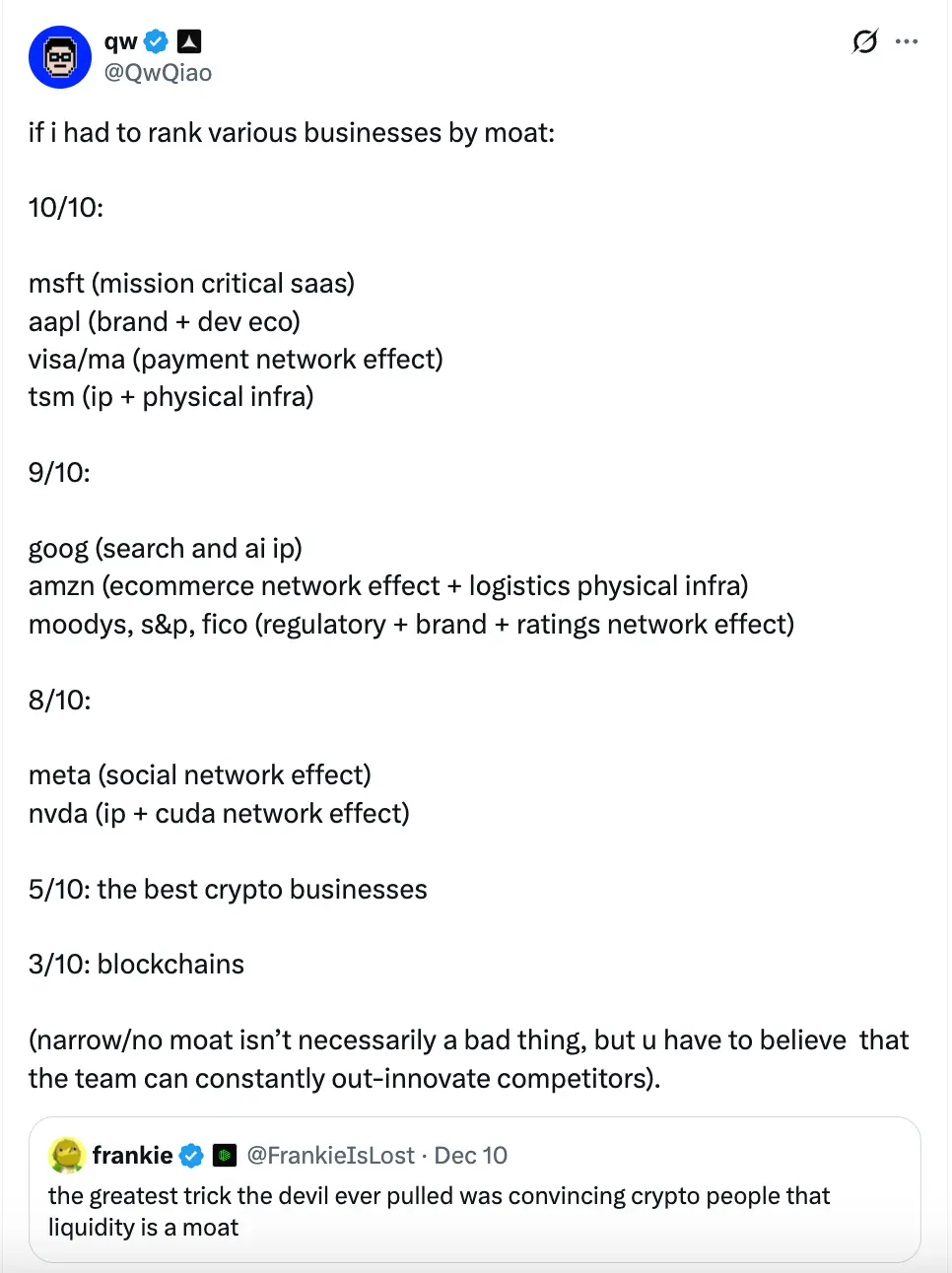
In his view, the moat of the blockchain (public chain) itself is very limited, rated only 3/10.

  • He believes Microsoft (key SaaS), Apple (brand + developer ecosystem), Visa/Mastercard (payment network effects), TSMC (IP + physical infrastructure) can score 10/10 (strongest moat);
  • Google (search and AI IP), Amazon (e-commerce network effects + logistics infrastructure), rating agencies like Moody's, S&P, FICO (regulation-driven + brand + rating network effects), large-scale cloud computing (AWS/Azure/GCP, etc.) score 9/10;
  • Meta (social network effects), NVIDIA (IP + CUDA network effects) score 8/10;
  • The best crypto businesses in the crypto industry score 5/10;
  • Public chains (blockchains) score only 3/10 (narrow moat).

qw further stated that a low moat rating isn't necessarily bad, but it means teams must continuously lead in innovation, otherwise they will be quickly replaced. Later, perhaps feeling the initial rating was too hasty, he added some supplementary ratings in the comments:

  • The 3 major cloud service infrastructure providers score 9/10;
  • BTC's moat scores 9/10 (Odaily Planet Daily note: qw pointed out that no one can replicate BTC's founding story and the "Lindy Effect," but deducted 1 point because it's unclear if it can handle security budgets and quantum threats);
  • Tesla 7/10 (Odaily Planet Daily note: qw believes automated IP like self-driving is insane, but the car industry is commoditized, and humanoid robots might be similar)
  • Lithography machine manufacturer ASML 10/10.
  • AAVE's moat rating might be higher than 5/10, with qw's reasoning: "As a user, you must trust that their smart contract security testing is thorough enough not to lose your funds."

Of course, seeing qw so grandly play the "sharp critic," besides the debate over the "moat system," some in the comments made unrelated sarcastic remarks, even mentioning: "What about those terrible launch platforms you invested in?" (Odaily Planet Daily note: After investing in pump.fun, Alliance DAO's subsequent investments in one-click token launch platforms (like Believe) performed poorly, and even he himself didn't want to rate them)

With such a火药味十足 (fireworks-filled) focal topic, Dragonfly partner Haseeb's subsequent angry retort followed.

Dragonfly Partner's Inner OS: Nonsense, I've Never Seen Someone So Shameless

In response to qw's "moat rating system," Dragonfly partner Haseeb posted angrily: "What? 'Blockchain moat: 3/10'? That's a bit absurd. Even Santi doesn't think public chains have 'no moat.'

Ethereum has dominated for 10 consecutive years. Hundreds of challengers have raised over $10 billion trying to capture market share. After a decade of competitors trying to defeat it, Ethereum has successfully defended its throne every time. If that doesn't indicate Ethereum has a moat, I don't know what a moat is!"

In the comments of this tweet, qw gave his perspective: "You're talking about the past ('the past ten years') and are factually wrong (Ethereum no longer holds the throne on multiple metrics)."

Subsequently, the two exchanged several rounds on "what exactly is a moat?" and "does Ethereum really have a moat?" qw even brought up a post he made in November, pointing out that the "moat" in his mind is actually revenue/profit. But Haseeb immediately countered with examples—once-popular crypto projects like OpenSea, Axie, BitMEX had high revenues but actually had no moat; the real moat should focus on—"can it be replaced by competitors."

Abra Global asset management head Marissa also joined the discussion: "Agree (with Haseeb). qw's statement is a bit strange—switching costs and network effects can be strong moats—Solana and Ethereum both have these, and I believe they will become stronger than other public chains over time. They both have strong brands and developer ecosystems, which are clearly part of the moat. Perhaps he was referring to other public chains that lack these advantages."

Haseeb continued, full of sarcasm: "qw is just splitting hairs and asking for trouble."

Based on the above discussion, perhaps we should break down the "real moat" of public chains in the cryptocurrency industry and what aspects it comprises.

The 7 Components of a Public Chain Moat: From People to Business, From Origin to Network

In my opinion, the main reasons why qw's "moat rating system" seems somewhat unable to hold water are:

First, its rating standard only looks at current industry status and revenue while ignoring multi-dimensional evaluation. Whether it's infrastructure like Microsoft, Apple, Amazon Cloud, or payment giants like Visa and Mastercard, the main reason qw gives high scores is their strong revenue models. This obviously oversimplifies and superficializes the business moat of a giant company. Moreover, Apple's global market share isn't dominant, and payment giants like Visa face challenges like market shrinkage and regional business decline.

Second, it ignores the complexity and uniqueness of public chains and crypto projects compared to traditional internet businesses. As challengers to the fiat system, cryptocurrency, blockchain technology, and subsequent public chains and crypto projects are grounded in the inherent "anonymity" and "nodality" of decentralized networks, which revenue-driven traditional businesses often cannot achieve.

Based on this, I believe the moat of public chain businesses mainly lies in the following 7 aspects:

1. Technical Philosophy. This is also the biggest advantage and differentiating feature of the Bitcoin network, Ethereum network, Solana network, and countless public chain projects. As long as humans remain wary of centralized systems, authoritarian governments, and the fiat system, and accept the concepts of sovereign individuals and related viewpoints, the real demand for decentralized networks will persist.

2. Founder Charisma. Satoshi Nakamoto disappeared after inventing Bitcoin and ensuring the network ran smoothly, sitting on tens of billions of dollars in assets but unmoved; from a World of Warcraft enthusiast mistreated by the game company to Ethereum co-founder, Vitalik resolutely embarked on his decentralized spiritual journey; Solana founder Toly and others were originally elite engineers at US big tech companies but were unwilling to stop there, thus starting their own "capital internet" construction journey. Not to mention the various public chains built inheriting the ambition of Meta's Libra network with the Move language. The personal charm and appeal of founders are particularly important in the crypto industry. This is why countless crypto projects receive VC favor, community追捧 (praise), and capital influx due to their founders, but also fade into obscurity due to founders stepping down or accidents. A good founder is the true soul of a public chain and even a crypto project.

3. Developer and User Network. On this point, as emphasized by the Metcalfe effect and the Lindy effect, the stronger the network effect of something and the longer it exists, the more likely it is to persist. The developer and user network is the cornerstone of public chains and numerous crypto projects, because developers can be considered the first and most enduring users of a crypto public chain or project.

4. Application Ecosystem. A tree with roots but no branches and leaves can hardly survive; the same goes for crypto projects. Therefore, a rich, self-contained application ecosystem with synergistic effects is crucial. The reason why public chains like Ethereum and Solana can survive the winter and still exist is离不开 (inseparable from) the various application projects that continue to build. Furthermore, the richer the application ecosystem, the more it can continuously generate value and feed back into the public chain.

5. Token Market Cap. If the aforementioned aspects are the inner core and foundation of a "moat," then the token market cap is the external form and brand image of a public chain and a crypto project. Only when you "look expensive" will more people believe you "have a lot of money" and that you are a "gold mine." This applies to individuals and projects alike.

6. Openness to the Outside. Besides building their own internal循环 (circulation) ecosystems, public chains and other crypto projects also need to maintain openness and interoperability/exchange value with the external environment. Therefore, openness to the outside is also crucial. Taking public chains like Ethereum and Solana as examples, this refers to the convenience and scale of their bridging with traditional finance, user fund inflows/outflows, and various industries through windows like payments and lending.

7. Long-Term Roadmap. A truly solid moat must not only provide support in the short term but also constantly update, iterate, and innovate to maintain its vitality and longevity in the long run. For public chains, the long-term roadmap is both a North Star metric and a powerful tool to激励 (incentivize) continuous development and innovation inside and outside the ecosystem. Ethereum's success is closely related to the planning of its long-term roadmap.

Based on the above elements, a public chain can grow from zero to one, from nothing to something, gradually moving past the野蛮生长 (wild growth) phase into the mature iteration phase. Corresponding liquidity and user stickiness will naturally follow.

Conclusion: The Crypto Industry Has Not Yet Reached the Stage of 'Relying on Talent'

Recently, Moore Threads, known as the "Chinese version of NVIDIA," successfully listed on the Hong Kong stock market, achieving a milestone of 300 billion yuan on its first day of trading; then, within just a few days, its stock price soared, reaching another astonishing breakthrough with a market cap exceeding 400 billion yuan today.

Compared to Ethereum, which took 10 years to finally reach a $300 billion market cap, Moore Threads covered 1/7 of that journey in just a few days. And compared to US stock giants with market caps in the trillions, the crypto industry is even more insignificant.

This makes us sigh again: today, with far smaller capital scale and user involvement scale than the traditional financial industry and the internet industry, we are far from the stage of "relying on talent." The only pain point of the crypto industry currently is that we don't have enough people, we don't attract enough capital, and the industries involved are not broad enough. Rather than worrying about those macro, all-encompassing "moats," perhaps what we should think about is how cryptocurrency can更快 (faster), lower cost, and more conveniently meet the real needs of more market users.

Related Questions

QWhat controversial statement did Alliance DAO founder qw make about blockchain moats?

AHe stated that blockchain moats are limited and gave L1 public chains a moat score of only 3 out of 10.

QWho strongly disagreed with qw's assessment of blockchain moats, and what was their main counterargument?

ADragonfly partner Haseeb strongly disagreed, arguing that Ethereum has a strong moat as it has maintained dominance for 10 years despite numerous well-funded challengers.

QAccording to the article, what is the fundamental reason for the cyclical identity anxiety and self-doubt within the crypto industry?

AThe article attributes this anxiety and self-doubt to the industry's limited scale, with its total market cap徘徊ing around $3-4 trillion, which is small compared to traditional financial giants.

QWhat are the seven components of a public chain's moat as proposed by the author of the article?

AThe seven components are: 1. Technical philosophy, 2. Founder's charisma, 3. Developer and user network, 4. Application ecosystem, 5. Token market capitalization, 6. Openness to the outside world, and 7. Long-term roadmap.

QWhat does the article suggest is the crypto industry's primary challenge, rather than worrying about宏观 moats?

AThe article suggests the primary challenge is that the industry needs to attract more people, more capital, and involve more sectors. The focus should be on how to meet the real needs of more users faster, cheaper, and more conveniently.

Related Reads

Can Iran 'Control' the Strait of Hormuz?

Iran has announced a comprehensive plan to assert control over the strategic Strait of Hormuz, a critical global oil shipping chokepoint. The proposed measures include requiring all vessels to obtain Iranian permission for passage, imposing fees for security, environmental protection, and navigation management—preferably paid in Iranian rials—and absolutely banning Israeli ships. Vessels from countries deemed hostile by Iran’s top security bodies may also be barred. Analysts suggest Iran’s motives are multifaceted: increasing pressure on the U.S. and Israel by leveraging control over oil transit to influence global prices and inflation; creating a new revenue stream, potentially exceeding $7.7 billion annually, to counter Western sanctions and support postwar reconstruction; and using transit permissions as bargaining chips in future negotiations, notably with the U.S. However, the plan faces significant practical and diplomatic challenges. Enforcing comprehensive interception and fee collection in the busy waterway, patrolled by international military forces, would be difficult. The U.S. has already countering with a blockade of Iranian ports and threats to intercept any ship paying fees, potentially strangling Iran’s oil exports and fee revenue. Broad international opposition, led by European and Gulf states, and legal controversies further complicate implementation. The proposal may ultimately serve more as a negotiating tactic than a feasible policy, with its execution remaining highly uncertain.

marsbit14m ago

Can Iran 'Control' the Strait of Hormuz?

marsbit14m ago

Trading

Spot
Futures

Hot Articles

What is SONIC

Sonic: Pioneering the Future of Gaming in Web3 Introduction to Sonic In the ever-evolving landscape of Web3, the gaming industry stands out as one of the most dynamic and promising sectors. At the forefront of this revolution is Sonic, a project designed to amplify the gaming ecosystem on the Solana blockchain. Leveraging cutting-edge technology, Sonic aims to deliver an unparalleled gaming experience by efficiently processing millions of requests per second, ensuring that players enjoy seamless gameplay while maintaining low transaction costs. This article delves into the intricate details of Sonic, exploring its creators, funding sources, operational mechanics, and the timeline of significant events that have shaped its journey. What is Sonic? Sonic is an innovative layer-2 network that operates atop the Solana blockchain, specifically tailored to enhance the existing Solana gaming ecosystem. It accomplishes this through a customised, VM-agnostic game engine paired with a HyperGrid interpreter, facilitating sovereign game economies that roll up back to the Solana platform. The primary goals of Sonic include: Enhanced Gaming Experiences: Sonic is committed to offering lightning-fast on-chain gameplay, allowing players and developers to engage with games at previously unattainable speeds. Atomic Interoperability: This feature enables transactions to be executed within Sonic without the need to redeploy Solana programmes and accounts. This makes the process more efficient and directly benefits from Solana Layer1 services and liquidity. Seamless Deployment: Sonic allows developers to write for Ethereum Virtual Machine (EVM) based systems and execute them on Solana’s SVM infrastructure. This interoperability is crucial for attracting a broader range of dApps and decentralised applications to the platform. Support for Developers: By offering native composable gaming primitives and extensible data types - dining within the Entity-Component-System (ECS) framework - game creators can craft intricate business logic with ease. Overall, Sonic's unique approach not only caters to players but also provides an accessible and low-cost environment for developers to innovate and thrive. Creator of Sonic The information regarding the creator of Sonic is somewhat ambiguous. However, it is known that Sonic's SVM is owned by the company Mirror World. The absence of detailed information about the individuals behind Sonic reflects a common trend in several Web3 projects, where collective efforts and partnerships often overshadow individual contributions. Investors of Sonic Sonic has garnered considerable attention and support from various investors within the crypto and gaming sectors. Notably, the project raised an impressive $12 million during its Series A funding round. The round was led by BITKRAFT Ventures, with other notable investors including Galaxy, Okx Ventures, Interactive, Big Brain Holdings, and Mirana. This financial backing signifies the confidence that investment foundations have in Sonic’s potential to revolutionise the Web3 gaming landscape, further validating its innovative approaches and technologies. How Does Sonic Work? Sonic utilises the HyperGrid framework, a sophisticated parallel processing mechanism that enhances its scalability and customisability. Here are the core features that set Sonic apart: Lightning Speed at Low Costs: Sonic offers one of the fastest on-chain gaming experiences compared to other Layer-1 solutions, powered by the scalability of Solana’s virtual machine (SVM). Atomic Interoperability: Sonic enables transaction execution without redeployment of Solana programmes and accounts, effectively streamlining the interaction between users and the blockchain. EVM Compatibility: Developers can effortlessly migrate decentralised applications from EVM chains to the Solana environment using Sonic’s HyperGrid interpreter, increasing the accessibility and integration of various dApps. Ecosystem Support for Developers: By exposing native composable gaming primitives, Sonic facilitates a sandbox-like environment where developers can experiment and implement business logic, greatly enhancing the overall development experience. Monetisation Infrastructure: Sonic natively supports growth and monetisation efforts, providing frameworks for traffic generation, payments, and settlements, thereby ensuring that gaming projects are not only viable but also sustainable financially. Timeline of Sonic The evolution of Sonic has been marked by several key milestones. Below is a brief timeline highlighting critical events in the project's history: 2022: The Sonic cryptocurrency was officially launched, marking the beginning of its journey in the Web3 gaming arena. 2024: June: Sonic SVM successfully raised $12 million in a Series A funding round. This investment allowed Sonic to further develop its platform and expand its offerings. August: The launch of the Sonic Odyssey testnet provided users with the first opportunity to engage with the platform, offering interactive activities such as collecting rings—a nod to gaming nostalgia. October: SonicX, an innovative crypto game integrated with Solana, made its debut on TikTok, capturing the attention of over 120,000 users within a short span. This integration illustrated Sonic’s commitment to reaching a broader, global audience and showcased the potential of blockchain gaming. Key Points Sonic SVM is a revolutionary layer-2 network on Solana explicitly designed to enhance the GameFi landscape, demonstrating great potential for future development. HyperGrid Framework empowers Sonic by introducing horizontal scaling capabilities, ensuring that the network can handle the demands of Web3 gaming. Integration with Social Platforms: The successful launch of SonicX on TikTok displays Sonic’s strategy to leverage social media platforms to engage users, exponentially increasing the exposure and reach of its projects. Investment Confidence: The substantial funding from BITKRAFT Ventures, among others, emphasizes the robust backing Sonic has, paving the way for its ambitious future. In conclusion, Sonic encapsulates the essence of Web3 gaming innovation, striking a balance between cutting-edge technology, developer-centric tools, and community engagement. As the project continues to evolve, it is poised to redefine the gaming landscape, making it a notable entity for gamers and developers alike. As Sonic moves forward, it will undoubtedly attract greater interest and participation, solidifying its place within the broader narrative of blockchain gaming.

1.1k Total ViewsPublished 2024.04.04Updated 2024.12.03

What is SONIC

What is $S$

Understanding SPERO: A Comprehensive Overview Introduction to SPERO As the landscape of innovation continues to evolve, the emergence of web3 technologies and cryptocurrency projects plays a pivotal role in shaping the digital future. One project that has garnered attention in this dynamic field is SPERO, denoted as SPERO,$$s$. This article aims to gather and present detailed information about SPERO, to help enthusiasts and investors understand its foundations, objectives, and innovations within the web3 and crypto domains. What is SPERO,$$s$? SPERO,$$s$ is a unique project within the crypto space that seeks to leverage the principles of decentralisation and blockchain technology to create an ecosystem that promotes engagement, utility, and financial inclusion. The project is tailored to facilitate peer-to-peer interactions in new ways, providing users with innovative financial solutions and services. At its core, SPERO,$$s$ aims to empower individuals by providing tools and platforms that enhance user experience in the cryptocurrency space. This includes enabling more flexible transaction methods, fostering community-driven initiatives, and creating pathways for financial opportunities through decentralised applications (dApps). The underlying vision of SPERO,$$s$ revolves around inclusiveness, aiming to bridge gaps within traditional finance while harnessing the benefits of blockchain technology. Who is the Creator of SPERO,$$s$? The identity of the creator of SPERO,$$s$ remains somewhat obscure, as there are limited publicly available resources providing detailed background information on its founder(s). This lack of transparency can stem from the project's commitment to decentralisation—an ethos that many web3 projects share, prioritising collective contributions over individual recognition. By centring discussions around the community and its collective goals, SPERO,$$s$ embodies the essence of empowerment without singling out specific individuals. As such, understanding the ethos and mission of SPERO remains more important than identifying a singular creator. Who are the Investors of SPERO,$$s$? SPERO,$$s$ is supported by a diverse array of investors ranging from venture capitalists to angel investors dedicated to fostering innovation in the crypto sector. The focus of these investors generally aligns with SPERO's mission—prioritising projects that promise societal technological advancement, financial inclusivity, and decentralised governance. These investor foundations are typically interested in projects that not only offer innovative products but also contribute positively to the blockchain community and its ecosystems. The backing from these investors reinforces SPERO,$$s$ as a noteworthy contender in the rapidly evolving domain of crypto projects. How Does SPERO,$$s$ Work? SPERO,$$s$ employs a multi-faceted framework that distinguishes it from conventional cryptocurrency projects. Here are some of the key features that underline its uniqueness and innovation: Decentralised Governance: SPERO,$$s$ integrates decentralised governance models, empowering users to participate actively in decision-making processes regarding the project’s future. This approach fosters a sense of ownership and accountability among community members. Token Utility: SPERO,$$s$ utilises its own cryptocurrency token, designed to serve various functions within the ecosystem. These tokens enable transactions, rewards, and the facilitation of services offered on the platform, enhancing overall engagement and utility. Layered Architecture: The technical architecture of SPERO,$$s$ supports modularity and scalability, allowing for seamless integration of additional features and applications as the project evolves. This adaptability is paramount for sustaining relevance in the ever-changing crypto landscape. Community Engagement: The project emphasises community-driven initiatives, employing mechanisms that incentivise collaboration and feedback. By nurturing a strong community, SPERO,$$s$ can better address user needs and adapt to market trends. Focus on Inclusion: By offering low transaction fees and user-friendly interfaces, SPERO,$$s$ aims to attract a diverse user base, including individuals who may not previously have engaged in the crypto space. This commitment to inclusion aligns with its overarching mission of empowerment through accessibility. Timeline of SPERO,$$s$ Understanding a project's history provides crucial insights into its development trajectory and milestones. Below is a suggested timeline mapping significant events in the evolution of SPERO,$$s$: Conceptualisation and Ideation Phase: The initial ideas forming the basis of SPERO,$$s$ were conceived, aligning closely with the principles of decentralisation and community focus within the blockchain industry. Launch of Project Whitepaper: Following the conceptual phase, a comprehensive whitepaper detailing the vision, goals, and technological infrastructure of SPERO,$$s$ was released to garner community interest and feedback. Community Building and Early Engagements: Active outreach efforts were made to build a community of early adopters and potential investors, facilitating discussions around the project’s goals and garnering support. Token Generation Event: SPERO,$$s$ conducted a token generation event (TGE) to distribute its native tokens to early supporters and establish initial liquidity within the ecosystem. Launch of Initial dApp: The first decentralised application (dApp) associated with SPERO,$$s$ went live, allowing users to engage with the platform's core functionalities. Ongoing Development and Partnerships: Continuous updates and enhancements to the project's offerings, including strategic partnerships with other players in the blockchain space, have shaped SPERO,$$s$ into a competitive and evolving player in the crypto market. Conclusion SPERO,$$s$ stands as a testament to the potential of web3 and cryptocurrency to revolutionise financial systems and empower individuals. With a commitment to decentralised governance, community engagement, and innovatively designed functionalities, it paves the way toward a more inclusive financial landscape. As with any investment in the rapidly evolving crypto space, potential investors and users are encouraged to research thoroughly and engage thoughtfully with the ongoing developments within SPERO,$$s$. The project showcases the innovative spirit of the crypto industry, inviting further exploration into its myriad possibilities. While the journey of SPERO,$$s$ is still unfolding, its foundational principles may indeed influence the future of how we interact with technology, finance, and each other in interconnected digital ecosystems.

54 Total ViewsPublished 2024.12.17Updated 2024.12.17

What is $S$

What is AGENT S

Agent S: The Future of Autonomous Interaction in Web3 Introduction In the ever-evolving landscape of Web3 and cryptocurrency, innovations are constantly redefining how individuals interact with digital platforms. One such pioneering project, Agent S, promises to revolutionise human-computer interaction through its open agentic framework. By paving the way for autonomous interactions, Agent S aims to simplify complex tasks, offering transformative applications in artificial intelligence (AI). This detailed exploration will delve into the project's intricacies, its unique features, and the implications for the cryptocurrency domain. What is Agent S? Agent S stands as a groundbreaking open agentic framework, specifically designed to tackle three fundamental challenges in the automation of computer tasks: Acquiring Domain-Specific Knowledge: The framework intelligently learns from various external knowledge sources and internal experiences. This dual approach empowers it to build a rich repository of domain-specific knowledge, enhancing its performance in task execution. Planning Over Long Task Horizons: Agent S employs experience-augmented hierarchical planning, a strategic approach that facilitates efficient breakdown and execution of intricate tasks. This feature significantly enhances its ability to manage multiple subtasks efficiently and effectively. Handling Dynamic, Non-Uniform Interfaces: The project introduces the Agent-Computer Interface (ACI), an innovative solution that enhances the interaction between agents and users. Utilizing Multimodal Large Language Models (MLLMs), Agent S can navigate and manipulate diverse graphical user interfaces seamlessly. Through these pioneering features, Agent S provides a robust framework that addresses the complexities involved in automating human interaction with machines, setting the stage for myriad applications in AI and beyond. Who is the Creator of Agent S? While the concept of Agent S is fundamentally innovative, specific information about its creator remains elusive. The creator is currently unknown, which highlights either the nascent stage of the project or the strategic choice to keep founding members under wraps. Regardless of anonymity, the focus remains on the framework's capabilities and potential. Who are the Investors of Agent S? As Agent S is relatively new in the cryptographic ecosystem, detailed information regarding its investors and financial backers is not explicitly documented. The lack of publicly available insights into the investment foundations or organisations supporting the project raises questions about its funding structure and development roadmap. Understanding the backing is crucial for gauging the project's sustainability and potential market impact. How Does Agent S Work? At the core of Agent S lies cutting-edge technology that enables it to function effectively in diverse settings. Its operational model is built around several key features: Human-like Computer Interaction: The framework offers advanced AI planning, striving to make interactions with computers more intuitive. By mimicking human behaviour in tasks execution, it promises to elevate user experiences. Narrative Memory: Employed to leverage high-level experiences, Agent S utilises narrative memory to keep track of task histories, thereby enhancing its decision-making processes. Episodic Memory: This feature provides users with step-by-step guidance, allowing the framework to offer contextual support as tasks unfold. Support for OpenACI: With the ability to run locally, Agent S allows users to maintain control over their interactions and workflows, aligning with the decentralised ethos of Web3. Easy Integration with External APIs: Its versatility and compatibility with various AI platforms ensure that Agent S can fit seamlessly into existing technological ecosystems, making it an appealing choice for developers and organisations. These functionalities collectively contribute to Agent S's unique position within the crypto space, as it automates complex, multi-step tasks with minimal human intervention. As the project evolves, its potential applications in Web3 could redefine how digital interactions unfold. Timeline of Agent S The development and milestones of Agent S can be encapsulated in a timeline that highlights its significant events: September 27, 2024: The concept of Agent S was launched in a comprehensive research paper titled “An Open Agentic Framework that Uses Computers Like a Human,” showcasing the groundwork for the project. October 10, 2024: The research paper was made publicly available on arXiv, offering an in-depth exploration of the framework and its performance evaluation based on the OSWorld benchmark. October 12, 2024: A video presentation was released, providing a visual insight into the capabilities and features of Agent S, further engaging potential users and investors. These markers in the timeline not only illustrate the progress of Agent S but also indicate its commitment to transparency and community engagement. Key Points About Agent S As the Agent S framework continues to evolve, several key attributes stand out, underscoring its innovative nature and potential: Innovative Framework: Designed to provide an intuitive use of computers akin to human interaction, Agent S brings a novel approach to task automation. Autonomous Interaction: The ability to interact autonomously with computers through GUI signifies a leap towards more intelligent and efficient computing solutions. Complex Task Automation: With its robust methodology, it can automate complex, multi-step tasks, making processes faster and less error-prone. Continuous Improvement: The learning mechanisms enable Agent S to improve from past experiences, continually enhancing its performance and efficacy. Versatility: Its adaptability across different operating environments like OSWorld and WindowsAgentArena ensures that it can serve a broad range of applications. As Agent S positions itself in the Web3 and crypto landscape, its potential to enhance interaction capabilities and automate processes signifies a significant advancement in AI technologies. Through its innovative framework, Agent S exemplifies the future of digital interactions, promising a more seamless and efficient experience for users across various industries. Conclusion Agent S represents a bold leap forward in the marriage of AI and Web3, with the capacity to redefine how we interact with technology. While still in its early stages, the possibilities for its application are vast and compelling. Through its comprehensive framework addressing critical challenges, Agent S aims to bring autonomous interactions to the forefront of the digital experience. As we move deeper into the realms of cryptocurrency and decentralisation, projects like Agent S will undoubtedly play a crucial role in shaping the future of technology and human-computer collaboration.

557 Total ViewsPublished 2025.01.14Updated 2025.01.14

What is AGENT S

Discussions

Welcome to the HTX Community. Here, you can stay informed about the latest platform developments and gain access to professional market insights. Users' opinions on the price of S (S) are presented below.

活动图片