Polygon's $250 Million Acquisition Signals Shift in L2 Competition

marsbitPublished on 2026-01-14Last updated on 2026-01-14

Abstract

Polygon Labs has announced the acquisition of cryptocurrency payment infrastructure provider Coinme and blockchain development platform Sequence for a total exceeding $250 million. The strategic move aims to bolster Polygon's stablecoin strategy and its vision for an "Open Money Stack." Coinme, a long-standing compliant crypto business in the U.S., operates a vast network of over 50,000 retail locations and holds a series of money transmitter licenses. This acquisition provides Polygon with critical off-ramp and on-ramp capabilities, enabling seamless conversion between cash, fiat, and on-chain assets like stablecoins. Sequence contributes its modular technology stack, including a smart wallet with account abstraction and a cross-chain orchestration engine called Trails. This simplifies the user experience by allowing seamless interactions across multiple chains without users needing to manage gas fees or underlying complexities. Together, these acquisitions form the foundation of Polygon's Open Money Stack, which integrates layers for fiat ramps, wallet infrastructure, cross-chain interoperability, and blockchain settlement. This reflects a broader shift in the Layer 2 competitive landscape, where success is increasingly determined by full-stack integration—combining compliant entry points with seamless user experiences—rather than just technical performance.

Original Author: Sanqing, Foresight News

On January 13, Polygon Labs announced the completion of its acquisition of cryptocurrency payment infrastructure Coinme and blockchain development platform Sequence, with a total acquisition amount exceeding $250 million. However, Polygon Labs did not disclose the specific acquisition price for each company, nor did it specify whether the transactions were conducted in cash, equity, or a combination of both.

Marc Boiron, CEO of Polygon Labs, and Sandeep Nailwal, founder of the Polygon Foundation, stated that this acquisition aims to support the blockchain network's stablecoin strategy. Coinme holds a series of money transmission licenses in the United States, while Sequence is dedicated to building blockchain infrastructure, including crypto wallets.

Coinme: Complementing the Offline Entry Point for the Stablecoin Ecosystem

On January 9, CoinDesk reported, citing sources, that Polygon was in talks to acquire Bitcoin ATM operator Coinme. Polygon plans to spend between $100 million and $125 million to complete this acquisition.

Founded in 2014, Coinme has long operated in the U.S. compliant crypto business. It launched the first licensed Bitcoin ATM in the United States and has partnered with traditional brands like Coinstar and MoneyGram to establish a cash network of over 50,000 retail points across 48 states.

Coinme is regulated by the Nationwide Multistate Licensing System (NMLS) and state financial regulators, offering online wallet and vending machine transaction services. It supports the exchange and withdrawal of mainstream cryptocurrencies such as Bitcoin, Ethereum, and Litecoin, making it easier for users to trade crypto assets.

As early as 2024, Coinme's transaction volume exceeded $1 billion and achieved profitability for the first time, demonstrating the sustained demand for its compliant payment model.

For Polygon, acquiring Coinme means directly obtaining a series of money transmission licenses across the United States, enabling Polygon to connect cash, debit cards, and on-chain assets within a compliant framework, further advancing the integration of stablecoin payments and off-chain capital inflows.

Sequence: Simplifying Web3 User Experience

While Coinme handles "money," Sequence focuses on "users." Sequence is dedicated to eliminating the complexity of blockchain through a modular stack, including smart wallets, account abstraction, and the Trails cross-chain orchestration engine.

Sequence's core technology includes the Smart Wallet, which uses account abstraction to make wallet behavior more akin to Web2 account experiences, supporting features like social recovery, gas fee abstraction, and automatic transactions.

Its key component for cross-chain execution is Trails, which allows users to automatically find and execute the optimal path for cross-chain or cross-protocol transactions without needing to be aware of cross-chain complexities, gas fees, or token compatibility after expressing their intent.

Combining chain abstraction and account abstraction, Sequence not only enables developers to "build once, run on multiple chains" but also allows end-users to trade, pay, and interact across multiple chains with a single identity, much like using internet services, lowering the barrier for new users entering the on-chain world.

Building the Open Money Stack Strategy

Polygon Labs stated that the core goal of this acquisition is its stablecoin strategy and the Open Money Stack, aiming to reduce system fragmentation through a unified API.
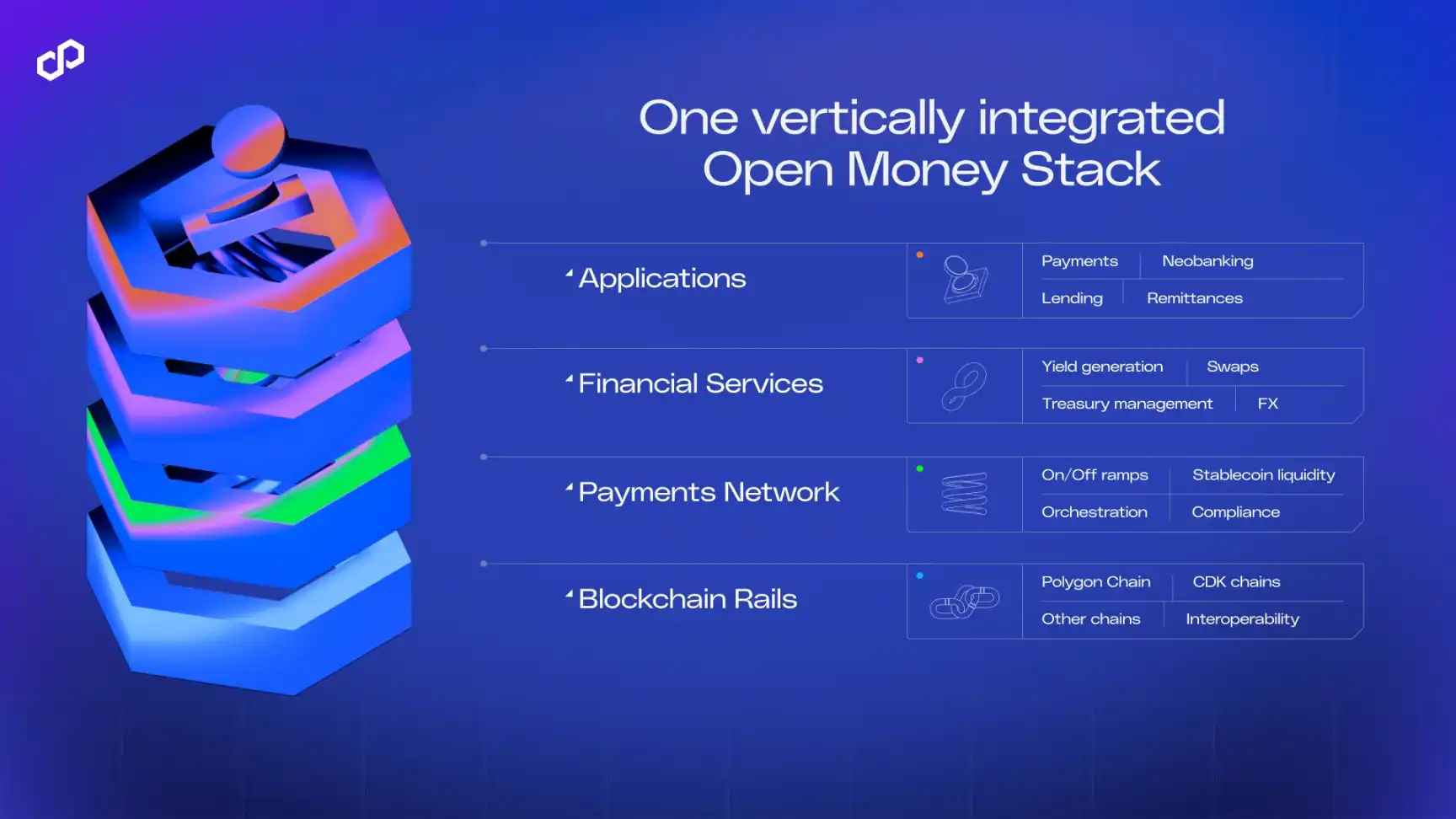
Open Money Stack | Source: Polygon Tweet

On/Off & Cash Ramps Layer: Utilizes Coinme's compliant network and U.S. regulatory licenses to enable instant cash and fiat on-ramps and off-ramps, converting physical cash or electronic fiat into stablecoins or other on-chain assets.

Wallet & Interaction Layer: Leverages Sequence's enterprise-grade smart wallets and account abstraction technology, along with one-click cross-chain transactions and cross-chain interaction capabilities, allowing end-users to receive, send, and make on-chain payments without worrying about underlying chains, gas, or intermediate assets.

Cross-Chain Interoperability Layer: Combines Sequence's Trails cross-chain orchestration engine and Polygon's interoperability protocol to make value flow between different chains completely transparent to users and support cross-chain transactions for any chain and any token.

Settlement Layer (Blockchain Rails): Relies on the Polygon network and its scaling technology to provide high-speed, low-cost, secure on-chain settlement infrastructure, enabling commercial-scale efficiency for stablecoin payments and value transfer.

Additionally, the Open Money Stack plans to integrate stablecoin orchestration with modules for compliance, identity, and yield generation, providing enterprises with payment and treasury management solutions.

L2 Competition Shifts to "Full-Stack Integration"

Polygon's $250 million acquisition reflects that the focus of competition in the L2 space is shifting from underlying technical parameters to full-stack business integration.

This path is highly consistent with the logic behind Coinbase's support for Base. The compliant entry point—acquiring Coinme—is to address the短板 (shortcoming) of fiat on-ramps and off-ramps,对标 (countering) Coinbase's CEX core advantage. For interaction experience, integrating Sequence is to lower the barrier to on-chain entry,对标 (countering) the ease of use of Coinbase Wallet (Base).

Against the backdrop of increasingly converging L2 technologies, ecosystems with compliant channels and low-barrier experiences will more easily attract incremental capital. Through this series of acquisitions, Polygon is attempting to build its own full-link moat in competition with opponents like Base, which possess native centralized advantages.


Trending Cryptos

Related Questions

QWhat is the total acquisition amount announced by Polygon Labs, and which two companies were acquired?

APolygon Labs announced a total acquisition amount exceeding $250 million for the cryptocurrency payment infrastructure company Coinme and the blockchain development platform Sequence.

QHow does the acquisition of Coinme benefit Polygon's stablecoin strategy?

AThe acquisition of Coinme provides Polygon with a series of U.S. money transmission licenses and an extensive cash network, enabling compliant integration of cash, debit cards, and on-chain assets to facilitate stablecoin payments and off-chain capital inflows.

QWhat core technologies does Sequence offer to simplify the Web3 user experience?

ASequence offers a modular stack including Smart Wallet with account abstraction for features like social recovery and gas fee abstraction, and the Trails cross-chain orchestration engine to enable seamless cross-chain transactions without user awareness of underlying complexities.

QWhat is the 'Open Money Stack' strategy that Polygon aims to build through these acquisitions?

AThe 'Open Money Stack' strategy aims to create a unified API system comprising layers for on/off ramps (using Coinme's network), wallet infrastructure (via Sequence's technology), cross-chain interoperability, and blockchain settlement, all integrated with stablecoin orchestration and compliance modules.

QHow does Polygon's acquisition approach reflect the shifting competitive focus in the L2 space?

APolygon's acquisitions indicate that L2 competition is moving from underlying technical parameters to full-stack business integration, focusing on compliant entry points and user-friendly experiences to attract incremental capital and build a comprehensive competitive moat.

Related Reads

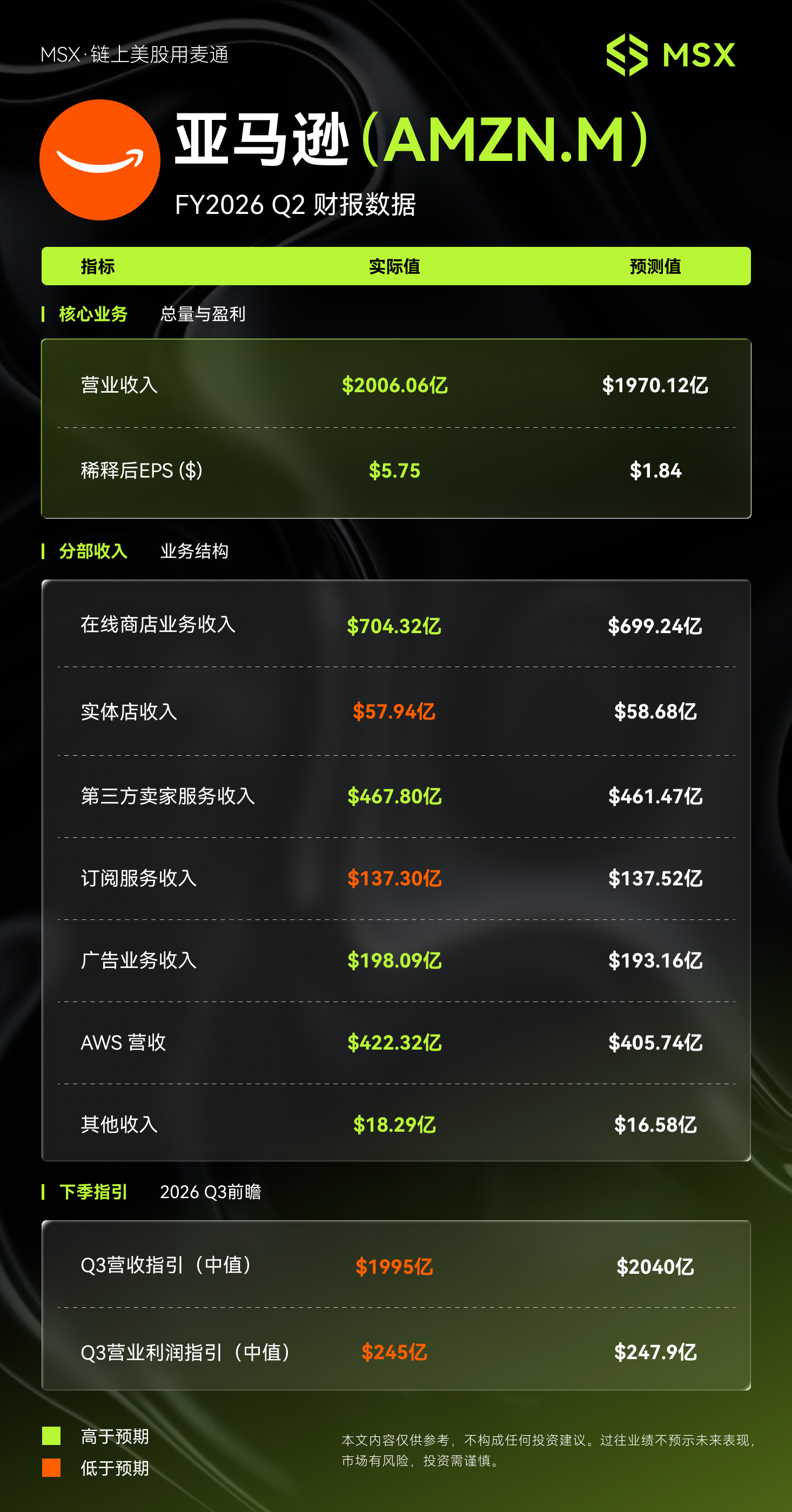
MSX US Stock Daily Insight: Amazon 2026 Q2 Earnings: AWS Records Fastest Growth in Five Years

**MSX Daily US Stock Observation: Amazon's Q2 2026 Earnings: AWS Achieves Fastest Growth in Five Years** Amazon's latest quarterly results exceeded expectations, driven by a strong performance from its cloud computing unit. The company reported revenue of $200.66 billion, surpassing estimates of approximately $197 billion. The key highlight was Amazon Web Services (AWS), which generated $42.232 billion in revenue, surging 37% year-over-year. This marked the segment's fastest growth pace in 18 quarters, indicating robust demand for cloud services. Reported Earnings Per Share (EPS) of $5.75 significantly exceeded the $1.84 forecast. However, this figure included a substantial one-time, non-operating gain of $53.4 billion, primarily from the revaluation of Amazon's investment in AI company Anthropic. Excluding this item, core operating profit was $27.461 billion, a strong increase of 43% compared to the same period last year. Despite the positive results, Amazon provided guidance for the upcoming third quarter that fell short of market expectations. The company's revenue guidance midpoint is $199.5 billion, below the consensus estimate of around $204 billion. Operating profit guidance of $24.5 billion also slightly missed expectations of approximately $247.9 billion. Furthermore, Amazon raised its forecast for full-year capital expenditures to $220 billion, citing rising memory chip costs, which weighed on investor sentiment regarding future profitability. In summary, Amazon's quarter showcased accelerating momentum in its core AWS business. The underlying operational profit growth remains solid. However, cautious forward guidance and increased investment spending present key areas for monitoring in the coming quarters, as the market assesses whether the current growth phase will translate into sustained profit margin expansion.

Odaily星球日报8m ago

MSX US Stock Daily Insight: Amazon 2026 Q2 Earnings: AWS Records Fastest Growth in Five Years

Odaily星球日报8m ago

Cyclical Stock or Growth Stock? Coinbase's Q2 Earnings Report Reveals 'Valuation Disagreement'

Coinbase's Q2 2026 financial results revealed a mixed performance, reigniting debate over whether the company should be valued as a cyclical stock tied to crypto markets or a growth stock with future potential. Total revenue missed expectations at $1.22 billion, down 19% year-over-year. Transaction revenue fell to $599 million, with retail crypto spot trading revenue dropping 30% to $452 million, back to 2023 levels. The company reported a net loss of $359 million, marking its third consecutive quarterly loss. Despite CEO Brian Armstrong's positive commentary on metrics like a 10.3% overall crypto trading market share and 106% growth in prediction markets, the market reacted negatively, with shares dropping over 5% after-hours. A key issue is the decline in core retail trading. While Coinbase touted record market share, this figure includes derivatives and new products. Its traditional crypto spot trading share is likely shrinking. New ventures like prediction markets, while growing, contributed less than $30 million, insufficient to offset the core revenue decline. The valuation debate hinges on perspective. As a cyclical stock, Coinbase remains deeply tied to the crypto bear market, with user attrition and competitive pressures justifying a lower valuation. The company's strategy appears focused on surviving until the next bull cycle. Viewed as a growth stock, however, Coinbase shows promising diversification. Subscription and service revenue reached $555 million, nearly matching transaction revenue. Stablecoin revenue, its second-largest source at $292 million, remains strong through its partnership with Circle. Critically, Coinbase is positioning itself as a leader in the emerging on-chain "agent economy." Over 90% of agent-based stablecoin transactions occur on its Base network, which it believes could handle trillions in future agent transactions. The recent acquisition of Deribit also aims to boost its international derivatives offering. In summary, Coinbase's present struggles are clear, but its future hinges on whether its investments in revenue diversification, stablecoins, and the agent economy can ultimately transform its business model and justify a growth premium.

Odaily星球日报28m ago

Cyclical Stock or Growth Stock? Coinbase's Q2 Earnings Report Reveals 'Valuation Disagreement'

Odaily星球日报28m ago

Global Market Share Survey: Japanese Firms Lead in Semiconductor Materials

Global Market Share Survey: Japanese Firms Lead in Semiconductor Materials According to the 2025 "Major Goods and Services Market Share Survey" by Nikkei, Japanese companies maintain strong positions in semiconductor-related materials. In silicon wafers, Shin-Etsu Chemical ranks first with a 26.3% share, followed by SUMCO at 17.8%. Together, they hold 44.1% of the market, widening their lead over competitors from Taiwan, Germany, and South Korea. In photoresists, Tokyo Ohka Kogyo, JSR, and Shin-Etsu Chemical occupy the top three spots, with a combined share of 60.5%. Despite their strength in materials, Japanese firms have a weaker presence in core semiconductor segments like DRAM and NAND flash memory, where South Korean and U.S. companies dominate. For instance, SK Hynix and Samsung lead in DRAM, while China’s CXMT doubled its share to 6% in 2025. The semiconductor market is projected to grow rapidly, with WSTS forecasting a 90% increase to $1.5112 trillion by 2026. Major players like Samsung, SK Hynix, and Micron are making massive investments to expand capacity. To maintain their edge in materials, Japanese companies must similarly commit to large-scale, risk-taking investments. In contrast, Japan’s automotive sector shows stagnation. Toyota remains the global leader but with only a slight share increase to 12.3%, while Japanese brands are absent from the top five in the EV market. In shipbuilding, Imabari Shipbuilding rose to third place globally with a 7.2% share, benefiting from large container ship deliveries. However, Chinese and South Korean firms dominate the sector, holding the top two positions. Japan aims to revitalize its shipbuilding industry through government and corporate efforts, targeting a near doubling of output by 2035. Addressing labor shortages and adopting advanced technologies like physical AI will be critical for competitiveness.

marsbit53m ago

Global Market Share Survey: Japanese Firms Lead in Semiconductor Materials

marsbit53m ago

Trading

Spot

Hot Articles

How to Buy T

Welcome to HTX.com! We've made purchasing Threshold Network Token (T) simple and convenient. Follow our step-by-step guide to embark on your crypto journey.Step 1: Create Your HTX AccountUse your email or phone number to sign up for a free account on HTX. Experience a hassle-free registration journey and unlock all features.Get My AccountStep 2: Go to Buy Crypto and Choose Your Payment MethodCredit/Debit Card: Use your Visa or Mastercard to buy Threshold Network Token (T) instantly.Balance: Use funds from your HTX account balance to trade seamlessly.Third Parties: We've added popular payment methods such as Google Pay and Apple Pay to enhance convenience.P2P: Trade directly with other users on HTX.Over-the-Counter (OTC): We offer tailor-made services and competitive exchange rates for traders.Step 3: Store Your Threshold Network Token (T)After purchasing your Threshold Network Token (T), store it in your HTX account. Alternatively, you can send it elsewhere via blockchain transfer or use it to trade other cryptocurrencies.Step 4: Trade Threshold Network Token (T)Easily trade Threshold Network Token (T) on HTX's spot market. Simply access your account, select your trading pair, execute your trades, and monitor in real-time. We offer a user-friendly experience for both beginners and seasoned traders.

12.6k Total ViewsPublished 2024.03.29Updated 2026.06.02

How to Buy T

Discussions

Welcome to the HTX Community. Here, you can stay informed about the latest platform developments and gain access to professional market insights. Users' opinions on the price of T (T) are presented below.

活动图片