PayPal Expands PYUSD Access To 68 New Countries Amid Stablecoin Push

bitcoinistPublished on 2026-03-18Last updated on 2026-03-18

Abstract

PayPal has expanded access to its U.S. dollar-pegged stablecoin, PayPal USD (PYUSD), to 70 markets worldwide, including 68 new countries this month. This expansion allows users in regions like Asia-Pacific, Europe, and Latin America to send, hold, and receive PYUSD, enabling faster and lower-cost cross-border transactions compared to traditional methods. The stablecoin, which initially faced regulatory scrutiny, saw its market cap grow to $4.1 billion after the SEC closed its investigation in February 2025. Users in most regions can also receive rewards on holdings, though exceptions include Singapore and the UK. PayPal aims to build a more inclusive global commerce ecosystem by increasing PYUSD’s utility and accessibility.

PayPal has expanded access to its stablecoin PayPal USD (PYUSD) to 70 markets, allowing users worldwide to send, hold, and receive the token while enabling faster, lower-cost global transactions.

PayPal Expands PYUSD Across 70 Markets

On Tuesday, payments giant PayPal announced that its USD-pegged stablecoin, PYUSD, will be available to users in 70 markets worldwide following its expansion into 68 new countries this month.

The fintech launched the stablecoin in August 2023 after initially pausing development due to scrutiny of PayPal’s issuance partner, Paxos. That same year, PayPal received a subpoena from the US Securities and Exchange Commission (SEC) related to its stablecoin.

As crypto regulation gained momentum and financial watchdogs loosened their grip under the Trump Administration, the Commission concluded its 16-month investigation into PYUSD without enforcement action in February 2025. Since then, PYUSD’s total market capitalization has reached $4.1 billion, a fivefold increase over the past year.

Previously, only customers in the US and the UK had access to the PYUSD. However, the latest expansion has made PYUSD available to users across multiple global regions, including Asia-Pacific, Europe, Latin America, and North America.

This includes Colombia, Costa Rica, the Dominican Republic, the Faroe Islands, Greenland, Guatemala, Honduras, Panama, Peru, Singapore, the United Kingdom, and the United States. Meanwhile, users in the remaining markets will have access to PYUSD in the coming weeks.

Users in the newly supported regions will be able to hold, send, and receive the stablecoin directly on their PayPal accounts, enabling faster settlement and lower cost than traditional payment methods.

Users will also be eligible to earn rewards on their stablecoin holdings, but rewards won’t be available to users in Singapore or the United Kingdom, the official announcement noted. Existing holders in the United States receive an annual 4% reward.

PayPal Eyes ‘More Inclusive, Global Commerce Ecosystem’

The payments giant affirmed that this geographical expansion marks a critical step in its stablecoin push to build “the liquidity, utility, and ubiquity of PYUSD necessary to create a more inclusive, global commerce ecosystem.”

While consumers and businesses worldwide are seeking faster, more seamless global transactions, the current system still incurs excessive charges and adheres to outdated timelines, May Zabaneh, Senior Vice President and General Manager of Crypto at PayPal, noted, adding that the company is working to change that.

“Enabling PYUSD in users’ accounts across 70 markets gives people faster access to their funds, lower-cost ways to send money across borders, and a more direct path to participating in the global economy, and that is what drives commerce forward for everyone,” she affirmed in the official announcement.

“Now you’re really opening up not only access—especially in places where they need it most— but also cross-border transfers and volume, where the pain is felt so high,” Zabaneh also told Fortune.

The stablecoin was initially launched on Ethereum and later expanded to other networks, including Tron, Avalanche, Aptos, and Sei, through LayerZero in September. In addition, YouTube added a new payout option last December that allows US creators to receive earnings in PYUSD.
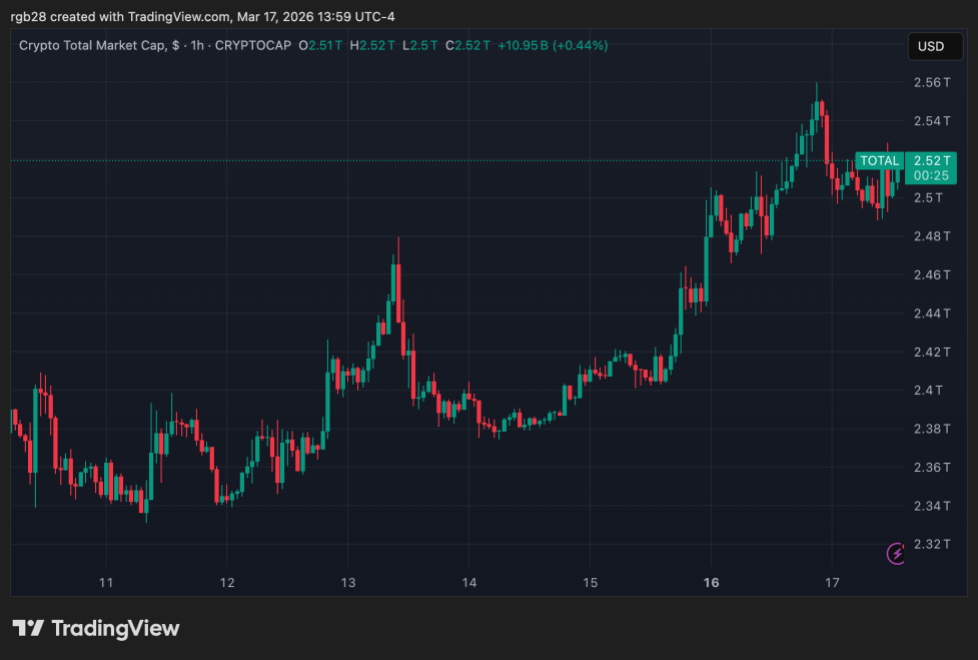
The total crypto market capitalization is at $2.52 trillion in the one-week chart. Source: TOTAL on TradingView


Related Questions

QHow many new countries did PayPal expand PYUSD access to in its latest announcement?

APayPal expanded PYUSD access to 68 new countries.

QWhat was the total market capitalization of PYUSD as mentioned in the article, and how much has it increased over the past year?

APYUSD's total market capitalization reached $4.1 billion, which is a fivefold increase over the past year.

QWhich regions are included in the latest expansion of PYUSD access?

AThe latest expansion includes users across multiple global regions, such as Asia-Pacific, Europe, Latin America, and North America.

QWhat benefits do users in newly supported regions gain from holding PYUSD?

AUsers in newly supported regions can hold, send, and receive PYUSD directly on their PayPal accounts, enabling faster settlement and lower costs compared to traditional payment methods.

QOn which blockchain networks is PYUSD available besides Ethereum?

ABesides Ethereum, PYUSD is available on other networks including Tron, Avalanche, Aptos, and Sei.

Related Reads

$9.4 Billion: The Largest Robotics Funding This Year Has Emerged

Munich-based humanoid robotics company Neura has completed a $1.4 billion (approximately RMB 94.9 billion) Series C funding round, valuing the company at around $7 billion and positioning it among the global leaders in the sector. The investment round is notable not just for its size—reportedly the largest in robotics this year—but also for its strategic backers, which include tech giants like NVIDIA and Amazon, alongside established industrial players such as German engineering firms Bosch and Schaeffler. This mix of investors signals a significant shift in the industry's focus from technological demonstrations and general-purpose narratives toward practical, industrial deployment and commercialization. Neura's approach centers on developing humanoid robots for defined, high-value industrial tasks rather than pursuing a general-purpose model. Its early validation comes from a partnership with BMW, where its robots are being tested on actual production lines. The involvement of Bosch and Schaeffler, companies deeply embedded in global manufacturing, underscores a growing belief that humanoid robots are transitioning from labs to viable factory-floor solutions. The article highlights two converging trends driving investment: advancements in AI and large language models, which enhance robots' perception and decision-making in unstructured environments, and mounting pressure from labor shortages and rising costs in major manufacturing regions. The funding landscape is now bifurcating between companies like Figure AI, focusing on versatile general-purpose robots, and firms like Neura, targeting specific vertical industrial applications with clearer, shorter paths to ROI. While technical hurdles remain, the core challenges for widespread adoption are increasingly seen as engineering and commercial in nature: managing the high integration and customization costs for different factory environments and establishing robust, localized maintenance and service networks. The record investment in Neura, particularly from industrial capital, indicates the industry's growing confidence in moving from proving feasibility to solving the practical problems of scalability, reliability, and building sustainable business models around humanoid robots in real-world settings like automotive manufacturing and hazardous labor environments.

marsbit1h ago

$9.4 Billion: The Largest Robotics Funding This Year Has Emerged

marsbit1h ago

"119 to 176 Dollars": Behind SpaceX's Listing, MSX Once Again Successfully Executes the Pre-IPO Closed Loop

Following May's 300% gain on Cerebras, MSX delivered another outstanding performance during SpaceX's listing night. On June 12, SpaceX (SPCX) launched on Nasdaq, reaching a high of $176. This marked the successful culmination of MSX's Pre-IPO project launched in March, where users subscribed at $119, achieving gains of approximately 40-48%. This event validated MSX's complete Pre-IPO mechanism, a crucial advantage in a market where access to top-tier private company equity is typically limited to institutions. MSX's model provides a full cycle for users: subscription (at $119 for SpaceX), real-time on-chain portfolio tracking, optional early redemption, seamless conversion to tradable spot assets (SPCX.M) upon IPO, and final settlement in stablecoins. This end-to-end process distinguishes MSX from platforms that faced settlement issues during the SpaceX IPO, highlighting that the core challenge of Pre-IPO is not just access, but a clear exit and conversion path post-listing. This success with SpaceX is MSX's second major Pre-IPO verification, following the Cerebras listing in May, which yielded ~300% returns for early participants. These back-to-back achievements demonstrate MSX's capability to source, structure, and deliver real assets through a replicable on-chain model. The true barrier for Pre-IPO products lies not in providing an entry point, but in ensuring reliable fulfillment from subscription through to post-IPO liquidity. MSX's proven闭环 (closed-loop) process addresses this, offering Web3 users a structured way to access high-growth, pre-public companies in sectors like AI and frontier tech. MSX plans to continue expanding its Pre-IPO portfolio with this focus on authenticity, transparency, and post-listing execution.

Odaily星球日报14h ago

"119 to 176 Dollars": Behind SpaceX's Listing, MSX Once Again Successfully Executes the Pre-IPO Closed Loop

Odaily星球日报14h ago

Trading

Spot
Futures

Hot Articles

How to Buy PUSH

Welcome to HTX.com! We've made purchasing Push Protocol (PUSH) simple and convenient. Follow our step-by-step guide to embark on your crypto journey.Step 1: Create Your HTX AccountUse your email or phone number to sign up for a free account on HTX. Experience a hassle-free registration journey and unlock all features.Get My AccountStep 2: Go to Buy Crypto and Choose Your Payment MethodCredit/Debit Card: Use your Visa or Mastercard to buy Push Protocol (PUSH) instantly.Balance: Use funds from your HTX account balance to trade seamlessly.Third Parties: We've added popular payment methods such as Google Pay and Apple Pay to enhance convenience.P2P: Trade directly with other users on HTX.Over-the-Counter (OTC): We offer tailor-made services and competitive exchange rates for traders.Step 3: Store Your Push Protocol (PUSH)After purchasing your Push Protocol (PUSH), store it in your HTX account. Alternatively, you can send it elsewhere via blockchain transfer or use it to trade other cryptocurrencies.Step 4: Trade Push Protocol (PUSH)Easily trade Push Protocol (PUSH) on HTX's spot market. Simply access your account, select your trading pair, execute your trades, and monitor in real-time. We offer a user-friendly experience for both beginners and seasoned traders.

3.7k Total ViewsPublished 2024.03.29Updated 2026.06.02

How to Buy PUSH

Discussions

Welcome to the HTX Community. Here, you can stay informed about the latest platform developments and gain access to professional market insights. Users' opinions on the price of PUSH (PUSH) are presented below.

活动图片












