Pacific 'Fever': How Extreme Weather Becomes Wall Street's ATM?

链捕手Published on 2026-07-08Last updated on 2026-07-08

Abstract

"Pacific 'Fever': How Extreme Weather Becomes Wall Street's Piggy Bank" The article examines how the 2026-2027 El Niño, potentially the strongest since 1950, is not only disrupting global weather but also creating major financial opportunities. It links recent extreme events in China and worldwide to this climate phenomenon, which alters atmospheric patterns, increasing risks of floods, droughts, and heatwaves. The core narrative explores how financial markets capitalize on these disruptions. A hedge fund is raising $500 million specifically to bet on El Niño-affected crops like South African corn and Malaysian palm oil. Historically, such strategies have yielded massive profits. Examples include Richard Dennis ("Turtle Trader") making his first fortune in the 1970s soy boom triggered by El Niño's impact on Peruvian anchovies (a key fishmeal source), and Anthony Ward's cocoa empire built on superior weather intelligence. The 2024 cocoa price surge, driven by West African drought, enriched quantitative trend-following funds. Currently, markets are preemptively bidding up palm oil, rubber, and sugar futures based on anticipated future supply shocks, despite high current inventories. The article details El Niño's asymmetric global impacts: causing drought in Southeast Asia (hurting palm oil/rubber) and India (affecting sugar/cotton), but bringing beneficial rains to South American soy and sugarcane. Key metrics to watch include the Niño3.4 index, Indian monsoon data, and Mal...

Author: Jia Liu, Zhangsheng Beatz

It rained heavily and unexpectedly for several days in Tianjin. You'd leave home in sunshine only to get soaked halfway. A friend's flight to Shenzhen in the evening was canceled due to a typhoon, and all high-speed train tickets to Zhejiang direction were suspended.

Checking the news on the phone: rainfall exceeded 329 mm in just a few hours in Fushun, Liaoning. Residents in Fangchenggang, Guangxi, said it was the most severe flood in 20 years. Daily precipitation records were broken at seven national meteorological stations. The largest high-temperature warning in northern China was issued, with ground temperatures approaching 50°C in some places. In the first week of July, two to three typhoons were queuing up to form in the Western Pacific, with super typhoon 'Bavi' approaching the southeast coast.

Since the start of summer in 2026, the weather in China has clearly become more restless.

And it's not just us. Sea temperatures off the coast of Peru remain persistently warm, limiting anchovy catches, with fishmeal prices rising about 80% over the past year. As Southeast Asia enters the dry season, drought signals are strengthening, putting palm oil producing regions in Malaysia and Indonesia on edge. The crucial window for the Indian monsoon hasn't arrived yet, but markets are already betting it will be weak. Analysts have flagged Australian wheat planting area as potentially shrinking significantly.

These extreme weather changes are scattered across different continents, seemingly unrelated. But in fact, beyond the direct trigger mechanisms like monsoon moisture, tropical storm peripheral circulation, location, and topography, they most likely have all been influenced by the same storm:

ENSO, El Niño.

El Niño: The Pacific is Running a Fever

ENSO, translated in Chinese as El Niño–Southern Oscillation, is the largest interannual signal in Earth's climate system. Simply put, it describes the periodic changes between Pacific sea temperatures and atmospheric circulation.

Under normal conditions, the eastern equatorial Pacific is relatively cool, and the western part is relatively warm. Trade winds push warm water toward the western Pacific. But if the trade winds weaken, warm water flows back eastward, abnormally raising sea temperatures in the central and eastern Pacific, resulting in an El Niño.

Meteorological agencies judge whether an El Niño is occurring mainly by looking at a key region: the Niño3.4 region (a critical area in the equatorial central Pacific, understood as the "thermometer" for judging El Niño strength). If this region's temperature remains 0.5°C above the normal for several consecutive months, it's considered an El Niño state; if it's 2°C above, it's a super-strong level. 1997 and 2015 were two typical super-strong El Niño events.

This year's El Niño could become the strongest one since 1950.

On June 11, the U.S. National Oceanic and Atmospheric Administration (NOAA) officially issued an El Niño watch, confirming that El Niño conditions have emerged and are expected to strengthen through late 2026 to early 2027. They estimate a 63% probability of a super-strong El Niño occurring from November this year to January next year. The judgment from the Chinese Academy of Sciences' Institute of Atmospheric Physics is slightly more conservative, with a probability of over 70% for a moderate event and about 10% for a super-strong one.
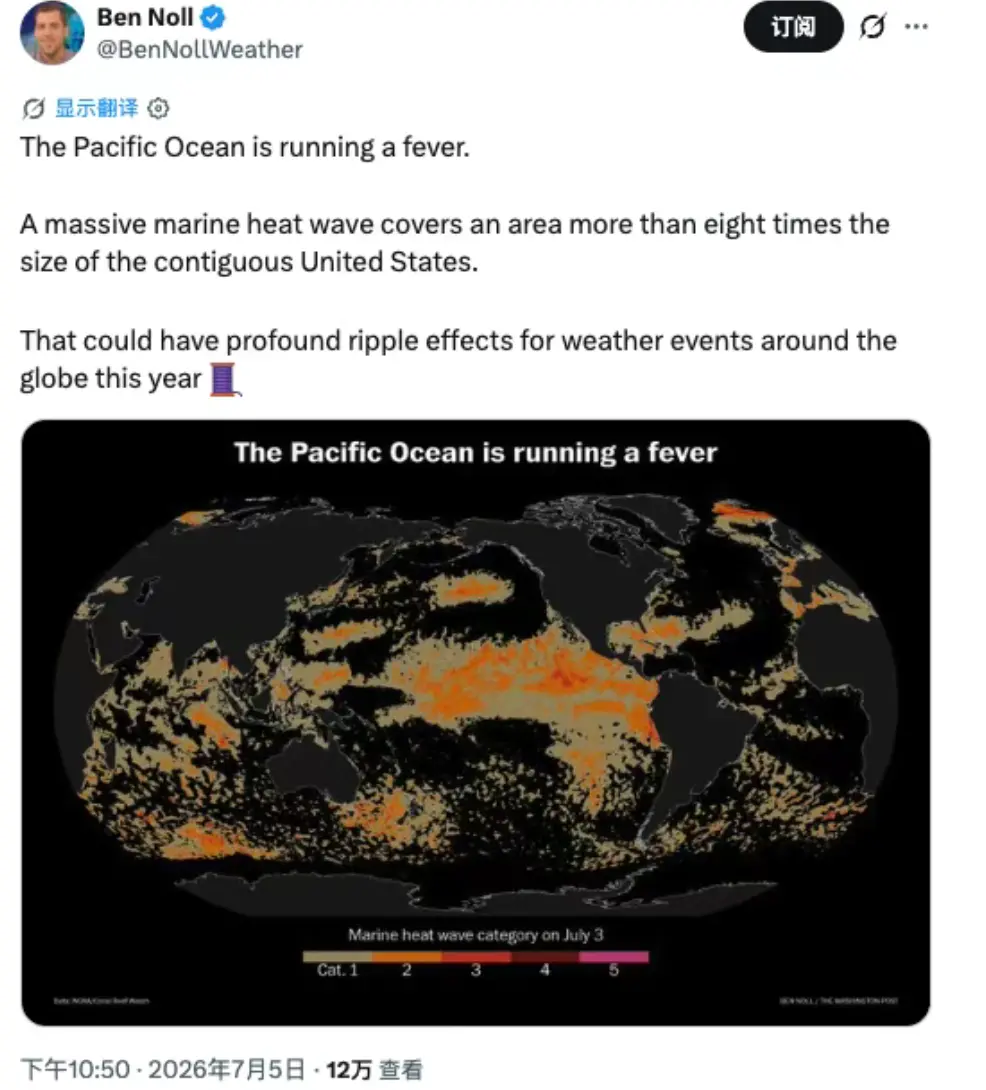
Meteorologist Ben Noll posted a Pacific sea temperature map on X with the caption "Pacific fever." Deep orange and red cover most of the Pacific on the map, showing the area of this marine heatwave exceeds 8 times the size of the contiguous United States.

For us, its impact is not "directly creating a specific rainstorm," but rather altering the underlying tone of atmospheric circulation. It influences the position of the Western Pacific Subtropical High, changes the path of water vapor transported by the East Asian Summer Monsoon, making rain belts more likely to deviate from their normal positions, and increasing the risk of high temperatures, droughts, and severe convection.

Compounded with global warming, for every 1°C increase in atmospheric temperature, its capacity to hold water vapor increases by about 7%. So today's El Niño isn't happening in a normal climate but against a backdrop that is already hotter, wetter, and more prone to extremes.

Here we have monsoons and typhoons, but over there in financial markets, some have already caught the scent, and funds are stirring.

On June 24, Bloomberg reported that hedge fund Moreton Capital Partners is raising $500 million for a dedicated vehicle. The assets targeted are agricultural products affected by El Niño, such as South African corn, Malaysian palm oil, and Australian wheat. Co-founder Les Finemore's rationale was simply: the market is vastly underestimating the risks brought by this year's El Niño.

Weather is no longer just background noise in a commodity portfolio; to some extent, it can stand alone as a separate theme for capital raising.

How can Finemore raise $500 million? Because profiting from extreme weather like El Niño isn't theoretical; people have been making big money from it for decades.

The First Fortune of the 'Turtle Trading' Founder

In 1972, the anchovies off the coast of Peru suddenly disappeared.

This tiny fish, about a dozen centimeters long, is something most people in the world will never eat, but when ground into fishmeal, it's one of the most important protein sources in global animal feed.

The disappearance of the anchovies was precisely because the equatorial Pacific waters suddenly warmed up. Cold water no longer upwelled, breaking the plankton chain. Meteorologists later named this phenomenon: El Niño.

With no fishmeal, feed manufacturers had to find substitutes, pushing up the price of soybean meal, which in turn drove up the price of soybeans.

At the Chicago Mercantile Exchange, a young trader not yet 26, Richard Dennis, saw prices hitting new highs and kept buying soybeans. In 1974, he made about $500,000 on soybeans and became a millionaire by year-end.

Richard Dennis in his youth

And this young trader, Richard Dennis, who made his first fortune, would later become the famous founder of the "Turtle Traders," his name enshrined as one of the patriarchs of trend trading.

Another classic story is that of Anthony Ward, nicknamed Chocfinger. He founded Armajaro in London in 1998, specializing in cocoa and coffee. What set this company apart was not its trading desk but its meteorology department: a proprietary weather station network, employing full-time meteorologists, and a research team of over 20 people in West African producing regions.

His logic: small weather changes could cause crop yields to fluctuate by 10%; whoever knows the weather first knows the price first. In 2002, he took three-quarters of the London exchange's cocoa delivery for the month, with a pre-tax profit of £10.4 million. On July 17, 2010, he received 240,100 tonnes of physical cocoa in one go, valued at £658 million, about 7% of global annual production, essentially all visible inventory in Europe at the time, pushing cocoa prices to their highest since 1977.

Let's look at some more recent examples.

In 2024, cocoa was the craziest commodity globally. West Africa's Côte d'Ivoire and Ghana, producers of 70% of the world's cocoa, suffered from abnormally high temperatures and dry Harmattan winds (a dry, hot wind blowing from the Sahara to the West African coast). Cocoa pods rotted on a large scale, compounded by disease, old trees, and low inventories. Cocoa futures rose over 400% in two years, briefly surpassing $10,000 per tonne.

Those who captured the bulk of this move weren't just cocoa industry players, but a group of quantitative trend funds. Razvan Remsing of Aspect Capital said it was their best first quarter in 25 years. AQR's managed futures strategy rose about 17.4% in Q1. Capital Fund Management's trend fund rose about 17.5%. Aspect's flagship fund was up 21.4% by late April. Winton, founded by David Harding, saw its diversified macro fund rise about 13% in Q1.

During the same period, besides making significant money on cocoa, Winton also made a lot on another front: El Niño typically brings warmer winters to parts of the U.S. A less cold winter means weaker heating demand for natural gas, inventories build up, and the U.S. natural gas benchmark price, Henry Hub (equivalent to Brent in the oil market), fell to near 30-year lows.

Bottom-Fishing Cocoa, or Sugar?

Back to 2026. This round of El Niño hasn't peaked yet, but the market has already front-run one wave.

Palm oil futures surged from 9400 yuan in late April to 9993 yuan before retreating. Rubber rose from its April low, briefly breaking 18300 yuan in mid-May. Sugar fluctuated repeatedly between 5200 and 5450 yuan. Peanuts rallied for seven consecutive sessions, supported by drought conditions and cost factors.

The strange thing is, the actual fundamentals of these commodities don't support the rise. Malaysian palm oil inventories were still increasing month-on-month by the end of May. Domestic sugar inventories in China were 1.83 million tonnes higher year-on-year. Domestic palm oil inventories were up 25.68% year-on-year. Production hasn't started falling yet, but prices rose first. The only reason for the rise is the anticipation of reduced yields 6 to 12 months later due to El Niño.

Over the past fifty years, every round of moderate or stronger El Niño has left its mark on commodity markets. In the 1982 round, palm oil rose 169%. From 2009 to 2010, Indonesian rubber production fell 11.3%, and spot prices rose 157.79% over two years. From 2015 to 2016, sugar rose 65%.
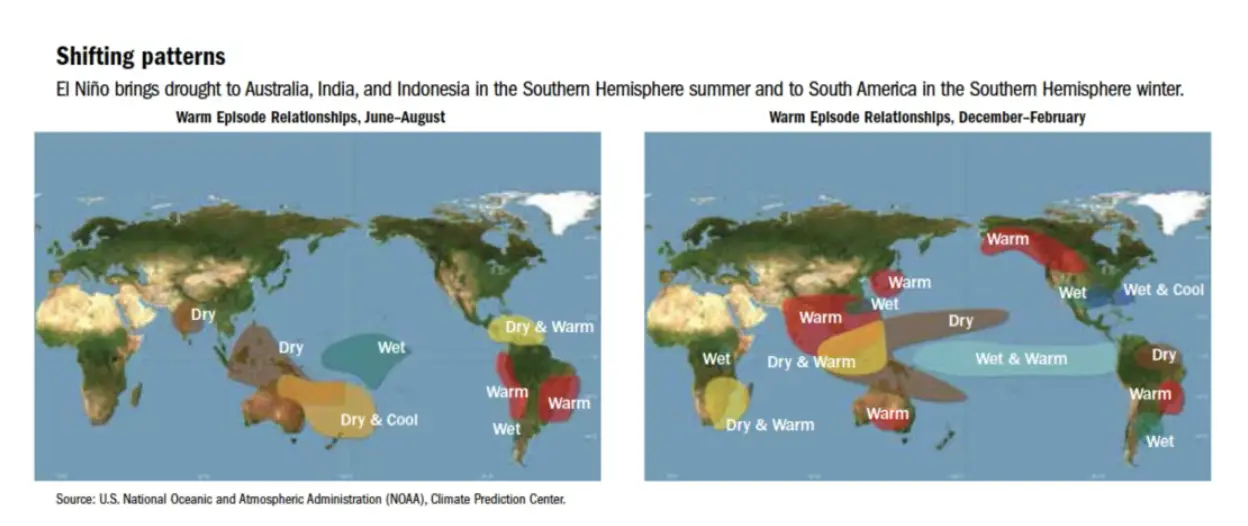
In Southeast Asia, it brings drought, suppressing palm oil and rubber yields. In India, it weakens the monsoon, affecting sugar and cotton. In Peru, it makes anchovies disappear, pushing up fishmeal prices. But at the other end of South America, it brings more rain, potentially improving soybean and sugarcane conditions in Brazil and Argentina. In the mining regions of Chile and Peru, heavy rainfall impacts not farmland but copper mines. In the U.S., a warm winter suppresses natural gas demand.

Overseas community discussions about this El Niño are still fermenting.
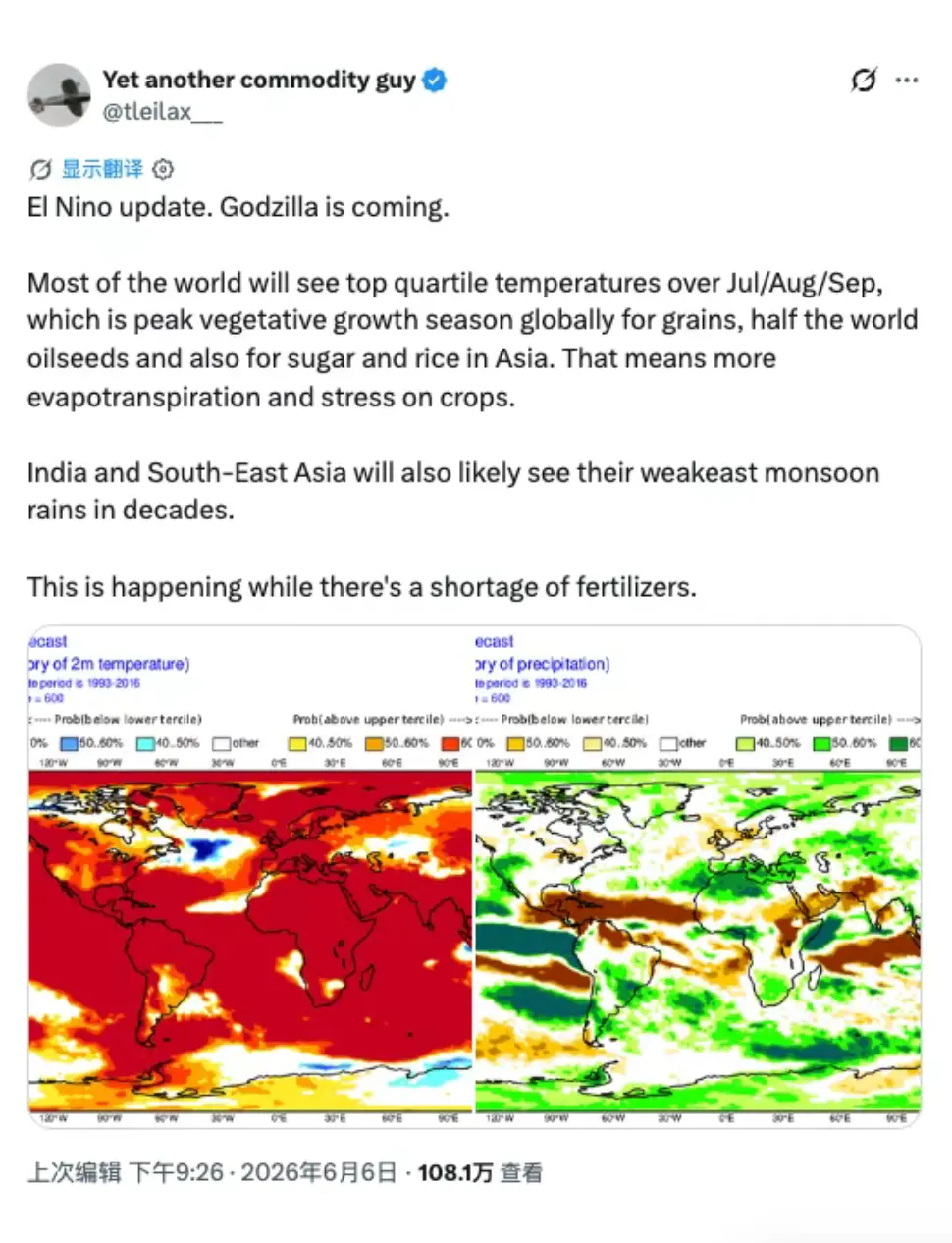
Commodities blogger @tleilax__ posted with two forecast maps. One map shows how much higher global temperatures from July to September this year are expected to be compared to the same period in previous years. The map is almost entirely red, and this timeframe coincides with the crucial growing period for grains, oilseeds, Asian rice, and sugar.

The other map shows whether rainfall will be higher or lower than the historical average for the same period. It shows large swathes of India and Southeast Asia as drier than usual, precisely matching the market's biggest fear: a weak monsoon.

His conclusion: India and Southeast Asia could experience the weakest monsoon rainfall in decades, and this is happening against a backdrop of a global fertilizer shortage. This post has garnered over 1.08 million views so far.

A commodities column on Substack listed palm oil, cotton, and cocoa as the cluster with the clearest risk-reward profile for the next 6 to 12 months. The Singapore investment community is scrutinizing Malaysian plantation stocks one by one, concluding that pure upstream planters capture the full elasticity, while companies like Wilmar International, focused on midstream and downstream processing, get their margins squeezed by rising palm oil prices. The U.S. stock community is circulating an even more nuanced argument: Adecoagro, an agricultural company in Brazil and Argentina, is a "weather hedge for tech-heavy portfolios" because El Niño brings rain, not drought, to South America; its output expands while Asia's production declines, pushing up prices.

The script for this round's market move is still largely unwritten, so it's not necessarily better to buy earlier. There aren't many hard indicators that can change position direction, but each is crucial:

  • Whether the Niño3.4 index breaks above 2.0°C in autumn/winter. This is the dividing line between moderate and super-strong, and the switch for overall agricultural volatility to step up.

  • Indian monsoon rainfall data from June to September. The steering wheel for the sugar, cotton, and rice group of commodities.

  • Monthly inventory reports from the Malaysian Palm Oil Board. The speed at which high inventories are drawn down determines when the expected market move connects with the actual market move.

  • Rainfall in Guangxi, China, in July and the consecutive days of high temperatures in North China. The former governs sugar, the latter electricity.

  • The subsequent fundraising scale of weather-focused funds like Moreton. The volume of institutional capital determines whether weather trading is a short-lived pulse or a year-long theme.

The experiences of 1972 and 2024 point to the same time lag: the real price effects of El Niño mostly occur after the event's peak. Dennis made his money two years after the anchovy collapse. Cocoa truly exploded after ENSO turned neutral. In the second half of 2026, the market is trading on expectations; in 2027, it will trade on the actual production shortfall itself.

At First, No One Cared About This Storm

Beyond these trading opportunities, what's more thought-provoking are two highly shared posts on X by finance blogger @FinanceLancelot.
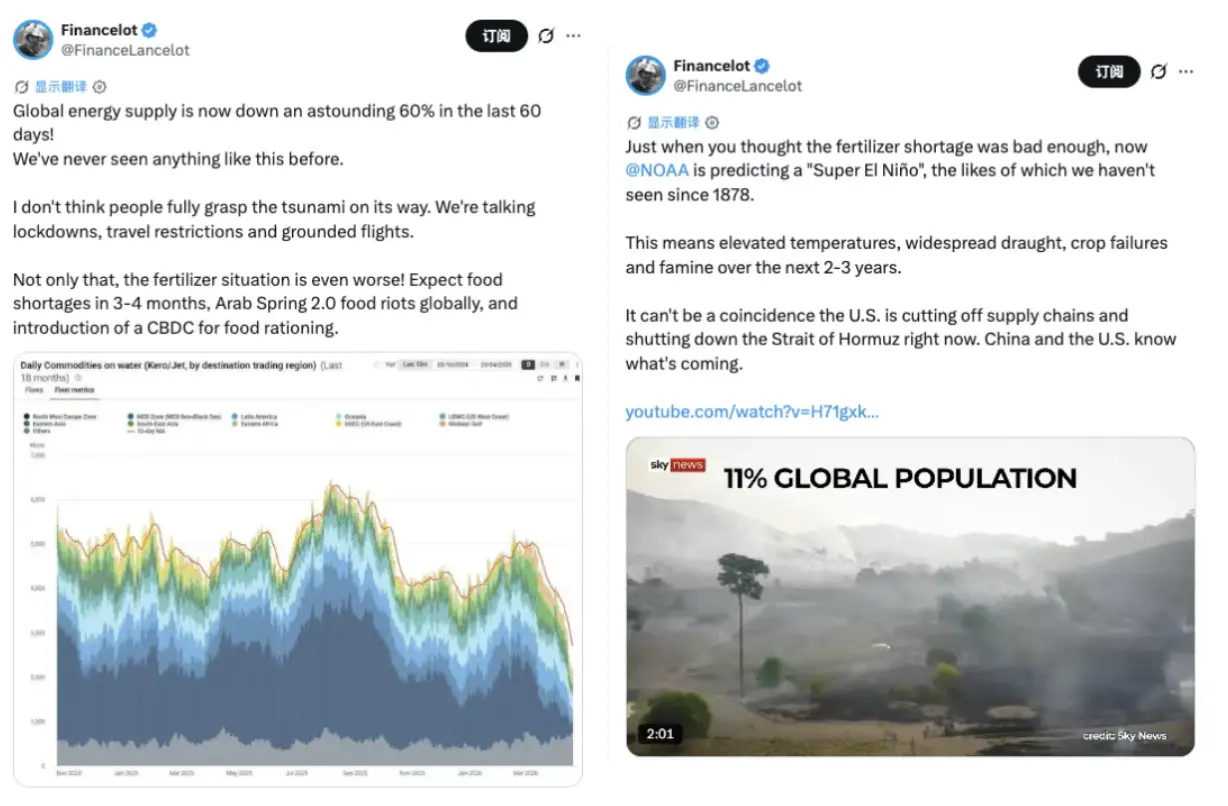
One said NOAA (the U.S. National Oceanic and Atmospheric Administration, one of the world's most frequently cited climate monitoring agencies) is predicting a "super El Niño" unseen since 1878, implying warming, widespread drought, crop failures, and famine risks over the next two to three years. It was accompanied by a Sky News video titled "11% of the global population."

Another post expressed a similar view: global energy and maritime supply has fallen 60% in the past 60 days, accompanied by a shipping oil product flow chart showing a cliff-like drop from the start of the year. His conclusion: fertilizer shortages coupled with El Niño could lead to food shortages globally within 3 to 4 months.

The wording of these posts carries obvious doomsday overtones and shouldn't be taken at face value.

But they reflect one thing: a group of people in the market are already weaving a narrative connecting El Niño, energy supply disruptions, fertilizer shortages, and tensions in the Strait of Hormuz. And this narrative is gaining traction and attention.

More importantly, this narrative points not just to gains and losses in futures accounts, but to potential impacts on the lives of ordinary people, adding to everyone's cost of living.

At first, no one cared about this storm. It was just a typhoon, a downpour, a slight rise in sea temperature.

But the storm doesn't stop just because no one cares. The heavy rains around the world, the canceled flights, the disappearing anchovies in Peru, the rotting cocoa pods in Ghana, the sugar shortages—these are already part of the storm, destined to land in the lives of different people.


Trending Cryptos

Related Questions

QWhat is ENSO (El Niño-Southern Oscillation) and how does it act as a 'fever' for the Pacific, according to the article?

AENSO describes the periodic variation in sea surface temperatures and atmospheric circulation in the Pacific Ocean. During an El Niño event, weakened trade winds allow warm water to flow back east, causing abnormally high sea temperatures in the central-eastern Pacific. The article metaphorically calls this a 'fever' for the Pacific, referencing a scientist's post showing a vast area of deep orange and red on a sea temperature map, indicating a massive oceanic heatwave.

QWho was Richard Dennis and how did his first major profit relate to an El Niño event?

ARichard Dennis was a young trader who later became famous as a founder of the 'Turtle Traders.' His first major profit came in the 1970s by trading soybeans. The price surge was indirectly caused by an El Niño event off Peru, which devastated the anchovy population. As fishmeal (made from anchovies) became scarce and expensive, feed manufacturers switched to soybean meal, driving up soybean prices. Dennis capitalized on this trend, making around $500,000 and becoming a millionaire by the end of 1974.

QWhat are some of the key financial indicators or data points that traders are watching to gauge the impact of the 2026 El Niño on commodity markets?

ATraders are monitoring several key indicators: 1) Whether the Niño3.4 index exceeds 2.0°C in autumn/winter, marking a shift to a strong El Niño. 2) India's monsoon rainfall data from June to September, crucial for sugar, cotton, and rice. 3) Monthly stock reports from the Malaysian Palm Oil Board to see if high inventories are decreasing. 4) Rainfall in Guangxi, China, and the duration of heatwaves in North China, affecting sugar and electricity demand. 5) The fundraising scale of weather-focused funds like Moreton Capital Partners, indicating institutional interest.

QHow does the article illustrate the time lag between an El Niño event and its full impact on commodity prices?

AThe article highlights that the most significant price effects often occur after the El Niño peaks, not during its initial development. For example, Richard Dennis profited from the 1972-73 El Niño's impact on soybeans in 1974. Similarly, the 2024 cocoa price explosion happened after the ENSO cycle had turned neutral. The article suggests that for the 2026 event, the market in late 2026 is trading on anticipation, while 2027 will likely trade on the actual supply shortages and减产 (yield reduction) itself.

QBeyond specific trades, what broader, more alarming narrative is emerging in some financial communities regarding the 2026 El Niño, according to the article's conclusion?

AA broader, more alarming narrative is forming that connects several crises: the potential 'super El Niño,' a reported 60% drop in global energy and maritime shipping supplies, fertilizer shortages, and geopolitical tensions like those around the Strait of Hormuz. This narrative, promoted by some financial commentators, warns of widespread drought, crop failures, and the risk of global food shortages impacting '11% of the global population' within a few months, ultimately affecting the cost of living for ordinary people worldwide.

Related Reads

Bitcoin’s path to $80K may hinge on THIS hidden trend

Bitcoin's potential path toward $80,000 is influenced by conflicting market signals. Data shows the Coinbase Bitcoin Premium Index has recorded its longest-ever streak of consecutive negative premiums, indicating muted institutional demand or net selling from U.S. institutions. While such a trend often signals short-term weakness, it doesn't necessarily forecast a long-term bear market. Additionally, a bearish crossover occurred in Bitcoin's Net Unrealized Profit/Loss (NUPL), with its short-term average falling below the longer-term average, suggesting declining investor profitability and waning market momentum. Historically, major bear market bottoms saw the 100-day NUPL drop below zero, but this cycle it remains positive, implying either an unprecedented bottom or a further decline is needed. Currently trading around $63,148, Bitcoin has seen weekly gains but remains below its May peak. Technical indicators present a mixed picture: the MACD shows bullish momentum, while the RSI signals bearish pressure. A positive development is the return of inflows to Bitcoin ETFs after eight weeks of outflows. Analysts hold divergent views; some highlight a key liquidity zone between $48,000-$50,000 where a market bottom could form, while others maintain a more optimistic long-term outlook. Ultimately, while some bullish signs exist, a strong push from institutional investors appears crucial for Bitcoin to challenge the $80,000 level.

ambcrypto14m ago

Bitcoin’s path to $80K may hinge on THIS hidden trend

ambcrypto14m ago

Unexpected Weak Non-Farm Payrolls Data Pushes BTC to Rebound 11%, FOMC Minutes to Test the Narrative of This Rally

Bitcoin has rebounded 11% from its 21-month low, but the sustainability of this rally hinges entirely on the Federal Reserve's release of the June FOMC meeting minutes. The bounce was triggered by a weaker-than-expected US jobs report, which showed only 57,000 jobs added in June—about half of economists' forecasts. This data prompted traders to scale back bets on further Fed rate hikes, fueling a rally in Bitcoin alongside gold and stocks. The upcoming minutes are critical. They will reveal whether Fed officials, in their mid-June meeting, were already expressing concerns about a weakening labor market, tight credit conditions, or the risks of overtightening—factors that would support the market's recent dovish shift. Conversely, if the discussion focused on persistent inflation and the conditions for more rate hikes, the rally's foundational narrative would crumble. Market indicators show the rebound's fragility. While US spot Bitcoin ETFs saw a significant single-day inflow, it followed a prolonged period of outflows. On-chain data indicates a substantial increase in Bitcoin being moved to exchanges, creating potential sell pressure. Options market positioning suggests key price levels around $60,000 and $62,000 that could either stabilize or accelerate price movement. In essence, Bitcoin's 11% gain is built on speculation about the Fed's private deliberations three weeks ago. The FOMC minutes will replace that speculation with concrete details, and the discrepancy between market expectations and the actual record will determine whether Bitcoin holds above $64,000 or falls back toward $58,000.

marsbit24m ago

Unexpected Weak Non-Farm Payrolls Data Pushes BTC to Rebound 11%, FOMC Minutes to Test the Narrative of This Rally

marsbit24m ago

Just Now, The World's First Ultra-High-Frame World Model Was Born, Nvidia Content 0, Racing to 50 FPS

Just Now, Global First Ultra-High-Frame World Model Born, 0% NVIDIA, Speeds to 50 FPS A Chinese team has developed MoWorld, the world's first Flash World Model, achieving real-time interactive inference exceeding 50 FPS. Crucially, it is entirely built on domestic NPUs (National Processing Units), bypassing NVIDIA GPUs. Developed by Moxin Technology in collaboration with Zhejiang University's Pan Yunhe academician team, MoWorld represents a complete, closed-loop system from training and distillation to deployment on domestic computing power. The model tackles the critical industry bottleneck of real-time performance, essential for applications like robotics, gaming, and digital worlds. MoWorld achieves this through a full-stack redesign for NPUs, including a proprietary 3D-annotated data pipeline, system-level optimizations for long-sequence training (up to 2000 frames), and inference optimizations like dynamic mixed-precision quantization. On a Huawei Ascend 910C platform, a 14B MoE parameter model achieves over 50 FPS, reducing typical inference costs by 70% compared to equivalent GPU solutions. This breakthrough lowers the deployment barrier, potentially accelerating the industrialization of world models. Key application areas include gaming/entertainment (offering 6-DoF camera control for immersive exploration), embodied AI/autonomous driving (providing a high-fidelity digital training ground), film pre-visualization, and 3D reconstruction/digital twins due to its strong geometric consistency. MoWorld demonstrates that a full-stack domestic compute ecosystem can support cutting-edge, real-time world models, positioning China at a competitive starting line in defining next-generation spatial intelligence standards. The project underscores a shift in competition from model scale to real-world usability and cost-effective deployment.

marsbit1h ago

Just Now, The World's First Ultra-High-Frame World Model Was Born, Nvidia Content 0, Racing to 50 FPS

marsbit1h ago

Pacific 'Fever': How Extreme Weather Becomes Wall Street's Cash Machine?

"Pacific Fever": How Extreme Weather Becomes Wall Street's ATM? The summer of 2026 sees unusually fierce weather across China and globally. The common driver behind this global pattern is a powerful El Niño event, potentially the strongest since 1950, as declared by NOAA. This phenomenon, characterized by warming central/eastern Pacific waters, disrupts global atmospheric circulation, raising risks of floods, droughts, and heatwaves, further intensified by climate change. For financial markets, especially commodities, El Niño is not just weather but a major trading theme. History shows its price impact is profound. In the 1970s, El Niño-driven anchovy collapse in Peru fueled a soybean boom, giving Richard Dennis his first million. Anthony Ward's cocoa empire was built on superior weather intelligence. Most recently in 2024, West African droughts caused cocoa prices to soar over 400%, delivering huge gains for trend-following hedge funds. In 2026, markets are again pricing in future El Niño-induced supply shocks. Despite high current inventories, prices for palm oil, rubber, and sugar have rallied on anticipation of upcoming Southeast Asian droughts and weak Indian monsoons. Analysts identify key indicators to watch: the Niño3.4 index, Indian monsoon rainfall, Malaysian palm oil stocks, and the fundraising scale of specialized weather funds like Moreton Capital. Beyond trading opportunities, a concerning narrative is gaining traction online, linking El Niño with fertilizer shortages and energy supply disruptions to warn of potential global food crises within months. While alarmist, it highlights a deeper truth: the cascading effects of climate-driven weather extremes ultimately translate into higher costs of living for everyone, far beyond the trading floor.

marsbit1h ago

Pacific 'Fever': How Extreme Weather Becomes Wall Street's Cash Machine?

marsbit1h ago

Just Now, OpenAI's Chief Futurist Departed, Once Called a Jackass by Musk

Just now, OpenAI's Chief Futurist, Joshua Achiam, announced his departure from the company via X. Having joined as a 25-year-old intern in 2017, he spent nine years at OpenAI, evolving from an AI safety research scientist to leading the Mission Alignment team. Earlier this year, that team was dissolved, and Achiam transitioned to the newly created role of Chief Futurist, positioned at the intersection of AI safety and policy to study AGI's long-term risks and opportunities. In his departure statement, Achiam called his time a "graduation," reflecting on the immense progress from AI that couldn't converse to systems solving scientific problems. He expressed optimism about a future of peace, prosperity, and possibility, closing with "To safe AGI." His tenure was notably marked by a 2018 incident where he publicly challenged Elon Musk—then still with OpenAI—on safety compromises if Musk pursued AGI at Tesla, leading Musk to call him a "jackass." This became an internal legend, with colleagues later giving him a trophy inscribed, "To safety, never stop being that jackass." Achiam's exit follows a pattern of prominent safety and alignment experts leaving OpenAI, including Jan Leike and others who joined rivals like Anthropic or started non-profits. His departure coincides with OpenAI's internal efforts to more tightly integrate its research and policy teams, and the recent hiring of former White House AI advisor Dean Ball. Achiam did not cite a specific reason for leaving but indicated it was a long-considered decision, stating the mission to ensure AGI benefits humanity can now be advanced beyond the "frontier lab's" walls.

marsbit1h ago

Just Now, OpenAI's Chief Futurist Departed, Once Called a Jackass by Musk

marsbit1h ago

Trading

Spot

Hot Articles

What is SONIC

Sonic: Pioneering the Future of Gaming in Web3 Introduction to Sonic In the ever-evolving landscape of Web3, the gaming industry stands out as one of the most dynamic and promising sectors. At the forefront of this revolution is Sonic, a project designed to amplify the gaming ecosystem on the Solana blockchain. Leveraging cutting-edge technology, Sonic aims to deliver an unparalleled gaming experience by efficiently processing millions of requests per second, ensuring that players enjoy seamless gameplay while maintaining low transaction costs. This article delves into the intricate details of Sonic, exploring its creators, funding sources, operational mechanics, and the timeline of significant events that have shaped its journey. What is Sonic? Sonic is an innovative layer-2 network that operates atop the Solana blockchain, specifically tailored to enhance the existing Solana gaming ecosystem. It accomplishes this through a customised, VM-agnostic game engine paired with a HyperGrid interpreter, facilitating sovereign game economies that roll up back to the Solana platform. The primary goals of Sonic include: Enhanced Gaming Experiences: Sonic is committed to offering lightning-fast on-chain gameplay, allowing players and developers to engage with games at previously unattainable speeds. Atomic Interoperability: This feature enables transactions to be executed within Sonic without the need to redeploy Solana programmes and accounts. This makes the process more efficient and directly benefits from Solana Layer1 services and liquidity. Seamless Deployment: Sonic allows developers to write for Ethereum Virtual Machine (EVM) based systems and execute them on Solana’s SVM infrastructure. This interoperability is crucial for attracting a broader range of dApps and decentralised applications to the platform. Support for Developers: By offering native composable gaming primitives and extensible data types - dining within the Entity-Component-System (ECS) framework - game creators can craft intricate business logic with ease. Overall, Sonic's unique approach not only caters to players but also provides an accessible and low-cost environment for developers to innovate and thrive. Creator of Sonic The information regarding the creator of Sonic is somewhat ambiguous. However, it is known that Sonic's SVM is owned by the company Mirror World. The absence of detailed information about the individuals behind Sonic reflects a common trend in several Web3 projects, where collective efforts and partnerships often overshadow individual contributions. Investors of Sonic Sonic has garnered considerable attention and support from various investors within the crypto and gaming sectors. Notably, the project raised an impressive $12 million during its Series A funding round. The round was led by BITKRAFT Ventures, with other notable investors including Galaxy, Okx Ventures, Interactive, Big Brain Holdings, and Mirana. This financial backing signifies the confidence that investment foundations have in Sonic’s potential to revolutionise the Web3 gaming landscape, further validating its innovative approaches and technologies. How Does Sonic Work? Sonic utilises the HyperGrid framework, a sophisticated parallel processing mechanism that enhances its scalability and customisability. Here are the core features that set Sonic apart: Lightning Speed at Low Costs: Sonic offers one of the fastest on-chain gaming experiences compared to other Layer-1 solutions, powered by the scalability of Solana’s virtual machine (SVM). Atomic Interoperability: Sonic enables transaction execution without redeployment of Solana programmes and accounts, effectively streamlining the interaction between users and the blockchain. EVM Compatibility: Developers can effortlessly migrate decentralised applications from EVM chains to the Solana environment using Sonic’s HyperGrid interpreter, increasing the accessibility and integration of various dApps. Ecosystem Support for Developers: By exposing native composable gaming primitives, Sonic facilitates a sandbox-like environment where developers can experiment and implement business logic, greatly enhancing the overall development experience. Monetisation Infrastructure: Sonic natively supports growth and monetisation efforts, providing frameworks for traffic generation, payments, and settlements, thereby ensuring that gaming projects are not only viable but also sustainable financially. Timeline of Sonic The evolution of Sonic has been marked by several key milestones. Below is a brief timeline highlighting critical events in the project's history: 2022: The Sonic cryptocurrency was officially launched, marking the beginning of its journey in the Web3 gaming arena. 2024: June: Sonic SVM successfully raised $12 million in a Series A funding round. This investment allowed Sonic to further develop its platform and expand its offerings. August: The launch of the Sonic Odyssey testnet provided users with the first opportunity to engage with the platform, offering interactive activities such as collecting rings—a nod to gaming nostalgia. October: SonicX, an innovative crypto game integrated with Solana, made its debut on TikTok, capturing the attention of over 120,000 users within a short span. This integration illustrated Sonic’s commitment to reaching a broader, global audience and showcased the potential of blockchain gaming. Key Points Sonic SVM is a revolutionary layer-2 network on Solana explicitly designed to enhance the GameFi landscape, demonstrating great potential for future development. HyperGrid Framework empowers Sonic by introducing horizontal scaling capabilities, ensuring that the network can handle the demands of Web3 gaming. Integration with Social Platforms: The successful launch of SonicX on TikTok displays Sonic’s strategy to leverage social media platforms to engage users, exponentially increasing the exposure and reach of its projects. Investment Confidence: The substantial funding from BITKRAFT Ventures, among others, emphasizes the robust backing Sonic has, paving the way for its ambitious future. In conclusion, Sonic encapsulates the essence of Web3 gaming innovation, striking a balance between cutting-edge technology, developer-centric tools, and community engagement. As the project continues to evolve, it is poised to redefine the gaming landscape, making it a notable entity for gamers and developers alike. As Sonic moves forward, it will undoubtedly attract greater interest and participation, solidifying its place within the broader narrative of blockchain gaming.

1.8k Total ViewsPublished 2024.04.04Updated 2024.12.03

What is SONIC

What is $S$

Understanding SPERO: A Comprehensive Overview Introduction to SPERO As the landscape of innovation continues to evolve, the emergence of web3 technologies and cryptocurrency projects plays a pivotal role in shaping the digital future. One project that has garnered attention in this dynamic field is SPERO, denoted as SPERO,$$s$. This article aims to gather and present detailed information about SPERO, to help enthusiasts and investors understand its foundations, objectives, and innovations within the web3 and crypto domains. What is SPERO,$$s$? SPERO,$$s$ is a unique project within the crypto space that seeks to leverage the principles of decentralisation and blockchain technology to create an ecosystem that promotes engagement, utility, and financial inclusion. The project is tailored to facilitate peer-to-peer interactions in new ways, providing users with innovative financial solutions and services. At its core, SPERO,$$s$ aims to empower individuals by providing tools and platforms that enhance user experience in the cryptocurrency space. This includes enabling more flexible transaction methods, fostering community-driven initiatives, and creating pathways for financial opportunities through decentralised applications (dApps). The underlying vision of SPERO,$$s$ revolves around inclusiveness, aiming to bridge gaps within traditional finance while harnessing the benefits of blockchain technology. Who is the Creator of SPERO,$$s$? The identity of the creator of SPERO,$$s$ remains somewhat obscure, as there are limited publicly available resources providing detailed background information on its founder(s). This lack of transparency can stem from the project's commitment to decentralisation—an ethos that many web3 projects share, prioritising collective contributions over individual recognition. By centring discussions around the community and its collective goals, SPERO,$$s$ embodies the essence of empowerment without singling out specific individuals. As such, understanding the ethos and mission of SPERO remains more important than identifying a singular creator. Who are the Investors of SPERO,$$s$? SPERO,$$s$ is supported by a diverse array of investors ranging from venture capitalists to angel investors dedicated to fostering innovation in the crypto sector. The focus of these investors generally aligns with SPERO's mission—prioritising projects that promise societal technological advancement, financial inclusivity, and decentralised governance. These investor foundations are typically interested in projects that not only offer innovative products but also contribute positively to the blockchain community and its ecosystems. The backing from these investors reinforces SPERO,$$s$ as a noteworthy contender in the rapidly evolving domain of crypto projects. How Does SPERO,$$s$ Work? SPERO,$$s$ employs a multi-faceted framework that distinguishes it from conventional cryptocurrency projects. Here are some of the key features that underline its uniqueness and innovation: Decentralised Governance: SPERO,$$s$ integrates decentralised governance models, empowering users to participate actively in decision-making processes regarding the project’s future. This approach fosters a sense of ownership and accountability among community members. Token Utility: SPERO,$$s$ utilises its own cryptocurrency token, designed to serve various functions within the ecosystem. These tokens enable transactions, rewards, and the facilitation of services offered on the platform, enhancing overall engagement and utility. Layered Architecture: The technical architecture of SPERO,$$s$ supports modularity and scalability, allowing for seamless integration of additional features and applications as the project evolves. This adaptability is paramount for sustaining relevance in the ever-changing crypto landscape. Community Engagement: The project emphasises community-driven initiatives, employing mechanisms that incentivise collaboration and feedback. By nurturing a strong community, SPERO,$$s$ can better address user needs and adapt to market trends. Focus on Inclusion: By offering low transaction fees and user-friendly interfaces, SPERO,$$s$ aims to attract a diverse user base, including individuals who may not previously have engaged in the crypto space. This commitment to inclusion aligns with its overarching mission of empowerment through accessibility. Timeline of SPERO,$$s$ Understanding a project's history provides crucial insights into its development trajectory and milestones. Below is a suggested timeline mapping significant events in the evolution of SPERO,$$s$: Conceptualisation and Ideation Phase: The initial ideas forming the basis of SPERO,$$s$ were conceived, aligning closely with the principles of decentralisation and community focus within the blockchain industry. Launch of Project Whitepaper: Following the conceptual phase, a comprehensive whitepaper detailing the vision, goals, and technological infrastructure of SPERO,$$s$ was released to garner community interest and feedback. Community Building and Early Engagements: Active outreach efforts were made to build a community of early adopters and potential investors, facilitating discussions around the project’s goals and garnering support. Token Generation Event: SPERO,$$s$ conducted a token generation event (TGE) to distribute its native tokens to early supporters and establish initial liquidity within the ecosystem. Launch of Initial dApp: The first decentralised application (dApp) associated with SPERO,$$s$ went live, allowing users to engage with the platform's core functionalities. Ongoing Development and Partnerships: Continuous updates and enhancements to the project's offerings, including strategic partnerships with other players in the blockchain space, have shaped SPERO,$$s$ into a competitive and evolving player in the crypto market. Conclusion SPERO,$$s$ stands as a testament to the potential of web3 and cryptocurrency to revolutionise financial systems and empower individuals. With a commitment to decentralised governance, community engagement, and innovatively designed functionalities, it paves the way toward a more inclusive financial landscape. As with any investment in the rapidly evolving crypto space, potential investors and users are encouraged to research thoroughly and engage thoughtfully with the ongoing developments within SPERO,$$s$. The project showcases the innovative spirit of the crypto industry, inviting further exploration into its myriad possibilities. While the journey of SPERO,$$s$ is still unfolding, its foundational principles may indeed influence the future of how we interact with technology, finance, and each other in interconnected digital ecosystems.

100 Total ViewsPublished 2024.12.17Updated 2024.12.17

What is $S$

What is AGENT S

Agent S: The Future of Autonomous Interaction in Web3 Introduction In the ever-evolving landscape of Web3 and cryptocurrency, innovations are constantly redefining how individuals interact with digital platforms. One such pioneering project, Agent S, promises to revolutionise human-computer interaction through its open agentic framework. By paving the way for autonomous interactions, Agent S aims to simplify complex tasks, offering transformative applications in artificial intelligence (AI). This detailed exploration will delve into the project's intricacies, its unique features, and the implications for the cryptocurrency domain. What is Agent S? Agent S stands as a groundbreaking open agentic framework, specifically designed to tackle three fundamental challenges in the automation of computer tasks: Acquiring Domain-Specific Knowledge: The framework intelligently learns from various external knowledge sources and internal experiences. This dual approach empowers it to build a rich repository of domain-specific knowledge, enhancing its performance in task execution. Planning Over Long Task Horizons: Agent S employs experience-augmented hierarchical planning, a strategic approach that facilitates efficient breakdown and execution of intricate tasks. This feature significantly enhances its ability to manage multiple subtasks efficiently and effectively. Handling Dynamic, Non-Uniform Interfaces: The project introduces the Agent-Computer Interface (ACI), an innovative solution that enhances the interaction between agents and users. Utilizing Multimodal Large Language Models (MLLMs), Agent S can navigate and manipulate diverse graphical user interfaces seamlessly. Through these pioneering features, Agent S provides a robust framework that addresses the complexities involved in automating human interaction with machines, setting the stage for myriad applications in AI and beyond. Who is the Creator of Agent S? While the concept of Agent S is fundamentally innovative, specific information about its creator remains elusive. The creator is currently unknown, which highlights either the nascent stage of the project or the strategic choice to keep founding members under wraps. Regardless of anonymity, the focus remains on the framework's capabilities and potential. Who are the Investors of Agent S? As Agent S is relatively new in the cryptographic ecosystem, detailed information regarding its investors and financial backers is not explicitly documented. The lack of publicly available insights into the investment foundations or organisations supporting the project raises questions about its funding structure and development roadmap. Understanding the backing is crucial for gauging the project's sustainability and potential market impact. How Does Agent S Work? At the core of Agent S lies cutting-edge technology that enables it to function effectively in diverse settings. Its operational model is built around several key features: Human-like Computer Interaction: The framework offers advanced AI planning, striving to make interactions with computers more intuitive. By mimicking human behaviour in tasks execution, it promises to elevate user experiences. Narrative Memory: Employed to leverage high-level experiences, Agent S utilises narrative memory to keep track of task histories, thereby enhancing its decision-making processes. Episodic Memory: This feature provides users with step-by-step guidance, allowing the framework to offer contextual support as tasks unfold. Support for OpenACI: With the ability to run locally, Agent S allows users to maintain control over their interactions and workflows, aligning with the decentralised ethos of Web3. Easy Integration with External APIs: Its versatility and compatibility with various AI platforms ensure that Agent S can fit seamlessly into existing technological ecosystems, making it an appealing choice for developers and organisations. These functionalities collectively contribute to Agent S's unique position within the crypto space, as it automates complex, multi-step tasks with minimal human intervention. As the project evolves, its potential applications in Web3 could redefine how digital interactions unfold. Timeline of Agent S The development and milestones of Agent S can be encapsulated in a timeline that highlights its significant events: September 27, 2024: The concept of Agent S was launched in a comprehensive research paper titled “An Open Agentic Framework that Uses Computers Like a Human,” showcasing the groundwork for the project. October 10, 2024: The research paper was made publicly available on arXiv, offering an in-depth exploration of the framework and its performance evaluation based on the OSWorld benchmark. October 12, 2024: A video presentation was released, providing a visual insight into the capabilities and features of Agent S, further engaging potential users and investors. These markers in the timeline not only illustrate the progress of Agent S but also indicate its commitment to transparency and community engagement. Key Points About Agent S As the Agent S framework continues to evolve, several key attributes stand out, underscoring its innovative nature and potential: Innovative Framework: Designed to provide an intuitive use of computers akin to human interaction, Agent S brings a novel approach to task automation. Autonomous Interaction: The ability to interact autonomously with computers through GUI signifies a leap towards more intelligent and efficient computing solutions. Complex Task Automation: With its robust methodology, it can automate complex, multi-step tasks, making processes faster and less error-prone. Continuous Improvement: The learning mechanisms enable Agent S to improve from past experiences, continually enhancing its performance and efficacy. Versatility: Its adaptability across different operating environments like OSWorld and WindowsAgentArena ensures that it can serve a broad range of applications. As Agent S positions itself in the Web3 and crypto landscape, its potential to enhance interaction capabilities and automate processes signifies a significant advancement in AI technologies. Through its innovative framework, Agent S exemplifies the future of digital interactions, promising a more seamless and efficient experience for users across various industries. Conclusion Agent S represents a bold leap forward in the marriage of AI and Web3, with the capacity to redefine how we interact with technology. While still in its early stages, the possibilities for its application are vast and compelling. Through its comprehensive framework addressing critical challenges, Agent S aims to bring autonomous interactions to the forefront of the digital experience. As we move deeper into the realms of cryptocurrency and decentralisation, projects like Agent S will undoubtedly play a crucial role in shaping the future of technology and human-computer collaboration.

768 Total ViewsPublished 2025.01.14Updated 2025.01.14

What is AGENT S

Discussions

Welcome to the HTX Community. Here, you can stay informed about the latest platform developments and gain access to professional market insights. Users' opinions on the price of S (S) are presented below.

活动图片