Nobel Laureate Becomes New Employee at Anthropic

marsbitPublished on 2026-06-20Last updated on 2026-06-20

Abstract

Nobel laureate and AlphaFold lead John Jumper has left Google DeepMind after nearly nine years to join AI company Anthropic. Jumper, who co-won the 2024 Nobel Prize in Chemistry for his work on the protein-structure-predicting AI, led the AlphaFold project from its early stages, revolutionizing structural biology by predicting hundreds of millions of protein structures. His departure follows closely that of Transformer co-inventor Noam Shazeer, who recently left Google for OpenAI, marking a significant talent drain for the tech giant. Analysts suggest top AI researchers are seeking environments where individual impact can more directly shape a company's trajectory. Anthropic's hiring of Jumper signals a major push into AI for life sciences. The company recently acquired biotech firm Coefficient Bio and is building wet labs, aiming to drastically accelerate drug discovery and biomedical research. This move aligns with a broader trend, as OpenAI and Google DeepMind (via Isomorphic Labs) are also heavily investing in AI-driven biology and healthcare. The stage is now set for intensified competition among AI leaders to redefine life sciences through artificial intelligence.

Nobel laureate joins Anthropic!

Today, AlphaFold core leader John Jumper announced: He is leaving Google DeepMind after nearly 9 years and joining Anthropic.

A Nobel laureate who rewrote structural biology with an AI model has turned and left.
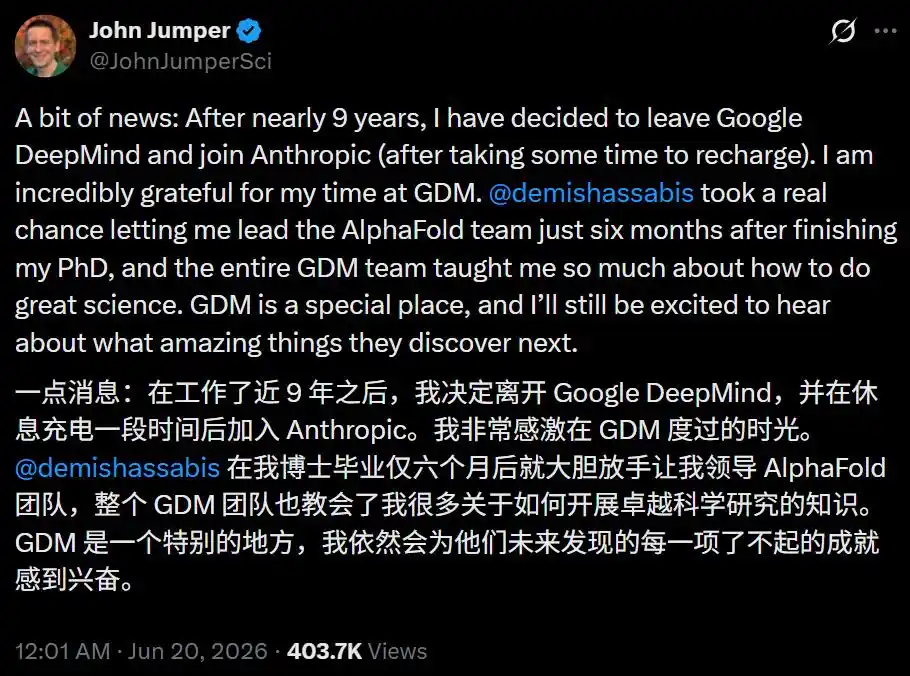
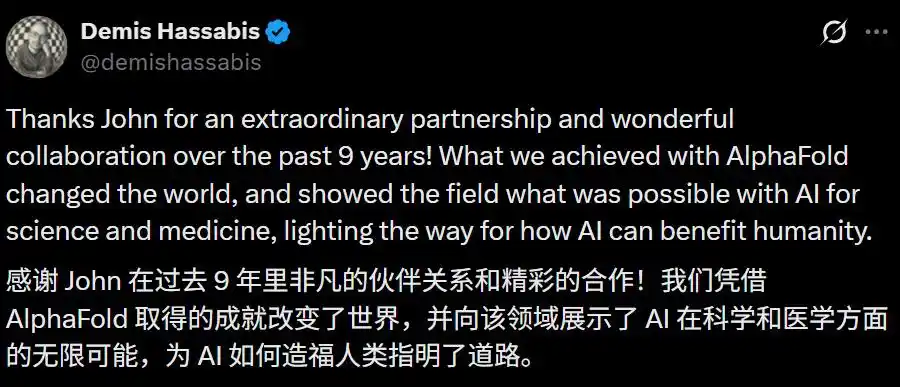
Hassabis responded quickly: "Thank you John for an incredible partnership over the past 9 years! What we achieved with AlphaFold changed the world."

Nine years of collaboration, sharing a Nobel Prize—this is probably the most amicable farewell in the tech circle.
And just two days ago, the legendary co-first author of the Transformer paper and Gemini co-lead, Noam Shazeer, announced he was leaving Google for OpenAI.

In less than 72 hours, Google lost two aces.

One couldn't be kept even after a $2.7 billion buyback, the other couldn't be kept even after 9 years of shared history.

Leading AlphaFold Directly, 6 Months After PhD Graduation

In the life sciences world, John Jumper is practically synonymous with "rewriting an entire discipline with AI."

Born in 1985 in Little Rock, Arkansas, an ordinary small town in the American South.

He earned a dual bachelor's degree in Mathematics and Physics from Vanderbilt, then went on to the University of Chicago all the way to his Ph.D., researching theoretical chemistry. Specifically, using computational methods to simulate the dynamic behavior of proteins.

Mathematics gave him intuition for modeling, physics gave him understanding of complex systems, and theoretical chemistry made him understand the protein problem itself better than any pure AI researcher.

The combination of these three fields just happens to be the rarest knowledge set needed to solve the protein folding problem.

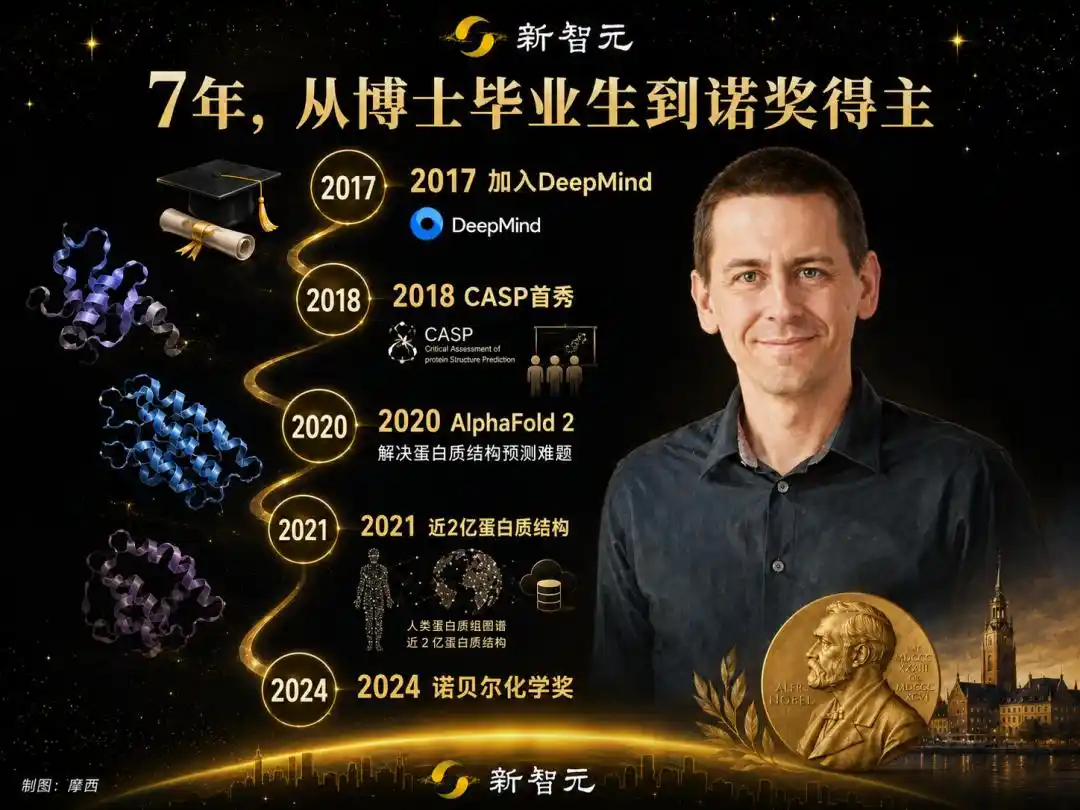
After receiving his Ph.D. in 2017, Jumper directly joined DeepMind.
Notably, at that time he had almost no deep learning experience. What stood out on his resume was not mastery of neural networks, but his understanding of protein physics.

But that's precisely what Hassabis valued.

Immediately after, he made a decision no one expected—letting this young man, who had graduated only 6 months prior and had to learn deep learning on the job, directly lead the AlphaFold team.

No transition period, no "do a few years as a researcher to build seniority."

Hassabis was betting that solving the protein folding puzzle required understanding proteins more than understanding AI. And what Jumper took on was the biggest gamble in the entire field of computational biology.

Single-handedly Scaling Biology by 1000x

What happened in the following years can only be described as "unbelievable"—

2018, AlphaFold made its debut at the protein structure prediction competition CASP, crushing traditional methods.

2020, AlphaFold 2 emerged, directly "solving" the protein folding problem that had puzzled biologists for 50 years.

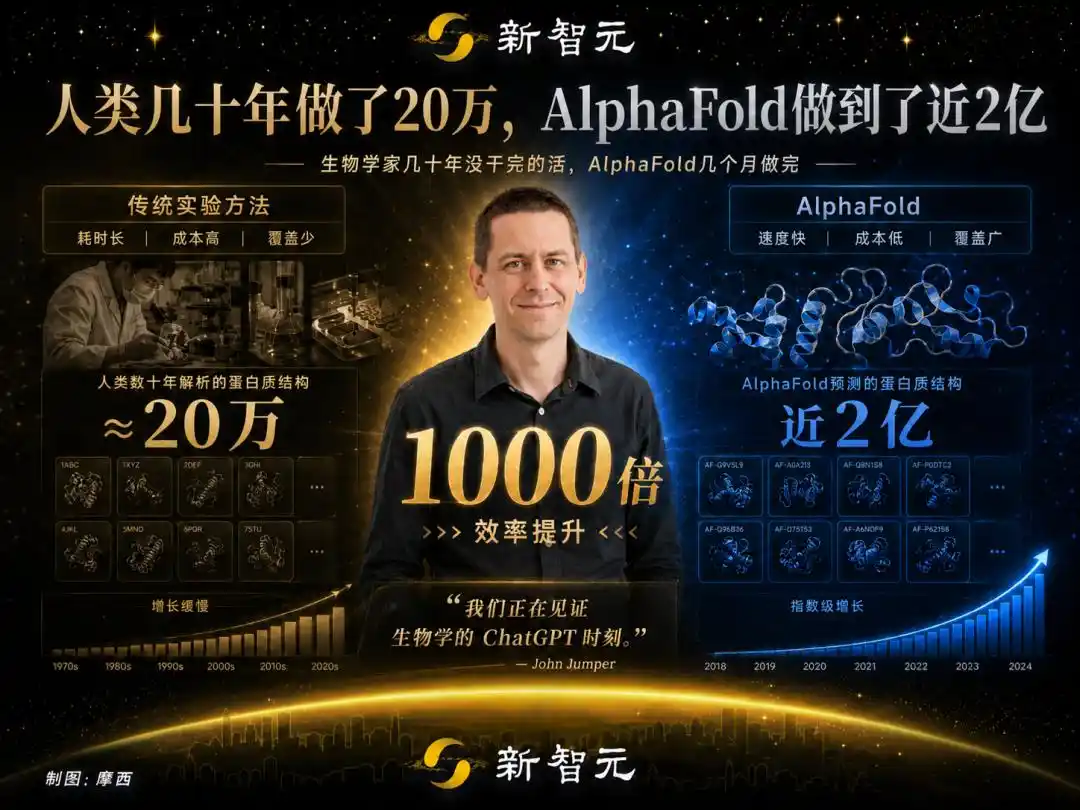
2021, Jumper's team calculated the 3D structures of nearly all 50,000+ human proteins. Ultimately, they generated structures for about 1 million species, nearly 200 million known protein structures.

Before AlphaFold, humanity spent decades using experimental methods like X-ray crystallography, cryo-electron microscopy to solve about 200,000 protein structures in total.

Jumper's team scaled that by 1000x in one go.

It's no exaggeration to say that the work biologists hadn't finished in the past hundred years, AlphaFold did in a few months.
May 2024, AlphaFold 3 was released—not just predicting proteins anymore, it can calculate interactions between DNA, RNA, small molecule drugs. Protein-ligand docking accuracy 76.4%, 1.8x improvement over previous methods.

Five months later in Stockholm, John Jumper and Demis Hassabis stood together on the Nobel Chemistry Prize podium.

That year Jumper was 39, the youngest Chemistry Nobel laureate in 70 years.

From a fresh Ph.D. graduate who had to learn deep learning on the fly, to standing under the Stockholm spotlight, it took him only 7 years.

Thus, the return on Hassabis's bet back then is probably among the highest in the history of human science.

So his departure today is not simply about Google DeepMind losing a Director.

What's Really Going on with Google?

After the news exploded, comments on X directly boiled over.

User Chubby exclaimed: "This is a huge loss for Google, and absolutely insane for Anthropic!"
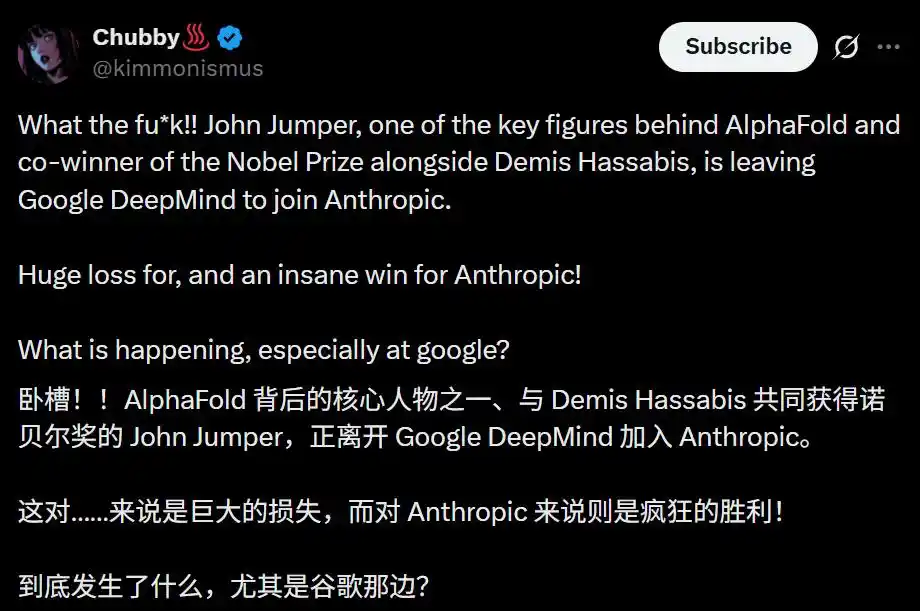
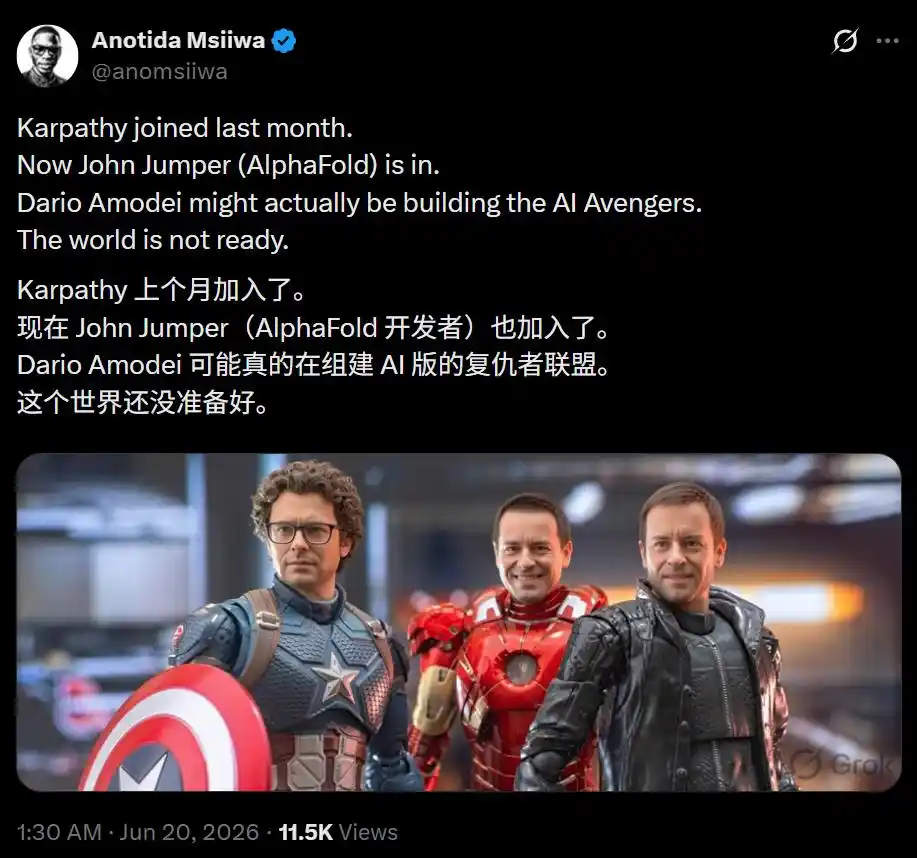
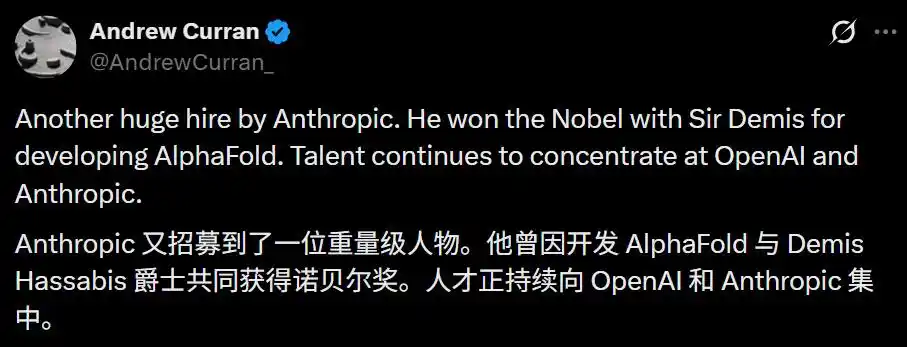
Some lamented, "Anthropic welcomes a Nobel laureate, talent is continuously concentrating towards OpenAI and Anthropic." Others outright declared: "First Karpathy, now the person behind AlphaFold, Anthropic is assembling an AI Avengers."

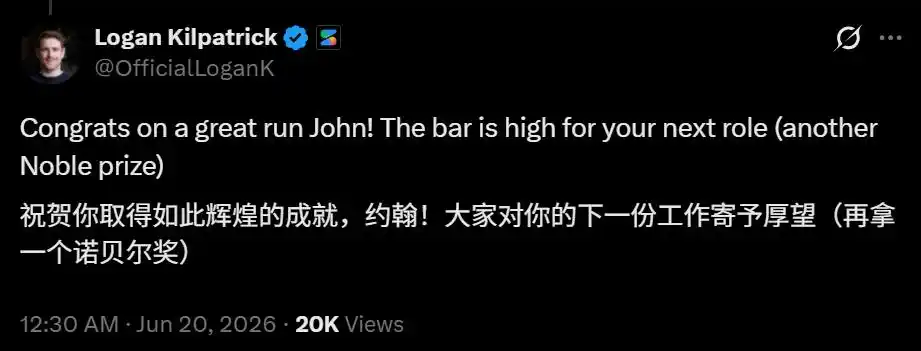
Logan Kilpatrick joked about expecting Jumper to "win another Nobel Prize." The tone was teasing, but on second thought, it's not really an exaggeration.

And after the shock, everyone was asking the same question—what's wrong with Google?
Jumper didn't say, Anthropic didn't say, Google didn't say.

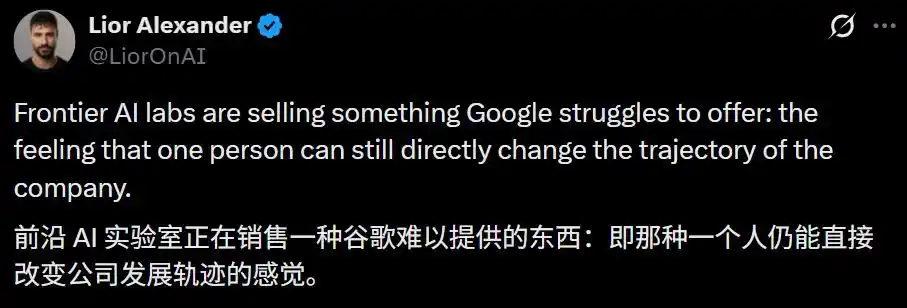
Perhaps a comment by investor Lior Alexander is the closest to an answer currently—

"Frontier AI labs are selling something Google can't offer: the feeling that one person can change a company's trajectory."
Couldn't Keep the Person Bought Back for $2.7 Billion Either

Just two days before Jumper's announcement, Noam Shazeer announced leaving Google for OpenAI, as "Head of Architecture Research."

In the 2017 foundational paper of modern AI, "Attention Is All You Need," he was one of the core authors. The multi-head attention mechanism was his design, the first usable implementation that beat SOTA was coded line by line by him.

And Google spent $2.7 billion to bring him back from Character.AI.

After returning, Shazeer became Gemini co-lead, a key figure in Google's counterattack with large models.

Result: less than two years later, he left again. Two days after that, Jumper left.

They are neither the first, nor will they be the last.
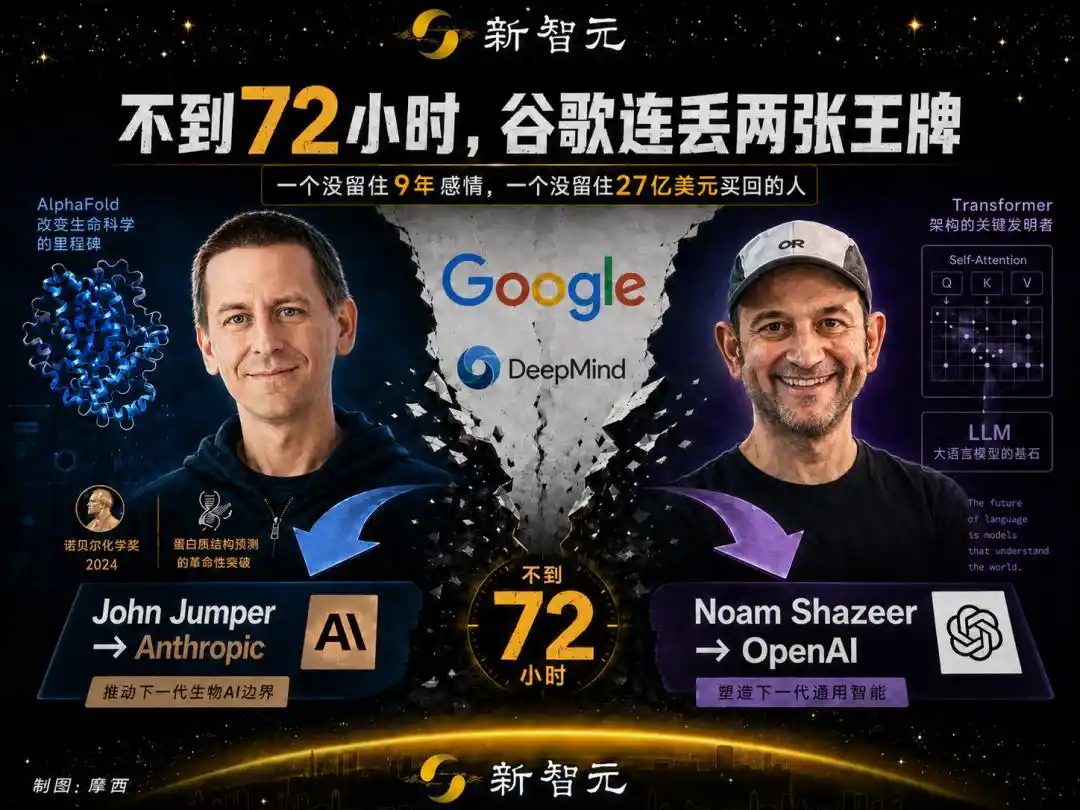
Over the past 8 years, more than 20 top researchers who authored milestone papers have left DeepMind/Brain one after another.

In 2025 alone, at least 11 executives left. DeepMind co-founder Mustafa Suleyman himself was also poached by Microsoft in a $650 million acqui-hire round.

Life Sciences, the Next Battlefield for the AI Big Three

Back to Anthropic's side. The groundwork began over two months ago.

April 3rd, Anthropic acquired biotech company Coefficient Bio for $400 million in stock. The team was less than 10 people but had already achieved top-tier results in AI-driven antibody design.

Meanwhile, Anthropic is also building its own wet lab. Last October, they launched Claude for Life Sciences to help researchers accelerate drug discovery and biological experiment design. This January, they launched Claude for Healthcare for medical institutions.

They say the goal is to compress the life science R&D cycle by 10x. And now, a Nobel-caliber protein scientist is leading this effort.

In fact, it's not just Anthropic betting on life sciences.
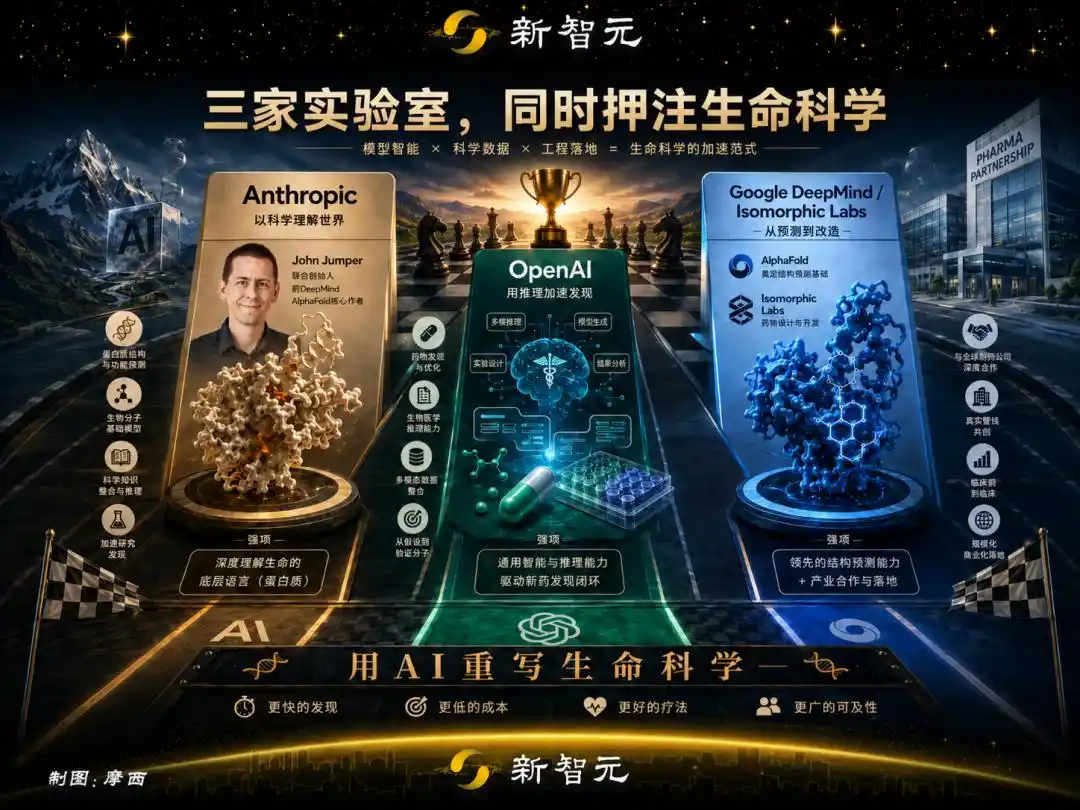
OpenAI released GPT-Rosalind in April this year, a reasoning model specifically for biomedicine, focusing on drug discovery, genomic analysis, and protein engineering. They have already partnered with top pharmaceutical companies like Amgen, Moderna, Thermo Fisher.

The OpenAI Foundation directly stated: investments in life sciences in the coming year will be no less than $1 billion. With the newly poached Shazeer overseeing architecture research, OpenAI is also making a strong move on this track.

On Google DeepMind's side, Hassabis's Isomorphic Labs raised $600 million last year, signed collaboration agreements with Eli Lilly and Novartis with total milestone values up to $3 billion. The AlphaFold technology foundation remains the industry benchmark.

Three labs simultaneously placed their bets on the same direction—rewriting life sciences with AI.

Jumper's choice is just the latest move in this grand chess game.

References:

https://x.com/JohnJumperSci/status/2068001285173834106

Editor: Moses

This article is from the WeChat public account "新智元", author: ASI启示录

Trending Cryptos

Related Questions

QWhat significant move did Nobel laureate John Jumper recently make?

ANobel laureate John Jumper recently announced that he has left Google DeepMind, where he worked for nearly nine years, to join the AI company Anthropic.

QWhat major scientific contribution is John Jumper best known for?

AJohn Jumper is best known for leading the AlphaFold team at Google DeepMind, which developed the AI system that revolutionized structural biology by solving the protein folding problem and predicting the structures of nearly 200 million proteins.

QWhy is John Jumper's departure considered a significant loss for Google?

AHis departure is a significant loss because Jumper was a key leader of the groundbreaking AlphaFold project, a recent Nobel Prize winner, and his move follows closely after another top AI researcher, Noam Shazeer, also left Google, indicating a pattern of top talent leaving for competitors.

QWhat area is Anthropic focusing on with its recent acquisitions and hires?

AAnthropic is focusing on the life sciences sector. This is evidenced by its $400 million stock acquisition of biotech company Coefficient Bio, the establishment of its own wet lab, and now the hiring of Nobel laureate John Jumper, aiming to compress life science R&D cycles.

QWhich other major AI companies are also heavily investing in the life sciences field?

AAlongside Anthropic, OpenAI and Google DeepMind are also heavily investing in life sciences. OpenAI has released GPT-Rosalind for biomedicine and pledged over $1 billion, while Google's Isomorphic Labs has secured major partnerships in drug discovery, all aiming to use AI to rewrite the field.

Related Reads

Two Legends Lost in Three Days: Is Google's AI Talent Dam Cracking?

In three days, Google lost two AI legends. On June 18, Noam Shazeer, co-author of the seminal "Attention is All You Need" paper and Gemini co-lead, left for OpenAI. Just 48 hours later, John Jumper, 2024 Nobel laureate and AlphaFold lead, departed DeepMind for Anthropic. This follows Andrej Karpathy joining Anthropic in May. These moves highlight a structural trend: top AI talent is concentrating at mission-driven, pre-IPO firms like OpenAI and Anthropic, while Google becomes a primary source. The exodus stems from a core mission mismatch. Google's ad-centric model often subordinates AI research to product and revenue goals, creating friction for pioneers like Shazeer, who returned in 2024 only to leave again. In contrast, OpenAI and Anthropic offer singular focus on pushing AI boundaries, whether towards AGI or safety-aligned models, which deeply appeals to top researchers like Jumper. Financial incentives amplify the pull. With both OpenAI and Anthropic nearing IPO, employees stand to gain immensely from equity, an upside Google's mature stock cannot match. Furthermore, the 2023 merger of Google Brain and DeepMind, intended to consolidate strength, has instead created cultural tension and slowed the path from research to product, as evidenced by Gemini's pace. This talent redistribution is reshaping the AI landscape. While Google retains vast data and compute resources, its true crisis is the quiet, continuous loss of the people who define the field's future. The real moat in AI is not infrastructure, but the concentration of brilliant minds—a battle Google is currently losing.

marsbit1h ago

Two Legends Lost in Three Days: Is Google's AI Talent Dam Cracking?

marsbit1h ago

Behind the AI Report Card, Lies a Chinese 'Exam Setter'

Beyond the familiar performance charts like MMLU-Pro and MMMU, which major AI models strive to ace, stands a key "examiner": Chinese-Canadian researcher Wenhu Chen. An assistant professor at the University of Waterloo and founder of TIGERLab, Chen addresses the crucial need for more rigorous AI evaluation. As models like GPT-4 began scoring near-perfect results on older benchmarks like MMLU, it became difficult to distinguish their true capabilities. In response, Chen introduced MMLU-Pro in 2024, featuring harder, more reasoning-focused questions with more answer choices, successfully reintroducing meaningful performance gaps. His work extends to multi-modal evaluation with MMMU and its enhanced version, MMMU-Pro. These benchmarks test a model's ability to understand and reason with complex information from images, charts, and text across diverse academic subjects, exposing the significant challenges even top models face in genuine comprehension. Chen's background in complex QA, table reasoning, and his experience at Google DeepMind on projects like Gemini inform his approach. He understands that effective benchmarks must anticipate how models might "cheat" by memorizing data or avoiding visual analysis. His lab also actively researches video understanding and generation models (e.g., UniVideo, Vamba), ensuring his evaluation work is grounded in practical model-building challenges. Now at Meta's Super Intelligence Lab, Chen continues his focus on multi-modal data and evaluation, representing the deep yet often unseen contributions of Chinese talent in shaping the fundamental tools of the AI industry.

marsbit1h ago

Behind the AI Report Card, Lies a Chinese 'Exam Setter'

marsbit1h ago

Alliance Co-founder's Letter to Entrepreneurs: Written at the Moment Cursor Sold for $600 Billion

Alliance Co-founder's Letter to Entrepreneurs: On Cursor's $60 Billion Sale Many aspiring founders see massive exits like Cursor's $60B sale and wonder why they can't achieve the same, often concluding opportunities are exhausted. But great companies aren't built in obvious, crowded spaces. Cursor, like Stripe, Figma, and Shopify before it, started with a non-consensus belief about the future. Before ChatGPT, they believed AI would transform knowledge work. They focused on a genuinely exciting domain, became their own customer, and obsessed over power users. Their journey involved years of "glass-chewing" effort before the market was ready. The pattern is consistent: identify a long-term technological shift, find a missed entry point, and execute for years before the trend becomes obvious. First-generation products (PayPal, Adobe, Amazon) prove a market exists. Second-generation winners (Stripe, Figma, Shopify) rebuild that market around new insights, technology, or changing customer behaviors. Founders must identify their phase in the cycle. Early entrants like Coinbase or Cursor focus on making new technology usable for power users. Later entrants find the "yin" to the established "yang"—the blind spots incumbents miss as they grow distant from individual users. The key is deep market immersion. Use every product in your space. Talk to users. Build an audience. Stop looking for ideas and start *seeing* them everywhere. Then, choose one. The idea must offer a 10x improvement or solve a "hair-on-fire" pain point—something severe enough that users are already crafting workarounds. When building, avoid feature bloat. Ask: why would someone switch? Great startups rarely force new behaviors; they improve familiar workflows with drastically lower friction (e.g., Cursor forked VS Code instead of creating a new editor). Distribution is the underestimated moat. Before product-market fit, achieve distribution-market fit. How do customers discover new tools? Founders like those at Airbnb, Stripe, and Cursor did unscalable, manual work to recruit early users. The final, unteachable ingredient is resilience. Cursor built for years pre-market, faced rejection, and persisted. So did Airbnb, Nvidia, and Rain (which launched post-FTX collapse). The lesson isn't that these founders were smarter, but that they stayed in the game long enough for their insights to compound. Framework: Spot technological cycles. Cultivate unique insight. Obsess over your market. Talk to customers. Find a hair-on-fire problem. Build the simplest wedge. Win your distribution channel. Above all, don't quit when it gets hard. Most people won't do these things consistently. The few who do build the next generation of great companies. Go build.

marsbit1h ago

Alliance Co-founder's Letter to Entrepreneurs: Written at the Moment Cursor Sold for $600 Billion

marsbit1h ago

Weekly Editor's Picks (0613-0619)

Weekly Editor's Picks (0613-0619): Market Insights & Analysis This weekly digest curates in-depth analysis often lost in the information flow, focusing on key insights across macro trends, investment, and technology. **Macro & Geopolitics:** With the Strait of Hormuz reopening and military conflict shifting to negotiation, markets are pivoting from "war shock" to "supply restoration." Trades include shorting crude risk premiums, longing airlines/tourism, Asian energy importers, and bond duration, while shorting inflation expectations. LNG, fertilizer, and chemical chains are also being repriced. **Investment & VC:** Ray Dalio advises against betting on concentrated AI giants dominating indices, advocating for diversified portfolios of high-quality, low-correlation assets instead. Analysis covers the 4-year crypto cycle, predicting the core surviving product by 2029 will be asset trading markets. Current BTC metrics suggest a potential bottoming zone, presenting a patient accumulation window. SpaceX's high-profile IPO at a $2.1T valuation faces scrutiny over fundamentals, with key watchpoints being its likely inclusion in the Nasdaq index and Q2 earnings. Concerns are raised about potential "gamma squeeze" and systemic risks if its narrative-driven valuation gets amplified by passive index funds. Robinhood (HOOD) is noted for breaking its high correlation with crypto, bolstered by its stock trading and new underwriting business. **Web3 & AI:** A warning highlights ~$1.8T in off-balance-sheet AI infrastructure commitments (purchase commitments, leases) as a potential systemic risk if AI monetization lags. AI models are being used for World Cup predictions, adding a new layer for betting markets. A cost breakdown of a $20 AI subscription reveals the supply chain from model companies to cloud, GPUs, and power. **Prediction Markets:** The emergence of prediction market "concept stocks" is noted, with Robinhood developing its own platform, Rothera, signaling a shift from market competition to a "channel war" for user access. **CeFi & DeFi:** The SpaceX IPO tested perpetual contract mechanisms for pre-IPO assets, highlighting challenges in handling corporate actions like stock splits on-chain. The de-pegging of STRC (Strategy's preferred share) to ~$89 reflects market concerns over MicroStrategy's capital structure and BTC-backed leverage model. BlackRock's covered-call Bitcoin ETF (BITA) offers yield but caps upside, appealing to yield-seeking institutions. **Ethereum:** An opinion piece argues Ethereum's core strength is its vast developer community and composability, solidifying its role as the default operating system for the financial internet. **Weekly Hot Topics:** Include the US-Iran deal reopening the Strait of Hormuz, Fed's hawkish hold, Anthropic restricting model access, SpaceX acquiring Cursor, and a humorous stock surge for "Liuliumei" due to its "LLM" ticker.

marsbit1h ago

Weekly Editor's Picks (0613-0619)

marsbit1h ago

Alliance's Co-Founder's Letter to Entrepreneurs: Written on the Occasion of Cursor's $60 Billion Sale

In this letter to entrepreneurs, Alliance reflects on the success of Cursor's $60 billion sale to Elon Musk, using it as a case study to counter the misconception that opportunities in crowded fields like AI or crypto are exhausted. The piece argues that great companies like Cursor, Stripe, Figma, and Shopify are not built by geniuses with perfect ideas, but by founders who start with a non-consensus belief about the future and build for years before that future becomes obvious to everyone. They identify long-term shifts, find overlooked entry points, and execute relentlessly. The framework for success involves: 1. **Identifying your place in the technology cycle**: Early-stage opportunities focus on making new tech usable for power users (e.g., Coinbase, Cursor). Later-stage opportunities involve finding the "yin" to an existing "yang"—the blind spots of first-generation players (e.g., Stripe vs. PayPal, Figma vs. Adobe). 2. **Cultivating unique insights**: Immerse yourself deeply in the market. Use every product, talk to users, and build an audience. Insights will emerge naturally from deep engagement. 3. **Finding a "hair-on-fire" problem**: Look for a 10x improvement or a severe, urgent pain point. The strongest signal is people already building clumsy workarounds. 4. **Building a focused MVP**: Don't just add features because you can. Ask why users would abandon their current tool for yours. The best startups rarely force new behaviors; they improve familiar workflows with drastically lower friction. 5. **Winning a distribution channel**: Distribution is often the moat. Before product-market fit, achieve channel-market fit. Find where your customers are and build an engine to reach them, even through unscalable, manual efforts initially. 6. **Persistence**: The final, unteachable ingredient is resilience. Success stories like Cursor, Airbnb, and Nvidia involved years of grinding, rejection, and perseverance when the path forward seemed unclear. The conclusion is that there is no secret. Most people fail to consistently execute these steps over the long term. The few who do build the companies that define the next era. The world is yours to create.

链捕手2h ago

Alliance's Co-Founder's Letter to Entrepreneurs: Written on the Occasion of Cursor's $60 Billion Sale

链捕手2h ago

Trading

Spot
Futures

Hot Articles

How to Buy CORE

Welcome to HTX.com! We've made purchasing CORE (CORE) simple and convenient. Follow our step-by-step guide to embark on your crypto journey.Step 1: Create Your HTX AccountUse your email or phone number to sign up for a free account on HTX. Experience a hassle-free registration journey and unlock all features.Get My AccountStep 2: Go to Buy Crypto and Choose Your Payment MethodCredit/Debit Card: Use your Visa or Mastercard to buy CORE (CORE) instantly.Balance: Use funds from your HTX account balance to trade seamlessly.Third Parties: We've added popular payment methods such as Google Pay and Apple Pay to enhance convenience.P2P: Trade directly with other users on HTX.Over-the-Counter (OTC): We offer tailor-made services and competitive exchange rates for traders.Step 3: Store Your CORE (CORE)After purchasing your CORE (CORE), store it in your HTX account. Alternatively, you can send it elsewhere via blockchain transfer or use it to trade other cryptocurrencies.Step 4: Trade CORE (CORE)Easily trade CORE (CORE) on HTX's spot market. Simply access your account, select your trading pair, execute your trades, and monitor in real-time. We offer a user-friendly experience for both beginners and seasoned traders.

5.5k Total ViewsPublished 2024.03.29Updated 2026.06.02

How to Buy CORE

Discussions

Welcome to the HTX Community. Here, you can stay informed about the latest platform developments and gain access to professional market insights. Users' opinions on the price of CORE (CORE) are presented below.

活动图片