To be realistic, for the past few years, most narratives in the crypto industry can be boiled down to an almost obsessive question:
"What is the next asset that will go up?"
Starting from DeFi Summer, with NFTs, public chains/L2s, restaking, meme coins, and even AI tokens taking turns on stage, the technical logic and market contexts of different narratives vary, but they all ultimately come back to price performance. Even though stablecoins, wallets, and cross-chain bridges have clear utility attributes, market attention often remains confined to how much trading and speculative activity they can facilitate.
However, entering 2026, a series of changes distributed across different sectors have begun to emerge intensively within the same time window:
- The total market capitalization of stablecoins reached approximately $300 billion, entering a high-level platform period for penetrating global payment networks.
- DTCC completed its first batch of production-environment asset tokenization conversions and plans to officially launch related services in October.
- Prediction markets are moving from Crypto-native products into brokerages and regulated exchanges.
- AI Agents are beginning to autonomously purchase data, model calls, and digital services using stablecoins.
These changes appear unrelated on the surface, but when placed together, a more complete picture emerges: the issuance, custody, trading, payment, and settlement capabilities accumulated by the crypto industry over the past decade are gradually expanding from serving crypto assets themselves to serving broader financial activities and the machine economy.
In other words, Crypto has not shed its speculative nature, but beneath that speculative market, it is developing an increasingly complete layer of infrastructure.
一、 Why Are These Breakthroughs Happening Almost Simultaneously?
Objectively speaking, RWA, stablecoins, prediction markets, and AI Agents are not gaining attention in the same phase because of a single, sudden hype narrative.
The real reason is that the different components required for a new financial infrastructure, after years of independent development, are finally beginning to interconnect.
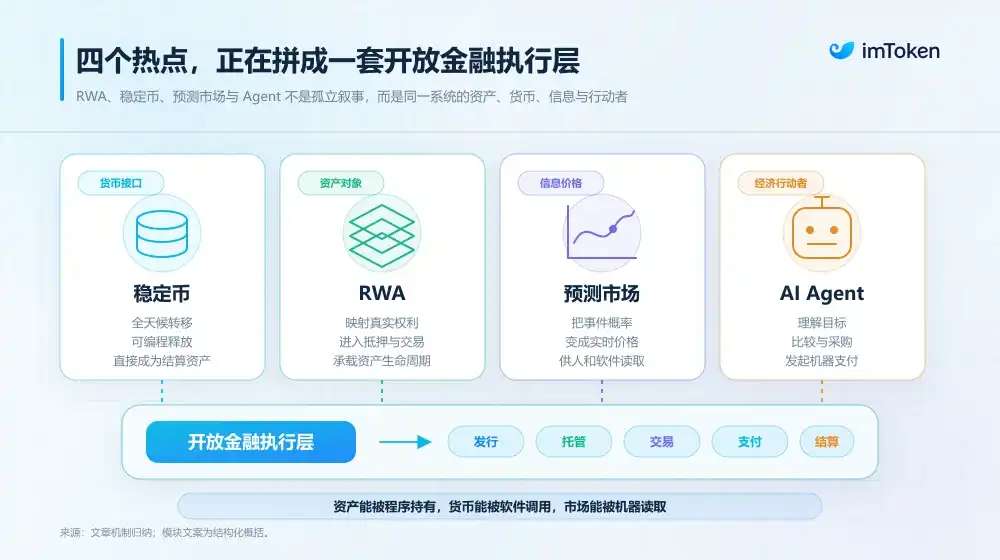
1. Stablecoins Turn Currency into an Interface That Can Be Called
First are stablecoins. They are not new, but the role they play is changing.
As is well known, early stablecoins primarily served roles like exchange quotation, on-chain hedging, and crypto asset trading settlement, with the vast majority of funds still circulating within Crypto. Today, more and more issuers, banks, payment institutions, and fintech companies are starting to use stablecoins for merchant payments, global payroll, corporate payments, fund aggregation, and cross-border settlement.
According to data disclosed by Circle in Q1 2026, the network's annualized transaction volume based on the previous 30-day period reached about $8.3 billion, and its partner Nium's payment network covers over 190 countries and regions. This means stablecoins here are no longer just "on-chain dollars," but a form of currency that can be directly called by software.
They can be transferred 24/7, embedded into programs, automatically released based on conditions, and directly become the settlement asset after a transaction. For internet applications, sending a stablecoin is increasingly akin to calling a payment API—no need to understand correspondent banks, clearing times, or cross-border account systems, just confirm the amount, address, and execution conditions.
This is the key shift for stablecoins moving from a Crypto trading tool to payment infrastructure.
2. RWA Turns Assets into Programmable Objects
If stablecoins solve "what currency to settle with," RWA solves "what assets can be traded and settled."
Past RWA products mostly concentrated in areas like U.S. Treasuries, money market funds, and private credit, with their core value primarily allowing Crypto users to access off-chain asset yields. However, starting last year, TradFi infrastructure has been visibly and proactively bringing the registration, custody, trading, and settlement of securities on-chain.
On July 15, DTCC completed a tokenized asset trade test in an actual production environment, with over 30 traditional financial institutions and digital asset companies participating. They plan to officially launch related services in October. Unlike simple asset mapping, DTCC plans for tokenized securities to retain the ownership, investor protections, and rights arrangements corresponding to traditional securities.
Earlier, in March, the U.S. SEC approved Nasdaq's plan to allow qualified listed securities to trade in tokenized form. Tokenized shares use the same CUSIP as traditional shares, possess the same substantive rights, and continue to trade under existing market systems and securities rules.
This is fundamentally different from simply issuing a "stock-mapped token." It signifies that on-chain assets are beginning to attempt connection with real ownership, custodial relationships, corporate actions, and legal rights, starting to carry part of the lifecycle of traditional assets.
Therefore, when this layer of connection gradually establishes, blockchain is no longer just about creating new assets, but also begins to host part of the operational process of traditional assets.
3. Prediction Markets Turn Future Information into Price
Prediction markets fill in the layer of information and price discovery.
Stock trading involves a company's future cash flows, bond trading involves credit and interest rates, while prediction markets trade the probability of a specific event occurring. Election results, interest rate decisions, sports events, corporate events, and even product release dates can all be compressed into a continuously changing market price.
Robinhood disclosed that in the first year of its prediction markets business, over 1 million users participated, trading approximately 9 billion contracts cumulatively. It has also acquired CFTC-regulated exchange and clearing infrastructure. From an infrastructure perspective, prediction markets provide a capability that traditional financial markets struggle to cover at scale: aggregating dispersed information into a real-time readable probability.
4. AI Agents Begin to Become New Economic Actors
Stablecoins and RWA address assets and funds; the new variable AI Agents bring is: who initiates economic activity?
Traditional software can only execute operations according to pre-set flows, whereas an Agent can understand goals, search for services, compare prices, and make decisions within a certain scope of authority. When an Agent can purchase APIs autonomously, it is no longer just an information tool but also begins to function as a new economic actor.
The problem is, many Agent payments might be just a few cents or even less, which traditional bank card fixed fees cannot cover. Their fixed fees, settlement cycles, and identity verification processes are not naturally suited for high-frequency, low-value, automated machine payments.
This is precisely a scenario where stablecoins and low-cost blockchains can play a role.
Coinbase has integrated x402 and stablecoin wallets into AWS Bedrock AgentCore, allowing enterprises to set budgets and governance rules for Agents; Google's Agent Payments Protocol uses cryptographically signed authorization credentials to record what users allow Agents to purchase, spending limits, and who initiated the operation.
二、 So What Does the Next-Generation Financial Infrastructure Already Possess?
Overall, the reason these lines are occurring simultaneously is precisely because they are different components of the same system.
Stablecoins turn currency into an API, RWA turns assets into programmable objects, prediction markets turn future information into price, and AI Agents enable software to directly participate in asset exchange for the first time.
However, it's worth noting that judging whether Crypto is beginning to become infrastructure does not mean judging whether speculation still exists in the market. Just as stocks, forex, and commodity markets also have significant speculative trading, a more important criterion is: whether external businesses and users are beginning to rely on a set of technologies to accomplish tasks that were previously difficult, costly, or inefficient.
By this standard, Crypto and Web3, as the next-generation financial infrastructure, have preliminarily formed multi-layered capabilities.
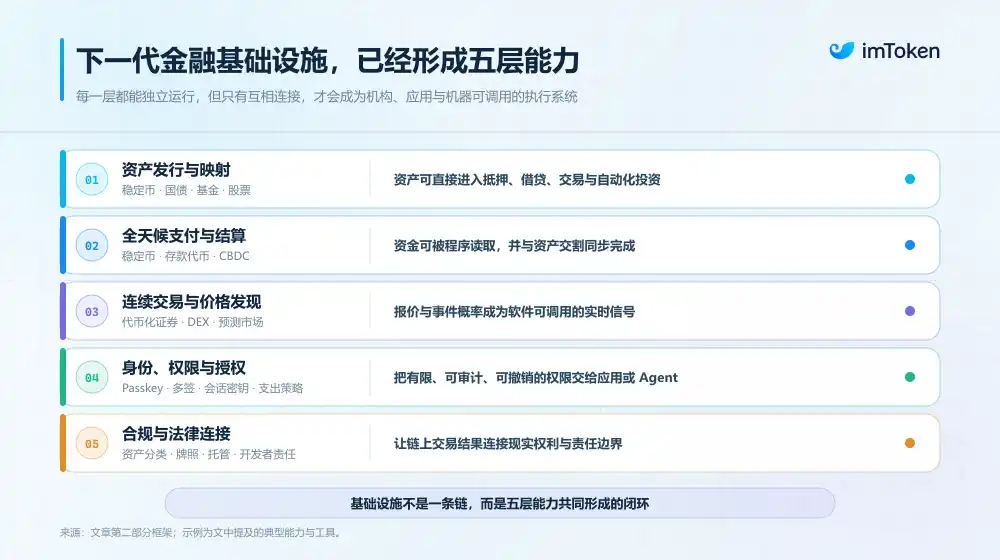
The first layer is asset issuance and mapping.
What can now be brought on-chain is no longer limited to native tokens. Stablecoins, government bonds, money market funds, private credit, gold, fund shares, and stocks have all seen various forms of on-chain products. The significance of putting different assets on-chain is not just about placing a certificate into a wallet.
When assets can be recognized by smart contracts, they can directly enter processes like collateralization, lending, trading, fund management, and automated investing. Operations previously scattered across registrars, custodians, brokers, and clearing systems have the potential to be compressed into a more unified execution environment.
The second layer is 24/7 payment and settlement.
Traditional cross-border payments typically involve multiple correspondent banks and are constrained by business hours, account systems, and regional networks. Stablecoins, under a unified asset standard, can facilitate near-real-time, 24/7 value transfer.
J.P. Morgan stated that since its launch, Kinexys has processed over $4 trillion cumulatively, with average daily transaction volume exceeding $7 billion, and has expanded blockchain deposit accounts to multiple currencies including USD, EUR, GBP, JPY, HKD, SGD, and CNY.
Essentially, on-chain settlement does not necessarily require all funds to be converted into publicly issued stablecoins. In the future, bank deposit tokens, regulated stablecoins, central bank digital currencies (CBDCs), and on-chain commercial bank money may coexist. Their commonality is that funds can be read, scheduled by programs, and settled synchronously with asset delivery.
The third layer is continuous trading and price discovery.
Crypto has already proven that markets can operate 24/7 and that liquidity can be automatically matched and managed via smart contracts.
This capability is being extended to more asset classes. Tokenized securities can shorten the time between trade and settlement, and prediction markets can provide probabilities for events that traditional finance cannot directly price.
In the future, an enterprise might not only hold on-chain money market funds but also automatically adjust cash positions based on changes in interest rate prediction markets; AI Agents might simultaneously read asset prices, event probabilities, and liquidity conditions before deciding whether to execute a trade.
At that point, what markets provide will no longer be just quotes for human viewing, but a set of real-time signals directly callable by software.
The fourth layer is identity, permissions, and authorization.
Financial activity isn't just about transferring assets; it must also answer a series of questions: Who initiated the transaction? Who has permission? How long does this authorization last? What is the spending limit? Who is responsible if something goes wrong?
Early Crypto primarily answered these questions with private keys; holding the private key meant having full control. But when enterprises, institutions, and AI Agents come on-chain, a single private key is clearly inadequate for complex permission management needs.
Google AP2 uses verifiable authorization records for user intent; Visa is establishing Agent identity directories, credentials, and scoring mechanisms; Mastercard's Agent Pay for Machines attempts to provide machines with identity authentication, permission settings, transaction, and settlement capabilities.
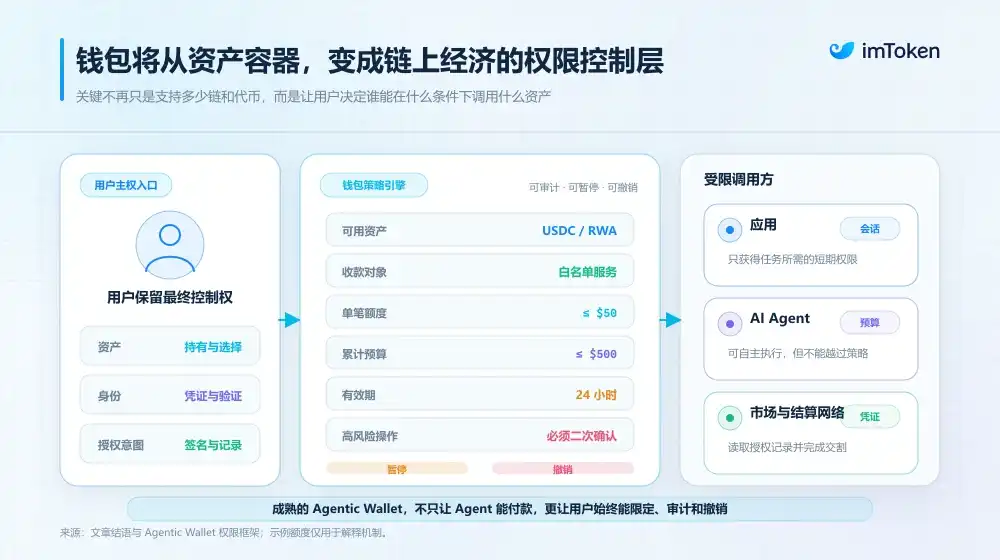
Account abstraction, Passkeys, multi-signature wallets, session keys, and spending policies also allow users to grant limited permissions to an application or Agent, rather than handing over full account control.
This implies that the role of wallets may also change. Future wallets will not only store assets and private keys but will also need to manage user identities, institutional credentials, Agent permissions, spending budgets, and authorization records, becoming a control interface for users entering the on-chain economy.
The fifth layer is connection with real-world legal and regulatory systems.
Whether a financial system can become true infrastructure depends not only on whether the technology can run, but also on whether real-world law recognizes the transaction outcomes.
In January 2026, the U.S. SEC issued guidance on tokenized securities, clearly distinguishing between tokenized securities directly issued by the issuer, tokenized interests created by third-party custody of underlying assets, and on-chain products offering only synthetic price exposure. This distinction is crucial because several products may look like "on-chain stocks," but the actual legal rights held by owners may be completely different.
The CLARITY Act attempts to further delineate the regulatory scopes of the SEC and CFTC and establish clearer rules around digital asset issuance, trading platforms, software developers, DeFi, and investor protection. The bill remains controversial and has not yet been passed into law, but the regulatory focus has gradually shifted from "whether Crypto should be allowed to exist" to "who can issue, who is responsible for custody, and what rules apply to what assets."
This shift itself is a key signal of infrastructuralization, because only when participants can roughly gauge their legal responsibilities can banks, brokerages, asset management firms, and payment companies make long-term investments, rather than just undertaking isolated pilot projects.
三、 The Inevitable Path from 'Speculative Market' to 'Infrastructure'
Is Crypto transitioning from a speculative market to infrastructure?
The answer is yes, and this process is irreversible, but it is not a simple, either-or replacement process.
Crypto will not suddenly lose its speculative nature because of stablecoin payments and RWA growth. More accurately, it is building an execution system beneath the original trading market that can be used by real-world assets, traditional institutions, and intelligent software collectively.
This change is first reflected in the expansion of the industry's funding sources. Previously, significant protocol revenue came from leveraged trading, asset issuance, liquidations, and on-chain capital recycling. Now, a second type of cash flow is emerging on-chain from external economic activities: companies using stablecoins for cross-border settlement, funds distributing and managing assets via on-chain channels, software purchasing APIs per use, and Agents automatically paying for data and model fees.
Second, the participants in the on-chain economy are expanding. The typical user of the past was a human trader sitting in front of a screen clicking "confirm" and "sign"; in the future, a large portion of on-chain interactions may be initiated by corporate systems, payment programs, and AI Agents. Humans will be responsible for setting goals, boundaries, and permissions, while software handles specific execution.
Regulatory discussions are also evolving. Past debates centered on whether Crypto should be integrated into the existing financial system; current questions are gradually shifting to how to delineate regulatory boundaries, protect investors, regulate intermediaries, while preserving space for self-custody and open software.
However, the journey from "can run" to "worth long-term reliance" remains long for crypto infrastructure.
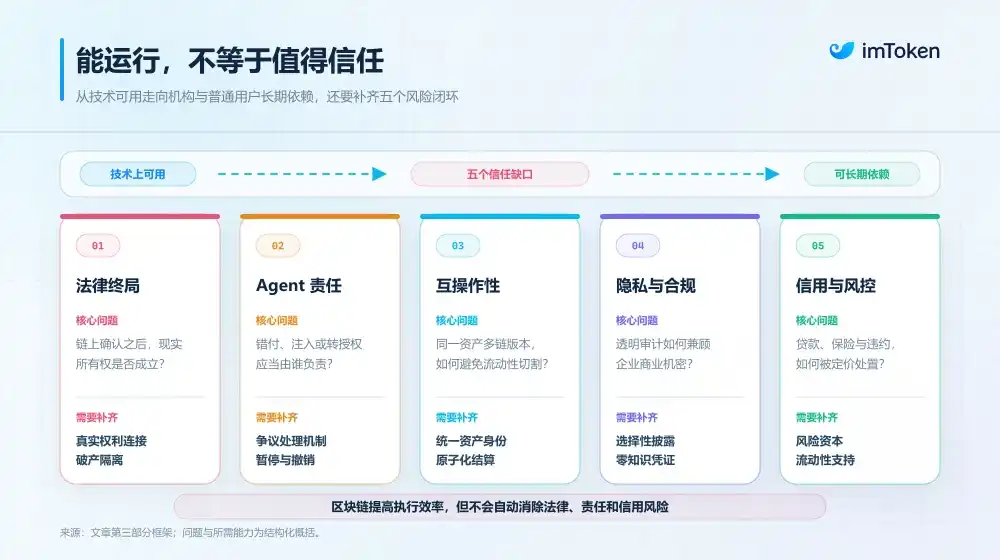
First, on-chain confirmation does not equal legal finality. Who custodies the asset behind a token? Can investors reclaim assets if the issuer goes bankrupt? Do different jurisdictions recognize ownership transfers on-chain? And do token holders actually have rights to dividends, voting, or merely price exposure? These questions cannot be solved by smart contracts alone.
Agentic payments also face liability boundaries. When an AI Agent executes an erroneous transaction due to misinformation, prompt injection, or model hallucination, who bears the responsibility—the user, the model provider, the wallet, or the merchant? Mature handling mechanisms are still lacking. Future wallets need to solve not just how to enable Agents to pay, but how to limit what assets they can use, who they can pay, what the limits are, and how to pause and revoke permissions in case of anomalies.
Meanwhile, as assets and networks proliferate, liquidity fragmentation may become more pronounced. The same stablecoin, fund, or security can exist across different public chains, bank ledgers, and permissioned networks but may not be freely transferable. More important than issuing yet more assets in the next phase is establishing unified asset standards, cross-network communication, and secure settlement mechanisms.
Privacy is another unavoidable hurdle for institutional adoption. Public blockchains facilitate verification and audit, but enterprises will not want to publicize all customer, supplier, payroll, and fund flow details. How to leverage zero-knowledge proofs, selective disclosure, and on-chain credentials to maintain necessary privacy while meeting compliance requirements will directly determine how far on-chain finance can go.
A more fundamental issue is that while blockchain can improve transaction and settlement efficiency, it cannot automatically create credit. Real-world financial systems require credit lending, insurance, accounts receivable, default resolution, and liquidity support, all underpinned by complex risk management, legal, and liability frameworks. Prediction markets also won't naturally solve problems like insider information, illiquidity, and outcome arbitration simply because prices are public.
Therefore, today's Crypto is more like having erected the basic framework for assets, currency, trading, and settlement, but credit, privacy, liability, and legal finality have yet to form a complete closed loop.
It is becoming infrastructure, but it is far from being a set of infrastructure that can be unconditionally trusted by everyone.
In Conclusion
Looking back, the most noteworthy aspect of 2026 is not the sudden explosion of a single sector, but that several puzzle pieces, which developed independently in the past, are beginning to connect in the same phase.
Assets are taking on-chain forms, currency is gaining programmable carriers, markets are starting to provide 24/7 prices, software is gradually acquiring payment and trading permissions, and regulation is moving from vague gray areas toward more concrete boundary definitions.
These changes are not yet sufficient to prove that a "completely new financial system" has been built, but they are enough to indicate that Crypto's role is changing. It hasn't left the speculative market; rather, beneath that market, it is progressively establishing an execution system that can be used by real-world assets, traditional institutions, and intelligent software.
Regardless, after 15 years of evolution, the Crypto industry has finally taken the most crucial step from a "sociological experiment with digital gold" to a "high-frequency speculative casino" and now toward "frictionless global financial infrastructure."
Let's continue to witness the next 15 years.