Original Author: Zhao Ying
Original Source: Wall Street News
Samsung Electronics' Q2 2026 marks the most profitable single quarter in its history.
Specifically:
- Revenue reached 171.5 trillion KRW, surging 130% year-over-year and increasing 28% quarter-over-quarter;
- Operating profit skyrocketed to 89.49 trillion KRW, a massive year-over-year increase of 1813.8%, achieving a leap from 4.68 trillion KRW in the same period last year, with a quarter-over-quarter growth of 56.4%; the operating profit margin reached 52.2%, a year-over-year increase of 1814%.
- Net profit was 71.62 trillion KRW, exceeding the estimated 68.36 trillion KRW, a staggering year-over-year surge of 1299.9%, with a net profit margin of 41.8%.
- Earnings per share were 10,849 KRW, a significant leap from 737 KRW a year ago, representing an increase of 3726 KRW quarter-over-quarter.
- From the cumulative data for the first half, the combined revenue for the first two quarters reached 305.37 trillion KRW, and operating profit reached 146.73 trillion KRW, representing year-over-year growth of 98.7% and 1191.5% respectively.
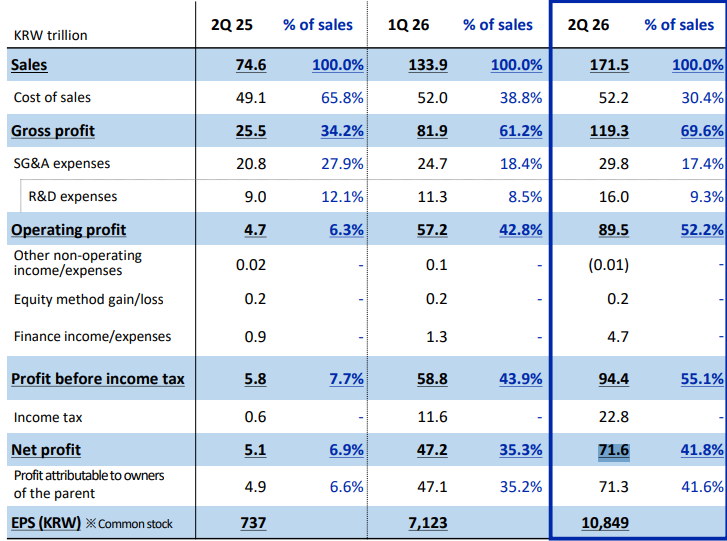
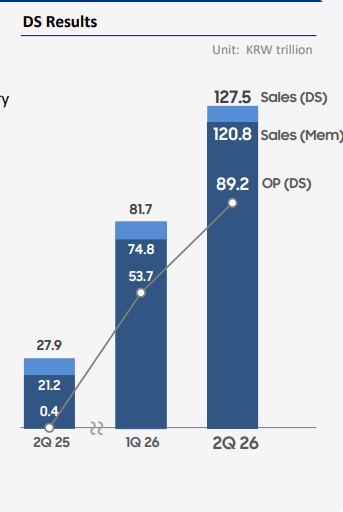
The core engine driving this round of explosive performance is undoubtedly the semiconductor business. Centered on AI server demand, Samsung's memory division achieved sales of 120.8 trillion KRW, setting a new historical record. The DS (Device Solutions) division alone contributed a quarterly operating profit of 89.2 trillion KRW, accounting for over 99% of the company's total operating profit. Meanwhile, R&D investment climbed synchronously to 16 trillion KRW, a 41% increase quarter-over-quarter, demonstrating Samsung's continued bet on its technology leadership position.
However, the divergence in the performance structure is equally clear. The DX (Device eXperience) division—covering mobile phones, TVs, and home appliances—recorded a negative operating profit of -0.8 trillion KRW, as rising component costs eroded the profit margin of the consumer-facing businesses. The brilliance of the overall performance largely relies on the high-speed rotation of the single semiconductor engine.
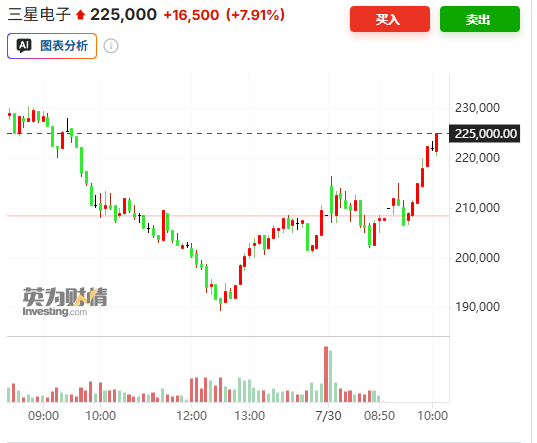
After the announcement, Samsung's stock price in Seoul surged as much as 4.1% intraday on Thursday but later reversed to a 1.9% decline, currently up 7.91%.
Memory & HBM: A Super Cycle Under the AI Wave, Profits Soar 250x
The memory business is the brightest spot this quarter.
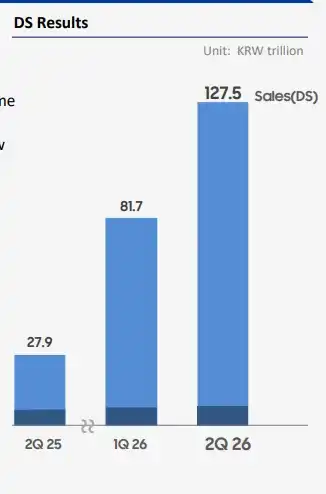
DS division sales jumped to 127.5 trillion KRW from 81.7 trillion KRW last quarter, a 56% quarter-over-quarter increase; operating profit rose to 89.2 trillion KRW from 53.7 trillion KRW, representing a year-over-year increase of over 250 times and a quarter-over-quarter growth of 66%. Both DRAM and NAND achieved record-high shipments, with the server revenue mix reaching a new high.
Regarding HBM (High Bandwidth Memory), Samsung has completed volume production of HBM4 and begun mass delivery to key customers, while also completing shipments of the industry's first HBM4E samples—this means Samsung has taken the lead in positioning itself for the next-generation AI accelerator platform competition. The continuous volume ramp-up of high-value-added products like DDR5 and SOCAMM2, coupled with strong demand for enterprise SSDs, has kept the overall memory market in a state of relative supply tightness.
The significant outperformance of Samsung's semiconductor division is primarily driven by the explosive growth in demand for high-bandwidth memory from AI servers. Counterpoint Research Director Mr. Huang stated that Samsung's DRAM business continues to expand its market share lead, "Samsung is leveraging its strong position in memory to actively expand its market share in most of its business divisions."
Looking ahead to the second half, Samsung expects AI infrastructure capital expenditure to remain robust, with the widespread adoption of Agentic AI further driving demand for server DRAM and enterprise SSDs. Although there is some cyclical softening in demand from mobile and PC segments, Samsung assesses that the overall market will remain undersupplied and plans to continue solidifying its technology leadership around HBM4, Gen6, and UFS 5.0.
S.LSI & Foundry: Dual-Front Breakthrough, Advancing High-End Nodes
The System Semiconductor (S.LSI) division achieved a record high for first-half revenue this quarter, with strong sales of SoCs and image sensors being the primary drivers. The company has successfully secured orders for next-generation flagship SoCs and new custom SoC design contracts, continuing to expand its share in the high-end mobile market. Key subsequent initiatives include driving sales of next-generation flagship SoCs, expanding new Custom SoC business, and entering more high-value areas, including diversified image sensor applications and Power IC business.
The Foundry business also showed positive momentum: HBM B-Die demand drove revenue growth, orders from U.S. clients were strong, and design contracts for the 2nm HPC project continued to progress. Entering the second half, Samsung plans to advance the mass production ramp-up of 2nm Gen 2 mobile chips, the volume ramp of 4nm LPU, and the expansion of Base-Die shipments, targeting double-digit revenue growth and driving medium-to-long-term growth through advanced node wins and AI/HPC design wins.
DX Division: Consumer Segment Under Pressure, Costs Erode Profits
In stark contrast to the semiconductor brilliance, the DX division recorded an operating loss of -0.8 trillion KRW this quarter.
For the mobile business (MX/NW), smartphone revenue was 32.3 trillion KRW, up 14% year-over-year, with solid sales of flagship models and the A series, and the launch of the Galaxy Z Fold8 series also brought a new growth point. However, operating profit turned negative to -0.7 trillion KRW, with industry-wide component cost increases being the core pressure source. The company is actively pushing forward efficiency optimization measures and plans to expand the AI experience ecosystem with new form factors like "Smart Glasses."
The VD/DA (Visual Display & Digital Appliances) division revenue was 14.5 trillion KRW, showing a slight year-over-year increase, but operating profit was near breakeven (-0.01 trillion KRW). Air conditioner demand boosted DA division revenue, but cost pressures remained a drag. In the second half, Samsung plans to use "Vision AI" as a differentiation tag, combined with the expansion of TV Plus content and advertising business to improve overall profitability.
SDC & Harman: Improved Profit Flexibility
Samsung Display (SDC) showed clear marginal improvement this quarter. Revenue reached 7.5 trillion KRW, a 17% year-over-year increase; operating profit recovered to 0.7 trillion KRW from 0.4 trillion KRW last quarter.
Strong demand for high-end smartphone OLED panels was the core driver, and expansion in the gaming monitor market also benefited the large-size panel business. In the second half, Samsung plans to advance the timely mass production of the 8.6G IT OLED production line and further expand differentiated product offerings to the tablet, gaming, and automotive markets.
VD/DA sales were 14.5 trillion KRW, up 2% quarter-over-quarter and 3% year-over-year; operating profit was -0.01 trillion KRW. For VD, profitability declined quarter-over-quarter due to cost increases, but revenue and profit grew year-over-year driven by capturing demand from sports events. For DA, revenue grew driven by air conditioner demand, but cost pressures weighed on profits. In the second half, VD will rely on "Vision AI" to lead the AI TV market and enhance profitability by diversifying TV Plus content and expanding the advertising business; DA will expand AI product sales and strengthen channel diversification and product competitiveness.
Harman (the acquired premium audio and automotive solutions brand) recorded revenue of 4.6 trillion KRW, up 19% year-over-year; operating profit recovered to 0.4 trillion KRW. Strong sales of automotive central computing units and portable audio products drove the overall improvement. The company will subsequently focus on maintaining steady growth in high-growth automotive segments and brand-driven audio businesses.
Balance Sheet & Cash Flow: Financial Strength Significantly Strengthened
Samsung Electronics' financial condition improved significantly with the performance explosion. As of the end of June 2026, total assets reached 759.5 trillion KRW, an increase of over 12 trillion KRW from three months prior; cash and equivalents reached 190 trillion KRW, and the net cash position was as high as 167.6 trillion KRW, nearly doubling from 86.7 trillion KRW in the same period last year.
Operating cash flow this quarter was a record high of 105.1 trillion KRW, with net profit's contribution to cash flow already exceeding depreciation and amortization. ROE jumped from 5% a year ago to 56%, and the EBITDA margin reached 59%.
Regarding investment, capital expenditure this quarter was 14.1 trillion KRW, while Samsung also spent 5.6 trillion KRW on treasury stock buybacks and 6.2 trillion KRW on dividend payments, demonstrating continued focus on shareholder returns supported by strong earnings. The debt ratio remained low at 31%, and the net debt/equity ratio was -29%, indicating a sound financial structure.


















