Musk's 'One-Man Dynasty' Set to Ring the Bell on June 12th

marsbitPublished on 2026-05-22Last updated on 2026-05-22

Abstract

SpaceX Files for IPO, Targets Up to $2 Trillion Valuation SpaceX has officially filed for an initial public offering (IPO) with the U.S. SEC, planning to list on Nasdaq under the ticker "SPCX" on June 12. The company aims to raise $70-$80 billion, targeting a historic valuation between $1.75 and $2 trillion. Despite going public, founder Elon Musk will retain approximately 85% of the voting power through a dual-class share structure, maintaining absolute control. The S-1 filing reveals a company with sharply contrasting financial segments. In 2025, SpaceX reported $18.67 billion in revenue but a net loss of $4.94 billion. The loss was primarily driven by its AI unit, xAI, which burned $6.4 billion. In contrast, the Starlink satellite internet business was highly profitable, generating $11.4 billion in revenue and $4.4 billion in operating profit with an impressive 63% EBITDA margin. Starlink's user base grew to 10.3 million by Q1 2026, though average revenue per user has been declining. A key driver of the sky-high valuation is the recent $1.25 trillion merger with xAI, which added an AI narrative to the core aerospace business. SpaceX plans futuristic ventures like orbital AI data centers and space mining, though these are not yet revenue-generating. The company's capital expenditures are massive, exceeding $20.7 billion in 2025, with AI spending surpassing that of space operations. The IPO, led by Goldman Sachs, has drawn both enthusiasm and skepticism from Wall Street....

Written by: Su Yang

Edited by: Xu Qingyang

On May 20th, US local time, SpaceX formally submitted its S-1 filing publicly to the U.S. Securities and Exchange Commission (SEC), initiating its Nasdaq IPO process, with the stock ticker set as 'SPCX'. The company plans to raise $70 to $80 billion through this IPO, targeting a valuation of $1.75 to $2 trillion. It is expected to list on Nasdaq on June 12th.

This is the largest IPO in human history and also Musk's debut in the public markets with absolute control. Post-listing, he will retain approximately 85.1% of the voting power, leaving public shareholders with almost no voice.

As early as April 1st this year, SpaceX had already confidentially submitted a draft S-1 registration statement to the SEC under the internal code name 'Project Apex', marking the first formal legal step in the IPO process.

According to the prospectus, Goldman Sachs leads as the lead underwriter, with Morgan Stanley, Bank of America, and 15 other underwriters acting as co-managers participating in the offering.

This filing also marks the first time SpaceX has revealed its financial cards to the outside world—Starlink is the cash cow, xAI is the money-burning black hole, and Musk has forcefully rewritten an aerospace company into a 'AI + Aerospace' super narrative. So, what supports this $2 trillion valuation?

01 Starlink Generates $11.4 Billion Annually, AI Business Loses $6.4 Billion in a Single Quarter

SpaceX's financial data presents a picture of 'polar opposites'.
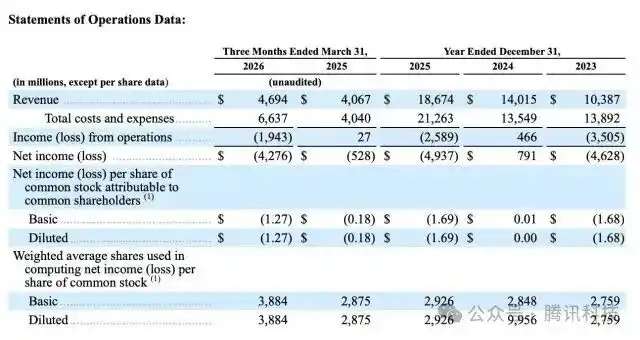
SpaceX Key Financial Data

For the full year 2025, SpaceX achieved consolidated revenue of $18.67 billion, adjusted EBITDA of $6.584 billion, but an operating loss of $2.589 billion, with a net loss close to $4.94 billion. The losses almost entirely came from the AI business—xAI lost $6.4 billion in 2025, while Starlink contributed $4.4 billion in operating profit over the same period. The money made in space was entirely burned by the large models on Earth.

In Q1 2026, the company's revenue was $4.694 billion, adjusted EBITDA was $1.127 billion, and the operating loss was $1.943 billion.

Breaking down by business, the Connectivity business, i.e., Starlink, contributed $3.26 billion, accounting for nearly 70% of revenue and serving as the absolute mainstay; the AI business (xAI) generated $818 million in revenue; and the Space Operations business (including rocket launches and government contracts) brought in $619 million.
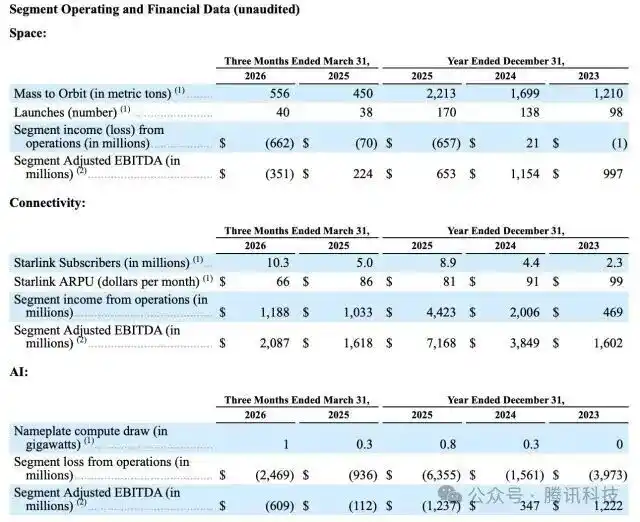
SpaceX Core Business Financial Data

Looking at the balance sheet, as of March 31, 2026, SpaceX held $15.9 billion in cash and cash equivalents, $7.8 billion in marketable securities, total assets of $102.1 billion, total liabilities of $60.5 billion, including debt and financing leases of approximately $30.3 billion.

Even with tens of billions in cash on hand, facing annual capital expenditures exceeding $20 billion, the company's cash flow pressure remains immense.

Starlink's operational data is equally astonishing.
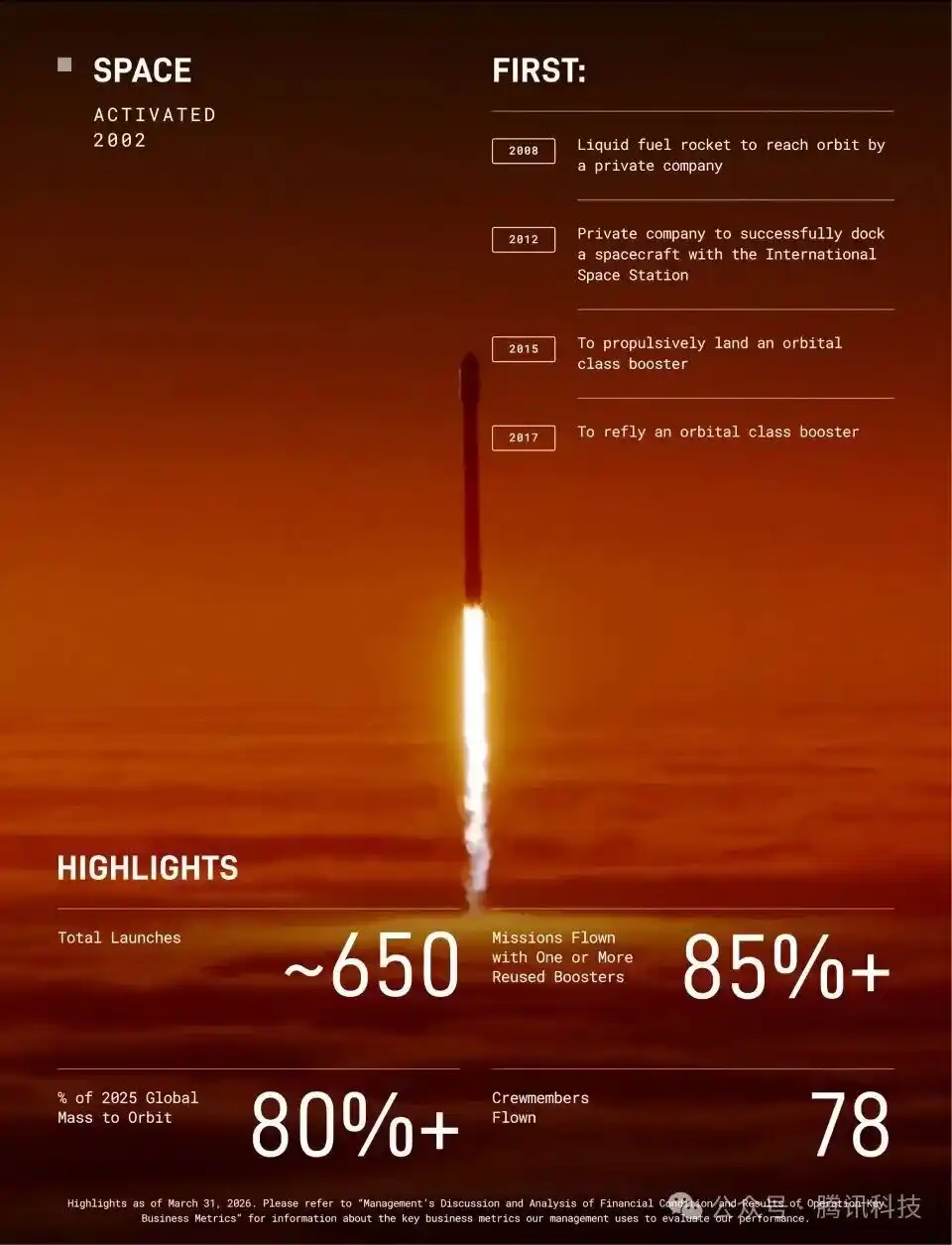
SpaceX Space Business Highlights

The prospectus shows that as of March 31, 2026, Starlink had reached 10.3 million users, compared to only 8.9 million at the end of 2025, a net increase of 1.4 million users in a single quarter. With approximately 9,600 satellites in orbit, Starlink's adjusted EBITDA reached $7.2 billion, with an EBITDA margin as high as 63%, an improvement of 22 percentage points compared to 41% in 2023. Free cash flow was approximately $3 billion, making it the only business segment within SpaceX capable of generating positive cash flow.

However, the Average Revenue Per User (ARPU) for Starlink's individual customers has declined from $99 in 2023 to $81 in 2025, and further to $66 in Q1 2026, shrinking by over 30% in two and a half years.

This is a classic price-for-volume logic—SpaceX trades lower prices for rapid user growth, but as the scale increases, the payment capability per user is actually declining. If ARPU continues to fall, to achieve the market's long-term revenue expectations, the growth rate of the user base must persistently outpace the rate of price decline.

SpaceX's capital expenditure for the full year 2025 was $20.7 billion, exceeding its total revenue for the year, with the AI department spending a staggering $12.7 billion, already surpassing the combined total of aerospace and satellite businesses.
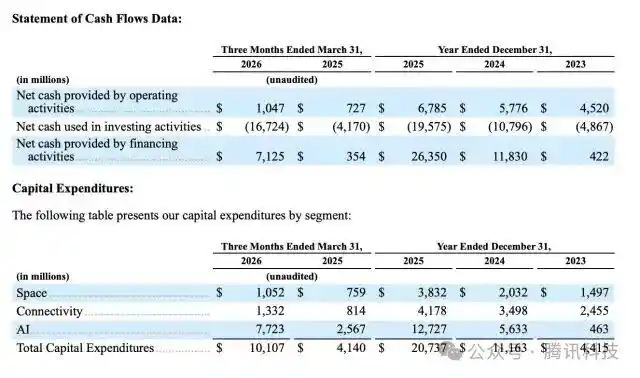
SpaceX Capital Expenditure and Cash Flow

xAI burns through an average of about $1 billion per month, with annual cash consumption around $14 billion. For reference, OpenAI and Anthropic burned approximately $9 billion and $4 billion respectively in 2025. SpaceX's AI segment alone surpasses the sum of these two major competitors. While spending aggressively, in terms of revenue scale and growth rate, xAI also lags far behind these two rivals.

More noteworthy are the valuation multiples.

SpaceX's IPO targets a valuation of $1.75 to $2 trillion, which is approximately 266 times its EBITDA. In comparison, Meta's valuation multiple is 16x, Alphabet's is 25x, Nvidia's is 36x, and even Tesla, known for its high valuation, is only 119x.

SpaceX is entering the public market with a valuation multiple more than double that of Tesla. Whether this represents value discovery or bubble narrative will be the first test posed by the market post-listing.

The prospectus also explicitly states: the company does not intend to pay dividends on Class A shares for the foreseeable future. This means investors can only bet on stock price appreciation—this is a pure growth stock with no parachute.

02 85% Voting Power: Musk's 'One-Man Dynasty'

SpaceX has adopted a multi-class share structure. The company issues Class A common stock (1 vote per share) to public investors, while Class B common stock (10 votes per share) is held by Musk and insiders.
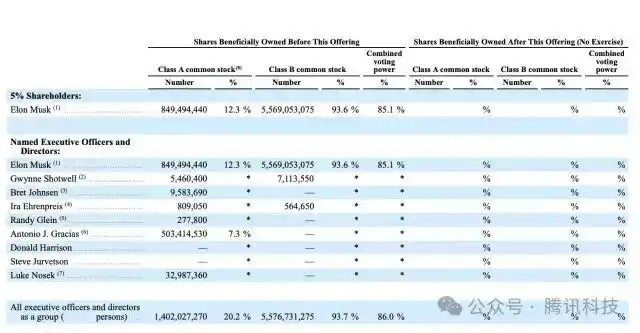
Management and Director Shareholdings

According to the prospectus data, Musk holds approximately 42.5% of SpaceX's equity, but due to the Class B super-voting shares, he controls about 84% to 85.1% of the total voting power. This means that post-listing, regardless of how many shares public investors purchase, Musk alone can decide board composition, major mergers and acquisitions, and even amendments to the corporate charter.

The prospectus further discloses that Musk will continue to hold three key positions: Chief Executive Officer, Chief Technology Officer, and Chairman of the Board, and has the unilateral authority to remove or fill Class B board seats. SpaceX will also apply for a 'controlled company' exemption, freeing it from the governance rule requiring a majority of independent directors.

Besides Musk, the prospectus shows no other shareholders hold more than 5%. However, SpaceX's shareholder list still features notable institutions: Alphabet (Google's parent company), as an early strategic investor, currently holds about 5%; Fidelity Investments holds approximately 2%; Silicon Valley VCs Valor Equity Partners, Founders Fund, Sequoia Capital, etc., collectively hold about 10%; additionally, there are hedge funds like D1 Capital and Darsana, as well as Middle Eastern sovereign wealth funds. SpaceX has also established a large employee stock option pool to incentivize its core technical team.

In Silicon Valley, multi-class share structures are quite common. According to Fenwick's 2025 Corporate Governance Survey, 27.3% of the top 150 tech companies in Silicon Valley still use multi-class structures, a proportion far exceeding the 10.1% of S&P 100 index components. However, the design specifics differ among companies.

But SpaceX has taken this control mechanism to an unprecedented degree—85% of voting power concentrated in one individual, making it stand out prominently compared to other tech giants.

Looking at Tesla, another public company owned by Musk, the situation is completely different. Tesla operates on a 'one share, one vote' principle with no super-voting shares, which is why Musk often faces challenges and questions from activist shareholders.

03 xAI Merger: The 'Narrative Engine' for a $2.5 Trillion Valuation
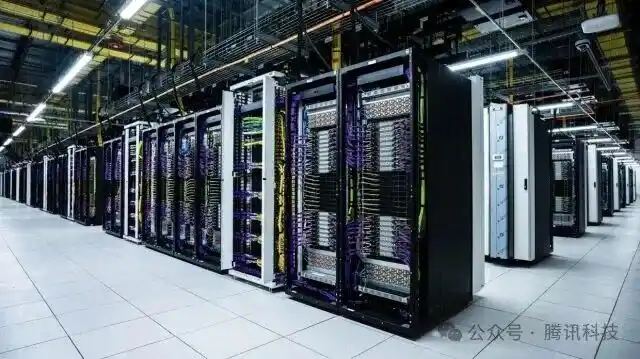
The 'COLOSSUS II' Facility in Memphis, Tennessee

In February this year, SpaceX completed the acquisition of xAI at an overall valuation of $1.25 trillion, with xAI valued at $250 billion. Prior to the merger, SpaceX's independent valuation was approximately $1 trillion. The AI story added about $250 billion in premium.

This transaction had two immediate effects. First, revenue growth, with the AI business contributing $818 million in Q1 2026. Second, narrative elevation—SpaceX transformed from an 'aerospace company' into a composite of 'AI + Aerospace'.

Wall Street's valuation expectations for SpaceX have consequently been raised from $1.25 trillion to a range between $1.75 and $2 trillion.

The prospectus also reveals even more ambitious long-term plans. SpaceX intends to deploy its first orbital AI computing pods by the end of this decade, operating AI computing facilities in space.
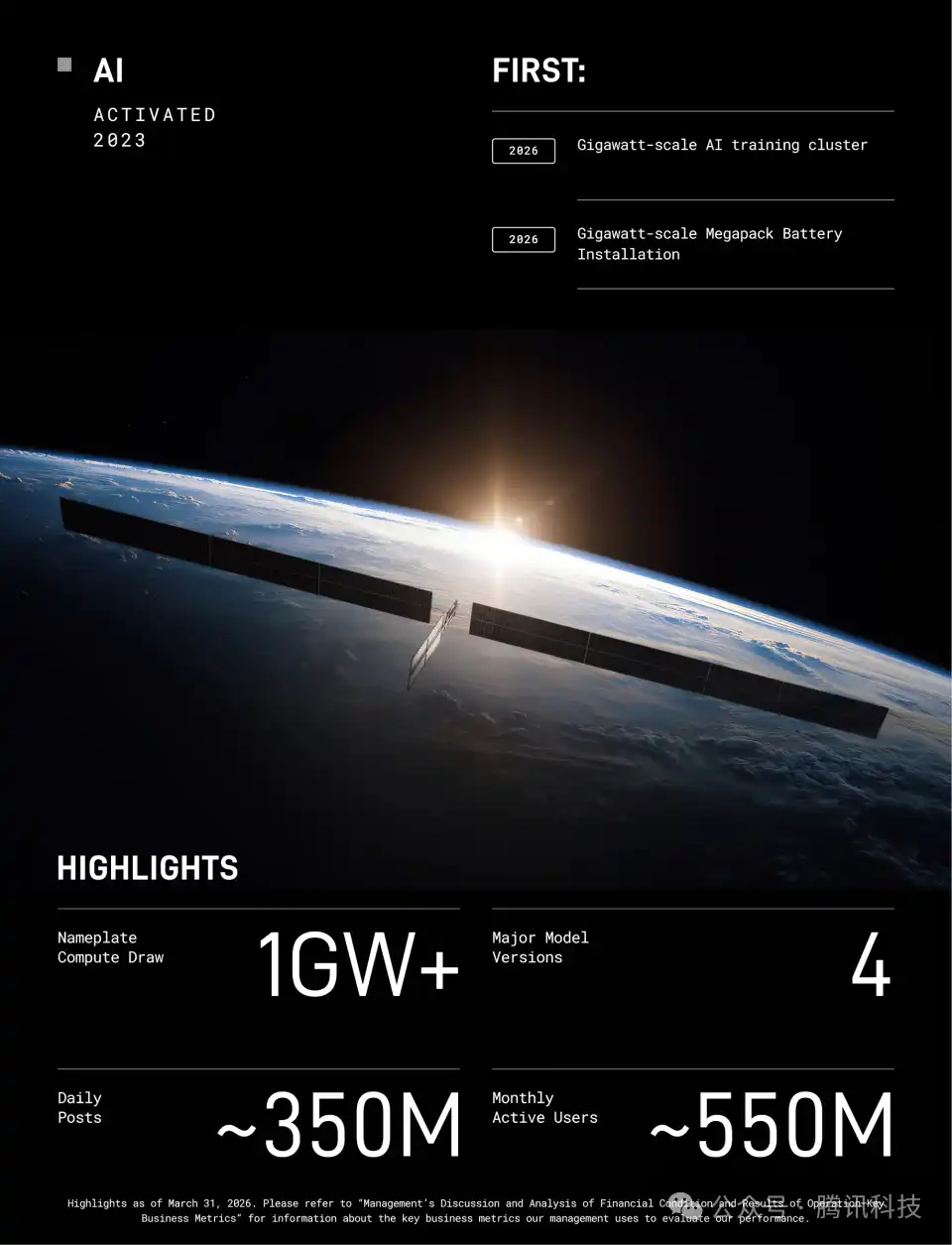
xAI Business Highlights

Musk's judgment is that producing AI computing power in space is cheaper than on Earth.

Simultaneously, SpaceX also mentions 'space mining' for extracting metal resources from near-Earth asteroids. These plans currently generate no revenue and don't even have technological prototypes, but they constitute the sexiest pages in the prospectus and represent the areas with the greatest valuation divergence.

04 Terafab, Cursor Acquisition, and Financial Services: Musk's 'Ecological Alchemy'

The prospectus also hides several easily overlooked strategic moves.

Among them, SpaceX and Tesla jointly announced the Terafab project, aiming to integrate various stages of semiconductor production into a single system to produce two types of chips: one optimized for Tesla's Full Self-Driving system, the Optimus humanoid robot, and the Robotaxi fleet; the other being radiation-resistant, high-power space chips.

According to public information, the total project investment could reach up to $119 billion, utilizing Intel's 14A process technology, with the goal of directing 80% of its computing power capacity toward orbital AI data centers.

Additionally, SpaceX plans to acquire Cursor using Class A common stock as consideration after the IPO completion, implying an equity value of $60 billion for the transaction. SpaceX has secured an exclusive option to acquire Cursor at a $60 billion valuation, exercisable 30 days post-IPO, with a reverse breakup fee as high as $10 billion. Several core engineering team members from Cursor have already joined xAI.

The company also plans to launch a financial product covering payments, banking, and other services, extending into the financial services sector.
The common thread among these businesses is that they are all in early stages, require significant capital burning, and rely on SpaceX's fundraising ability and Musk's storytelling prowess.

05 Market Divergence: Banking All-Stars Amidst Skepticism

The underwriter lineup revealed an unexpected twist, which actually reflects the divergence on Wall Street.

Morgan Stanley, which has long maintained close ties with Musk, was edged out from the top lead underwriter position by Goldman Sachs, a result that surprised some market observers, given that Morgan Stanley led Tesla's IPO and the Twitter acquisition financing.

University of Florida scholar, 'IPO Guru' Jay Ritter, explicitly stated that if SpaceX's valuation reaches $2 trillion, he would choose to short the stock once it begins trading. Ritter further noted that for new listings with inflation-adjusted revenue exceeding $100 million and a P/S ratio over 40x, they tend to significantly underperform the market on average over three years post-listing.

Greater concern stems from the AI business losses—xAI lost $6.4 billion in 2025, and the $4.4 billion earned by Starlink couldn't fill this hole. If AI continues to burn cash while commercialization lags expectations, SpaceX's overall profitability pressure will increase dramatically.

BNP Paribas analyst James Picariello bluntly stated that SpaceX's listing would 'split' the retail investor base supporting Musk, putting pressure on Tesla's stock price.
UBS analyst Joseph Spak earlier reminded clients that massive investments in hardware AI might just be the beginning. Simultaneously, Musk's simultaneous leadership of Tesla, SpaceX, xAI, X, and other companies has raised questions among some institutional investors about potential management focus dilution.

06 Conclusion

June 12th will be a referendum testing the 'Musk Premium'.

Starlink provides a solid cash cow, xAI provides a sexy narrative, and Musk provides absolute control. The upside is extremely high decision-making efficiency; the downside is there are no brakes.

Goldman Sachs calls this IPO a once-in-a-generation opportunity, but some analysts compare it to buying a lottery ticket—the jackpot is Mars, the consolation prize is Earth.

Cook handed Apple over to Tenus, a successor with a hardware engineering background, but Musk doesn't plan to hand SpaceX over to anyone—going public just adds a group of passengers without voting rights; he remains the sole occupant of the cockpit.

What can you say? That's very Musk.

Related Questions

QWhat is the target valuation range for SpaceX's upcoming IPO on Nasdaq, and when is it scheduled to be listed?

ASpaceX's target valuation range for its IPO is $1.75 trillion to $2 trillion. It is scheduled to be listed on the Nasdaq on June 12.

QWhat are the main financial contributions and losses from SpaceX's Starlink and xAI businesses respectively in 2025?

AIn 2025, SpaceX's Starlink business contributed $4.4 billion in operating profit. In contrast, the xAI business incurred a loss of $6.4 billion, consuming nearly all of Starlink's profits.

QWhat percentage of voting control will Elon Musk retain after SpaceX goes public, and how is this achieved?

AAfter the IPO, Elon Musk will retain approximately 84% to 85.1% of the total voting control. This is achieved through a dual-class share structure where his Class B shares carry 10 votes per share, while public Class A shares carry 1 vote per share.

QHow does SpaceX's planned valuation multiple (based on EBITDA) compare to other major tech companies like Meta, Alphabet, and Tesla?

ASpaceX's target IPO valuation is about 266 times its EBITDA. In comparison, Meta's multiple is 16x, Alphabet's is 25x, Nvidia's is 36x, and Tesla's is 119x, making SpaceX's valuation multiple significantly higher.

QWhat are some of the ambitious future projects mentioned in the prospectus that contribute to SpaceX's 'AI + Space' narrative?

AThe prospectus mentions ambitious future projects including deploying orbital AI computing modules in space by the end of the decade for potentially cheaper AI compute, 'space mining' for extracting metal resources from near-Earth asteroids, the Terafab semiconductor project with Tesla, and plans to acquire Cursor and launch financial services products.

Related Reads

From 'Old Guys' to 'New Favorites': How AI Is Revaluing Old Infrastructure from Dell to Nokia?

From "Vintage Tech" to "New AI Darlings": How AI Revalues Old Infrastructure One year ago, tech giants like Dell, Nokia, Cisco, and Western Data were seen as slow-growth, low-valuation stories, far from the AI spotlight dominated by players like Nvidia. Now, these legacy tech stocks are gaining market attention, sparking debate on whether this is genuine industry revaluation or a temporary narrative. As AI moves from model parameters to real-world data centers, the market is recognizing companies with proven delivery and infrastructure capabilities. This shift marks a change in the AI investment thesis: from pure model and GPU focus to the complex systems engineering required for deployment. Companies like Dell, HPE, and Corning are being revalued not for being "sexy" AI innovators, but for their decades of accumulated expertise in supply chains, enterprise delivery, and infrastructure—assets that have become critical in the AI buildout phase. The revaluation is unfolding across three key infrastructure lines: 1. **Servers & System Integration:** Dell and HPE are emerging as crucial system integrators or "general contractors" for AI data centers, translating GPU orders into complete, deployable server racks integrated with power, cooling, and networking. 2. **Networking & Connectivity:** AI's scale demands robust high-speed connections. Corning (fiber optics), Nokia (AI-RAN, 6G), and Cisco (data center switches) are gaining importance for enabling efficient data transfer within and between AI clusters. 3. **Storage:** Beyond high-speed memory (HBM/DRAM), the AI data explosion is driving demand for high-capacity hard drives (HDDs) from companies like Western Digital and Seagate to handle training data, logs, and cold storage cost-effectively. For this revaluation to be substantive and not just a narrative, three criteria are key: 1) Concrete AI-related order and revenue growth (e.g., Dell's AI server sales), 2) Upward revisions to company financial guidance, and 3) Sustainable improvements in profit quality, not just top-line revenue spikes. In essence, AI's transition to a real construction phase is re-pricing "old assets" against "new demand." The opportunity, however, is selective. Only those legacy firms that are demonstrably integrated into the capital expenditure chains of data center and enterprise AI deployment are likely to experience a true "logic re-rating" rather than just a temporary valuation bounce.

marsbit6m ago

From 'Old Guys' to 'New Favorites': How AI Is Revaluing Old Infrastructure from Dell to Nokia?

marsbit6m ago

The Merger of Codex and ChatGPT Marks the Beginning of a Major Reshuffle in Programming Tools

OpenAI is shifting its strategic focus from ChatGPT to Codex, merging them along with the browser tool Atlas into a unified desktop super-app. This move signals an internal belief that Codex, originally a programming tool, represents the next evolution of AI more than conversational models like ChatGPT. Over the past year, Codex's weekly active users have surged past 5 million. The key distinction is that while ChatGPT answers questions, Codex executes tasks. Enterprises increasingly value this ability to get work done over simply receiving advice. Consequently, Codex is attracting professionals beyond developers, including analysts, bankers, marketers, and product managers. OpenAI's reorganization and increased investment in Codex stem from recognizing that the future of AI competition lies in execution capabilities, not just conversation. The company is launching role-specific plugins (e.g., for data analysis, sales, design) to transform Codex into a broad knowledge work platform that automates and redefines white-collar workflows. Beyond being a tool, Codex reflects OpenAI's ambition to redefine software. New features like "Sites"—which generates interactive websites from documents—and collaborative "Annotations" aim to create a paradigm where the AI understands the goal and handles the tools and steps, functioning more like a digital colleague than traditional software. The ultimate goal is a unified experience where the user cares only about the completed task.

marsbit15m ago

The Merger of Codex and ChatGPT Marks the Beginning of a Major Reshuffle in Programming Tools

marsbit15m ago

Interpreting Investment Opportunities in the Age of Great Navigation, Invesco Great Wall Fund Releases '2026 Report on Chinese Enterprises Going Global'

Invesco Great Wall Fund has released its "2026 China Corporate Globalization Report," titled "The 'Great Navigation Era' of Chinese Enterprises." The report analyzes the new trends and investment opportunities as Chinese companies expand globally, moving from simple product exports to comprehensive overseas operations involving services, branding, and local production. Driven by factors like trade friction, the pursuit of higher profit margins abroad, and policy support, globalization is becoming essential for Chinese companies. The report outlines an evolution: from early product export ("Globalization 1.0") to the current "Globalization 2.0," characterized by overseas capacity, capital goods investment, consumer brand expansion, and service exports. Chinese firms' competitive advantages are highlighted, including a vast engineer talent pool, low-cost and robust infrastructure, and complete industrial clusters. Specific sectors with significant出海 potential are identified: * **Capital Goods** (e.g., engineering machinery, power equipment): Benefiting from global demand, especially in Belt & Road markets and the AI-driven power grid upgrade cycle. * **Consumer Brands**: Transitioning from cost to brand advantage, leveraging供应链 efficiency. * **Technology & Innovation**: Including AI applications, optical modules within global tech supply chains, and new energy vehicles focusing on local production. * **Pharmaceuticals**: Chinese biotech firms are becoming preferred partners for global pharma, with potential for breakthrough drugs in areas like oncology and weight loss. The report concludes that corporate globalization represents a sustained, core theme for China's capital markets, though companies must navigate challenges like geopolitics and localization.

marsbit27m ago

Interpreting Investment Opportunities in the Age of Great Navigation, Invesco Great Wall Fund Releases '2026 Report on Chinese Enterprises Going Global'

marsbit27m ago

GitHub, Transfixed by AI

On the night of February 9th, GitHub suffered a major outage caused by a simple configuration change—reducing a cache refresh interval from 12 to 2 hours—that triggered a cascade of failures. This was not an isolated event, but part of a broader pattern. In early 2026, GitHub experienced at least 8 major incidents, failing to meet its promised 99.9% availability. These outages stemmed from structural issues: explosive growth in load, tight service coupling, and insufficient protection against abnormal traffic. This unprecedented load is driven by AI Agents. In 2025, GitHub handled ~1 billion commits. By 2026, weekly commits reached 275 million, projecting to ~14 billion for the year—a 14x increase. AI tools like Claude Code now contribute 4.5% of all public repository commits, with weekly submissions surging 25x in just three months. AI-generated pull requests jumped from 4 million to 17 million per month in half a year. Unlike human developers, AI Agents work continuously, generating commits at a scale that overwhelms infrastructure designed for human rhythms. The surge also shattered GitHub's business model. Copilot's flat-rate pricing, based on assisting human developers, became unsustainable as Agentic AI sessions consumed resources worth hundreds of dollars for a few dollars in fees. In response, GitHub imposed usage limits and, by June 1st, shifted to a pay-per-use "AI Credits" system. Facing this new reality, GitHub realized a 10x scaling plan was insufficient. It announced a need to *redesign* its architecture for 30x current scale—decoupling services, adding fault isolation, and improving change management to prevent cascading failures. Other platforms like Stripe and AWS are facing similar challenges with AI Agents. Fundamentally, GitHub is transitioning from a human collaboration platform to an "exhaust pipe" for automated AI workflows. Its detailed post-mortem reports aim to maintain trust during this turbulent rebuild. The February outage was not just a technical glitch, but a signal of the software industry's entry into a new, AI-driven era.

marsbit1h ago

GitHub, Transfixed by AI

marsbit1h ago

Trading

Spot
Futures

Hot Articles

How to Buy ONE

Welcome to HTX.com! We've made purchasing Harmony (ONE) simple and convenient. Follow our step-by-step guide to embark on your crypto journey.Step 1: Create Your HTX AccountUse your email or phone number to sign up for a free account on HTX. Experience a hassle-free registration journey and unlock all features.Get My AccountStep 2: Go to Buy Crypto and Choose Your Payment MethodCredit/Debit Card: Use your Visa or Mastercard to buy Harmony (ONE) instantly.Balance: Use funds from your HTX account balance to trade seamlessly.Third Parties: We've added popular payment methods such as Google Pay and Apple Pay to enhance convenience.P2P: Trade directly with other users on HTX.Over-the-Counter (OTC): We offer tailor-made services and competitive exchange rates for traders.Step 3: Store Your Harmony (ONE)After purchasing your Harmony (ONE), store it in your HTX account. Alternatively, you can send it elsewhere via blockchain transfer or use it to trade other cryptocurrencies.Step 4: Trade Harmony (ONE)Easily trade Harmony (ONE) on HTX's spot market. Simply access your account, select your trading pair, execute your trades, and monitor in real-time. We offer a user-friendly experience for both beginners and seasoned traders.

3.7k Total ViewsPublished 2024.03.29Updated 2026.06.02

How to Buy ONE

Discussions

Welcome to the HTX Community. Here, you can stay informed about the latest platform developments and gain access to professional market insights. Users' opinions on the price of ONE (ONE) are presented below.

活动图片