Morgan Stanley Files For Ethereum ETF Amid Major Crypto Push

bitcoinistPublished on 2026-01-08Last updated on 2026-01-08

Abstract

Morgan Stanley has filed an S-1 form with the SEC for a spot Ethereum ETF, named the Morgan Stanley Ethereum Trust. The proposed fund aims to track the price of ETH and generate returns, including through staking a portion of the trust's assets. This filing follows the bank's recent submissions for spot Bitcoin and Solana ETFs, which also include staking plans for the Solana fund. This move is part of the firm's broader expansion into crypto, which includes offering crypto ETFs to its wealth management clients and enabling cryptocurrency access through its E-Trade platform. The push aligns with a wider regulatory shift in the U.S. towards embracing digital assets.

Wall Street behemoth Morgan Stanley is expanding its recent push into crypto Exchange-Traded Funds (ETFs) and has filed a registration statement for an Ethereum (ETH) Trust with the US Securities and Exchange Commission (SEC).

Morgan Stanley Files For Ethereum Trust

On Tuesday, banking giant Morgan Stanley submitted an S-1 form with the US SEC for its Morgan Stanley Ethereum Trust, which seeks to generate returns for investors by tracking the price of ETH and to “reflect rewards from staking a portion of the Trust’s ether.”

The SEC Filing shows that the bank “plans to engage one or more Staking Services Providers to conduct such Staking Activities,” using a staking model that “aims to maximize the portion of the Trust’s ether available for staking while controlling for liquidity and redemption risks.
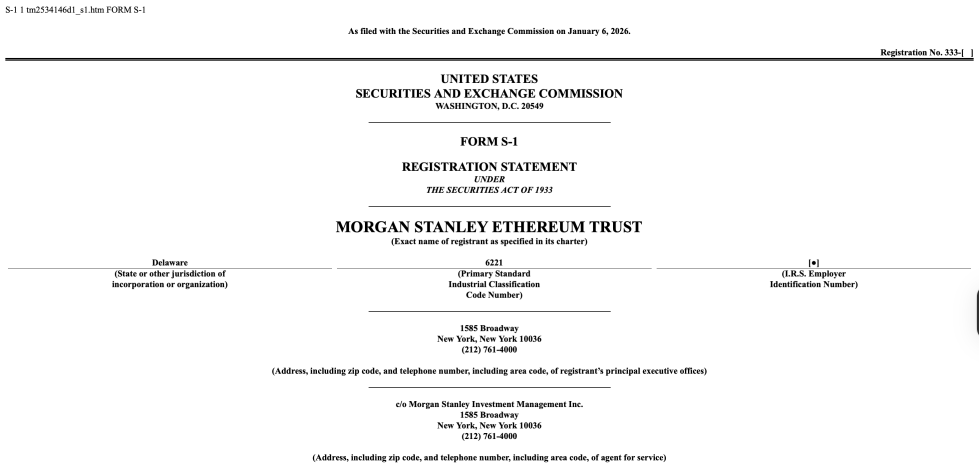
Morgan Stanley files S-1 form for Ethereum ETF. Source: sec.gov

Nonetheless, the document doesn’t address key details, such as the exchange on which the fund will be listed, the Trust’s custodian, or the ticker. Morgan Stanley’s Ethereum ETF filing follows recent efforts to launch other investment products based on some of the largest cryptocurrencies by market capitalization.

As reported by Bitcoinst, the Wall Street giant announced that it had submitted preliminary filings for spot Bitcoin (BTC) and Solana (SOL) Trusts on Tuesday, seeking to hold and generate returns by tracking these two cryptocurrencies.

In a January 6 statement, the bank detailed that “Morgan Stanley Bitcoin Trust and Morgan Stanley Solana Trust are pending regulatory approval and would be passive investment vehicles that seek to track the performance of the price of the relevant cryptocurrency.”

Similar to its submitted Ethereum ETF, the Solana fund will include an allocation for staking, and plans to engage one or more third-party staking service providers to conduct these activities.

A Broader Crypto Push

Notably, Morgan Stanley’s crypto ETF move is part of a broader shift toward a more welcoming approach that expands the presence of traditional institutions in the digital assets industry.

This pivot follows US regulatory efforts led by the Trump administration to turn the country into the “crypto capital of the world.” Amid this major push, the SEC has published new generic listing standards for crypto-based ETFs, which have seen a successful run since their initial launch nearly two years ago.

In 2024, Morgan Stanley, which had built one of the most significant Bitcoin ETF holdings in the US, allowed its managers to offer the products as an investment option for its wealthy customers. This enabled access to individuals with a minimum of $1.5 million in assets and an aggressive risk tolerance.

In October 2025, it expanded its access to crypto fund investments for all clients, including those with retirement accounts, moving away from its previous customer restrictions. The shift allowed its financial advisors to present crypto funds to any client.

It also announced last year that it would enable trading of the largest cryptocurrencies, Bitcoin, Ethereum, and Solana, through its E-Trade subsidiary.
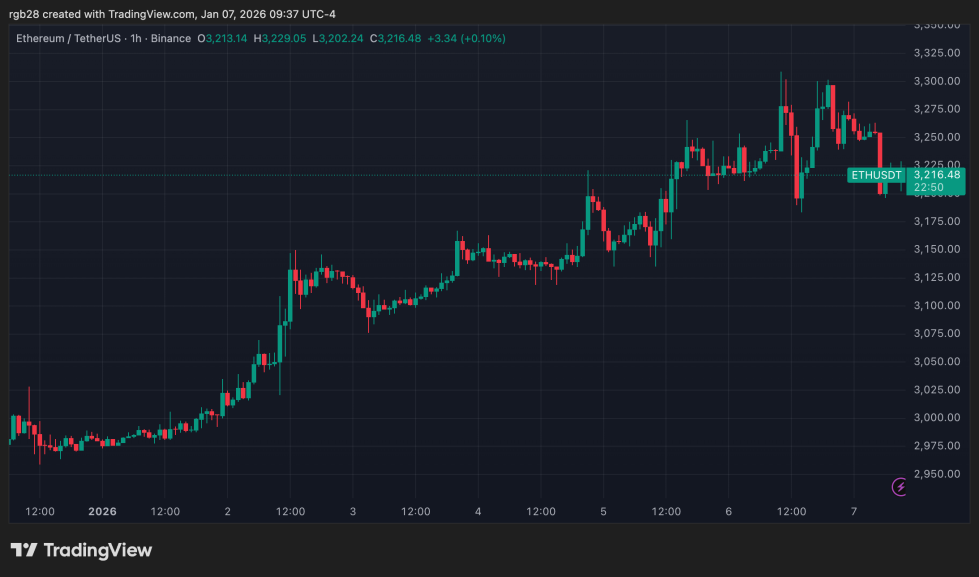
Ethereum trades at $3,216 in the one-week chart. Source: ETHUSDT on TradingView


Trending Cryptos

Related Questions

QWhat type of financial product has Morgan Stanley filed for with the SEC, and which cryptocurrency does it track?

AMorgan Stanley has filed an S-1 form for a Morgan Stanley Ethereum Trust, an Exchange-Traded Fund (ETF) that seeks to generate returns by tracking the price of Ethereum (ETH).

QBeyond price tracking, what additional feature does the proposed Morgan Stanley Ethereum Trust include to generate returns?

AThe Trust also aims to reflect rewards from staking a portion of its ether holdings, and it plans to engage one or more Staking Services Providers to conduct these staking activities.

QBesides an Ethereum ETF, what other two cryptocurrency-based investment products did Morgan Stanley file for on the same day?

AOn the same day, Morgan Stanley also submitted preliminary filings for a spot Bitcoin (BTC) Trust and a Solana (SOL) Trust.

QHow has Morgan Stanley's policy on offering crypto investments to its clients evolved since 2024?

AIn 2024, it allowed managers to offer Bitcoin ETFs only to wealthy customers with at least $1.5M in assets. By October 2025, it expanded access to crypto funds for all clients, including those with retirement accounts, and allowed financial advisors to present them to any client.

QThrough which subsidiary did Morgan Stanley announce it would enable direct trading of Bitcoin, Ethereum, and Solana?

AMorgan Stanley announced it would enable trading of these major cryptocurrencies through its E-Trade subsidiary.

Related Reads

CPU Makes a Comeback to the Table, A $170 Billion "Power Seizure" Drama Begins

A new era is dawning for the server CPU (Central Processing Unit), driven by the shift from AI model training to large-scale reasoning and the rise of Agentic AI. This article explores how the CPU is reclaiming a central role in the AI data center. For years, the focus has been on the GPU (Graphics Processing Unit) for AI training. However, as AI moves to the inference and Agent phase—where tasks involve complex, multi-step reasoning, tool calls, and data management—the workload balance is flipping. Studies show CPUs now handle over 70% of the workload in Agentic AI, up from 10-30% in training. This is because Agent tasks generate massive intermediate data (KV Cache) that exceeds GPU memory, forcing it to be offloaded to the CPU's larger, more scalable memory pools. This increased importance is translating into market changes. Major players are taking note: NVIDIA launched its first standalone CPU line, Vera, based on ARM architecture and optimized for Agent performance. AMD doubled its server CPU market forecast to over $1200 billion by 2030. Analyst reports project the total server CPU market could reach $1700 billion by 2030, with AI-driven demand being a primary driver. Furthermore, the classic ratio of CPUs to GPUs in AI servers is rapidly changing, converging from 1:8 toward 1:1 for Agent deployments. This surge in demand has led to a rare industry-wide price increase of 10-15% for server CPUs from Intel and AMD, breaking a decade-long trend of "more performance for the same price." Demand is bifurcating into high-core-count CPUs for in-rack GPU support and moderate-core CPUs for standalone Agent task orchestration. In China, this global trend presents an opportunity for domestic CPU manufacturers like Hygon (海光信息) and Huawei Kunpeng, who are bolstered by both growing AI infrastructure needs and national policies promoting technological self-reliance ("xin chuang"). The maturity of their software ecosystems is also accelerating, evidenced by faster adaptation to new AI models. In conclusion, the narrative is shifting from a GPU-centric view to one where CPU-GPU synergy is critical. The CPU is no longer a peripheral component but a performance-defining bottleneck and a key growth driver in the AI hardware stack, opening a massive new market estimated in the hundreds of billions of dollars.

marsbit10h ago

CPU Makes a Comeback to the Table, A $170 Billion "Power Seizure" Drama Begins

marsbit10h ago

TechFlow Intelligence: AMD AI Director Publicly Criticizes Claude Code for "Becoming Dumber and Lazier", Trump Claims Full Ceasefire in Hormuz But Strait Still Has 80 Unexploded Mines

TechFlow Intelligence Report: This daily digest covers key developments in AI, crypto, hardware, and geopolitics. In AI, SK Telecom faces US export control scrutiny over its partnership with Anthropic, while a Gemini user reports being misled in a scam scenario, sparking safety debates. China's Z.AI launches the GLM-5.2 model, rivaling Claude Opus without NVIDIA chips. In crypto, Bithumb lists ReProtocol, and Upbit delists KernelDAO. On the hardware front, MIT researchers build a custom OS to study chips, ASML denies US claims its advanced lithography machines are in China, and Amazon considers selling its in-house AI chips. Apple's future A21 Pro chip may use TSMC's latest N2P process. Major tech issues include 10,000 GitHub repositories distributing malware and Apple patching a critical eavesdropping flaw in Beats earbuds. US stocks rise, led by semiconductors, with Intel surging 10.6%, while SpaceX falls 3.5%. Geopolitically, despite a US-Iran deal, the Strait of Hormuz remains risky with ~80 uncleared mines, stalling 80M barrels of oil on standby tankers. Iran postpones Switzerland talks, and Trump calls the agreement an "unconditional surrender." The report highlights a contrast: temporary geopolitical calm versus the ongoing, fundamental restructuring of tech supply chains and chip independence.

marsbit10h ago

TechFlow Intelligence: AMD AI Director Publicly Criticizes Claude Code for "Becoming Dumber and Lazier", Trump Claims Full Ceasefire in Hormuz But Strait Still Has 80 Unexploded Mines

marsbit10h ago

Trading

Spot
Futures

Hot Articles

How to Buy PUSH

Welcome to HTX.com! We've made purchasing Push Protocol (PUSH) simple and convenient. Follow our step-by-step guide to embark on your crypto journey.Step 1: Create Your HTX AccountUse your email or phone number to sign up for a free account on HTX. Experience a hassle-free registration journey and unlock all features.Get My AccountStep 2: Go to Buy Crypto and Choose Your Payment MethodCredit/Debit Card: Use your Visa or Mastercard to buy Push Protocol (PUSH) instantly.Balance: Use funds from your HTX account balance to trade seamlessly.Third Parties: We've added popular payment methods such as Google Pay and Apple Pay to enhance convenience.P2P: Trade directly with other users on HTX.Over-the-Counter (OTC): We offer tailor-made services and competitive exchange rates for traders.Step 3: Store Your Push Protocol (PUSH)After purchasing your Push Protocol (PUSH), store it in your HTX account. Alternatively, you can send it elsewhere via blockchain transfer or use it to trade other cryptocurrencies.Step 4: Trade Push Protocol (PUSH)Easily trade Push Protocol (PUSH) on HTX's spot market. Simply access your account, select your trading pair, execute your trades, and monitor in real-time. We offer a user-friendly experience for both beginners and seasoned traders.

3.7k Total ViewsPublished 2024.03.29Updated 2026.06.02

How to Buy PUSH

Discussions

Welcome to the HTX Community. Here, you can stay informed about the latest platform developments and gain access to professional market insights. Users' opinions on the price of PUSH (PUSH) are presented below.

活动图片