Lasting 233 Days with Over 50% Drawdown, Is This the Mildest Bear Market to Date?

marsbitPublished on 2026-06-26Last updated on 2026-06-26

Abstract

Bitcoin's current bear market has lasted 233 days as of June 24, making it the fourth-longest cycle since 2014, defined by its price staying below the 200-day moving average (200 DMA) for over 30 days. Historically, the longest bear markets were in 2018-2019 (385 days) and 2022-2023 (381 days), driven by major structural crashes post-all-time highs. In contrast, the current 2025-2026 downturn, following Bitcoin's January 2025 peak of $124,773, appears driven by broader macro shifts like rising interest rates and fading post-halving momentum. This cycle is notably the mildest on record so far, with a peak-to-trough drawdown of 51.2%. Previous major bear markets saw declines between 76.7% and 83.6%. Even the sharp but brief 2020 COVID crash caused a 74.4% drop. As of the analysis date, Bitcoin's price is $62,651, about 22% below its 200 DMA of $76,450. A sustained rally of over one-fifth is needed to reclaim this key level. If the recent low of $60,861 on June 7, 2026, is confirmed as the cycle bottom, historical recovery patterns suggest reclaiming the 200 DMA could take from 65 to 166 days, potentially placing it around August 2026 at the earliest.

Author: Coingecko

Compiled by: Felix, PANews

As of June 24, the current Bitcoin bear market has lasted 233 days, making it the fourth-longest bear market cycle among the 7 cycles since 2014. This article defines a "bear market cycle" as a period during which Bitcoin's closing price remains below its 200-day moving average (200 DMA) for 30 consecutive days or longer.

A moving average is a technical indicator that smooths out short-term price fluctuations to identify broader trends. The 200-day moving average (200 DMA) specifically tracks the average closing price over the past 200 days and is a widely used benchmark for assessing long-term market direction.

Overview of Past Bear Market Cycles:
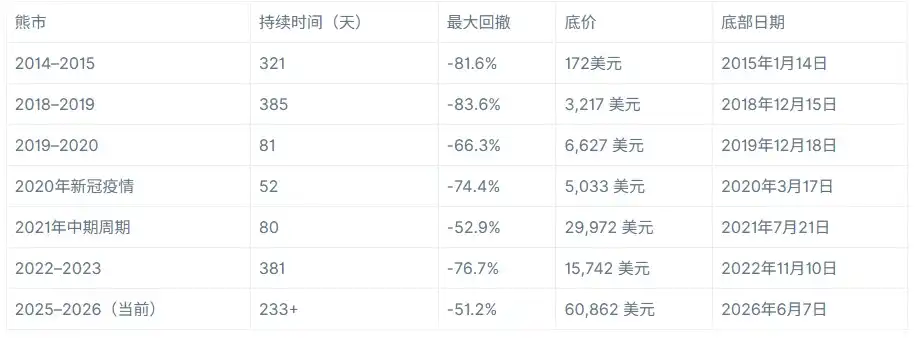
Daily closing price data sourced from CoinGecko, covering January 1, 2014, to June 24, 2026.

The two longest-lasting bear market cycles in Bitcoin's history were the 2018–2019 cycle (385 days) and the 2022–2023 cycle (381 days). Both followed all-time highs and were structural crashes driven by excessive leverage and loss of confidence. The 2018–2019 bear market came right after the peak of the ICO craze in late 2017, gradually subsiding as retail speculation waned and global regulatory pressure increased. The 2022–2023 bear market was triggered by the collapse of the Terra/LUNA ecosystem in May 2022, subsequently causing a chain of bankruptcies including Three Arrows Capital, Celsius, and ultimately FTX, which shattered institutional confidence and dragged Bitcoin below $16,000 in November 2022.

The 2014–2015 bear market (lasting 321 days) was caused by the failure of Mt. Gox, then the world's largest Bitcoin exchange, which completely destroyed trust in the nascent market.

The remaining four bear markets were shorter in duration and triggered by more isolated shock events. The 2019–2020 pullback (81 days) and the 2021 mid-cycle correction (80 days) were relatively brief; the former was a consolidation phase during a market recovery, while the latter resulted from a temporary crash in hash rate and sentiment due to China's mining ban. The 2020 "COVID-19 crash" (52 days) was the most intense but bottomed out the fastest—a macro liquidity shock that eased as global stimulus flooded the market.

The current 2025–2026 bear market (233 days as of the time of analysis) appears to stem from broader macro shifts: rising interest rate uncertainty, fading post-halving momentum, and the rise of AI as a speculative asset class. These factors have all pressured Bitcoin since it reached its all-time high of $124,773 in January 2025.

How Severe Were Past Bear Markets?

The current 2025–2026 bear market is actually the mildest on record (so far, hopefully), with a maximum drawdown of 51.2% from Bitcoin's all-time high of $124,773. Every previous bear market cycle had larger declines, with the three major bear markets experiencing drops between 76.7% and 83.6%.

The closest comparable event is the 2021 mid-cycle correction (a 52.9% drop), though that event lasted only 80 days and occurred within a broader bull trend rather than as a standalone bear market cycle.

Historically, the most destructive cycles were the 2018–2019 bear market (83.6% drop) and the 2014–2015 bear market (81.6% drop), both erasing the vast majority of Bitcoin's previous gains before bottoming and recovering. The 2022–2023 cycle (76.7% drop) was similarly severe, with Bitcoin falling from its all-time high of $67,617 to a low of $15,742 in November 2022.

Even the shorter, shock-driven crashes resulted in significant losses: the 2020 COVID-19 crash caused a 74.4% drawdown despite lasting only 52 days, highlighting how quickly crypto market sentiment and liquidity can deteriorate. The current cycle has so far avoided such severe damage, possibly reflecting more resilient market structure, higher institutional participation, or simply because the bear market isn't over yet.

Is Recovery in Sight?

As of June 24, Bitcoin's 200 DMA stands at $76,450, while the spot price is $62,651, representing a 22% gap. This means that reclaiming the 200 DMA would require a sustained rally of over one-fifth from current levels. Historically, the 200 DMA has acted as a strong resistance level during price recoveries, not just as support during declines.

Currently, Bitcoin is about 2.9% above the cycle low of $60,861 reached on June 7, 2026. In past bear markets, the time span from confirming a bottom to finally reclaiming the 200 DMA has ranged from 65 days (2022–2023 cycle) to 166 days (2014–2015 cycle). If June 7 indeed marks the bottom of this bear market (which needs more time to confirm), then even at the historically fastest recovery pace, reclaiming the 200 DMA would not occur until August 2026 at the earliest.

Related Read: Bitwise: Bullish on Bitcoin in H2, AI and Regulation to Usher in New Altcoin Season


Trending Cryptos

Related Questions

QAccording to the article, how is a 'bear market cycle' defined for Bitcoin?

AThe article defines a 'bear market cycle' as a period when Bitcoin's closing price has remained below its 200-day moving average (200 DMA) for 30 consecutive days or more.

QWhat are the two longest-lasting bear market cycles in Bitcoin's history mentioned in the article, and what were their durations?

AThe two longest-lasting bear market cycles mentioned are the 2018–2019 cycle (385 days) and the 2022–2023 cycle (381 days).

QWhy is the current 2025–2026 bear market described as the most mild one on record so far?

AIt is described as the most mild because it has recorded a maximum drawdown of 51.2% from its all-time high, which is a smaller decline compared to previous major bear markets that saw drawdowns ranging from 76.7% to 83.6%.

QWhat were the key factors cited as causing the current 2025–2026 bear market?

AThe article attributes the current bear market to a broader macro shift including rising interest rate uncertainty, fading post-halving momentum, and the rise of AI as a speculative asset class.

QBased on historical patterns, what is the earliest possible date suggested in the article for Bitcoin to potentially reclaim its 200 DMA, assuming June 7, 2026, was the cycle bottom?

ABased on the fastest historical recovery time of 65 days (from the 2022–2023 cycle), the article suggests the earliest possible date to reclaim the 200 DMA would be around August 2026.

Related Reads

Stablecoins Becoming the Next Policy Challenge for the Fed's Walsh Version

Fed Governor Christopher Waller's speech at the June 22 conference on the U.S. dollar's international role signifies a notable policy shift: stablecoins like USDT and USDC are now being formally considered as potential channels for transmitting U.S. dollar liquidity globally. With their combined market cap surpassing $250 billion and high transaction volumes, these digital assets are moving from the periphery of crypto policy to the core of monetary system research. The key concern for policymakers is how stablecoin flows interact with traditional dollar infrastructure. Their growth could affect bank deposits, demand for short-term Treasury securities (like T-bills), and global access to dollars, depending on whether demand originates overseas or substitutes for domestic bank balances. Issuers' reserve management—holding assets in banks, money market funds, or Treasuries—links stablecoin activity directly to these core markets. The Fed's research agenda now examines whether stablecoins, by combining payment and balance-holding functions on digital rails, could complicate monetary policy implementation or transmit liquidity stress to banks. While current Treasury holdings by issuers are under 1% of the total market, their concentrated demand could marginally impact yields, especially during periods of stress. Consequently, stablecoins are evolving from mere crypto trading tools into a private-layer dollar transmission system with public policy implications, prompting closer regulatory scrutiny of their reserve robustness, redemption mechanisms, and systemic integration.

marsbit5m ago

Stablecoins Becoming the Next Policy Challenge for the Fed's Walsh Version

marsbit5m ago

A 380% Soar, Shenzhen’s 100-Billion-Yuan IPO Rings the Bell

HKC Holdings, a major Chinese display panel manufacturer, has successfully listed on the Shenzhen Stock Exchange's main board. The company's shares surged over 380% on its debut, pushing its market capitalization to around 350 billion yuan (formerly reaching 500 billion yuan). Founded by Wang Zhiyong in Shenzhen's Huaqiangbei electronics market nearly three decades ago, HKC evolved from assembling monitors to becoming a global top-tier supplier of semiconductor display panels for TVs, monitors, and smartphones. The IPO marks a significant milestone for HKC and its backers. The company's growth into the capital-intensive panel manufacturing sector was supported through partnerships with state-owned capital from regions like Chongqing, Mianyang, and Chuzhou. Its shareholder list also includes BOE Technology's investment arm. In recent years, HKC reported strong financials, with core panel business contributing over 70% of revenue and clients including Samsung, TCL, and Xiaomi. This listing is seen as part of a broader trend in Shenzhen's evolving tech landscape. Beyond established giants, the city is nurturing clusters of leading companies in specialized sectors like robotics—exemplified by the "Shenzhen Robot Valley"—and storage chips, where a group of firms dubbed the "Storage Five Tigers" has achieved a combined trillion-yuan market valuation. Shenzhen's strategic focus on emerging industries such as AI terminals, low-altitude economy, and humanoid robotics aims to build new industrial depth and foster the next generation of tech champions.

marsbit17m ago

A 380% Soar, Shenzhen’s 100-Billion-Yuan IPO Rings the Bell

marsbit17m ago

Domestic First Explosion-Proof Certification, World's First Fueling Brain Solution: How Did They Secure Two 'Firsts'?

China's embodied AI sector is booming, with over ¥37 billion in funding this year. The focus has shifted decisively to real-world application, particularly in hazardous, repetitive tasks humans should avoid. A key, often prohibitive, barrier to entry for robots in environments like gas stations and oil fields is obtaining explosion-proof certification, requiring meticulous hardware and circuit design from the ground up. The article explores three main application areas. At gas stations, the challenge lies in executing a long, precise sequence of actions (opening caps, handling the fuel nozzle) with millimeter accuracy across diverse car models. For facility inspections, robots need sustained autonomous patrols combined with real-time anomaly detection and response. Port scenarios introduce the complexity of multi-robot coordination. Addressing the core challenge of long-horizon tasks, the piece highlights a technical breakthrough: a "world model"-driven approach. This enables predictive planning, allowing the AI to visualize the desired end-state (e.g., nozzle returned, cap closed) and work backward to synthesize intermediate visual frames. This "imagination" of the task trajectory, as implemented in the H-GAR architecture, guides action generation, significantly reducing cumulative error in multi-step operations. The three-step H-GAR process involves generating a coarse action draft, synthesizing target-conditioned observation frames, and then refining actions based on visual context and a memory of past successful motions. The conclusion emphasizes that success in specialized, safety-critical fields requires long-term commitment and deep integration of the "embodied brain" (AI) with a purpose-built, certified physical "body." Mastering this brain-body-data闭环 (closed-loop) is positioned as a crucial competitive advantage for commercialization.

marsbit1h ago

Domestic First Explosion-Proof Certification, World's First Fueling Brain Solution: How Did They Secure Two 'Firsts'?

marsbit1h ago

Bitcoin Bear Market Triggers Crypto Layoffs, Yet Fuels Industry's Most Aggressive M&A Wave Ever

A prolonged Bitcoin downturn is forcing crypto companies to lay off employees and automate operations, but has simultaneously triggered the industry's most aggressive wave of mergers and acquisitions (M&A). In the first half of 2026, crypto M&A deal value reached $93.7 billion, 26 times higher than the same period last year. This activity is primarily driven by traditional financial institutions—banks, payment processors, and asset managers—who are acquiring compliant crypto infrastructure like custody solutions, payment rails, and regulatory licenses instead of building them internally. Examples include Mastercard's acquisition of stablecoin firm BVNK and Franklin Templeton's launch of a dedicated crypto division via acquisition. This consolidation contrasts sharply with a shrinking crypto labor market, where active job openings have plummeted. Companies like Coinbase are restructuring to become "AI-native," leading to a sharp increase in roles requiring AI skills, while engineering and compliance positions now dominate hiring. Financially pressured crypto firms, such as Messari which was acquired at a fraction of its prior valuation, are becoming prime targets. Capital remains available but is highly selective, flowing overwhelmingly into businesses that bridge digital assets with traditional finance, such as tokenization platforms and regulated trading venues. The trend indicates a market where capital is rewarding compliant, utility-focused infrastructure while weaker models consolidate or downsize.

marsbit1h ago

Bitcoin Bear Market Triggers Crypto Layoffs, Yet Fuels Industry's Most Aggressive M&A Wave Ever

marsbit1h ago

Trading

Spot
Futures

Hot Articles

What is $BITCOIN

DIGITAL GOLD ($BITCOIN): A Comprehensive Analysis Introduction to DIGITAL GOLD ($BITCOIN) DIGITAL GOLD ($BITCOIN) is a blockchain-based project operating on the Solana network, which aims to combine the characteristics of traditional precious metals with the innovation of decentralized technologies. While it shares a name with Bitcoin, often referred to as “digital gold” due to its perception as a store of value, DIGITAL GOLD is a separate token designed to create a unique ecosystem within the Web3 landscape. Its goal is to position itself as a viable alternative digital asset, although specifics regarding its applications and functionalities are still developing. What is DIGITAL GOLD ($BITCOIN)? DIGITAL GOLD ($BITCOIN) is a cryptocurrency token explicitly designed for use on the Solana blockchain. In contrast to Bitcoin, which provides a widely recognized value storage role, this token appears to focus on broader applications and characteristics. Notable aspects include: Blockchain Infrastructure: The token is built on the Solana blockchain, known for its capacity to handle high-speed and low-cost transactions. Supply Dynamics: DIGITAL GOLD has a maximum supply capped at 100 quadrillion tokens (100P $BITCOIN), although details regarding its circulating supply are currently undisclosed. Utility: While precise functionalities are not explicitly outlined, there are indications that the token could be utilized for various applications, potentially involving decentralized applications (dApps) or asset tokenization strategies. Who is the Creator of DIGITAL GOLD ($BITCOIN)? At present, the identity of the creators and development team behind DIGITAL GOLD ($BITCOIN) remains unknown. This situation is typical among many innovative projects within the blockchain space, particularly those aligning with decentralized finance and meme coin phenomena. While such anonymity may foster a community-driven culture, it intensifies concerns about governance and accountability. Who are the Investors of DIGITAL GOLD ($BITCOIN)? The available information indicates that DIGITAL GOLD ($BITCOIN) does not have any known institutional backers or prominent venture capital investments. The project seems to operate on a peer-to-peer model focused on community support and adoption rather than traditional funding routes. Its activity and liquidity are primarily situated on decentralized exchanges (DEXs), such as PumpSwap, rather than established centralized trading platforms, further highlighting its grassroots approach. How DIGITAL GOLD ($BITCOIN) Works The operational mechanics of DIGITAL GOLD ($BITCOIN) can be elaborated on based on its blockchain design and network attributes: Consensus Mechanism: By leveraging Solana’s unique proof-of-history (PoH) combined with a proof-of-stake (PoS) model, the project ensures efficient transaction validation contributing to the network's high performance. Tokenomics: While specific deflationary mechanisms have not been extensively detailed, the vast maximum token supply implies that it may cater to microtransactions or niche use cases that are still to be defined. Interoperability: There exists the potential for integration with Solana’s broader ecosystem, including various decentralized finance (DeFi) platforms. However, the details regarding specific integrations remain unspecified. Timeline of Key Events Here is a timeline that highlights significant milestones concerning DIGITAL GOLD ($BITCOIN): 2023: The initial deployment of the token occurs on the Solana blockchain, marked by its contract address. 2024: DIGITAL GOLD gains visibility as it becomes available for trading on decentralized exchanges like PumpSwap, allowing users to trade it against SOL. 2025: The project witnesses sporadic trading activity and potential interest in community-led engagements, although no noteworthy partnerships or technical advancements have been documented as of yet. Critical Analysis Strengths Scalability: The underlying Solana infrastructure supports high transaction volumes, which could enhance the utility of $BITCOIN in various transaction scenarios. Accessibility: The potential low trading price per token could attract retail investors, facilitating wider participation due to fractional ownership opportunities. Risks Lack of Transparency: The absence of publicly known backers, developers, or an audit process may yield skepticism regarding the project's sustainability and trustworthiness. Market Volatility: The trading activity is heavily reliant on speculative behavior, which can result in significant price volatility and uncertainty for investors. Conclusion DIGITAL GOLD ($BITCOIN) emerges as an intriguing yet ambiguous project within the rapidly evolving Solana ecosystem. While it attempts to leverage the “digital gold” narrative, its departure from Bitcoin's established role as a store of value underscores the need for a clearer differentiation of its intended utility and governance structure. Future acceptance and adoption will likely depend on addressing the current opacity and defining its operational and economic strategies more explicitly. Note: This report encompasses synthesised information available as of October 2023, and developments may have transpired beyond the research period.

459 Total ViewsPublished 2025.05.13Updated 2025.05.13

What is $BITCOIN

Discussions

Welcome to the HTX Community. Here, you can stay informed about the latest platform developments and gain access to professional market insights. Users' opinions on the price of BTC (BTC) are presented below.

活动图片