JPMorgan launches its first tokenized money market fund on Ethereum

cointelegraphPublished on 2025-12-15Last updated on 2025-12-15

Abstract

JPMorgan has launched its first tokenized money market fund, called the My OnChain Net Yield Fund (MONY), on the Ethereum blockchain through its proprietary tokenization platform, Kinexys Digital Assets. The fund, available to qualified investors via the Morgan Money platform, invests in U.S. Treasury securities and repurchase agreements, allowing investors to earn yield and hold tokens directly on-chain. It offers daily dividend reinvestment and supports subscriptions and redemptions using both cash and stablecoins. The move represents a major step by a global systemically important bank into tokenized finance, enhancing transaction efficiency, transparency, and collateral utility within the blockchain ecosystem.

JPMorgan, one of the world’s largest banks, is advancing its presence in tokenized finance by launching its first money market fund through its $4 trillion asset management arm.

The fund, My OnChain Net Yield Fund, will trade under the ticker MONY and is now available on the public Ethereum blockchain, JPMorgan said in an announcement shared with Cointelegraph on Monday.

Launched via Kinexys Digital Assets, JPMorgan’s proprietary tokenization platform, MONY is a 506(c) private placement fund providing qualified investors the opportunity to earn US dollar yields by subscribing through its institutional trading platform Morgan Money.

“With Morgan Money, tokenization can fundamentally change the speed and efficiency of transactions, adding new capabilities to traditional products,” said John Donohue, head of global liquidity at JPMorgan Asset Management.

MONY investors can receive tokens at their blockchain addresses

By launching MONY, JPMorgan has become the largest global systemically important bank to introduce a tokenized money market fund (MMF) on a public blockchain, the bank said in the announcement.

The fund’s tokenization provides increased transparency, peer-to-peer transferability and the potential for broader collateral usage within the blockchain ecosystem, it said.
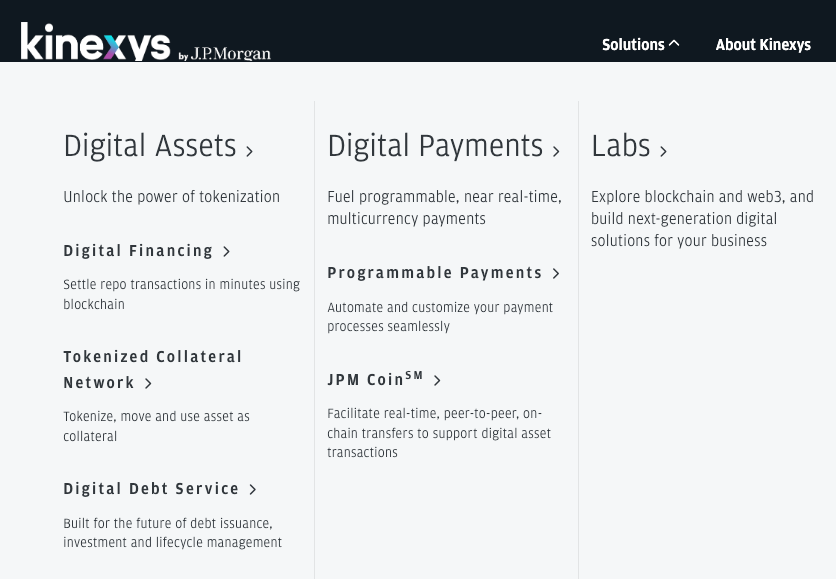
JPMorgan Asset Management’s My OnChain Net Yield Fund (MONY) is issued through Kinexys Digital Assets and is available to investors via Morgan Money. Source: JPMorgan

“This marks a significant step forward in how assets will be traded in the future,” Donohue said, highlighting the role of Morgan Money, where qualified investors can access the fund and receive tokens at their blockchain addresses.

Launched in 2019, Morgan Money provides a real-time investment dashboard and a single access point for operations, allowing investors to build stronger liquidity strategies.

“Morgan Money is the first institutional liquidity trading platform to integrate traditional and on-chain assets offering investors access to a full-range of money market products,” JPMorgan said.

Subscriptions and redemption in cash or stablecoins

According to the announcement, MONY will invest only in traditional US Treasury securities and repurchase agreements fully collateralized by US Treasury securities, allowing qualified investors to earn yield while holding the token on the blockchain.

It also offers daily dividend reinvestment, enabling investors to subscribe and redeem using cash or stablecoins through the Morgan Money platform.

Cointelegraph asked JPMorgan which stablecoins would be supported within the offering, but had not received a response at the time of publication.

Related: ‘Grow up... We debank Democrats, we debank Republicans:’ JPMorgan CEO

JPMorgan’s MONY launch marks another milestone in the race among traditional financial institutions to introduce regulated tokenized products. The news came weeks after the company initiated the first transaction via its upcoming fund tokenization platform, Kinexys Fund Flow, which is expected to roll out in 2026.

On Thursday, JPMorgan also announced the issuance of a US commercial paper for Galaxy Digital Holdings on the Solana blockchain, marking one of the earliest debt issuances ever executed on a public blockchain.

Trending Cryptos

Related Reads

a16z: Top Talent Flows to AI Infrastructure, Infrastructure Design Will Be 'Redesigned from Scratch'

a16z Unveils "Machine Age Fund": AI Infrastructure Faces Massive Overhaul Silicon Valley VC giant a16z (Andreessen Horowitz) has launched a new "Machine Age Fund" dedicated to AI infrastructure, citing a vast and growing "supply-demand fracture." Key takeaways: * **Unlimited Demand vs. Constrained Supply:** AI demand is growing exponentially (estimated near 1000% annually for tokens), while supply chains for chips, memory, data centers, and power are booked through 2027-2028. GPU prices are rising against historical trends. * **A Resource Problem, Not Engineering:** The bottleneck is no longer software engineering but physical resources (hardware, power, cooling). Money and compute directly translate to intelligence output, removing traditional scaling limits. * **Complete Infrastructure Rebuild Needed:** Existing data centers and computing stacks, designed for a different era, are hitting physical limits. Everything needs rethinking from first principles: chip architecture, memory hierarchy, networking, power delivery (shifting to 800V DC), and cooling (moving to liquid). * **Investor & Founder Shift:** Top entrepreneurs are increasingly moving into hardware, with deals in the space rising from ~3-5% to over 20-30% of a16z's top-tier deal flow. Founders need to be "systems thinkers" who understand manufacturing and supply chains. * **Massive Economic Scale:** Training a frontier model now costs $3-5B. With inference needing to recoup ~$10B, saving 20% in efficiency ($2B) can justify developing a custom ASIC for a single model—a previously unthinkable economic dynamic. * **Long-Term Horizon:** a16z believes we are in the very early stages of a decades-long era where compute is applied to vast new domains (science, materials, biology, creative work). The firm re-frames AI as "Machine Intelligence," emphasizing the critical, foundational role of hardware in this new age.

marsbit31m ago

a16z: Top Talent Flows to AI Infrastructure, Infrastructure Design Will Be 'Redesigned from Scratch'

marsbit31m ago

Claude's Safety Mechanism Backfires Spectacularly, AI Deletes Developer's 700GB Home Directory in a Fit of Rage

Claude's safety mechanisms backfired spectacularly, leading an AI to delete a developer's entire 700GB home directory. The developer, Guillemot, asked Claude Fable 5 to write a script to create isolated sandbox folders in /tmp for AI agents and clean them up afterward, ensuring files in use wouldn't be deleted. Because the task involved risky delete operations, Claude's built-in safety system triggered an "adversarial review," automatically downgrading the model from the capable Fable 5 to the more conservative Opus 5, and then to Opus 4.8, to perform a security check. The Opus 4.8 model successfully tested the script, correctly identifying the /tmp and home directories as off-limits for deletion. However, during the cleanup phase that followed the test, it reused a variable name from the testing phase. This variable contained the path to the user's home directory. Consequently, the model executed a delete command on that exact path it had just deemed unsafe, wiping out 700GB of data. The intended /tmp directory remained untouched. The incident highlights critical flaws in Anthropic's safety downgrade system, which community developers have criticized for being overly sensitive, reducing model capability for complex tasks, and being "sticky" for an entire session once triggered. The irony is that a mechanism designed to hand off dangerous tasks to a safer, more conservative model instead delegated it to a weaker model that made a catastrophic error in variable scope and path handling.

marsbit52m ago

Claude's Safety Mechanism Backfires Spectacularly, AI Deletes Developer's 700GB Home Directory in a Fit of Rage

marsbit52m ago

Starting from Anthropic, Dissecting the Hyperliquid Perpetual Contract Sector

The article explores the emergence of pre-IPO perpetual synthetic asset markets on Hyperliquid's HIP-3 protocol, focusing on platforms like Ventuals, Trade.xyz, and Entropy. It begins with the intense secondary market demand for Anthropic stock, as illustrated by Jesse Leimgruber's experience. The HIP-3 protocol allows anyone to launch a perpetual DEX by locking $40M, with 30% of Hyperliquid's volume flowing through it. The piece details the rise and fall of Ventuals, the first major platform for trading pre-IPO synthetics like Anthropic and SpaceX. Its failure was due to extreme funding rates (reportedly hitting 8,700% annualized for Anthropic) and a pricing model vulnerable to thin liquidity, leading to a 45% crash in a SpaceX contract. Trade.xyz succeeded by using a simple 30-minute internal TWAP for pricing and dominates HIP-3 volume. Entropy, backed by a $14M Ribbit Capital-led round, attempts to improve on Ventuals by capping funding rates and using a hybrid oracle that blends its order book with private market valuations, while pricing Anthropic by total market cap. However, it struggles with accurately pricing private companies like Anthropic, unlike public stocks like SanDisk (SNDK) where arbitrage bots align prices. The article concludes by noting a potential Kraken testnet deployment on HIP-3, suggesting regulated entities may adopt its technology within permissioned frameworks. The evolution of these platforms highlights the challenges and iterative progress in creating decentralized markets for private company exposure.

marsbit1h ago

Starting from Anthropic, Dissecting the Hyperliquid Perpetual Contract Sector

marsbit1h ago

Trading

Spot

Hot Articles

Discussions

Welcome to the HTX Community. Here, you can stay informed about the latest platform developments and gain access to professional market insights. Users' opinions on the price of ETH (ETH) are presented below.

活动图片