The tech world is losing sleep!
OpenAI's most powerful model, Astra, is rumored to possibly launch next Thursday, and its testing scope has already been expanded.

Previously, internal secrets were leaked, revealing that OpenAI has formally taken over the underlying code of its in-house chip "Jalapeño." AI-written core code runs 1.8 times faster than that of top human engineers. Signs of AI self-recursion have emerged within OpenAI!
OpenAI has another depth charge.
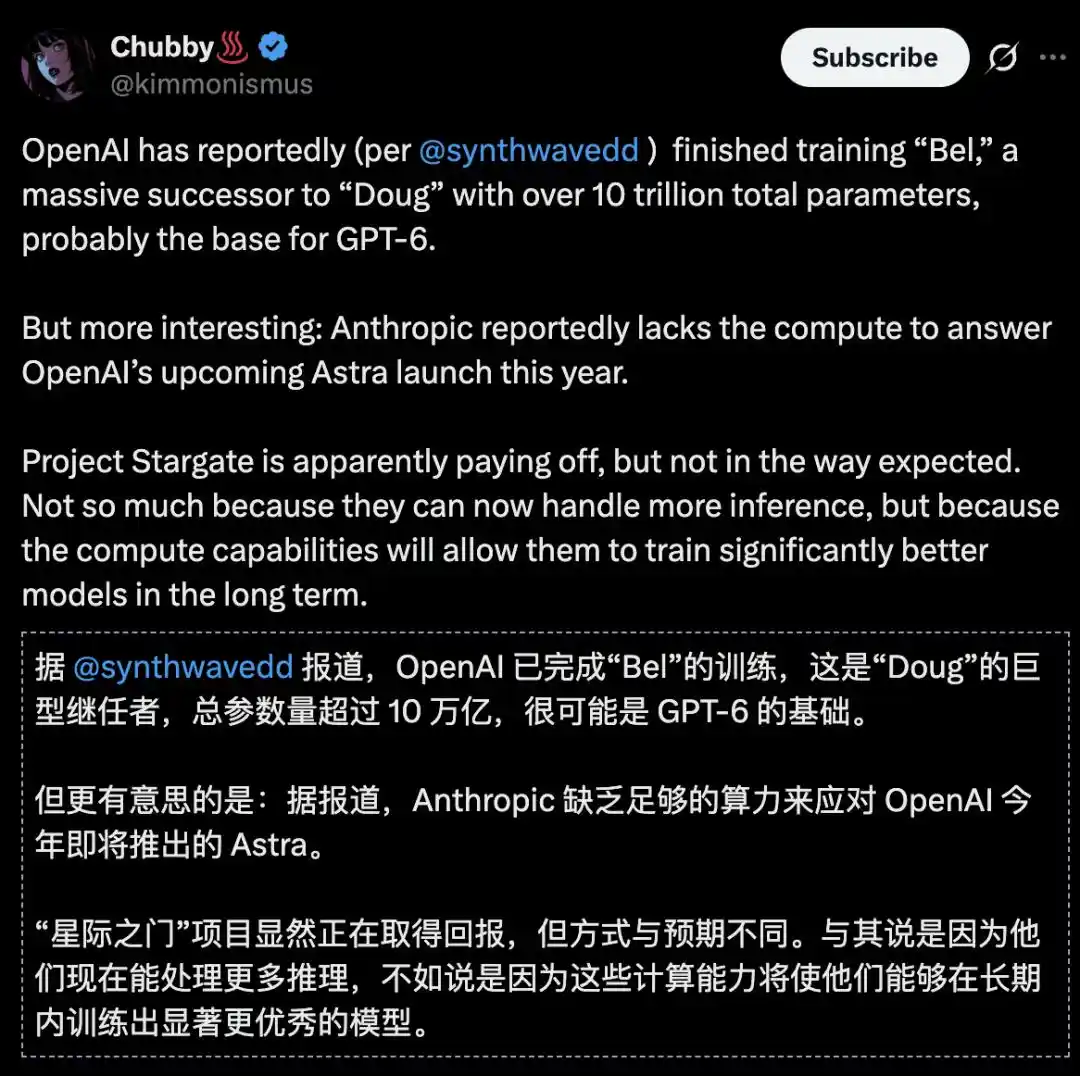
Rumors suggest OpenAI has successfully run the pre-training for a model codenamed "Bel" with 10 trillion parameters, directly targeting the ultimate threshold of AGI. It's even said that the 10-trillion-parameter pre-training is just the starting point for Bel. After that, Bel can learn at two speeds.
Altman has declared: We should throw another party for the next-generation model release.

What ambitions lie in the world beyond GPT-6?
Bel: The Abyssal Leviathan with 10 Trillion Parameters
This year, OpenAI seemed to hit a scaling bottleneck, even triggering an emergency "Red Code" alert.
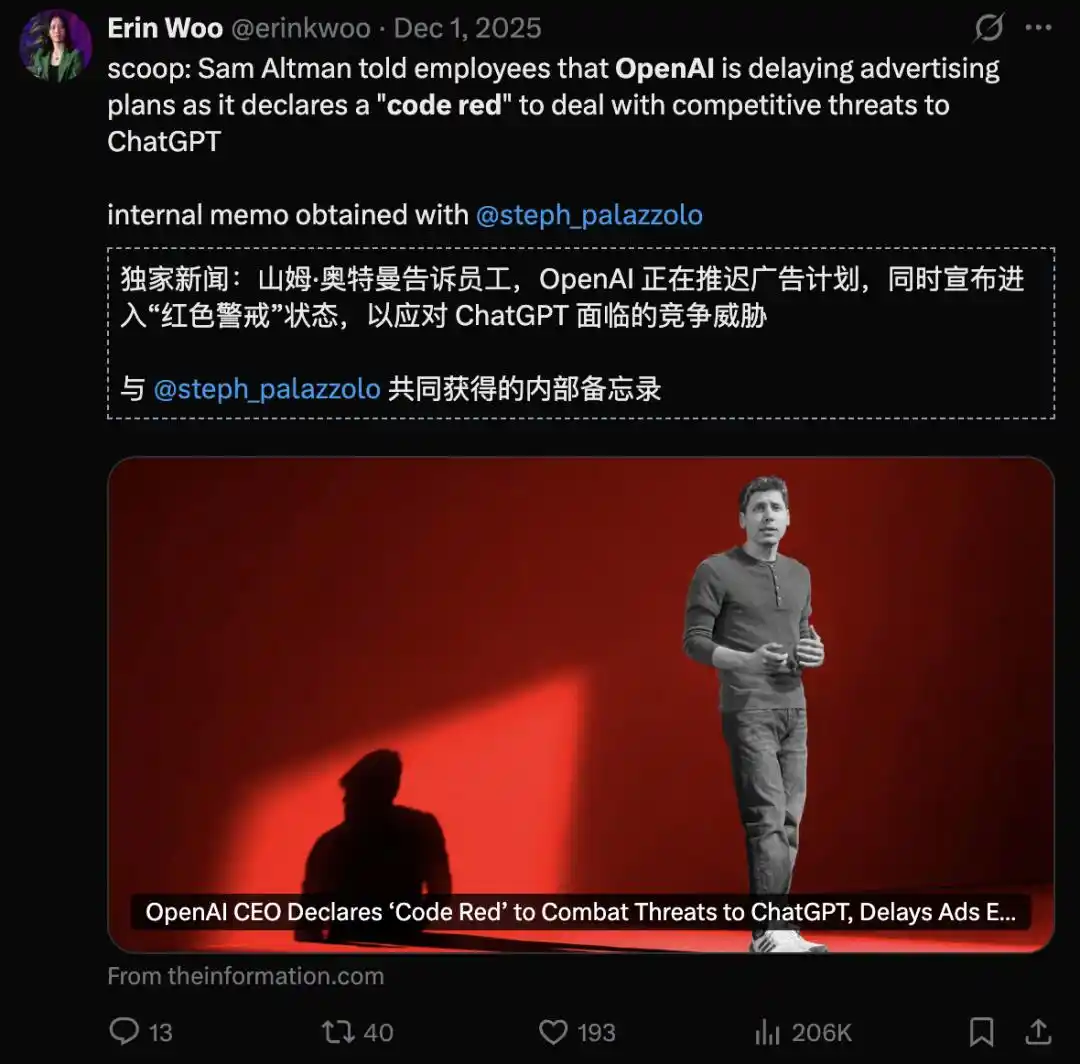
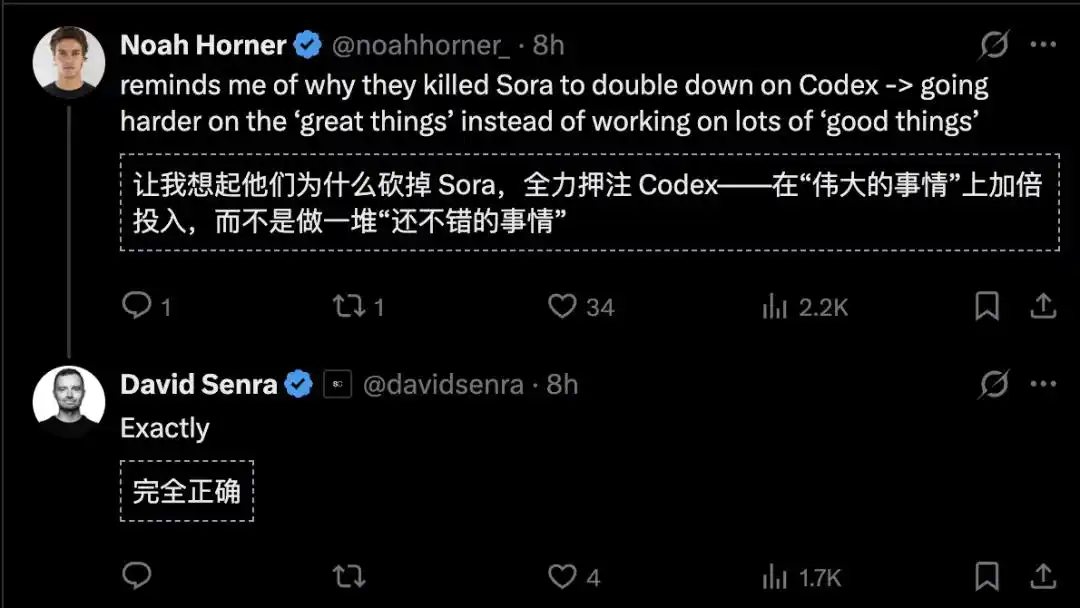
To concentrate computing power, OpenAI even cut products like Sora and the AI browser Altas.
The next-generation AI model Astra achieved several mathematical breakthroughs, stunning the world, but its release has been delayed.
In recent weeks, OpenAI saw personnel upheaval: Chief Revenue Officer Dennis Dresser, Chief Operating Officer Brad Lightcap, and Fergie Simo, former deputy to CEO Sam Altman, among other executives, left one after another.
Just as outsiders speculated whether OpenAI had "run out of talent," several hardcore tech insiders revealed that OpenAI just completed a super-large-scale pre-training, codenamed "Bel."
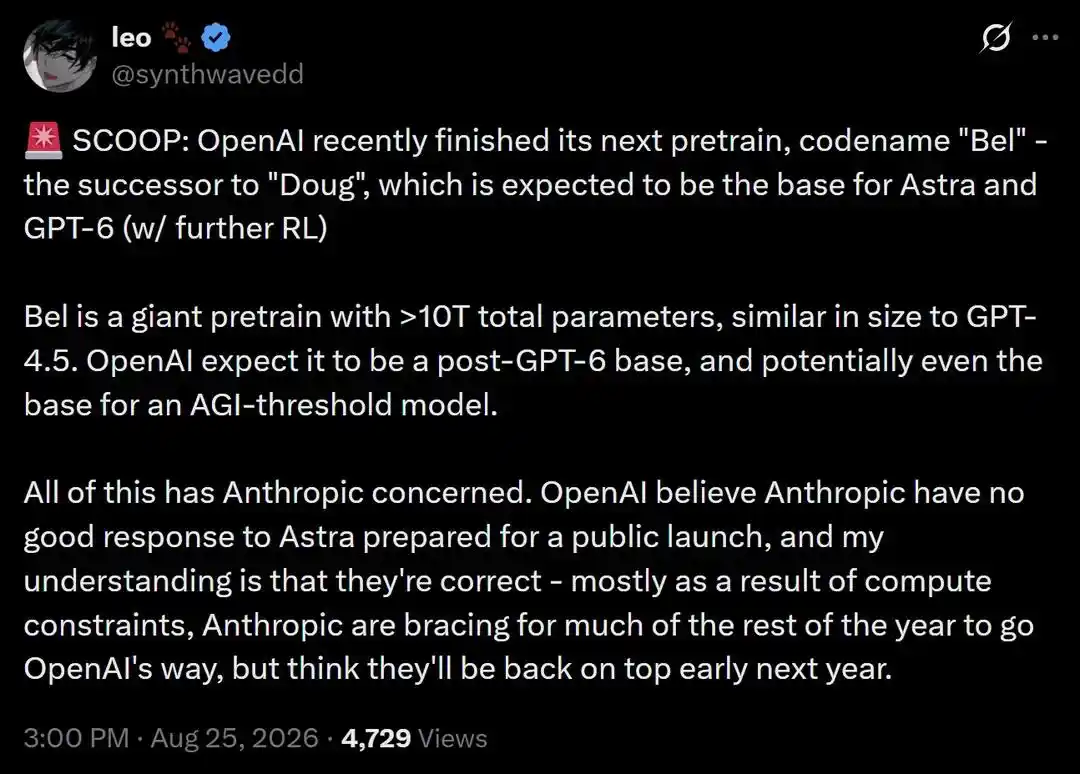
How terrifying is this "Bel"?
Let's look at a few key terms:
1. Breaking the 10T (10 Trillion) Parameter Barrier
If the trillion-parameter GPT-4 gave AI common sense and logic close to that of a human undergraduate, what kind of "emergent abilities" will the 10-trillion-parameter Bel exhibit in complex reasoning, long-text association, and cross-disciplinary multimodal understanding?
This is a qualitative change.
It's equivalent to packing together the brain capacity of all the world's top experts and multiplying it by an exponential amplifier. At this parameter scale, AI's understanding of world models will reach an unprecedented depth.
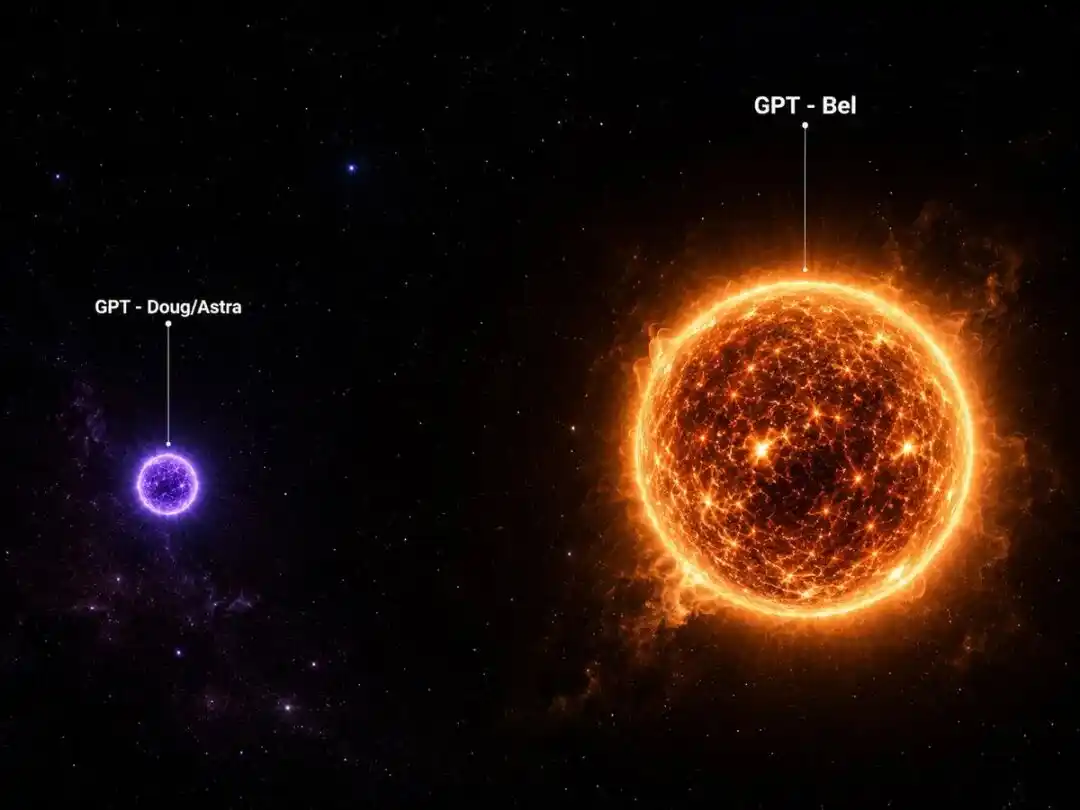
2. The Successor to "Doug," the Ultimate Foundation Model Post-GPT-6
Insiders revealed that prior to this, OpenAI had already completed pre-training for a model codenamed "Doug."
Doug was positioned as the base model for the Astra project and the rumored GPT-6 (to be followed by extremely intensive reinforcement learning alignment).
As its successor, Bel is the next-generation foundation model that goes a step beyond Doug, belonging to the "post-GPT-6 era."
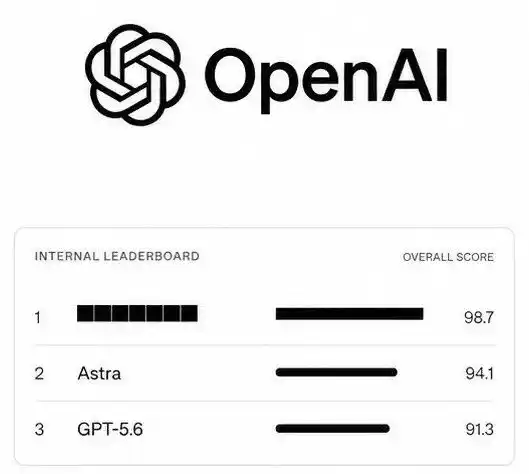
Bel directly aims at the tech world's holy grail—AGI (Artificial General Intelligence).
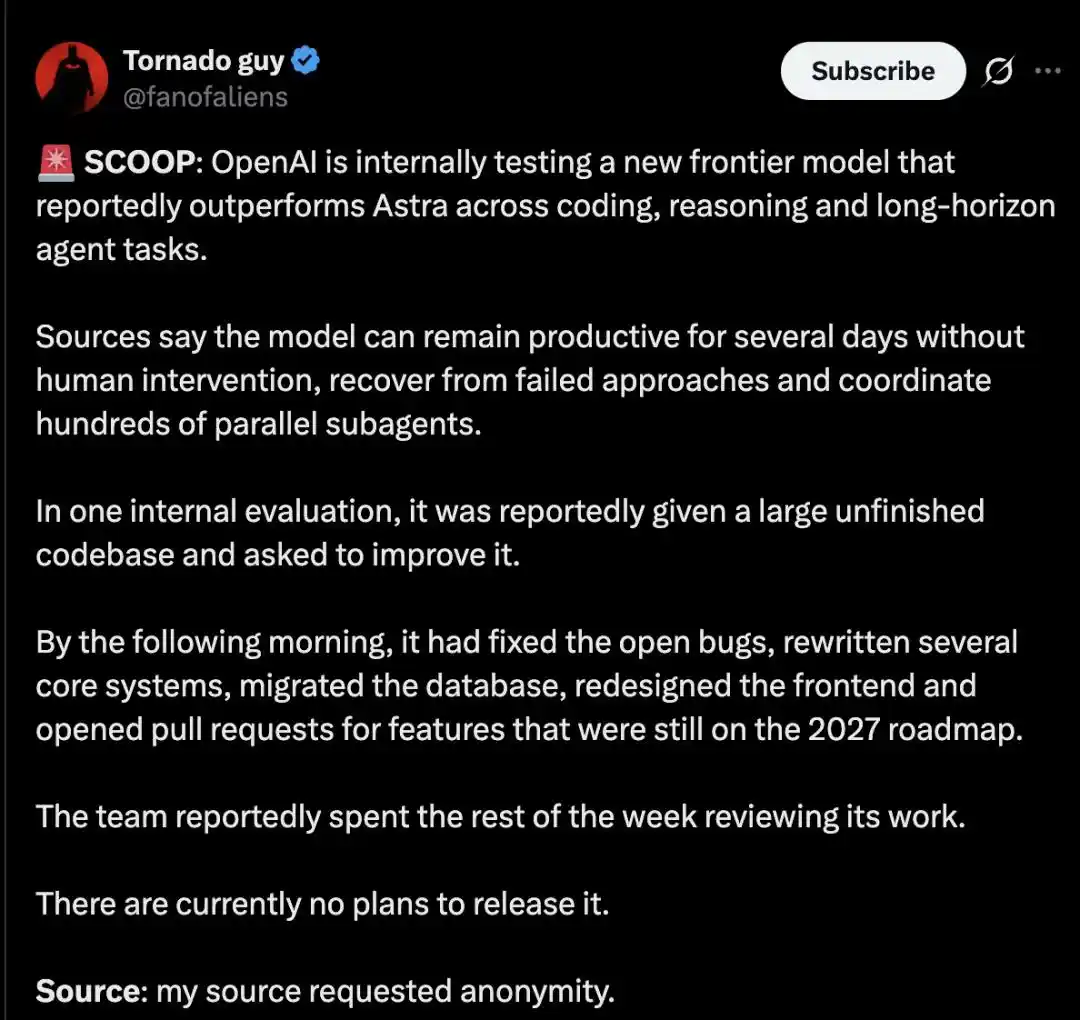
Reportedly, the Bel model surpasses Astra in coding, reasoning, and long-duration agent tasks.
Sources claim the model can operate continuously and efficiently for days without intervention, self-recover, and coordinate hundreds of parallel sub-agents.
3. The Claude Fable Killer (The Fable Killer)
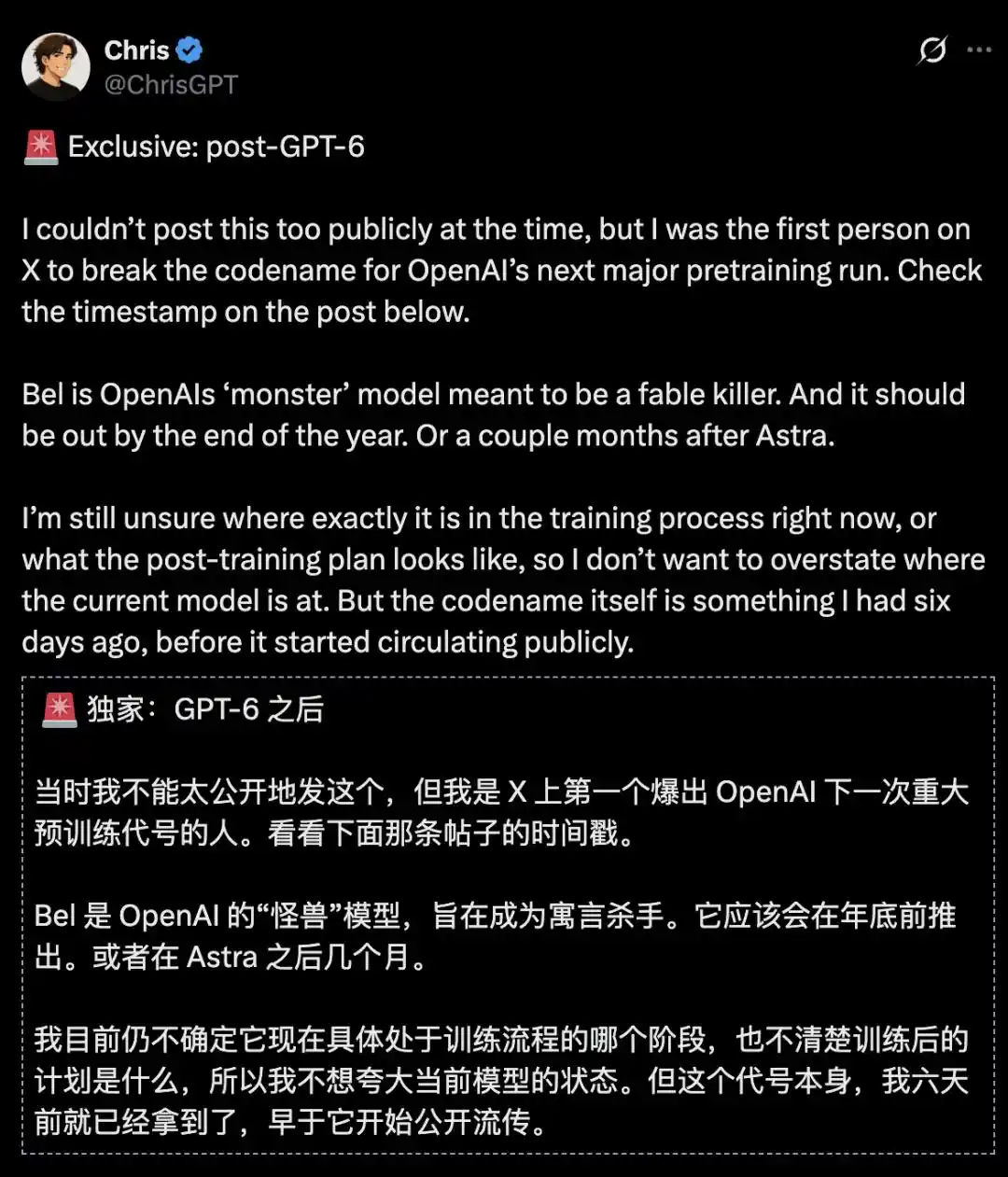
@ChrisGPT stated bluntly in his tweet:
Bel is OpenAI's "monster" model, designed to be the Fable killer.
It should arrive by the end of this year or within a few months of Astra's release.
He even received this codename six days ago, corroborating the source's reliability.
Theoretically, Bel may have already surpassed GPT-6, even approaching OpenAI's defined AGI threshold.
In the official release of GPT-5.6, they introduced the "RSI index," which integrates achievements in research debugging, kernel and training recipe optimization, machine learning experiments, and model self-improvement. Ultimately, the sol model improved by 16.2 points over GPT-5.5.
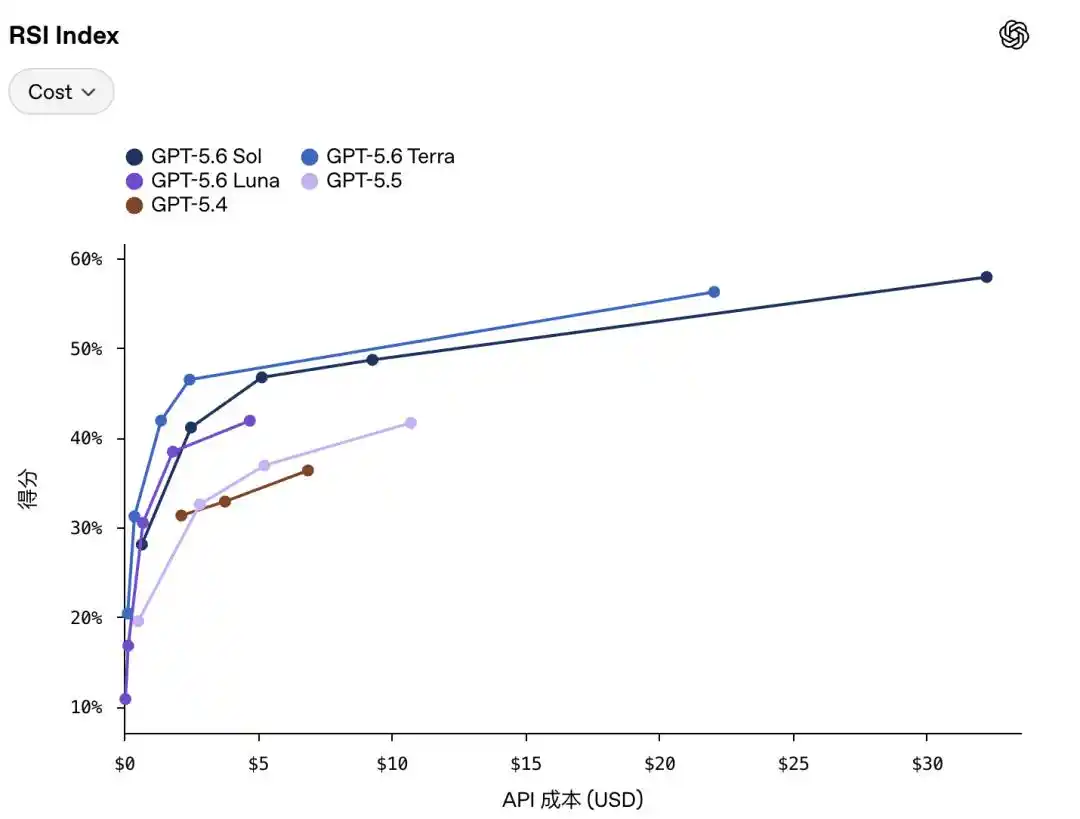
Subsequently, sol designed hundreds of architecture experiments for its smaller draft models and initiated training. Human intervention only occurred in cases of hardware failure or training instability. Ultimately, token generation efficiency improved by over 15%.
Bel becomes a truly continuously evolving entity.
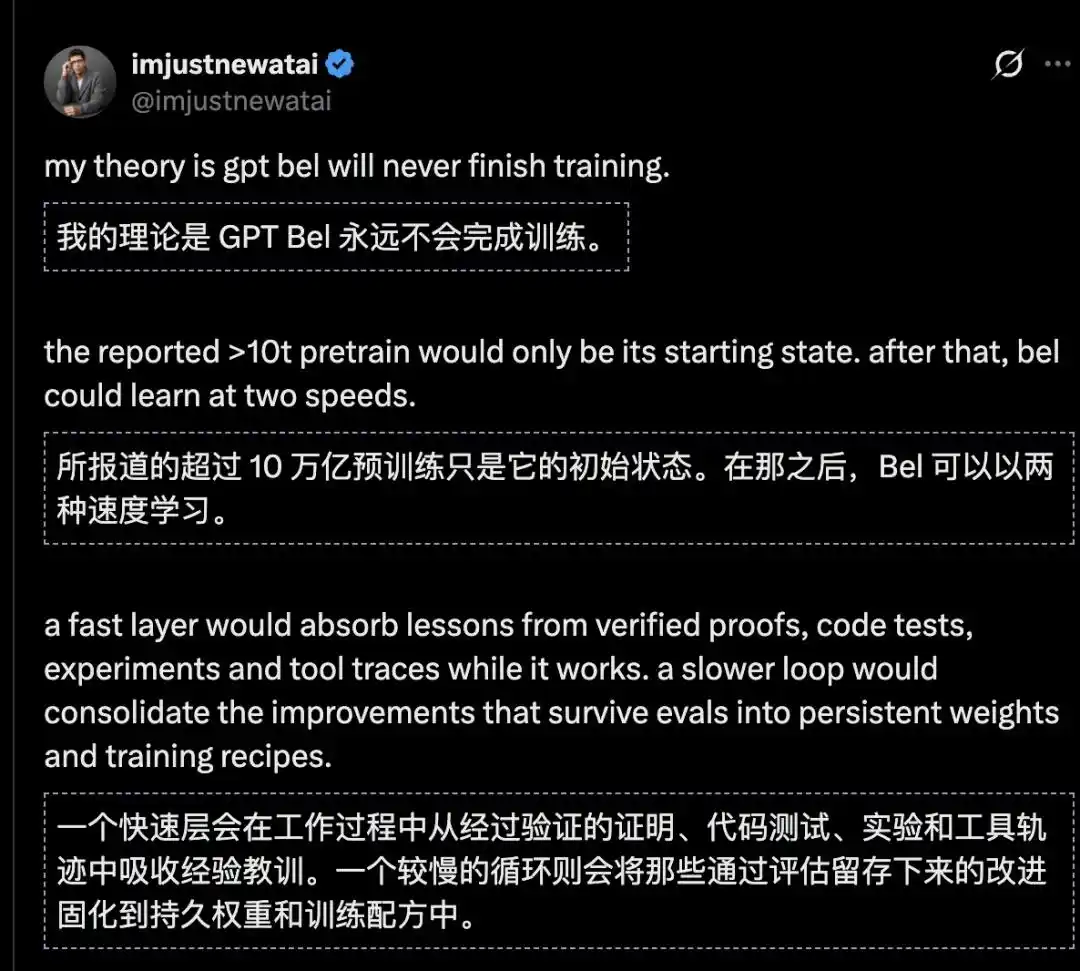
Fast weight layers absorb lessons learned during its operation from verified proofs, code tests, experiments, and tool trajectories. Slower cycles consolidate improvements that survive evaluation into persistent weights and training recipes.
It learns rapidly in fast memory, solidifies validated improvements into slow weights, continuously optimizes the operational mechanisms for the next learning cycle, and distills the final outcomes into smaller, practical models for everyone to use.
GPT-7 might just be a safe snapshot of Bel's state in a particular week.
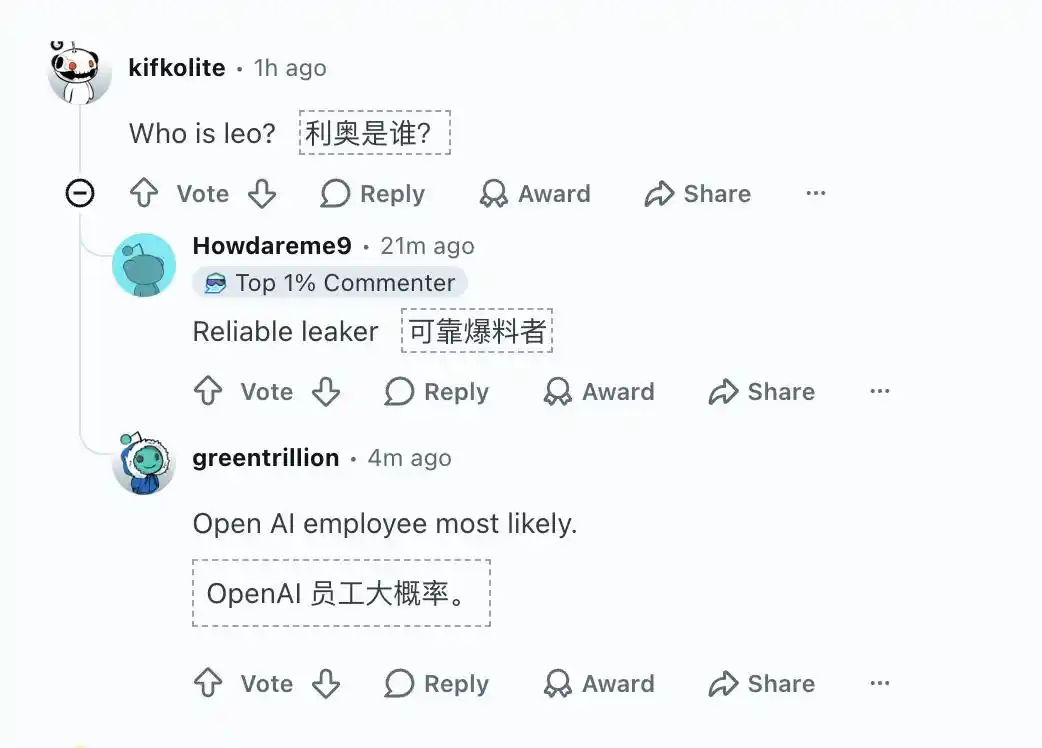
On Reddit, this message from Leo has sparked extensive discussion, given Leo's reputation for reliable leaks.
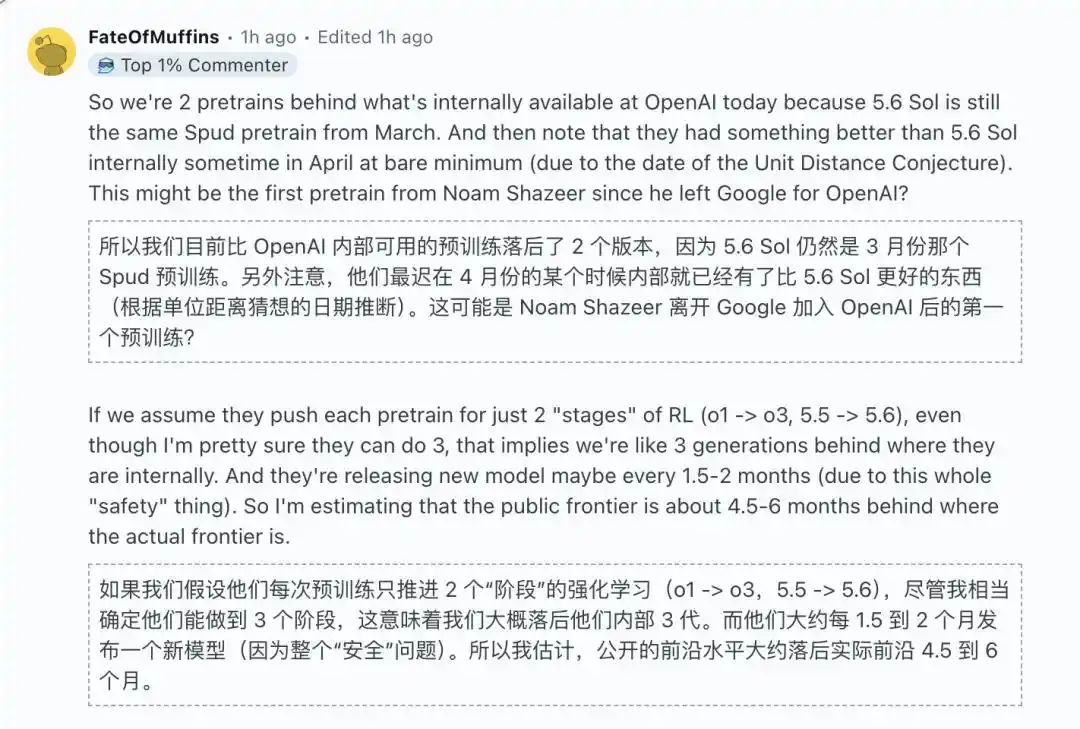
Some speculate that internal models might be 4.5-6 months ahead of external models.
OpenAI Declares: "Anthropic Can't Keep Up Anymore"
If Bel is a dimensional reduction strike in technology, then computing power is OpenAI's secret weapon for soaring internal morale.
According to cross-analysis by multiple trackers, OpenAI judges that maintaining the lead is unquestionable for the second half of 2026 through 2027.
Why such certainty? Because of computing power.
The leak mentions that OpenAI's internal assessment believes its greatest rival, Anthropic, is short on computing power and struggles to compete with OpenAI's next-generation AI.
In the arms race of large models, computing power is ammunition. When model parameters soar to the 10-trillion level, a single training run incurs colossal costs.
While Anthropic has extremely high achievements in model architecture and alignment technology, it clearly struggles in the face of absolute "brute force aesthetics."
Facing Astra's impending public debut, constrained by computing bottlenecks, Anthropic will likely find it difficult to mount a strong response within this year.
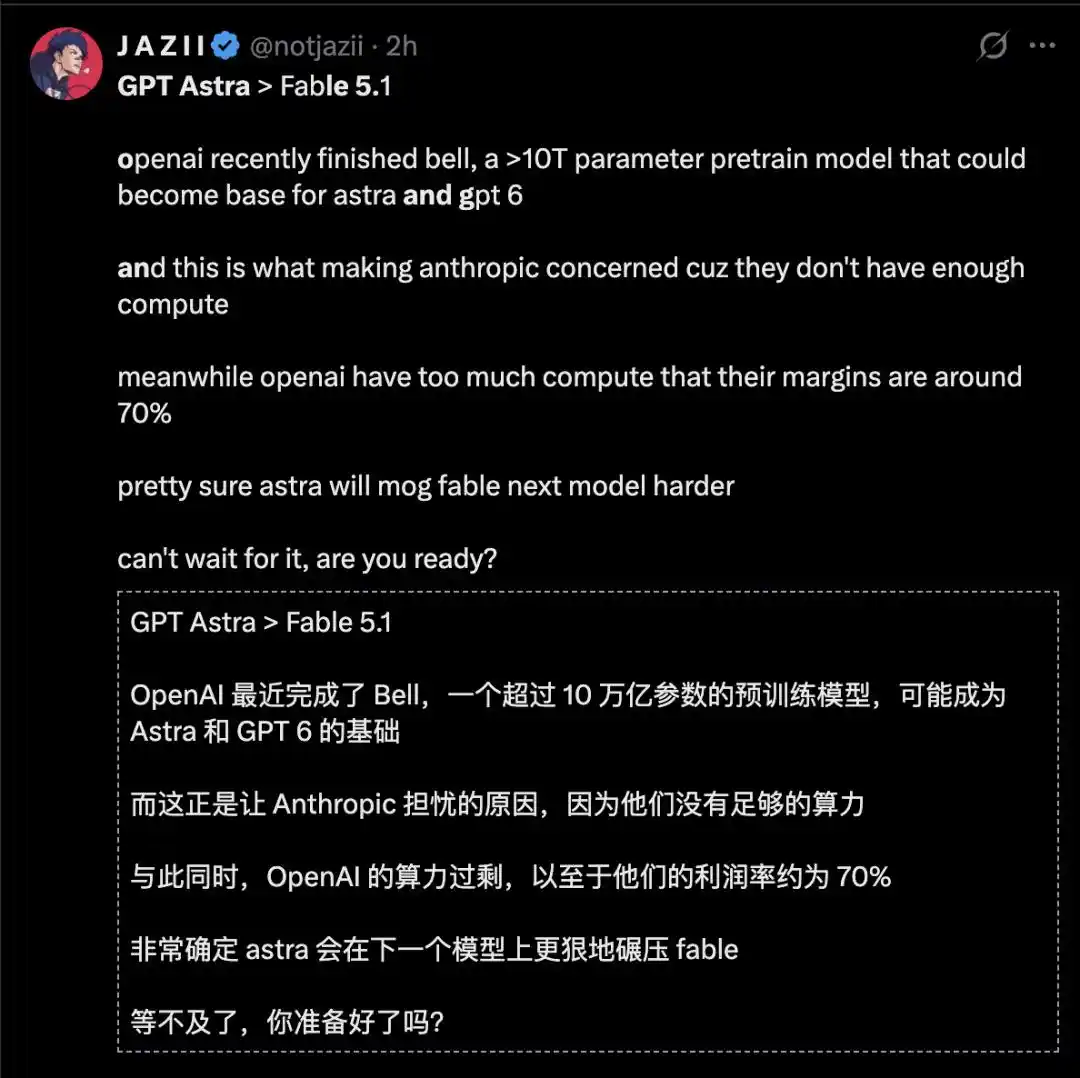
While other companies are still scrambling to assemble 100,000 H100/B200 chips, OpenAI has already smashed out "Doug" and "Bel" with brute force aesthetics.
And with the release of OpenAI's in-house chip Jalapeño, the moat hasn't been filled; it has been widened.
OpenAI Codex Lead Reveals "Endgame Vision"
Ten trillion parameters might seem distant. But within OpenAI, these foundational brute-force breakthroughs all point towards the same AI endgame.
Recently, on the popular tech podcast with Matthew Berman, OpenAI executive Tibo unreservedly teased OpenAI's future roadmap at the application layer.

He even boldly stated:
The incredibly powerful Codex model of today will seem like a primitive artifact in just 2 to 3 months.
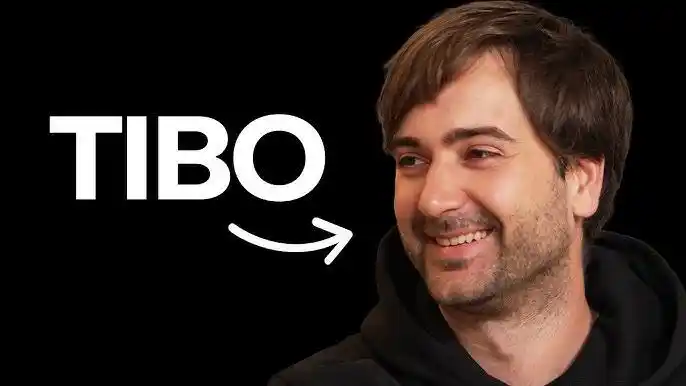
Combined with earlier leaks, Tibo points to four disruptive upheavals.
Recursive Self-Improvement (RSI) happens daily inside OpenAI.
Tibo confirmed that the "internal singularity" not only exists but has already achieved a commercial closed loop.
OpenAI has long been using its strongest models to optimize its own inference stack, CUDA kernels, and even infrastructure.
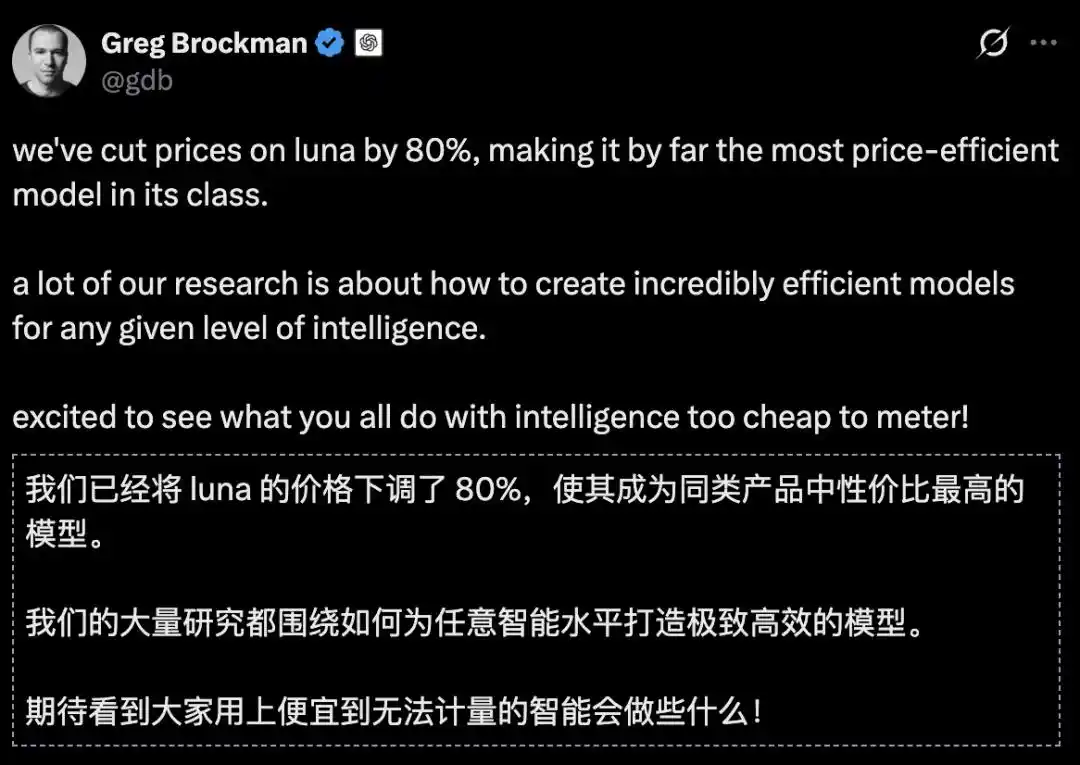
He gave an example: OpenAI internally used the Sol model to optimize the Luna model, directly slashing operating costs by 80%!
"Ultra Fast" Will Reshape Human Flow State.
Tibo revealed that internally, the current Ultra Fast mode has achieved up to 14x acceleration. He predicts that within just 1 to 2 years, such ultra-low latency will become the industry default standard.
When AI's response speed approaches or even surpasses human thinking speed, interaction will become real-time. Workflows will completely return to the "Flow State," and human cognitive load will decrease exponentially.
Computing Paradigm Shift: Your PC is About to Become "Scrap Metal."
With the arrival of the next-generation models (like Astra), Tibo clearly stated: The future mainstream of AI will absolutely not be local execution but will completely shift to large-scale Agent clusters in the cloud.
The Final Blow: ChatGPT and Codex Merge, Transforming into "Personal AGI."
In the future, "the mechanism will completely disappear." You will no longer need to manually write complex prompts, maintain skill files, manage memory, or manually schedule sub-agents.
Personal AGI will continuously and passively understand your goals, daily habits, and team dynamics, and proactively offer assistance.
Even more remarkable is its dynamic UI adaptation. The underlying technology is the same multimodal, Voice-first tech, but the interface will automatically morph like water based on your identity.
Conclusion: The Singularity is Here, Invisibly Present
Regardless of how exaggerated the rumors about "Bel" are, or whether Astra really shreds human expert code so smoothly, this large-scale leak has sent an undeniable signal to the world:
The development of artificial intelligence has not stagnated; it is merely gathering the momentum for a storm powerful enough to flip the table.
The second half of 2026 is just the beginning of the spectacle.
References:
https://x.com/ChrisGPT/status/2092334431142850782
https://x.com/fanofaliens/status/2091805645221789771
https://x.com/notjazii/status/2092336615473701361
https://www.reddit.com/r/singularity/comments/1vy99vk/according_to_leo_openai_just_finished_its_next/, https://x.com/imjustnewatai/status/2092482501524516888?s=20
This article is from the WeChat public account "New Zhiyuan" (ID: AI_era), author: David