JPMorgan Hit With Lawsuit Tied To $328 Million Crypto Ponzi Scheme

bitcoinistPublished on 2026-03-13Last updated on 2026-03-13

Abstract

In a proposed class action lawsuit, JPMorgan Chase is accused of enabling a $328 million crypto Ponzi scheme operated by Florida-based Goliath Ventures. The suit alleges the bank ignored red flags and allowed the firm to use its banking infrastructure to process around $250 million, despite Know Your Customer obligations. One plaintiff claims he lost $650,000, including retirement savings. Goliath’s CEO, Christopher Delgado, has been arrested on fraud and money laundering charges. A separate federal case also names Bank of America for its role. The lawsuit argues JPMorgan should have detected and stopped the fraudulent activity.

One of the first named plaintiffs in a new lawsuit against JPMorgan Chase says he lost $650,000 — including retirement savings — to an alleged $328 million crypto Ponzi scheme the bank helped keep running.

Robby Alan Steele is among more than 2,000 investors who say they were defrauded by Goliath Ventures, a Florida-based crypto investment firm that prosecutors say collected hundreds of millions of dollars under false pretenses.

JPMorgan Named As Sole Financial Institution For Goliath

A proposed class action filed Tuesday in the US District Court for the Northern District of California accuses JPMorgan of letting Goliath use its banking infrastructure to pull in investor funds while ignoring warning signs that something was wrong.
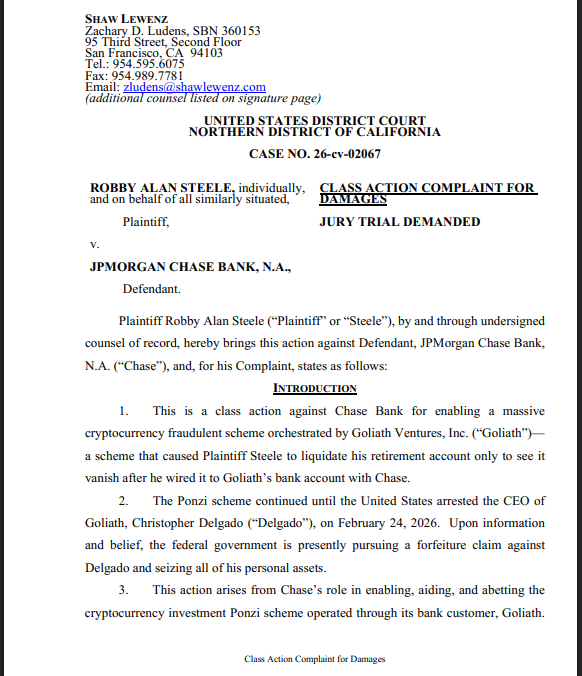
Source: Law.com

According to the complaint, JPMorgan was the only bank holding Goliath’s accounts from January 2023 through mid-2025 — the bulk of the scheme’s run.

During that stretch, roughly $250 million passed through a single JPMorgan account linked to Goliath. About $123 million of that was sent to Goliath’s wallets held at Coinbase.

Attorneys say the sheer volume moving through one account should have triggered scrutiny under federal banking rules that require institutions to know who their customers are and what those customers do with their money.

“Chase, by virtue of its Know Your Customer obligations, actually knew that Goliath was acting as a private equity cryptocurrency pool operator investing money for investors, without being licensed at all to sell these investments,” the complaint states.

BTCUSD now trading at $70,261. Chart: TradingView

Goliath, originally called Gen-Z Venture Firm, operated from January 2023 until January 2026, based on court documents. CEO Christopher Delgado was arrested on Feb. 24 by the US Attorney’s Office for the Middle District of Florida.

He faces wire fraud and money laundering charges. If convicted on all counts, he could spend up to 30 years in federal prison.

Bank Of America Also Appears In Federal Case

A separate federal criminal complaint names Bank of America as well. Prosecutors say Delgado was a co-signatory on a BOA business account used by Goliath, with at least one investor directed to that account by company representatives.

Investor funds, based on the government’s account, were routed through the JPMorgan account, the BOA account, or sent straight to Goliath’s Coinbase wallets — all controlled by Delgado.

The civil lawsuit was filed by attorneys from Shaw Lewenz, Sonn Law Group, and Schwartzbaum. Lead attorney Jordan Shaw said more complaints are coming as the team continues to identify people believed to be involved in the scheme.

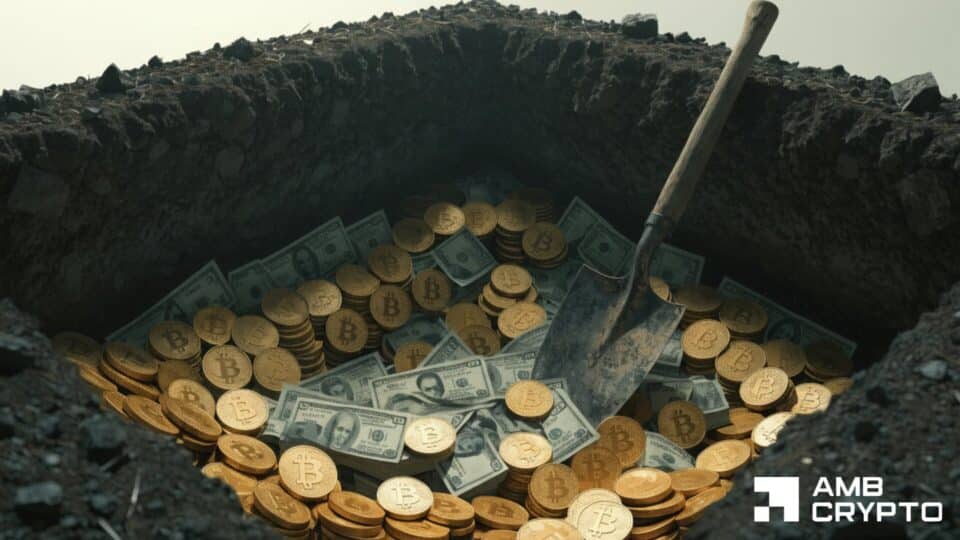
Featured image from Unsplash, chart from TradingView

Trending Cryptos

Related Questions

QWhat is the main allegation against JPMorgan Chase in the lawsuit?

AThe lawsuit alleges that JPMorgan Chase allowed Goliath Ventures to use its banking infrastructure to collect investor funds while ignoring red flags that it was a Ponzi scheme, violating its Know Your Customer obligations.

QHow much money did the lead plaintiff, Robby Alan Steele, allegedly lose in the scheme?

ARobby Alan Steele allegedly lost $650,000, which included his retirement savings.

QWhat was the total amount of the alleged Ponzi scheme and how much passed through a single JPMorgan account?

AThe alleged Ponzi scheme totaled $328 million. Approximately $250 million passed through a single JPMorgan account linked to Goliath.

QWhat charges does Goliath Ventures CEO Christopher Delgado face?

AChristopher Delgado faces charges of wire fraud and money laundering. If convicted on all counts, he could face up to 30 years in federal prison.

QBesides JPMorgan, which other major bank is named in the federal case related to this scheme?

ABank of America is also named in a separate federal criminal complaint, as Delgado was a co-signatory on a BOA business account used by Goliath.

Related Reads

The Largest Upgrade Since The Merge? How Glamsterdam Will Affect Ethereum and Regular Users?

The upcoming Glamsterdam upgrade, scheduled for late 2026, is considered Ethereum's most significant change since The Merge. It focuses on fundamentally restructuring Ethereum's block production, transaction execution, and gas pricing to enable major scalability improvements while preserving decentralization. The upgrade centers on three key innovations: * **Enshrined PBS (ePBS)**: Moves the Proposer-Builder Separation mechanism into the protocol's core, eliminating reliance on external relays. This reorganizes the block pipeline, extending the time window for processing execution payloads, which is crucial for safely increasing block capacity. * **Block-Level Access Lists (BALs)**: Attaches a "map" to each block, declaring in advance which state data its transactions will access. This enables potential parallel transaction processing and faster node synchronization, breaking a key performance bottleneck. * **Gas Repricing**: Introduces a more accurate resource pricing model by separating computation costs from state storage costs. This discourages uncontrolled state growth by making operations that create permanent data (like new accounts) more accurately reflect their long-term network burden. Together, these changes aim to solve the core challenges of increasing Ethereum's throughput (e.g., raising the Gas Limit) without overburdening node hardware or increasing centralization risks. They prepare the infrastructure for higher capacity, targeting a credible post-upgrade capacity of up to 200 million Gas. For users, the impact will be nuanced: * General transaction fees may become lower and more stable as block space increases. * Simple transfers could see cost reductions, while state-intensive operations (like contract deployment) may become relatively more expensive due to the new gas model. * Gas fee estimations by wallets will become more accurate. * L2 networks could benefit long-term from increased data blob capacity. * Standardized logs for all ETH transfers (EIP-7708) will improve tracking for wallets and exchanges. Ultimately, Glamsterdam represents a foundational shift, not a simple block size increase. It seeks to expand Ethereum's capacity by re-engineering its underlying mechanics, maintaining its commitment to decentralization while enabling significant performance gains.

marsbit2h ago

The Largest Upgrade Since The Merge? How Glamsterdam Will Affect Ethereum and Regular Users?

marsbit2h ago

Circle CEO Responds to the OUSD Challenge: Stablecoin is a Winner-Takes-All Business, and We Won't Slow Down

In response to questions about the OUSD stablecoin initiative, Circle CEO Jeremy Allaire argues that the stablecoin market is a "winner-take-most" platform business driven by powerful network effects, and Circle has no plans to slow down. He outlines three key drivers behind USDC's dominant position: 1. **Protocol/Software Layer Network Effects**: The value of a stablecoin network grows as more developers and services integrate it, creating compounding utility and user preference. Circle has spent nearly a decade building this ecosystem with USDC, now accelerated by mainstream adoption and enhanced by software stacks like CCTP and Gateway for interoperability. 2. **Liquidity Network Effects**: Liquidity begets more liquidity. USDC has achieved top-tier global liquidity—ranking among the top three digital assets alongside BTC and USDT—through nearly a decade of building deep primary and secondary market access across regions and venues. 3. **Regulatory and Policy Integration**: Establishing a global stablecoin requires deep regulatory engagement, licensing, and compliance across key markets—a significant, long-term investment where Circle is a leader. Allaire cites Artemis data showing USDC facilitated 80% of all dollar stablecoin on-chain transaction volume in Q1 2026, with USDT at 20% and all others negligible. He addresses OUSD's purported advantages: "free" minting/burning is often not sustainable in practice; redistributing all revenue can starve essential infrastructure investment; and large consortium models historically struggle with inefficiency and slow execution, unlike focused strategic partnerships. He reaffirms Circle's strong ongoing partnership with Coinbase on USDC and notes Circle collaborates with dozens of other stablecoin issuers through its expanding platform (Arc, CCTP, CPN, etc.). While welcoming OUSD to the ecosystem, Allaire asserts that Circle's vast, trusted network and continued investment make USDC the foundational digital dollar infrastructure for the world.

链捕手2h ago

Circle CEO Responds to the OUSD Challenge: Stablecoin is a Winner-Takes-All Business, and We Won't Slow Down

链捕手2h ago

Q2 Crypto Market Review: Did Bitcoin Rise for 'Nothing'? Did Money Flow to AI and On-Chain?

Q2 2026 Crypto Market Recap: Bitcoin's Gains Erased Amid Shift to AI and On-Chain Activity The second quarter of 2026 saw a significant reversal for the cryptocurrency market. Bitcoin gave back all its April gains, ending Q2 down approximately 11%, while major stock indices posted strong gains. This divergence was driven by a hawkish shift in Fed rate expectations, capital rotation into AI stocks, and weakening liquidity channels into crypto. Key demand pillars deteriorated simultaneously. Spot Bitcoin ETFs recorded net outflows of $4.08 billion for the quarter, with outflows dominating June. Crypto treasury entity Strategy's bitcoin accumulation slowed markedly, and the total stablecoin market cap contracted by ~$4.2 billion. This created a tighter liquidity environment. Exchange data reflected the downturn. Spot trading volumes fell 28% quarter-over-quarter. The market underwent significant deleveraging, with $8.35 billion in long liquidations for BTC and ETH, primarily in late May/early June. Open interest and order book liquidity also declined. Despite the bearish price action, structural developments point to an expanding on-chain ecosystem. These include the rise of tokenized stocks with full legal rights, the growth of RWA (real-world asset) perpetual contracts for trading stocks and commodities 24/7, and the use of crypto markets for price discovery ahead of major events like the SpaceX IPO. On-chain vaults are also emerging as a core layer for institutional capital allocation.

Foresight News2h ago

Q2 Crypto Market Review: Did Bitcoin Rise for 'Nothing'? Did Money Flow to AI and On-Chain?

Foresight News2h ago

Trading

Spot

Hot Articles

How to Buy ONE

Welcome to HTX.com! We've made purchasing Harmony (ONE) simple and convenient. Follow our step-by-step guide to embark on your crypto journey.Step 1: Create Your HTX AccountUse your email or phone number to sign up for a free account on HTX. Experience a hassle-free registration journey and unlock all features.Get My AccountStep 2: Go to Buy Crypto and Choose Your Payment MethodCredit/Debit Card: Use your Visa or Mastercard to buy Harmony (ONE) instantly.Balance: Use funds from your HTX account balance to trade seamlessly.Third Parties: We've added popular payment methods such as Google Pay and Apple Pay to enhance convenience.P2P: Trade directly with other users on HTX.Over-the-Counter (OTC): We offer tailor-made services and competitive exchange rates for traders.Step 3: Store Your Harmony (ONE)After purchasing your Harmony (ONE), store it in your HTX account. Alternatively, you can send it elsewhere via blockchain transfer or use it to trade other cryptocurrencies.Step 4: Trade Harmony (ONE)Easily trade Harmony (ONE) on HTX's spot market. Simply access your account, select your trading pair, execute your trades, and monitor in real-time. We offer a user-friendly experience for both beginners and seasoned traders.

4.1k Total ViewsPublished 2024.03.29Updated 2026.06.02

How to Buy ONE

Discussions

Welcome to the HTX Community. Here, you can stay informed about the latest platform developments and gain access to professional market insights. Users' opinions on the price of ONE (ONE) are presented below.

活动图片