Japan’s LDP Calls For Crypto ETF Framework, Yen Stablecoin Push In New Proposal

bitcoinistPublished on 2026-06-02Last updated on 2026-06-02

Abstract

Japan's ruling Liberal Democratic Party (LDP) has proposed establishing a legal framework for cryptocurrency-based exchange-traded funds (ETFs) to boost the country's digital asset sector. The party's blockchain promotion panel submitted the proposal to Finance Minister Satsuki Katayama, arguing that crypto ETFs would provide accessible investment options and should be recognized as official financial products. While Japan's Financial Services Agency (FSA) has historically been cautious, recent reports suggest potential regulatory amendments could allow the first crypto ETFs within two years. Separately, the LDP urged the government to promote the use of yen-denominated stablecoins for settlements in Asia, aiming to leverage Japan's upcoming hosting of the Asian Development Bank's annual meeting. Japan's stablecoin regulations, established in 2022, permit issuance only by licensed financial institutions. Recent legal changes have also eased rules for certain foreign trust-backed stablecoins and classified crypto assets as financial instruments.

Japan’s ruling party has called for the creation of the long-awaited rules for crypto exchange-traded funds (ETFs) and promotion of yen-denominated stablecoins in the region in a new proposal to the government.

Japan’s Ruling Party Pushes For Crypto ETF Rules

On Monday, Japan’s Liberal Democratic Party (LDP) asked the government to develop a legal framework to allow crypto-based ETFs in the country, seeking to strengthen the local digital assets sector, Reuters reported.

In a proposal ‌to the government, the ruling party affirmed that “Crypto-ETFs would provide investors with easy-to-understand ways of investment,” urging the government to “position the product as an official means of ​investment in the financial market.”

According to the report, LDP’s panel on the promotion of ​blockchain technology submitted its proposal to Finance Minister Satsuki Katayama, ⁠who oversees the Financial Services Agency (FSA).

It’s worth noting that Japanese authorities have been cautious about crypto-based investment products over the past few years, with the main financial regulator repeatedly expressing its reservations about the funds.

Earlier this year, reports indicated that the FSA plans to amend the Investment Trust Act’s enforcement order to add cryptocurrencies to the list of specified assets for ETFs, with stronger safeguards to protect investors.

Reportedly, the country will likely approve and list its first wave of crypto ETFs in the next two years, with some industry leaders affirming that the rollout could come as early as next year if the law’s revision allows it.

In an April interview, Hiromi Yamaji, CEO of Japan Exchange Group (JPX), the parent company of the Tokyo Stock Exchange, stated that asset management firms are interested in creating crypto investment products.

“We’re ready to work on it once legislation and tax treatment are made clear,” JPX CEO told Bloomberg, but noted that listings could come in 2028, if progress on the law’s amendments stalls.

Lawmakers Eye Yen-Stablecoin Boost In Asia

After Monday’s meeting with Katayama, Junichi Kanda, a lawmaker on the panel, told reporters that the ruling party had also pushed the government to boost the use of yen stablecoins in the region.

“We urged the government to take steps to promote ​yen stablecoins for settlement in Asia in the future,” he said, adding that Japan could promote yen stablecoins and its efforts on blockchain innovation next year, when the country hosts the Asian Development Bank’s annual meeting.

Japan’s legal framework for stablecoins was established through the 2022 amendment to the Payment Services Act. Under these rules, only licensed money transfer companies, trust companies, and banks are allowed to issue yen-denominated tokens.

Last year, Tokyo fintech company JPYC launched the first yen-pegged stablecoin, backed by Japanese yen reserves, including bank deposits and government debt. The FSA also endorsed a project by three major Japanese banks to jointly issue a yen-backed token.

This May, the financial regulator expanded the Cabinet Office Ordinance to recognize certain trust-type stablecoins issued by foreign trust banks and similar entities as “electronic payment instruments” under the Payment Services Act, starting June 1.

The revisions remove foreign trust-backed stablecoins from the Financial Instruments and Exchange Act (FIEA) “securities” classification, allowing domestic registered operators to manage them legally.

Similarly, authorities amended the FIEA earlier this year to classify crypto assets as financial instruments and outlined compliance requirements for the use of crypto in real estate deals.
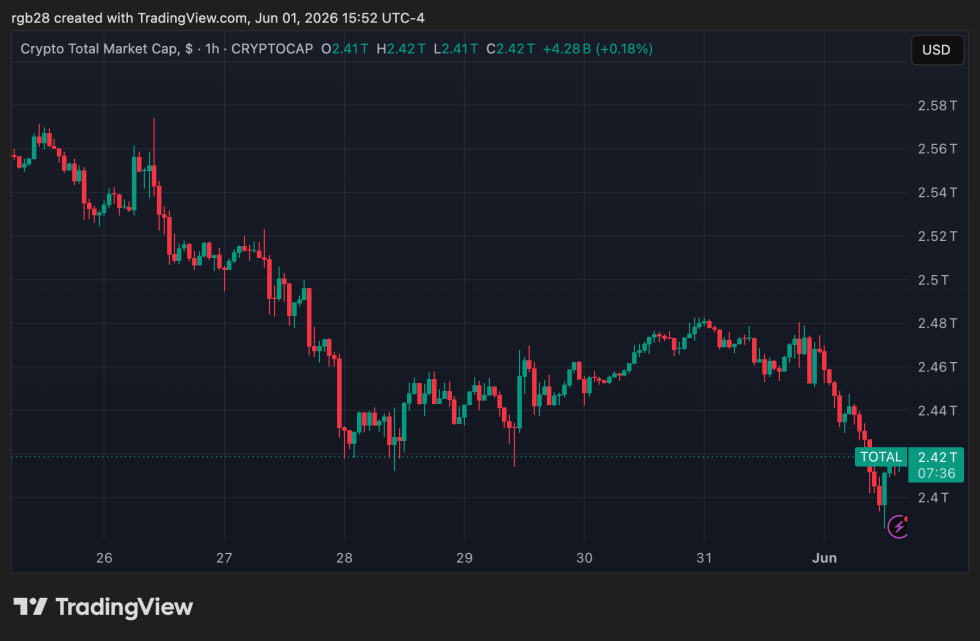
The total crypto market capitalization is at $2.42 trillion in the one-week chart. Source: TOTAL on TradingView


Related Questions

QWhat are the two main proposals Japan's Liberal Democratic Party (LDP) has submitted to the government regarding digital assets?

AJapan's Liberal Democratic Party (LDP) has submitted two main proposals. First, it called for the government to develop a legal framework to allow crypto-based Exchange-Traded Funds (ETFs) in the country. Second, it urged the government to promote the use of yen-denominated stablecoins for settlement within Asia.

QWhat is the status of the legal framework for stablecoins in Japan, and who is allowed to issue yen-denominated stablecoins?

AJapan established its legal framework for stablecoins through a 2022 amendment to the Payment Services Act. Under these rules, only licensed money transfer companies, trust companies, and banks are permitted to issue yen-denominated stablecoins.

QWhat are the potential timelines for the approval and listing of the first crypto ETFs in Japan according to the article?

AThe article mentions that the first wave of crypto ETFs in Japan could be approved and listed within the next two years. Some industry leaders believe the rollout could happen as early as next year if legal revisions allow. However, the CEO of JPX also noted that listings might be delayed until 2028 if progress on amending the law stalls.

QWhat recent regulatory change did Japan's FSA make regarding foreign stablecoins, effective from June 1?

AIn May, Japan's Financial Services Agency (FSA) expanded the Cabinet Office Ordinance to recognize certain trust-type stablecoins issued by foreign trust banks and similar entities as 'electronic payment instruments' under the Payment Services Act, starting June 1. This change removes these foreign trust-backed stablecoins from the 'securities' classification under the Financial Instruments and Exchange Act (FIEA).

QWhat are the stated benefits of crypto ETFs according to the LDP's proposal?

AAccording to the LDP's proposal, 'Crypto-ETFs would provide investors with easy-to-understand ways of investment.' The party urged the government to position such products as an official means of investment in the financial market.

Related Reads

Can DeepSeek Save China One Trillion Dollars?

"DeepSeek and the $1 Trillion Infrastructure Question" The article examines whether DeepSeek's AI optimization breakthroughs could potentially save China $1 trillion in future AI infrastructure costs. The analysis begins with Nvidia's upcoming Vera Rubin AI platform, costing ~$7.8 million, where memory (HBM4/LPDDR5X) constitutes $2 million—a 435% cost increase in one year, highlighting how AI hardware spending is shifting toward expensive memory components. DeepSeek's approach works in the opposite direction. Through three key technical innovations showcased in DeepSeek V4, the company dramatically improves hardware efficiency: 1. **Memory Compression (MLA)**: Re-engineers the attention mechanism to compress long-context memory (KV Cache) by over 90%, drastically reducing expensive HBM usage. 2. **Selective Activation (MoE)**: Employs Mixture-of-Experts architecture where only a small fraction of parameters (e.g., 49B out of 1.6T in V4-Pro) are activated per token, allowing most parameters to reside in cheaper memory/SSD. 3. **Computation Caching**: Reuses previously computed results via cache hits, replacing expensive GPU computations with cheap memory reads. Combined, these optimizations allow the same hardware to produce approximately 4x more tokens, effectively reducing required hardware investment by 75%. DeepSeek's pricing reflects this: a 10-billion token workload costs ~$522 monthly versus ~$9,000-$10,000 for competitors. The $1 trillion savings projection stems from McKinsey's estimate that global AI infrastructure will require ~$5.2 trillion investment by 2030. As China's daily token consumption grows toward quadrillions, even marginal efficiency gains scale massively. With a conservative 4x throughput improvement, China could avoid building tens of thousands of AI data centers equivalent to ~7 trillion RMB ($1 trillion) in saved investment. Critically, this strategy shifts dependency from scarce, expensive GPU/HBM—where China lags—toward more accessible storage, caching, and systems engineering where domestic suppliers like CXMT are gaining strength. Rather than "replacing Nvidia," DeepSeek rebalances AI's value chain away from monolithic hardware dependency. Ultimately, DeepSeek's technical breakthroughs could lower the barrier to AI adoption across Chinese industries by making advanced capabilities affordable at scale—transforming who can access next-generation AI.

marsbit42m ago

Can DeepSeek Save China One Trillion Dollars?

marsbit42m ago

Overturning the Mainstream Approach to Hallucinations: Metacognition is the New Solution for Large Models to Break the Hallucination Barrier

This paper, "Hallucinations Undermine Trust; Metacognition is a Way Forward," proposes a paradigm shift in combating AI hallucination. It argues that the current mainstream approaches—striving for omniscience by scaling data/models or having AI abstain from uncertain answers—are fundamentally flawed. The former has inevitable knowledge gaps, while the latter imposes a crippling "utility tax," requiring the rejection of many correct answers to achieve high accuracy, due to models' poor "discrimination" (the ability to distinguish correct from incorrect answers internally). The core contribution is redefining hallucination not as "being wrong," but as "expressing false information with unwarranted certainty." The proposed solution is **Faithful Uncertainty** or **Metacognition**: enabling AI to accurately perceive its internal uncertainty and honestly express it in its language (e.g., using hedging phrases when unsure). This creates a more reliable assistant that provides useful information while signaling its confidence, minimizing harm from errors. The paper emphasizes that metacognition is critical for the era of AI Agents. Without it, Agents cannot intelligently decide when to use tools like search engines, leading to inefficiency and misuse. Key implementation challenges are highlighted: the "bootstrapping paradox" of training with static uncertainty data, the "alignment distortion signal" where human preference training suppresses internal uncertainty cues, and the difficulty of causally evaluating true metacognition vs. its superficial imitation. The paper concludes that the goal should not be an infallible AI, but one that is honest about the limits of its knowledge, thereby building user trust through transparent communication of its certainty.

marsbit46m ago

Overturning the Mainstream Approach to Hallucinations: Metacognition is the New Solution for Large Models to Break the Hallucination Barrier

marsbit46m ago

Hedge by Buying Gold and Oil, Chase Soaring Returns with AI. ‘Dated’ Bitcoin Enters a Bear Market

Bitcoin has recently declined, hitting a two-month low near $66,123, while Ethereum fell to a three-month low around $1,837. Analysts suggest the drop is not merely due to factors like ETF outflows or MicroStrategy's selling but reflects a deeper issue: Bitcoin is losing a broader asset competition. In a near-zero interest rate environment, Bitcoin previously thrived as an outlet for investor dissatisfaction with inflation and limited options. However, the market landscape has shifted. Bitcoin now occupies an "awkward middle ground," facing competition on three fronts. For inflation hedging, investors prefer gold, energy stocks, and commodity producers—assets with tangible backing and clearer pricing power. For growth exposure, AI-related companies with actual revenues and profits are more attractive. Even within crypto, investors can choose stablecoins, exchanges, or infrastructure firms tied directly to adoption, offering clearer business models and leverage. Thus, Bitcoin is no longer the top choice for hedging, growth, or crypto exposure. This shift is evident in market reactions: despite recent warnings about persistent inflation from a Fed official, Bitcoin did not rally as it might have in the past. Instead, capital flowed to assets with direct commodity or energy exposure. The recent ETF outflows and MicroStrategy sales are symptoms, not causes, of this new reality. Investors are becoming more selective, demanding clearer value propositions beyond mere scarcity. The emerging bear case for Bitcoin is not about it being a bubble or failed technology, but that scarcity alone is no longer sufficient.

华尔街日报49m ago

Hedge by Buying Gold and Oil, Chase Soaring Returns with AI. ‘Dated’ Bitcoin Enters a Bear Market

华尔街日报49m ago

Trading

Spot
Futures

Hot Articles

How to Buy PUSH

Welcome to HTX.com! We've made purchasing Push Protocol (PUSH) simple and convenient. Follow our step-by-step guide to embark on your crypto journey.Step 1: Create Your HTX AccountUse your email or phone number to sign up for a free account on HTX. Experience a hassle-free registration journey and unlock all features.Get My AccountStep 2: Go to Buy Crypto and Choose Your Payment MethodCredit/Debit Card: Use your Visa or Mastercard to buy Push Protocol (PUSH) instantly.Balance: Use funds from your HTX account balance to trade seamlessly.Third Parties: We've added popular payment methods such as Google Pay and Apple Pay to enhance convenience.P2P: Trade directly with other users on HTX.Over-the-Counter (OTC): We offer tailor-made services and competitive exchange rates for traders.Step 3: Store Your Push Protocol (PUSH)After purchasing your Push Protocol (PUSH), store it in your HTX account. Alternatively, you can send it elsewhere via blockchain transfer or use it to trade other cryptocurrencies.Step 4: Trade Push Protocol (PUSH)Easily trade Push Protocol (PUSH) on HTX's spot market. Simply access your account, select your trading pair, execute your trades, and monitor in real-time. We offer a user-friendly experience for both beginners and seasoned traders.

3.6k Total ViewsPublished 2024.03.29Updated 2026.06.02

How to Buy PUSH

Discussions

Welcome to the HTX Community. Here, you can stay informed about the latest platform developments and gain access to professional market insights. Users' opinions on the price of PUSH (PUSH) are presented below.

活动图片












