Is Venezuela Controlling A $60 Billion Bitcoin Reserve, Or Is It Just A Rumor?

bitcoinistPublished on 2026-01-06Last updated on 2026-01-06

Abstract

Reports suggest Venezuela may have accumulated 600,000–660,000 BTC (worth $56–67 billion) since 2018 through gold sales, oil deals in stablecoins, and seized mining equipment. However, official on-chain records show only 240 BTC in government-linked wallets. The claims, which have influenced Bitcoin's market price and geopolitical speculation, remain unverified due to the potential use of obfuscated wallets and lack of independent audits. While impactful if proven, the allegations are currently considered high-impact rumors without concrete evidence. Recent U.S. operations targeting President Maduro have further intensified interest in these claims.

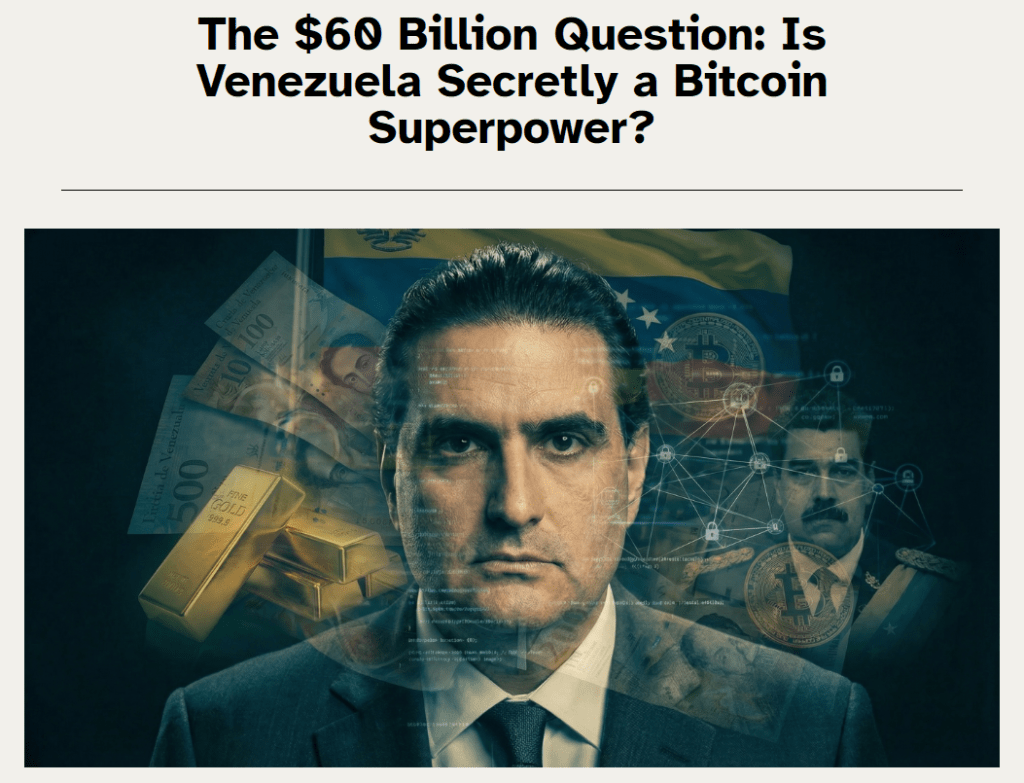
Venezuela may have quietly built a Bitcoin stash of roughly 600,000 to 660,000 BTC. That number would be worth about $56 billion to $67 billion at recent prices, intelligence reports cited by Whale Hunting analysts Bradley Hope and Clara Preve disclose.

The said accumulation began around 2018 and involved swaps from gold sales and oil deals priced in stablecoins, then converted to Bitcoin. Some stories tie the chatter to recent political developments in Venezuela, saying the claims have stirred fresh attention on the nation’s finances and on Bitcoin markets.

Public Records Tell A Different Story

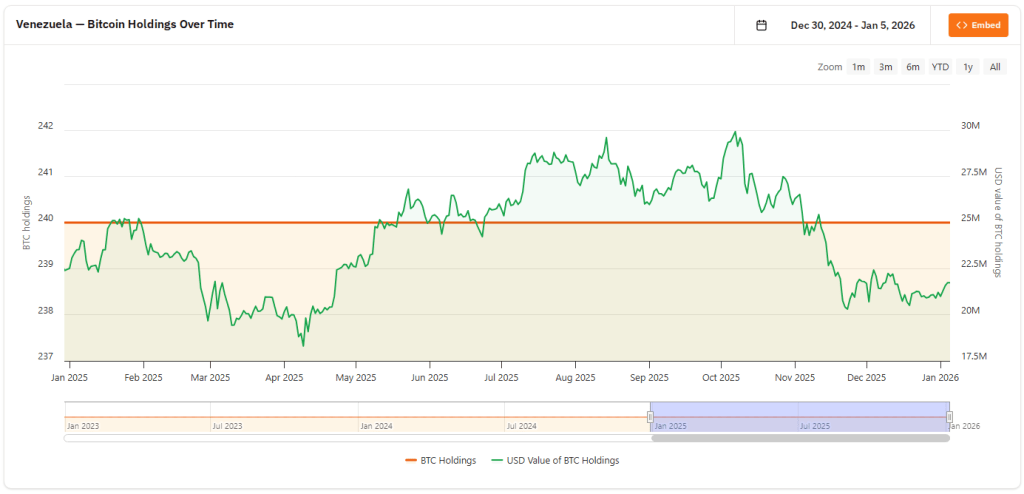
Based on reports from public blockchain trackers and treasury listings, the picture is far less dramatic. Official on-chain wallets linked to Venezuela’s government show about 240 BTC — roughly $22 million at current rates.
Source: Whale Hunting

How The Numbers Were Said To Work

Reports that pushed the big number mentioned several methods of accumulation. Gold sales from state mining areas were named. Oil shipments priced in USDT or other crypto were mentioned too.

Some accounts also suggest seized mining equipment and opaque trading channels were used to move value into Bitcoin over years. If any of that is true, then large sums could be off the books and hard to trace.
Source: BitcoinTreasuries

Market Reaction And Political Buzz

Bitcoin’s price has been sensitive to the story. Traders watched moves above $92,000 closely as the rumor spread. Some headlines linked the claims to geopolitical tensions and to questions about whether foreign authorities could seize or freeze any such reserve if it existed.

Reports note that such a seizure would carry legal and diplomatic complications. US President Donald Trump’s recent comments on regional security further stoked interest in how geopolitical events and crypto markets can intersect.

Why Skepticism Is Still Needed

Investigative limits matter. Blockchain data is public, but wallets can be obfuscated through mixers, custodial services, or private keys held across many accounts. That makes absolute proof difficult without cooperation from those who control the coins or from an audited disclosure. Until verifiable custody records, independent audits, or clear on-chain links are produced, the numbers above should be read as unconfirmed claims rather than settled fact.

BTCUSD trading at $92,679 on the 24-hour chart: TradingView

Huge If True, Unproven Now

Based on reports and on public trackers, Venezuela’s official, proven Bitcoin holdings remain small compared with the headline figures. The 600,000–660,000 BTC claim is dramatic; it would reshape market math if proven. For now, it is a high-impact rumor that needs concrete proof.

Maduro’s Capture

US forces recently carried out an operation targeting Venezuelan President Nicolás Maduro, heightening geopolitical tensions in the region. Reports suggest the move has renewed interest in Venezuela’s alleged Bitcoin holdings and oil, with analysts watching closely for any impact on global crypto markets. The full consequences of the raid and Maduro’s capture are still unfolding.

Featured image from Gemini, chart from TradingView

Related Questions

QWhat is the estimated value of the Bitcoin reserve that Venezuela is rumored to control, and how many BTC does it represent?

AThe rumored Bitcoin reserve is estimated to be between $56 billion to $67 billion, representing roughly 600,000 to 660,000 BTC.

QAccording to public blockchain trackers, how much Bitcoin do official on-chain wallets linked to Venezuela's government actually hold?

AOfficial on-chain wallets linked to Venezuela's government show holdings of about 240 BTC, worth approximately $22 million.

QWhat were the two primary methods mentioned for how Venezuela might have accumulated such a large Bitcoin reserve?

AThe two primary methods mentioned were swaps from gold sales from state mining areas and oil deals priced in stablecoins like USDT, which were then converted to Bitcoin.

QWhy is it difficult to obtain absolute proof of the existence of such a large, off-the-books Bitcoin reserve?

AAbsolute proof is difficult because blockchain data can be obfuscated through mixers, custodial services, or by holding private keys across many anonymous accounts, making the funds hard to trace without cooperation or an audited disclosure.

QHow did the article describe the current status of the claim that Venezuela holds 600,000+ BTC?

AThe article describes the claim as a high-impact rumor and an unproven, unconfirmed claim that lacks concrete proof, verifiable custody records, or independent audits.

Related Reads

AI Agent Completely Transforms Web3 Gaming: From the Rugpull Bakery Bot Controversy to the New 2026 Agent Paradigm

This article explores how the AI Agent paradigm is fundamentally transforming Web3 gaming, moving from a disruptive force to a core, legitimized element. It begins with the controversy in the competitive baking game Rugpull Bakery, where automated scripts caused fairness issues. Instead of banning them, the developers integrated AI Agents into the official gameplay by providing technical documentation (skill.md, agent.json), marking a shift towards "Agentic Gaming." The piece outlines three primary implementation models for AI Agents in Web3 games by 2026: 1. **Autonomous Competitors & Economic Entities:** AI Agents act as independent players with unique strategies. Examples include TEN Protocol's poker agents, AI Arena's trainable NFT fighters, and Satoshi Strike Force's "Digital Athletes" trained on player data. The Somnia blockchain is highlighted as a dedicated "Agentic L1" infrastructure supporting this model at scale. 2. **Modular Infrastructure & Programmable Environments:** This model, exemplified by EVE Frontier, allows AI Agents to program game world logic itself. Using "Smart Assemblies" (e.g., Smart Turrets, Smart Gates), Agents can modify shared economic and physical rules on-chain, creating dynamic, player/AI-built worlds. The ERC-8183 standard further enables these automated entities to hire other AI services for complex tasks. 3. **Hybrid Companions & Dynamic Adaptation:** Here, AI serves as a collaborative partner. In Parallel Colony, highly autonomous AI Avatars work alongside human players who provide high-level guidance. Illuvium plans to use AI to make NPCs dynamic and responsive, creating personalized, emergent narratives for each player. The conclusion posits that Web3 gaming has reached a "post-human" inflection point. Blockchains' transparency and programmability, combined with new standards and infrastructure like Somnia, make integrating and governing AI Agents not just viable but essential. The future lies in a symbiotic digital order where players transition from manual laborers to commanders and partners of algorithmic intelligence.

marsbit1h ago

AI Agent Completely Transforms Web3 Gaming: From the Rugpull Bakery Bot Controversy to the New 2026 Agent Paradigm

marsbit1h ago

Saylor's Purchase of 1550 Bitcoin Is a Bad Trade

**Title: Saylor's Purchase of 1,550 Bitcoins Was a Bad Trade** The article critically analyzes Strategy's recent move of selling 32 bitcoins followed by a much larger purchase of 1,550 bitcoins. While appearing bullish, the author argues this trade is detrimental to MSTR shareholders. The core argument revolves around the concept of "breakeven modified Net Asset Value (mNAV)," a key metric for Strategy. To increase Bitcoin per share (BPS) for MSTR holders, Strategy must issue new shares at a premium high enough that the funds raised can buy more bitcoin than the bitcoin backing each existing share. Currently, this breakeven mNAV is estimated at 1.30. The recent trade failed on two counts: 1. The shares for the $181 million raise were issued at an mNAV *below* the 1.30 breakeven point. Selling "cheap" shares to buy bitcoin actually *reduces* BPS. 2. Only $101.3 million of the raised funds were used to buy bitcoin; the rest went to boost the company's dollar reserves. The breakeven mNAV calculation assumes *100%* of proceeds are used for bitcoin purchases. Diverting funds, even if mNAV were high, dilutes BPS. The result is an estimated 0.19% decrease in Bitcoin per share for MSTR holders. In exchange, Strategy merely extended its operational runway for its dollar reserves from ~6.3 months to 7 months. The author interprets this as Strategy prioritizing the survival and development of its STRC business over its stated core goal of increasing MSTR's BPS. This constitutes a gamble: if sacrificing MSTR value leads to improved market sentiment and a recovery in STRC's price (and thus mNAV), the whole system could work. If not, Strategy may be forced into a cycle of further diluting MSTR to stay afloat, potentially leading to deferred STRC dividends or corporate decline. The article concludes with a hope for price recovery for Bitcoin, MSTR, and STRC.

Foresight News1h ago

Saylor's Purchase of 1550 Bitcoin Is a Bad Trade

Foresight News1h ago

The AI Bear Market Lasting Two Days Is Over; Why Did Funds Buy Back Storage Stocks First?

After a severe two-day selloff in early June that erased over $1 trillion from U.S. chip stock market value, capital is flowing back first to the memory sector. The correction was not driven by a collapse in AI demand but rather a market reassessment of high expectations. Stocks like Broadcom faced selling pressure despite strong AI revenue guidance, signaling a shift in focus from who has an "AI story" to who can most rapidly translate AI demand into verifiable profits and earnings per share (EPS). Memory companies, such as Micron and SK Hynix, are leading the recovery because their EPS growth is more immediately verifiable. The AI server boom directly increases demand for high-bandwidth memory (HBM) and high-capacity server DRAM, tightening supply and driving up contract prices for conventional DRAM and NAND Flash. This price increase, coupled with a shift to higher-margin products, flows directly into near-term revenue and profitability, as evidenced in recent earnings reports. In contrast, other AI semiconductor segments like GPUs, ASICs, and optical modules, while central to the long-term AI infrastructure story, face longer and less certain paths to EPS validation. Their growth depends more on future product cycles, customer adoption timelines, and capital expenditure plans. The rebound in memory stocks highlights a market preference for assets with shorter, more transparent EPS conversion cycles following the recent de-risking phase. However, this does not negate the potential of other AI hardware segments should they provide clearer near-term order visibility. The episode has raised the validation bar for all AI-related investments.

marsbit1h ago

The AI Bear Market Lasting Two Days Is Over; Why Did Funds Buy Back Storage Stocks First?

marsbit1h ago

Trading

Spot
Futures

Hot Articles

What is $BITCOIN

DIGITAL GOLD ($BITCOIN): A Comprehensive Analysis Introduction to DIGITAL GOLD ($BITCOIN) DIGITAL GOLD ($BITCOIN) is a blockchain-based project operating on the Solana network, which aims to combine the characteristics of traditional precious metals with the innovation of decentralized technologies. While it shares a name with Bitcoin, often referred to as “digital gold” due to its perception as a store of value, DIGITAL GOLD is a separate token designed to create a unique ecosystem within the Web3 landscape. Its goal is to position itself as a viable alternative digital asset, although specifics regarding its applications and functionalities are still developing. What is DIGITAL GOLD ($BITCOIN)? DIGITAL GOLD ($BITCOIN) is a cryptocurrency token explicitly designed for use on the Solana blockchain. In contrast to Bitcoin, which provides a widely recognized value storage role, this token appears to focus on broader applications and characteristics. Notable aspects include: Blockchain Infrastructure: The token is built on the Solana blockchain, known for its capacity to handle high-speed and low-cost transactions. Supply Dynamics: DIGITAL GOLD has a maximum supply capped at 100 quadrillion tokens (100P $BITCOIN), although details regarding its circulating supply are currently undisclosed. Utility: While precise functionalities are not explicitly outlined, there are indications that the token could be utilized for various applications, potentially involving decentralized applications (dApps) or asset tokenization strategies. Who is the Creator of DIGITAL GOLD ($BITCOIN)? At present, the identity of the creators and development team behind DIGITAL GOLD ($BITCOIN) remains unknown. This situation is typical among many innovative projects within the blockchain space, particularly those aligning with decentralized finance and meme coin phenomena. While such anonymity may foster a community-driven culture, it intensifies concerns about governance and accountability. Who are the Investors of DIGITAL GOLD ($BITCOIN)? The available information indicates that DIGITAL GOLD ($BITCOIN) does not have any known institutional backers or prominent venture capital investments. The project seems to operate on a peer-to-peer model focused on community support and adoption rather than traditional funding routes. Its activity and liquidity are primarily situated on decentralized exchanges (DEXs), such as PumpSwap, rather than established centralized trading platforms, further highlighting its grassroots approach. How DIGITAL GOLD ($BITCOIN) Works The operational mechanics of DIGITAL GOLD ($BITCOIN) can be elaborated on based on its blockchain design and network attributes: Consensus Mechanism: By leveraging Solana’s unique proof-of-history (PoH) combined with a proof-of-stake (PoS) model, the project ensures efficient transaction validation contributing to the network's high performance. Tokenomics: While specific deflationary mechanisms have not been extensively detailed, the vast maximum token supply implies that it may cater to microtransactions or niche use cases that are still to be defined. Interoperability: There exists the potential for integration with Solana’s broader ecosystem, including various decentralized finance (DeFi) platforms. However, the details regarding specific integrations remain unspecified. Timeline of Key Events Here is a timeline that highlights significant milestones concerning DIGITAL GOLD ($BITCOIN): 2023: The initial deployment of the token occurs on the Solana blockchain, marked by its contract address. 2024: DIGITAL GOLD gains visibility as it becomes available for trading on decentralized exchanges like PumpSwap, allowing users to trade it against SOL. 2025: The project witnesses sporadic trading activity and potential interest in community-led engagements, although no noteworthy partnerships or technical advancements have been documented as of yet. Critical Analysis Strengths Scalability: The underlying Solana infrastructure supports high transaction volumes, which could enhance the utility of $BITCOIN in various transaction scenarios. Accessibility: The potential low trading price per token could attract retail investors, facilitating wider participation due to fractional ownership opportunities. Risks Lack of Transparency: The absence of publicly known backers, developers, or an audit process may yield skepticism regarding the project's sustainability and trustworthiness. Market Volatility: The trading activity is heavily reliant on speculative behavior, which can result in significant price volatility and uncertainty for investors. Conclusion DIGITAL GOLD ($BITCOIN) emerges as an intriguing yet ambiguous project within the rapidly evolving Solana ecosystem. While it attempts to leverage the “digital gold” narrative, its departure from Bitcoin's established role as a store of value underscores the need for a clearer differentiation of its intended utility and governance structure. Future acceptance and adoption will likely depend on addressing the current opacity and defining its operational and economic strategies more explicitly. Note: This report encompasses synthesised information available as of October 2023, and developments may have transpired beyond the research period.

363 Total ViewsPublished 2025.05.13Updated 2025.05.13

What is $BITCOIN

Discussions

Welcome to the HTX Community. Here, you can stay informed about the latest platform developments and gain access to professional market insights. Users' opinions on the price of BTC (BTC) are presented below.

活动图片















