Interpreting the True Turning Point of Crypto Regulation: BTC, ETH, and USDC Gain Access to the U.S. Derivatives Market

Odaily星球日报Published on 2025-12-09Last updated on 2025-12-09

Abstract

The U.S. Commodity Futures Trading Commission (CFTC), under Acting Chair Caroline D. Pham, has launched a Digital Asset Collateral Pilot Program. This initiative allows regulated derivatives market participants to use Bitcoin (BTC), Ethereum (ETH), and the stablecoin USDC as compliant margin. The program is a significant regulatory shift, marking the first time digital assets are formally recognized as collateral in mainstream U.S. finance. Key details of the pilot include: - **Participants:** Licensed Futures Commission Merchants (FCMs) are the eligible entities. - **Assets:** Initially limited to BTC, ETH, and USDC for a three-month period, with strict weekly reporting requirements to the CFTC. - **Safeguards:** Stringent rules are in place, including holding assets in segregated accounts, conservative haircuts to mitigate volatility risk, and immediate reporting of any issues. - **Framework:** The CFTC also issued new guidance for tokenized collateral and provided "No-Action Relief" to give institutions regulatory clarity for operating within the rules. Industry leaders from Coinbase, Crypto.com, Circle, and Ripple hailed the move. They see it as a milestone that unlocks capital efficiency, reduces settlement risk, legitimizes stablecoins for payments, and paves the way for 24/7 trading, ultimately signaling deeper integration between crypto and traditional finance. While the pilot's immediate impact on retail investors is limited, it is a major long-term signal...

Original | Odaily Planet Daily (@OdailyChina)

Author | Asher (@Asher_ 0210)
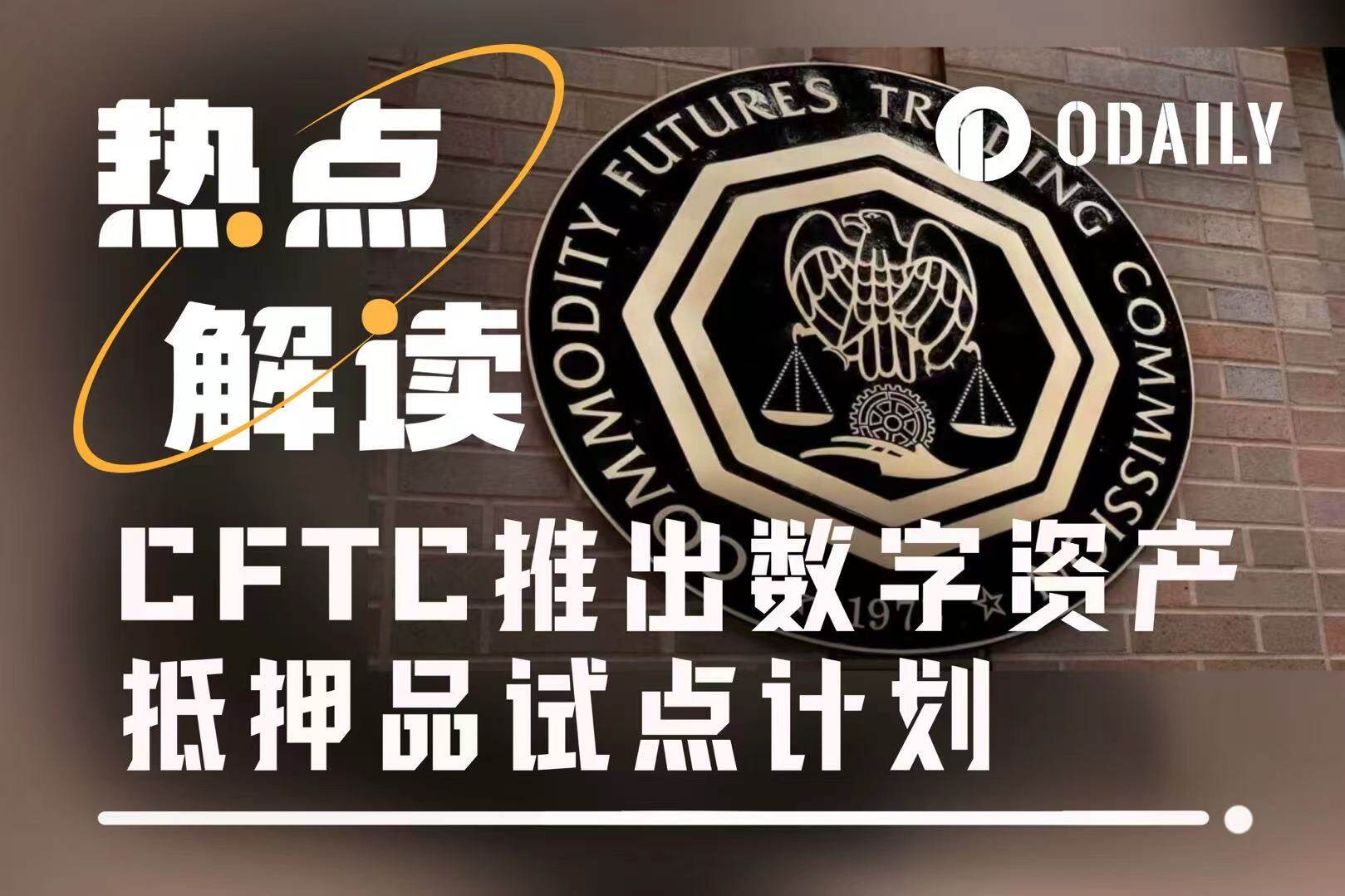
This morning, acting Chairman of the U.S. Commodity Futures Trading Commission (CFTC), Caroline D. Pham, announced the launch of a Digital Asset Collateral Pilot Program, allowing digital assets such as BTC, ETH, and USDC to be used as compliant margin in U.S. regulated derivatives markets, and issued regulatory guidance on tokenized collateral, while simultaneously repealing outdated rules that had become ineffective following the enactment of the GENIUS Act. Additionally, Caroline D. Pham stated: "As I have said before, embracing responsible innovation ensures that U.S. markets remain world-leading and drive U.S. economic growth, as market participants can deploy capital more safely to achieve greater investment returns."

Crypto Assets Officially Enter the Derivatives Market with a Compliant Identity

The Digital Asset Collateral Pilot Program launched by the CFTC is essentially a policy opening where U.S. regulators are proactively "clearing the way." In the past, in U.S. regulated derivatives markets, margin could only exist in the form of traditional assets like cash, Treasury bonds, commercial paper, etc., with crypto assets being excluded. The launch of the pilot program means regulators have, for the first time, explicitly acknowledged that digital assets can participate in mainstream financial transactions as collateral. The specific details of the program are interpreted as follows:

Applicable Entities: Futures Commission Merchants (FCMs)

The pilot targets licensed Futures Commission Merchants, who are core participants in the derivatives market, responsible for custoding client funds, providing margin management, and clearing channels.

Permissible Assets: BTC, ETH, USDC

For the initial three months, the digital asset collateral acceptable by FCMs (Futures Commission Merchants) is limited to BTC, ETH, and USDC, and they must report position sizes to the CFTC weekly on a per-account basis. The regulator clearly stated that this move adheres to a "technology-neutral" principle, focusing on risk attributes rather than asset labels.

Extremely Stringent Regulatory Requirements

To ensure the stability of the traditional financial system, the CFTC has issued highly prudent requirements, including:

  • Digital assets must be held in segregated accounts and cannot be commingled with institutional proprietary funds;
  • FCMs must report position changes to the CFTC weekly;
  • Major issues must be reported immediately;
  • The CFTC will apply the most conservative haircut to digital assets to hedge against price volatility risk.

In other words, the regulator is not simply granting permission but is establishing a controllable, auditable, and traceable institutional framework.

Repealing Old Rules, Introducing New Guidance

Alongside the launch of the Digital Asset Collateral Pilot Program, the CFTC announced the repeal of the 2020 Staff Advisory 20-34—this old rule was no longer suitable for the current market after the passage of the GENIUS Act. The CFTC also issued new regulatory guidelines for "tokenized collateral," providing an institutional foundation for the future on-chain representation of traditional assets like "tokenized Treasuries, tokenized funds."

Shift in Regulatory Attitude: Providing "No-Action Relief"

For FCMs wishing to pilot digital asset margin, the CFTC has provided "No-Action Relief," offering regulatory clarity to institutions and requiring them to maintain robust risk controls. This is equivalent to the CFTC clearly telling institutions: "Operate within the rule framework, and we will not impose additional enforcement risks." For traditional institutions looking to enter the crypto space, this is a crucial "confidence booster."

Industry Leaders' Perspectives

Coinbase: Confirming Industry Consensus, Driving a Payment Revolution

Coinbase Chief Legal Officer Paul Grewal posted on X: "The CFTC's launch of the Digital Asset Collateral Pilot Program confirms a long-standing consensus in the crypto industry: stablecoins and digital assets can make payments faster, cheaper, and reduce risk." Paul Grewal pointed out that this pilot aligns with the original intent of Congress when it passed the GENIUS Act, paving the way for stablecoins to serve as key settlement tools, enabling faster, lower-cost cross-border payments. Coinbase Chief Policy Officer Faryar Shirzad added that this move will significantly enhance the utility of digital assets, attracting more institutional investors into regulated markets. Simultaneously, the potential of stablecoins as settlement tools will be fully unleashed,有望实现有望实现有望实现有望实现有望实现有望实现有望实现有望实现有望实现有望实现有望实现有望实现有望实现有望实现有望实现有望实现有望实现有望实现有望实现有望实现有望实现有望实现有望实现有望实现有望实现有望实现有望实现有望实现有望实现有望实现有望实现有望实现有望实现有望实现有望实现有望实现有望实现有望实现有望实现有望实现有望实现有望实现有望实现有望实现有望实现有望实现有望实现有望实现有望实现有望实现有望实现有望实现有望实现有望实现有望实现有望实现有望实现有望实现有望实现有望实现有望实现有望实现有望实现有望实现有望实现有望实现有望实现有望实现有望实现有望实现有望实现有望实现有望实现有望实现有望实现有望实现有望实现有望实现有望实现有望实现有望实现有望实现有望实现有望实现有望实现有望实现有望实现有望实现有望实现有望实现有望实现有望实现有望实现有望实现有望实现有望实现有望实现有望实现有望实现有望实现有望实现有望实现有望实现有望实现有望实现有望实现有望实现有望实现有望实现有望实现有望实现有望实现有望实现有望实现有望实现有望实现有望实现有望实现有望实现有望实现有望实现有望实现有望实现有望实现有望实现有望实现有望实现有望实现有望实现有望实现有望实现有望实现有望实现有望实现有望实现有望实现有望实现有望实现有望实现有望实现有望实现有望实现有望实现有望实现有望实现有望实现有望实现有望实现有望实现有望实现有望实现有望实现有望实现有望实现有望实现有望实现有望实现有望实现有望实现有望实现有望实现有望实现有望实现有望实现有望实现有望实现有望实现有望实现有望实现有望实现有望实现有望实现有望实现有望实现有望实现有望实现有望实现有望实现有望实现有望实现有望实现有望实现有望实现有望实现有望实现有望实现有望实现有望实现有望实现有望实现有望实现有望实现有望实现有望实现有望实现有望实现有望实现有望实现有望实现有望实现有望实现有望实现有望实现有望实现有望实现有望实现有望实现有望实现有望实现有望实现有望实现有望实现有望实现有望实现有望实现有望实现有望实现有望实现有望实现有望实现有望实现有望实现有望实现有望实现有望实现有望实现有望实现有望实现有望实现有望实现有望实现有望实现有望实现有望实现有望实现有望实现有望实现有望实现有望实现有望实现有望实现有望实现有望实现有望实现有望实现有望实现有望实现有望实现有望实现有望实现有望实现有望实现有望实现有望实现有望实现有望实现有望实现有望实现有望实现有望实现有望实现有望实现有望实现有望实现有望实现有望实现有望实现有望实现有望实现有望实现有望实现有望实现有望实现有望实现有望实现有望实现有望实现有望实现有望实现有望实现有望实现有望实现有望实现有望实现有望实现有望实现有望实现有望实现有望实现有望实现有望实现有望实现有望实现有望实现有望实现有望实现有望实现有望实现有望实现有望实现有望实现有望实现有望实现有望实现有望实现有望实现有望实现有望实现有望实现有望实现有望实现有望实现有望实现有望实现有望实现有望实现有望实现有望实现有望实现有望实现有望实现有望实现有望实现有望实现有望实现有望实现有望实现有望实现有望实现有望实现有望实现有望实现有望实现有望实现有望实现有望实现有望实现有望实现有望实现有望实现有望实现有望实现有望实现有望实现有望实现有望实现有望实现有望实现有望实现有望实现有望实现有望实现有望实现有望实现有望实现有望实现有望实现有望实现有望实现有望实现有望实现有望实现有望实现有望实现有望实现有望实现有望实现有望实现有望实现有望实现有望实现有望实现有望实现有望实现有望实现有望实现有望实现有望实现有望实现有望实现有望实现有望实现有望实现有望实现有望实现有望实现有望实现有望实现有望实现有望实现有望实现有望实现有望实现有望实现有望实现有望实现有望实现有望实现有望实现有望实现有望实现有望实现有望实现有望实现有望实现有望实现有望实现有望实现有望实现有望实现有望实现有望实现有望实现有望实现有望实现有望实现有望实现有望实现有望实现有望实现有望实现有望实现有望实现有望实现有望实现有望实现有望实现有望实现有望实现有望实现有望实现有望实现有望实现有望实现有望实现有望实现有望实现有望实现有望实现有望实现有望实现有望实现有望实现有望实现有望实现有望实现有望实现有望实现有望实现有望实现有望实现有望实现有望实现有望实现有望实现有望实现有望实现有望实现有望实现有望实现有望实现有望实现有望实现有望实现有望实现有望实现有望实现有望实现有望实现有望实现有望实现有望实现有望实现有望实现有望实现有望实现有望实现有望实现有望实现有望实现有望实现有望实现有望实现有望实现有望实现有望实现有望实现有望实现有望实现有望实现有望实现有望实现有望实现有望实现有望实现有望实现有望实现有望实现有望实现有望实现有望实现有望实现有望实现有望实现有望实现有望实现有望实现有望实现有望实现有望实现有望实现有望实现有望实现有望实现有望实现有望实现有望实现有望实现有望实现有望实现有望实现有望实现有望实现有望实现有望实现有望实现有望实现有望实现有望实现有望实现有望实现有望实现有望实现有望实现有望实现有望实现有望实现有望实现有望实现有望实现有望实现有望实现有望实现有望实现有望实现有望实现有望实现有望实现有望实现有望实现有望实现有望实现有望实现有望实现有望实现有望实现有望实现有望实现有望实现有望实现有望实现有望实现有望实现有望实现有望实现有望实现有望实现有望实现有望实现有望实现有望实现有望实现有望实现有望实现有望实现有望实现有望实现有望实现有望实现有望实现有望实现有望实现有望实现有望实现有望实现有望实现有望实现有望实现有望实现有望实现有望实现有望实现有望实现有望实现有望实现有望实现有望实现有望实现有望实现有望实现有望实现有望实现有望实现有望实现有望实现有望实现有望实现有望实现有望实现有望实现有望实现有望实现有望实现有望实现有望实现有望实现有望实现有望实现有望实现有望实现有望实现有望实现有望实现有望实现有望实现有望实现有望实现有望实现有望实现有望实现有望实现有望实现有望实现有望实现有望实现有望实现有望实现有望实现有望实现有望实现有望实现有望实现有望实现有望实现有望实现有望实现有望实现有望实现有望实现有望极有可能实现faster, lower-cost cross-border payments.

Crypto.com: Ushering in the Era of 24/7 Trading in the U.S. Market, a Milestone for Crypto Assets Moving into Mainstream Finance

Crypto.com CEO Kris Marszalek posted on X: "This announcement will make the reality of true 24/7 trading in the U.S. a reality, promoting the deep integration of crypto assets with mainstream finance." He emphasized that the use of tokenized collateral will reduce settlement friction, enhance liquidity, and set a benchmark for global markets. This is not just a technological advancement but also a regulatory "green channel" for innovation.

Circle: Reducing Settlement Risk, Embracing Real-Time Clearing

Circle President Heath Tarbert commented: "This is an 'unlocking moment' for the crypto market, allowing institutions to efficiently manage risk while maintaining asset exposure. These changes will significantly reduce settlement risk and friction in derivatives trading by enabling near real-time margin calls." Additionally, Heath Tarbert specifically mentioned that USDC's qualification as eligible collateral will further solidify the stablecoin's core role in traditional finance.

Ripple: Unlocking Capital Efficiency, the U.S. Regains Leadership

Ripple stated in its response that this pilot "finally provides institutions with the long-awaited unlocking of capital efficiency," strengthening the U.S.'s global leadership at a critical moment. It also noted that allowing BTC, ETH, and USDC to be used directly as margin will reduce the friction of institutions needing to convert crypto assets to cash, driving trillions of dollars into regulated derivatives markets. This marks a strategic shift from "offshore uncertainty" to "onshore compliance."

Overall, while the Digital Asset Collateral Pilot Program is a short-term test (lasting three months), its stringent reporting and risk control mechanisms (such as weekly position disclosures, maximum haircuts) ensure a safety foundation while paving the way for future expansion. Its impact on retail investors is limited in the short term, but in the long run, it is indeed an important signal of institutional-grade recognition.

The True Turning Point of U.S. Crypto Regulation

The CFTC's Digital Asset Collateral Pilot not only means that BTC, ETH, and USDC can be used as compliant margin but also marks the first time digital assets have entered the core U.S. financial market with an institutionalized identity. Futures and swaps markets are the most important capital hubs globally. When crypto assets can be collateralized and used in these markets, they leap from "speculative assets" to regulated financial instruments. Institutional investors gain a clear compliance path, and market liquidity and capital efficiency improve accordingly.

The inclusion of the stablecoin USDC is particularly symbolic. It is officially recognized as a digitized载体 of the U.S. dollar capable of supporting financial transactions, not only consolidating the dollar's core position in on-chain payments and settlements but also paving the way for stablecoins to serve as critical financial infrastructure. This means U.S. regulation is beginning to shift from "restriction" to "institutionalized guidance," providing a clear framework for the development of tokenized finance, including core requirements for custody, segregation, valuation, and risk management, laying the foundation for the future on-chain representation of tokenized Treasuries, funds, and money market instruments.

In the short term, this pilot has limited impact on retail investors, as its strict reporting and risk management mechanisms ensure market safety. However, in the long term, it is an important signal of institutional recognition, meaning more capital will enter the crypto market through regulated channels, the settlement function of stablecoins will be fully unleashed, and derivatives liquidity and market efficiency are expected to improve significantly. More importantly, this pilot reflects a structural shift in U.S. regulation: crypto assets are no longer just objects of speculation but are institutionalized assets that can be incorporated into the mainstream financial system.

If crypto ETFs meant "crypto assets becoming assets," then the CFTC's launch of the Digital Asset Collateral Pilot marks the moment "crypto assets officially enter the U.S. financial system." In the future, more assets will be tokenized, institutions will use on-chain assets as collateral, and the U.S. dollar will circulate on-chain via stablecoins. This is not just a short-term policy but heralds a new cycle of deep integration between crypto and mainstream finance.


Trending Cryptos

Related Questions

QWhat is the significance of the CFTC's Digital Asset Collateral Pilot Program announced by Acting Chairman Caroline D. Pham?

AThe program is a significant policy shift that allows digital assets like BTC, ETH, and USDC to be used as compliant collateral in regulated U.S. derivatives markets for the first time. It marks a move from restriction to institutional guidance, providing a clear regulatory framework and a 'green channel' for innovation, integrating crypto into the core financial system.

QWhich specific entities are eligible to participate in the new pilot program, and what are their roles?

AThe eligible participants are licensed Futures Commission Merchants (FCMs). They are core participants in the derivatives market responsible for custoding client funds, providing margin management, and clearing channels.

QWhat are the three digital assets initially approved for use as collateral, and what is the reporting requirement for FCMs?

AThe initially approved digital assets are Bitcoin (BTC), Ethereum (ETH), and USD Coin (USDC). FCMs are required to report their holdings of these assets to the CFTC on a weekly basis.

QHow did industry leaders from companies like Coinbase and Circle react to the CFTC's announcement?

AIndustry leaders hailed it as a pivotal 'unlock moment.' Coinbase's CLO stated it confirms that stablecoins enable faster, cheaper payments. Circle's President said it reduces settlement risk and embraces real-time clearing, solidifying stablecoins' core role in traditional finance.

QWhat does the inclusion of the stablecoin USDC in this program symbolize for the future of finance?

AThe inclusion of USDC symbolically marks its official recognition as a digitized dollar vehicle for financial transactions. It paves the way for stablecoins to become critical financial infrastructure and lays the foundation for the future tokenization of assets like treasury bonds and funds.

Related Reads

Beyond the Stadium: The Profitable Games Surrounding the World Cup

"Beyond the Pitch: The Profit Game Around the World Cup" The FIFA World Cup transcends being a sporting spectacle, evolving into a massive global arena for speculation and profit-seeking. The 2026 tournament has amplified this dynamic, creating a multi-layered ecosystem of financial opportunism alongside the football. **Prediction markets** have surged into the mainstream. Platforms like Polymarket and Kalshi saw trading volumes for World Cup contracts soar, attracting new users with their financial trading model and high-profile, chain-based wealth stories that overshadow traditional sports betting in terms of growth and narrative. However, **traditional sportsbooks** remain the dominant force, leveraging established user habits, legal markets, and comprehensive product offerings to handle the vast majority of speculative wagers, with projections suggesting record-breaking betting volumes. Capital markets also react. **"Concept stocks"** in countries like South Korea and Japan experience volatile price swings based on team performance and anticipated fan spending on items like chicken, beer, and viewing parties, effectively becoming a stock market reflecting fan sentiment. The **ticket resale market** has become a sophisticated arena for arbitrage. Prices fluctuate wildly based on team draws and star power, with sellers sometimes listing tickets they don't yet own in a practice akin to short-selling, while FIFA's own "Right to Buy" tokens add another layer of speculative trading. **Collectibles and merchandise** offer another avenue. Panini sticker albums, with their inherent scarcity and nostalgic value, can become high-value collectibles. Limited-edition or locally themed jerseys command significant premiums on secondary markets, and even counterfeit vendors profit from fans' desire for affordable match-day identity. The **cryptocurrency** space has seen a frenzy of speculative, unauthorized World Cup-themed meme coins on chains like Solana. These tokens, often exploiting team names and player imagery, experience extreme pump-and-dump cycles, creating stories of massive gains for a few early entrants and steep losses for many others. Finally, an entire industry thrives on **providing information and tools** to other speculators. Developers create platforms like SeatSidekick to track ticket inventory and prices, while paid Telegram groups and subscriptions sell betting tips and predictions, monetizing the widespread desire for an informational edge. In essence, the World Cup has become a compressed, global laboratory for speculation. While the games determine champions on the field, a parallel, complex network of financial transactions—spanning prediction contracts, bets, stocks, tickets, collectibles, crypto, and information services—settles its own scores in the global market.

marsbit38m ago

Beyond the Stadium: The Profitable Games Surrounding the World Cup

marsbit38m ago

How Does Codex Use a Computer? Three Entry Points and Permission Boundaries

This article explains the three primary methods for Codex to interact with a computer, each with distinct use cases, permission boundaries, and trust levels. **1. Computer Use:** This offers the broadest access, allowing Codex to visually control and interact with the graphical user interface of authorized macOS/Windows apps, system settings, and even iOS simulators. It's ideal for tasks lacking APIs or structured tools, such as operating legacy software or multi-app workflows. However, it's the slowest method and has the widest permission scope, requiring careful supervision for sensitive actions. **2. Chrome Extension:** This grants Codex access to the user's logged-in Chrome browser state, including cookies, profiles, and open tabs. It's best for tasks requiring user identity across websites like Gmail, LinkedIn, Salesforce, or internal dashboards. Its key advantage is multi-tab control for complex workflows. While more powerful for browser-based tasks than Computer Use, it carries higher sensitivity as actions are performed under the user's identity. **3. In-App Browser:** This is a browser isolated within the Codex thread, separate from the user's personal browsing data. It excels in web development and debugging scenarios—previewing local servers, testing responsive layouts, or annotating designs directly on the page. Its isolation is a strength for development but a limitation for tasks requiring login sessions. The core principle is to choose the narrowest, safest, and most structured interface for the task. Use plugins or MCPs first, resort to visual control (Computer Use) only for GUI-dependent tasks, employ the Chrome extension for identity-reliant browser work, and prefer the In-App Browser for isolated development. **Appshots** are clarified as a fourth, complementary tool for *inputting* context—capturing a screenshot of a window to point Codex to something—rather than a method for Codex to *act*. Together, this layered approach highlights a key to AI agent productization: not granting unlimited permissions, but constraining them within clear boundaries for specific tasks while preserving user oversight.

marsbit2h ago

How Does Codex Use a Computer? Three Entry Points and Permission Boundaries

marsbit2h ago

The "Iron Rule" of Chip Equipment Is Being Broken

For years, the semiconductor equipment industry followed an unwritten "iron rule": suppliers offered steep discounts for new tool introductions (Design-in) and faced consistent price pressure during repeat orders, especially during market downturns. This long-standing buyer's market dynamic is now being upended. Recently, SK Hynix's primary equipment suppliers have reportedly requested a 3-4% price *increase*, a nearly unprecedented move. This shift is driven by a severe supply-demand imbalance fueled by the AI compute boom. Securing equipment has become an urgent arms race as chipmakers' expansion speed dictates their ability to fulfill massive AI chip orders. Key areas feeling the strain include: **TCB (Thermal Compression Bonding) Equipment:** Demand is exploding, driven by the simultaneous needs of HBM4 memory stacking, AI chip Chip-on-Substrate (C2S), and logic Chiplet Chip-on-Wafer (C2W) packaging. Players like Hanmi Semiconductor, Hanwha Semitech, and ASMPT are receiving major orders. While hybrid bonding is seen as the future, TCB remains the pragmatic choice for HBM4 mass production, with its lifecycle extended by relaxed specifications and ongoing technological upgrades. **Test Equipment Bottlenecks:** Ironically, AI-driven shortages are now crippling test equipment manufacturing. Critical components like FPGAs, Driver ICs, and CPUs face severe shortages and extended lead times (up to 52 weeks for FPGAs), as AI data center and server vendors prioritize supply. This creates a paradoxical cycle: AI chip shortages drive fab expansion, which requires more test equipment, whose production is delayed because its key parts are diverted to make AI chips. The industry is entering a broad, AI-powered upcycle. SEMI forecasts global semiconductor equipment sales to hit a record $156 billion by 2027, fueled by investment in advanced logic/foundry, HBM-driven DRAM, and advanced packaging (like CoWoS). Major players like TSMC, SK Hynix, and Micron are aggressively ramping capital expenditure. In conclusion, leading equipment vendors are no longer just selling tools; they are selling the critical capability to deliver AI-era capacity. Pricing power is shifting decisively to those with indispensable technology in key process nodes like advanced logic, HBM, and advanced packaging, rewriting the industry's traditional power structure.

marsbit2h ago

The "Iron Rule" of Chip Equipment Is Being Broken

marsbit2h ago

Trading

Spot
Futures

Hot Articles

What is $BITCOIN

DIGITAL GOLD ($BITCOIN): A Comprehensive Analysis Introduction to DIGITAL GOLD ($BITCOIN) DIGITAL GOLD ($BITCOIN) is a blockchain-based project operating on the Solana network, which aims to combine the characteristics of traditional precious metals with the innovation of decentralized technologies. While it shares a name with Bitcoin, often referred to as “digital gold” due to its perception as a store of value, DIGITAL GOLD is a separate token designed to create a unique ecosystem within the Web3 landscape. Its goal is to position itself as a viable alternative digital asset, although specifics regarding its applications and functionalities are still developing. What is DIGITAL GOLD ($BITCOIN)? DIGITAL GOLD ($BITCOIN) is a cryptocurrency token explicitly designed for use on the Solana blockchain. In contrast to Bitcoin, which provides a widely recognized value storage role, this token appears to focus on broader applications and characteristics. Notable aspects include: Blockchain Infrastructure: The token is built on the Solana blockchain, known for its capacity to handle high-speed and low-cost transactions. Supply Dynamics: DIGITAL GOLD has a maximum supply capped at 100 quadrillion tokens (100P $BITCOIN), although details regarding its circulating supply are currently undisclosed. Utility: While precise functionalities are not explicitly outlined, there are indications that the token could be utilized for various applications, potentially involving decentralized applications (dApps) or asset tokenization strategies. Who is the Creator of DIGITAL GOLD ($BITCOIN)? At present, the identity of the creators and development team behind DIGITAL GOLD ($BITCOIN) remains unknown. This situation is typical among many innovative projects within the blockchain space, particularly those aligning with decentralized finance and meme coin phenomena. While such anonymity may foster a community-driven culture, it intensifies concerns about governance and accountability. Who are the Investors of DIGITAL GOLD ($BITCOIN)? The available information indicates that DIGITAL GOLD ($BITCOIN) does not have any known institutional backers or prominent venture capital investments. The project seems to operate on a peer-to-peer model focused on community support and adoption rather than traditional funding routes. Its activity and liquidity are primarily situated on decentralized exchanges (DEXs), such as PumpSwap, rather than established centralized trading platforms, further highlighting its grassroots approach. How DIGITAL GOLD ($BITCOIN) Works The operational mechanics of DIGITAL GOLD ($BITCOIN) can be elaborated on based on its blockchain design and network attributes: Consensus Mechanism: By leveraging Solana’s unique proof-of-history (PoH) combined with a proof-of-stake (PoS) model, the project ensures efficient transaction validation contributing to the network's high performance. Tokenomics: While specific deflationary mechanisms have not been extensively detailed, the vast maximum token supply implies that it may cater to microtransactions or niche use cases that are still to be defined. Interoperability: There exists the potential for integration with Solana’s broader ecosystem, including various decentralized finance (DeFi) platforms. However, the details regarding specific integrations remain unspecified. Timeline of Key Events Here is a timeline that highlights significant milestones concerning DIGITAL GOLD ($BITCOIN): 2023: The initial deployment of the token occurs on the Solana blockchain, marked by its contract address. 2024: DIGITAL GOLD gains visibility as it becomes available for trading on decentralized exchanges like PumpSwap, allowing users to trade it against SOL. 2025: The project witnesses sporadic trading activity and potential interest in community-led engagements, although no noteworthy partnerships or technical advancements have been documented as of yet. Critical Analysis Strengths Scalability: The underlying Solana infrastructure supports high transaction volumes, which could enhance the utility of $BITCOIN in various transaction scenarios. Accessibility: The potential low trading price per token could attract retail investors, facilitating wider participation due to fractional ownership opportunities. Risks Lack of Transparency: The absence of publicly known backers, developers, or an audit process may yield skepticism regarding the project's sustainability and trustworthiness. Market Volatility: The trading activity is heavily reliant on speculative behavior, which can result in significant price volatility and uncertainty for investors. Conclusion DIGITAL GOLD ($BITCOIN) emerges as an intriguing yet ambiguous project within the rapidly evolving Solana ecosystem. While it attempts to leverage the “digital gold” narrative, its departure from Bitcoin's established role as a store of value underscores the need for a clearer differentiation of its intended utility and governance structure. Future acceptance and adoption will likely depend on addressing the current opacity and defining its operational and economic strategies more explicitly. Note: This report encompasses synthesised information available as of October 2023, and developments may have transpired beyond the research period.

410 Total ViewsPublished 2025.05.13Updated 2025.05.13

What is $BITCOIN

Discussions

Welcome to the HTX Community. Here, you can stay informed about the latest platform developments and gain access to professional market insights. Users' opinions on the price of BTC (BTC) are presented below.

活动图片