Hash Global Founder: Why I Also Chose to Liquidate All My ETH?

链捕手Published on 2026-05-28Last updated on 2026-05-28

Abstract

Title: Hash Global Founder Explains Why He Sold All His ETH The author (Hash Global founder) has liquidated his entire ETH holdings, despite acknowledging that the potential U.S. CLARITY Act (clarifying ETH as a decentralized digital commodity) is a significant regulatory positive. His core argument is that this regulatory clarity should not be conflated with granting ETH a "monetary premium" akin to Bitcoin (BTC) or gold. He disputes the thesis that ETH's valuation framework should shift from network revenue to a monetary/store-of-value logic. The market continues to value ETH based on concrete metrics like network fees, DeFi activity, staking yield, and ecosystem competition—essentially as a productive infrastructure/platform asset. BTC's narrative as "digital gold" is simpler and more suited for monetary premium. The author identifies several key reservations: 1) Legal classification solves compliance for institutions but doesn't automatically create long-term store-of-value demand. 2) ETH's "yield-bearing" advantage over BTC/gold may diminish as DeFi and Real-World Assets (RWA) tokenize traditional assets like gold and treasuries, which can also generate yield on-chain. 3) Future monetary premium will likely remain with BTC, physical gold, and potentially tokenized gold, while ETH serves as the core settlement infrastructure for these assets. 4) Ethereum's value-capture mechanism remains unresolved, especially with Layer-2 scaling; ecosystem growth does not guarantee p...

Author: HashGlobal KK, Founder of Hash Global

Compiled by: Jiahuan, ChainCatcher

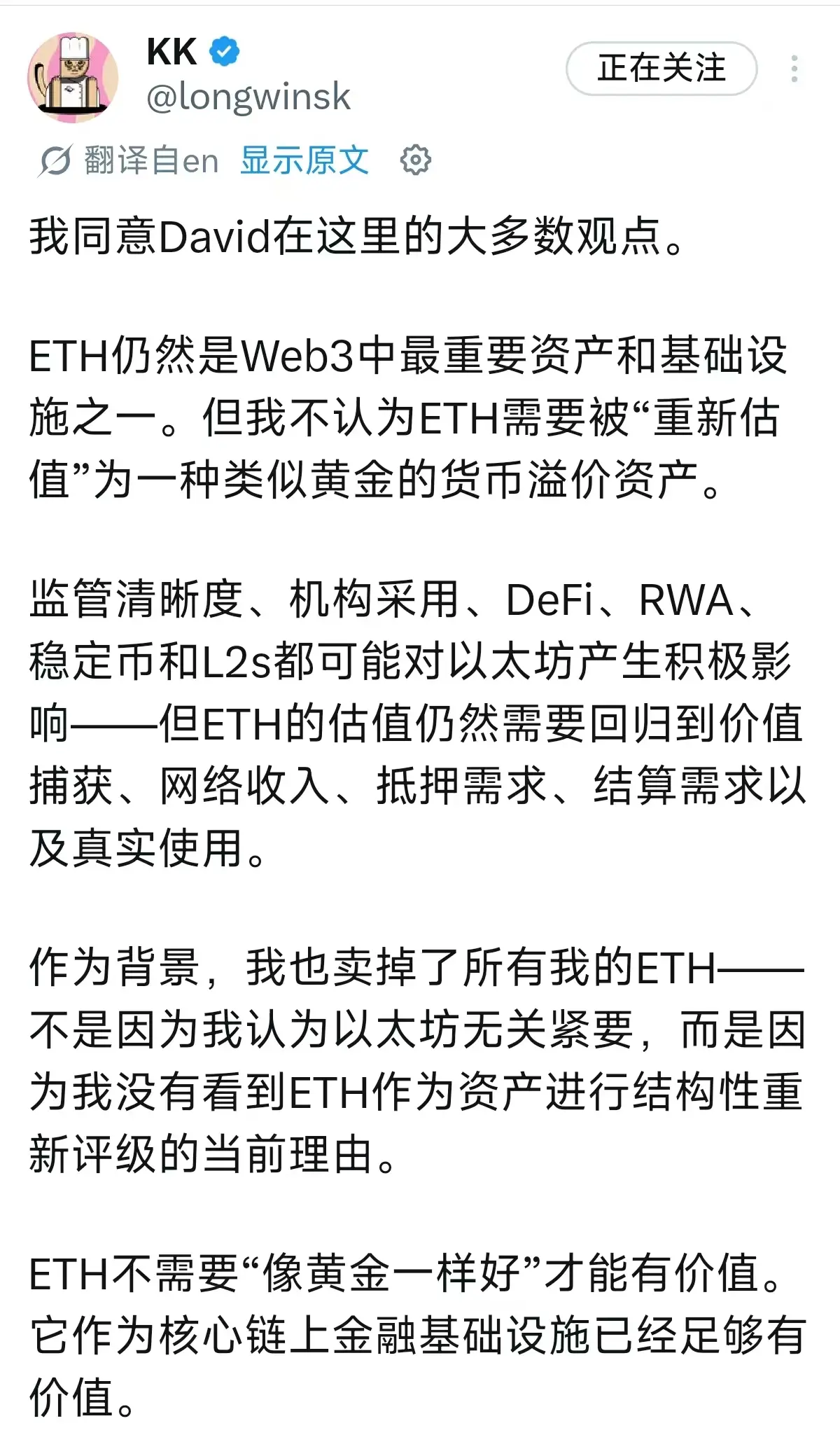
The author has liquidated all ETH holdings. This article was published on May 24.
Recently, I read an article arguing that if the U.S. CLARITY Act passes, Ethereum will become the biggest winner.

Its core argument is that ETH may become the only asset in the U.S. regulatory framework that combines the attributes of a "decentralized digital commodity" and a "programmable smart contract platform." Therefore, ETH's valuation framework should shift from a network revenue logic to a monetary premium logic similar to BTC, gold, or even sovereign reserve assets.

I find this perspective enlightening, but the conclusion may be overly extended.

This is not to say I am bearish on ETH or deny the positive impact of CLARITY.

On the contrary, regulatory clarity is undoubtedly a major positive for ETH. It will reduce compliance concerns for institutional allocation to ETH and help further develop ETFs, custody services, staking, institutional DeFi, RWA, and on-chain settlement businesses.

However, regulatory clarity is not equivalent to a monetary premium.

CLARITY may solve ETH's "regulatory discount" issue, but it will not automatically open up valuation spaces associated with gold, real estate, or global reserve assets.

These are two entirely different matters and should be analyzed separately.

1. The Market Hasn't Bought This Logic Yet

If ETH were truly viewed by the market as "programmable gold" or an "interest-bearing monetary asset," its valuation should be closer to BTC's.

But that's not the case.

When evaluating ETH, the market still focuses on specific metrics:

  • Ethereum mainnet revenue;
  • DeFi activity;
  • Whether stablecoins and RWAs are primarily settled within the Ethereum ecosystem;
  • Value flow from L2s to L1;
  • ETH staking yield;
  • Inflows into ETH ETFs;
  • Competition from ecosystems like Solana, BNB Chain, and Base.

These are essentially valuation logics for network assets, platform assets, and ecosystem assets.

BTC is different. It has no cash flow, no application ecosystem, and no need to discuss network revenue. Its logic is simple: 21 million supply, non-sovereign, censorship-resistant, digital gold. People may disagree with this narrative, but it's simple, clear, and easy to disseminate.

ETH's narrative is much more complex. ETH serves as gas fees, a staking asset, DeFi collateral, L2 settlement asset, and infrastructure for institutional on-chain finance. While multiple functions are advantageous, monetary premiums typically require an extremely simple narrative.

Complexity is beneficial for ecosystem development but doesn't necessarily contribute to forming a monetary premium like gold and BTC.

2. Legal Classification Is Just an Entry Ticket

The original article makes a crucial leap: because ETH may be legally recognized as a decentralized digital commodity, it should enter the valuation framework of top-tier monetary premium assets.

I believe this inference is problematic.

Legal classification addresses issues like: Can institutions hold it compliantly? Can they trade it compliantly? Can they custody it compliantly? Can they develop related products compliantly?

Monetary premium addresses issues like: Is the global market willing to hold it as a long-term store of wealth?

These are two different questions.

Gold has a monetary premium not because any single law classifies it as such, but because millennia of historical consensus, physical scarcity, central bank reserve demand, and geopolitical safe-haven attributes have collectively formed immense consensus.

BTC has a monetary premium not because it can execute smart contracts, but because it is simple enough, pure enough, and resembles "digital gold" enough.

For ETH to gain a monetary premium, regulatory classification alone is insufficient. It must also prove that global capital is willing to hold ETH as a long-term store of value, not merely as a critical on-chain financial infrastructure asset.

There is still a significant gap between these two states.

3. DeFi Will Undermine ETH's "Sole Yield-Bearing" Narrative

The original article emphasizes an advantage of ETH: ETH can generate yield through staking, while BTC and gold cannot.

While this holds some truth today, the situation may change in the coming years.

With the development of DeFi and RWA, many assets will be tokenized in the future. Gold, treasury bonds, money market funds, real estate funds, income rights, commodities, and stock ETFs can all enter the on-chain financial system as tokens.

Once these assets are on-chain, they will also gain new capabilities:

  • Can be used as collateral;
  • Can be lent/borrowed;
  • Can be used for market making;
  • Can be combined into structured yield products;
  • Can be integrated with DeFi protocols;
  • Can form closed-loop on-chain capital flows with stablecoins.

Therefore, in the future, ETH will not be the only "yield-bearing" asset.

Tokenized gold integrated with DeFi can also generate on-chain yield. Tokenized treasury bonds and money market funds inherently have baseline yields. Tokenized real estate funds and other RWAs can generate cash flows.

By then, the question will no longer be "ETH can generate yield, gold cannot."

The real questions will become: Who is the better collateral? Which has lower volatility? Whose yield source is clearer? Who has higher regulatory acceptance? Who is more suitable for institutional balance sheets? Who is more likely to be held long-term by global capital?

From this perspective, ETH may not have an advantage compared to tokenized gold, tokenized treasury bonds, or tokenized money market funds.

ETH's staking yield comes from network security mechanisms, not traditional risk-free returns. It carries protocol risk, validator risk, slashing risk, liquid staking protocol risk, regulatory risk, and price volatility risk.

For institutions, ETH staking is certainly a valuable feature, but it should not be equated directly with "superior to gold."

4. Monetary Premium Belongs to BTC, Gold, and Tokenized Gold

I tend to believe that future monetary premiums will primarily belong to BTC, gold, and potentially tokenized gold.

BTC's positioning is clear: digital gold.

Gold's positioning is also clear: the traditional world's most important non-sovereign store of value.

If tokenized gold develops, the situation could be very attractive. It would inherit gold's historical credibility while gaining on-chain liquidity, composability, and collateral capability. In this scenario, gold's monetary premium might not flow to ETH; instead, it might be further strengthened due to tokenized gold.

This isn't necessarily bad for ETH. These tokenized assets also need on-chain infrastructure and can be issued, traded, and collateralized on Ethereum or Ethereum L2s.

However, this means ETH is more of an infrastructure asset than the ultimate monetary premium asset.

Infrastructure certainly has value. But infrastructure valuations typically revert to usage metrics, revenue, network effects, and value capture, not direct analogies to gold's total market cap, real estate's monetary premium, or global reserve asset pools.

5. Ethereum's Value Capture Problem Remains Unresolved

The original article posits that CLARITY will widen the gap between ETH and other smart contract platforms, with other L1s potentially entering a second-tier valuation while ETH remains in the first tier.

This judgment also requires caution.

The real world won't choose blockchains based solely on U.S. regulatory classifications.

Different countries, assets, and institutions will select underlying networks based on various factors:

  • Cost;
  • Performance;
  • Compliance interfaces;
  • KYC/AML requirements;
  • Local regulatory attitudes;
  • Ecosystem resources;
  • Liquidity;
  • Relationships with asset issuers and service providers;
  • Whether a permissioned environment is needed.

Many RWA, stablecoin, and payment scenarios won't necessarily choose the Ethereum mainnet. They might choose L2s, app-chains, consortium chains, or other L1s that better fit local regulations and business needs.

More importantly, even with significant activity within the Ethereum ecosystem, there's no guarantee that ETH can capture value proportionally.

As we've seen in recent years, while L2s expand the Ethereum ecosystem, they also raise a question: once L2s scale, how much value truly flows back to ETH?

If substantial transaction volume occurs on L2s with declining fees, and the application layer and L2s themselves capture more user value, while the ETH mainnet only handles final settlement and security, then ETH's value capture ability remains to be proven.

We cannot assume that ETH's value appreciates synchronously with Ethereum ecosystem growth.

That's why I believe ETH's valuation must return to specific questions like network revenue, settlement demand, collateral demand, staking yield, and ecosystem value flow.

6. Using Ethereum ≠ Buying ETH

Another distinction needs to be made: institutional entry into on-chain finance does not mean they will allocate ETH as a core asset.

Institutions might:

  • Use the Ethereum network;
  • Use Ethereum L2s;
  • Issue tokenized funds;
  • Use stablecoins for settlement;
  • Use on-chain custody and compliant transfer tools;
  • Use DeFi or permissioned DeFi;
  • Indirectly access on-chain finance through service providers.

None of these require them to purchase large amounts of ETH.

Just as enterprises heavily using cloud services don't necessarily buy shares of the cloud service company, institutions using blockchain infrastructure don't necessarily need to hold the underlying token long-term.

For ETH to transform from a "network being used" to an "asset held long-term," a clear value capture mechanism is required.

If such a mechanism remains unclear, the market will continue to evaluate ETH based on revenue, fees, staking yield, and ecosystem growth.

7. Grand Narratives Can't Support Valuation Anymore

In the last cycle, the market was willing to assign valuation based on grand narratives.

"World computer," "internet of value," "global settlement layer," "foundation of decentralized finance"—these narratives were very powerful. Ethereum was undoubtedly the most important representative.

But the market has changed.

Investors are increasingly asking: Where is the revenue? Where are the users? Where is the value capture? Where is the real demand? What's the regulatory path? Where's the closed-loop business logic?

As we've emphasized repeatedly in recent years, Web3 cannot remain at the vision stage; it must ultimately return to fundamental value and basic business logic.

Can it generate profit? Can it provide a better user experience? Can it create real economic value? If these questions cannot be answered, even the grandest narratives will struggle to sustain valuation long-term.

The same applies to ETH.

While it is certainly one of the most important Web3 infrastructures, to command a higher valuation, the market may need to see:

  • Re-growth of DeFi;
  • Recovery of mainnet revenue;
  • Clearer value flow from L2s to L1;
  • Real settlement demand for stablecoins and RWAs within the Ethereum ecosystem;
  • Sustained growth in ETH collateral demand;
  • Institutions not just using Ethereum, but genuinely needing to hold ETH.

None of this can be automatically achieved through a single piece of legislation.

8. CLARITY's True Significance Is Fixing the Regulatory Discount

Therefore, I prefer to view CLARITY's impact on ETH as reducing the regulatory discount, not unlocking a multi-trillion-dollar monetary premium revaluation potential.

ETH indeed faced regulatory uncertainty in the past. If U.S. regulators more clearly recognize ETH's commodity status, that would be a significant positive.

However, this would shift ETH from a "network asset with regulatory tail risk" to a "network asset with clearer regulation."

That is already significant.

But it doesn't mean ETH will automatically become a substitute for gold, BTC, or global reserve assets.

If the market continues to evaluate ETH based on network revenue, staking yield, L2 value flow, DeFi activity, RWA settlement volume, and institutional usage, then ETH's valuation will remain constrained by fundamentals.

This isn't necessarily bad. High-quality infrastructure assets deserve high value. But they are not equivalent to monetary premium assets.

9. My Stance on ETH

I still believe ETH is one of the most important assets in the digital asset industry.

Its long-term value stems from the following aspects: First, it is the most important open smart contract network.

Second, it is the key settlement layer for DeFi, stablecoins, RWAs, and on-chain finance.

Third, from a regulatory perspective, it is one of the most defensible decentralized infrastructures.

Fourth, it has accumulated long-term recognition from developers, applications, assets, and institutions.

Fifth, as Web3 enters large-scale commercial applications, it may become an extremely important underlying trust and settlement asset.

However, this value is more akin to infrastructure value, network value, ecosystem value, and collateral value.

It may enjoy some scarcity premium, regulatory clarity premium, and network effect premium, but not necessarily the pure monetary premium enjoyed by BTC or gold.

ETH possesses significant long-term value, but its valuation framework should not be mistakenly substituted.

10. CLARITY Benefits ETH, But Don't Treat ETH Like Gold

My core judgment on this matter is straightforward:

CLARITY benefits ETH, but this doesn't mean ETH should be valued like gold.

Regulatory clarity is a positive, but it is not equivalent to a monetary premium.

ETH is an extremely important on-chain financial infrastructure asset, but it may not become the ultimate store of value for global wealth.

In the future, those truly enjoying monetary premiums will likely still be mainly BTC, gold, and potentially tokenized gold and other high-credit stores of value. ETH is more likely to serve as the core infrastructure for on-boarding, circulating, collateralizing, settling, and compositing these assets.

This position is already important enough; there's no need to force ETH into a "superior to gold" narrative.

A more robust valuation framework for ETH might be: regulatory clarity drives discount repair; institutional entry drives increased demand; DeFi, RWA, stablecoins, and L2 ecosystems determine network usage; network revenue, collateral demand, and value flow determine long-term valuation; monetary premium can be considered an optimistic scenario but should not be the base assumption.

These are my main reservations regarding the ETH revaluation thesis.

The Web3 industry often extrapolates real positives into huge valuation stories. While imagination is valuable, returning to fundamental questions is more critical.

What problem does this asset actually solve? Who will hold it long-term? What are the returns and risks of holding it? Where does its value truly come from? If the ecosystem develops, will the value indeed accrue to this token?

If these questions cannot be answered clearly, regulatory classification alone will struggle to support a genuine valuation leap.


Related Questions

QAccording to the author, why is the view that the CLARITY Act could grant Ethereum a 'monetary premium' flawed?

AThe author argues that while regulatory clarity (CLARITY Act) is a significant positive for ETH by removing a 'regulatory discount' and enabling institutional adoption, it does not automatically confer a 'monetary premium.' A monetary premium, like that enjoyed by Bitcoin and gold, stems from long-term historical consensus, perceived scarcity, and global acceptance as a store of value. ETH's valuation is still tied to network-specific fundamentals like revenue, DeFi activity, and staking yields, not the simpler, scarcity-driven narrative of a monetary asset.

QWhat key distinction does the author make between Bitcoin's and Ethereum's core valuation narratives?

AThe author distinguishes Bitcoin's valuation as based on a simple, scarcity-driven 'digital gold' or monetary premium narrative (non-sovereign, censorship-resistant, fixed supply). In contrast, Ethereum's valuation is tied to its role as a 'network asset' or 'platform asset,' focused on complex fundamentals like network revenue, DeFi activity, staking yields, L2 value flow, and competition—metrics more akin to infrastructure valuation than pure monetary store-of-value.

QHow does the author suggest the rise of DeFi and tokenized real-world assets (RWA) could undermine the narrative of ETH being a unique 'yield-bearing' asset?

AThe author posits that as DeFi and RWA develop, many traditional assets (like gold, Treasury bonds, real estate funds) will be tokenized. These tokenized assets can also generate yield through lending, market-making, and integration with DeFi protocols. Therefore, ETH's 'yield-bearing' feature will not be unique. Furthermore, compared to tokenized sovereign debt or money market funds, ETH's staking yield carries protocol and volatility risks, making it potentially less attractive for institutional balance sheets seeking stable returns.

QWhat is the author's primary concern regarding Ethereum's value capture, especially in relation to Layer 2 solutions (L2s)?

AThe author's concern is that even if the Ethereum ecosystem grows significantly (e.g., through L2s, RWA, DeFi), it's not guaranteed that value will proportionally accrue to the ETH token itself. If high-volume, low-fee transactions occur on L2s, and applications/L2 tokens capture more user value, while Ethereum mainnet only handles final settlement and security, then ETH's value capture mechanism remains unproven and potentially weak.

QWhat does the author conclude is the most realistic impact of the CLARITY Act on Ethereum's valuation, as opposed to granting it a monetary premium?

AThe author concludes that the CLARITY Act's true impact on ETH should be viewed as a 'repair of the regulatory discount,' not an unlocking of trillion-dollar monetary premium potential. It moves ETH from being a 'network asset with regulatory tail risk' to a 'network asset with clearer regulation.' This is a major positive that facilitates institutional use and product development, but ETH's valuation will still be constrained by its fundamental metrics like network income, staking demand, and ecosystem growth, not by a direct re-rating to gold/Bitcoin-like monetary asset status.

Related Reads

Justin Sun’s Interview with Hurun Report: A New Order and Certainty for Value Flow in the Era of Transformation

In an interview with *Hurun Report*, Justin Sun, founder of TRON, discussed the evolution of the Web3 industry as it moves from initial exploration to large-scale adoption. He emphasized that the core value of blockchain lies in building an open and inclusive internet of value, enabling anyone globally to transfer and use funds efficiently and at low cost, regardless of location or access to banking. Sun highlighted that projects with lasting impact are those built on genuine demand and real-world usage. He pointed to the stablecoin payment ecosystem as the most mature and scalable application currently, noting that TRON has rapidly become one of the world's largest stablecoin networks. The circulation of USDT on TRON has surpassed $86.3 billion, driven by actual use cases such as cross-border transfers and daily payments, demonstrating strong network effects. Regarding strategy, Sun outlined a methodology combining data-driven iteration, rapid execution, and user-centric focus. He cited the decision to partner with Tether to launch TRC-20 USDT as a key strategic move, based on an assessment of market trends and long-term potential, which has become a significant growth engine for the TRON ecosystem. On globalization, Sun stressed the importance of local compliance and cultural adaptation, noting that success in different markets depends on deep understanding and local partnerships. He also addressed the convergence of AI and blockchain, describing it as a transformative direction where blockchain provides decentralized infrastructure for AI, while AI enhances the intelligence and user experience of blockchain systems. For industry participants and young entrepreneurs, Sun advised continuous learning and adaptability in a fast-changing environment, focusing on building irreplaceable core strengths rather than spreading resources too thinly. Through infrastructure development, global strategy, and technological foresight, TRON aims to advance the practical implementation and evolution of the value internet.

marsbit22m ago

Justin Sun’s Interview with Hurun Report: A New Order and Certainty for Value Flow in the Era of Transformation

marsbit22m ago

Samsung Leverages Technology Cycles, SK Hynix Relies on HBM, What Enabled Micron to Win a Trillion-Dollar Market Cap?

Micron Technology, the Idaho-based memory chip maker, recently saw its market cap surpass $1 trillion, securing its position as one of the top three DRAM manufacturers alongside Samsung and SK Hynix. Its survival and growth story is marked by a unique combination of political maneuvering and hard-won manufacturing efficiency, but also strategic missteps that now challenge its future. Founded in 1978 in Boise without significant government or capital backing, Micron repeatedly turned to Washington for survival during critical junctures. In the 1980s, it filed anti-dumping complaints against Japanese firms, leading to the U.S.-Japan Semiconductor Agreement. Ironically, this created an opening for Samsung, which Micron had earlier licensed its 64K DRAM technology to. In 2002, Micron avoided heavy fines in a price-fixing investigation by acting as a whistleblower against its competitors, cementing its reputation as a "political opportunist." A major strategic error occurred in 2013 with its $2.5 billion acquisition of bankrupt Japanese firm Elpida. This deal burdened Micron with integrating incompatible manufacturing processes just as the industry was pivoting toward HBM (High Bandwidth Memory), a critical technology for AI. SK Hynix had launched its first HBM chip that same year. By the time AI demand exploded with ChatGPT in 2022, SK Hynix commanded about 85% of the HBM3 market, while Micron, playing catch-up, held only around 3%. In 2017, Micron employed similar tactics against a new competitor, Chinese startup Fujian Jinhua, by alleging intellectual property theft, which led to U.S. sanctions effectively crippling the firm. However, this strategy backfired in 2023 when China banned Micron's products from its critical infrastructure, causing its revenue share from China to plummet from 14% in FY2023 to just 7.1% by FY2025. Today, Micron faces a triple squeeze: it lags in the high-margin HBM race, faces pricing pressure in low-end DRAM from Chinese manufacturers like CXMT, and has lost crucial access to the booming Chinese AI server market. Despite its political strategies, Micron's core strength is its exceptional manufacturing cost control, achieved through decades of engineering. Its DRAM chips have a smaller cell area than its rivals, yielding more chips per wafer. This efficiency has been vital for weathering industry downturns. However, this advantage cannot compensate for the decade lost in HBM development. Micron is now racing to ramp up production of its HBM3E, certified by NVIDIA, and develop HBM4. Its future hinges on whether it can close this technological "time debt" through relentless R&D and execution, in a marathon where its competitors, having started earlier, are not slowing down.

marsbit41m ago

Samsung Leverages Technology Cycles, SK Hynix Relies on HBM, What Enabled Micron to Win a Trillion-Dollar Market Cap?

marsbit41m ago

Deconstructing Mysterious Researcher Serenity's Chokepoint Algorithm and the Global Revaluation of Equity Assets

Unmasking Serenity's "Chokepoint Theory": A Framework for AI-Era Investment This article deconstructs the investment methodology of the pseudonymous online researcher Serenity (formerly AleaBito on Reddit), who claims extraordinary returns by identifying critical bottlenecks in AI and robotics supply chains. Rejecting Wall Street's typical top-down analysis, Serenity employs a bottom-up, reverse-engineering approach. Starting with an end product like an Nvidia GPU cluster, he meticulously maps the global supply chain down to its most essential, irreplaceable physical components—the "choke points." These are low-profile, often monopolized sub-sectors where a disruption could paralyze entire downstream industries, analogous to a strategic strait controlling global oil flow. His primary focus is the physical evolution of AI data centers, specifically the shift from copper interconnects to silicon photonics and Co-Packaged Optics (CPO). He identifies five critical, monopolized technical barriers within CPO: high-precision fiber alignment components (e.g., FOCI), external light sources and high-power lasers (e.g., SIVE), molecular beam epitaxy equipment (ALRIB/Riber), ultra-high-purity red phosphorus raw materials, and Silicon-on-Insulator (SOI) wafers (Soitec). Serenity extends this framework to humanoid robotics, arguing that while the AI "brain" resides in the US, the physical "body" hardware (actuators, gears, motors) is dominated by Asian manufacturers. He highlights a looming "demand tsunami" for specific rare earth elements essential for robot motors, presenting a severe future supply chain and geopolitical challenge. The article cites several of his investment targets (RPI, SIVE, Soitec, VLN, NBIS) where identifying such choke points, coupled with correcting market mispricings (e.g., ticker code confusion for VLN), allegedly led to significant re-ratings. Ultimately, the article posits that Serenity's core value is not in providing stock picks, but in demonstrating a paradigm: using deep technical analysis to find the silent, indispensable "physical switches" within complex systems, thereby exploiting institutional research blind spots. However, it warns of major risks, including illiquidity in micro-cap stocks, potential "pump-and-dump" accusations, and the foundational gamble that his identified technological paths (like CPO) are the correct and inevitable ones.

marsbit43m ago

Deconstructing Mysterious Researcher Serenity's Chokepoint Algorithm and the Global Revaluation of Equity Assets

marsbit43m ago

Cross-strait Regulators Jointly Block Hong Kong Stock Account Openings: Where Can Your Money Go Now?

**Summary:** On May 22, 2026, financial regulators in mainland China and Hong Kong launched a synchronized crackdown targeting informal channels used by mainland investors to trade in Hong Kong and US stocks via Hong Kong-based securities firms. The Hong Kong Securities and Futures Commission (SFC) issued a stringent circular to licensed brokers, mandating stricter onboarding procedures for mainland clients. New requirements include a mandatory written declaration stating that all investment funds originate from *outside* mainland China and are from legal sources. The SFC also demanded the closure of accounts opened with suspicious documents and dormant accounts. Simultaneously, China's securities regulator, along with seven other ministries, initiated a two-year rectification plan, penalizing firms like Futu and Tiger Brokers for illegal cross-border operations. This effectively ends the previously common grey-area practice for mainlanders. Immediate impacts are evident. Social media reports show mainland investors traveling to Hong Kong for in-person account openings are now frequently denied after signing the new declaration, even at firms like uSMART that still accept applications. The declaration acts as both a compliance shield for brokers and a filter for clients. While major internet brokers have halted new mainland accounts, limited options remain. A few Hong Kong-licensed firms like uSMART, Fosun Wealth, and Cheerful still offer avenues, but approval is not guaranteed and hinges on proving offshore fund sources. Crucially, funding accounts must now be in the investor's own name at qualified Hong Kong or international banks, blocking previous informal methods like third-party transfers. For compliant access, official channels like Stock Connect, QDII, and the Cross-boundary Wealth Management Connect remain open. Individuals with verifiable overseas residency or status have better prospects. The crackdown signals the definitive end of the loosely regulated expansion period, forcing mainland investors toward stricter, fully compliant pathways for overseas asset allocation.

marsbit48m ago

Cross-strait Regulators Jointly Block Hong Kong Stock Account Openings: Where Can Your Money Go Now?

marsbit48m ago

Iran and the Fed -- Three Scenarios That Will Impact Global Markets Next

"Three Scenarios for Iran and the Fed Shaping Global Markets" Iranian geopolitics and the Fed's monetary policy path are two dominant themes for markets. Deutsche Bank Research outlines three scenarios linking Iran ceasefire outcomes to Fed policy, with oil prices as the key transmission channel. **Scenario 1: Peace Deal.** A breakthrough leading to the Strait of Hormuz reopening would ease near-term Fed tightening pressure. Recent inflation would be viewed as a temporary energy shock. However, medium-term risks remain; rate hikes could resurface in 2027 if inflation persists. **Scenario 2: Stalemate.** A breakdown in talks and a prolonged Strait closure, but no major escalation, is deemed the scenario with the *highest* Fed hike risk. Sustained high oil prices would feed into core inflation and threaten inflation expectations, while not severely damaging demand enough to give the Fed a reason to pause. This environment could necessitate multiple Fed rate hikes in 2026. **Scenario 3: Conflict Escalation.** Renewed conflict and sharply higher oil prices create a two-way risk for Fed policy. On one hand, it would risk severe inflation expectations de-anchoring, forcing a hawkish response. On the other, extreme oil prices could severely damage demand and the labor market, potentially shifting the Fed's focus toward easing. The ultimate policy decision would depend on which risk materializes first. Overall, Deutsche Bank's framework emphasizes that the path for oil prices, dictated by Iran, will define the nature of inflation pressures and ultimately determine the Fed's policy space. Key signals to watch include ceasefire progress, whether Brent crude stabilizes below $100, and any shift in Fed officials' rhetoric from discussing cuts to potential hikes.

marsbit56m ago

Iran and the Fed -- Three Scenarios That Will Impact Global Markets Next

marsbit56m ago

Trading

Spot
Futures

Hot Articles

Discussions

Welcome to the HTX Community. Here, you can stay informed about the latest platform developments and gain access to professional market insights. Users' opinions on the price of ETH (ETH) are presented below.

活动图片