
Hackers and Scammers Stole $4 Billion in Cryptocurrencies in 2025

RBK-cryptoPublished on 2026-01-13Last updated on 2026-01-13

Abstract

In 2025, hackers and fraudsters stole over $4 billion in cryptocurrencies, a 34.2% increase compared to the $3.01 billion stolen in 2024, according to analytics firm PeckShieldAlert. The total damage exceeded $4.04 billion, with $2.67 billion (a 24.2% annual increase) attributed to hacks and $1.37 billion (a 64.2% increase) to fraud cases. A strategic shift was noted towards a rise in scams utilizing social engineering methods, such as psychological manipulation to trick victims into revealing confidential information, which accounted for 12% of the losses. The most significant single incident was the $1.4 billion hack of the Bybit exchange in February of the previous year. An additional 22% of losses came from scams, including 'rug pulls' and pseudo-crypto investment schemes. Another key change was the increasing share of centralized services among the affected platforms. Their share of losses grew from just over 35% in 2023 to around 45% in 2024, and exceeded 70% in 2025. Only about $334.9 million of the stolen funds were frozen or returned during the year, a decrease from the $488.5 million recovered in 2024.

Damage to crypto industry participants increased by 34% compared to 2024

Due to hacks and fraud with cryptocurrencies in 2025, more than $4 billion was lost, according to analysts at PeckShieldAlert. According to their data, this is 34.2% more than in 2024, when $3.01 billion worth of cryptocurrency was stolen.
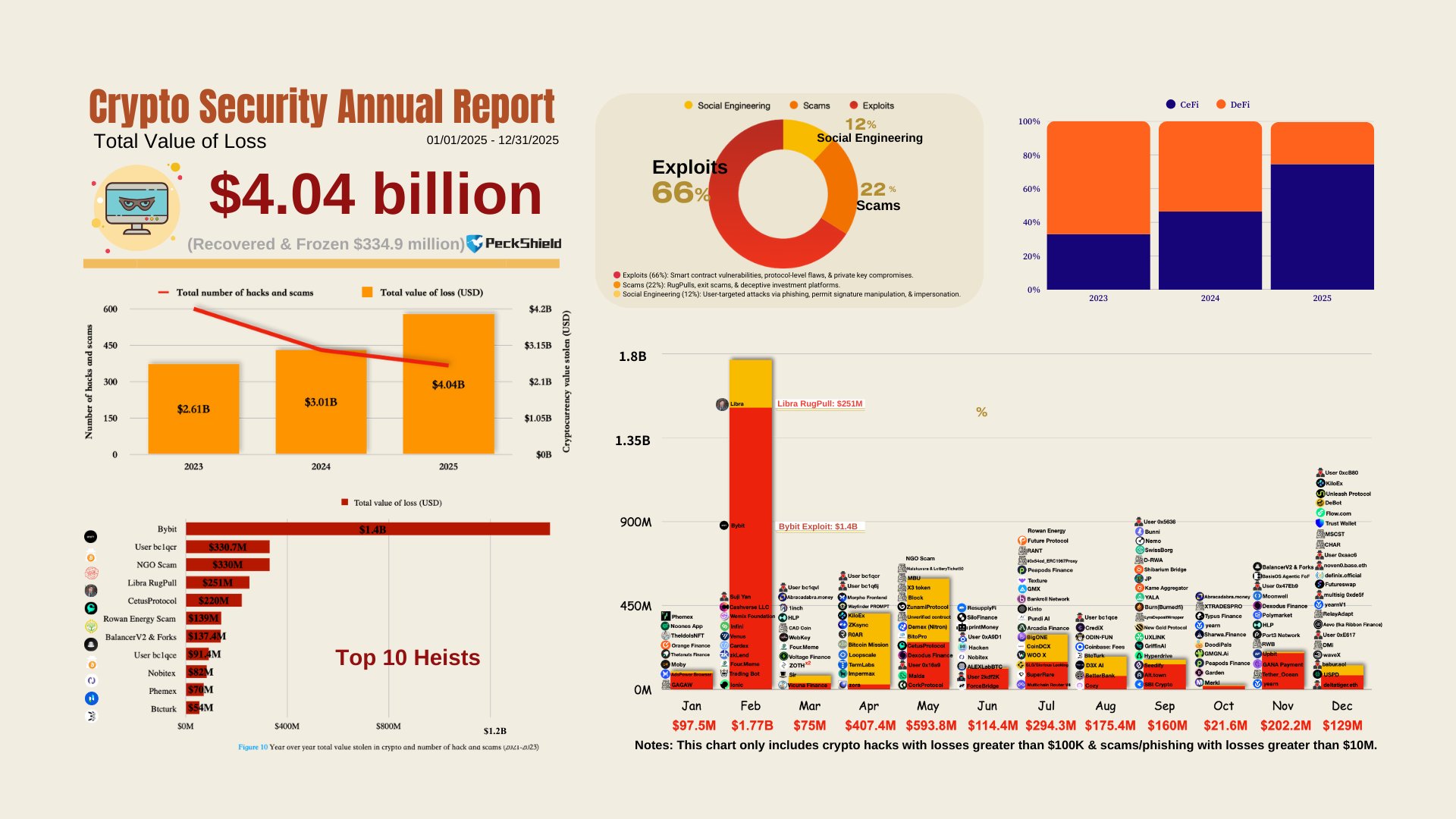
Damage from hacks and fraud with cryptocurrencies in 2025. Source: PeckShield

The total damage in 2025 exceeded $4.04 billion. Of this, $2.67 billion came from losses due to hacks (a 24.2% year-on-year increase) and $1.37 billion was attributed to cases of fraud (a 64.2% increase).

RBC-Crypto Telegram Channel — subscribe and stay up to date with the most important and relevant news about cryptocurrencies.

Join the RBC-Crypto forum on Telegram to discuss news and trends in the crypto world.

The report emphasizes that a strategic shift is occurring — the number of thefts using social engineering methods (psychological techniques and manipulations that force the victim to disclose confidential information that the attacker could use to steal funds) is growing. Analysts attributed 12% of the losses in 2025 to incidents where such methods were used.

66% of the total damage came from hacks, the most serious being the theft of $1.4 billion from the Bybit exchange in February of last year. Another 22% of losses came from scams, including "rug pulls" (when developers withdraw liquidity at the price peak) and pseudo-cryptoinvestments.

Another important change was the increase in the share of centralized services among the affected platforms. If in 2023 they accounted for just over 35%, in 2024 it was already around 45%, and in 2025 — over 70%.

Over the year, only about $334.9 million of the stolen funds was frozen or returned. PeckShield noted a decrease compared to 2024, when $488.5 million was recovered.

Cardano Founder: Trump's Policy Pushed Suburbs Away from Cryptocurrency

Former New York 'Bitcoin Mayor' Faces Charges in Crypto Fraud

The First Bitcoin Transaction Was Executed 17 Years Ago. Who Received These Coins

Trending Cryptos

Related Questions

QHow much was stolen in cryptocurrencies due to hacks and fraud in 2025 according to PeckShieldAlert?

A$4 billion was stolen in cryptocurrencies in 2025.

QWhat was the percentage increase in losses from crypto hacks and fraud in 2025 compared to 2024?

ALosses increased by 34.2% in 2025 compared to 2024.

QWhat was the largest single crypto theft incident mentioned in the report for 2025?

AThe largest single theft was the $1.4 billion hack of the Bybit exchange in February of the previous year.

QWhat significant shift in attack methods did the PeckShield report highlight for 2025?

AThe report highlighted a strategic shift towards an increase in the number of scams using social engineering methods, which accounted for 12% of the losses.

QWhat percentage of the total losses in 2025 were attributed to centralized services?

AOver 70% of the total losses in 2025 were attributed to centralized services.

Related Reads

Bitcoin Withdrawals Continue: 8 Years of Storage in a Coldcard Cold Wallet Ended in Zero

Coldcard Hardware Wallet Hacked: Losses Mount Due to Vulnerable Seed Generation A critical vulnerability in Coldcard hardware wallets has led to a continued wave of fund thefts. According to Galaxy Research, the total stolen has reached 1,367.05 BTC (approx. $88.6 million) from 4,585 addresses, a significant increase from the initial 594.5 BTC reported on July 30, 2026. Most of the stolen funds remain on the attackers' addresses. The issue is not with the current firmware, which Coinkite has updated, but with seed phrases generated on vulnerable devices between March 2021 and the release of fixed firmware versions. Due to a programmer error, devices switched from using a hardware random number generator to the software-based Yasmarang generator, which was initialized with publicly accessible data like the chip's serial number. This made the seed phrases predictable through offline brute-force attacks, meaning wallets remain at risk until funds are moved to a new wallet generated with the patched firmware. Affected devices include Mk2/Mk3 with firmware 4.0.1–4.1.9 (and up to 5.0.3), Mk4/Mk5 up to version 5.6.0, and Q models up to 1.5.0Q. The only exceptions are seeds created with a high-entropy method like at least 50 independent dice rolls or a strong unique BIP-39 passphrase. All other owners must generate a new seed on the fixed firmware and transfer their assets. A case highlighting the human impact involves a 39-year-old long-term investor who lost 2 BTC (approx. $130,000) in minutes. He had accumulated the Bitcoin over eight years through physical labor, viewing it as a financial lifeline and a retirement plan in a country suffering from hyperinflation. His story underscores that even conservative "buy and hold in cold storage" strategies can be compromised by such underlying technical flaws. From a technical perspective, this incident echoes historical failures where weak random number generators undermined cryptographic security, challenging the assumption that offline storage is automatically foolproof.

cryptonews.ru4h ago

Bitcoin Withdrawals Continue: 8 Years of Storage in a Coldcard Cold Wallet Ended in Zero

cryptonews.ru4h ago

Trading

Spot

Hot Articles

How to Buy 4

Welcome to HTX.com! We've made purchasing 4 (4) simple and convenient. Follow our step-by-step guide to embark on your crypto journey.Step 1: Create Your HTX AccountUse your email or phone number to sign up for a free account on HTX. Experience a hassle-free registration journey and unlock all features.Get My AccountStep 2: Go to Buy Crypto and Choose Your Payment MethodCredit/Debit Card: Use your Visa or Mastercard to buy 4 (4) instantly.Balance: Use funds from your HTX account balance to trade seamlessly.Third Parties: We've added popular payment methods such as Google Pay and Apple Pay to enhance convenience.P2P: Trade directly with other users on HTX.Over-the-Counter (OTC): We offer tailor-made services and competitive exchange rates for traders.Step 3: Store Your 4 (4)After purchasing your 4 (4), store it in your HTX account. Alternatively, you can send it elsewhere via blockchain transfer or use it to trade other cryptocurrencies.Step 4: Trade 4 (4)Easily trade 4 (4) on HTX's spot market. Simply access your account, select your trading pair, execute your trades, and monitor in real-time. We offer a user-friendly experience for both beginners and seasoned traders.

5.0k Total ViewsPublished 2025.10.20Updated 2026.06.02

How to Buy 4

Discussions

Welcome to the HTX Community. Here, you can stay informed about the latest platform developments and gain access to professional market insights. Users' opinions on the price of 4 (4) are presented below.

活动图片