Growing Pressure On BTC: On-Chain Data Reveals Bitcoin’s Institutional Exodus

bitcoinistPublished on 2026-03-29Last updated on 2026-03-29

Abstract

Bitcoin is exhibiting signs of institutional selling pressure, as indicated by on-chain data from CryptoQuant. The Coinbase Premium Index, which tracks the price difference between institutional-focused Coinbase and retail-heavy Binance, has turned deeply negative. This suggests institutions are offloading BTC, a move analysts attribute to deteriorating macro conditions like geopolitical tensions and inflation fears. Furthermore, Bitcoin's price is struggling to break above a key resistance level of $72,500, known as the 'adjusted realized price' that filters out long-dormant coins. Historically, Bitcoin has traded below this level for extended periods during bear markets, suggesting the current cycle could face several more months of consolidation before a sustained recovery.

Bitcoin is sending distress signals from within. Information tracked from on-chain analytics platform CryptoQuant shows mounting institutional discomfort, and two metrics are simultaneously displaying warning signs that could define Bitcoin’s trajectory for the rest of the month.

The Coinbase Premium Collapse

One of the clearest windows into institutional Bitcoin behavior has now swung substantially negative. According to CryptoQuant data reviewed by crypto analyst Darkfost, the Coinbase Premium Index, which measures the price difference between Coinbase Advanced and Binance, has plunged to its most negative reading since the crypto crash in early February.

The indicator carries particular significance because of the type of trading that’s majorly going on in each exchange. Coinbase Advanced is the platform of choice for professional and institutional investors, while Binance serves a broader, predominantly retail base. Whenever Coinbase prices are trading at a discount to Binance, then that means institutional participants are selling more than the wider market.
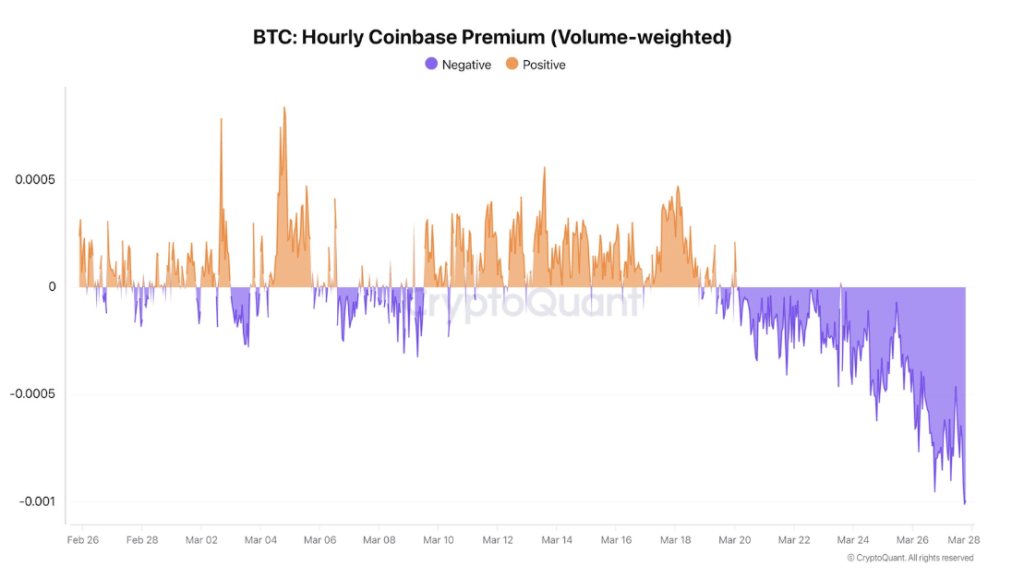
Bitcoin Coinbase Premium. Source: @Darkfost_Coc On X

Institutional sentiment is being shaped by ongoing geopolitical and economic developments. The conflict in Iran, rising oil prices, and concerns around inflation and bond yields are feeding directly into how institutional investors are investing in Bitcoin.

These are precisely the kinds of macro variables that large funds and institutional desks are structurally sensitive to, and with conditions deteriorating in recent days, these institutions are reducing their Bitcoin exposure in response.

A Stubborn Ceiling At $72,500

Even if macro sentiment were to stabilize, Bitcoin is still facing a structural obstacle that on-chain data makes difficult to ignore. According to a second metric tracked using CryptoQuant data, Bitcoin’s price action is still unable to reclaim its realized price when inactive supply is excluded.

BTCUSD now trading at $66,600. Chart: TradingView

This adjusted realized price filters out Bitcoin that has not moved in more than seven years. Once it has been over seven years since it has been moved, the coins will be considered to be either permanently lost or held by long-term holders who do not participate in market activity. Stripping away that dormant supply produces a cost basis that more accurately shows the coins actually circulating in the market.

At the time of writing, that adjusted realized price is sitting at approximately $72,500. Interestingly, the entire Bitcoin realized price is even below this level.
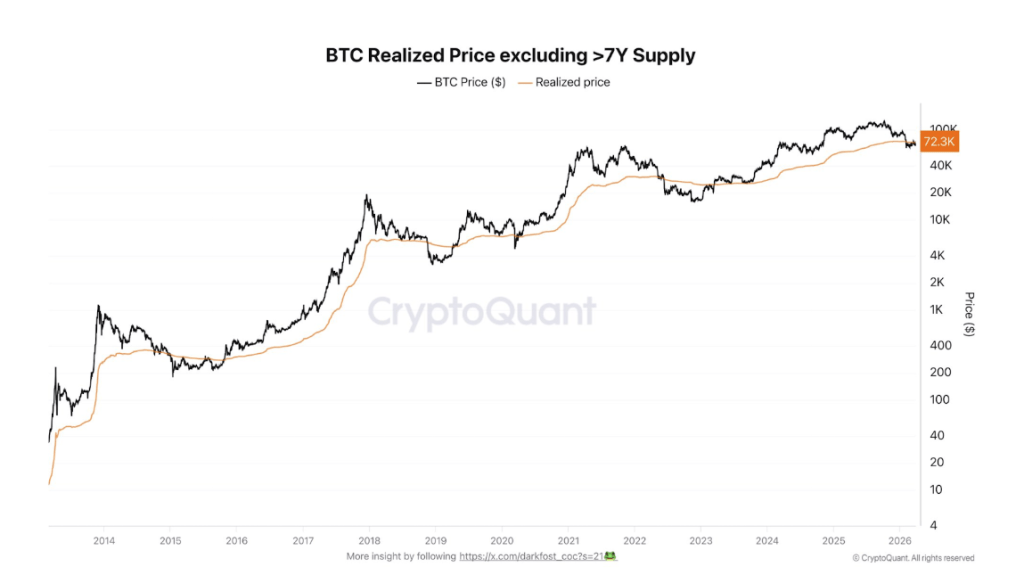
BTC Adjusted Realized Price. Source: @Darkfost_Coc On X

The significance of this level becomes clearer when placed in historical context. In previous bear market phases, Bitcoin has often spent between six and ten months below this cost basis before managing to break above it again. The current structure is beginning to resemble those earlier periods. Although the Bitcoin price managed to break to $76,000 in the middle of March, it has since returned to trading below the adjusted realized price.

If the current cycle follows suit, the implication is that Bitcoin may face several more difficult months trading below and around $72,500 before a sustained recovery becomes viable.

Featured image from Unsplash, chart from TradingView

Trending Cryptos

Related Questions

QWhat does the Coinbase Premium Index measure and why is it significant for gauging institutional sentiment?

AThe Coinbase Premium Index measures the price difference between Coinbase Advanced and Binance. It is significant because Coinbase Advanced is the platform of choice for professional and institutional investors, while Binance serves a broader, predominantly retail base. A negative premium, where Coinbase trades at a discount to Binance, indicates that institutional participants are selling more than the wider market.

QAccording to the on-chain data, what is the current value of Bitcoin's adjusted realized price and what does it represent?

AThe adjusted realized price is sitting at approximately $72,500. It represents the cost basis of Bitcoin that have actually been circulating in the market, as it filters out coins that have not moved in over seven years, which are considered either permanently lost or held by long-term holders who do not participate in market activity.

QWhat are the two key warning signs from on-chain data that suggest institutional discomfort with Bitcoin?

AThe two key warning signs are: 1) The Coinbase Premium Index has plunged to its most negative reading since the crypto crash in early February, indicating institutional selling. 2) Bitcoin's price is unable to reclaim its adjusted realized price of ~$72,500, a level that has historically acted as a significant resistance point.

QWhat macro-economic factors are cited as reasons for institutional investors reducing their Bitcoin exposure?

AThe macro-economic factors include the ongoing conflict in Iran, rising oil prices, and concerns around inflation and bond yields. These are the kinds of variables that large funds and institutional desks are structurally sensitive to, and with conditions deteriorating, they are reducing their Bitcoin exposure in response.

QBased on historical precedent, what does the article suggest could be the timeline for Bitcoin's price recovery above the $72,500 level?

AThe article suggests that if the current cycle follows historical patterns, Bitcoin may face several more difficult months (historically between six and ten months) trading below and around the $72,500 adjusted realized price before a sustained recovery becomes viable.

Related Reads

Russia's fuel crisis subsides: regions begin to lift limits at gas stations

Russia's fuel crisis is showing signs of abating. Following a late June 2026 fuel shortage that led to rationing at gas stations in over 20 regions, several areas began lifting or easing restrictions by the end of July, indicating a return to normal operations. Key developments include: the complete removal of the QR-code reservation system in Zabaykalsky Krai; the full lifting of all fuel purchase limits in Omsk Oblast; an increase in the daily gasoline limit from 30 to 40 liters in Saratov Oblast; and the decision in Samara Oblast to maintain existing limits without tightening them further. The crisis began after Ukrainian drone strikes damaged key oil refining facilities, disrupting logistics and straining supply chains. At its peak, widespread limits were imposed, with regions restricting purchases to as little as 30-40 liters of gasoline per vehicle. Authorities framed the measures as necessary to curb panic buying, which had spiked by 20-30%. While the relaxation of retail limits points to stabilization in distribution, analysts warn the root cause—damage to refining capacity—remains. Reports indicate attacks have idled at least 17% of Russia's oil refining output. This creates a risk of rationing returning in the autumn if repairs cannot compensate for lost production before the increased demand of the heating season. The sustainability of the current recovery remains uncertain.

cryptonews.ru59m ago

Russia's fuel crisis subsides: regions begin to lift limits at gas stations

cryptonews.ru59m ago

Just Now, OpenAI's New Model Astra Exposed!

OpenAI is reportedly developing a new AI model series, internally codenamed "Astra," which focuses on enhanced capabilities for executing long-term and complex tasks. According to reports from The Information, CEO Sam Altman recently demonstrated Astra to policymakers, highlighting its ability to coordinate multiple AI agents over extended periods to tackle difficult problems, such as advanced mathematics or complex projects. Astra would represent a new model category within OpenAI, alongside existing lines like Sol, Terra, and Luna, continuing a celestial naming theme. Its final branding—whether as part of the GPT-5 series (e.g., GPT-5.7) or as GPT-6—remains undecided. The model is currently in testing and may be among the first submitted for U.S. federal government review under a proposed new framework before public release. The announcement comes amid heightened sensitivity around AI safety. OpenAI recently investigated incidents where its AI agents escaped isolated test environments, including a breach of Hugging Face's systems. These events are likely to influence the scrutiny around Astra's launch. Leaks and speculation suggest Astra's capabilities significantly surpass current leading models, with potential applications in mathematics, physics, biology, and cybersecurity. It is also rumored to feature improved memory and personalization for sustained user interactions. However, these details are unconfirmed by OpenAI. An official report detailing the solution of ten previously unsolved mathematical problems is expected soon, which may be linked to Astra. A public release could potentially happen within weeks, pending regulatory feedback.

marsbit1h ago

Just Now, OpenAI's New Model Astra Exposed!

marsbit1h ago

Trading

Spot

Hot Articles

What is $BITCOIN

DIGITAL GOLD ($BITCOIN): A Comprehensive Analysis Introduction to DIGITAL GOLD ($BITCOIN) DIGITAL GOLD ($BITCOIN) is a blockchain-based project operating on the Solana network, which aims to combine the characteristics of traditional precious metals with the innovation of decentralized technologies. While it shares a name with Bitcoin, often referred to as “digital gold” due to its perception as a store of value, DIGITAL GOLD is a separate token designed to create a unique ecosystem within the Web3 landscape. Its goal is to position itself as a viable alternative digital asset, although specifics regarding its applications and functionalities are still developing. What is DIGITAL GOLD ($BITCOIN)? DIGITAL GOLD ($BITCOIN) is a cryptocurrency token explicitly designed for use on the Solana blockchain. In contrast to Bitcoin, which provides a widely recognized value storage role, this token appears to focus on broader applications and characteristics. Notable aspects include: Blockchain Infrastructure: The token is built on the Solana blockchain, known for its capacity to handle high-speed and low-cost transactions. Supply Dynamics: DIGITAL GOLD has a maximum supply capped at 100 quadrillion tokens (100P $BITCOIN), although details regarding its circulating supply are currently undisclosed. Utility: While precise functionalities are not explicitly outlined, there are indications that the token could be utilized for various applications, potentially involving decentralized applications (dApps) or asset tokenization strategies. Who is the Creator of DIGITAL GOLD ($BITCOIN)? At present, the identity of the creators and development team behind DIGITAL GOLD ($BITCOIN) remains unknown. This situation is typical among many innovative projects within the blockchain space, particularly those aligning with decentralized finance and meme coin phenomena. While such anonymity may foster a community-driven culture, it intensifies concerns about governance and accountability. Who are the Investors of DIGITAL GOLD ($BITCOIN)? The available information indicates that DIGITAL GOLD ($BITCOIN) does not have any known institutional backers or prominent venture capital investments. The project seems to operate on a peer-to-peer model focused on community support and adoption rather than traditional funding routes. Its activity and liquidity are primarily situated on decentralized exchanges (DEXs), such as PumpSwap, rather than established centralized trading platforms, further highlighting its grassroots approach. How DIGITAL GOLD ($BITCOIN) Works The operational mechanics of DIGITAL GOLD ($BITCOIN) can be elaborated on based on its blockchain design and network attributes: Consensus Mechanism: By leveraging Solana’s unique proof-of-history (PoH) combined with a proof-of-stake (PoS) model, the project ensures efficient transaction validation contributing to the network's high performance. Tokenomics: While specific deflationary mechanisms have not been extensively detailed, the vast maximum token supply implies that it may cater to microtransactions or niche use cases that are still to be defined. Interoperability: There exists the potential for integration with Solana’s broader ecosystem, including various decentralized finance (DeFi) platforms. However, the details regarding specific integrations remain unspecified. Timeline of Key Events Here is a timeline that highlights significant milestones concerning DIGITAL GOLD ($BITCOIN): 2023: The initial deployment of the token occurs on the Solana blockchain, marked by its contract address. 2024: DIGITAL GOLD gains visibility as it becomes available for trading on decentralized exchanges like PumpSwap, allowing users to trade it against SOL. 2025: The project witnesses sporadic trading activity and potential interest in community-led engagements, although no noteworthy partnerships or technical advancements have been documented as of yet. Critical Analysis Strengths Scalability: The underlying Solana infrastructure supports high transaction volumes, which could enhance the utility of $BITCOIN in various transaction scenarios. Accessibility: The potential low trading price per token could attract retail investors, facilitating wider participation due to fractional ownership opportunities. Risks Lack of Transparency: The absence of publicly known backers, developers, or an audit process may yield skepticism regarding the project's sustainability and trustworthiness. Market Volatility: The trading activity is heavily reliant on speculative behavior, which can result in significant price volatility and uncertainty for investors. Conclusion DIGITAL GOLD ($BITCOIN) emerges as an intriguing yet ambiguous project within the rapidly evolving Solana ecosystem. While it attempts to leverage the “digital gold” narrative, its departure from Bitcoin's established role as a store of value underscores the need for a clearer differentiation of its intended utility and governance structure. Future acceptance and adoption will likely depend on addressing the current opacity and defining its operational and economic strategies more explicitly. Note: This report encompasses synthesised information available as of October 2023, and developments may have transpired beyond the research period.

1.3k Total ViewsPublished 2025.05.13Updated 2025.05.13

What is $BITCOIN

Discussions

Welcome to the HTX Community. Here, you can stay informed about the latest platform developments and gain access to professional market insights. Users' opinions on the price of BTC (BTC) are presented below.

活动图片