Google's AI Chief is Actually the Secret Backer of Anthropic, Hassabis Quietly Controls the Global AI Ecosystem

marsbitPublished on 2026-05-21Last updated on 2026-05-21

Abstract

A bombshell report reveals that Demis Hassabis, the head of Google AI and DeepMind founder, was an early, secret investor in Anthropic, Google's arch-rival in the AI race. This discovery unveils a vast, interconnected empire—dubbed the "DeepMind Mafia"—where Hassabis's capital and influence extend through numerous top AI startups like Inflection AI and Ineffable Intelligence, which have collectively raised over $14 billion. Despite the public rivalry between Google's Gemini and Anthropic's Claude, Hassabis personally funded Anthropic at its inception, a stake now astronomically valuable given the company's reported $900 billion valuation. Furthermore, a close, mentor-like relationship exists between Hassabis and Anthropic CEO Dario Amodei. Concurrently, Hassabis has consolidated power within Google. Following the 2023 merger of Google Brain and DeepMind into Google DeepMind, his loyalists have assumed key leadership roles across Google's AI and cloud divisions. However, Hassabis continues to operate his power base from London, not Silicon Valley. The report paints a picture of Hassabis as a master strategist, quietly orchestrating the global AI ecosystem through a web of personal investments, former protégés, and internal corporate control, ensuring his influence prevails regardless of which public-facing company wins in the market.

Just now, a massive bombshell exploded in the global tech world—

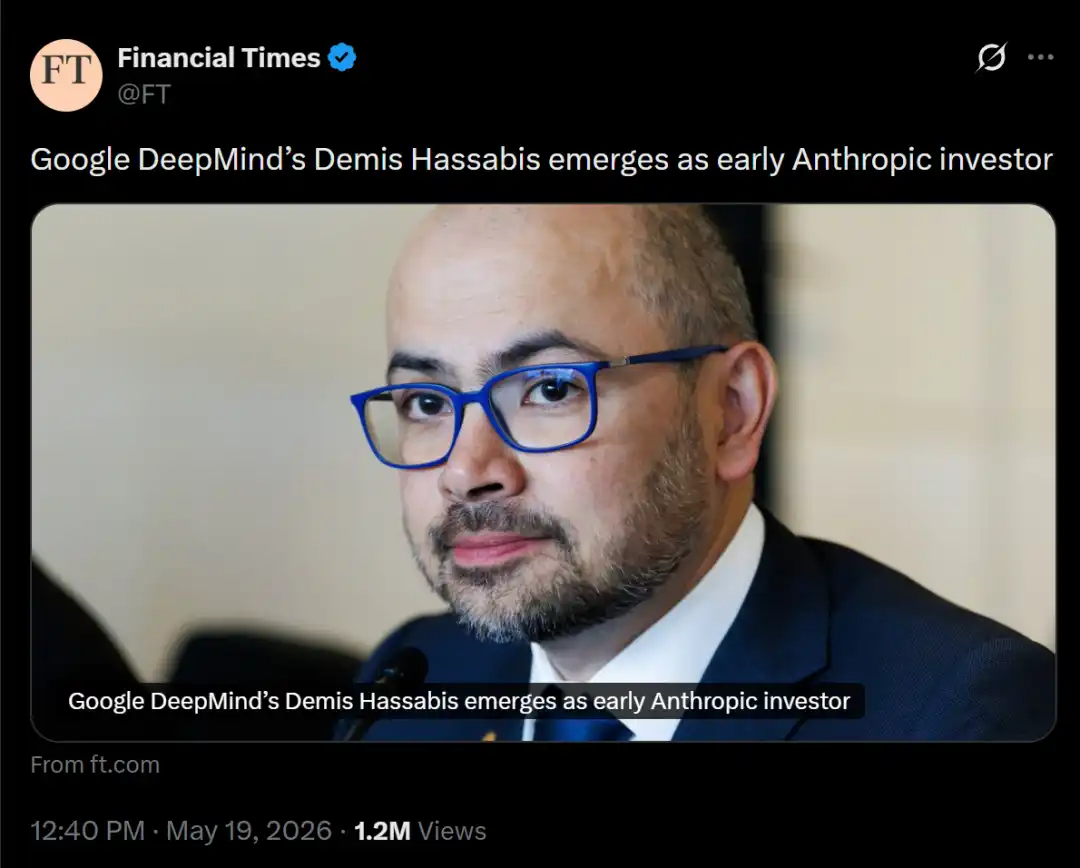
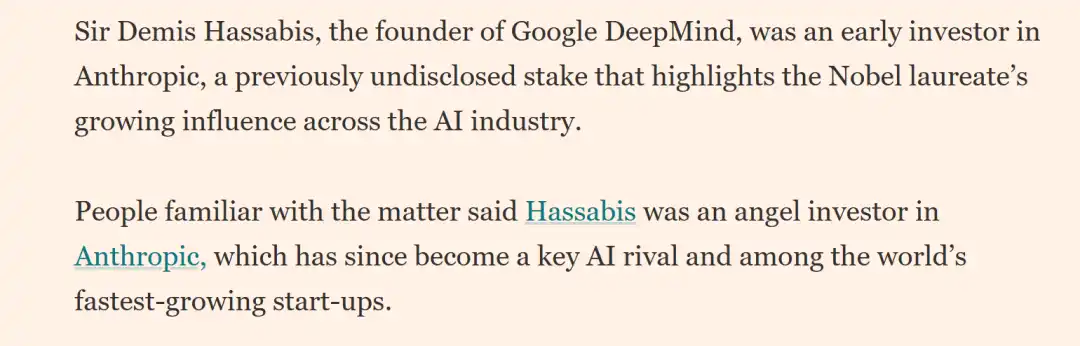
Demis Hassabis, Google AI's top leader, DeepMind founder, and Nobel laureate, was reportedly revealed to be an early, secret financial backer of its biggest rival, the super-unicorn Anthropic!
This meticulously planned infiltration is utterly shocking.

Even more unexpected is that following this clue has unearthed a vast 'DeepMind Mafia' empire, intricately woven and with deeply intertwined interests, personally orchestrated by Hassabis.

From Anthropic, valued at a staggering $900 billion, to Inflection AI which secured massive Microsoft investment, to Ineffable Intelligence which recently landed over $3 billion in funding... the leading figures or early backers behind the world's hottest, most cash-magnetizing AI startups are all him!

This is perhaps the most brilliant "Trojan Horse" in tech history—this "Godfather of AI" has quietly taken control of the discourse power in the global AI ecosystem right under our noses.
The Ultimate "Infiltration": Google AI Boss is a Major Shareholder in Its Rival?

In the current large model battlefield, Google's Gemini and Anthropic's Claude are locked in intense competition.

To outmaneuver their opponent, the two companies are engaged in a pixel-perfect arms race every day.

Yet, who would have thought that while Google employees work overtime to benchmark against Claude, their top boss had quietly bought shares in this "rival" company back when Anthropic was first founded.

According to the latest revelations by the Financial Times, Hassabis secretly invested in Anthropic as a personal angel investor during its early days.

This hidden ownership stake was previously unknown to the public.

The shock level is akin to discovering that during the fierce Cola Wars, the CEO of Coca-Cola was a founding shareholder of PepsiCo.
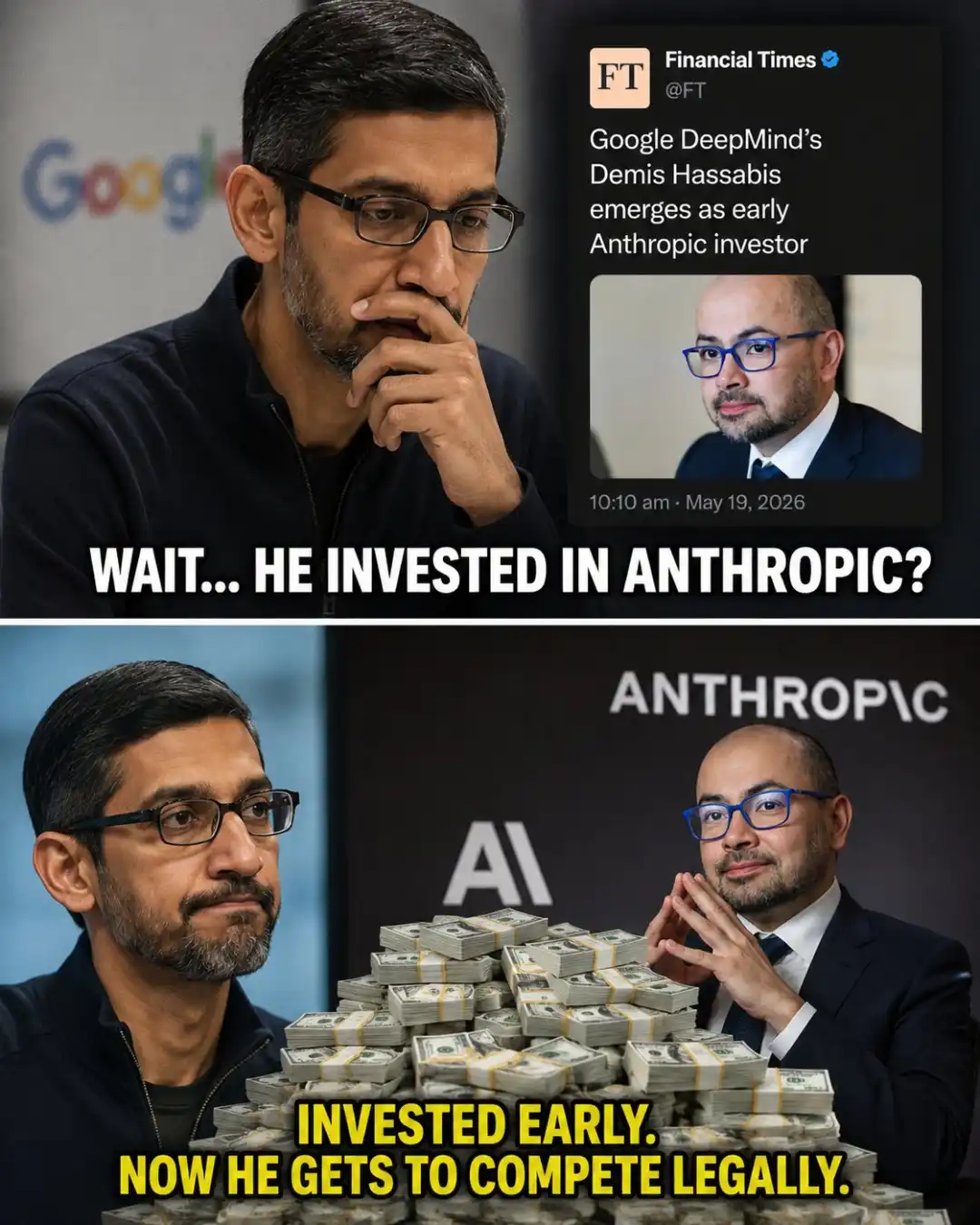
Looking at Anthropic's current monstrous size, you know Hassabis's investment paid off handsomely.

According to insiders, Anthropic's valuation has skyrocketed to an astonishing $900 billion in its latest funding round!

It has not only surpassed its arch-rival OpenAI but has ballooned into the fastest-growing "Leviathan" in global tech history.

Do the math, the assets in Hassabis's hands are now enormous enough to rival nations.

What's even more interesting is that Hassabis's "mothership," Google, later joined the game as well.

Google officially announced a multi-billion dollar investment in Anthropic earlier, establishing a deep cloud and AI partnership.
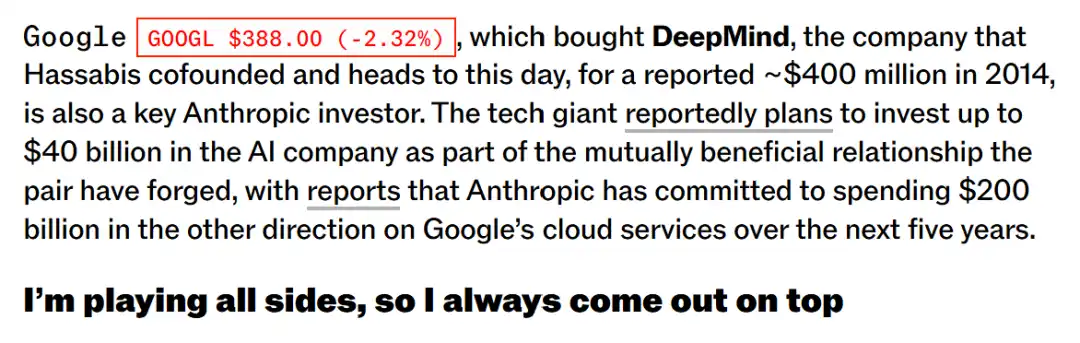
Rumored details of the deal suggest the scale of this "two-way street" is staggering—

Google reportedly plans to invest up to $40 billion in Anthropic; in return, as part of the agreement, Anthropic is said to have committed to spending a whopping $200 billion on Google Cloud services over the next five years!

In his left hand is the Google AI empire he commands; in his right hand is the $900 billion rival he incubated early on; and in between are tens of billions in cloud service contracts.

Hassabis's actions show us, "If I bet on both sides, the only winner in the end can be me."

Dario: He is My Mentor

Digging deeper, things get even more intriguing.

The relationship between the two men goes far beyond mere financial ties.

According to sources close to Anthropic's leadership, Dario Amodei, Anthropic's founder and CEO, privately regards Hassabis as his role model and mentor.

Even though Dario previously held a core executive position at OpenAI, in his heart, Hassabis's DeepMind represents the holy grail of modern AI engineering.

In Dario's widely circulated personal essay "Machines of Loving Grace," although he doesn't name names directly, the reverence and admiration for a certain "AI pioneer" between the lines is unmistakable to anyone reading.

Anyone with insight can tell—he's talking about Hassabis.

The "Couch Moment" at the World Economic Forum

This relationship of friendly rivalry and mutual admiration was immortalized in a famous moment at the 2025 World Economic Forum.

At the time, as leaders of two industry giants, Hassabis and Dario, during an interview, were squeezed onto a narrow two-seater sofa by event staff.

The two AI titans, worth billions and shaping humanity's future, sat shoulder to shoulder, pressed tightly together due to the cramped space.

According to eyewitnesses, the scene was described like this: "It was a textbook example of tech world bromance. Two public rivals, squeezed together on camera, their eyes holding not animosity, but instead a sense of mutual understanding and amusement shared by peers at the top."

This personal closeness, transcending corporate boundaries, not only softens the coldness of business warfare but also reveals that on the highest throne of AI, they are fellow travelers on the same path.

The "DeepMind Mafia" on a Rampage: Former Employees Raised $14 Billion in Four Years!

Hassabis's ambition is far from limited to just Anthropic.

In Silicon Valley, there was once the famous "PayPal Mafia." This entrepreneurial clique, consisting of Elon Musk, Peter Thiel, Reid Hoffman, and others, nearly dominated the early Web 2.0 era.

Today, a more massive and potentially more disruptive "DeepMind Mafia" is rapidly expanding, with dual centers in London and Silicon Valley.
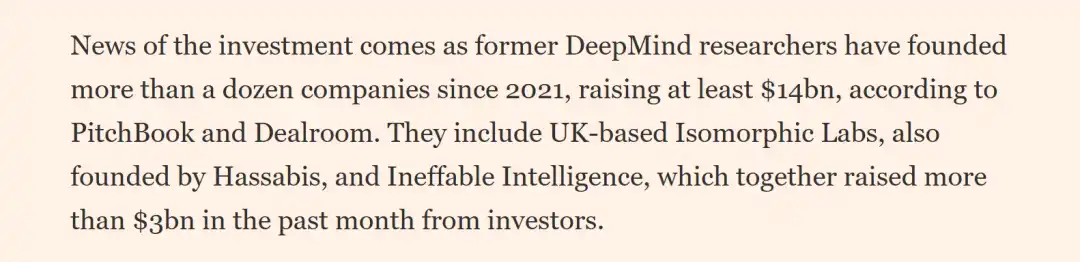
According to the latest statistics from the international authoritative startup databases PitchBook and Dealroom: Since 2021, core technical leads and executives who left DeepMind have gone on to found over 12 super AI startups.

Within just four years, this faction has cumulatively and frenziedly secured over $14 billion in funding from the market!

This scale is enough to make any venture capital firm tremble.

Let's look at this empire map composed of Hassabis and his disciples—

Core Members of the "DeepMind Mafia"
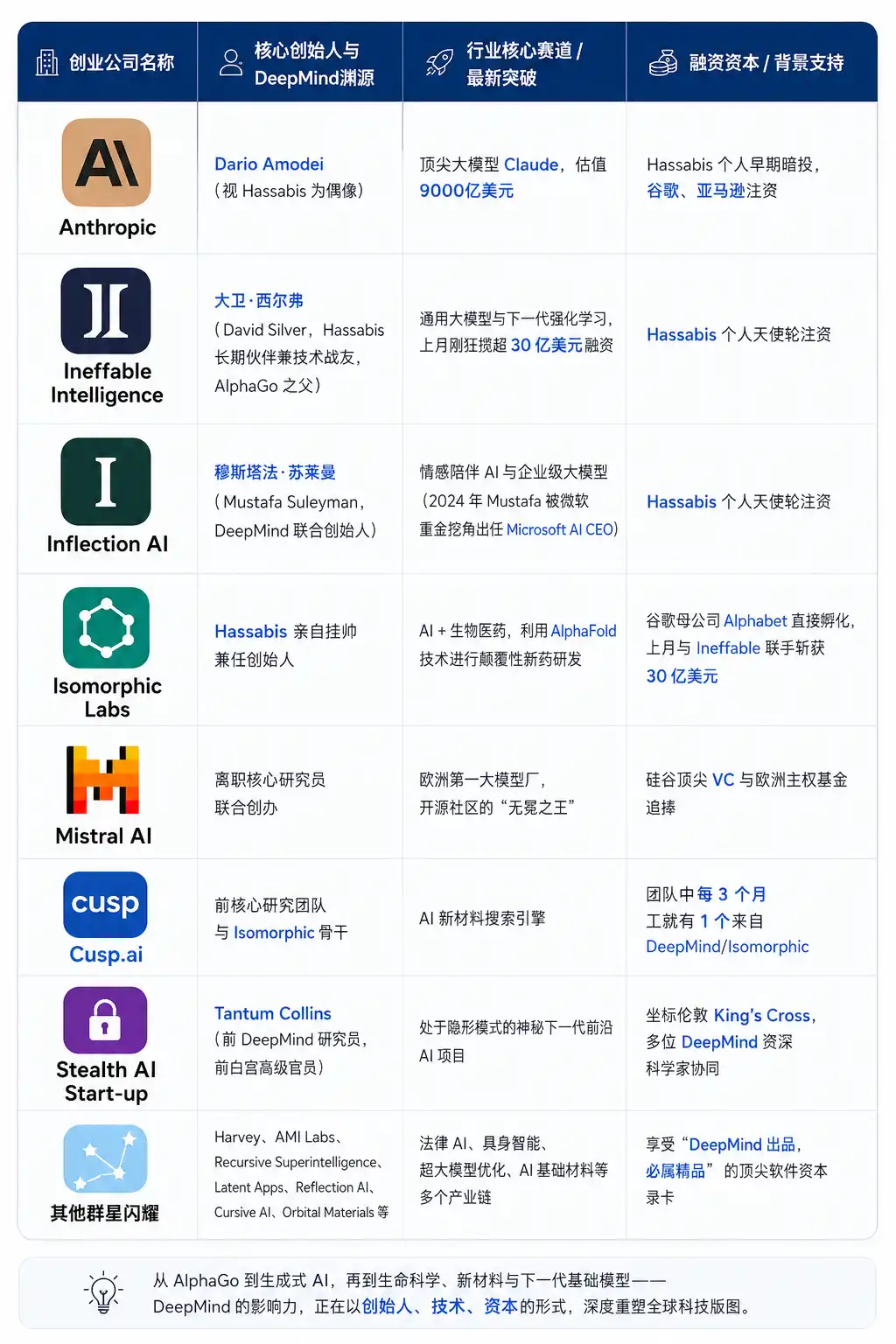
This list is still growing rapidly.

A seasoned Silicon Valley investor put it this way: "Nowadays, in the AI startup scene, if your resume says 'Former Senior Researcher at DeepMind,' you don't even need to finish your pitch deck—the checks are already on the table."

The Hidden Capital Web: Revealing the Harsh Truth Behind the Giants' 'Bloody War'

The most terrifying aspect of Hassabis's capital puzzle is its comprehensiveness and covertness.

As a billionaire who sold DeepMind to Google for £400 million in 2014, Hassabis holds vast cash reserves.

But instead of spending it on yachts or mansions like the typical wealthy, he turned this money into numerous precise capital tentacles, quietly reaching into the entrepreneurial ventures of former colleagues and subordinates.

David Silver wants to work on general AI, Hassabis invests.

Mustafa Suleyman leaves to start Inflection AI, Hassabis invests.

He is even a core angel investor in the famous startup incubator Entrepreneurs First (EF).

This kind of capital deployment completely tears open the harsh truth of modern tech giant competition—

Under the spotlight, the giants fight fiercely over market share, for financial reports and stock prices, engaging in bloody PR wars and patent battles.

But behind the curtain, the top AI elites are deeply bound together through a hidden network woven from personal capital, mentor-discipleship, and former colleague relationships.
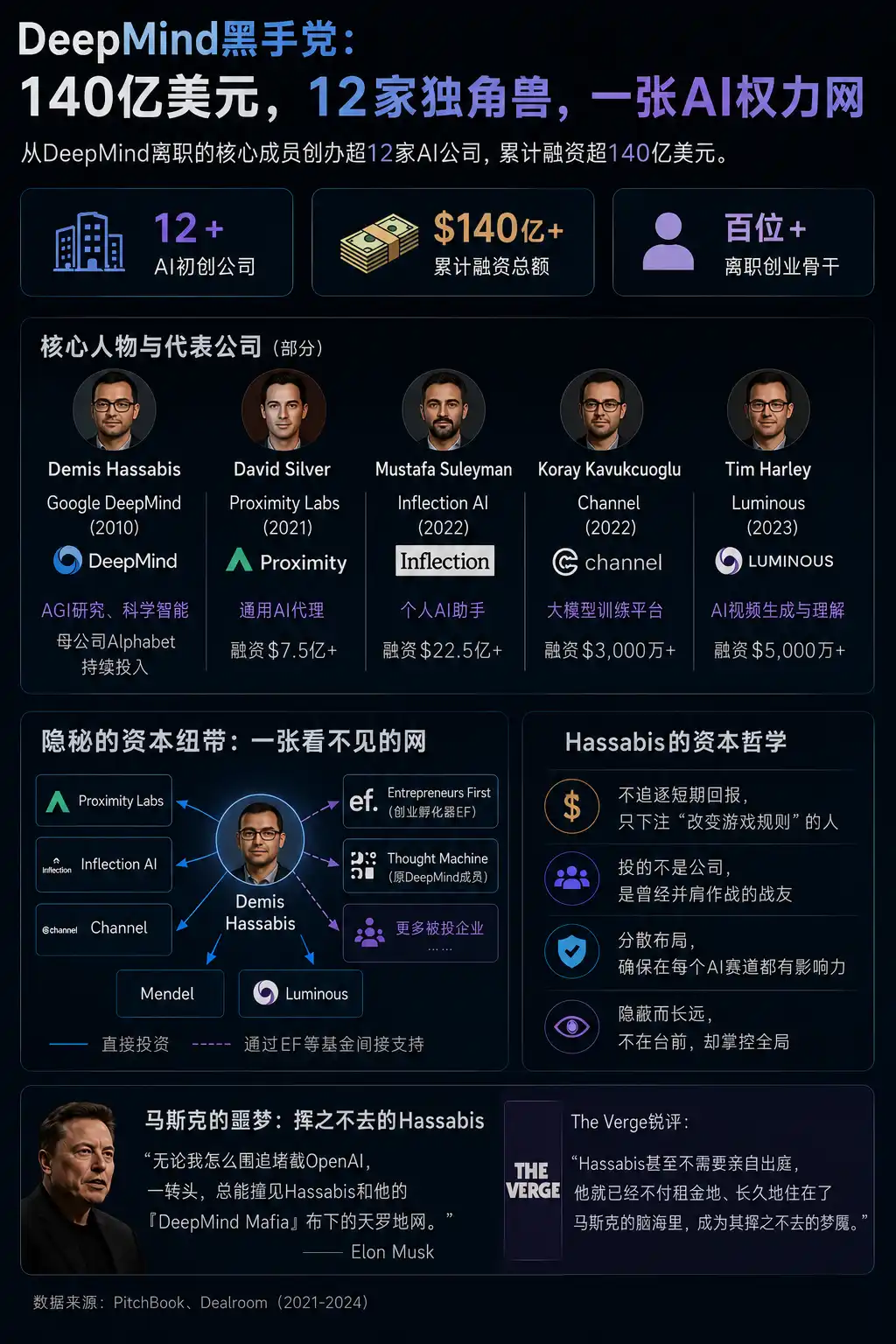
This phenomenon has even caused the maverick Elon Musk anxiety and anger.

In the high-profile, ongoing "Musk vs. Altman" lawsuit, court documents and testimonies show that Hassabis's name appears with high frequency in Musk's legal filings.

The Verge sharply commented: "Hassabis doesn't even need to show up in court; he already resides rent-free, permanently, in Musk's mind, becoming Musk's haunting nightmare.

Because Musk has discovered that no matter how he tries to corner OpenAI, whenever he turns around, he always runs into the intricate net laid by Hassabis and his 'DeepMind Mafia.'"

Pulling the Strings from Within: DeepMind Takes Over Google Completely

If aggressively deploying capital externally and nurturing external armies represents Hassabis's external strategy; then centralizing power and pulling strings from behind the scenes within Google is his internal mastery.

While exporting capital outward, DeepMind's senior executives are taking over the core power of the entire Google tech empire at an astonishing pace.

2023: The Unification of Google AI

Looking back to 2023, when OpenAI unleashed ChatGPT and caught Google off guard, causing its stock price to plummet, Alphabet made a historic decision: forcibly merging Google's once-proud Google Brain with DeepMind to form the new Google DeepMind, placed under Hassabis's unified command.

On the surface, this merger was a combination of strengths; in reality, it was a full-scale takeover of Google's core R&D force by DeepMind.

Hassabis declared at the time: "We need to simplify decision-making with greater speed, stronger collaboration, and execution to focus on achieving maximum impact."

Translation: I'm in charge of the AI business here.

Core Lieutenants, Ascending to Power

Within just two years, DeepMind's trusted inner circle has completely taken over and occupied the core decision-making layers of Google's AI and cloud services.

Koray Kavukcuoglu, DeepMind's former CTO, was officially promoted last year to Google's Chief AI Architect.

This means the underlying architecture of all future Google AI products bears the DeepMind stamp.

Pushmeet Kohli, who led the Nobel Prize-winning scientific marvel AlphaFold project, was formally appointed last month as Google Cloud's Chief Scientist. Thus, the technical brain behind Google's most profitable cloud business is also now a DeepMind confidant.

The "Power Behind the Throne" in London

Most remarkably, even though DeepMind has thoroughly completed its reverse takeover of Google's AI empire, Hassabis, wielding immense power, stubbornly keeps his headquarters in London's King's Cross district, refusing to relocate to Silicon Valley's Mountain View.

To accommodate this true power, Google even spent $1 billion building a grand new headquarters building in London's King's Cross.

"Demis possesses terrifying, incalculable soft power both within Google and across the entire tech industry," remarked Matt Clifford, a long-time friend of Hassabis and co-founder of EF.

"He was a pioneer long before anyone else figured out what AI was. A large part of the reason the younger generation of founders can raise such massive amounts of money is because they carry Demis's spiritual endorsement. Whether he's in Silicon Valley or London, his influence is growing exponentially."

The Ultimate Gambit of the "Godfather of AI"

As a former child prodigy in chess, now knighted by the British monarchy, Demis Hassabis clearly sees the entire global AI industry as a grand chess game.

In this game, Gemini is his public-facing chariot charging for Google; Anthropic is the hidden piece he placed secretly as a contingency; Ineffable, Inflection, Mistral, and other billion-dollar unicorns are the sharp pawns he has scattered across the board, ready to encircle the market at any moment.

And he himself sits calmly in his King's Cross office, watching capital, talent, and technology circulate perfectly within the web he has woven.

This recent exposure by the media punctures the harshest truth in the tech circle: the so-called great war among giants is nothing but a capital game played by the top elites, moving pieces from left hand to right.

No matter where the tide of technology flows, it never escapes the grasp of those who bought into the wave early.


Related Questions

QWhat was the shocking revelation about Google's AI chief Demis Hassabis reported in the article?

ADemis Hassabis, Google's AI chief and DeepMind founder, was revealed to be an early secret financial backer of Anthropic, Google's major rival in AI.

QAccording to the article, what is the term used to describe the network of former DeepMind employees and their influence in the AI startup scene?

AThe term used is the 'DeepMind Mafia,' referring to the extensive network of former DeepMind employees who have founded and led major AI startups, collectively raising over $14 billion in funding.

QWhat significant corporate restructuring did Google undertake in 2023 in response to competitive pressure, as mentioned in the article?

AIn 2023, Google merged its Google Brain AI research unit with DeepMind to form Google DeepMind, placing it under the unified leadership of Demis Hassabis to streamline AI efforts.

QHow does the article characterize the relationship between Demis Hassabis and Anthropic CEO Dario Amodei?

AThe article characterizes their relationship as one of mutual respect and mentorship, with Dario Amodei privately viewing Hassabis as a role model and spiritual guide, despite their companies being public rivals.

QWhat is the article's perspective on the nature of competition among major AI companies?

AThe article suggests that while AI giants compete fiercely in public, the competition is underpinned by a hidden network of personal capital, mentorship, and former colleague ties among top AI elites, implying a more interconnected and less adversarial reality at the highest levels.

Related Reads

In-Depth Research Report on U.S. Crypto Equity Market in 2026 — Opportunities, Risks, and Portfolio Allocation Framework

Since the U.S. Securities and Exchange Commission (SEC) historically approved spot Bitcoin ETFs in January 2024, the U.S. crypto investment landscape has undergone a profound maturation process. In 2026, investors can participate in the crypto market through four primary channels: spot ETFs, crypto-related public equities (including miners and treasury companies), leveraged and inverse ETFs, and blockchain-themed funds. As of March 30, 2026, U.S. spot Bitcoin ETFs collectively held approximately 1.29 million BTC, representing roughly $86.9 billion in assets under management (AUM), while spot Ethereum ETFs reached approximately $18 billion in AUM. Notably, the rise of the Ethereum treasury company model is reshaping the logic of institutional participation. Exemplified by Bitmine Immersion Technologies (BMNR), these firms generate native on-chain yield annually through ETH staking, creating a fundamentally different business resilience model compared with traditional Bitcoin treasury companies. On the regulatory front, the 2025 GENIUS Act established the first federal stablecoin framework in the United States. The U.S. Strategic Bitcoin Reserve has been officially established, banks have been authorized to provide crypto custody services, and major compliance bottlenecks have been definitively removed. Nevertheless, the high volatility of leveraged ETFs, the balance-sheet risks embedded in treasury-company financing structures, and the slashing risk of staked assets continue to pose investment obstacles that cannot be overlooked. For investors seeking exposure to this sector, building a tiered portfolio comprising core holdings, sector beta exposure, and high-risk tactical position may be the most viable path of participation.

HTX Learn10m ago

In-Depth Research Report on U.S. Crypto Equity Market in 2026  — Opportunities, Risks, and Portfolio Allocation Framework

HTX Learn10m ago

Viewpoint: After Surviving the Death Cycle, Why Has Privacy Pioneer Zcash Returned to the Mainstream Spotlight?

Zcash, the pioneering privacy-focused cryptocurrency built with zero-knowledge proof (ZK) technology, is re-emerging as a major narrative. Having survived a "death cycle" and proven its resilient community, Zcash is now positioned at a unique convergence of factors driving renewed institutional and retail interest. Key catalysts include the increasing institutionalization of crypto (e.g., BlackRock's ETF), which creates a "Trojan horse" for privacy adoption through Zcash's transparent mode. The rise of AI-powered on-chain surveillance makes financial privacy a critical necessity, not just for niche users but for mainstream wealth preservation against overreach. ZK technology has finally matured to enable practical, user-friendly private transactions, a core advantage over older "obfuscation" methods like Monero's ring signatures. Zcash’s narrative as "private Bitcoin"—a fork with the same 2100M cap and PoW—is simple and powerful. It competes in the store-of-value arena, offering cryptographic privacy as a fundamental human right. Its development roadmap is robust, featuring a soon-to-be-complete quantum resistance upgrade for its shielded pool, faster block times, and improved wallet support (e.g., from Ledger). With backing from major funds and a growing developer ecosystem, Zcash is seen as leading the crucial reintegration of privacy into the crypto landscape, fulfilling the original cypherpunk vision.

marsbit18m ago

Viewpoint: After Surviving the Death Cycle, Why Has Privacy Pioneer Zcash Returned to the Mainstream Spotlight?

marsbit18m ago

Conversation with Glassnode Analyst: Bitcoin Bull Market Has Restarted, Current Market Still in 'Sell on Rally' Phase

Bitcoin analyst Checkmate believes the cryptocurrency market is now in a bull phase following a likely capitulation event in June, with an 80% probability the $60,000 low marked the bottom. However, he expects a prolonged consolidation period, similar to past cycles. Key resistance levels are identified at $78,000 (short-term cost basis), $85,000 (a critical supply zone and 200-day moving average), and $95,000. Sustained price appreciation requires consistent capital inflows, with institutions expected to enter more aggressively if Bitcoin surpasses $100,000. The discussion extends to macroeconomics, where rising global bond yields signal a loss of trust in government fiscal management. Checkmate argues this reflects a broader monetary regime change, where Bitcoin and gold will serve as primary stores of value outside the traditional system, while fiat currencies like the USD act as mediums of exchange. Finally, Checkmate criticizes proposed Australian capital gains tax reforms, calling them a "wealth grab." The plan to replace a 50% discount for assets held over a year with inflation indexing based on low CPI rates would drastically increase effective tax rates, punishing savers and investors trying to overcome the country's severe housing affordability crisis. He urges public opposition to prevent such policies from spreading globally.

marsbit1h ago

Conversation with Glassnode Analyst: Bitcoin Bull Market Has Restarted, Current Market Still in 'Sell on Rally' Phase

marsbit1h ago

Trading

Spot
Futures

Hot Articles

What is SONIC

Sonic: Pioneering the Future of Gaming in Web3 Introduction to Sonic In the ever-evolving landscape of Web3, the gaming industry stands out as one of the most dynamic and promising sectors. At the forefront of this revolution is Sonic, a project designed to amplify the gaming ecosystem on the Solana blockchain. Leveraging cutting-edge technology, Sonic aims to deliver an unparalleled gaming experience by efficiently processing millions of requests per second, ensuring that players enjoy seamless gameplay while maintaining low transaction costs. This article delves into the intricate details of Sonic, exploring its creators, funding sources, operational mechanics, and the timeline of significant events that have shaped its journey. What is Sonic? Sonic is an innovative layer-2 network that operates atop the Solana blockchain, specifically tailored to enhance the existing Solana gaming ecosystem. It accomplishes this through a customised, VM-agnostic game engine paired with a HyperGrid interpreter, facilitating sovereign game economies that roll up back to the Solana platform. The primary goals of Sonic include: Enhanced Gaming Experiences: Sonic is committed to offering lightning-fast on-chain gameplay, allowing players and developers to engage with games at previously unattainable speeds. Atomic Interoperability: This feature enables transactions to be executed within Sonic without the need to redeploy Solana programmes and accounts. This makes the process more efficient and directly benefits from Solana Layer1 services and liquidity. Seamless Deployment: Sonic allows developers to write for Ethereum Virtual Machine (EVM) based systems and execute them on Solana’s SVM infrastructure. This interoperability is crucial for attracting a broader range of dApps and decentralised applications to the platform. Support for Developers: By offering native composable gaming primitives and extensible data types - dining within the Entity-Component-System (ECS) framework - game creators can craft intricate business logic with ease. Overall, Sonic's unique approach not only caters to players but also provides an accessible and low-cost environment for developers to innovate and thrive. Creator of Sonic The information regarding the creator of Sonic is somewhat ambiguous. However, it is known that Sonic's SVM is owned by the company Mirror World. The absence of detailed information about the individuals behind Sonic reflects a common trend in several Web3 projects, where collective efforts and partnerships often overshadow individual contributions. Investors of Sonic Sonic has garnered considerable attention and support from various investors within the crypto and gaming sectors. Notably, the project raised an impressive $12 million during its Series A funding round. The round was led by BITKRAFT Ventures, with other notable investors including Galaxy, Okx Ventures, Interactive, Big Brain Holdings, and Mirana. This financial backing signifies the confidence that investment foundations have in Sonic’s potential to revolutionise the Web3 gaming landscape, further validating its innovative approaches and technologies. How Does Sonic Work? Sonic utilises the HyperGrid framework, a sophisticated parallel processing mechanism that enhances its scalability and customisability. Here are the core features that set Sonic apart: Lightning Speed at Low Costs: Sonic offers one of the fastest on-chain gaming experiences compared to other Layer-1 solutions, powered by the scalability of Solana’s virtual machine (SVM). Atomic Interoperability: Sonic enables transaction execution without redeployment of Solana programmes and accounts, effectively streamlining the interaction between users and the blockchain. EVM Compatibility: Developers can effortlessly migrate decentralised applications from EVM chains to the Solana environment using Sonic’s HyperGrid interpreter, increasing the accessibility and integration of various dApps. Ecosystem Support for Developers: By exposing native composable gaming primitives, Sonic facilitates a sandbox-like environment where developers can experiment and implement business logic, greatly enhancing the overall development experience. Monetisation Infrastructure: Sonic natively supports growth and monetisation efforts, providing frameworks for traffic generation, payments, and settlements, thereby ensuring that gaming projects are not only viable but also sustainable financially. Timeline of Sonic The evolution of Sonic has been marked by several key milestones. Below is a brief timeline highlighting critical events in the project's history: 2022: The Sonic cryptocurrency was officially launched, marking the beginning of its journey in the Web3 gaming arena. 2024: June: Sonic SVM successfully raised $12 million in a Series A funding round. This investment allowed Sonic to further develop its platform and expand its offerings. August: The launch of the Sonic Odyssey testnet provided users with the first opportunity to engage with the platform, offering interactive activities such as collecting rings—a nod to gaming nostalgia. October: SonicX, an innovative crypto game integrated with Solana, made its debut on TikTok, capturing the attention of over 120,000 users within a short span. This integration illustrated Sonic’s commitment to reaching a broader, global audience and showcased the potential of blockchain gaming. Key Points Sonic SVM is a revolutionary layer-2 network on Solana explicitly designed to enhance the GameFi landscape, demonstrating great potential for future development. HyperGrid Framework empowers Sonic by introducing horizontal scaling capabilities, ensuring that the network can handle the demands of Web3 gaming. Integration with Social Platforms: The successful launch of SonicX on TikTok displays Sonic’s strategy to leverage social media platforms to engage users, exponentially increasing the exposure and reach of its projects. Investment Confidence: The substantial funding from BITKRAFT Ventures, among others, emphasizes the robust backing Sonic has, paving the way for its ambitious future. In conclusion, Sonic encapsulates the essence of Web3 gaming innovation, striking a balance between cutting-edge technology, developer-centric tools, and community engagement. As the project continues to evolve, it is poised to redefine the gaming landscape, making it a notable entity for gamers and developers alike. As Sonic moves forward, it will undoubtedly attract greater interest and participation, solidifying its place within the broader narrative of blockchain gaming.

1.4k Total ViewsPublished 2024.04.04Updated 2024.12.03

What is SONIC

What is $S$

Understanding SPERO: A Comprehensive Overview Introduction to SPERO As the landscape of innovation continues to evolve, the emergence of web3 technologies and cryptocurrency projects plays a pivotal role in shaping the digital future. One project that has garnered attention in this dynamic field is SPERO, denoted as SPERO,$$s$. This article aims to gather and present detailed information about SPERO, to help enthusiasts and investors understand its foundations, objectives, and innovations within the web3 and crypto domains. What is SPERO,$$s$? SPERO,$$s$ is a unique project within the crypto space that seeks to leverage the principles of decentralisation and blockchain technology to create an ecosystem that promotes engagement, utility, and financial inclusion. The project is tailored to facilitate peer-to-peer interactions in new ways, providing users with innovative financial solutions and services. At its core, SPERO,$$s$ aims to empower individuals by providing tools and platforms that enhance user experience in the cryptocurrency space. This includes enabling more flexible transaction methods, fostering community-driven initiatives, and creating pathways for financial opportunities through decentralised applications (dApps). The underlying vision of SPERO,$$s$ revolves around inclusiveness, aiming to bridge gaps within traditional finance while harnessing the benefits of blockchain technology. Who is the Creator of SPERO,$$s$? The identity of the creator of SPERO,$$s$ remains somewhat obscure, as there are limited publicly available resources providing detailed background information on its founder(s). This lack of transparency can stem from the project's commitment to decentralisation—an ethos that many web3 projects share, prioritising collective contributions over individual recognition. By centring discussions around the community and its collective goals, SPERO,$$s$ embodies the essence of empowerment without singling out specific individuals. As such, understanding the ethos and mission of SPERO remains more important than identifying a singular creator. Who are the Investors of SPERO,$$s$? SPERO,$$s$ is supported by a diverse array of investors ranging from venture capitalists to angel investors dedicated to fostering innovation in the crypto sector. The focus of these investors generally aligns with SPERO's mission—prioritising projects that promise societal technological advancement, financial inclusivity, and decentralised governance. These investor foundations are typically interested in projects that not only offer innovative products but also contribute positively to the blockchain community and its ecosystems. The backing from these investors reinforces SPERO,$$s$ as a noteworthy contender in the rapidly evolving domain of crypto projects. How Does SPERO,$$s$ Work? SPERO,$$s$ employs a multi-faceted framework that distinguishes it from conventional cryptocurrency projects. Here are some of the key features that underline its uniqueness and innovation: Decentralised Governance: SPERO,$$s$ integrates decentralised governance models, empowering users to participate actively in decision-making processes regarding the project’s future. This approach fosters a sense of ownership and accountability among community members. Token Utility: SPERO,$$s$ utilises its own cryptocurrency token, designed to serve various functions within the ecosystem. These tokens enable transactions, rewards, and the facilitation of services offered on the platform, enhancing overall engagement and utility. Layered Architecture: The technical architecture of SPERO,$$s$ supports modularity and scalability, allowing for seamless integration of additional features and applications as the project evolves. This adaptability is paramount for sustaining relevance in the ever-changing crypto landscape. Community Engagement: The project emphasises community-driven initiatives, employing mechanisms that incentivise collaboration and feedback. By nurturing a strong community, SPERO,$$s$ can better address user needs and adapt to market trends. Focus on Inclusion: By offering low transaction fees and user-friendly interfaces, SPERO,$$s$ aims to attract a diverse user base, including individuals who may not previously have engaged in the crypto space. This commitment to inclusion aligns with its overarching mission of empowerment through accessibility. Timeline of SPERO,$$s$ Understanding a project's history provides crucial insights into its development trajectory and milestones. Below is a suggested timeline mapping significant events in the evolution of SPERO,$$s$: Conceptualisation and Ideation Phase: The initial ideas forming the basis of SPERO,$$s$ were conceived, aligning closely with the principles of decentralisation and community focus within the blockchain industry. Launch of Project Whitepaper: Following the conceptual phase, a comprehensive whitepaper detailing the vision, goals, and technological infrastructure of SPERO,$$s$ was released to garner community interest and feedback. Community Building and Early Engagements: Active outreach efforts were made to build a community of early adopters and potential investors, facilitating discussions around the project’s goals and garnering support. Token Generation Event: SPERO,$$s$ conducted a token generation event (TGE) to distribute its native tokens to early supporters and establish initial liquidity within the ecosystem. Launch of Initial dApp: The first decentralised application (dApp) associated with SPERO,$$s$ went live, allowing users to engage with the platform's core functionalities. Ongoing Development and Partnerships: Continuous updates and enhancements to the project's offerings, including strategic partnerships with other players in the blockchain space, have shaped SPERO,$$s$ into a competitive and evolving player in the crypto market. Conclusion SPERO,$$s$ stands as a testament to the potential of web3 and cryptocurrency to revolutionise financial systems and empower individuals. With a commitment to decentralised governance, community engagement, and innovatively designed functionalities, it paves the way toward a more inclusive financial landscape. As with any investment in the rapidly evolving crypto space, potential investors and users are encouraged to research thoroughly and engage thoughtfully with the ongoing developments within SPERO,$$s$. The project showcases the innovative spirit of the crypto industry, inviting further exploration into its myriad possibilities. While the journey of SPERO,$$s$ is still unfolding, its foundational principles may indeed influence the future of how we interact with technology, finance, and each other in interconnected digital ecosystems.

54 Total ViewsPublished 2024.12.17Updated 2024.12.17

What is $S$

What is AGENT S

Agent S: The Future of Autonomous Interaction in Web3 Introduction In the ever-evolving landscape of Web3 and cryptocurrency, innovations are constantly redefining how individuals interact with digital platforms. One such pioneering project, Agent S, promises to revolutionise human-computer interaction through its open agentic framework. By paving the way for autonomous interactions, Agent S aims to simplify complex tasks, offering transformative applications in artificial intelligence (AI). This detailed exploration will delve into the project's intricacies, its unique features, and the implications for the cryptocurrency domain. What is Agent S? Agent S stands as a groundbreaking open agentic framework, specifically designed to tackle three fundamental challenges in the automation of computer tasks: Acquiring Domain-Specific Knowledge: The framework intelligently learns from various external knowledge sources and internal experiences. This dual approach empowers it to build a rich repository of domain-specific knowledge, enhancing its performance in task execution. Planning Over Long Task Horizons: Agent S employs experience-augmented hierarchical planning, a strategic approach that facilitates efficient breakdown and execution of intricate tasks. This feature significantly enhances its ability to manage multiple subtasks efficiently and effectively. Handling Dynamic, Non-Uniform Interfaces: The project introduces the Agent-Computer Interface (ACI), an innovative solution that enhances the interaction between agents and users. Utilizing Multimodal Large Language Models (MLLMs), Agent S can navigate and manipulate diverse graphical user interfaces seamlessly. Through these pioneering features, Agent S provides a robust framework that addresses the complexities involved in automating human interaction with machines, setting the stage for myriad applications in AI and beyond. Who is the Creator of Agent S? While the concept of Agent S is fundamentally innovative, specific information about its creator remains elusive. The creator is currently unknown, which highlights either the nascent stage of the project or the strategic choice to keep founding members under wraps. Regardless of anonymity, the focus remains on the framework's capabilities and potential. Who are the Investors of Agent S? As Agent S is relatively new in the cryptographic ecosystem, detailed information regarding its investors and financial backers is not explicitly documented. The lack of publicly available insights into the investment foundations or organisations supporting the project raises questions about its funding structure and development roadmap. Understanding the backing is crucial for gauging the project's sustainability and potential market impact. How Does Agent S Work? At the core of Agent S lies cutting-edge technology that enables it to function effectively in diverse settings. Its operational model is built around several key features: Human-like Computer Interaction: The framework offers advanced AI planning, striving to make interactions with computers more intuitive. By mimicking human behaviour in tasks execution, it promises to elevate user experiences. Narrative Memory: Employed to leverage high-level experiences, Agent S utilises narrative memory to keep track of task histories, thereby enhancing its decision-making processes. Episodic Memory: This feature provides users with step-by-step guidance, allowing the framework to offer contextual support as tasks unfold. Support for OpenACI: With the ability to run locally, Agent S allows users to maintain control over their interactions and workflows, aligning with the decentralised ethos of Web3. Easy Integration with External APIs: Its versatility and compatibility with various AI platforms ensure that Agent S can fit seamlessly into existing technological ecosystems, making it an appealing choice for developers and organisations. These functionalities collectively contribute to Agent S's unique position within the crypto space, as it automates complex, multi-step tasks with minimal human intervention. As the project evolves, its potential applications in Web3 could redefine how digital interactions unfold. Timeline of Agent S The development and milestones of Agent S can be encapsulated in a timeline that highlights its significant events: September 27, 2024: The concept of Agent S was launched in a comprehensive research paper titled “An Open Agentic Framework that Uses Computers Like a Human,” showcasing the groundwork for the project. October 10, 2024: The research paper was made publicly available on arXiv, offering an in-depth exploration of the framework and its performance evaluation based on the OSWorld benchmark. October 12, 2024: A video presentation was released, providing a visual insight into the capabilities and features of Agent S, further engaging potential users and investors. These markers in the timeline not only illustrate the progress of Agent S but also indicate its commitment to transparency and community engagement. Key Points About Agent S As the Agent S framework continues to evolve, several key attributes stand out, underscoring its innovative nature and potential: Innovative Framework: Designed to provide an intuitive use of computers akin to human interaction, Agent S brings a novel approach to task automation. Autonomous Interaction: The ability to interact autonomously with computers through GUI signifies a leap towards more intelligent and efficient computing solutions. Complex Task Automation: With its robust methodology, it can automate complex, multi-step tasks, making processes faster and less error-prone. Continuous Improvement: The learning mechanisms enable Agent S to improve from past experiences, continually enhancing its performance and efficacy. Versatility: Its adaptability across different operating environments like OSWorld and WindowsAgentArena ensures that it can serve a broad range of applications. As Agent S positions itself in the Web3 and crypto landscape, its potential to enhance interaction capabilities and automate processes signifies a significant advancement in AI technologies. Through its innovative framework, Agent S exemplifies the future of digital interactions, promising a more seamless and efficient experience for users across various industries. Conclusion Agent S represents a bold leap forward in the marriage of AI and Web3, with the capacity to redefine how we interact with technology. While still in its early stages, the possibilities for its application are vast and compelling. Through its comprehensive framework addressing critical challenges, Agent S aims to bring autonomous interactions to the forefront of the digital experience. As we move deeper into the realms of cryptocurrency and decentralisation, projects like Agent S will undoubtedly play a crucial role in shaping the future of technology and human-computer collaboration.

682 Total ViewsPublished 2025.01.14Updated 2025.01.14

What is AGENT S

Discussions

Welcome to the HTX Community. Here, you can stay informed about the latest platform developments and gain access to professional market insights. Users' opinions on the price of S (S) are presented below.

活动图片