From Hot Storage to Cold Memory: Decentralized Storage in the AI Era's Storage Boom

marsbitPublished on 2026-07-27Last updated on 2026-07-27

Abstract

"From Hot Storage to Cold Memory: Decentralized Storage in the Era of AI Storage Boom" This article explores the divergent market trajectories of AI-driven centralized storage and Web3's decentralized storage. It argues that while AI storage is experiencing a massive revaluation focused on "hot data efficiency" — maximizing computational throughput via technologies like HBM, enterprise SSDs, and sophisticated data pipelines — decentralized storage projects like Filecoin and Arweave are currently sidelined. Their core value proposition lies in "cold data trust," prioritizing data integrity, censorship resistance, and long-term archival over raw speed. The piece details the AI storage architecture, emphasizing its role as a "performance engine" critical for feeding GPUs, contrasted with decentralized storage's focus on serving as a permanent, verifiable ledger for humanity's collective memory. It analyzes the challenges decentralized storage faces, including product-market fit, enterprise readiness, and token economic misalignment, but concludes that its fundamental value in preserving provenance, public datasets, and civilizational archives positions it for potential long-term revaluation as issues of data sovereignty, AI auditability, and historical preservation become more acute. The current market rewards efficiency, but the pendulum may eventually swing back towards trust.

Author: Jacob Zhao @ IOSG


Today, "China's first domestic memory stock," Changxin Storage Technology (CXMT), officially debuted on the ChiNext board, igniting the market with a staggering 500% surge. Although the overall storage sector is still experiencing some residual volatility from recent corrections, AI storage continues to be frantically revalued by capital amid the current wave of tech narrative. At the same time, decentralized storage in the Web3 realm has fallen into a prolonged period of silence and despondency. Why do entities both bearing the name "storage" exhibit such a stark contrast in market performance? The fundamental answer lies in a complete divergence of their underlying value functions.

The revaluation of storage in the AI era is essentially a frenzy surrounding "hot data efficiency," serving the ultimate maximization of computing utilization and commercial realization. What decentralized storage adheres to, however, is the value proposition of "cold data trustworthiness," defending data fairness, censorship resistance, and the long-term memory of human civilization. The former is an efficiency system for hot data; the latter is a trustworthiness system for cold data. The current capital market undoubtedly stands firmly on the side of "efficiency," but human civilization ultimately still needs a tamper-proof memory foundation. The long-term value of trustworthy cold storage has never disappeared; it merely lies dormant in the dark side of the cycle, waiting to be repriced by the times.

Why Storage Has Regained Spotlight in the AI Industry Chain

In the traditional IT era, storage was a "capacity business." Enterprise CIOs focused on cost per unit capacity, hard drive reliability, disaster recovery solutions, archival strategies, and equipment refresh cycles spanning 3-5 years. Storage was seen as an accessory accompanying server procurement.

This round of storage fervor is not a traditional cyclical recovery but rather a repricing of data flow capabilities by AI. In the era of large models, the storage logic has qualitatively shifted from "capacity first" to "efficiency supreme," relentlessly pursuing extreme metrics such as GPU feeding rate, Checkpoint write speeds, and ultra-low latency for RAG. This signifies that the value of storage is leaping from "the final parking place for data" to "the high-speed channel for data entry into computation."

The evolution of resource bottlenecks in AI infrastructure is essentially a battle to fill the gaps in the "barrel effect." The real utilization of computing power is not a linear sum of individual assets but a stringent multiplicative effect: Real Compute Utilization = GPU × HBM × DRAM × SSD × Network × File System. A shortfall in any single link can cause overall computing efficiency to collapse. In the AI era, storage has transformed for the first time from a "cost center" to an "efficiency engine." This is the fundamental logic behind storage's repricing.
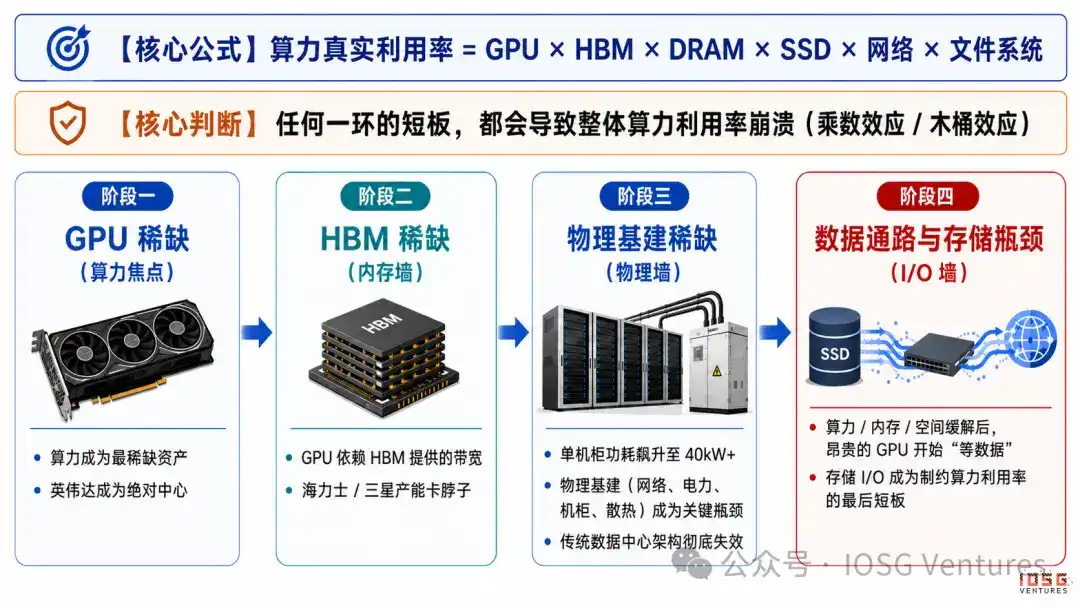
Panorama of AI Storage Architecture: From HBM Bandwidth Organ to Data Lake Foundation

AI storage is by no means a mere pile of individual hardware components; it is a complex, tightly coupled, and hierarchically managed system. Within this system, industrial value and capital focus are highly concentrated on HBM, enterprise SSDs, SSD controllers, NVMe/CXL protocols, and high-performance storage systems. To clearly deconstruct its value flow, we divide the AI storage architecture into four core hierarchical layers:
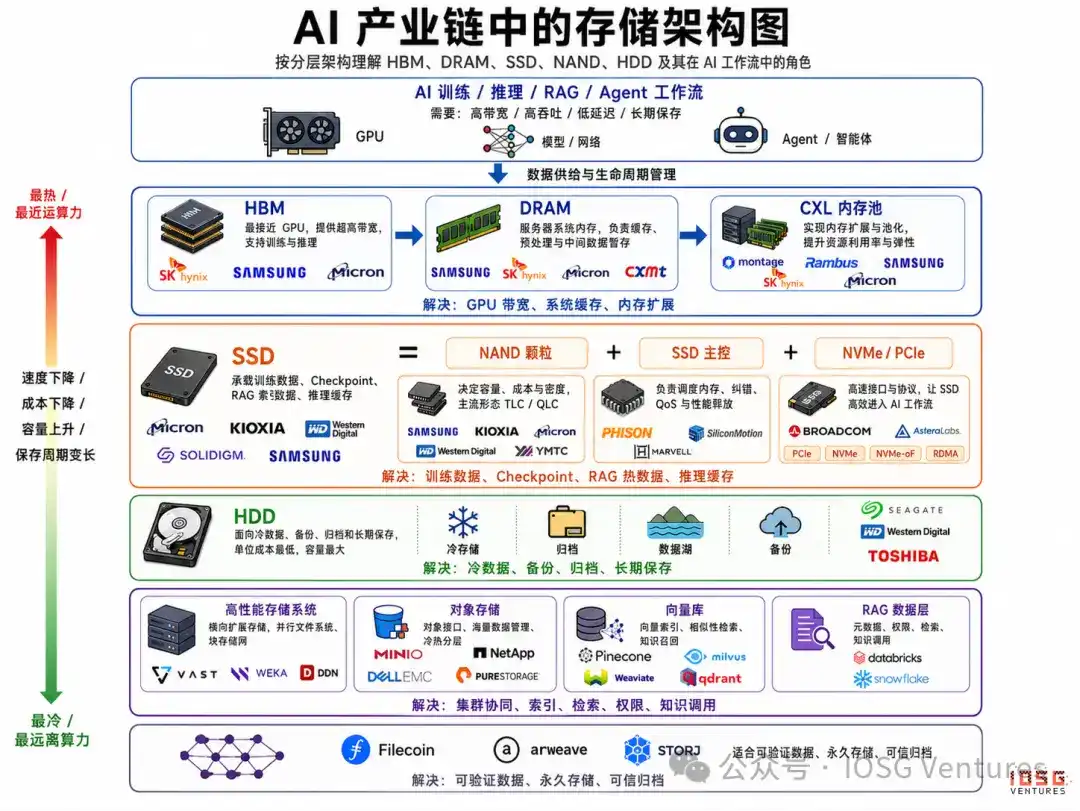
  • Compute-Near Memory Layer (Bandwidth Core): Dominated by HBM, supplemented by DRAM and CXL memory pooling technology. This layer is directly attached to GPU/CPU packaging or the bus, aiming to break the "memory wall." It is the first gate determining whether computing power can be fully unleashed.

  • High-Speed Persistent Storage Layer (I/O Hub): The core logic is Enterprise SSD = NAND Flash + SSD Controller + NVMe/PCIe Data Path. This layer handles high-frequency Checkpoint writes, massive training dataset loading, and RAG hot data caching. It represents the most definitive increment in persistent storage for AI data centers.

  • Low-Cost, High-Capacity Storage Layer (Capacity Base): Consisting of HDDs, cold storage, and data lake archival systems. Faced with the exponential growth of multimodal raw data, historical logs, and compliance backups, this layer still provides irreplaceable TCO (Total Cost of Ownership) advantages.

  • AI Storage Systems & Data Software (Scheduling Brain): Includes high-performance parallel file systems, distributed object storage, vector databases, and RAG data governance layers. What AI truly consumes is not bare hardware, but the data availability efficiently organized, indexed, and secured by the software stack.

As an ecosystem extension, decentralized storage does not directly engage in the millisecond-level race of AI hot data. Instead, it anchors positions like public dataset attestation, AI training data provenance, and long-term cold memory archival, establishing its unique niche as the "trustworthy cold layer."

HBM: The "Bandwidth Organ" Closest to Compute in the AI Storage Chain

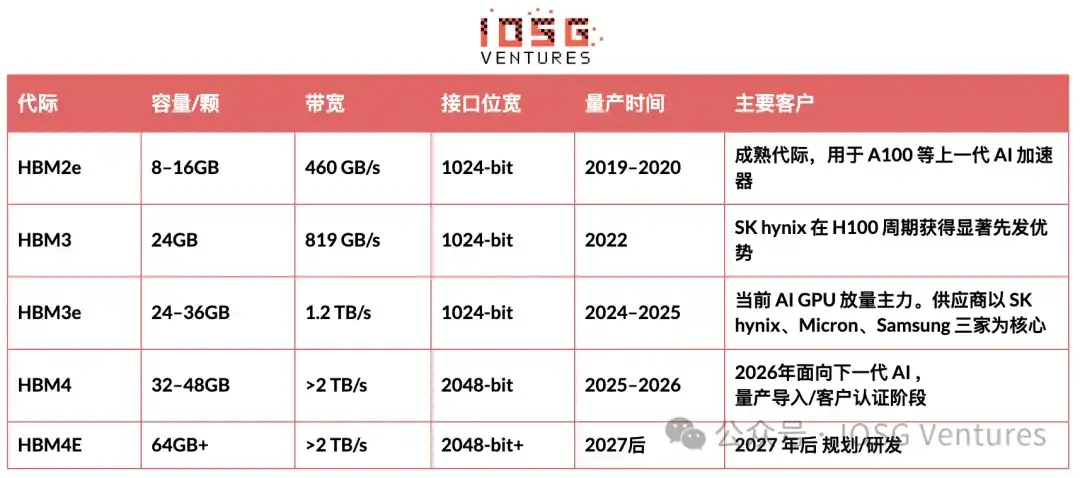
High Bandwidth Memory (HBM) is not traditional storage; it is a high-bandwidth memory layer proximate to the GPU. Its core mission is not to save data, but to continuously "feed" data to the compute units with extremely high bandwidth. HBM is the link in the AI storage chain that is closest to compute, with the highest certainty. It directly determines whether GPUs can be "fed adequately" and is the most critical supply chain bottleneck currently.

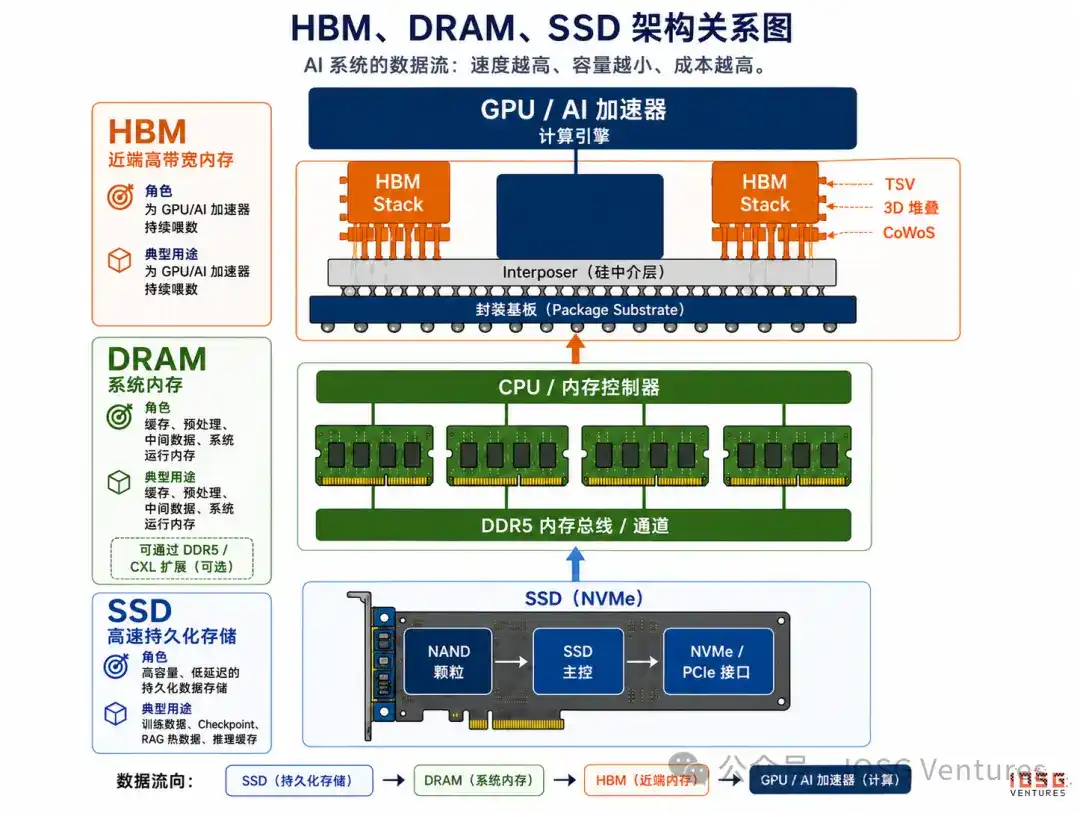
The core architecture of HBM is "3D DRAM stacking + 2.5D advanced packaging": Through TSV vertical stacking and CoWoS heterogeneous integration, the distance between memory and compute is compressed to the extreme, achieving generational leaps in bandwidth. Its industrial barriers encompass not just DRAM design, but a system engineering effort involving DRAM process technology, TSV, ultra-thin stacking, packaging, thermal management, testing, and customer certification. A defect in any single link can cause the entire HBM stack to be scrapped.

Currently, only three giants worldwide can stably mass-produce HBM: SK hynix, Samsung, and Micron, who have built a triple moat of top-tier DRAM process, packaging capabilities, and NVIDIA/AMD customer certifications.
DRAM & CXL: The System Memory Base and Memory Pooling Engine

HBM solves the extreme bandwidth problem near the GPU, DRAM solidifies the server's system memory foundation, while CXL attempts to break physical boundaries and reorganize memory resource allocation within data centers.

  • DRAM: Primarily handles CPU-side caching, data preprocessing, intermediate state storage, and system operation. It is the most fundamental system memory layer in servers. The global DRAM market is highly concentrated among three giants: SK hynix, Samsung, and Micron; Changxin Storage (CXMT) is the core variable in China's domestic DRAM substitution strategy.

  • CXL (Compute Express Link): A new-generation cache-coherent interconnect protocol for data centers, aiming to overcome the limitations of traditional DIMM slots, local memory capacity, and server memory resource silos, driving memory architecture towards expansion, pooling, and sharing. CXL is currently still in its early stages, transitioning from platform support to scaled deployment, but holds significant medium-to-long-term architectural value. Key companies include Astera Labs and Montage Technology.
Enterprise SSD: The Data Hub Built on NAND, Controllers, and NVMe

Enterprise SSDs represent the most critical high-throughput persistent storage increment in AI data centers. They continuously "feed" data to GPUs with extremely high throughput, ultra-low latency, and stable QoS, covering the entire lifecycle including training data loading, Checkpoint writes, RAG retrieval, inference caching, and log streaming.

Within the AI storage architecture, SSDs are not isolated hardware but a highly coupled system, which can be distilled into an industrial formula: Enterprise SSD = NAND Flash + SSD Controller + NVMe/PCIe Data Path. These three layers represent independent industrial chain segments:

  • NAND Flash (Raw Material Layer): Determines storage density and unit cost. Representative companies: Samsung, SK hynix (Solidigm), Micron, Kioxia, Western Digital, Yangtze Memory Technologies (YMTC).

  • SSD Controller (Performance Enablement Layer): Determines performance delivery, data error correction, QoS stability, and wear-leveling. Representative companies: Phison, Silicon Motion, Marvell, Maxio (Rayson).

  • NVMe/PCIe (Data Path Layer): Determines the efficiency of data transfer from storage to compute. Combined with technologies like GPUDirect Storage, it reduces CPU memory bounce buffers and CPU involvement, significantly alleviating I/O bottlenecks. Representative companies: Broadcom, Marvell, Astera Labs.

HDD / Cold Storage / Archival: The Low-Cost Base for AI Data Lakes

AI will not eliminate HDDs. With multimodal large models' voracious appetite for video and image data, and the exponential growth of enterprise compliance logs and historical datasets, demand for low-cost cold data storage is simultaneously exploding. In AI storage architecture, SSDs and HDDs collaborate based on a tiered business value approach: SSDs handle hot data and high throughput, while HDDs handle low cost and long-term preservation. Representative companies include Seagate, Western Digital, and Toshiba.

AI Storage Software Stack: The Scheduling Hub for Data Availability

What AI truly consumes is never bare drives, but "data services" meticulously organized by the software stack. This architecture transforms underlying hardware into knowledge assets directly callable by upper-layer AI. It can be divided into four specific layers:

  • High-Performance Storage Systems (Feeding System): Focus on concurrent throughput and low latency. Parallel file systems address the GPU cluster's "data hunger," ensuring rapid flow for training and inference. Representative companies: VAST Data, WEKA, Pure Storage.

  • Object Storage (Raw Data Lake): Core concepts are Object, Key, and Metadata management, hosting massive unstructured data. It doesn't pursue extreme low latency but builds capacity bases with low cost and cloud-native characteristics. Representative company: AWS S3.

  • Vector Databases (Semantic Indexing Layer): Vector databases store, index, and retrieve vectors generated by embedding models, enabling AI to precisely locate relevant content from vast knowledge bases. Representative companies: Pinecone, Milvus.

  • RAG Data Layer (Knowledge Invocation Layer): Goes beyond simple retrieval, encompassing data chunking, cleaning, access control, and citation provenance, ensuring enterprise data can be safely, accurately, and traceably invoked by large models. Representative company: Databricks.

From AI Hot Storage to Decentralized Cold Memory: Efficiency Maximization vs. Trust Maximization

AI Storage is an extreme efficiency-driven system whose value function focuses on maximizing computational output. HBM bandwidth determines whether GPUs can be fed adequately, SSD throughput determines dataset and Checkpoint read/write efficiency, and low latency is critical for RAG and real-time inference experiences. These metrics ultimately converge into GPU utilization and per-Token cost, directly deciding the commercial profitability of AI applications. The ultimate goal of AI storage is not preservation but acceleration, serving productivity.

Conversely, the value function of decentralized storage is fundamentally different. It questions whether data will still exist in ten years, whether it has been tampered with, and whether it can resist single-point censorship. Through cryptographic proofs and distributed networks, it builds an openly accessible, permanently preserved public data foundation. Its ultimate goal is to defend the absolute truth and sovereign independence of data, serving fairness, censorship resistance, and civilizational memory.
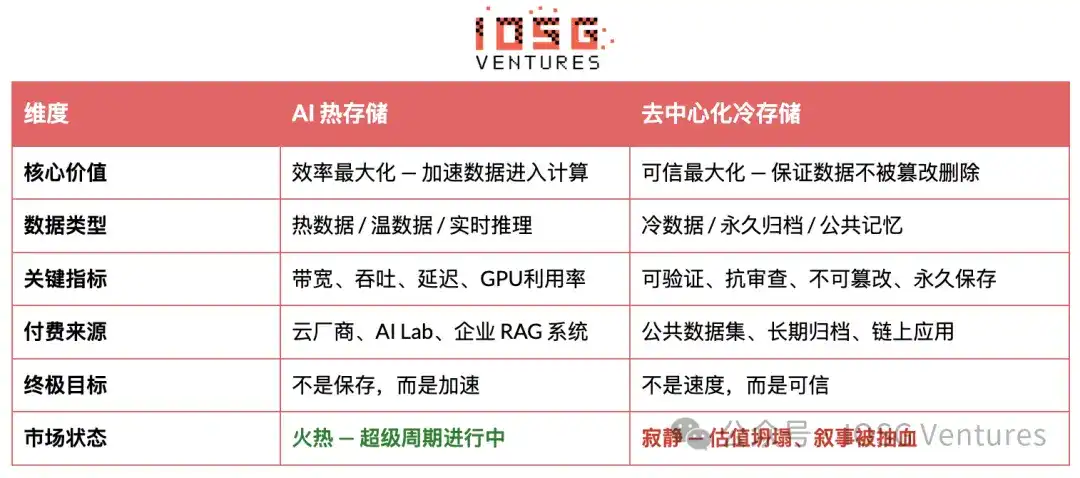
AI storage is "hot storage" providing fuel for future productivity; decentralized storage is "cold memory" preserving undeletable historical records for human civilization. The former serves efficiency, pursuing extreme speed; the latter serves trustworthiness, defending silent memory. The former determines how fast models run; the latter determines whether memories might be deleted. Currently, market mechanisms reward productive efficiency. AI storage is at the forefront of the wave, while decentralized storage seems to be experiencing a silence of valuation collapse and narrative bloodletting.

The Vision and Reality of Decentralized Storage

There are numerous decentralized storage projects, but in terms of industry mindshare and ecosystem depth, the core representatives remain Filecoin and Arweave. Although both fall under "decentralized storage," their underlying architectural philosophies are almost entirely divergent paths—the former approximates AWS-like elasticity through market-based contracts, while the latter approximates the permanence of a library through a one-time social contract.

  • Filecoin: Has built the most complete verifiable economic system through PoRep and PoSt. It should not continue to compete directly with AWS on consumer-grade cloud storage. Instead, it should pivot towards AI data provenance, public dataset hosting, and compliance archiving, providing verifiable chains for model auditing and copyright proof. The necessary path is to package itself as an S3-compatible API supporting fiat payments, upgrading from a "cheap storage marketplace" to "verifiable computational infrastructure."

  • Arweave: With its "pay once, store forever" narrative, it uses Blockweave and SPoRA mechanisms to incentivize miners to preserve and quickly access as much data as possible, especially scarce historical data. Its best fit is as a public memory foundation for human civilization—preserving human rights records, evidence of war crimes, cultural archives, archiving legal and financial history, and providing permanent, accessible long-term memory for AI Agents. Arweave's value lies not in speed but in its capacity to carry civilizational memory across cycles.
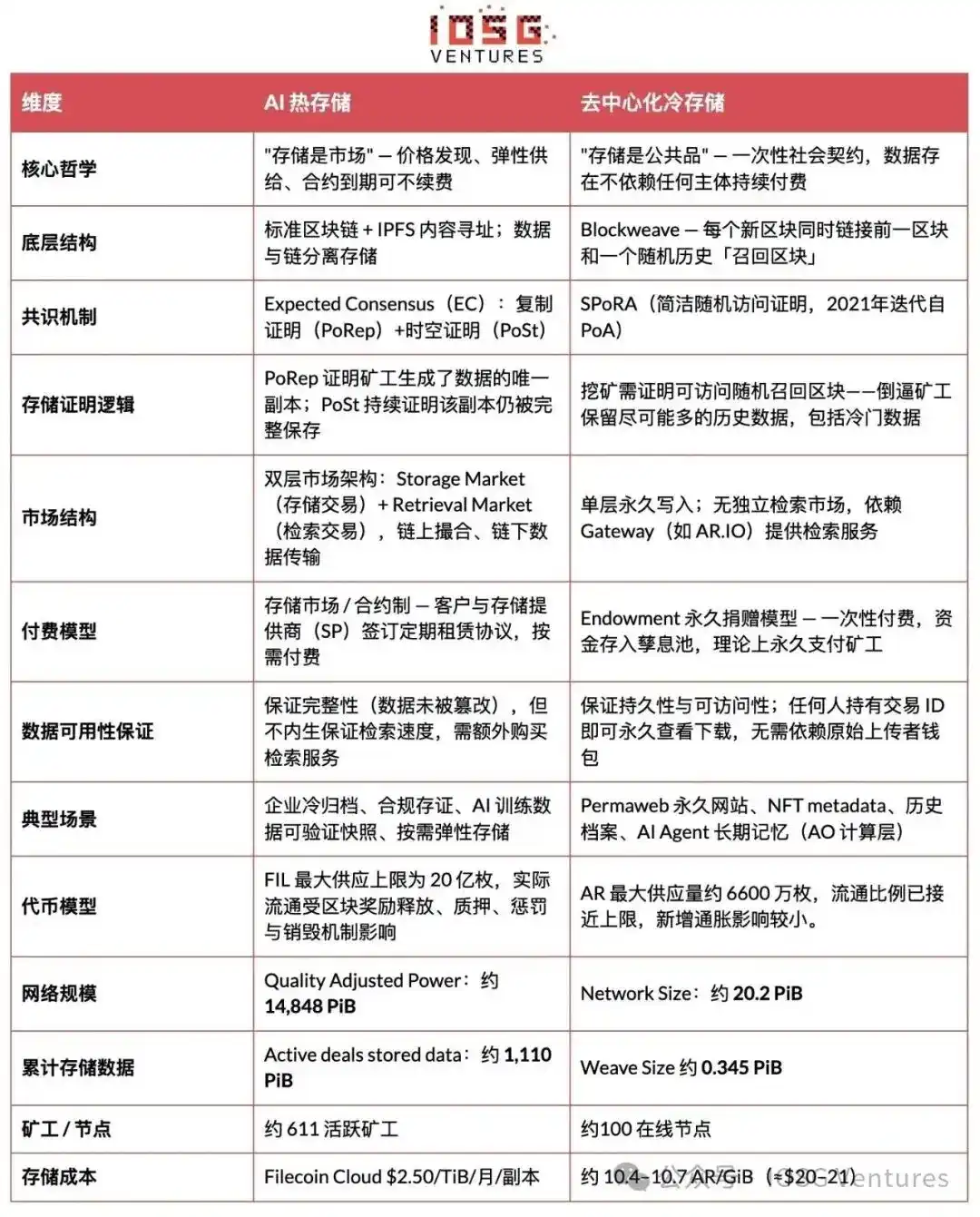
The predicament of decentralized storage projects like Filecoin and Arweave lies not in a flawed value proposition, but in the long-term misalignment among productization, retrieval experience, real-world demand, and token incentives. This reveals a significant gap between geek idealism and mainstream commercial adoption:

  • Supply-Demand Incentive Misalignment: Early networks like Filecoin rapidly expanded capacity via token incentives but failed to build sufficiently strong paid demand, resulting in vast capacity but low utilization and conversion. It rewards "I can store" rather than "need me to store."

  • Lack of Enterprise-Grade Service Capabilities: AWS's moat isn't hard drives, but the "data operating system" composed of APIs, SLAs, access management, compliance auditing, and technical support. Enterprises buy "peace of mind," not experimental infrastructure requiring them to handle keys and node selection themselves.

  • Retrieval Experience Shortcomings: "Storing in" does not equal "retrieving stably and with low latency." Distributed nodes, complex topology, and a lack of unified SLAs make it difficult to handle AI hot data workflows. It's more suitable for trustworthy cold archiving and data provenance.

  • Inadequate Privacy & Compliance: Enterprise private data cannot simply be written to a public, permanent network; the right to be forgotten inherently conflicts with permanent immutability. Decentralized storage is better suited for public data and long-term archives, not indiscriminately hosting core private data.

  • Token Economics Amplifying Cycles: Bull market financialization masks insufficient demand; bear market ROI decline for miners exposes commercialization shortcomings. Tokens can bootstrap supply but cannot automatically create demand and sustainable revenue.

Other decentralized storage projects mostly focus on specific ecosystems or niche segments: Storj/Sia have weaker cross-cycle industry mindshare and Web3 narrative influence compared to Filecoin/Arweave; BNB Greenfield/Walrus are tied to specific public chain ecosystems like BNB or SUI; Celestia/EigenDA belong to the Data Availability (DA) layer, serving Rollup transaction confirmation rather than long-term archival; AI/DA hybrid narrative projects like 0G attempt to integrate storage, data availability, computation, and AI agent settlement into an AI-native modular infrastructure, but their real-world demand, developer adoption, and commercial closure remain to be validated.

Future Opportunities for Decentralized Storage: The Long-Term Pendulum of Efficiency and Trust

During periods of technological红利爆发, capital frantically chases efficiency. Assets like GPUs and HBM are assigned extremely high premiums, while decentralized storage advocating "trust and fairness" is naturally marginalized. However, history's pendulum will not remain forever on the side of efficiency. Unjustifiable platform bans and content takedowns, AI copyright lawsuits forcing data provenance, geopolitical conflicts sparking data sovereignty disputes, data monopolies leading to the disappearance of public archives, and regulatory pressure for compliance auditing of model training data—all such events could potentially brew a repricing of "trustworthy storage." Decentralized storage's future opportunities may still manifest unique value in the following directions:

  • AI Data Provenance: Combining cryptographic proofs to build "data lineage proofs," addressing regulatory and audit pressures.

  • Public Datasets & Civilizational Archives: Anchoring censored archives and cultural heritage, building irreplaceable, undeletable memory.

  • Trustworthy Archival & Compliance Attestation: Achieving trustworthy self-attestation through hash storage, providing high-grade digital notarization.

  • Integration with ZK/TEE/DID Technologies: Mitigating privacy tensions, upgrading from a single "storage protocol" to "trustworthy data infrastructure."

  • Invisible Product Route: Offering S3-compatible APIs and fiat billing, allowing users to directly purchase "trustworthy archival" services.

AI storage and decentralized storage—one pursues ultimate efficiency, providing fuel for our sprint into the future; the other defends silent memory, safeguarding our right to look back at the past. The current market unhesitatingly rewards efficiency, which is why decentralized storage appears silent, even collapsing. However, when the AI era further amplifies data monopolies, copyright disputes, and the fragility of historical memory, decentralized storage may experience a revaluation as a "trustworthy cold layer." Those memories that cannot be easily erased by platforms, corporations, or any single authority might transition from an idealistic romance, from a fringe belief, into necessary infrastructure.


Trending Cryptos

Related Questions

QWhat is the fundamental difference between the value proposition of AI storage and decentralized storage, according to the article?

AThe core difference lies in their value functions. AI storage is driven by efficiency maximization, focusing on maximizing GPU utilization and lowering per-token costs to accelerate computing power and serve productivity. Decentralized storage is driven by trust maximization, focusing on data permanence, censorship resistance, authenticity, and serving as a long-term, immutable memory base for fairness and civilizational heritage.

QWhy is HBM considered a critical and bottleneck component in the AI storage chain?

AHBM is critical because it is the 'bandwidth organ' closest to the compute unit (GPU/CPU). Its core mission is not to preserve data but to feed data to the compute unit with extremely high bandwidth, directly determining whether the GPU can be fully utilized ('fed'). Its production involves complex system engineering with high barriers including advanced DRAM process, TSV technology, ultra-thin stacking, packaging, thermal management, and customer certification. Currently, only SK hynix, Samsung, and Micron can produce it stably.

QWhat are the four core layers of the AI storage architecture as outlined in the article?

AThe four core layers are: 1) Compute-proximate memory layer (Bandwidth Core), primarily HBM, supplemented by DRAM and CXL memory pooling. 2) High-speed persistent storage layer (I/O Hub), centered on enterprise SSD components. 3) Low-cost, high-capacity storage layer (Capacity Base), consisting of HDDs and cold storage/archive systems. 4) AI storage system and data software (Orchestration Brain), including parallel file systems, object storage, vector databases, and RAG data governance layers.

QWhat are the main challenges or mismatches currently facing decentralized storage projects like Filecoin and Arweave?

AThe main challenges include: 1) Supply-demand incentive mismatch, where networks incentivize storage capacity but lack strong paying demand. 2) Lack of enterprise-grade service capabilities like comprehensive APIs, SLA guarantees, permission management, and support. 3) Poor retrieval experience, making them unsuitable for hot data workflows. 4) Privacy and compliance issues, as permanent storage conflicts with deletion rights. 5) Token economies amplifying market cycles, where bull market speculation masks weak fundamentals.

QAccording to the article, what are the potential future opportunities for decentralized storage to demonstrate unique value?

APotential opportunities include: 1) AI Data Provenance: Providing cryptographic proof for data lineage and model training data to meet audit and regulatory needs. 2) Public Datasets & Civilizational Archives: Hosting censored records, cultural heritage, and public data. 3) Trusted Archiving & Compliance Attestation: Offering immutable hash-based proof for digital notarization. 4) Integration with technologies like ZK, TEE, and DID to enhance privacy and evolve into trusted data infrastructure. 5) An 'invisible' product route, offering S3-compatible APIs and fiat billing for easy enterprise adoption of 'trusted archive' services.

Related Reads

Expect news tomorrow: this time the Bank of Japan will announce its interest rate decision! What impact will this have on Bitcoin?

A day before the Bank of Japan's (BOJ) interest rate decision announcement, the Japanese yen surged nearly 3% against the US dollar. The sharp move in the currency market fueled speculation that the Japanese government may have intervened again to support the yen. The USD/JPY pair fell over 400 pips to 158.5, its steepest daily drop since Japan's currency intervention earlier this year. Market participants suspect the rapid, strong yen appreciation could be due to direct foreign currency sales by Japanese authorities, though the Ministry of Finance has made no official statement. The yen had previously fallen to its weakest level against the dollar in nearly 40 years. In late April and May, the government intervened with roughly 9.6 trillion yen to prevent the USD/JPY from rising sustainably above 160, but the yen faced renewed selling pressure afterward. Investors are now focused on the BOJ's rate decision and its signals on future monetary policy. Potential hawkish signals from the BOJ are seen as a factor that could support further yen strength. A sharp yen appreciation could create short-term selling pressure on Bitcoin by increasing the risk of unwinding carry trades, where investors borrow low-yielding yen to invest in Bitcoin and other risky assets. This pressure could intensify if the BOJ takes a hawkish stance or raises interest rates.

cryptonews.ru1h ago

Expect news tomorrow: this time the Bank of Japan will announce its interest rate decision! What impact will this have on Bitcoin?

cryptonews.ru1h ago

Trading

Spot

Hot Articles

What is SONIC

Sonic: Pioneering the Future of Gaming in Web3 Introduction to Sonic In the ever-evolving landscape of Web3, the gaming industry stands out as one of the most dynamic and promising sectors. At the forefront of this revolution is Sonic, a project designed to amplify the gaming ecosystem on the Solana blockchain. Leveraging cutting-edge technology, Sonic aims to deliver an unparalleled gaming experience by efficiently processing millions of requests per second, ensuring that players enjoy seamless gameplay while maintaining low transaction costs. This article delves into the intricate details of Sonic, exploring its creators, funding sources, operational mechanics, and the timeline of significant events that have shaped its journey. What is Sonic? Sonic is an innovative layer-2 network that operates atop the Solana blockchain, specifically tailored to enhance the existing Solana gaming ecosystem. It accomplishes this through a customised, VM-agnostic game engine paired with a HyperGrid interpreter, facilitating sovereign game economies that roll up back to the Solana platform. The primary goals of Sonic include: Enhanced Gaming Experiences: Sonic is committed to offering lightning-fast on-chain gameplay, allowing players and developers to engage with games at previously unattainable speeds. Atomic Interoperability: This feature enables transactions to be executed within Sonic without the need to redeploy Solana programmes and accounts. This makes the process more efficient and directly benefits from Solana Layer1 services and liquidity. Seamless Deployment: Sonic allows developers to write for Ethereum Virtual Machine (EVM) based systems and execute them on Solana’s SVM infrastructure. This interoperability is crucial for attracting a broader range of dApps and decentralised applications to the platform. Support for Developers: By offering native composable gaming primitives and extensible data types - dining within the Entity-Component-System (ECS) framework - game creators can craft intricate business logic with ease. Overall, Sonic's unique approach not only caters to players but also provides an accessible and low-cost environment for developers to innovate and thrive. Creator of Sonic The information regarding the creator of Sonic is somewhat ambiguous. However, it is known that Sonic's SVM is owned by the company Mirror World. The absence of detailed information about the individuals behind Sonic reflects a common trend in several Web3 projects, where collective efforts and partnerships often overshadow individual contributions. Investors of Sonic Sonic has garnered considerable attention and support from various investors within the crypto and gaming sectors. Notably, the project raised an impressive $12 million during its Series A funding round. The round was led by BITKRAFT Ventures, with other notable investors including Galaxy, Okx Ventures, Interactive, Big Brain Holdings, and Mirana. This financial backing signifies the confidence that investment foundations have in Sonic’s potential to revolutionise the Web3 gaming landscape, further validating its innovative approaches and technologies. How Does Sonic Work? Sonic utilises the HyperGrid framework, a sophisticated parallel processing mechanism that enhances its scalability and customisability. Here are the core features that set Sonic apart: Lightning Speed at Low Costs: Sonic offers one of the fastest on-chain gaming experiences compared to other Layer-1 solutions, powered by the scalability of Solana’s virtual machine (SVM). Atomic Interoperability: Sonic enables transaction execution without redeployment of Solana programmes and accounts, effectively streamlining the interaction between users and the blockchain. EVM Compatibility: Developers can effortlessly migrate decentralised applications from EVM chains to the Solana environment using Sonic’s HyperGrid interpreter, increasing the accessibility and integration of various dApps. Ecosystem Support for Developers: By exposing native composable gaming primitives, Sonic facilitates a sandbox-like environment where developers can experiment and implement business logic, greatly enhancing the overall development experience. Monetisation Infrastructure: Sonic natively supports growth and monetisation efforts, providing frameworks for traffic generation, payments, and settlements, thereby ensuring that gaming projects are not only viable but also sustainable financially. Timeline of Sonic The evolution of Sonic has been marked by several key milestones. Below is a brief timeline highlighting critical events in the project's history: 2022: The Sonic cryptocurrency was officially launched, marking the beginning of its journey in the Web3 gaming arena. 2024: June: Sonic SVM successfully raised $12 million in a Series A funding round. This investment allowed Sonic to further develop its platform and expand its offerings. August: The launch of the Sonic Odyssey testnet provided users with the first opportunity to engage with the platform, offering interactive activities such as collecting rings—a nod to gaming nostalgia. October: SonicX, an innovative crypto game integrated with Solana, made its debut on TikTok, capturing the attention of over 120,000 users within a short span. This integration illustrated Sonic’s commitment to reaching a broader, global audience and showcased the potential of blockchain gaming. Key Points Sonic SVM is a revolutionary layer-2 network on Solana explicitly designed to enhance the GameFi landscape, demonstrating great potential for future development. HyperGrid Framework empowers Sonic by introducing horizontal scaling capabilities, ensuring that the network can handle the demands of Web3 gaming. Integration with Social Platforms: The successful launch of SonicX on TikTok displays Sonic’s strategy to leverage social media platforms to engage users, exponentially increasing the exposure and reach of its projects. Investment Confidence: The substantial funding from BITKRAFT Ventures, among others, emphasizes the robust backing Sonic has, paving the way for its ambitious future. In conclusion, Sonic encapsulates the essence of Web3 gaming innovation, striking a balance between cutting-edge technology, developer-centric tools, and community engagement. As the project continues to evolve, it is poised to redefine the gaming landscape, making it a notable entity for gamers and developers alike. As Sonic moves forward, it will undoubtedly attract greater interest and participation, solidifying its place within the broader narrative of blockchain gaming.

2.0k Total ViewsPublished 2024.04.04Updated 2024.12.03

What is SONIC

What is $S$

Understanding SPERO: A Comprehensive Overview Introduction to SPERO As the landscape of innovation continues to evolve, the emergence of web3 technologies and cryptocurrency projects plays a pivotal role in shaping the digital future. One project that has garnered attention in this dynamic field is SPERO, denoted as SPERO,$$s$. This article aims to gather and present detailed information about SPERO, to help enthusiasts and investors understand its foundations, objectives, and innovations within the web3 and crypto domains. What is SPERO,$$s$? SPERO,$$s$ is a unique project within the crypto space that seeks to leverage the principles of decentralisation and blockchain technology to create an ecosystem that promotes engagement, utility, and financial inclusion. The project is tailored to facilitate peer-to-peer interactions in new ways, providing users with innovative financial solutions and services. At its core, SPERO,$$s$ aims to empower individuals by providing tools and platforms that enhance user experience in the cryptocurrency space. This includes enabling more flexible transaction methods, fostering community-driven initiatives, and creating pathways for financial opportunities through decentralised applications (dApps). The underlying vision of SPERO,$$s$ revolves around inclusiveness, aiming to bridge gaps within traditional finance while harnessing the benefits of blockchain technology. Who is the Creator of SPERO,$$s$? The identity of the creator of SPERO,$$s$ remains somewhat obscure, as there are limited publicly available resources providing detailed background information on its founder(s). This lack of transparency can stem from the project's commitment to decentralisation—an ethos that many web3 projects share, prioritising collective contributions over individual recognition. By centring discussions around the community and its collective goals, SPERO,$$s$ embodies the essence of empowerment without singling out specific individuals. As such, understanding the ethos and mission of SPERO remains more important than identifying a singular creator. Who are the Investors of SPERO,$$s$? SPERO,$$s$ is supported by a diverse array of investors ranging from venture capitalists to angel investors dedicated to fostering innovation in the crypto sector. The focus of these investors generally aligns with SPERO's mission—prioritising projects that promise societal technological advancement, financial inclusivity, and decentralised governance. These investor foundations are typically interested in projects that not only offer innovative products but also contribute positively to the blockchain community and its ecosystems. The backing from these investors reinforces SPERO,$$s$ as a noteworthy contender in the rapidly evolving domain of crypto projects. How Does SPERO,$$s$ Work? SPERO,$$s$ employs a multi-faceted framework that distinguishes it from conventional cryptocurrency projects. Here are some of the key features that underline its uniqueness and innovation: Decentralised Governance: SPERO,$$s$ integrates decentralised governance models, empowering users to participate actively in decision-making processes regarding the project’s future. This approach fosters a sense of ownership and accountability among community members. Token Utility: SPERO,$$s$ utilises its own cryptocurrency token, designed to serve various functions within the ecosystem. These tokens enable transactions, rewards, and the facilitation of services offered on the platform, enhancing overall engagement and utility. Layered Architecture: The technical architecture of SPERO,$$s$ supports modularity and scalability, allowing for seamless integration of additional features and applications as the project evolves. This adaptability is paramount for sustaining relevance in the ever-changing crypto landscape. Community Engagement: The project emphasises community-driven initiatives, employing mechanisms that incentivise collaboration and feedback. By nurturing a strong community, SPERO,$$s$ can better address user needs and adapt to market trends. Focus on Inclusion: By offering low transaction fees and user-friendly interfaces, SPERO,$$s$ aims to attract a diverse user base, including individuals who may not previously have engaged in the crypto space. This commitment to inclusion aligns with its overarching mission of empowerment through accessibility. Timeline of SPERO,$$s$ Understanding a project's history provides crucial insights into its development trajectory and milestones. Below is a suggested timeline mapping significant events in the evolution of SPERO,$$s$: Conceptualisation and Ideation Phase: The initial ideas forming the basis of SPERO,$$s$ were conceived, aligning closely with the principles of decentralisation and community focus within the blockchain industry. Launch of Project Whitepaper: Following the conceptual phase, a comprehensive whitepaper detailing the vision, goals, and technological infrastructure of SPERO,$$s$ was released to garner community interest and feedback. Community Building and Early Engagements: Active outreach efforts were made to build a community of early adopters and potential investors, facilitating discussions around the project’s goals and garnering support. Token Generation Event: SPERO,$$s$ conducted a token generation event (TGE) to distribute its native tokens to early supporters and establish initial liquidity within the ecosystem. Launch of Initial dApp: The first decentralised application (dApp) associated with SPERO,$$s$ went live, allowing users to engage with the platform's core functionalities. Ongoing Development and Partnerships: Continuous updates and enhancements to the project's offerings, including strategic partnerships with other players in the blockchain space, have shaped SPERO,$$s$ into a competitive and evolving player in the crypto market. Conclusion SPERO,$$s$ stands as a testament to the potential of web3 and cryptocurrency to revolutionise financial systems and empower individuals. With a commitment to decentralised governance, community engagement, and innovatively designed functionalities, it paves the way toward a more inclusive financial landscape. As with any investment in the rapidly evolving crypto space, potential investors and users are encouraged to research thoroughly and engage thoughtfully with the ongoing developments within SPERO,$$s$. The project showcases the innovative spirit of the crypto industry, inviting further exploration into its myriad possibilities. While the journey of SPERO,$$s$ is still unfolding, its foundational principles may indeed influence the future of how we interact with technology, finance, and each other in interconnected digital ecosystems.

212 Total ViewsPublished 2024.12.17Updated 2024.12.17

What is $S$

What is AGENT S

Agent S: The Future of Autonomous Interaction in Web3 Introduction In the ever-evolving landscape of Web3 and cryptocurrency, innovations are constantly redefining how individuals interact with digital platforms. One such pioneering project, Agent S, promises to revolutionise human-computer interaction through its open agentic framework. By paving the way for autonomous interactions, Agent S aims to simplify complex tasks, offering transformative applications in artificial intelligence (AI). This detailed exploration will delve into the project's intricacies, its unique features, and the implications for the cryptocurrency domain. What is Agent S? Agent S stands as a groundbreaking open agentic framework, specifically designed to tackle three fundamental challenges in the automation of computer tasks: Acquiring Domain-Specific Knowledge: The framework intelligently learns from various external knowledge sources and internal experiences. This dual approach empowers it to build a rich repository of domain-specific knowledge, enhancing its performance in task execution. Planning Over Long Task Horizons: Agent S employs experience-augmented hierarchical planning, a strategic approach that facilitates efficient breakdown and execution of intricate tasks. This feature significantly enhances its ability to manage multiple subtasks efficiently and effectively. Handling Dynamic, Non-Uniform Interfaces: The project introduces the Agent-Computer Interface (ACI), an innovative solution that enhances the interaction between agents and users. Utilizing Multimodal Large Language Models (MLLMs), Agent S can navigate and manipulate diverse graphical user interfaces seamlessly. Through these pioneering features, Agent S provides a robust framework that addresses the complexities involved in automating human interaction with machines, setting the stage for myriad applications in AI and beyond. Who is the Creator of Agent S? While the concept of Agent S is fundamentally innovative, specific information about its creator remains elusive. The creator is currently unknown, which highlights either the nascent stage of the project or the strategic choice to keep founding members under wraps. Regardless of anonymity, the focus remains on the framework's capabilities and potential. Who are the Investors of Agent S? As Agent S is relatively new in the cryptographic ecosystem, detailed information regarding its investors and financial backers is not explicitly documented. The lack of publicly available insights into the investment foundations or organisations supporting the project raises questions about its funding structure and development roadmap. Understanding the backing is crucial for gauging the project's sustainability and potential market impact. How Does Agent S Work? At the core of Agent S lies cutting-edge technology that enables it to function effectively in diverse settings. Its operational model is built around several key features: Human-like Computer Interaction: The framework offers advanced AI planning, striving to make interactions with computers more intuitive. By mimicking human behaviour in tasks execution, it promises to elevate user experiences. Narrative Memory: Employed to leverage high-level experiences, Agent S utilises narrative memory to keep track of task histories, thereby enhancing its decision-making processes. Episodic Memory: This feature provides users with step-by-step guidance, allowing the framework to offer contextual support as tasks unfold. Support for OpenACI: With the ability to run locally, Agent S allows users to maintain control over their interactions and workflows, aligning with the decentralised ethos of Web3. Easy Integration with External APIs: Its versatility and compatibility with various AI platforms ensure that Agent S can fit seamlessly into existing technological ecosystems, making it an appealing choice for developers and organisations. These functionalities collectively contribute to Agent S's unique position within the crypto space, as it automates complex, multi-step tasks with minimal human intervention. As the project evolves, its potential applications in Web3 could redefine how digital interactions unfold. Timeline of Agent S The development and milestones of Agent S can be encapsulated in a timeline that highlights its significant events: September 27, 2024: The concept of Agent S was launched in a comprehensive research paper titled “An Open Agentic Framework that Uses Computers Like a Human,” showcasing the groundwork for the project. October 10, 2024: The research paper was made publicly available on arXiv, offering an in-depth exploration of the framework and its performance evaluation based on the OSWorld benchmark. October 12, 2024: A video presentation was released, providing a visual insight into the capabilities and features of Agent S, further engaging potential users and investors. These markers in the timeline not only illustrate the progress of Agent S but also indicate its commitment to transparency and community engagement. Key Points About Agent S As the Agent S framework continues to evolve, several key attributes stand out, underscoring its innovative nature and potential: Innovative Framework: Designed to provide an intuitive use of computers akin to human interaction, Agent S brings a novel approach to task automation. Autonomous Interaction: The ability to interact autonomously with computers through GUI signifies a leap towards more intelligent and efficient computing solutions. Complex Task Automation: With its robust methodology, it can automate complex, multi-step tasks, making processes faster and less error-prone. Continuous Improvement: The learning mechanisms enable Agent S to improve from past experiences, continually enhancing its performance and efficacy. Versatility: Its adaptability across different operating environments like OSWorld and WindowsAgentArena ensures that it can serve a broad range of applications. As Agent S positions itself in the Web3 and crypto landscape, its potential to enhance interaction capabilities and automate processes signifies a significant advancement in AI technologies. Through its innovative framework, Agent S exemplifies the future of digital interactions, promising a more seamless and efficient experience for users across various industries. Conclusion Agent S represents a bold leap forward in the marriage of AI and Web3, with the capacity to redefine how we interact with technology. While still in its early stages, the possibilities for its application are vast and compelling. Through its comprehensive framework addressing critical challenges, Agent S aims to bring autonomous interactions to the forefront of the digital experience. As we move deeper into the realms of cryptocurrency and decentralisation, projects like Agent S will undoubtedly play a crucial role in shaping the future of technology and human-computer collaboration.

881 Total ViewsPublished 2025.01.14Updated 2025.01.14

What is AGENT S

Discussions

Welcome to the HTX Community. Here, you can stay informed about the latest platform developments and gain access to professional market insights. Users' opinions on the price of S (S) are presented below.

活动图片