Five Meme Coins Soar Against the Market Trend, Which Is the Next Potential Coin?

Odaily星球日报Published on 2025-12-18Last updated on 2025-12-18

Abstract

Despite a generally bearish crypto market, five tokens have experienced significant price surges. PIPPIN, an AI Agent token, saw a dramatic rise from $0.05 to over $0.44, driven by concentrated buying and suspected insider control of up to 80% of its supply. FOLKS, the token of cross-chain DeFi protocol Folks Finance, surged nearly 24x from its low following its S2 incentive announcement, though it later fell sharply. BEAT, a Web3 AI entertainment token on BNB Chain, rapidly grew its market cap to $440 million. AIA, a decentralized AI agent token, plummeted over 90% after Binance Futures delisted its perpetual contract but rebounded 160% after a contract swap. RAVE, a music and culture DAO token, gained attention after support from Donald Trump Jr. and CZ, rising over 410% and listing on multiple exchanges. These tokens share characteristics of low initial market caps, community or insider-driven pumps, and high volatility.

Original / Odaily Planet Daily (@OdailyChina)

Author / Wenser(@wenser2010)

The cryptocurrency market continues to fluctuate and trend lower. However, even in a sluggish market, a few tokens defy the trend, maintaining their own independent rhythm of "sharp rises and falls." Odaily Planet Daily will梳理(review) the "meme coins" with impressive recent price performance in this article, attempting to summarize common characteristics to help discover the next investment target with potential for a surge.

PIPPIN: The Orphan of the AI Agent Craze, a Masterpiece of "Insider Trading"

From late last year to January this year, AI Agent tokens once captured the absolute focus of the crypto market. Tokens like ai16z(ELIZAOS) and swarms frequently topped the token gain charts, and PIPPIN was also a product of the same batch of AI-themed tokens at that time.

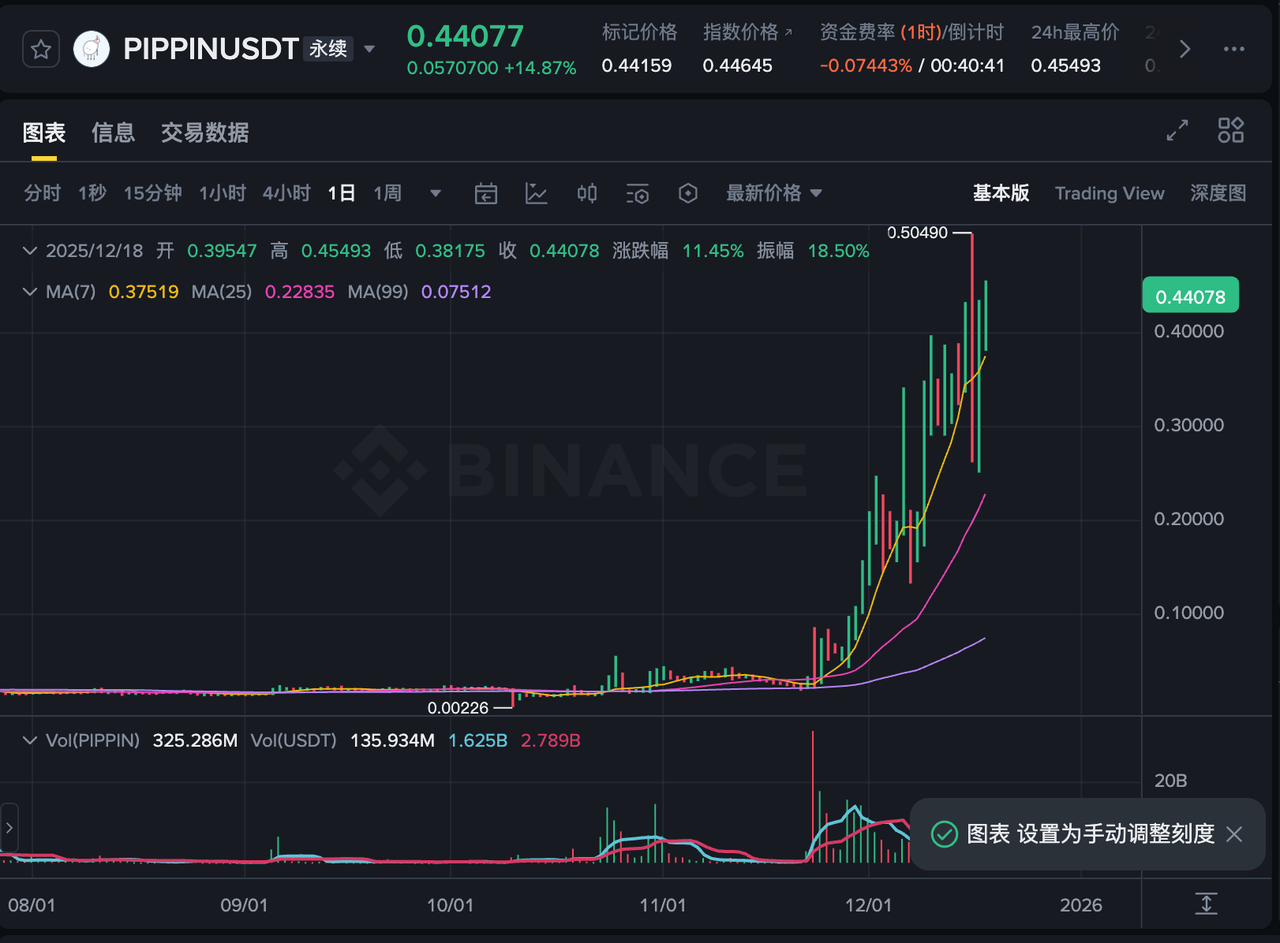
But nearly a year later, only PIPPIN remains, possibly selected by wild market manipulators for its ease of control, experiencing a continuous rise over the past half month. It's worth noting that on November 23rd, its price was only around $0.05. Just a week later, its price had skyrocketed to over $0.17:

On December 1st, PIPPIN defied the market by surging over 60%, its price approaching $0.18; at that time, analyst @frontrunnersx提醒(warned), PIPPIN showed characteristics of concentrated accumulation, with some addresses continuously buying and holding without significant selling, causing the price to continuously hit short positions during the upward trend and trigger chain liquidations. One address bought about $200,000 worth of PIPPIN 6 days prior, sold after the price doubled, and is currently performing a similar operation on ARC.

On December 2nd, Bubblemaps monitoring revealed that 50 related addresses purchased PIPPIN tokens worth $19 million. It was also found that 26 addresses withdrew 44% of the PIPPIN token supply, totaling $96 million, from the Gate platform over two months, with most wallets being recently funded. Most PIPPIN token withdrawals occurred on October 24th and November 23rd. By then, the PIPPIN token price had already surged by 1000%, with insiders controlling half of the token supply, valued at $120 million.

In other words, the wild manipulators' accumulation period for PIPPIN started even earlier, about a month prior, with the真正的(violent)拉升(surge) occurring about a month and a week after accumulation began.

Subsequently, a diamond hands address liquidated its previously accumulated 24.8 million PIPPIN tokens, with floating profits shrinking from a peak of $7.6 million to $3.65 million.

On December 6th, Onchain Lens monitoring showed a whale spent 23,736 SOL (worth approximately $3.3 million) to buy 16.35 million PIPPIN at $0.20 over 3 days, with floating profits exceeding $740,000 at that time.

On December 16th, Bubblemaps issued another reminder. The PIPPIN price continued to rise, but internal addresses now held about 80% of the supply, valued at approximately $380 million. Bubblemaps pointed out: Since the last disclosure (December 2nd), 16 new wallets with the same pattern have appeared (funded by HTX, received similar amounts of SOL, no history, large PIPPIN withdrawals from CEXs); another group of 11 wallets linked to Bitget was identified, collectively holding about 9% of the supply, with highly consistent fund flows and timing windows, suspected to be controlled by the same entity.

That night, as the PIPPIN price fell below $0.3, this "meme coin spectacle"宣告(declared) a阶段性(phase)收网(wind-down). But the next day, December 17th, PIPPIN一度(surged) to around $0.5, causing another large wave of short liquidations. It must be said, the brutal methods of bear market manipulators are堪称(truly)残忍(ruthless).

As of writing, the PIPPIN price is temporarily reported at $0.44, with a 24-hour increase of over 15%. Its performance continues.
FOLKS: Cross-Chain DeFi Protocol Token, Up Nearly 24x From Low Point Due to S2 Incentive Announcement

As a cross-chain DeFi protocol providing lending, staking, and trading services, primarily operating on the Algorand chain, Folks Finance originally had relatively few followers. But with the official announcement of the S2 incentive campaign, market enthusiasm for its token reignited.

It's worth mentioning that Folks Finance distributed 1.5 million FOLKS tokens during the S1 incentive campaign, including Chainlink incentives; on November 6th, FOLKS officially launched on Binance Alpha, with a historical low price of around $2.

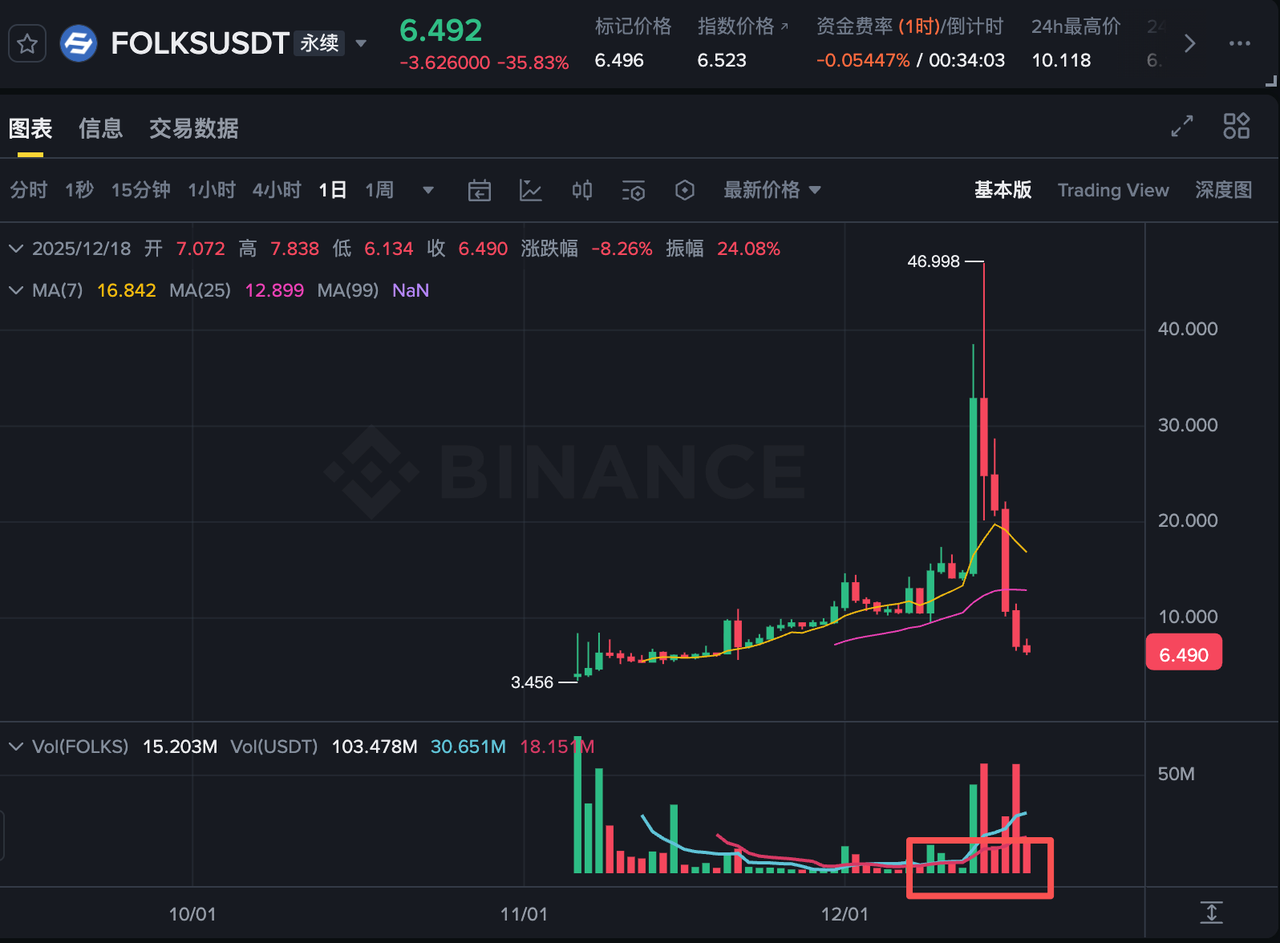
After the official Folks Finance announcement on December 9th, the FOLKS token price soared from under $10;

On December 14th, after nearly a week of speculation, the FOLKS token price broke through $40 for the first time, eventually rising to nearly $47, an increase of nearly 24 times from the low point;

Subsequently, the FOLKS price quickly retreated, falling by about 80%.

As of writing, the FOLKS price is temporarily reported at $6.4, with a 24-hour decrease of over 24%. The circulating supply is 12.7 million tokens (25.4% of total supply), with a temporary market cap of around $81 million.
BEAT: A True Meme Coin Needs Few Words

As another altcoin choosing to root itself in the BNB Chain ecosystem, similar to previous meme coins like MYX and COAI, BEAT's rise is another classic case.

It's worth noting that the official account behind the BEAT token project promotes the concept of a "Web3 AI entertainment platform + IP creation platform" – a rehashed version of hot concepts. After launching on Binance Alpha and futures in early November, BEAT officially claimed to have over 1.2 million independent on-chain holding addresses. One must say, "Audacity leads to abundance."

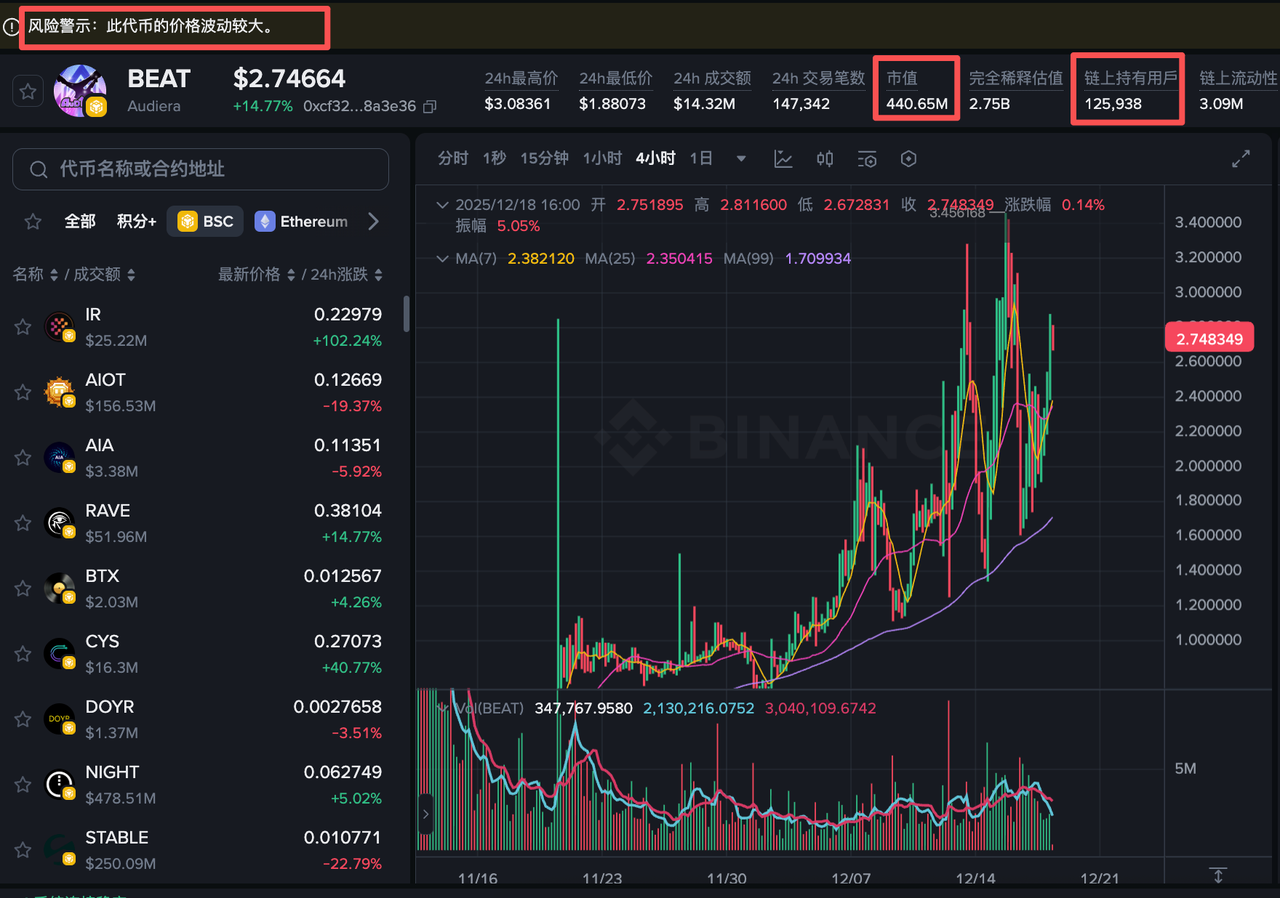
Similar to the price action of previous meme coins, BEAT started with a low market cap – after an initial rise upon listing on Binance Alpha, its market cap remained around $25 million; subsequently, the price飞速(rapidly)上涨(rose) amidst repeated pumps and dumps.

As of writing, the BEAT price is temporarily reported at around $2.7, with a 24-hour increase of over 14%. The circulating market cap is temporarily reported at $440 million, with about 1.26 million on-chain holding addresses (Note: Original said 12.6, assumed typo for 1.26 million based on context).
AIA: Decentralized AI Agent Concept Token, Volatility from Contract Swap

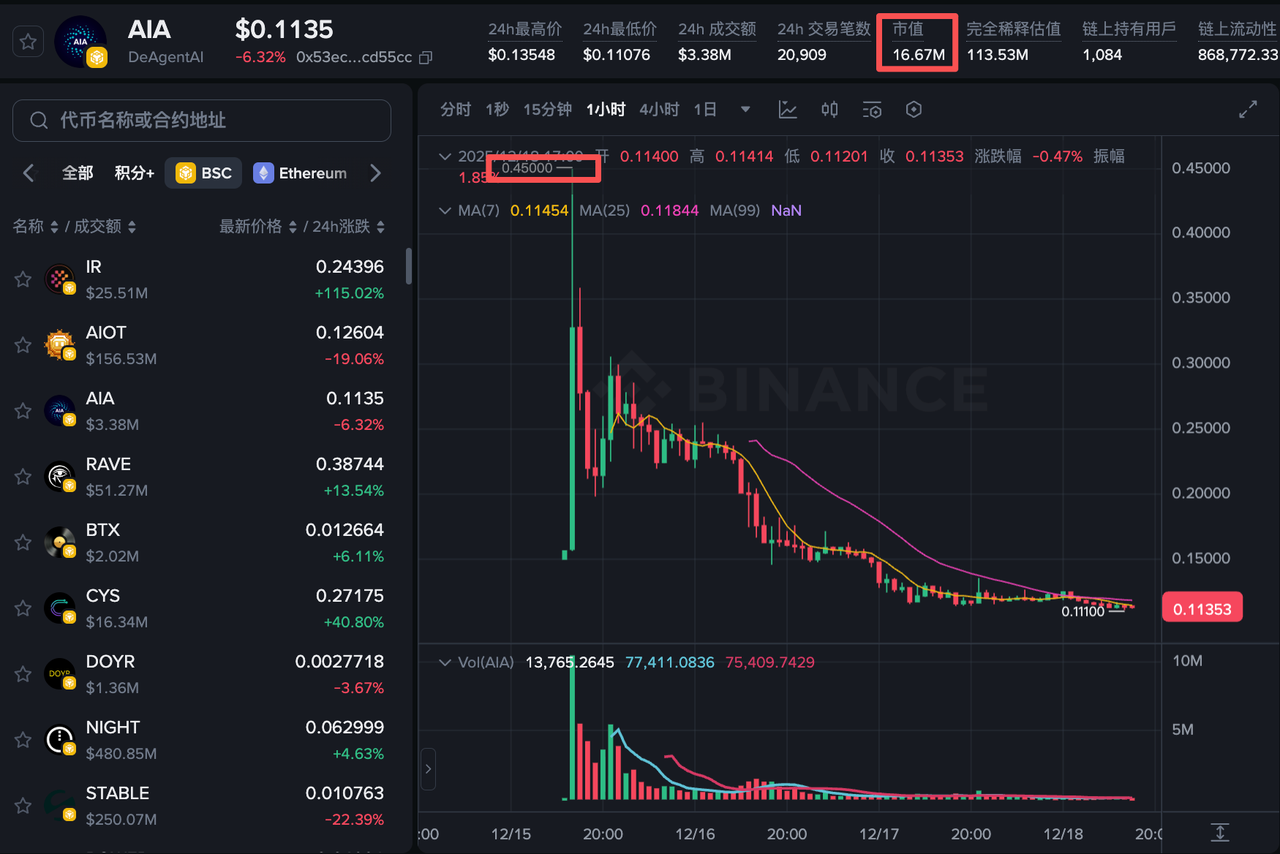
As the project token for DeAgent AI, AIA previously attracted significant market liquidity and attention due to a massive surge after listing on Binance futures, its price once skyrocketing over $1. However, constrained by the increasingly quiet market environment and the gradual cooling of the AI narrative, the token price gradually fell into silence, experiencing a continuous decline.

But the incident of "Binance delisting AIA futures" injected volatile energy into its liquidity once again.

On December 11th, according to an official announcement, Binance Futures announced it would close all AIAUSDT perpetual contracts at 20:15 (UTC+8) on December 11, 2025, for automatic settlement. After settlement, the contract would be delisted. AIA一度(plummeted) over 90%.

But subsequently, Binance announced that Alpha 2.0 would support a contract swap for DeAgentAI (AIA). Starting from 20:00 (UTC+8) on December 11, 2025, Binance Alpha 2.0 had temporarily closed AIA trading to execute this contract migration. This migration would be executed at a 1:1 ratio. The snapshot time was 20:00 (UTC+8) on December 11, 2025. Binance Alpha 2.0 would resume DeAgentAI (AIA) trading at 16:00 (UTC+8) on December 15, 2025.

On December 15th, official data from Binance Alpha showed that DeAgentAI (AIA) had completed the smart contract swap and officially resumed trading at 16:00 (UTC+8) on December 15th. Market data showed AIA surged significantly after opening, with gains一度(exceeding) 160%, topping the Binance Alpha gain charts.

As of writing, the AIA price is temporarily reported at $0.11, with a 24-hour decrease of 6.3%. The circulating market cap is temporarily reported at $16 million.
RAVE: Offline Community-Driven Culture Platform, Supported by Trump Jr. and CZ's Reposts

As a DAO organization promoting the concept of a "decentralized music and culture community and platform ecosystem," RaveDAO's development speed has been like a cheat code. After months of community and project building, RaveDAO has previously completed several member NFT sales.

On November 10th, RaveDAO officially announced its tokenomics and airdrop details. The official stated that the token aims to connect artists, organizers, and fans through token economics, promoting a decentralized entertainment ecosystem of "culture as protocol." RAVE has a total supply of 1 billion tokens, allocated as follows: Community 30%, Ecosystem 31%, Team & Co-builders 20%, Early Supporters 5%, Liquidity 5%, Airdrop 3%, Foundation & Public Goods Pool 6%. Approximately 23.03% will be in circulation after the Token Generation Event (TGE), with the rest subject to a 12-month cliff and a 36-month linear vesting period.

A month later, on December 10th, Binance Alpha announced it would soon list RaveDAO (RAVE).

The next day, news spread that RaveDAO received support from both the WLFI and Aster ecosystems. On December 12th, within an hour of listing on Binance Alpha, its trading volume exceeded $25 million.

Moreover, RaveDAO's "top-level connections" were remarkably impressive – on the evening of the 12th, Trump Jr. reposted and followed news about Aster's collaboration with USD1. RaveDAO, as one of the collaboration participants, gained massive exposure from this. CZ also reposted this tweet later. The RAVE price subsequently rose.

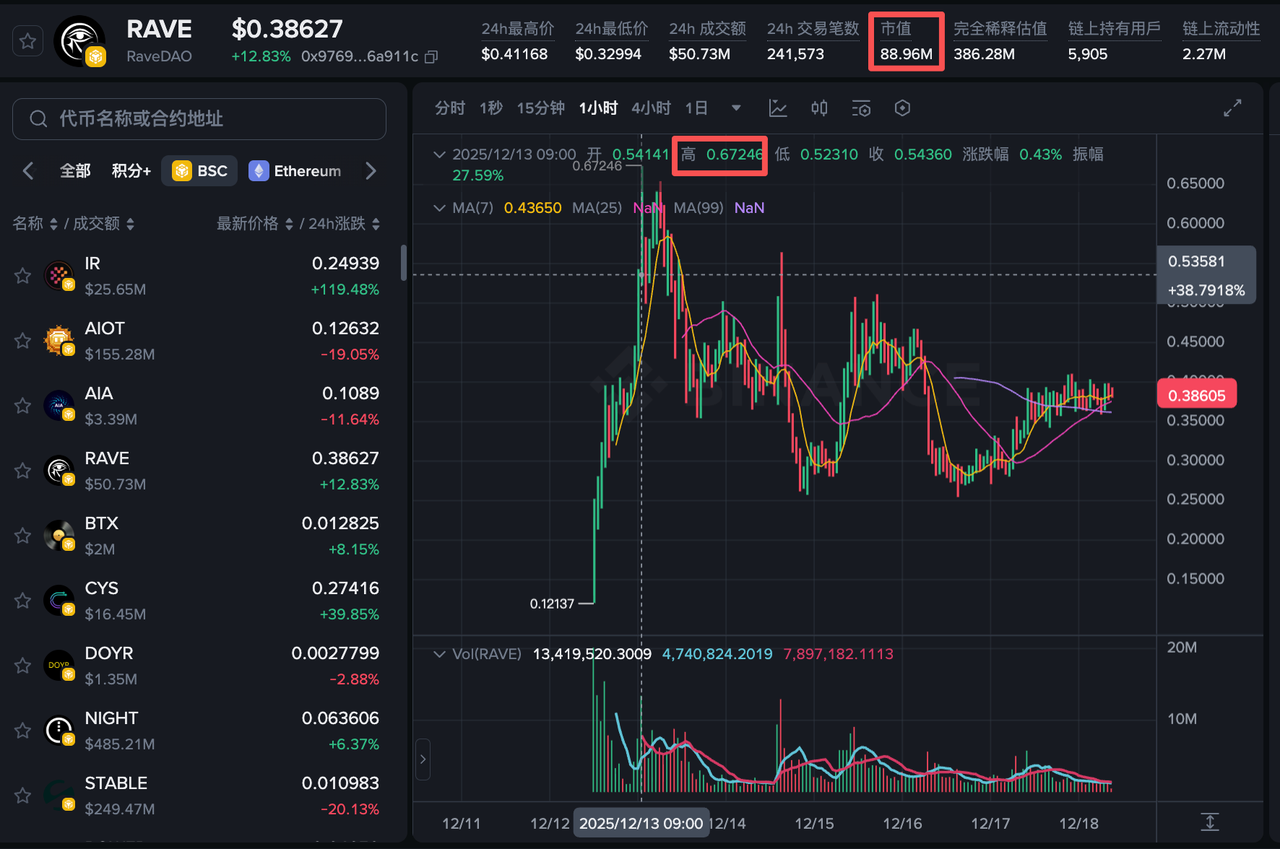
On December 13th, the RAVE price一度(touched) $0.67, with a 24-hour increase of over 410%;

On December 14th, Binance Futures launched RAVE U本位(USD-M) contracts;

On December 15th, RAVE was successively listed on OKX, Bybit, Bitget, Aster, Gate, Kucoin, MEXC, and other centralized exchanges. The price at that time fell back to around $0.41.

As of writing, the on-chain RAVE price is temporarily reported at $0.38, with a 24-hour increase of over 12%. The circulating market cap is temporarily reported at $88 million.
Related Questions

QWhat are the five 'meme coins' mentioned in the article that have surged against the market trend?

AThe five coins are PIPPIN, FOLKS, BEAT, AIA, and RAVE.

QAccording to the article, what was a key characteristic of the PIPPIN token that allowed it to be manipulated?

AA key characteristic was that a large portion of its supply (up to 80%) was controlled by internal addresses and wallets linked to exchanges, making it easy for a 'wild whale' to manipulate the price.

QWhich token experienced a near 24x price increase from its low point due to an incentive announcement, and what was the reason for its subsequent sharp drop?

AThe FOLKS token experienced the near 24x increase after the announcement of its Season 2 incentives. Its price subsequently dropped sharply by around 80% after the initial hype subsided.

QWhat event caused the AIA token to crash over 90%, and what action by Binance later caused its price to surge again?

AThe AIA token crashed over 90% after Binance Futures announced it would delist and settle all AIAUSDT perpetual contracts. Its price later surged over 160% when Binance Alpha announced and executed a 1:1 contract swap for the token.

QHow did RAVE token gain significant exposure and celebrity endorsement according to the article?

ARAVE gained significant exposure when Donald Trump Jr. tweeted about a partnership involving RaveDAO, which was later retweeted by former Binance CEO Changpeng Zhao (CZ).

Related Reads

The Largest IPO in History Ignites Heated Debate: Is SpaceX Worth $1.77 Trillion?

SpaceX's potential IPO is priced at $135 per share, aiming to raise $75 billion and valuing the company at approximately $1.77 trillion, which would make it the largest IPO in history. This valuation has sparked intense debate among investors. Bullish analysts, including major underwriters Goldman Sachs and Morgan Stanley, argue the valuation is justified by SpaceX's long-term potential. They see it not just as a rocket company but as a future leader in space infrastructure, with key growth drivers being Starlink satellite internet, low-cost rocket launches, and future AI-related ventures. They project revenues reaching hundreds of billions to trillions of dollars by 2030-2040. ARK Invest's model suggests a 2030 enterprise value could reach $2.5 trillion. Bearish analysts from independent research firms like Morningstar, PitchBook, and New Constructs contend the IPO price is excessively high, already pricing in unrealistic future growth. Using DCF and sum-of-the-parts models, they estimate fair value between $780 billion and $1.7 trillion, significantly below the IPO target. They highlight risks such as the speculative nature of AI projections, over-dependence on Elon Musk, high growth expectations, and corporate governance concerns. Trefis set a target price of just $79 per share. While both sides acknowledge SpaceX's unique position in commercial space, the core disagreement centers on whether the $135 share price offers a reasonable margin of safety or is overly optimistic. Despite the valuation controversy, reported strong demand for the IPO indicates significant market interest.

marsbit48m ago

The Largest IPO in History Ignites Heated Debate: Is SpaceX Worth $1.77 Trillion?

marsbit48m ago

After the Passage of the GENIUS Act and the CLARITY Act, What Is the Correct Architecture for On-Chain Yield?

The article discusses the evolution of on-chain credit, distinguishing three markets: overcollateralized crypto lending, unsecured lending (largely unsuccessful), and asset-backed credit (ABC). ABC, backed by identifiable real-world collateral with legal recourse, is identified as the fastest-growing category and the only one credibly addressing adverse selection—the core problem in credit where the riskiest borrowers self-select. Current growth in on-chain Real World Assets (RWAs), particularly tokenized private credit funds (e.g., Maple Finance, Centrifuge), is substantial but often merely "wraps" existing fund structures, inheriting their risks rather than solving adverse selection at the protocol level. The regulatory landscape is a key driver, with the US GENIUS Act (prohibiting stablecoin issuers from paying yield) and the proposed CLARITY Act (closing loopholes on indirect yield) set to redefine permissible yield-bearing products. This makes vaults (like ERC-4626) the critical architecture—they become the primary compliant vehicle for delivering yield, functioning as issuance, disclosure, distribution, and recovery mechanisms. The author's thesis is that the correct post-GENIUS/CLARITY architecture involves building ABC solutions where credit assessment, structure, and recovery are encoded directly into the smart contract vault layer, moving beyond mere tokenized fund wrappers to solve adverse selection fundamentally and ensure regulatory compliance.

Foresight News1h ago

After the Passage of the GENIUS Act and the CLARITY Act, What Is the Correct Architecture for On-Chain Yield?

Foresight News1h ago

TechFlow Intelligence Bureau: Anthropic's New Model Fable Sparks Controversy by Restricting Biosafety Research, US CPI Soars to 4.2%, a Three-Year High

**Summary of TechFlow Intelligence Report:** The newsletter covers several key tech and finance developments. In AI, Anthropic's new Fable model faced backlash for secretly limiting biomedical research capabilities and enforcing a 30-day data retention policy, prompting the company to promise more transparent adjustments. In a related story, Anthropic's founder revealed his departure from OpenAI was due to dishonesty from Sam Altman, not safety concerns. Meanwhile, OpenAI is considering significant price cuts to compete with Anthropic, potentially sparking a price war. In crypto/Web3, BlackRock filed a new amendment for a yield-generating Bitcoin ETF, while Bank of America's CEO warned that stablecoin yields could drain trillions from traditional banks. U.S. Senator Cynthia Lummis advocated for the U.S. to officially accumulate Bitcoin reserves. In hardware, Nvidia released the DiffusionGemma-2-6B image model optimized for efficient inference, and AMD promoted its unified memory architecture to challenge Nvidia's dominance. TSMC's CFO hinted at possible price increases due to soaring AI chip demand. A major legal ruling in Germany held Google legally responsible for inaccurate information generated by its AI Overviews feature. Google Chrome also moved to fully block ad-blocker workarounds like uBlock Origin. Macroeconomic headlines included U.S. CPI rising to 4.2% (a 3-year high) and Iran's complete closure of the Strait of Hormuz, raising oil price and inflation fears. South Korean markets saw continued volatility with massive foreign capital outflow. Other notable stories: Microsoft expanded its Copilot AI assistant "Mico" globally; a study found r/wallstreetbets users' stock picks outperformed Wall Street; a fully autonomous drone killed a human soldier for the first time, raising AI ethics concerns; and a Chinese hospital used brain-computer interface technology to help a blind person "see." The overarching theme connects debates over AI boundaries and responsibility (Anthropic's restrictions, Google's liability, lethal autonomous drones) with real-world economic and geopolitical turmoil (inflation, Strait of Hormuz closure, market instability), highlighting the tense interplay between technological advancement and global chaos.

marsbit1h ago

TechFlow Intelligence Bureau: Anthropic's New Model Fable Sparks Controversy by Restricting Biosafety Research, US CPI Soars to 4.2%, a Three-Year High

marsbit1h ago

Alibaba's Yet Another New Business Division: What Signal Does It Send?

Alibaba has established a new "Token Foundry" business unit, merging its Tongyi large model division and Future Life Lab. Led directly by Group CEO Wu Yongming, this marks the company's third significant AI organizational reshuffle in 2026, following the creation of the Alibaba Token Hub (ATH) and a Group Technology Committee. The move signals a strategic shift from consolidating AI resources to accelerating productization and commercialization. The "Token Foundry" name reflects Alibaba's ambition to become a foundational supplier in the AI era, focusing on model development and commercial application. Key teams, including those behind the high-performing HappyHorse video generation model, have been integrated into the new unit. Concurrently, Zhou Jingren, architect of the Qwen model series, has been appointed Group Chief Scientist to lead a new AI Future Research Institute, focusing on long-term technological breakthroughs like Agent capabilities. This restructuring creates a clear four-layer AI architecture within Alibaba: the research institute for frontier exploration, Token Foundry for core models and commercialization, MaaS for platform services, and business units like Qianwen (C端) and Wukong (B端) for end-user applications. The adjustments align with a global trend among tech giants like Google and Microsoft to centralize AI leadership under the CEO and deeply integrate research with business units. The urgency is driven by a narrowing competitive window. Alibaba has announced its AI business is now entering a commercialization phase, with AI-related revenue seeing triple-digit growth for eleven consecutive quarters. The company faces intense competition in the MaaS (Model-as-a-Service) sector from rivals like ByteDance and Tencent. The Token Foundry initiative represents Alibaba's effort to streamline execution and enhance competitiveness in this critical, fast-evolving landscape.

marsbit2h ago

Alibaba's Yet Another New Business Division: What Signal Does It Send?

marsbit2h ago

Trading

Spot
Futures

Hot Articles

Discussions

Welcome to the HTX Community. Here, you can stay informed about the latest platform developments and gain access to professional market insights. Users' opinions on the price of MEME (MEME) are presented below.

活动图片