Farewell to Traditional Bulls and Bears: The Market Has Entered an Era of Rotating Bubbles

marsbitPublished on 2026-06-08Last updated on 2026-06-08

Abstract

Farewell to traditional bull and bear markets; we have entered an era of rolling bubbles. This article uses a meteorological analogy to explain the modern market's shift from slow-moving, long-term trends to a chain of rapid, successive speculative frenzies. The old market resembled "stratiform" weather—slow, broad cycles lasting years. Today's market is like a "mesoscale convective system," where isolated storms (bubbles in sectors like AI, GLP-1 drugs, or crypto) form in sequence. Each is triggered by the outflow of capital and sentiment from the previous one, creating a self-perpetuating chain of booms and busts. This structural change is driven by eight permanent shifts: the democratization of speculation (zero-commission trading, retail options activity), perpetual buying from defined-contribution retirement plans, the dominance of passive investing (creating price-insensitive flows), the rise of multi-strategy funds and high-frequency trading (weakening price discovery), suppressed volatility that erupts violently, an index composition now dominated by long-duration, narrative-driven tech stocks, the elimination of information delays, and a permissive fiscal/monetary backdrop. These conditions ensure that rolling bubbles are the new normal. To navigate this environment, investors should either become deep-sector experts who understand the underlying technologies and business models or become adept observers of trends and capital flows. While chaotic from within each "...

Original Author: Smac, Partner at Compound VC

Original Compilation: Saoirse, Foresight News

Editor's Note: Hot market themes are emerging one after another. The AI frenzy is sweeping the board, with some questioning if it will follow the fate of the metaverse hype. Amidst the noisy market swings, people are often swept up by the latest trends, losing sight of the long-term trajectory. To make rational judgments, one must learn to adopt a higher perspective. In this article, Smac, a partner at Compound, uses a weather analogy to dissect the underlying market logic behind these successive bubbles.

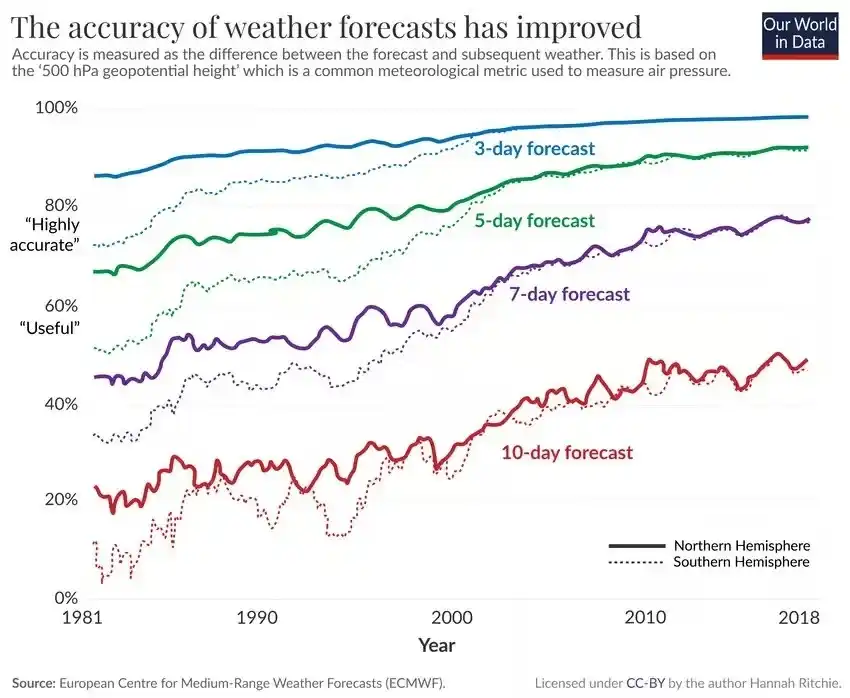
Meteorology is a fascinating field. Over the past fifty years, various weather prediction tools have continuously evolved, improving forecast accuracy. Today's five-day forecast is as accurate as the single-day forecast was thirty years ago.
Most people perceive weather as a single, coherent, moving system: clouds roll in, rain falls, rain stops, sunshine returns. Imagine a winter front approaching. The picture in your mind is likely a vast grey cloud blanket covering hundreds of miles, bringing heavy snowfall. Meteorologists call this type of weather a stratiform system—simply put, like a layered cake, where areas under the cloud cover experience the same weather changes.

But weather isn't always like this. If you've seen summer thunderstorms over plains, you'll notice they operate quite differently. First, individual convective cells form: warm, moist air near the surface rises, meets cold air aloft, water vapor condenses, and towering, localized cumulonimbus clouds develop. Within just an hour, hail, lightning, and torrential rain can strike, reducing visibility to less than a hundred meters.

Once the cell reaches its peak and releases its energy, it gradually dissipates. The cold air descending from the storm spreads outward at speeds up to 40 miles per hour. When this cold air collides with the still warm, moist air surrounding the original storm, it acts like a wedge, forcing the warm air upward again.

As long as sufficient atmospheric instability exists, this "cold air wedge" can trigger a new convective cell about a dozen miles away from the original storm.
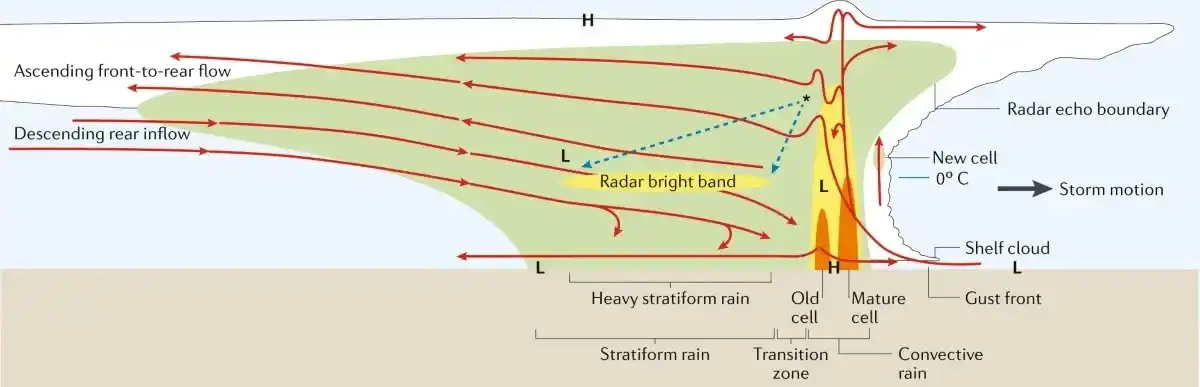
The new cell couldn't have formed on its own; the atmosphere had already stored the energy but lacked a trigger, which the dying storm provided. This new cell then repeats the life cycle of the previous storm.

When multiple convective cells form in succession, they create a mesoscale convective system. On the ground, people experience each storm individually; each one feels like the entire weather system. On one side, calm prevails with no awareness of the coming storm; on the other, the rain has already passed. But from a satellite's perspective, you see a line of distinct cells, each at a different stage of development, moving forward until they exhaust the supply of warm, moist air along their path.

Supercell storm clouds near Amistad, New Mexico at sunset

This chain-reaction storm system forms under very different conditions than a single frontal system. It relies on a specific atmospheric environment:

  • Warm, moist air near the surface acts as the storm's "fuel."
  • Dry, cold air aloft prompts continuous upward motion of warm air, creating atmospheric instability.
  • Winds blowing in different directions at different altitudes, known as wind shear, cause the storm to rotate and move laterally.

When these three conditions are met, successive storms will roll through.

With that meteorological detour, let's get back on topic: The current financial market landscape looks almost exactly like the weather phenomenon described above.

The markets of the past resembled a stratiform weather system: a long bull market followed by a bear market, with sector themes rotating slowly, each lasting for years. The period from 1982 to 2000 was a prolonged bull market, followed by the internet bubble, then the 2003-2007 real estate and credit cycle. These cycles were long and their trajectories clear. Even if an investor's timing was off by a few years, understanding the major trend could still lead to profits.

But today's market is nothing like that. We are in a convective chain-reaction market: one hot sector after another hits like successive storms. To those caught in one, it feels all-consuming and overwhelming.

Capital flows out of fading narratives, fueling new ones in adjacent areas. The pace of theme rotation has accelerated dramatically. AI infrastructure, GLP-1s (a class of diabetes drugs that gained popularity for weight loss, now a hot investment theme), stablecoins, quantum technology, nuclear energy, distributed autonomous technologies, robotics, aerospace... each sector experiences a full hype cycle, complete with devoted participants, a compelling narrative arc, and an inevitable cool-down. The "cold air" spreading from the demise of one trend then ignites the next hotspot in a new area.

Refusing to acknowledge that the market has fundamentally changed is self-deception. People love to mock the phrase "this time is different," but deliberately ignoring the permanent structural shifts in the financial market environment is either intellectual laziness or stubborn nostalgia for the old market.

A Market Unlike Any Before

For a long time after World War II, financial markets moved like slow-moving weather systems. A bull market could last ten, fifteen, or even twenty years, with sector rotations centered around long-term mega-trends.
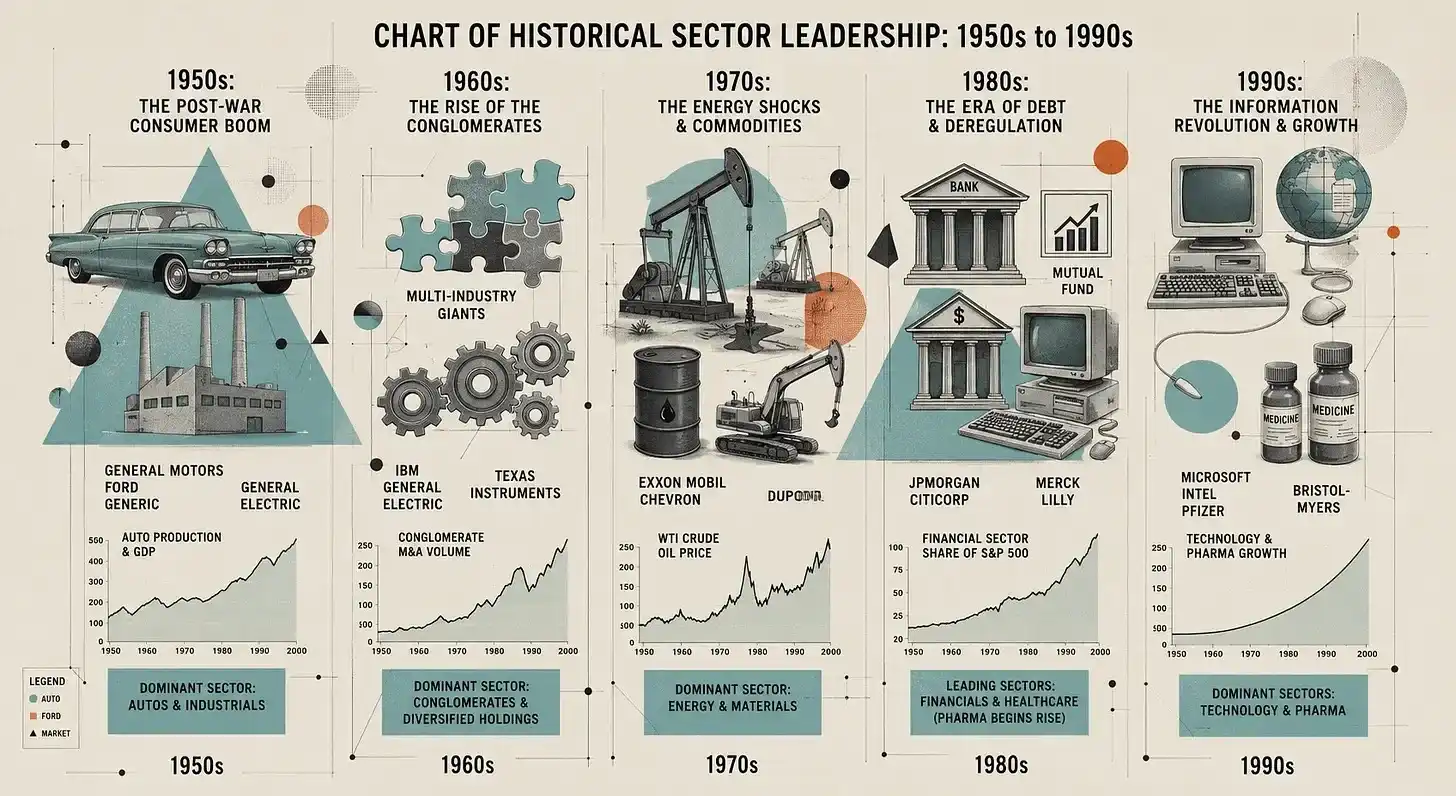
Approximate timeline of sector themes and leading industries

Back then, sector shifts occurred within a unified macro environment. Only at iconic turning points—like the collapse of the Bretton Woods system, Volcker's anti-inflation policies, the peak of the internet bubble, or the global financial crisis—would the market's grand structure be upended.

This market form was shaped by many structural factors: high transaction costs, extremely low retail participation which forced a long-term holding mindset, pensions as the primary vehicle for retirement savings, and S&P 500 index dominated by manufacturing, energy, banking, and retail firms whose earnings growth largely tracked GDP, resulting in stable, predictable performance. Information also traveled slowly; after an annual report was released, it took weeks for most investors to learn its contents.

Market volatility was also relatively balanced. Bull markets were followed by deep corrections where leverage unwound slowly over extended periods; bear market rallies were gradual. The market lingered in different sentiment regimes for long stretches, with overall shifts measured in quarters and years.

In weather terms, the old market had: moderate fuel, high atmospheric stability, weak wind shear, resulting in long, gentle trends allowing for patient planning. Today, all environmental conditions have changed, some even reversed, leading to a fundamental transformation in market structure.

Where Did the Change Come From?

Numerous changes intertwine and amplify each other, each alone sufficient to reshape the market. In summary, there are eight core transformations:

  1. Democratization of Speculation
  2. Formation of Perpetual Bid
  3. Passive Investing Creates Inelastic Counterparties
  4. Rise of Multi-Strategy Funds & HFT; Disappearance of Market Middle
  5. Artificial Suppression of Volatility
  6. Complete Change in Index Composition
  7. Total Elimination of Information Lag
  8. Shift in Fiscal & Monetary Environment

Democratization of Speculation

The composition of market participants has visibly changed. In the 1990s, retail trading volume accounted for only about 10% of total US equity volume. High commissions meant retail investors largely bought and held stocks, with little active speculation.

Robinhood pioneered zero-commission trading with payment for order flow; in Fall 2019, Schwab eliminated trading commissions, followed by Fidelity, TD Ameritrade, and E*Trade, rewriting the industry rulebook.

COVID-19 accelerated this trend: fiscal stimulus, idle time at home, and mobile trading apps gamifying investing saw retail's share of trading volume surge to 25% in 2020-2021. Many thought this was temporary, but high retail participation persists. On April 29, 2025, amid market turmoil from tariff policies, JPMorgan data showed retail order flow hit a record 48% of total volume. On normal days, retail volume is more than double pre-pandemic levels; during high-volatility days, it can reach up to 35%.

The deeper change is in what retail trades. Single-stock options are now mainstream for retail, with zero-day-to-expiry options exploding in popularity. New participants are often younger, with concentrated holdings, chasing market themes. Crucially, these investors often use leverage (not reflected in traditional margin data), making decisions based more on price action than fundamentals, and are prone to herd behavior.

In weather terms: The market's near-surface "warm, moist air" is now more abundant than ever, storing unprecedented potential energy.

Formation of Perpetual Bid

I've written about this before. In short, the US retirement system shifted from defined-benefit pensions to defined-contribution plans. Individuals are now responsible for their own retirement savings. Market-wise, this means a massive, price-insensitive, passive flow of money automatically buys stocks with every pay cycle, creating an automated perpetual bid.

Traditional pensions worked differently: defined-benefit plans needed to match liabilities and manage duration risk. Managers actively judged market valuations, reducing equity exposure if deemed too expensive, and increasing bonds. Even if slow, this was far more active than today's purely passive perpetual bid.

This is crucial: marginal trading flows now exert far greater influence on prices than before.

Passive Investing Creates Inelastic Counterparties

The nature of passive index investing is buying and selling based solely on index weights, regardless of price. The higher a stock's market cap, the more passive buying it receives, and vice versa. This embeds momentum inherently into the market's plumbing: stronger performers get more passive flows, a key reason for the dominance of the "Magnificent Seven" tech stocks.

Many articles have analyzed index concentration in top names. Of course, these companies are also exceptionally profitable and growing, so the concentration isn't baseless. But the core issue: passive flows have no natural "profit-taking switch."

Rise of Multi-Strategy Funds & HFT; Disappearance of Market Middle

While the passive perpetual bid formed, active trading underwent its own revolution, marked by the rise of multi-strategy platforms. Firms like Citadel, Millennium, Point72, Balyasny house hundreds of independent portfolio managers, each running a specific strategy under strict risk controls. Their AUM has exploded, with concentration mirroring that in indices.

Simultaneously, high-frequency trading now accounts for 50%-60% of US equity volume and up to 75% in futures. This combination creates a fragile market microstructure: funds trade against each other, weakening price discovery. Much of the volume is just capital churning within the market.

Under normal conditions, bid-ask spreads are tiny, which is good. But when a narrative breaks, positioning becomes extreme, or multiple firms' risk limits are triggered simultaneously, the microstructure can fail. Portfolio managers have highly correlated exposures and similar stop-loss rules; if one is forced to sell, others follow. The market drops in February 2018, August 2019, March 2020, and August 2024 are examples. The market structure that breeds these events is now entrenched and will repeat.

Traditional fundamental long/short hedge funds are being squeezed out. These funds relied on deep research, held 20-40 stocks for multiple quarters. Now, they are either absorbed into large platforms or move to private markets, family offices, or single-strategy funds. In my view, significant alpha can still be found by understanding theme rotation and being patient with short-term flows.

Artificial Suppression of Volatility

Given the above four points, today's volatility behavior is understandable. Data shows that since 1990, the VIX has closed below 20 two-thirds of the time; volatility exhibits ~85% day-to-day correlation, meaning today's level strongly predicts tomorrow's.

But volatility regime shifts have become extreme and asymmetric: extensive research shows suppressed volatility, once it breaks, can explode higher in just a few days, while the decline back to low levels is slow, often taking weeks.

Multiple structural reasons exist: a massive "short volatility" industry has emerged. The rise of zero-day options means market makers' hedging further suppresses intraday moves. The market stews in low volatility, allowing risk to build, then everyone rushes for the exits during tail events.

Simply put, volatility distribution is increasingly pathological: long periods of calm build up to more violent spikes.

Complete Change in Index Composition

The sixth change is the composition of the indices themselves. In 1980, the S&P 500 was dominated by industrial, materials, energy, financials, and consumer staples firms. Their earnings growth largely tracked GDP, with smooth curves and valuation multiples that mean-reverted. Projecting P&G's earnings five years out wasn't wildly off.
Today is different. Information Technology, Communication Services, plus tech-heavy names in Consumer Discretionary like Amazon and Tesla, collectively make up over 40% of the S&P 500. These companies don't grow linearly: software has near-zero marginal distribution costs; AI is deeply uncertain—will AI labs become the core infrastructure for the next half-century or money-losing science projects? Opinions are polarized.

For such firms, estimating near-term earnings is hard; long-term value is highly uncertain, leading to wild valuation swings. Valuation relies less on financial statements and more on narrative. For investors who can anticipate technological shifts, understand competitive moats, and position for emerging markets, this creates massive alpha opportunities.

Traditional industrials expand capacity gradually; DCF models are relatively stable, and multiples mean-revert. Today, valuation often hinges on the market's belief in a company's story. I'm not saying traditional valuation is dead; it's just the reality for these new-era firms.

Major indices are now packed with these long-duration, narrative-driven companies. The steeper the atmospheric temperature gradient, the more energy stored; similarly, the more such companies, the greater the market's latent energy, leading to more violent moves when triggered.

Total Elimination of Information Lag

Everyone feels this intuitively, but its impact is often underestimated. For most of financial history, market-relevant information dissemination was constrained by distribution channels. Today, information travels with near-zero lag.

Especially positioning information spreads faster than ever. Investors see real-time reactions from prominent figures; more people publicly share their holdings. A torrent of real-time data fuels FOMO, with profit screenshots everywhere, stories of turning thousands into millions going viral, and constant anxiety about missing out.

Shift in Fiscal & Monetary Environment

This needs little elaboration; the core summary:

  • Long-term accommodative US monetary policy, low real rates.
  • Quantitative Easing expanding the Fed's balance sheet.
  • Low discount rates inflating all long-duration asset prices.
  • Activist fiscal policy with subsidies, industrial bills.
  • Full employment, wartime-level fiscal deficits.
  • K-shaped economic recovery, decoupling financial markets from the real economy.

How Storms Form

Combining all these changes, rotating market bubbles become an inevitable outcome.
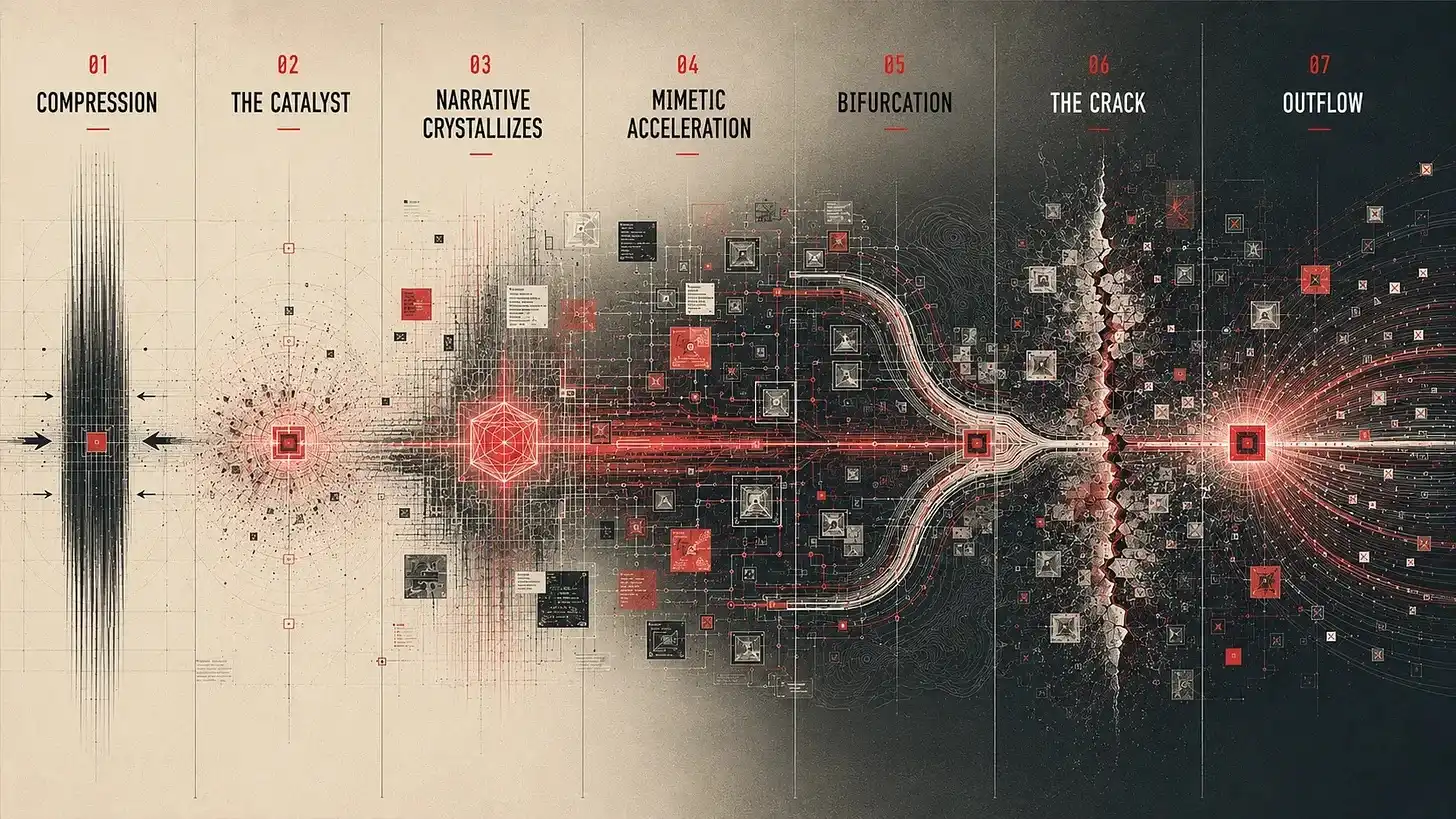
The life cycle of a theme is straightforward with distinct stages:

  • Dormancy: Various sectors languish in obscurity, receiving little attention. Even if out of favor, people keep working within them.
  • Ignition: A tangible catalyst—a technological breakthrough, regulatory shift, earnings beat—is spotted first by deep domain experts.
  • Narrative Formation: A marketable concept emerges, lowering the communication barrier. Even if purists dislike the simplification, a simple story enables broader participation.
  • Bifurcation: A clear divergence emerges. Beyond true believers, marginal buyers dwindle, and the gap between bullish and bearish valuations widens.
  • Breakdown: In hindsight, the top is always clear. Today, participants are eager to call the top early, a byproduct of online discourse and performance chasing. Once the narrative cracks, positioning unwinds, and capital seeks a new home.
  • New Theme Ignition: The outflowing capital moves to a new area, acting like the cold air wedge, sparking the next storm.

Looking Ahead

The implications of this new market regime are profound. We can predict the *shape* of moves but not precisely *where* each bubble will ignite.

Post-COVID, many argued market anomalies were temporary or specific to low rates. Some of that was true, but it's now clear the structural shift is permanent. The eight trends mentioned won't reverse:

  • Trading commissions won't rise again.
  • Passive investing won't shrink.
  • Traditional defined-benefit pensions are gone from the mainstream.
  • Social media and information flow will only accelerate.
  • Large multi-strategy platforms might evolve, but given their scale and profitability, they aren't disappearing soon.
  • Information lag won't re-appear.

Today's environment is the new "climatology." Expecting a return to the slow, stratiform markets of the 80s and 90s is refusing to face reality.

One argument is that successive bubbles will have shorter durations. This is hard to predict as markets become a game of anticipating others' anticipations. But one thing is certain: each cycle educates participants, potentially speeding up the next. Crypto traders are also adopting traditional finance playbooks. However, narrative-driven cycles have a natural lower bound; they can't accelerate infinitely.

This rotating bubble regime primarily benefits two types of investors: First, deep domain experts who understand the underlying technology, regulation, supply chains, and business models, and can judge if expectations are realistic. AI tools will make many mistakenly believe they belong here—a major risk. Second, trend observers. Most investors fall here, focusing on discerning what the sophisticated players are doing.

Meanwhile, the pipeline of investable themes remains rich: AI infrastructure & applications, robotics, embodied AI, precision medicine, crypto, materials science, fusion & advanced fission, grid storage, space, brain-computer interfaces, quantum. Even within a mega-theme, different subsectors and parts of the stack will experience their own mini-cycles.

Retail investors have inherent advantages in this market: time flexibility, agility, no investment committee meetings, no quarterly redemption pressures. The long-proven "buy the dip" strategy has also served them well. With proper risk management, retail can thrive in the new market.

Rising Above the Storm

Analyzing the causes of this market structure might sound like I'm making a value judgment. I do have opinions. In private markets, we can choose not to fund projects with negative social externalities. But in public markets, a common mistake is expecting the market to behave as you think it *should*.

This is a deep-seated human emotional flaw; even Newton fell victim to it, suffering massive losses.

Emotion is a major drag on returns. Perennially, asset managers appear in media predicting market tops and recessions—predictions repeated yet rarely realized.

The market isn't going back. Is this chain-reaction storm regime more pathological than the old one? I'm not sure. Objectively, many changes enabling it are positive: lower barriers to entry, automated retirement savings, accessible passive instruments, real-time information, democratizing market participation.

On the ground, each storm feels all-encompassing, vision limited to the immediate squall. That's exactly how participants in each sector bubble feel: it's a black hole absorbing all liquidity. Only by consciously raising your vantage point can you see the full chain: one theme fading, the next igniting, on and on. Participants in each cycle are mired in their own moment's euphoria or despair.

Financial markets fascinate because they constantly evolve, yet price discovery remains human-driven. Humans are emotional and repeat past mistakes. This tension creates what we see: seemingly chaotic and frenzied up close, but from a higher view, just one rolling bubble after another.

The core intent of this article is to encourage stepping out of the immediate storm, observing the market from a higher dimension, discerning the direction of thematic flows, and trying not to be swept away by the emotions of any single hotspot.

It's simple in concept but requires immense discipline. Easier said than done.

Related Questions

QAccording to the article, what is the main analogy used to describe the current financial market structure?

AThe article uses a meteorological analogy, comparing the current financial market to a mesoscale convective system (MCS), where individual 'storms' (market bubbles/hot trends) sequentially form, peak, and dissipate, triggering the next one, rather than a broad, slow-moving frontal system (traditional long bull/bear markets).

QWhat are the three key atmospheric conditions the article says are analogous to the prerequisites for the current chain-reaction market bubbles?

AThe three conditions are: 1) Warm, moist air near the surface (analogous to abundant retail speculative capital). 2) Cold, dry air aloft creating atmospheric instability (analogous to a market full of long-duration, narrative-driven assets with high valuation uncertainty). 3) Wind shear, or winds changing direction with altitude (analogous to the rapid information flow and capital rotation that provides the trigger for new trends).

QList at least four of the eight core structural shifts the author identifies as having permanently changed the market landscape.

AThe eight core shifts are: 1) Democratization of speculation. 2) The perpetual bid (from defined-contribution retirement plans). 3) Passive investing creating an inelastic counterparty. 4) The rise of multi-strategy funds and HFT, and the disappearance of the middle. 5) The artificial suppression of volatility. 6) The fundamental change in index composition. 7) The complete disappearance of information latency. 8) Fiscal and monetary regime change.

QAccording to the author, which two main types of investors are well-positioned to benefit in this new 'bubble rotation' market environment?

AThe two main types are: 1) Deep domain experts who can understand the underlying technology, regulations, and business models to judge if narratives will materialize. 2) Trend observers, who focus on tracking and understanding the actions of the dominant sophisticated players driving the trends.

QWhat is the article's final advice for navigating this new market structure, and why is it particularly challenging?

AThe final advice is to 'get above the storm'—to consciously elevate one's perspective to see the entire chain of rolling bubbles and identify the main sequence, avoiding being emotionally swept up by any single hot trend. It is challenging because it requires significant discipline and goes against basic human emotional instincts to focus on the immediate, all-consuming 'storm' one is in.

Related Reads

Elderly Borrow Money to Trade Stocks, Entire Nation Adds Leverage: 'Ant Army' Panics as South Korean Stock Market Plunges

Titled "Panic Among 'Ant Army' as South Korean Stocks Plunge After Elders Borrow to Invest, Everyone Leverages Up," this article details a dramatic reversal in South Korea's red-hot stock market. After a sustained rally toward 9,000 points driven by AI semiconductor hype, the KOSPI index recently crashed, triggering circuit breakers. The sell-off was led by major chipmakers Samsung Electronics and SK Hynix, whose combined weight in the index is over 50%. The plunge exposed the extreme leverage and speculative behavior that fueled the boom. Individual investors, dubbed the "ant army," had borrowed heavily or used leverage ETFs to chase gains, with trading accounts outnumbering the population. A significant portion of this leveraged money came from older citizens, some of whom reportedly cashed out insurance policies to invest. ETF trading became dominated (over 90%) by high-risk leveraged and inverse products. The correction was triggered by a pullback in U.S. tech stocks, leading to a foreign capital exodus and a weakening Korean won, creating a vicious cycle. While President Lee Jae-myung attempted to reassure markets and NVIDIA's CEO signaled support during a visit, officials like Finance Minister Ju Yeong-geun expressed concern over the dangerous "herd mentality." The article highlights a pervasive, high-risk investment culture where everyone from office workers to retirees and even parents opening accounts for newborns sought quick profits, largely concentrated in a few tech stocks, setting the stage for a sharp and painful correction.

marsbit6m ago

Elderly Borrow Money to Trade Stocks, Entire Nation Adds Leverage: 'Ant Army' Panics as South Korean Stock Market Plunges

marsbit6m ago

From Hunyuan to WeChat AI: Tencent's Slow Paced Journey Reaches the Delivery Juncture

On June 8, 2026, WeChat's developer platform announced the internal testing of "WeChat AI," an AI assistant integrated into the WeChat ecosystem. It allows users to invoke, access, and operate Mini Programs through natural language conversation. The platform offers two access modes: an "Automatic Mode" where developers authorize platform access to their source code for zero-configuration AI operation, and a "Developer Mode" for building custom skills. While the name "WeChat AI" is provisional, this marks WeChat's first step in opening its vast Mini Program ecosystem—comprising over 400,000 developers and hundreds of millions of daily active users—to AI-driven conversational interaction. This move represents the latest step in Tencent's deliberate AI strategy, moving from technical R&D and standalone product validation to integration within its super-app. The underlying foundation is Tencent's self-developed Hunyuan large language model. Ranked first domestically in application-oriented capabilities like Agent task execution in 2025, Hunyuan's focus on stability and precision over raw parameter count aligns with WeChat AI's need for reliable, low-latency operations involving sensitive tasks like payments and bookings. Prior C-side validation came from "Yuanbao," a standalone AI app whose Monthly Active Users (MAU) surpassed 114 million during the 2026 Chinese New Year红包 campaign, though daily activity later subsided. This "pulse growth" highlighted the challenge of user retention for standalone apps, informing the decision to integrate AI natively into WeChat's high-frequency scenarios. However, WeChat AI's "Automatic Mode," which requires source code access, raises developer concerns about code security, data visibility, and liability for AI errors. A deeper, ecosystem-level tension exists between the efficiency of centralized AI task调度 and the potential "short-circuiting" of merchant pages, which could erode their branding, advertising revenue, and user engagement. As Tencent Chairman Pony Ma noted, balancing centralized AI调度 with the protection of decentralized merchant traffic is a core challenge. In summary, Tencent's AI path—comprising the stable Hunyuan base model, the user-validated Yuanbao app, and the newly testing WeChat AI integration—is logically coherent. The success of WeChat AI now hinges on resolving developer trust, establishing fair ecosystem rules for merchants, and ensuring operational reliability to gain user confidence for deep, transactional use.

marsbit6m ago

From Hunyuan to WeChat AI: Tencent's Slow Paced Journey Reaches the Delivery Juncture

marsbit6m ago

STRC Briefly Fell Below $91: Will Strategy Be Hunted by 'Market Fear'?

The article draws a parallel between FTX's 2022 collapse and the current situation facing MicroStrategy (Strategy), a major corporate holder of Bitcoin. The author argues that MicroStrategy's financial model, heavily reliant on issuing equity and convertible debt at a premium to its Bitcoin holdings, is under stress. The core issue is the compression of MSTR's stock premium over its Bitcoin holdings (NAV). This erodes the viability of its "flywheel" – using equity sales to buy more Bitcoin. The company has shifted towards preferred shares (like STRC) and debt to raise capital, incurring significant dividend and interest obligations (approximately $1.7 billion annually). With cash reserves dwindling and debt maturities looming, MicroStrategy faces mounting pressure to generate cash. The article outlines three problematic options: 1) cutting preferred dividends, damaging investor confidence; 2) issuing more MSTR stock at low premiums, diluting existing shareholders; or 3) selling Bitcoin, which founder Michael Saylor had vowed against but recently did in a small symbolic transaction. The author suggests that, like FTX, a crisis of confidence could trigger a rapid downward spiral as investors flee. While noting Saylor's actions are legal—unlike SBF's fraud at FTX—the article warns the structural risk born from financial engineering and over-leverage is significant. The preferred path out is a sharp rise in Bitcoin's price to restart the premium flywheel, but this would only create a larger, more complex system vulnerable to future failure. The author concludes by advocating for direct Bitcoin ownership over exposure through MicroStrategy's increasingly risky financial structure.

Foresight News21m ago

STRC Briefly Fell Below $91: Will Strategy Be Hunted by 'Market Fear'?

Foresight News21m ago

The Battle for the AI Payment Race: Traditional Card Networks Face Off Against Coinbase

With the rise of AI agents conducting transactions, a battle for the underlying payment infrastructure is underway. Two distinct and incompatible approaches have emerged for enabling autonomous AI payments. The first approach is championed by traditional card networks Visa and Mastercard. They leverage their existing tokenized card credential systems, extending them to allow verified AI agents to make purchases within user-defined limits. Services like Mastercard's Agent Pay and Visa's Intelligent Commerce integrate with major AI platforms (e.g., OpenAI, Anthropic) and keep transactions within the established, decades-old card payment model. This system offers advantages for consumer retail, including robust fraud protection, chargeback mechanisms, and extensive merchant networks. The second approach, led by Coinbase, utilizes stablecoins on open internet protocols. Its x402 protocol reactivates the HTTP 402 status code for machine-to-machine micropayments, using USDC for settlement directly on-chain. This method eliminates the need for accounts or card fees, making it highly efficient for high-frequency, low-value, cross-border transactions between AI agents—such as paying for API calls, data streams, or computational resources—where traditional card fees and settlement times are impractical. While card networks excel in consumer-facing scenarios requiring dispute resolution, stablecoin protocols are tailored for machine economies. A key challenge for both is agent identity verification and transaction authorization. Notably, Visa and Mastercard are hedging their bets by also investing in stablecoins. Visa has rapidly grown its stablecoin settlement volume and is collaborating with Coinbase to bridge its network with the x402 protocol. Mastercard plans to acquire stablecoin platform BVNK. Their strategy is to become the fee-collecting gateway for all payment flows, regardless of the channel. Current applications reflect this division: consumer AI shopping tools (e.g., ChatGPT's checkout, Amazon's "Shop for Me") predominantly use card networks, while machine-focused services (e.g., Amazon Bedrock's core payments) adopt stablecoins via the x402 protocol. In the short term, a coexistence model is expected, with cards dominating retail and stablecoins powering machine transactions. The long-term outcome depends on whether AI-driven commerce evolves to resemble traditional retail or becomes a vast network of machine micropayments. By investing in both tracks, the incumbent card networks are positioning themselves to capture transaction fees regardless of which future prevails.

marsbit33m ago

The Battle for the AI Payment Race: Traditional Card Networks Face Off Against Coinbase

marsbit33m ago

Trading

Spot
Futures

Hot Articles

What is LINON

Linde plc Tokenized Stock (Ondo): Revolutionizing Traditional Equity Access Through Blockchain Innovation The emergence of Linde plc Tokenized Stock (Ondo), represented by the ticker $LINON, signifies a monumental shift in the fusion of traditional financial structures and decentralized finance (DeFi). This innovative financial instrument showcases the tremendous potential of blockchain technology to democratize access to traditional equity markets while ensuring the security and regulatory compliance necessary for institutional-grade financial products. Through Ondo Finance's pioneering tokenization platform, $LINON provides a seamless pathway for global investors to engage with one of the world's leading industrial gas companies, Linde plc, creating a blockchain-native representation of the underlying equity. Introduction to Linde plc Tokenized Stock The landscape of financial markets is witnessing a groundbreaking transformation through the tokenization of real-world assets. Linde plc Tokenized Stock (Ondo) epitomizes this revolutionary approach by bridging the gap between conventional stock ownership and blockchain-enabled financial infrastructure. The $LINON token allows investors to gain exposure to one of the prominent industrial companies worldwide through decentralized technology. Operating within Ondo Finance's comprehensive ecosystem, $LINON symbolizes a practical application of tokenization technology that enhances accessibility, efficiency, and global connectivity in traditional financial markets. By leveraging blockchain infrastructure, this tokenized stock enables international investors to participate in U.S. equity markets, overcoming traditional barriers associated with cross-border investing. The significance of $LINON goes beyond technological innovation; it represents a fundamental shift in asset structuring, distribution, and trading in the digital age. This tokenized stock maintains all the economic benefits associated with traditional Linde plc shares while offering improved liquidity, programmable compliance features, and seamless integration with decentralized finance protocols. The development of $LINON indicates a growing acceptance of blockchain technology as a viable means for traditional finance, exemplifying how even well-established assets like Linde plc can integrate into blockchain systems. This approach preserves the core attributes that appeal to investors while introducing advanced capabilities that enhance the overall investment proposition. Project Overview and Objectives Linde plc Tokenized Stock (Ondo) encapsulates a strategic effort to democratize access to traditional equity markets through advanced blockchain technologies. The primary objective of $LINON is to provide approved global investors seamless access to the economic exposure associated with Linde plc shares, furthering an effort to create a more inclusive financial ecosystem. Beyond the digital representation of traditional assets, $LINON endeavors to eliminate barriers of geography and time zones that limit investor participation. Its design ensures that blockchain technology can elevate traditional investment vehicles without undermining the security or compliance requirements expected by investors. Key goals of the project include enhanced liquidity provision, programmable compliance mechanisms, and interoperability with other blockchain networks. Each $LINON token is fortified by actual Linde plc securities housed at U.S.-registered broker-dealers, allowing holders to reap economic advantages akin to traditional stockholders, such as dividend reinvestment. Furthermore, $LINON aims to establish new industry standards for institutional-grade tokenized securities, paving the way for traditional assets to embrace blockchain technology while remaining compliant with regulatory frameworks. By associating itself with a company as reputable as Linde plc, the project opens avenues for exploring tokenized equities catering to both conservative institutional players and daring retail investors. Project Creator and Development Team The vision for Linde plc Tokenized Stock (Ondo) comes from Nathan Allman, founder and CEO of Ondo Finance. His background in traditional finance coupled with expertise in blockchain technology positions him uniquely to navigate the complexities of asset tokenization. Allman's academic journey began at Brown University, focusing on Economics and Biology, equipping him with valuable analytical skills. His time at Goldman Sachs in the Digital Assets division strengthened his understanding of the interplay between financial institutions and emerging technologies, laying the groundwork for his later endeavors in alternative investment strategies. Under Allman's guidance, Ondo Finance has emerged as a leader in asset tokenization, launching $LINON as a flagship example of the company's larger mission towards revolutionizing traditional financial systems using blockchain technology. His commitment to leveraging blockchain for creating institutional-grade financial products has shaped the landscape of real-world asset tokenization. Investment and Funding Structure The growth of Ondo Finance, the platform powering Linde plc Tokenized Stock (Ondo), is bolstered by robust financial backing from prestigious venture capital firms and strategic investors. This strong investment foundation underpins the development of the key infrastructure essential for compliant tokenized securities like $LINON. In August 2021, Ondo Finance secured $4 million in seed funding led by a major venture capital firm, which enabled the company to commence platform development and establish the necessary regulatory processes for tokenizing real-world assets. This early investment cemented Ondo Finance's credibility within the industry. The Series A funding round followed, garnering $20 million with participation from renowned firms committed to transformative technology companies. This backing demonstrated substantial institutional confidence in Ondo Finance's vision, allowing it to hone its approach to asset tokenization through mechanisms that ensure compliance and accessibility. Noteworthy contributors, including institutional investors and experienced partners, have added significant value to Ondo Finance’s development efforts. Their involvement underscores the confidence across sectors in Ondo Finance's approach to bridging traditional finance with blockchain innovations. Technical Infrastructure and Innovation The technical architecture that underpins Linde plc Tokenized Stock (Ondo) represents a sophisticated melding of traditional finance systems and cutting-edge blockchain technology. The architecture's foundation is built on the Ethereum network, renowned for its security and programmability—both critical for intricate financial instruments. The $LINON tokenization process comprises creating a blockchain-native representation of Linde plc shares that preserves economic benefits while augmenting investor capabilities. Each token corresponds to actual shares held at U.S.-registered broker-dealers, creating a compliant custody structure that legitimizes the asset's existence and value. Automated compliance systems are integrated into the tokenization process, managing critical components such as know-your-customer (KYC) verification and anti-money laundering (AML) protocols. This incorporation of programmable compliance empowers $LINON to uphold regulatory standards essential for institutional proliferation. Cross-chain interoperability characterizes the advanced technical features of $LINON. While initially deployed on Ethereum, the framework is designed for expansion to other networks such as Solana and BNB Chain. This adaptability enhances liquidity and accessibility, allowing investors to select their preferred blockchain ecosystems. Historical Timeline and Development Crafting the history of Linde plc Tokenized Stock (Ondo) unfolds in parallel with the evolution of Ondo Finance's tokenization platform. The timeline's inception dates back to March 2021 when Nathan Allman laid the foundations for creating institutional-grade financial products on blockchain infrastructure. The initial funding round in August 2021 provided crucial resources for developing the platform and establishing partnerships necessary for effective tokenization. By January 2023, Ondo Finance launched its tokenized treasury products, establishing mechanisms that would facilitate future tokenized equities such as $LINON. A pivotal milestone arose in February 2025 when Ondo Chain—a Layer 1 blockchain designed specifically for asset tokenization—was introduced. This infrastructure enhances capabilities vital for institutional markets, demonstrating Ondo Finance's long-term commitment to tokenization. Subsequently, the launch of Ondo Global Markets in September 2025 marked the official debut of $LINON. This milestone showcased the successful transition from development to active trading, enabling investors around the world to access American financial markets seamlessly. Ongoing development plans include a targeted expansion of available tokenized assets to over 1,000 by the end of 2025, pointing to a bright future for Ondo Finance's ecosystem and its mission to broaden tokenized equity accessibility. Regulatory Compliance and Legal Framework The legal architecture governing Linde plc Tokenized Stock (Ondo) emphasizes a sophisticated approach to regulatory compliance, allowing tokenized securities to be implemented within a blockchain-based framework. The legal structure governing $LINON spans multiple jurisdictions while maintaining a robust legal footing. Compliance systems ensure that only eligible investors can access the token, enforced through automated verification that aligns with international regulations. This innovative regulatory technology promises real-time enforcement of complex requirements, considerably enhancing efficiency in operating within the regulatory landscape. The custody framework undergirding $LINON ensures that the underlying shares are securely held at U.S.-registered broker-dealers, complying with necessary regulations while delivering blockchain-driven access to investors. The token maintains its economic equivalency and security through this carefully structured custody arrangement. KYC and AML compliance systems are embedded within the smart contract architecture, ensuring integrity and adherence to regulatory practices while fostering transparency for investors. The jurisdictional restrictions mark a commitment to navigating the evolving landscape of international securities laws. Market Impact and Industry Significance The advent of Linde plc Tokenized Stock (Ondo) holds profound implications for the broader financial landscape, symbolizing a clear shift towards blockchain-enabled markets. $LINON serves as a proof-of-concept for integrating traditional companies into blockchain ecosystems, showcasing the potential benefits such as broader accessibility and improved efficiency. The market's response to $LINON indicates a growing acceptance of tokenization among institutional investors, contributing to the emergence of an expanding sector wherein traditional assets can be interconnected with blockchain innovations. The success of $LINON further solidifies market confidence, indicating an overarching shift towards recognizing asset tokenization as a transformative force in finance. Future Development and Expansion Plans The future trajectory for Linde plc Tokenized Stock (Ondo) centers around the expansion of the tokenization ecosystem and enhanced infrastructure supporting blockchain-enabled financial services. Plans for cross-chain integration usher in new opportunities for liquidity and flexibility within the investment framework, with existing capabilities poised for continuous enhancement. With the introduction of Ondo Chain, Ondo Finance aims to transition $LINON to an optimized blockchain environment specifically designed for asset tokenization. This new infrastructure heralds exciting prospects for the development of institutional-grade financial products, ensuring ongoing compatibility with contemporary investment strategies. Further integration with decentralized finance protocols signifies a commitment to empowering $LINON holders through advanced financial strategies. The anticipated expansion of available tokenized assets promises to broaden investor access, enhancing the utility and appeal of the platform. In alignment with ambitions for regulatory expansion, ongoing efforts to secure approvals for new jurisdictions will enhance investor access, further positioning $LINON at the forefront of the burgeoning tokenization market. Conclusion Linde plc Tokenized Stock (Ondo), as represented by the $LINON token, stands at the intersection of traditional finance and blockchain innovation. It embodies a transformative milestone in how financial assets are structured, distributed, and engaged within modern investment ecosystems. The technical sophistication behind $LINON, combined with its regulatory compliance framework, illustrates that asset tokenization can improve financial infrastructure rather than simply digitizing existing products. This pioneering effort not only enhances investor access to U.S. equity markets but also signifies an evolution of how traditional financial services can integrate blockchain technology. As the asset tokenization market grows exponentially, with prospects suggesting significant valuation increases, $LINON paves the way for a future where tokenized securities become standard fixtures in the financial landscape. The trajectory of $LINON will undoubtedly influence how traditional finance adapts to a transformed, blockchain-powered world.

3.1k Total ViewsPublished 2025.12.05Updated 2025.12.05

What is LINON

What is CRMON

Salesforce Tokenized Stock (Ondo): Revolutionising Traditional Equity Access Through Blockchain Innovation The emergence of Salesforce Tokenized Stock (CRMON) marks a pivotal advancement in integrating traditional financial markets with blockchain technology. This innovative approach offers investors unprecedented access to equity exposure through tokenisation. Developed by Ondo Finance, CRMON provides tokenholders with economic exposure equivalent to holding Salesforce stock (CRM) while automatically reinvesting dividends. This effectively bridges the gap between conventional equity markets and decentralised finance (DeFi). Introduction and Comprehensive Overview of Salesforce Tokenized Stock In recent years, the financial landscape has dramatically transformed due to blockchain technology, fundamentally altering how investors access and interact with traditional assets. The development of Salesforce Tokenized Stock (CRMON) is a prime example of this evolution, representing a sophisticated fusion of conventional equity markets with cutting-edge distributed ledger technology. CRMON is a tokenised version of Salesforce stock, emerging from the innovative work of Ondo Finance, a leading platform in the real-world asset tokenisation sector that positions itself as a bridge between traditional finance and decentralised systems. Designed to provide tokenholders with economic exposure that mirrors the performance of the underlying Salesforce stock, CRMON incorporates automatic dividend reinvestment mechanisms. This eliminates many traditional barriers associated with international equity investment, such as complex brokerage relationships, currency conversion challenges, and restricted trading hours. The tokenisation process reimagines stock ownership as a blockchain-native asset while maintaining its economic equivalence with the underlying security, offering enhanced portability and integration capabilities within decentralised finance ecosystems. CRMON transcends its individual utility as an investment instrument to represent a fundamental shift in how financial markets can operate in an increasingly digital world. By maintaining full backing through U.S.-registered broker-dealers and implementing robust compliance frameworks, CRMON demonstrates that tokenised securities can achieve the regulatory standards necessary for institutional adoption while delivering the technological advantages of blockchain infrastructure. Understanding Tokenized Real-World Assets and CRMON's Strategic Position Tokenised real-world assets signify one of the most significant innovations in modern finance, fundamentally reimagining how traditional securities are represented, traded, and utilised within digital ecosystems. CRMON operates as a tokenised equity instrument correlating directly with Salesforce stock while optimising accessibility and efficiency. This aligns with Ondo Finance's broader mission to democratise access to institutional-grade financial products through innovative tokenisation strategies. The tokenisation process guarantees complete economic equivalence with the underlying Salesforce equity. Each CRMON token represents a proportional claim on Salesforce stock held by qualified custodians, with dividend payments automatically reinvested to maintain continuous exposure to total return performance. This structure simplifies dividend management and ensures that tokenholders receive the full economic benefit of their equity exposure, encompassing both capital appreciation and income generation. Ondo Finance's strategy in tokenising Salesforce stock demonstrates its expertise in creating compliant, institutional-grade products that meet traditional financial markets' stringent requirements. The platform’s focus on merging regulatory compliance with blockchain benefits positions it at the forefront of decentralised finance, captivating both institutional and retail investors seeking blockchain-native solutions. The Technology and Innovation Framework Behind CRMON The technological infrastructure supporting CRMON integrates blockchain technology with traditional financial mechanisms, delivering institutional-grade security and compliance while maintaining the operational advantages of decentralised systems. Built on the Ethereum blockchain, CRMON utilises robust smart contract capabilities to ensure transparent, secure operations. The smart contract architecture incorporates layered security and compliance mechanisms, enabling automated compliance checks and real-time asset backing verification. Integration with oracle services maintains accurate pricing and dividend information, ensuring CRMON reflects the underlying Salesforce stock's accurate performance. This architecture delivers automated dividend reinvestments and other corporate actions, eliminating manual processing requirements and directly enhancing tokenholder benefits. Ondo Finance ensures CRMON's security structure includes daily third-party verification of holdings, independent collateral agents, and a multiple-layer custody system through partnerships with established financial institutions. This framework safeguards tokenholder interests against operational risks while providing robust asset backing. The user interface enhances integration capabilities, allowing seamless interaction between CRMON and various decentralised finance protocols, as well as cryptocurrency exchanges. This interoperability enables users to leverage their tokenised equity across multiple platforms, creating sophisticated investment strategies that marry traditional equity characteristics with blockchain-native innovation. Leadership and Corporate Structure of Ondo Finance The leadership team behind CRMON and Ondo Finance blends expertise from traditional finance and blockchain technology, presenting a robust combination of skills essential for successfully bridging conventional markets with decentralised finance. Nathan Allman, the founder and CEO, emerged from a distinguished financial background before establishing Ondo Finance in 2021. Allman's experience includes notable roles at major financial institutions, including significant contributions to developing cryptocurrency market services. His insights into regulatory compliance were paramount in developing products like CRMON that successfully unify traditional securities with blockchain technology. With a team of professionals boasting substantial experience in both conventional finance and blockchain sectors, Ondo Finance's leadership comprises diverse expertise that covers every aspect of tokenised asset development. Justin Schmidt serves as President and COO, contributing unique operational expertise, while Chris Tyrell brings essential compliance knowledge. Investment Landscape and Funding History The investment landscape surrounding Ondo Finance reflects significant institutional confidence in its mission to tokenise real-world assets. The company has raised substantial funds through various investment rounds, attracting leading venture capital firms and strategic investors that recognise the transformative potential of tokenised securities like CRMON. Notably, Ondo Finance completed a successful Series A funding round in 2022, led by well-known venture capital firms. This funding success validates Ondo Finance's innovative approach to creating compliant, institutional-grade tokenised products. In total, Ondo Finance has successfully secured substantial funding, raising significant capital for product development and market expansion, including a noteworthy token sale that reinforced its governance structure through the establishment of the ONDO token. The diverse composition of investors reflects broad market confidence in Ondo Finance's business model, demonstrating support from both traditional and blockchain-native organisations. Operational Mechanics and Technical Implementation The operational framework supporting CRMON exemplifies sophisticated integration of traditional financial mechanisms with blockchain technology. The technical implementation introduces multiple layers of security, compliance, and operational efficiency to meet institutional standards while enhancing accessibility. The tokenisation process begins by acquiring actual Salesforce stock through U.S.-registered broker-dealers, ensuring each CRMON token maintains direct correlation with the underlying equity performance. Smart contracts automate operational processes, including dividend reinvestment and corporate action processing, facilitating a streamlined user experience. The Minting and redemption processes allow authorised participants to manage CRMON tokens effectively. During U.S. trading hours, institutions can mint new tokens by depositing stablecoins that are used to purchase corresponding Salesforce equity. This structure maintains a tight correlation with underlying assets, enhancing liquidity and price discovery. Additionally, the infrastructure supports twenty-four-hour token transfer capabilities, providing CRMON holders with operations outside traditional market hours. This represents a significant advantage over conventional securities ownership, thus promoting integration with decentralised finance applications. Plans for cross-chain compatibility through partnerships signal further ambitions for CRMON's market reach. By expanding to other blockchain networks, Ondo Finance aims to enhance accessibility and user engagement with tokenised equity products. Timeline and Historical Development of Tokenized Equity Innovation The timeline of CRMON's development and Ondo Finance's broader tokenised capabilities demonstrates a systematic innovation process beginning with the company's founding in 2021. 2021: Ondo Finance is founded by Nathan Allman and co-founders, launching initial products focused on structured vault offerings on the Ethereum blockchain. 2022: The company completes substantial funding rounds—both equity and token sales—totaling significant capital and launching initial tokenised U.S. Treasury products. 2023-2024: Ondo Finance experiences substantial growth, establishing partnerships with major financial institutions while expanding its product offerings beyond fixed-income securities. February 2025: Ondo Global Markets is announced, marking the transition into equity tokenisation with plans for accessing over one hundred U.S. stocks and ETFs. September 2025: The official launch of Ondo Global Markets includes CRMON alongside other tokenised equity offerings, marking a significant evolution in Ondo Finance's product ecosystem. This timeline highlights the organisation's rapid growth and its capability to adapt its technological and compliance frameworks to accommodate different asset classes effectively while maintaining security and regulatory integrity. Regulatory Framework and Compliance Approach Ondo Finance's regulatory framework showcases a sophisticated compliance strategy, essential for achieving institutional adoption in the tokenised securities market. The company's strong partnerships with U.S.-registered broker-dealers promote adherence to Securities and Exchange Commission regulations and apply robust investor protections. Acquisitions, such as Oasis Pro—a registered broker-dealer—significantly enhance Ondo Finance's compliance capabilities, ensuring thorough alignment with existing regulatory structures. The company employs independent verification procedures that foster transparency, aiming for a solid performance standards reputation. Furthermore, Ondo Finance's commitment extends to international regulatory compliance, ensuring token access remains restricted to eligible investors while adhering to pertinent cross-border securities regulations. Comprehensive attention to tax implications and reporting requirements fortifies the security and compliance landscape of CRMON, ensuring that investor obligations remain manageable. Future Prospects and Market Positioning The forward-looking landscape for CRMON and Ondo Finance illustrates substantial growth opportunities driven by institutional adoption of blockchain technology and escalating demand for efficient alternatives to conventional securities ownership. Market projections indicate the tokenised asset sector could value multiple trillion dollars by 2030. With plans to scale CRMON offerings significantly and integrate it with a dedicated blockchain infrastructure—Ondo Chain—Ondo Finance aims to elevate its institutional-grade tokenised asset operations. Additionally, the development of strategic partnerships enhances distribution capabilities while establishing the company's credibility in the financial market. Furthermore, the integration of tokenised equity with decentralised finance protocols offers new potential for innovative financial products and strategies previously impossible with traditional securities. These factors underscore CRMON's positioning to effectively capture increased market share and deliver innovative solutions for international investment exposure. Conclusion Salesforce Tokenized Stock (CRMON) symbolises a transformative development within financial markets, successfully bridging traditional equity ownership with blockchain technology to create unprecedented accessibility for global investors. Through Ondo Finance's sophisticated tokenisation framework, CRMON provides complete economic exposure to Salesforce equity performance while enhancing operational advantages that exceed traditional ownership. The launch of CRMON reflects the broader evolution of financial markets towards blockchain infrastructures that maintain regulatory compliance while delivering increased efficiency. Ondo Finance's extensive approach to regulatory adherence, institutional-grade security, and technological innovation solidifies CRMON as a model for future tokenised securities, delivering access previously unattainable in conventional brokerage structures. As the tokenised asset sector continues to develop, CRMON is well-positioned to address historical inefficiencies in capital markets while providing investors with innovative solutions for accessing traditional securities. The outlook for CRMON looks exceptionally promising, supported by ambitious expansion plans, technological innovations, and strategic partnerships, thereby representing a pioneering model of modern financial infrastructure evolving through blockchain integration.

3.2k Total ViewsPublished 2025.12.05Updated 2025.12.05

What is CRMON

What is SHOPON

Shopify Tokenized Stock (Ondo): A Comprehensive Analysis of Real-World Asset Tokenization in Web3 This article delves into the Shopify Tokenized Stock (Ondo), recognised by its ticker symbol $SHOPON, exploring its implications at the intersection of traditional finance and blockchain technology. As a part of Ondo Finance's tokenized securities platform, Shopify’s tokenized stock exemplifies advancements in democratizing access to global capital markets through innovative digital assets. Introduction and Overview of Shopify Tokenized Stock (Ondo) Shopify Tokenized Stock (Ondo), or $SHOPON, portrays a pivotal innovation in the realm of tokenized securities, allowing investors to gain economic exposure akin to directly owning shares of Shopify Inc. This token, developed under the umbrella of Ondo Finance, not only provides investors with the ability to hold digital representations of the company’s stock but also integrates features such as automatic reinvestment of dividends. This advancement represents a substantial shift in the landscape of decentralized finance (DeFi), linking conventional equity markets with blockchain solutions designed to enhance accessibility, transparency, and liquidity. By eliminating geographical barriers and enabling 24/7 trading capabilities, $SHOPON is positioned as a bridge connecting traditional financial instruments and the emerging Web3 ecosystem. What is Shopify Tokenized Stock (Ondo), $SHOPON? The $SHOPON token serves as a digital manifestation of Shopify Inc.'s shares, engineered to provide a direct correlation to the underlying asset's performance. Through the utilization of blockchain technology, the token gives holders a mechanism to participate in the economic benefits associated with equity ownership, including capital appreciation and dividend distribution. The unique aspect of $SHOPON lies in its automatic dividend reinvestment mechanism, which allows returns to compound without necessitating active management by the investor. This feature inherently enhances its attractiveness as an investment vehicle, particularly for individuals seeking passive income growth alongside exposure to high-performing equities. The tokenization process is facilitated by the custody of actual Shopify shares through regulated intermediaries, ensuring that every $SHOPON token is verifiably backed by real equity. This structure empowers investors with the dual advantages of both traditional financial characteristics and the innovative benefits tied to blockchain technology. Who is the Creator of Shopify Tokenized Stock (Ondo)? The creator of Shopify Tokenized Stock (Ondo), Nathan Allman, is an experienced figure in the finance sector, formerly associated with Goldman Sachs. His rich background includes significant expertise in digital asset development, bridging the gap between traditional finance and cryptocurrencies. Allman’s educational journey, marked by studies at Brown University, provided him with a deep understanding of economics and biology, equipping him with analytical skills that inform his strategic vision. In 2021, he founded Ondo Finance, committing to developing tokenized securities that meet institutional-grade standards while leveraging blockchain's transformative capabilities. Under Allman's leadership, Ondo Finance has focused on creating compliant and innovative financial products that empower a diverse investor base. Who are the Investors of Shopify Tokenized Stock (Ondo)? The investment landscape surrounding Shopify Tokenized Stock (Ondo) is notably robust, underpinned by significant institutional support. Primarily, Pantera Capital stands out as a strategic partner through the Ondo Catalyst initiative, a $250 million commitment aimed at accelerating the development of on-chain capital markets. This partnership not only signifies institutional confidence in the potential of tokenized assets but also reinforces Ondo Finance's operational capabilities and market positioning. The funding pathways have included earlier rounds that amassed millions in seed funding and further structural investments, solidifying relationships with both venture capital firms and private investors. Moreover, the financial framework is complemented by strategic partnerships with established financial institutions and technology companies, enhancing Ondo’s infrastructure and operational expertise. How Does Shopify Tokenized Stock (Ondo), $SHOPON Work? At the core of $SHOPON's operational framework is a sophisticated system integrating traditional finance mechanisms with blockchain technology. The custody of actual Shopify shares ensures that token holders retain authentic economic exposure, safeguarding their investments in line with recognized legal structures. The smart contracts employed in managing $SHOPON handle various functions, including automatic dividend reinvestment and ownership transfer, offering instant settlement and increased liquidity, marking a significant departure from conventional trading systems plagued by multi-day settlement delays. By providing interoperability with other decentralized finance applications, $SHOPON empowers holders with potentially lucrative opportunities for advanced investment strategies, including lending and automated market making. This complex integration presents a unique value proposition, catering to both traditional and crypto-native investors. The innovative structure of $SHOPON also allows for real-time settlements and transactions documented on the blockchain, delivering unparalleled transparency and security—a major advancement over standard equity trading practices. Timeline of Shopify Tokenized Stock (Ondo) March 2021: Nathan Allman establishes Ondo Finance, initially focusing on decentralized finance yield optimization. August 2021: Completion of a $4 million seed funding round led by Pantera Capital. January 2023: Launch of initial tokenized treasury security products, laying the groundwork for future equity tokenization. July 2025: Announcement of the Ondo Catalyst initiative, a strategic investment program valued at $250 million, aimed at propelling the development of tokenization in capital markets. September 3, 2025: Launch of Ondo Global Markets featuring over 100 tokenized U.S. stocks and ETFs, including $SHOPON. Technical Implementation and Blockchain Infrastructure Shopify Tokenized Stock (Ondo) operates on a technical architectural framework that marries blockchain protocols with traditional financial custody arrangements. The ecosystem leverages Ethereum's smart contract capabilities, providing seamless transaction management while ensuring compliance with regulatory standards through established financial custodians. Central to this architecture are security measures and transparent transaction records that affirm the legitimacy of each tokenholder's economic stake. With automated features managed by intricate smart contracts, $SHOPON not only streamlines ownership transfers but also allows for the tactical reinvestment of dividends—a hallmark of modern investment strategies. Moreover, the incorporation of LayerZero technology facilitates cross-chain interoperability, making $SHOPON accessible across multiple blockchain environments while preserving its functional robustness. This forward-thinking technical design positions $SHOPON as an adaptable asset within the larger DeFi milieu. Regulatory Framework and Compliance Architecture $SHOPON's regulatory framework is built upon the meticulous navigation of existing financial regulations that govern securities. The custody arrangements for the underlying Shopify shares are managed by U.S.-regulated broker-dealers, ensuring compliance and protection for investors. By maintaining a separation between the blockchain tokenization process and traditional custody, $SHOPON adheres to legal requirements while offering innovative functionalities that challenge conventional constraints. This dual-layered compliance approach enhances investor confidence and underscores Ondo Finance's commitment to regulatory integrity. Notably, the availability of $SHOPON is tailored to international investors from regions such as Asia-Pacific, Europe, and Africa, as regulatory parameters in the U.S. and U.K. present challenges in accessing tokenized securities. Market Access and Global Distribution Strategy The distribution strategy of $SHOPON is keenly designed to optimize global access while conforming to regulatory standards. The platform aims to establish comprehensive coverage for eligible investors across multiple regions, effectively dismantling traditional barriers through the implementation of blockchain technology. Integration with various cryptocurrency wallets and exchanges also promotes user-friendliness and accessibility, establishing a streamlined experience for investors to manage their holdings. Moreover, the 24/7 trading capabilities afforded by the tokenized model allow participants to react promptly to market shifts, fundamentally transforming how global equities are accessed and traded. Technology Integration and Cross-Chain Functionality The remarkable technological underpinnings of $SHOPON propagate its multi-chain functionality, set to expand its reach beyond Ethereum to networks such as Solana and BNB Chain. Such cross-chain capabilities allow users flexibility when navigating between blockchains, concurrently leveraging distinct network attributes to optimize their trading experience. LayerZero serves as the backbone for ensuring decentralized transfers between networks while providing the requisite security and speed, quintessential for maintaining investor trust. This comprehensive interoperability illustrates $SHOPON's commitment to being a versatile, user-centric asset in the evolving investment landscape. Ecosystem Integration and DeFi Compatibility Incorporating $SHOPON into broader DeFi protocols signifies its potential beyond traditional stock ownership. Token holders can leverage their holdings for various sophisticated strategies and applications, enhancing investment returns and liquidity management. By establishing a presence in lending protocols and automated trading systems, $SHOPON effectively democratizes access to advanced financial strategies previously limited to institutional investors. Such integration contributes to a more competitive and dynamic financial landscape, where individual investors can capitalize on tools typically reserved for larger entities. Risk Management and Security Framework Security remains paramount in the operational infrastructure of $SHOPON. The tokenization framework employs multiple layers of protection—beginning with regulated custody of the underlying Shopify shares. The operational protocols establish rigorous auditing, key management, and transaction monitoring standards, thus safeguarding against potential vulnerabilities. Moreover, meticulous adherence to evolving regulatory requirements provides an extra layer of security, fortifying investor protections and institutional compliance. Market Impact and Industry Implications The introduction of Shopify Tokenized Stock (Ondo) heralds a transformative shift in how financial markets operate, emphasizing the potential of tokenized securities to reshape traditional investment paradigms. The successful integration of $SHOPON encapsulates the efficiencies inherent in blockchain technology and opens avenues for new user demographics previously barred from extensive market participation. The impact extends beyond the immediate benefits to token holders, indicating broader trends that may challenge the status quo of investment services, particularly in addressing geographic restrictions and operational costs typically associated with traditional brokerage platforms. Undeniably, $SHOPON encapsulates the potential for traditional institutions to innovate further, leveraging the increasing demand for seamless blockchain access to complement existing financial infrastructure. Future Development Roadmap and Strategic Vision As Ondo Finance looks forward, the trajectory of $SHOPON rests on ambitious goals aimed at broadening the spectrum of available tokenized assets significantly. Over the next few years, plans are in place to expand to more than 1,000 tokenized securities, further enhancing market participation and investment options for individuals worldwide. Continued integration with traditional financial actors, development of specialized institutional products, and enhancements in automated trading capabilities will ensure that $SHOPON maintains its position at the forefront of financial innovation. Regulatory collaboration will also remain a focal point, establishing a framework that not only supports the compliance requirements but also promotes a healthy environment for tokenized asset proliferation. Conclusion and Market Significance In summary, Shopify Tokenized Stock (Ondo), represented by the ticker $SHOPON, is more than merely a tokenized equity offering; it embodies the innovation possible when traditional finance collides with modern blockchain applications. With a robust technical architecture, a commitment to compliance, and a clear strategic vision, $SHOPON exemplifies the potential for tokenized assets to enhance liquidity, accessibility, and functionality in capital markets. As the global investment landscape evolves, the transformative implications of $SHOPON extend beyond individual investors to revolutionize how financial instruments are perceived, traded, and utilized within both traditional and decentralized frameworks.

3.2k Total ViewsPublished 2025.12.05Updated 2025.12.05

What is SHOPON

Discussions

Welcome to the HTX Community. Here, you can stay informed about the latest platform developments and gain access to professional market insights. Users' opinions on the price of ERA (ERA) are presented below.

活动图片













