Most cryptocurrency speculation does not occur on the spot market, where buyers own the actual coins, but in perpetual futures—derivative contracts that allow a trader to control, for example, a $100,000 Bitcoin position with a margin of $10,000. When the price moves against the position to an extent that the collateral can no longer cover potential losses, the position is automatically sold on the open market.
It is with this automatic sale that cascade crashes begin, as each forced sale lowers the price a bit more, which in turn pushes the next trader's position below their margin maintenance threshold, triggering another forced sale. In a market where open interest (the total value of outstanding derivative contracts) worth billions is concentrated at similar price levels, one sharp move can knock down positions like dominoes within hours.
And although exchanges have "cushions," they have their own sharp edges. To elaborate, each major derivatives trading platform manages an insurance fund designed to cover positions that become unprofitable faster than they can be closed. When the fund is insufficient, platforms resort to automatic deleveraging, forcibly closing profitable traders' positions on the opposite side of the trade to balance the books.
Simply put, during the strongest cascade crashes, even the winners incur losses. And since liquidations are executed at whatever price is available in the order book, low liquidity during nighttime and weekends leads to sharp "wicks" (instantaneous price spikes far below fair value), causing the lows of cascade crashes to be much lower than what would be justified by spot selling alone.
The Day the Dominoes Fell
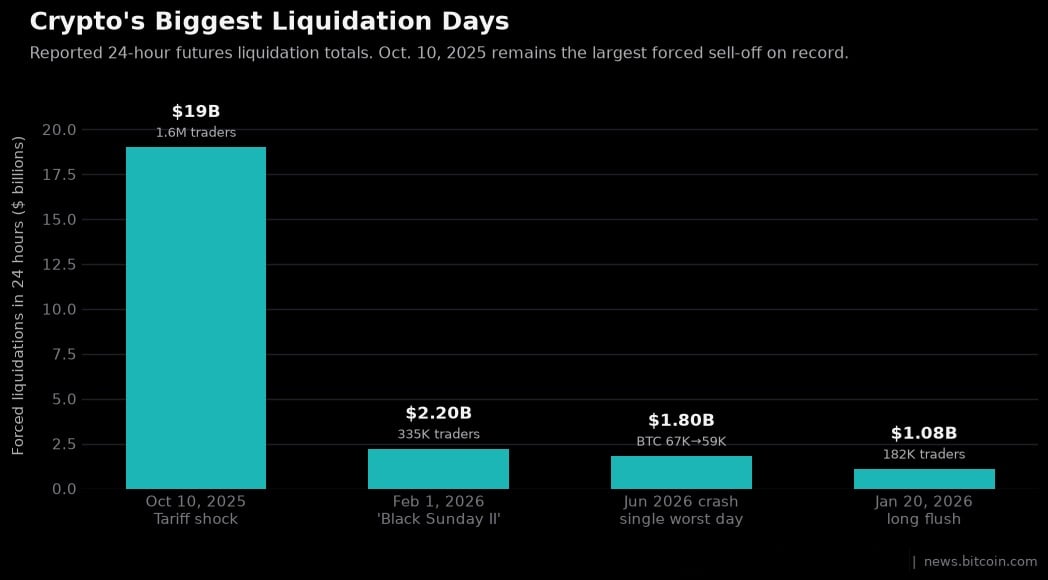
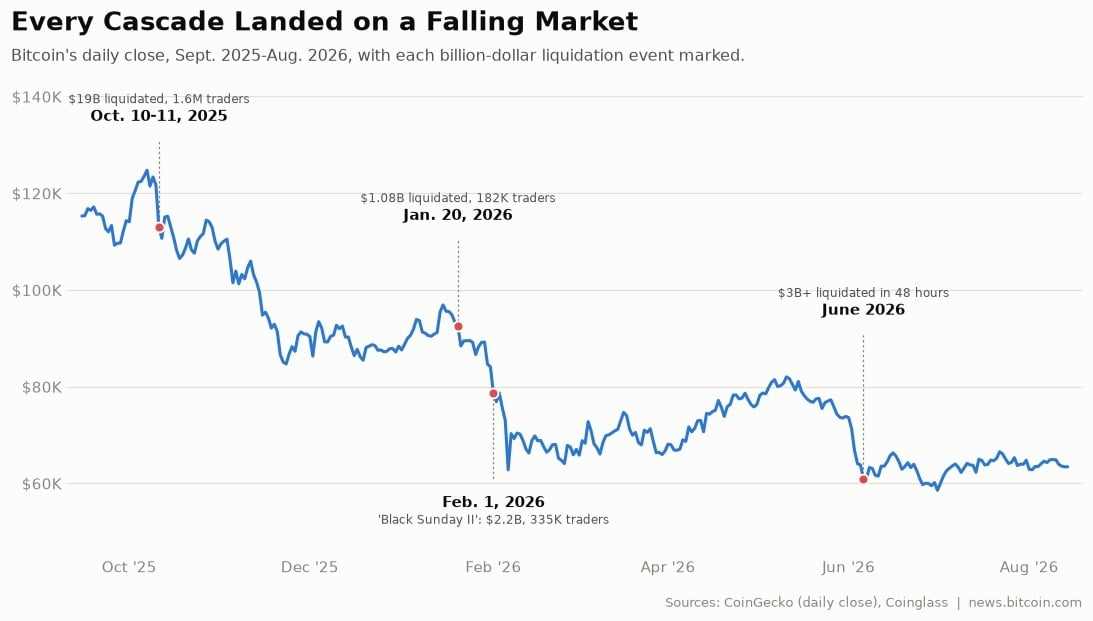
On October 10, 2025, President Trump announced a 100% tariff on imports from China. This triggered a sell-off in stocks and commodities, and cryptocurrencies (which were at levels close to record-high open interest with over-saturated long positions) became the pressure point. Over approximately 24 hours from October 10 to 11, leveraged positions worth over $19 billion were wiped out, affecting more than 1.6 million traders. About $16.7 billion of this amount came from long positions.
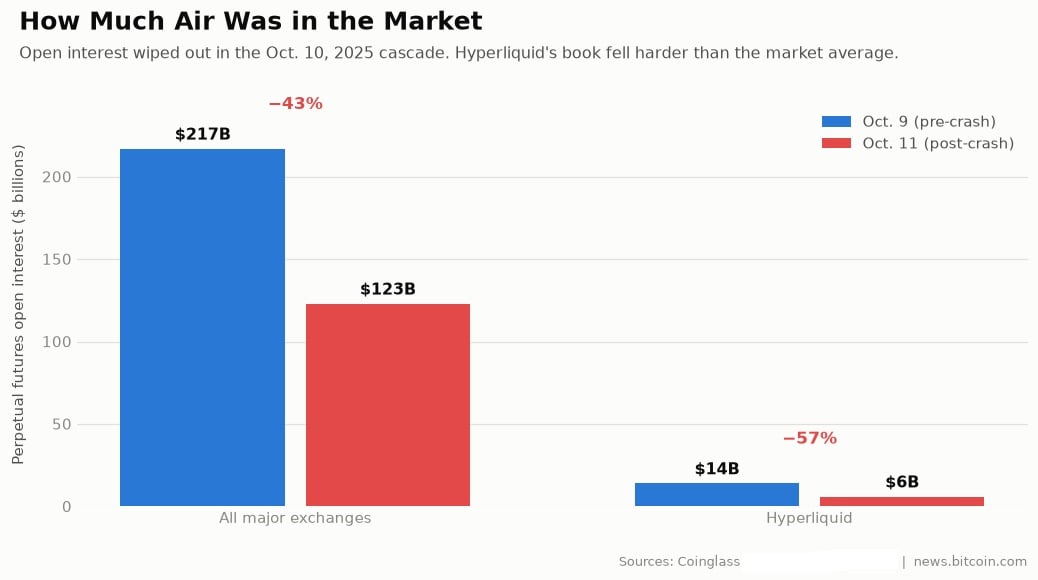
The aftermath revealed how overheated the market was: the total open interest in perpetual futures on major exchanges plummeted by 43% in a day—from $217 billion to $123 billion. On the decentralized derivatives exchange Hyperliquid, open interest fell by 57%—from $14 billion to $6 billion.
And because some platforms limit the amount of information they disclose or delay its publication, market makers estimated that the actual volume of liquidations may have approached $30–40 billion. For the entirety of 2025, analysts calculated that liquidation volumes exceeded $150 billion.
The Recidivists of 2026
Traders rebuilt their leveraged positions, and 2026 continued to gather them, but on January 20, over 182,000 traders again lost more than $1.08 billion in a single day, with almost all of this amount coming from long positions in Bitcoin and Ethereum futures.
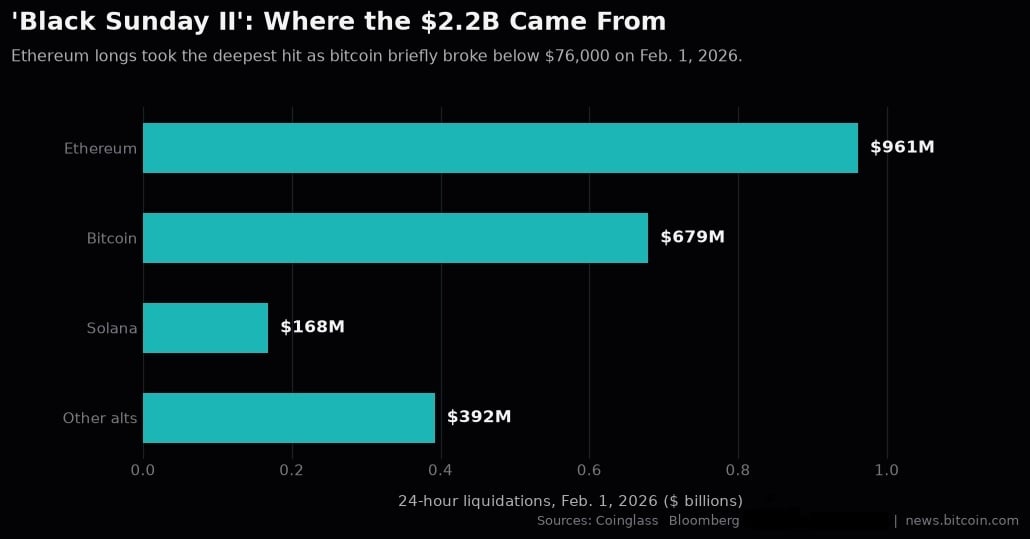
Twelve days later came the day traders dubbed "Black Sunday II" (February 1), when positions worth approximately $2.2 billion were forcibly closed within 24 hours, affecting over 335,000 traders. Ethereum led the losses with $961 million in liquidations, followed by Bitcoin at $679 million, and Solana added $168 million; long positions accounted for roughly 80–85% of the losses as Bitcoin briefly dipped below the $76,000 mark.
June brought the most significant spot market losses of the year: Bitcoin fell from around $67,000 to $59,100 over 48 hours, triggering forced liquidations totaling over $3 billion during that period (including one single most unprofitable day with losses of about $1.8 billion), as each wave of selling gave rise to the next.
How Traders Get Trapped
Market mechanisms punish the same behavior every time, namely: high leverage, over-saturation of positions, and the clustering of stop-loss levels where everyone else has set theirs. Funding rates (periodic payments traders with long and short positions make to each other) are the first alarm signal, and when long participants are forced to pay significant amounts to stay in the trade, positions become over-saturated, and even a small drop can set off a chain reaction.
The unpleasant lesson to draw from all this is that liquidation cascades are not rare accidents; they are the market's standard way of shedding excess leverage. Open interest recovered after each crash this year, which means the "fuel" for the next crash has already been accumulated.
The spark (be it tariff news, an exchange vulnerability, or panic over a fork) is never planned in advance, and liquidation cascades do not wait for bear markets, as some of the largest in history occurred within weeks of reaching all-time highs—precisely when confidence and leverage peaked.