Ex-Canaan exec blames China shutdowns for 10% Bitcoin hashrate fall

cointelegraphPublished on 2025-12-15Last updated on 2025-12-15

Abstract

Bitcoin's hashrate dropped approximately 10% in a single day, attributed to the shutdown of mining farms in China’s Xinjiang region, according to former Canaan executive Jianping Kong. He estimated that at least 400,000 ASIC miners went offline, reducing the network's hashrate by around 100 TH/s. Although China historically dominated Bitcoin mining, its share has declined since the 2021 ban, now estimated between 14% and 20%. Kong suggested the U.S. benefits from China’s mining instability, as American mining operations expand rapidly. The U.S. is also investigating Chinese ASIC manufacturers like Bitmain over potential national security risks, including concerns about remote control of mining hardware.

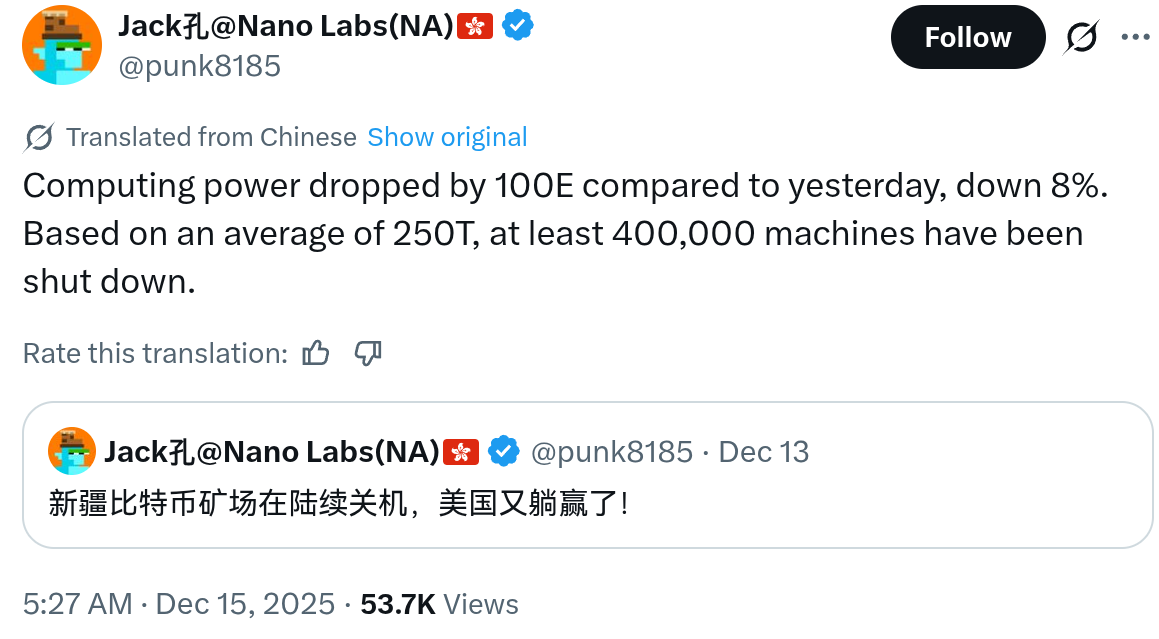
Bitcoin’s hashrate fell by about 10% in a single day on Sunday, with Jianping Kong, former co-chairman of Bitcoin mining hardware producer Canaan, attributing it to mining farms shutting down in China’s Xinjiang autonomous region.

In a Monday X post, Kong said Bitcoin’s hashrate dropped by about 100 terahashes per second (TH/s) since Sunday. He claimed the drop to was caused by “at least 400,000 machines” shutting down, based on an estimate of 250 terahashes per application-specific integrated circuit (ASIC) miners.

Kong tied the change to Bitcoin mining farms shutting down in China’s Xinjiang autonomous region. Cointelegraph was unable to verify the claims independently, but Kong’s position as a former co-chairman at a Chinese Bitcoin mining ASIC producer lends some credibility to the claim.

According to YCharts data, Bitcoin’s hashrate dropped from 1,053 TH/s on Sunday to just under 943 TH/s on Monday. This is equivalent to a loss of over 10%, or 110 TH/s — still, the network’s total hashrate is an estimate inferred from network statistics and cannot be precisely measured.
Source: Jianping Kong

Related: Scaramucci family invested over $100M in Trump’s Bitcoin mining firm: Report

China: Bitcoin’s unreliable friend

China has historically had a significant presence in the Bitcoin (BTC) mining industry, but it has also proved to be an unreliable source of hashrate. Before 2021, China accounted for most (about 65%) of Bitcoin’s hashrate until the Chinese government moved to stop mining activity that year.

In 2024, mining operations resumed across China, with October Hashrate Index data showing China now accounts for about 14% of global Bitcoin mining. CryptoQuant instead estimates China’s contribution to be between 15% and 20% of the total Bitcoin hashrate.

Late last month, Reuters reported that individual and corporate miners exploit cheap electricity across China despite the ban. Kong is less than happy about the situation, saying that with Xinjiang’s Bitcoin mining farms shutting down, “the US wins without lifting a finger.”
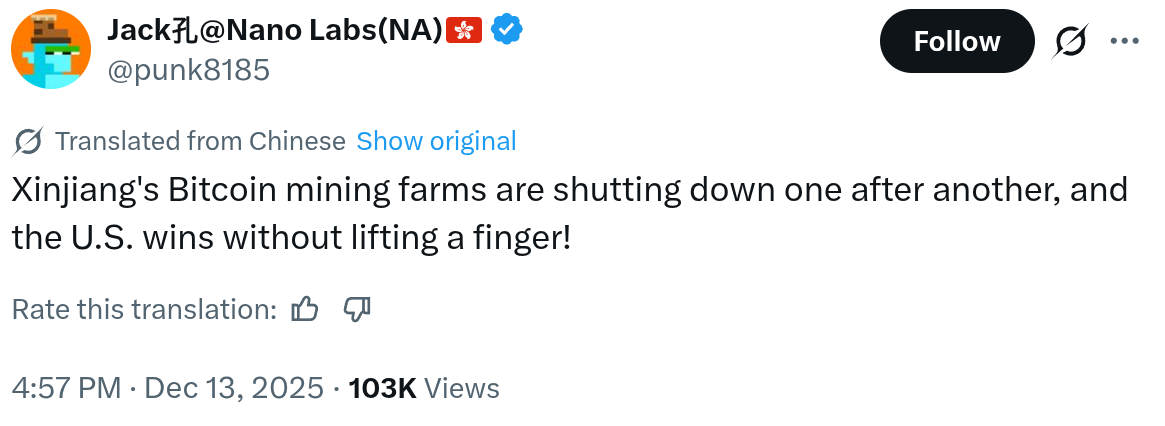
Source: Jianping Kong

Related: Google takes 5.4% stake in Bitcoin mining company Cipher Mining in $3B deal

The US aims for the Bitcoin mining crown

Kong’s comments come as the United States’ domestic Bitcoin mining industry grows at an increasingly rapid pace. At the end of August, Bitcoin mining company Hut 8 announced that it was building four new Bitcoin mining sites in Texas, Louisiana and Illinois, adding 1.5 gigawatts of capacity.

Hut 8 is the parent company of American Bitcoin, a Bitcoin mining and treasury company linked to the Trump family, and went public through a merger in early May. The company’s board of directors includes Eric Trump, the second-eldest of US President Donald Trump’s three sons — cementing the idea that US leadership is also betting on Bitcoin mining.

The US is also taking on China’s Bitcoin mining and ASIC industries more directly. Late November reports suggested that the leading Bitcoin mining ASIC producer, Bitcoin — based in China — is under investigation in the US over national security concerns.

The investigation aims to determine whether the hardware can be remotely controlled to spy on or sabotage the US power grid. Measures imposed following the inquiry may also affect the Trump family. American Bitcoin acquired a fleet of 16,299 Antminer U3S21EXPH units from Bitmain.

In October 2024, US authorities investigated Bitmain-linked Chinese chip designer Xiamen Sophgo over an alleged business relationship with US-sanctioned company Huawei. Just a month later, the US Customs and Border Protection Agency halted the delivery of thousands of Bitmain ASICs. US authorities only began releasing the hardware in March.


Trending Cryptos

Related Reads

Goldman Sachs Research Report Analysis: Circle and USDC Are Moving Beyond the Crypto World, Cross-Border Payments and AI Agents Become New Battlegrounds

Goldman Sachs published a summary of its meeting with Circle Internet Group (issuer of USDC) on July 5th. The core takeaway is that stablecoins, led by USDC, are evolving from a crypto-native tool into foundational infrastructure for traditional finance and the AI economy. USDC's use cases are rapidly expanding beyond crypto trading into cross-border payments, e-commerce, capital market settlements, and notably, payments for AI agents. Circle's management emphasized that stablecoin growth is now decoupled from crypto market cycles, driven by this diversification. They outlined five key application layers and highlighted USDC's network effects, global liquidity depth, and regulatory compliance as competitive moats. Circle distinguishes USDC from bank-issued tokenized deposits, arguing the former is an open, internet-native system without bank credit risk. Strategically, Circle is building a broader fintech platform with its Arc Layer 1 blockchain, the Circle Payments Network for cross-border transfers, and an "Agentic Stack" to serve AI agent economies, where USDC already dominates. Regarding regulation, Circle views potential U.S. legislation like the CLARITY Act as a catalyst for growth rather than a constraint, expecting it to encourage broader institutional adoption and active usage. Goldman Sachs maintains a Neutral rating on Circle with a $96 price target, noting the company's shift from a pure stablecoin issuer to a financial infrastructure provider. Key risks include competition from USDT and potential earnings pressure from declining interest rates on its reserve assets.

marsbit45m ago

Goldman Sachs Research Report Analysis: Circle and USDC Are Moving Beyond the Crypto World, Cross-Border Payments and AI Agents Become New Battlegrounds

marsbit45m ago

The Robinhood Stock Tokens You Bought Are Just Debts from Jersey Island

The Robinhood stock tokens you buy are essentially debt securities issued by a shell company in Jersey, not real equity. These tokens merely track stock prices like NVIDIA or Apple but grant no shareholder rights like voting or dividends. If the underlying company fails, you have no claim on its assets. Instead, you hold a debt instrument from Robinhood Assets (Jersey) Limited, which promises returns based on stock performance. If this Jersey entity goes bankrupt, you become an unsecured creditor. This complex structure stems from Robinhood's past crisis during the 2021 GameStop short squeeze, where T+2 settlement caused liquidity issues. The blockchain-based tokens enable instant settlement, theoretically preventing such trading halts. The product is classified by the SEC as a "linked security" or structured note, carrying counterparty risk not borne by actual shareholders. It is available globally but excluded from the US, UK, and other major markets, while Robinhood offers a fully compliant, asset-backed token model in Europe under MiFID II. The system relies on oracles for pricing, which poses risks like manipulation and faulty liquidations seen in DeFi exploits. Robinhood profits from spreads and aims to become a full-chain settlement layer. Meanwhile, competitors like Ondo have launched SEC-registered, fully compliant equity tokens in the US with actual voting rights and dividends. Robinhood’s Jersey debt model appears as a transitional, regulatory-arbitrage product, aiming to capture market share ahead of future regulatory clarity.

Foresight News1h ago

The Robinhood Stock Tokens You Bought Are Just Debts from Jersey Island

Foresight News1h ago

Trading

Spot

Hot Articles

What is $BITCOIN

DIGITAL GOLD ($BITCOIN): A Comprehensive Analysis Introduction to DIGITAL GOLD ($BITCOIN) DIGITAL GOLD ($BITCOIN) is a blockchain-based project operating on the Solana network, which aims to combine the characteristics of traditional precious metals with the innovation of decentralized technologies. While it shares a name with Bitcoin, often referred to as “digital gold” due to its perception as a store of value, DIGITAL GOLD is a separate token designed to create a unique ecosystem within the Web3 landscape. Its goal is to position itself as a viable alternative digital asset, although specifics regarding its applications and functionalities are still developing. What is DIGITAL GOLD ($BITCOIN)? DIGITAL GOLD ($BITCOIN) is a cryptocurrency token explicitly designed for use on the Solana blockchain. In contrast to Bitcoin, which provides a widely recognized value storage role, this token appears to focus on broader applications and characteristics. Notable aspects include: Blockchain Infrastructure: The token is built on the Solana blockchain, known for its capacity to handle high-speed and low-cost transactions. Supply Dynamics: DIGITAL GOLD has a maximum supply capped at 100 quadrillion tokens (100P $BITCOIN), although details regarding its circulating supply are currently undisclosed. Utility: While precise functionalities are not explicitly outlined, there are indications that the token could be utilized for various applications, potentially involving decentralized applications (dApps) or asset tokenization strategies. Who is the Creator of DIGITAL GOLD ($BITCOIN)? At present, the identity of the creators and development team behind DIGITAL GOLD ($BITCOIN) remains unknown. This situation is typical among many innovative projects within the blockchain space, particularly those aligning with decentralized finance and meme coin phenomena. While such anonymity may foster a community-driven culture, it intensifies concerns about governance and accountability. Who are the Investors of DIGITAL GOLD ($BITCOIN)? The available information indicates that DIGITAL GOLD ($BITCOIN) does not have any known institutional backers or prominent venture capital investments. The project seems to operate on a peer-to-peer model focused on community support and adoption rather than traditional funding routes. Its activity and liquidity are primarily situated on decentralized exchanges (DEXs), such as PumpSwap, rather than established centralized trading platforms, further highlighting its grassroots approach. How DIGITAL GOLD ($BITCOIN) Works The operational mechanics of DIGITAL GOLD ($BITCOIN) can be elaborated on based on its blockchain design and network attributes: Consensus Mechanism: By leveraging Solana’s unique proof-of-history (PoH) combined with a proof-of-stake (PoS) model, the project ensures efficient transaction validation contributing to the network's high performance. Tokenomics: While specific deflationary mechanisms have not been extensively detailed, the vast maximum token supply implies that it may cater to microtransactions or niche use cases that are still to be defined. Interoperability: There exists the potential for integration with Solana’s broader ecosystem, including various decentralized finance (DeFi) platforms. However, the details regarding specific integrations remain unspecified. Timeline of Key Events Here is a timeline that highlights significant milestones concerning DIGITAL GOLD ($BITCOIN): 2023: The initial deployment of the token occurs on the Solana blockchain, marked by its contract address. 2024: DIGITAL GOLD gains visibility as it becomes available for trading on decentralized exchanges like PumpSwap, allowing users to trade it against SOL. 2025: The project witnesses sporadic trading activity and potential interest in community-led engagements, although no noteworthy partnerships or technical advancements have been documented as of yet. Critical Analysis Strengths Scalability: The underlying Solana infrastructure supports high transaction volumes, which could enhance the utility of $BITCOIN in various transaction scenarios. Accessibility: The potential low trading price per token could attract retail investors, facilitating wider participation due to fractional ownership opportunities. Risks Lack of Transparency: The absence of publicly known backers, developers, or an audit process may yield skepticism regarding the project's sustainability and trustworthiness. Market Volatility: The trading activity is heavily reliant on speculative behavior, which can result in significant price volatility and uncertainty for investors. Conclusion DIGITAL GOLD ($BITCOIN) emerges as an intriguing yet ambiguous project within the rapidly evolving Solana ecosystem. While it attempts to leverage the “digital gold” narrative, its departure from Bitcoin's established role as a store of value underscores the need for a clearer differentiation of its intended utility and governance structure. Future acceptance and adoption will likely depend on addressing the current opacity and defining its operational and economic strategies more explicitly. Note: This report encompasses synthesised information available as of October 2023, and developments may have transpired beyond the research period.

645 Total ViewsPublished 2025.05.13Updated 2025.05.13

What is $BITCOIN

Discussions

Welcome to the HTX Community. Here, you can stay informed about the latest platform developments and gain access to professional market insights. Users' opinions on the price of BTC (BTC) are presented below.

活动图片