Every Ethereum Whale Cohort Now Underwater: ETH Capitulation Marking The Final Bottom?

bitcoinistPublished on 2026-02-21Last updated on 2026-02-21

Abstract

Ethereum is struggling below the $2,000 mark amid persistent selling pressure and weak market sentiment. Analysis shows all major whale cohorts are now holding ETH at an unrealized loss, with profit ratios turning negative. This increases the risk of capitulation, which could deepen short-term volatility. However, ETH has so far held above recent local support levels, suggesting large-scale selling hasn't yet occurred. Historically, such stress among large holders has sometimes marked medium-term bottoms. Technically, ETH remains fragile, trading below key moving averages with resistance near $2,200–$2,600. A sustained recovery would require improved liquidity, stronger demand, and supportive macro conditions.

Ethereum continues to struggle below the $2,000 level as persistent selling pressure and elevated uncertainty weigh on broader crypto market sentiment. Despite occasional rebound attempts, price action remains fragile, with volatility still elevated after months of corrective momentum. The inability to decisively reclaim this psychological threshold has reinforced caution among traders, particularly as liquidity conditions tighten and macro uncertainty continues to influence risk appetite across digital assets.

Recent analysis from Darkfost adds further context to the current market structure. According to the data, the ongoing correction is now affecting all investor cohorts, including Ethereum’s largest holders. Notably, the unrealized profit ratio for whale groups has shifted into negative territory across the board. Wallets holding between 1,000 and 10,000 ETH show an unrealized profit ratio of approximately -0.21, while those with 10,000 to 100,000 ETH stand near -0.18. Even the largest cohort — addresses holding more than 100,000 ETH — has slipped into negative territory around -0.08.
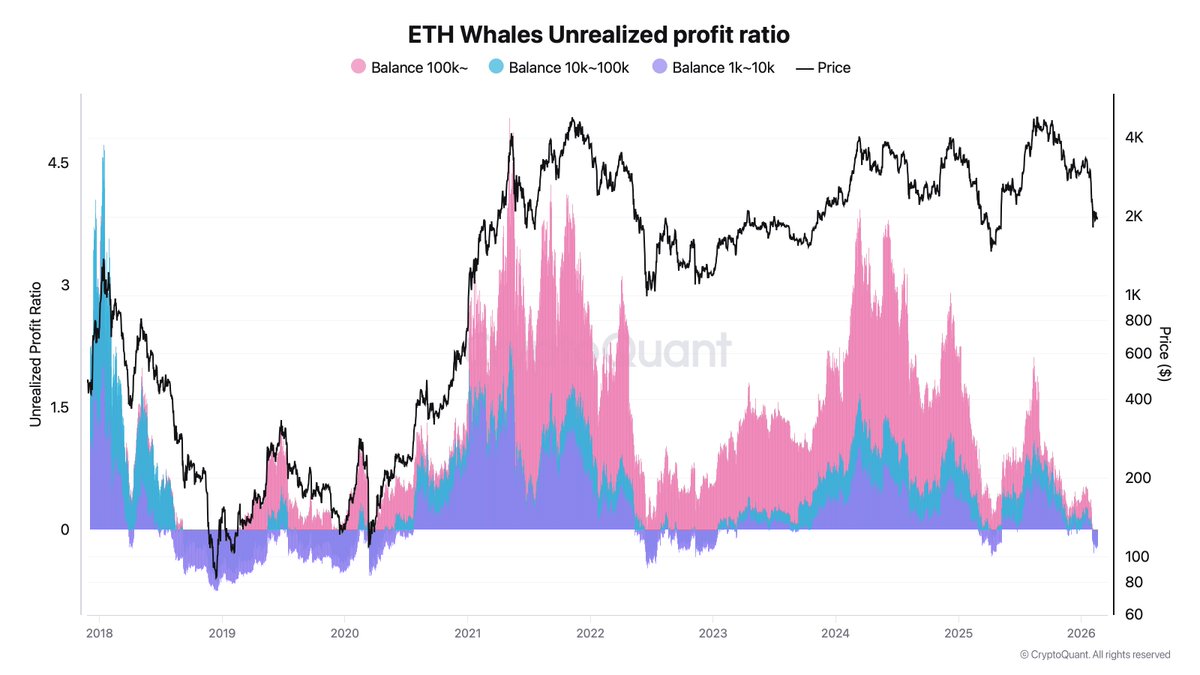
Ethereum Whales Unrealized profit ratio | Source: CryptoQuant

This development is notable because Ethereum has not yet revisited its April lows, suggesting the depth of unrealized losses is expanding earlier than in some previous corrective phases. Such conditions can increase market sensitivity, as even traditionally resilient holders may reassess positioning amid prolonged volatility.

Whale Stress Raises Capitulation Risk While Bottom Formation Signals Emerge

Darkfost further notes that if Ethereum extends its decline, large holders could face increasing financial pressure. Sustained downside would deepen unrealized losses across whale cohorts, potentially forcing some participants to reduce exposure or liquidate portions of their holdings. Historically, such capitulation events among large investors tend to amplify short-term volatility, particularly when liquidity conditions are already fragile.

However, despite the negative profit ratios now visible across whale groups, Ethereum has so far managed to stabilize above recent local support zones. This relative resilience suggests that, while sentiment remains cautious, immediate large-scale distribution from whales has not yet materialized. The distinction is important because unrealized losses alone do not necessarily trigger selling unless accompanied by liquidity stress, leverage pressure, or broader market shocks.

Periods in which major holders experience stress have often coincided with medium-term bottom formation phases in previous cycles. As weaker hands exit and leverage unwinds, markets sometimes transition into accumulation regimes characterized by lower volatility and gradual stabilization.

Still, this interpretation should be approached cautiously. Whale positioning is only one element of market structure, and confirmation typically requires improving liquidity, stronger spot demand, and supportive macro conditions before a sustained recovery can take hold.

Ethereum Price Structure Remains Fragile Below Key Averages

Ethereum continues to trade under clear technical pressure, with the weekly chart showing a sustained inability to reclaim the $2,000 region decisively. Following the sharp rejection from the 2025 highs near the $4,800 zone, price action has transitioned into a sequence of lower highs and weakening rebounds, typically associated with corrective market phases rather than accumulation-led recoveries.
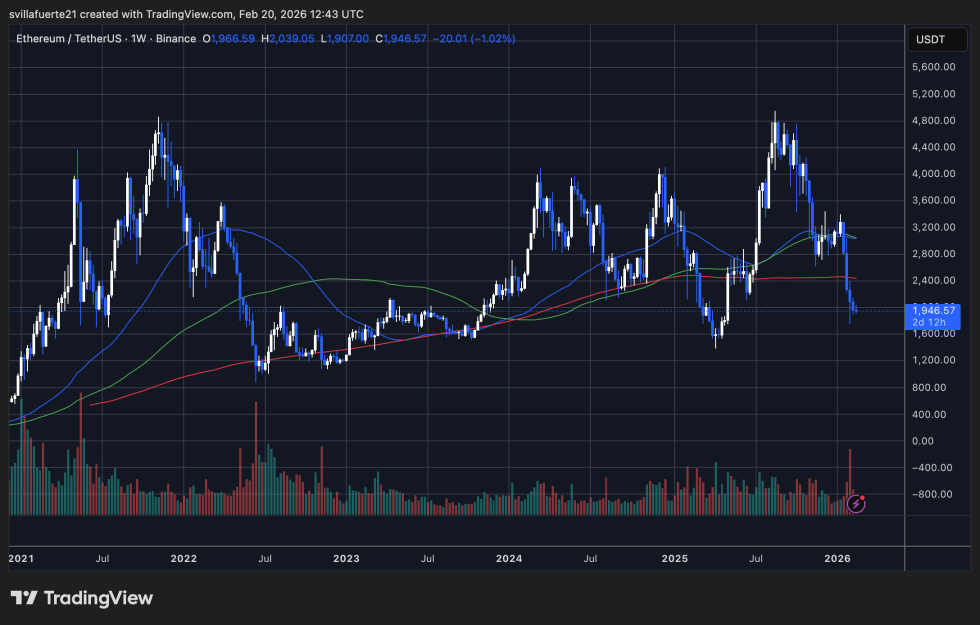
ETH testing critical demand level | Source: ETHUSDT chart on TradingView

Technically, ETH is currently positioned below several major moving averages that previously acted as dynamic support. These levels now function as resistance, limiting upside attempts unless a strong reclaim occurs with expanding volume. The recent decline toward the $1,900 area reflects persistent selling pressure, while repeated failures near the mid-$2,000 range reinforce cautious market sentiment.

Volume activity has moderated compared with the impulsive rally phase, suggesting reduced speculative participation. While declining volume during corrections can sometimes signal seller exhaustion, confirmation of stabilization usually requires sustained buying interest rather than temporary rebounds.

From a structural perspective, immediate support appears concentrated near the recent local lows around the $1,800 region, while resistance remains clustered between roughly $2,200 and $2,600. Until Ethereum reclaims these levels convincingly, the broader technical outlook remains vulnerable, with consolidation or further downside still plausible.

Featured image from ChatGPT, chart from TradingView.com

Trending Cryptos

Related Questions

QWhat is the current unrealized profit ratio for Ethereum whale cohorts holding between 1,000 and 10,000 ETH?

AThe unrealized profit ratio for wallets holding between 1,000 and 10,000 ETH is approximately -0.21.

QAccording to the article, what key psychological price level is Ethereum struggling to reclaim?

AEthereum is struggling to decisively reclaim the $2,000 psychological threshold.

QWhat potential risk arises if Ethereum extends its decline, according to Darkfost's analysis?

AIf Ethereum extends its decline, large holders could face increasing financial pressure, potentially forcing some to reduce exposure or liquidate portions of their holdings, which would amplify short-term volatility.

QWhat technical pattern is Ethereum's price action showing on the weekly chart after the rejection from 2025 highs?

AFollowing the rejection from the 2025 highs near $4,800, Ethereum's price action has transitioned into a sequence of lower highs and weakening rebounds, typical of corrective market phases.

QWhat does the article suggest periods of whale stress have often coincided with in previous market cycles?

APeriods in which major holders experience stress have often coincided with medium-term bottom formation phases in previous cycles, as weaker hands exit and leverage unwinds.

Related Reads

South Korean Stock Market Sees Sharp Rebound After Forceful De-leveraging, SK Hynix Rises 30%

On July 31, South Korean stocks staged a historic rebound. The benchmark KOSPI index surged 18.27%, with chipmaker SK Hynix hitting a 30% gain limit. This followed a brutal, near-40% decline in the KOSPI over the previous month, driven largely by a deleveraging spiral involving leveraged ETFs. Analysts attributed the sharp sell-off to structural liquidity issues rather than deteriorating corporate fundamentals. The rally was triggered by a confluence of positive catalysts. Firstly, strong earnings from U.S. cloud giants Microsoft and Amazon alleviated fears of an "AI bubble burst," boosting global tech sentiment. Secondly, SK Group Chairman Chey Tae-won made a rare personal purchase of SK Hynix shares, seen as a strong vote of confidence. Thirdly, the South Korean government announced a 20 trillion won ($139 billion) AI investment fund. In response to the market turmoil, South Korean regulators are tightening controls on leveraged ETFs, admitting oversight shortcomings. Measures include raising minimum cash保证金 requirements for散户 investors and suspending new product launches. While the rebound signals eased liquidity pressure, analysts note deep structural issues remain. The market's future stability is seen as dependent on global tech capital expenditure trends and memory chip price cycles, with some viewing the surge as a technical correction rather than a definitive trend reversal.

marsbit15m ago

South Korean Stock Market Sees Sharp Rebound After Forceful De-leveraging, SK Hynix Rises 30%

marsbit15m ago

Cryptocurrency Company Wintermute Makes Pessimistic Statements Regarding Expected Altcoin Growth! Here are the Details

Crypto market maker Wintermute has made a pessimistic assessment regarding the anticipated altcoin season, suggesting that any upcoming rally may benefit only a limited number of projects. The company reports a record 72% of its spot OTC trading volume in H1 2026 came from institutional clients, whose capital is becoming more selective and concentrated. Data shows institutional traders act quickly on price spikes, while retail interest lasts longer. This selective behavior indicates the classic altcoin season, where hundreds of tokens rise simultaneously, may be changing. Wintermute believes only projects with strong use cases, high liquidity, and institutional appeal will stand out. Supporting this view, CryptoQuant data shows altcoin trading volume against Bitcoin is near its lowest since 2021, with the top 10 altcoins (excluding stablecoins) holding about 80.5% of the total altcoin market cap. Similarly, Kaiko reports that the top 10 altcoins now account for 63% of total altcoin trading volume, up from ~50% a few months ago, indicating capital concentration. Analysts suggest that in the current cautious institutional climate, projects with advanced technology, liquidity, and robust ecosystems will attract disproportionate attention. Therefore, any potential new altcoin season may be less broad than past bull markets, with gains concentrated in a narrower set of promising tokens.

cryptonews.ru16m ago

Cryptocurrency Company Wintermute Makes Pessimistic Statements Regarding Expected Altcoin Growth! Here are the Details

cryptonews.ru16m ago

UNI Activates Fee Switch: Uniswap Completes Commercial Debut, Faces First Test in September

Uniswap's Fee Switch activation on V4 has driven a surge in protocol revenue, with daily income jumping from $118,000 to $318,000. The newly launched Robinhood Chain has become the primary contributor, accounting for over 52% of total revenue, largely fueled by meme coin trading. This revenue fuels a new tokenomic "flywheel": fees accumulate in a pool, incentivizing arbitrageurs to buy and burn UNI tokens, creating deflationary pressure and boosting the token's price. However, concerns loom beneath the surface. Uniswap's revenue is now highly concentrated and dependent on the speculative, volatile activity on Robinhood Chain, which is currently subsidized by free gas fees. This subsidy is set to expire in late September, posing a significant test for sustained transaction volume and, consequently, protocol revenue. Furthermore, UNI's high valuation faces pressure if growth expectations aren't met. Debate also centers on the Fee Switch's impact. While Uniswap founder Hayden Adams clarified that the protocol fee is an "add-on" for traders and does not cut into Liquidity Providers' (LPs) existing share, questions remain about whether higher overall trading costs could indirectly reduce volume and LP earnings over time. Despite these challenges, Uniswap's Fee Switch marks a major step in protocol monetization, with its long-term success hinging on cultivating more sustainable usage beyond speculative trading.

marsbit24m ago

UNI Activates Fee Switch: Uniswap Completes Commercial Debut, Faces First Test in September

marsbit24m ago

Trading

Spot

Hot Articles

Discussions

Welcome to the HTX Community. Here, you can stay informed about the latest platform developments and gain access to professional market insights. Users' opinions on the price of ETH (ETH) are presented below.

活动图片