UNI Activates Fee Switch: Uniswap Completes Commercial Debut, Faces First Test in September

marsbitPublished on 2026-07-31Last updated on 2026-07-31

Abstract

Uniswap's Fee Switch activation on V4 has driven a surge in protocol revenue, with daily income jumping from $118,000 to $318,000. The newly launched Robinhood Chain has become the primary contributor, accounting for over 52% of total revenue, largely fueled by meme coin trading. This revenue fuels a new tokenomic "flywheel": fees accumulate in a pool, incentivizing arbitrageurs to buy and burn UNI tokens, creating deflationary pressure and boosting the token's price. However, concerns loom beneath the surface. Uniswap's revenue is now highly concentrated and dependent on the speculative, volatile activity on Robinhood Chain, which is currently subsidized by free gas fees. This subsidy is set to expire in late September, posing a significant test for sustained transaction volume and, consequently, protocol revenue. Furthermore, UNI's high valuation faces pressure if growth expectations aren't met. Debate also centers on the Fee Switch's impact. While Uniswap founder Hayden Adams clarified that the protocol fee is an "add-on" for traders and does not cut into Liquidity Providers' (LPs) existing share, questions remain about whether higher overall trading costs could indirectly reduce volume and LP earnings over time. Despite these challenges, Uniswap's Fee Switch marks a major step in protocol monetization, with its long-term success hinging on cultivating more sustainable usage beyond speculative trading.

Author: Jae, PANews

On the evening of July 30th, rallying alongside AI stocks was DEX (decentralized exchange) leader Uniswap. UNI price broke through the $4 mark, surging over 10% for the day and extending its weekly cumulative gains to more than 17%, sweeping away the consolidation gloom of the past three months.
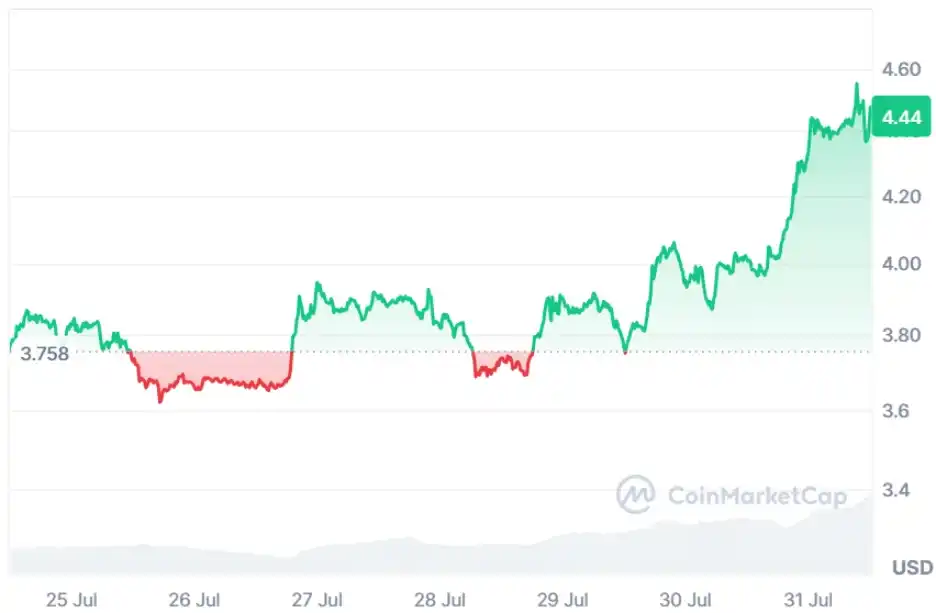
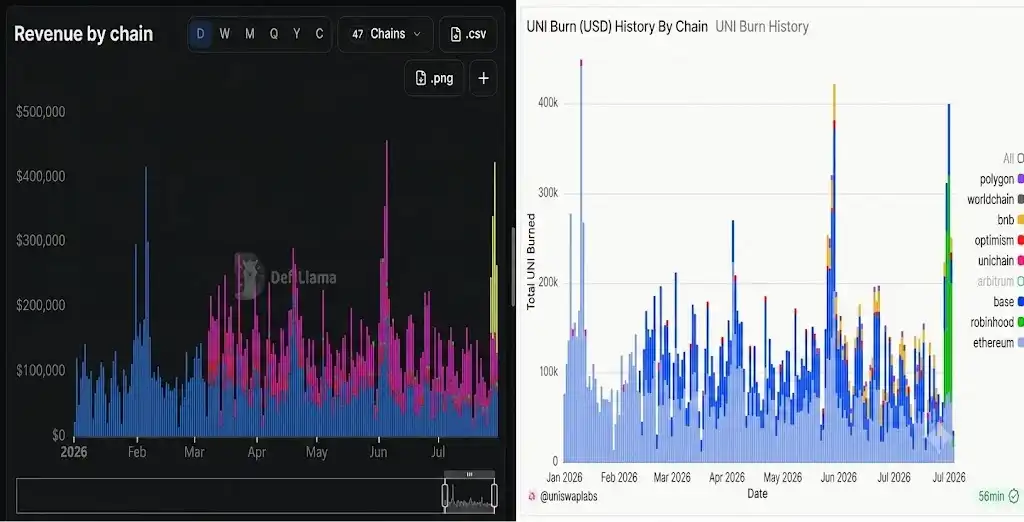
The immediate catalyst was the Fee Switch. On July 27th, the Fee Switch was officially activated on Uniswap V4, leading to an explosive growth in the protocol's network-wide revenue: average daily revenue soared from $118,000 in early July to $318,000, an increase of approximately 2.7 times. Among this, Robinhood Chain alone contributed an average of $168,000 daily, accounting for half of the protocol's total network-wide revenue.

Accompanying the revenue explosion was a strong wave of UNI burning. The daily burn scale of tokens reached 106,000, having previously set a historical record of 186,000. Beneath the surface of this狂欢, debates and concerns regarding the underlying nature of the traffic, sustainable growth, and the interests of LPs (Liquidity Providers) are also fermenting simultaneously.

Flywheel Kicks Off, Robinhood Chain Becomes Uniswap's Biggest 'Money Printer'

In conventional DEX fee mechanisms, transaction fees either flow entirely to LPs or are collected by front-end operators, with the protocol layer capturing almost no value. In late 2025, Uniswap introduced a comprehensive governance proposal, UNIfication, which established a programmatic fee distribution path by introducing the TokenJar fund pool and the Firepit burn contract.

Simply put, TokenJar is like a transparent money pot that only takes in, never pays out. Protocol-collected fees continuously accumulate in it, but no one can directly withdraw funds. The only way to 'open the pot' is to prove to the system that you have burned a corresponding amount of UNI tokens.

This creates an arbitrage opportunity: when the value of fees in the pot is higher than the cost of buying and burning UNI, arbitrageurs (such as MEV bots) will spontaneously buy UNI from the market and burn it to unlock the fees in the pot and profit from the price difference.

The entire process operates without manual intervention, entirely driven by on-chain economic incentives, forming a positive flywheel: transactions generate fees → arbitrageurs buy back and burn UNI → circulating supply decreases → token value increases.

After the Fee Switch was activated, the currently hottest Robinhood Chain has replaced the Ethereum mainnet as the core battleground for Uniswap to capture protocol fees, also becoming the most critical catalyst in the UNI deflationary wave.
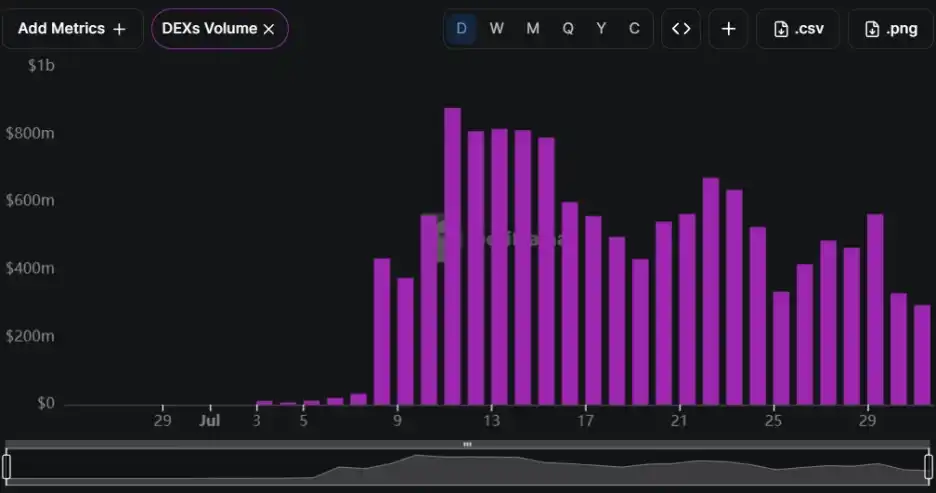
As a Layer2 network built on Arbitrum Orbit, Robinhood Chain has carried the halo of a fintech giant since its mainnet launch on July 1st. Free Gas fee subsidies and deeply integrated Web2 user entry points attracted a massive influx of capital. DeFiLlama data shows that just one week after deploying Uniswap V2, V3, and V4 protocols, the chain's cumulative trading volume rapidly surpassed the $6 billion mark.
When the Fee Switch was activated on Robinhood Chain, massive transactions were converted into tangible protocol revenue, contributing over 52% of Uniswap's daily average network-wide protocol revenue, catapulting it to become Uniswap's largest revenue source and a strong buy-side force for UNI.

Multiple Hidden Concerns Beneath the狂欢: Meme Bubble, Lofty Valuation, and Protocol 'Taxation'

However, Uniswap's highly concentrated revenue structure means the rate of UNI burning will be highly tied to the traffic fluctuations of a single chain.

The 'traffic engine' of Robinhood Chain is far more fragile than it appears on the surface.

According to Oak Research statistics, over 99% of the trading volume generated on Robinhood Chain since its launch has been driven by speculation on Meme coins like CASHCAT.

A greater test will arrive in late September.

Currently, Robinhood Chain's high trading volume is built upon the foundation of official free Gas fee subsidies. Once these subsidy policies expire in late September, and on-chain interactions resume their real cost, Meme coin speculation reliant on automated scripts and high-frequency arbitrage may cool down significantly further.

In simple terms, what currently supports half of Uniswap's revenue is highly speculative, extremely volatile Meme coin trading, not trading of real assets with long-term stability. Although Uniswap announced yesterday (July 30th) the launch of a Launches test version on Robinhood Chain, aiming to aggregate popular token launches and provide them with distribution channels, it does not change the weak underlying structure of the protocol's recent traffic.

Additionally, the market has already priced in extremely high growth expectations for UNI in advance. From a valuation perspective, Uniswap's fully diluted valuation (FDV) is approximately $4 billion, corresponding to an annualized revenue of about $41 million, implying a high P/E (Price-to-Earnings) ratio nearing 100. If revenue growth fails to meet expectations, the high valuation will face downward pressure.

The most intense debate focuses on: Is the protocol 'taxation' achieved at the expense of LP interests?

Direct competitor Aerodrome co-founder Alexander Cutler pointed out that the essence of the Fee Switch is the protocol forcibly carving out a piece of the existing pie. After activating the Fee Switch on Uniswap V2 and V3 concentrated liquidity pools, it effectively cut away up to 25% of the original LP profits; under the V4 architecture, it even imposed an up to 33% 'tax rate' on liquidity interactions.

In response to market doubts, Uniswap founder Hayden Adams posted a clarification, stating that the protocol fee in Uniswap V4 adopts an 'additive' system, not a 'deductive' one. The existing pool fees for LPs are not subject to any deduction; the protocol fee is an incremental fee additionally charged to traders on top of that. LP profits are not harmed.

Mathematically, Adams is correct; but economically, the question remains unresolved: will an increase in the total transaction fee rate raise costs for traders, thereby suppressing trading volume, and ultimately indirectly weaken the actual transaction earnings for LPs? This difficult problem still requires longer-term market data for verification.

Even so, Uniswap has completed an outstanding 'commercial' debut. But whether it can turn this debut into a sustainable norm depends on its ability to expand into application scenarios with more long-term value on-chain.

Related Questions

QWhat triggered the recent surge in UNI price and on-chain fee revenue for Uniswap?

AThe activation of the Fee Switch on Uniswap V4 triggered the surge. It enabled the protocol to capture a share of trading fees, leading to explosive growth in daily protocol revenue, which in turn drove significant UNI token buybacks and burns, creating positive price pressure.

QWhich blockchain has become Uniswap's primary source of protocol fee revenue after the Fee Switch activation, and why?

ARobinhood Chain has become Uniswap's primary source of protocol fee revenue. This is due to its massive transaction volume, driven largely by meme coin trading (e.g., CASHCAT) and bolstered by Robinhood's temporary gas fee subsidy for users, which attracted significant capital and activity to its Uniswap deployments.

QWhat are the main concerns regarding the sustainability of Uniswap's current fee revenue model?

AThe main concerns are: 1) Over-reliance on volatile, speculative meme coin trading on Robinhood Chain for revenue. 2) The impending end of Robinhood Chain's gas fee subsidy in late September, which may drastically reduce trading activity. 3) UNI's high valuation (implied P/E ~100x) pricing in aggressive growth expectations that may not be met.

QHow does the Fee Switch mechanism create a 'flywheel' effect for the UNI token according to the article?

AThe flywheel effect works as follows: Trading generates protocol fees → Fees accumulate in the TokenJar contract → When the value in TokenJar exceeds the cost of buying UNI, arbitrageurs (like MEV bots) buy and burn UNI to claim the fees → This reduces UNI's circulating supply → The reduced supply, coupled with buy pressure, aims to increase the token's value.

QWhat is the debate surrounding the impact of the protocol fee on Liquidity Providers (LPs)?

AThe debate centers on whether the protocol fee harms LP profits. Critics argue it effectively 'taxes' LP revenue by taking a cut (up to 25% in V2/V3, potentially 33% in V4 interactions). Uniswap's founder counters that in V4, the fee is 'additive'—charged to traders on top of the existing pool fee—and does not reduce the LP's designated share. However, the economic concern remains that higher total fees for traders could reduce trading volume and thus indirectly lower LP earnings.

Related Reads

Notable Forecast from an Analytical Company Regarding Bitcoin (BTC): After This Date, a New Bull Season Could Begin!

Bitcoin continues to trade sideways around $64,000 amid ongoing uncertainty regarding U.S. monetary policy and geopolitical risks in the Middle East. As BTC struggles for direction, an analyst predicts the next major uptrend could commence after the U.S. midterm elections. João Wedson, founder and CEO of crypto analytics firm Alphractal, revisited the connection between Bitcoin's price movements and the U.S. election calendar in his latest analysis. Wedson claims that analyzing past market cycles reveals similar patterns in Bitcoin's price behavior, particularly around U.S. midterm and presidential elections. Historically, Bitcoin has faced headwinds leading up to midterms but tends to recover once election-related uncertainty subsides. Based on historical data, Bitcoin entered bear markets roughly a year before past midterm elections, only to initiate prolonged bull markets after the elections concluded. In some cycles, price bottoms formed just days before the vote, while in others, the low occurred immediately after. The analyst also noted presidential elections have a distinct impact: Bitcoin experiences strong rallies each time a president wins re-election and approaches the peak of its main cycle shortly after the presidential inauguration. As an example, Wedson pointed to XRP, which began a sharp rise on the day Donald Trump won the 2024 election and reached a local peak on January 20, 2025, his inauguration day.

cryptonews.ru10m ago

Notable Forecast from an Analytical Company Regarding Bitcoin (BTC): After This Date, a New Bull Season Could Begin!

cryptonews.ru10m ago

Lummis: The CLARITY Act mechanism "is not working" as the Senate drags its feet

U.S. Senator Cynthia Lummis has argued that the current regulatory framework for digital assets is inadequate, harming industry, investors, and regulators alike. She is urgently pushing for the Senate to pass the Digital Asset Market Clarity Act (H.R. 3633/CLARITY Act) before the August recess, warning the current momentum for the bill is a unique opportunity this decade. The legislation aims to divide oversight between the SEC and CFTC. Time is running out, as the Senate must act before its August 8th recess. Delays would push the debate to September, further squeezing the legislative calendar before the midterm elections. Forecasting platforms now estimate only a 30% chance of the bill becoming law in 2026, a sharp drop from over 80% in February. Passage requires 60 votes, meaning at least seven Democrats must join Republicans, a task complicated by Democratic opposition. Key objections from figures like Senator Elizabeth Warren center on concerns the bill could weaken oversight of decentralized finance (DeFi) and consumer protection, potentially endangering the financial system. Over 200 crypto industry organizations, including Coinbase and Ripple, are lobbying for a vote, arguing continued uncertainty drives innovation and jobs overseas. Lummis contends the bill's custody and disclosure rules are precisely the consumer protections needed to close existing loopholes. The bill's fate now hinges on whether Senate Majority Leader John Thune schedules a vote this week or delays it until the fall session, where it would face an even more constrained political environment.

cryptonews.ru10m ago

Lummis: The CLARITY Act mechanism "is not working" as the Senate drags its feet

cryptonews.ru10m ago

Trading

Spot
活动图片