Ethereum's 11th Year: Why Is This Year Particularly Crucial?

marsbitPublished on 2026-07-31Last updated on 2026-07-31

Abstract

Ethereum's 11th year proved pivotal, marked by a dual evolution in its technical roadmap and organizational structure. The year saw the completion of the Fusaka upgrade, introducing PeerDAS to make data availability sampling more efficient and laying groundwork for future L2 scaling. This was followed by a significant reorganization of the Ethereum Foundation (EF). The EF downsized, redefining its core mandate around user sovereignty and CROPS principles, while spinning off key functions. Independent entities like Ethlabs (non-profit R&D), Ethereum Institutional (institutional onboarding), and EthSystems (institutional privacy solutions) now operate separately. Technologically, the community debated a bold, long-term vision outlined in Justin Drake's "Lean Ethereum" proposal and the collaborative "Strawmap." These point toward a "third major iteration" for Ethereum, targeting goals like faster finality (~1 second), gigagas-scale L1 throughput, teragas-scale L2 capacity, post-quantum cryptography, and protocol-level privacy. Data underscores Ethereum's dominant position: its L1 still holds roughly half of all stablecoin value, leads in tokenized Real-World Assets (RWA), and commands over 55% of total DeFi TVL. While L2s now handle over 10x more transactions than the mainnet, high-value assets remain concentrated on L1. The launch of Robinhood Chain, an EVM-compatible L2 for stock tokens, signals growing institutional adoption. The immediate roadmap includes the Glamsterdam...

Original Author: KarenZ, Foresight News

In 2015, Ethereum brought the concept of the "world computer" on-chain; in 2026, it is simultaneously restructuring the organizational network maintaining this machine and reshaping its underlying architecture for the years to come.

Over the past year, the Fusaka upgrade laid the foundation for Ethereum to carry more L2 data; the Ethereum Foundation underwent a major reorganization, with parts of its research & development, institutional outreach, and privacy operations being transferred to independent entities like Ethlabs, Ethereum Institutional, and EthSystems; Lean Ethereum and Strawmap then placed the next round of protocol redesigns on the table, covering consensus, validation methods, cryptography, and state, all of which may be redesigned in the coming years.

The First Decade, Condensed into a Few Lines

On July 30, 2015, the Frontier mainnet launched. Ethereum evolved from a concept in a whitepaper into a public network where anyone could deploy and run smart contracts.

In the ten years that followed: In 2016, The DAO was attacked, leading to a hard fork of Ethereum, with the unforked side continuing as Ethereum Classic; in 2020, the Beacon Chain launched; in 2022, The Merge transitioned the mainnet from Proof-of-Work to Proof-of-Stake; in 2023, Shapella enabled staking withdrawals; in 2024, Dencun introduced Blobs via EIP-4844, providing cheaper data space for Rollups.

In May 2025, Pectra further improved account functionality via EIP-7702 and increased the maximum effective balance for a single validator to 2048 ETH.

This roadmap never followed a fixed blueprint neatly. Ethereum's characteristic is precisely that it replaces its own core components while it runs.

The first decade laid Ethereum's foundation, and the past year has redefined where it is headed next.

Fusaka: No Longer Requiring Every Node to Download All Blob Data

On December 3, 2025, Fusaka activated on the mainnet. This was the second major mainnet upgrade Ethereum completed in 2025, following Pectra.

The most important change in Fusaka is PeerDAS. Previously, nodes needed to download the complete blob data to check its availability; PeerDAS allows nodes to only sample and verify a portion of it, then through division of labor and erasure coding mechanisms between different nodes, collectively confirm that the complete data indeed exists.

It's somewhat like inspecting a vast shipment of goods: no longer requiring each inspector to recount all boxes, but having many inspectors each sample check, then combining their results to form a reliable judgment of the entire shipment.

After the upgrade, Ethereum also increased the target blobs per block from 6 to 14 and the limit from 9 to 21 through two BPIs that adjusted only blob parameters; the default block Gas Limit was also raised from 45 million to 60 million.

Fusaka is more like an underlying structural construction, still far from the endpoint of performance expansion. Users may not immediately feel drastic changes, but subsequent increases in Blob capacity and reductions in L2 costs will be built upon this layer.

The Foundation Shrinks, Functions Grow Outward

Protocol upgrades happen on-chain, while another adjustment occurred at the organizational layer. Over the past year, the Ethereum Foundation underwent a reorganization of rare scale.

In March 2026, the Foundation published a Mandate, establishing user sovereignty as a core goal and summarizing censorship resistance, open source, privacy, and security as the non-compromisable CROPS principles.

On June 23, the Foundation announced the completion of a reorganization that lasted several months, with 54 people leaving, representing about 20% of the original team.

The reorganized Foundation set up five work areas: Protocol Layer, Access Layer, User Layer, Community Layer, and Institutional Layer, in addition to an Operations Cluster and management & support teams. It no longer attempts to house all protocol R&D, product access, ecosystem communication, and institutional outreach within a single organization, but focuses limited resources on work it believes only it can sustain long-term.

This reorganization also continued the Foundation's previously announced treasury policy. The EF's treasury policy started from annual operational expenses representing about 15% of the treasury in 2025, planning to linearly decrease over five years to a long-term level of roughly 5%. It chooses to concentrate resources on core protocol, sovereign access, privacy & security, while having more ecosystem functions undertaken by independent organizations.

Meanwhile, a number of new entities involving former Foundation members began operating independently:

  • Ethlabs is an independent non-profit R&D institution. The team includes several former Ethereum Foundation researchers, focusing on Ethereum protocol, scaling, interoperability, and infrastructure R&D.
  • Ethereum Institutional is a non-profit institution incubated within the Foundation and now independent. It positions itself as a neutral entry point for banks, asset management companies, and public institutions into the Ethereum ecosystem, responsible for education, demand aggregation, and ecosystem coordination. On July 29, Ethereum Institutional announced the completion of its first ecosystem funding round and supporter alliance formation, receiving support from over 100 ecosystem participants, led by BitMine, SharpLink, and Ethereum co-founders Joseph Lubin and Mihai Alisie. The amount was not disclosed.
  • EthSystems continues the work of the Foundation's Institutional Privacy Task Force, but operates as an independent for-profit company, designing privacy, compliance, and confidential transaction systems for institutions.

Strictly speaking, these three should not be broadly described as legal "spin-offs" of the Ethereum Foundation: Ethlabs was created by former Foundation researchers, Ethereum Institutional was incubated within the Foundation and then became independent, and EthSystems took over the relevant team and work. A more accurate description is that the Ethereum Foundation is having some talent, funding sources, and specialized functions move outside the Foundation, forming multiple organizations capable of independent financing and decision-making.

This does not directly change the governance of the Ethereum protocol, but it changes the organizational structure around protocol development, institutional communication, and product building. Related work no longer needs to be concentrated on a single balance sheet.

Lean Ethereum and Strawmap: One Vision, One Sketch

Behind this organizational adjustment lies a longer technical thread.

On July 31, 2025, the day after Ethereum's tenth anniversary, Justin Drake published the Lean Ethereum vision, proposing a more radical technical roadmap for the protocol's next decade.

At the consensus layer, Lean Ethereum aims to compress finality time to seconds; at the data layer, it plans to expand Blob capacity through next-generation data availability sampling; at the execution layer, it proposes adopting a leaner instruction set more suitable for SNARK proofs, while trying to preserve EVM compatibility and existing network effects.

On top of these modifications, the protocol also needs to gradually replace signature and cryptography components potentially threatened by quantum computing, preparing in advance for long-term security.

Long-term goals proposed by Lean Ethereum include roughly 1 gigagas/s for L1 and 1 teragas/s for L2, corresponding to its estimated ~10k TPS and ~10 million TPS. It is crucial to emphasize that this document was explicitly labeled as Justin Drake's personal vision upon release, aiming to spur community discussion, not a finalized upgrade commitment that has passed governance procedures.

In February 2026, the Strawmap maintained by EF Architecture went live. Justin Drake, Vitalik Buterin, and others participated in its maintenance and curation. Strawmap is a portmanteau of "strawman" and "roadmap," which can be understood as a sketch of a route awaiting further community modification.

On July 4, Vitalik Buterin published an updated interpretation after the Berlin researcher meeting: He estimated the main parts of Lean Ethereum would take three to four years to be implemented gradually through multiple upgrades; recursive STARKs, post-quantum cryptography, consensus and finality redesign, multi-dimensional gas, new state types, and client architecture are all within the scope of discussion. He termed this phase the "third major iteration" following early Ethereum and The Merge, and emphasized privacy had become a first-class goal.
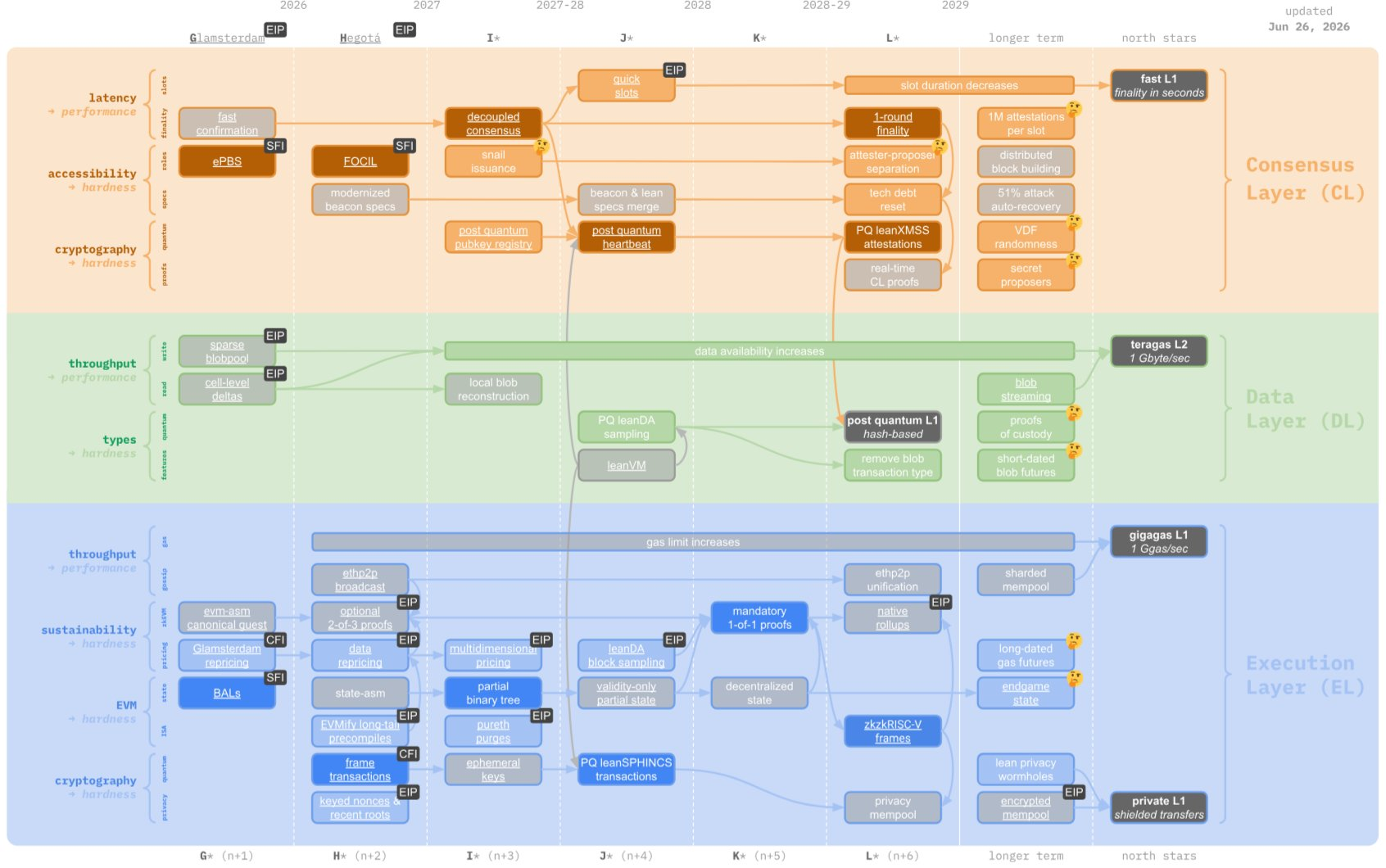
The five "directional goals" given by Strawmap are Fast L1, Gigagas L1, Teragas L2, Post-Quantum L1, and Private L1. In plain language, these are faster confirmation, higher mainnet throughput, larger L2 data space, quantum-resistant cryptography, and protocol-native privacy.

These are research directions and engineering goals, with significant design, implementation, testing, and community coordination work remaining before full deployment.

Four Sets of Data to Understand the 11-Year-Old Ethereum

The first set of data comes from stablecoins.

As of July 31, 2026, RWA.xyz statistics show the stablecoin scale on the Ethereum mainnet is approximately $155.9 billion. Compared to its global statistical value of ~$296.9 billion, the Ethereum mainnet accounts for about 52.5%.

DeFiLlama uses a different set of asset coverage and network classification criteria, reporting the stablecoin scale on Ethereum as approximately $146.9 billion, accounting for about 49.0% of the ~$300.1 billion total scale.
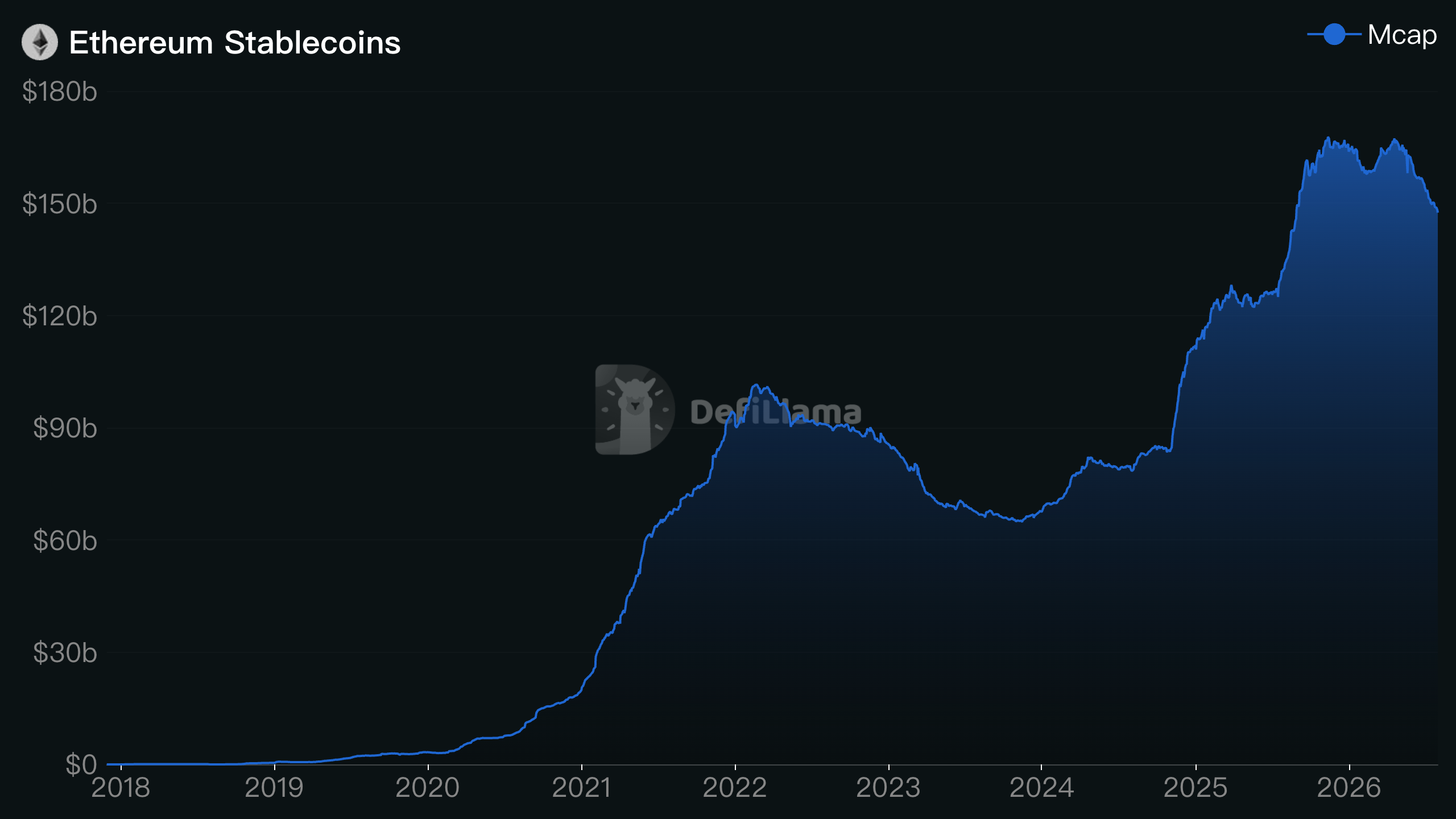
Source: DeFiLlama

The two datasets differ, mainly due to variations in token coverage, cross-chain assets, and statistical methods. However, the common conclusion they point to is that the Ethereum mainnet still carries close to half of the global stablecoin stock.

The second set of data comes from tokenized real-world assets.

According to RWA.xyz statistics, as of July 31, 2026, there are 1,552 RWAs on the Ethereum mainnet, with on-chain distributable asset value of approximately $17.15 billion, about 3.3 times that of the second-ranked BNB Chain, leading among the 38 networks it tracks. On-chain distributable assets refer to tokens that can leave the issuance platform and be transferred between wallets meeting whitelist or investor qualification requirements.

The institutional-grade Ethereum ecosystem service provider Ethereum Institutional, citing RWA.xyz's ecosystem criteria, states: Ethereum and its L2s host over 60% of stablecoin supply and over 75% of tokenized RWAs. This criterion includes L2s and broader asset classes and cannot be directly divided or mixed with RWA.xyz's single L1 data.

The third set of data comes from DeFi.

DeFiLlama statistics show Ethereum L1's DeFi TVL is approximately $41.2 billion, accounting for nearly 55% of all network TVL, with the following BSC and Tron both around $4.9 billion. As a single network, Ethereum's TVL is about 8 times that of the second place.

Another set of data comes from L2.

growthepie data shows that as of July 31, 2026, the tracked Ethereum L2 networks collectively process approximately 24.61 million transactions daily, 13.9 times the mainnet's 1.77 million; about 159.9 million weekly, 9.76 times the mainnet's 16.38 million; and about 661.46 million monthly, 10.4 times the mainnet's 63.51 million.

This data is sufficient to indicate that a large amount of execution activity has moved to scaling layers. Meanwhile, stablecoins, RWAs, and DeFi TVL remain highly concentrated on L1.

Beyond these data points, Robinhood Chain provides a more specific case study.

On July 1, 2026, the Robinhood Chain public mainnet launched. It uses the Arbitrum tech stack, is an EVM-compatible L2 that uses ETH for gas and ultimately settles to Ethereum, primarily targeting stock tokens and other financial assets. A securities brokerage platform with a massive retail user base has begun placing part of its future financial infrastructure within the Ethereum ecosystem.

The aforementioned data and cases cannot individually prove Ethereum has become a "global financial settlement layer." What they can prove is that Ethereum has accumulated substantial stock in stablecoins, DeFi, tokenized assets, and L2 execution activity, while beginning to attract traditional financial platforms to build on-chain infrastructure serving real users.

Next Stop: Glamsterdam, Then Hegotá

Ethereum's next mainnet upgrade is Glamsterdam, a name combining the execution layer upgrade Amsterdam and the consensus layer upgrade Gloas.

As of July 30, 2026, the official planning window is the second half of 2026, but the mainnet activation date has not been announced.

Glamsterdam has two core features. The first is ePBS, which writes the division of labor between proposers and block builders into the Ethereum protocol, reducing the network's reliance on extra-protocol relay services and leaving more time for block propagation. The second is Block-level Access Lists (BAL), allowing nodes to know in advance which accounts and storage locations a block will read and modify, creating conditions for parallel execution and faster synchronization.

Developers believe in testing that combining ePBS, BAL, and EIP-8037 repricing can provide a technical foundation for a post-upgrade baseline Gas Limit of 200 million.

Extended Reading: "Ethereum's Next Stop Glamsterdam: The Core Upgrade Points You Must Know"

The subsequent upgrade is Hegotá, for which a mainnet date has not been announced yet; it will likely be executed in 2027, largely depending on Glamsterdam's progress in the coming months.

Hegotá has selected FOCIL (EIP-7805) as the core feature for the consensus layer. It uses an in-protocol transaction inclusion list to let more validators participate in deciding which transactions should be included in a block, thereby reducing the ability of a single block builder to persistently filter transactions and improving the network's censorship resistance.

Frame Transaction (EIP-8141) is currently in "considered for inclusion" status. This proposal aims to split transaction validation, execution, and gas payment into different Frames, providing a foundation for native account abstraction, flexible signatures, and future migration to quantum-resistant accounts. However, "considered for inclusion" does not mean it's confirmed for the upgrade; client teams may still modify the design or choose other solutions.

Summary

Ethereum's most profound changes over the past year unfolded simultaneously along two lines:

On the technical level, Lean Ethereum and Strawmap pushed targets towards a systemic redesign of consensus, validation methods, cryptography, and state structure.

On the organizational level, the Ethereum Foundation actively shrank its boundaries, with some work previously undertaken internally by the Foundation now being advanced by multiple independent entities.

Eleven years ago, Frontier's first block brought the "world computer" from the whitepaper online. Eleven years later, Ethereum faces a more difficult challenge: how to allow a public network already carrying a massive load of assets, applications, and users to undergo self-reconstruction while maintaining continuous operation.


Trending Cryptos

Related Questions

QWhat are the two main technical and organizational changes that happened to Ethereum in the past year according to the article?

ATechnically, the vision for systemic protocol overhaul was introduced via Lean Ethereum and Strawmap, targeting consensus, data availability, and cryptography. Organizationally, the Ethereum Foundation significantly restructured, shrinking its scope and allowing independent entities like Ethlabs, Ethereum Institutional, and EthSystems to take over various functions.

QWhat was the key improvement introduced by the Fusaka upgrade in December 2025?

AThe Fusaka upgrade introduced PeerDAS (Peer Data Availability Sampling), which allows nodes to sample and verify only a part of the Blob data instead of downloading it entirely, making data availability checking more scalable.

QWhat is the core goal of the next major Ethereum upgrade, Glamsterdam?

AThe core goals of the Glamsterdam upgrade are to implement ePBS (enshrined Proposer-Builder Separation) to formalize the division of labor between block proposers and builders, and to introduce Block-level Access Lists (BAL) to facilitate parallel execution and faster synchronization.

QAccording to the data in the article, what proportion of global stablecoin supply does the Ethereum mainnet currently hold?

AAccording to the data from different trackers cited in the article, the Ethereum mainnet holds approximately 49% to 52.5% of the global stablecoin supply.

QWhat are the five directional goals outlined in the Strawmap for Ethereum's future development?

AThe five directional goals outlined in the Strawmap are: Fast L1 (faster finality), Gigagas L1 (higher L1 throughput), Teragas L2 (massive L2 data space), Post-Quantum L1 (quantum-resistant cryptography), and Private L1 (protocol-native privacy).

Related Reads

Interview with Robinhood Executive: Meme + Tokenized US Stocks as "Barbell" Customer Acquisition Strategy, All Business Lines Achieve Hundreds of Millions in Revenue

Interview with Robinhood executive Johann Kerbrat reveals the company's "barbell" customer acquisition strategy for its new Robinhood Chain, combining meme tokens with tokenized stocks. Three weeks after mainnet launch, the chain has seen over $3B in weekly DEX volume and 105M transactions. Kerbrat explains the logic behind the permissionless chain: meme tokens attract DeFi users, while tokenized real-world assets (RWA), currently over 90 US stocks and ETFs accessible in 120+ countries, serve global users. The goal is to bring Robinhood's 27 million funded accounts on-chain by simplifying DeFi with a user-friendly interface, exemplified by features like Robinhood Earn which offers yield without requiring wallet management. Built on Arbitrum's technology stack for its speed, low cost, and Ethereum's security, the chain focuses on financial products like Earn, spot trading, and perpetuals. Kerbrat downplays direct competition with platforms like Base, emphasizing the goal of expanding the overall market for on-chain assets. He details selective partnerships (e.g., Morpho, Lighter) based on compliance, unique UX, and differentiation. While regulatory clarity is pending for US perpetuals, the expansion continues via Bitstamp in Europe. Finally, Kerbrat positions Robinhood as a "super app" integrating stocks, options, crypto, banking, and AI trading, with all major business lines generating hundreds of millions in revenue. For the chain, current priority is driving adoption over maximizing gas fee revenue.

marsbit53m ago

Interview with Robinhood Executive: Meme + Tokenized US Stocks as "Barbell" Customer Acquisition Strategy, All Business Lines Achieve Hundreds of Millions in Revenue

marsbit53m ago

Fidelity Q3 Report: BTC, ETH, and SOL Continue to Build Bottoms; How Much Further Will This Crypto Bear Market Go?

Fidelity's Q3 Crypto Signal Report analyzes the current bear market, noting Bitcoin (BTC), Ethereum (ETH), and Solana (SOL) are in a prolonged bottoming phase. Key indicators like the weighted Net Unrealized Profit/Loss (NUPL) have turned negative (-0.01), signaling the market is slightly below its aggregate cost basis, with BTC acting as the primary stabilizing asset. BTC's dominance has risen to 68%, indicating a lack of capital rotation to other digital assets. Performance has been weak across the board, with BTC, ETH, and SOL down significantly year-to-date. Market sentiment is depressed, exacerbated by substantial outflows from spot ETPs and a challenging macro environment. The report compares the current ~203-day downtrend to historical ~300-day bottoming cycles, suggesting the process may be two-thirds complete, with late 2026 as a potential timeframe to monitor. For Bitcoin, NUPL at 0.09 indicates cautious sentiment, while momentum signals remain negative. The Yardstick metric points to potential undervaluation relative to network security (hashrate). Ethereum's NUPL is deep in the "capitulation" zone at -0.43, a historically positive signal for future returns, though its momentum and network fee revenue are negative. Solana shows the deepest NUPL at -0.72 but demonstrates relative resilience in on-chain activity and stablecoin transfer volume. The report concludes that while several metrics are near historical capitulation levels, a definitive market bottom has not yet been established. The path forward likely involves continued consolidation, with BTC's relative strength and fundamental on-chain usage for ETH and SOL providing key areas for investor observation.

marsbit1h ago

Fidelity Q3 Report: BTC, ETH, and SOL Continue to Build Bottoms; How Much Further Will This Crypto Bear Market Go?

marsbit1h ago

Trading

Spot

Hot Articles

What is SONIC

Sonic: Pioneering the Future of Gaming in Web3 Introduction to Sonic In the ever-evolving landscape of Web3, the gaming industry stands out as one of the most dynamic and promising sectors. At the forefront of this revolution is Sonic, a project designed to amplify the gaming ecosystem on the Solana blockchain. Leveraging cutting-edge technology, Sonic aims to deliver an unparalleled gaming experience by efficiently processing millions of requests per second, ensuring that players enjoy seamless gameplay while maintaining low transaction costs. This article delves into the intricate details of Sonic, exploring its creators, funding sources, operational mechanics, and the timeline of significant events that have shaped its journey. What is Sonic? Sonic is an innovative layer-2 network that operates atop the Solana blockchain, specifically tailored to enhance the existing Solana gaming ecosystem. It accomplishes this through a customised, VM-agnostic game engine paired with a HyperGrid interpreter, facilitating sovereign game economies that roll up back to the Solana platform. The primary goals of Sonic include: Enhanced Gaming Experiences: Sonic is committed to offering lightning-fast on-chain gameplay, allowing players and developers to engage with games at previously unattainable speeds. Atomic Interoperability: This feature enables transactions to be executed within Sonic without the need to redeploy Solana programmes and accounts. This makes the process more efficient and directly benefits from Solana Layer1 services and liquidity. Seamless Deployment: Sonic allows developers to write for Ethereum Virtual Machine (EVM) based systems and execute them on Solana’s SVM infrastructure. This interoperability is crucial for attracting a broader range of dApps and decentralised applications to the platform. Support for Developers: By offering native composable gaming primitives and extensible data types - dining within the Entity-Component-System (ECS) framework - game creators can craft intricate business logic with ease. Overall, Sonic's unique approach not only caters to players but also provides an accessible and low-cost environment for developers to innovate and thrive. Creator of Sonic The information regarding the creator of Sonic is somewhat ambiguous. However, it is known that Sonic's SVM is owned by the company Mirror World. The absence of detailed information about the individuals behind Sonic reflects a common trend in several Web3 projects, where collective efforts and partnerships often overshadow individual contributions. Investors of Sonic Sonic has garnered considerable attention and support from various investors within the crypto and gaming sectors. Notably, the project raised an impressive $12 million during its Series A funding round. The round was led by BITKRAFT Ventures, with other notable investors including Galaxy, Okx Ventures, Interactive, Big Brain Holdings, and Mirana. This financial backing signifies the confidence that investment foundations have in Sonic’s potential to revolutionise the Web3 gaming landscape, further validating its innovative approaches and technologies. How Does Sonic Work? Sonic utilises the HyperGrid framework, a sophisticated parallel processing mechanism that enhances its scalability and customisability. Here are the core features that set Sonic apart: Lightning Speed at Low Costs: Sonic offers one of the fastest on-chain gaming experiences compared to other Layer-1 solutions, powered by the scalability of Solana’s virtual machine (SVM). Atomic Interoperability: Sonic enables transaction execution without redeployment of Solana programmes and accounts, effectively streamlining the interaction between users and the blockchain. EVM Compatibility: Developers can effortlessly migrate decentralised applications from EVM chains to the Solana environment using Sonic’s HyperGrid interpreter, increasing the accessibility and integration of various dApps. Ecosystem Support for Developers: By exposing native composable gaming primitives, Sonic facilitates a sandbox-like environment where developers can experiment and implement business logic, greatly enhancing the overall development experience. Monetisation Infrastructure: Sonic natively supports growth and monetisation efforts, providing frameworks for traffic generation, payments, and settlements, thereby ensuring that gaming projects are not only viable but also sustainable financially. Timeline of Sonic The evolution of Sonic has been marked by several key milestones. Below is a brief timeline highlighting critical events in the project's history: 2022: The Sonic cryptocurrency was officially launched, marking the beginning of its journey in the Web3 gaming arena. 2024: June: Sonic SVM successfully raised $12 million in a Series A funding round. This investment allowed Sonic to further develop its platform and expand its offerings. August: The launch of the Sonic Odyssey testnet provided users with the first opportunity to engage with the platform, offering interactive activities such as collecting rings—a nod to gaming nostalgia. October: SonicX, an innovative crypto game integrated with Solana, made its debut on TikTok, capturing the attention of over 120,000 users within a short span. This integration illustrated Sonic’s commitment to reaching a broader, global audience and showcased the potential of blockchain gaming. Key Points Sonic SVM is a revolutionary layer-2 network on Solana explicitly designed to enhance the GameFi landscape, demonstrating great potential for future development. HyperGrid Framework empowers Sonic by introducing horizontal scaling capabilities, ensuring that the network can handle the demands of Web3 gaming. Integration with Social Platforms: The successful launch of SonicX on TikTok displays Sonic’s strategy to leverage social media platforms to engage users, exponentially increasing the exposure and reach of its projects. Investment Confidence: The substantial funding from BITKRAFT Ventures, among others, emphasizes the robust backing Sonic has, paving the way for its ambitious future. In conclusion, Sonic encapsulates the essence of Web3 gaming innovation, striking a balance between cutting-edge technology, developer-centric tools, and community engagement. As the project continues to evolve, it is poised to redefine the gaming landscape, making it a notable entity for gamers and developers alike. As Sonic moves forward, it will undoubtedly attract greater interest and participation, solidifying its place within the broader narrative of blockchain gaming.

2.2k Total ViewsPublished 2024.04.04Updated 2024.12.03

What is SONIC

What is $S$

Understanding SPERO: A Comprehensive Overview Introduction to SPERO As the landscape of innovation continues to evolve, the emergence of web3 technologies and cryptocurrency projects plays a pivotal role in shaping the digital future. One project that has garnered attention in this dynamic field is SPERO, denoted as SPERO,$$s$. This article aims to gather and present detailed information about SPERO, to help enthusiasts and investors understand its foundations, objectives, and innovations within the web3 and crypto domains. What is SPERO,$$s$? SPERO,$$s$ is a unique project within the crypto space that seeks to leverage the principles of decentralisation and blockchain technology to create an ecosystem that promotes engagement, utility, and financial inclusion. The project is tailored to facilitate peer-to-peer interactions in new ways, providing users with innovative financial solutions and services. At its core, SPERO,$$s$ aims to empower individuals by providing tools and platforms that enhance user experience in the cryptocurrency space. This includes enabling more flexible transaction methods, fostering community-driven initiatives, and creating pathways for financial opportunities through decentralised applications (dApps). The underlying vision of SPERO,$$s$ revolves around inclusiveness, aiming to bridge gaps within traditional finance while harnessing the benefits of blockchain technology. Who is the Creator of SPERO,$$s$? The identity of the creator of SPERO,$$s$ remains somewhat obscure, as there are limited publicly available resources providing detailed background information on its founder(s). This lack of transparency can stem from the project's commitment to decentralisation—an ethos that many web3 projects share, prioritising collective contributions over individual recognition. By centring discussions around the community and its collective goals, SPERO,$$s$ embodies the essence of empowerment without singling out specific individuals. As such, understanding the ethos and mission of SPERO remains more important than identifying a singular creator. Who are the Investors of SPERO,$$s$? SPERO,$$s$ is supported by a diverse array of investors ranging from venture capitalists to angel investors dedicated to fostering innovation in the crypto sector. The focus of these investors generally aligns with SPERO's mission—prioritising projects that promise societal technological advancement, financial inclusivity, and decentralised governance. These investor foundations are typically interested in projects that not only offer innovative products but also contribute positively to the blockchain community and its ecosystems. The backing from these investors reinforces SPERO,$$s$ as a noteworthy contender in the rapidly evolving domain of crypto projects. How Does SPERO,$$s$ Work? SPERO,$$s$ employs a multi-faceted framework that distinguishes it from conventional cryptocurrency projects. Here are some of the key features that underline its uniqueness and innovation: Decentralised Governance: SPERO,$$s$ integrates decentralised governance models, empowering users to participate actively in decision-making processes regarding the project’s future. This approach fosters a sense of ownership and accountability among community members. Token Utility: SPERO,$$s$ utilises its own cryptocurrency token, designed to serve various functions within the ecosystem. These tokens enable transactions, rewards, and the facilitation of services offered on the platform, enhancing overall engagement and utility. Layered Architecture: The technical architecture of SPERO,$$s$ supports modularity and scalability, allowing for seamless integration of additional features and applications as the project evolves. This adaptability is paramount for sustaining relevance in the ever-changing crypto landscape. Community Engagement: The project emphasises community-driven initiatives, employing mechanisms that incentivise collaboration and feedback. By nurturing a strong community, SPERO,$$s$ can better address user needs and adapt to market trends. Focus on Inclusion: By offering low transaction fees and user-friendly interfaces, SPERO,$$s$ aims to attract a diverse user base, including individuals who may not previously have engaged in the crypto space. This commitment to inclusion aligns with its overarching mission of empowerment through accessibility. Timeline of SPERO,$$s$ Understanding a project's history provides crucial insights into its development trajectory and milestones. Below is a suggested timeline mapping significant events in the evolution of SPERO,$$s$: Conceptualisation and Ideation Phase: The initial ideas forming the basis of SPERO,$$s$ were conceived, aligning closely with the principles of decentralisation and community focus within the blockchain industry. Launch of Project Whitepaper: Following the conceptual phase, a comprehensive whitepaper detailing the vision, goals, and technological infrastructure of SPERO,$$s$ was released to garner community interest and feedback. Community Building and Early Engagements: Active outreach efforts were made to build a community of early adopters and potential investors, facilitating discussions around the project’s goals and garnering support. Token Generation Event: SPERO,$$s$ conducted a token generation event (TGE) to distribute its native tokens to early supporters and establish initial liquidity within the ecosystem. Launch of Initial dApp: The first decentralised application (dApp) associated with SPERO,$$s$ went live, allowing users to engage with the platform's core functionalities. Ongoing Development and Partnerships: Continuous updates and enhancements to the project's offerings, including strategic partnerships with other players in the blockchain space, have shaped SPERO,$$s$ into a competitive and evolving player in the crypto market. Conclusion SPERO,$$s$ stands as a testament to the potential of web3 and cryptocurrency to revolutionise financial systems and empower individuals. With a commitment to decentralised governance, community engagement, and innovatively designed functionalities, it paves the way toward a more inclusive financial landscape. As with any investment in the rapidly evolving crypto space, potential investors and users are encouraged to research thoroughly and engage thoughtfully with the ongoing developments within SPERO,$$s$. The project showcases the innovative spirit of the crypto industry, inviting further exploration into its myriad possibilities. While the journey of SPERO,$$s$ is still unfolding, its foundational principles may indeed influence the future of how we interact with technology, finance, and each other in interconnected digital ecosystems.

229 Total ViewsPublished 2024.12.17Updated 2024.12.17

What is $S$

What is AGENT S

Agent S: The Future of Autonomous Interaction in Web3 Introduction In the ever-evolving landscape of Web3 and cryptocurrency, innovations are constantly redefining how individuals interact with digital platforms. One such pioneering project, Agent S, promises to revolutionise human-computer interaction through its open agentic framework. By paving the way for autonomous interactions, Agent S aims to simplify complex tasks, offering transformative applications in artificial intelligence (AI). This detailed exploration will delve into the project's intricacies, its unique features, and the implications for the cryptocurrency domain. What is Agent S? Agent S stands as a groundbreaking open agentic framework, specifically designed to tackle three fundamental challenges in the automation of computer tasks: Acquiring Domain-Specific Knowledge: The framework intelligently learns from various external knowledge sources and internal experiences. This dual approach empowers it to build a rich repository of domain-specific knowledge, enhancing its performance in task execution. Planning Over Long Task Horizons: Agent S employs experience-augmented hierarchical planning, a strategic approach that facilitates efficient breakdown and execution of intricate tasks. This feature significantly enhances its ability to manage multiple subtasks efficiently and effectively. Handling Dynamic, Non-Uniform Interfaces: The project introduces the Agent-Computer Interface (ACI), an innovative solution that enhances the interaction between agents and users. Utilizing Multimodal Large Language Models (MLLMs), Agent S can navigate and manipulate diverse graphical user interfaces seamlessly. Through these pioneering features, Agent S provides a robust framework that addresses the complexities involved in automating human interaction with machines, setting the stage for myriad applications in AI and beyond. Who is the Creator of Agent S? While the concept of Agent S is fundamentally innovative, specific information about its creator remains elusive. The creator is currently unknown, which highlights either the nascent stage of the project or the strategic choice to keep founding members under wraps. Regardless of anonymity, the focus remains on the framework's capabilities and potential. Who are the Investors of Agent S? As Agent S is relatively new in the cryptographic ecosystem, detailed information regarding its investors and financial backers is not explicitly documented. The lack of publicly available insights into the investment foundations or organisations supporting the project raises questions about its funding structure and development roadmap. Understanding the backing is crucial for gauging the project's sustainability and potential market impact. How Does Agent S Work? At the core of Agent S lies cutting-edge technology that enables it to function effectively in diverse settings. Its operational model is built around several key features: Human-like Computer Interaction: The framework offers advanced AI planning, striving to make interactions with computers more intuitive. By mimicking human behaviour in tasks execution, it promises to elevate user experiences. Narrative Memory: Employed to leverage high-level experiences, Agent S utilises narrative memory to keep track of task histories, thereby enhancing its decision-making processes. Episodic Memory: This feature provides users with step-by-step guidance, allowing the framework to offer contextual support as tasks unfold. Support for OpenACI: With the ability to run locally, Agent S allows users to maintain control over their interactions and workflows, aligning with the decentralised ethos of Web3. Easy Integration with External APIs: Its versatility and compatibility with various AI platforms ensure that Agent S can fit seamlessly into existing technological ecosystems, making it an appealing choice for developers and organisations. These functionalities collectively contribute to Agent S's unique position within the crypto space, as it automates complex, multi-step tasks with minimal human intervention. As the project evolves, its potential applications in Web3 could redefine how digital interactions unfold. Timeline of Agent S The development and milestones of Agent S can be encapsulated in a timeline that highlights its significant events: September 27, 2024: The concept of Agent S was launched in a comprehensive research paper titled “An Open Agentic Framework that Uses Computers Like a Human,” showcasing the groundwork for the project. October 10, 2024: The research paper was made publicly available on arXiv, offering an in-depth exploration of the framework and its performance evaluation based on the OSWorld benchmark. October 12, 2024: A video presentation was released, providing a visual insight into the capabilities and features of Agent S, further engaging potential users and investors. These markers in the timeline not only illustrate the progress of Agent S but also indicate its commitment to transparency and community engagement. Key Points About Agent S As the Agent S framework continues to evolve, several key attributes stand out, underscoring its innovative nature and potential: Innovative Framework: Designed to provide an intuitive use of computers akin to human interaction, Agent S brings a novel approach to task automation. Autonomous Interaction: The ability to interact autonomously with computers through GUI signifies a leap towards more intelligent and efficient computing solutions. Complex Task Automation: With its robust methodology, it can automate complex, multi-step tasks, making processes faster and less error-prone. Continuous Improvement: The learning mechanisms enable Agent S to improve from past experiences, continually enhancing its performance and efficacy. Versatility: Its adaptability across different operating environments like OSWorld and WindowsAgentArena ensures that it can serve a broad range of applications. As Agent S positions itself in the Web3 and crypto landscape, its potential to enhance interaction capabilities and automate processes signifies a significant advancement in AI technologies. Through its innovative framework, Agent S exemplifies the future of digital interactions, promising a more seamless and efficient experience for users across various industries. Conclusion Agent S represents a bold leap forward in the marriage of AI and Web3, with the capacity to redefine how we interact with technology. While still in its early stages, the possibilities for its application are vast and compelling. Through its comprehensive framework addressing critical challenges, Agent S aims to bring autonomous interactions to the forefront of the digital experience. As we move deeper into the realms of cryptocurrency and decentralisation, projects like Agent S will undoubtedly play a crucial role in shaping the future of technology and human-computer collaboration.

894 Total ViewsPublished 2025.01.14Updated 2025.01.14

What is AGENT S

Discussions

Welcome to the HTX Community. Here, you can stay informed about the latest platform developments and gain access to professional market insights. Users' opinions on the price of S (S) are presented below.

活动图片