The quantum behavior of 100 electrons, if calculated by brute force, would take longer than the age of the universe.
A single drug molecule often contains thousands of electrons, and a battery material even more. Simulating them is a fundamental need for drug, battery, and chip development.
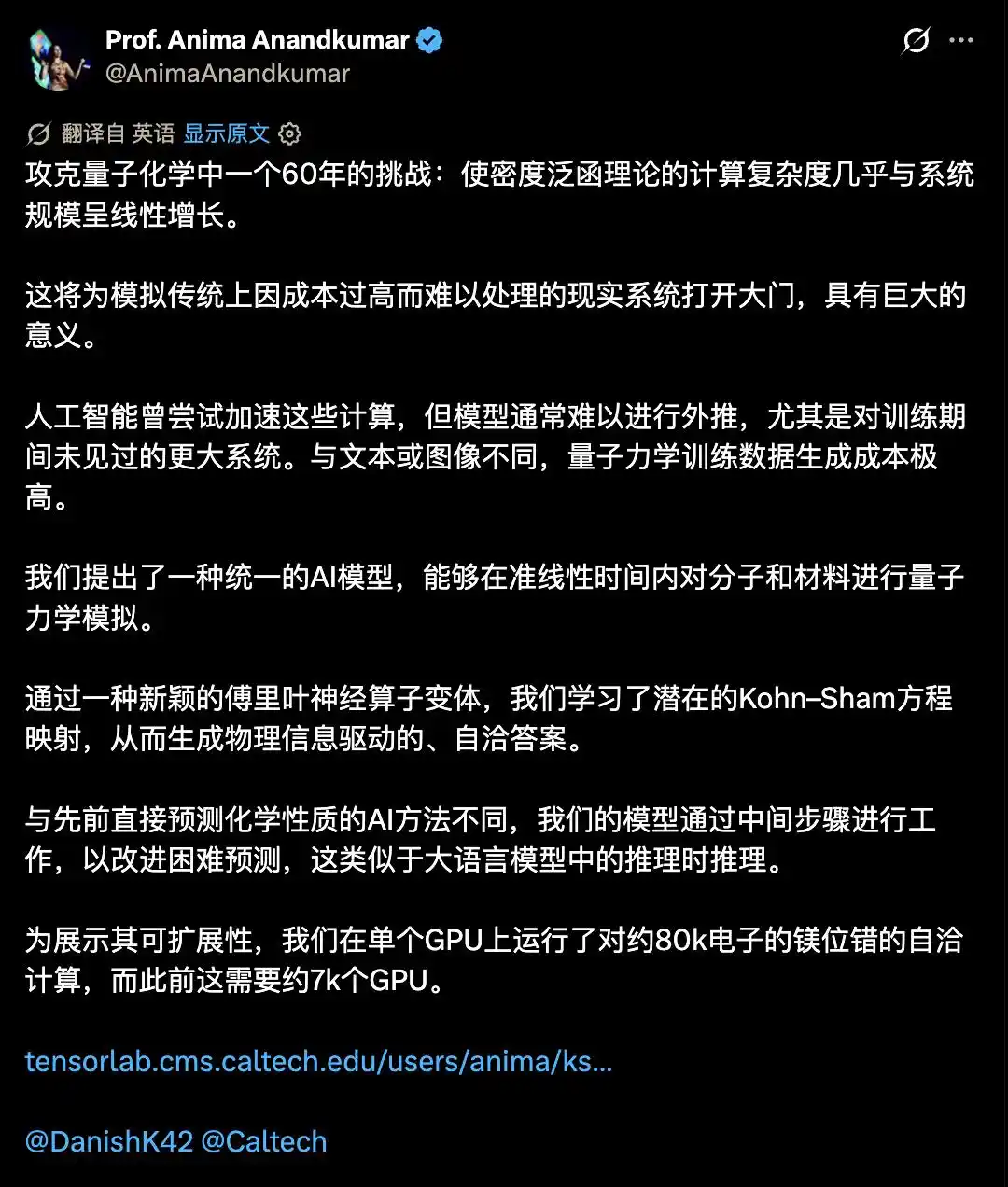
On August 24, a team led by Anima Anandkumar at Caltech published a paper, using an AI model to reduce the computational complexity of such calculations from cubic to nearly linear scaling.
https://x.com/AnimaAnandkumar/status/2092031815448248594
The results are stunning: a simulation of a metal defect containing 82,500 electrons was completed on a single GPU, a task that in 2019 required approximately 7800 GPUs.
A 60-Year Bottleneck
The most widely used computational method in quantum chemistry is Density Functional Theory (DFT), a Nobel Prize-winning theory essential for drug screening, catalyst design, and battery material research.
The problem is its slowness: as the system grows slightly larger, the computational cost increases cubically—a tenfold increase in electrons leads to a thousandfold increase in computation.
For 60 years, physicists have sought ways to accelerate it, but without a substantial breakthrough.
AI has tried two approaches.
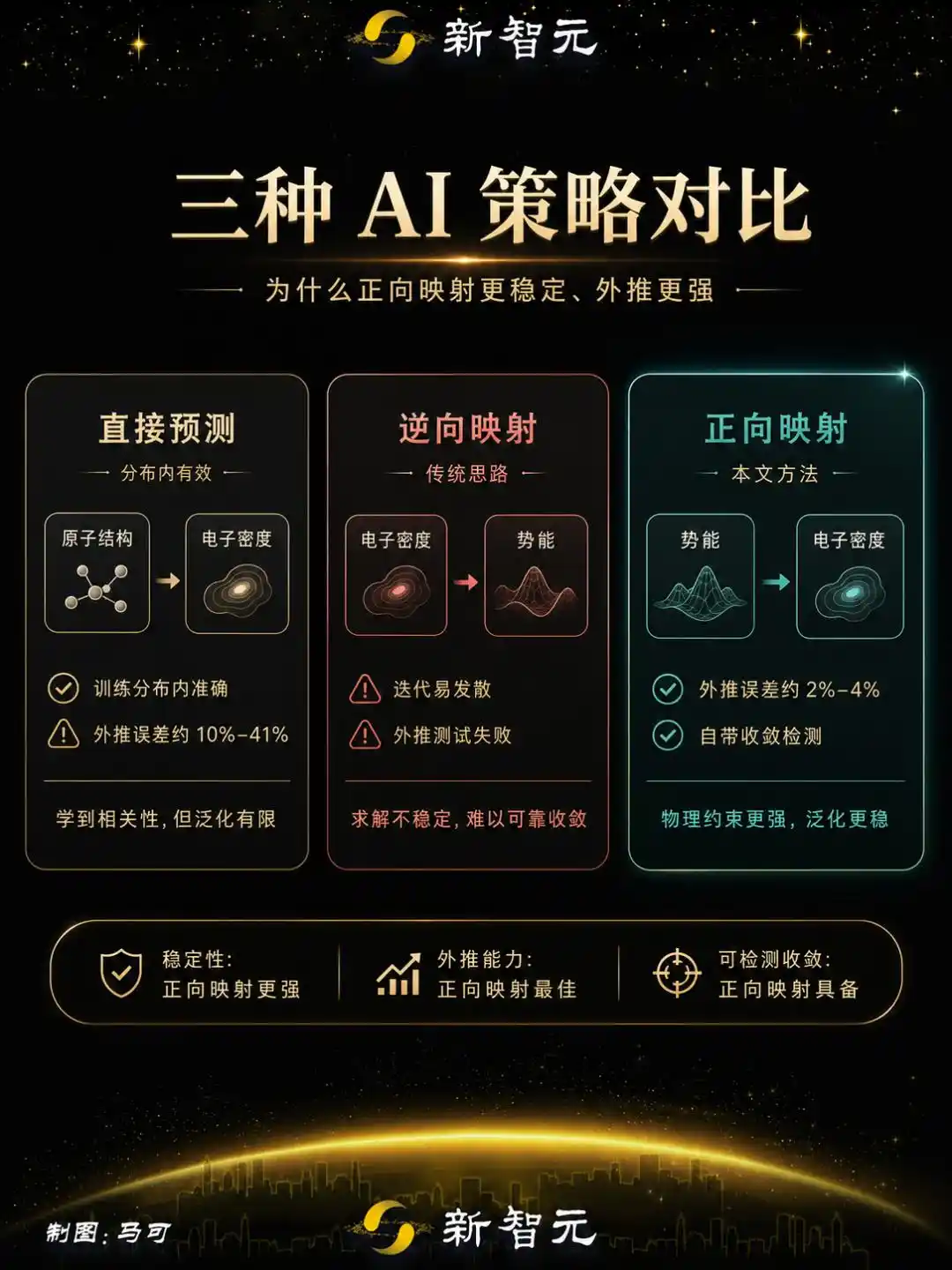
One approach trains a model to directly predict the final result in one step.
It works well within the training distribution but extrapolates poorly: once the molecule exceeds the size seen during training, errors spiral out of control.
The paper's experiments showed that when extrapolating from small molecules to drug-sized molecules, the error of direct-prediction models surged from less than 1% to around 10%, peaking at 41%.
The other approach follows the old path of physicists, having AI learn an inverse mapping.
This path is mathematically unstable; in the paper's control experiments, all calculations diverged after a few iterations, a complete failure.
Iterating Like a Chain-of-Thought Instead of Guessing the Answer in One Step
This paper takes a different direction.
The DFT calculation process is iterative: each round takes a set of input conditions, calculates the electron density, then uses the density to update the input conditions, repeating until the result stabilizes.
The traditional method gets stuck because each iteration requires solving a computationally massive step, which scales cubically.
The Anandkumar team's approach is: use AI to replace this step.
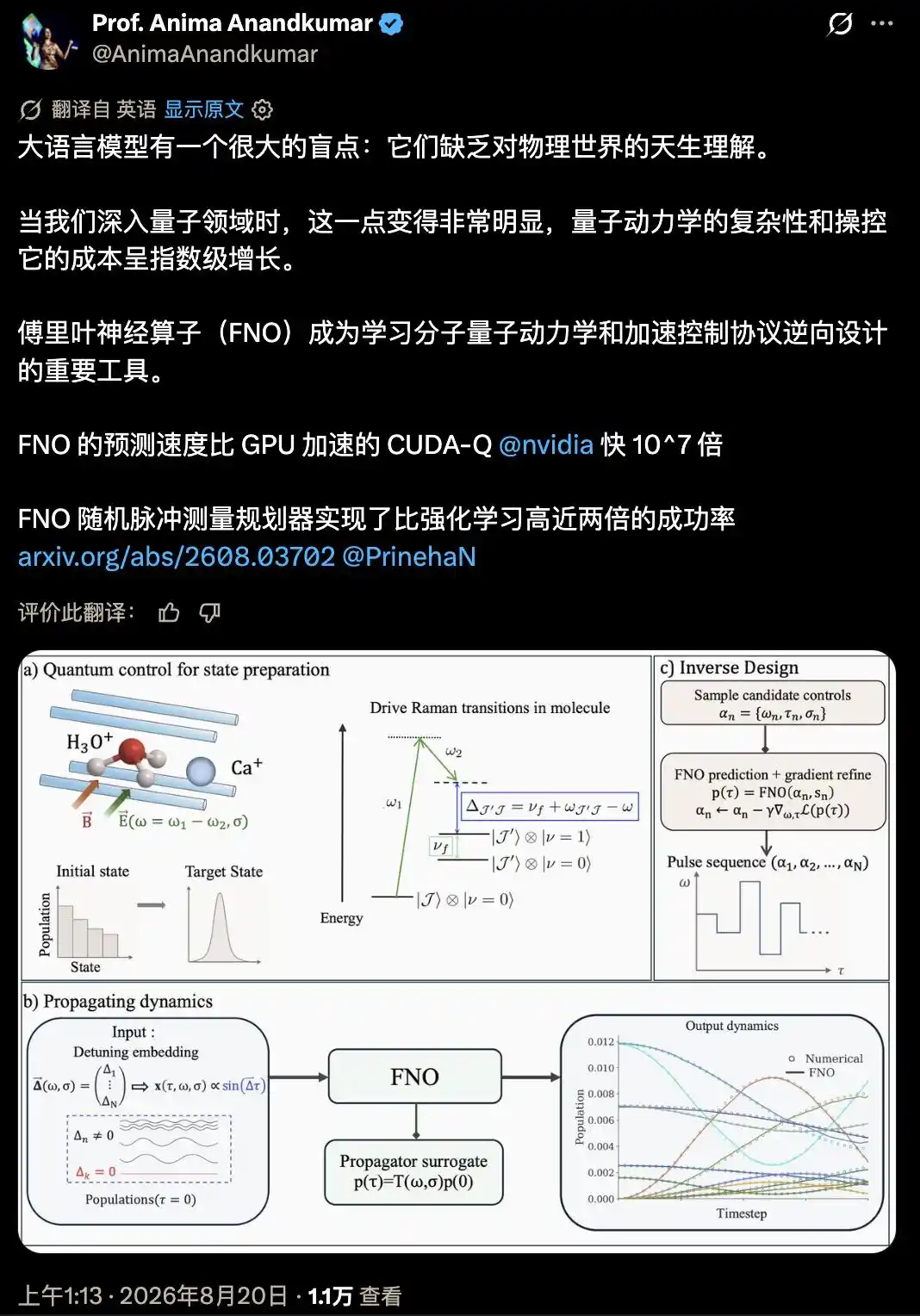
They train a Fourier Neural Operator (FNO) to learn the forward mapping of "given input conditions, output the corresponding electron density," reducing the computational complexity from O(N³) to O(N log N).
Then they embed the model back into the original iterative loop, keeping other steps unchanged.
https://x.com/AnimaAnandkumar/status/2090125110309204371
One can understand it this way: the direct-prediction model is like asking an LLM to give the final answer to a difficult problem in one step—fine for simple questions, but prone to errors on hard ones.
The Kohn-Sham FNO is like asking the model to perform a chain-of-thought reasoning, deducing step-by-step, with each step capable of self-verification; if it's wrong, subsequent iterations will pull it back.
This design also has an advantage that direct-prediction models lack: a safety valve.
If the model is pushed beyond its capabilities, the iteration will diverge, immediately alerting researchers that the result is unreliable.
The magnesium dislocation experiment in the paper verified this on the first attempt: using a general pre-trained model directly, all calculations diverged immediately—the divergence itself was the alarm.
A direct-prediction model gives an answer, but you have no way to judge if it's right or wrong.
The training data used only 8,504 structures. One model handles both molecules and solid-state materials, covering the first five rows of the periodic table.
This is thanks to a domain-invariant FNO variant designed by the team: systems of different sizes share the same learned filters, with small molecules and large crystals using the same model.
When extrapolating to drug-sized molecules not seen in the training set, the density error of Kohn-Sham FNO was 2.23%, compared to 9.97% for the direct-prediction model.
The larger the molecule, the more pronounced the gap: at 45 heavy atoms, the direct-prediction error skyrocketed to 41%, while Kohn-Sham FNO's was only 4%.
1 GPU, 80,000 Electrons
The team conducted a large-scale validation using a magnesium dislocation structure.
In 2019, a study nominated for the ACM Gordon Bell Prize performed full DFT calculations on 6,164 magnesium atoms, utilizing approximately 7,800 NVIDIA V100 GPUs on the Summit supercomputer.
The new Kohn-Sham FNO completed calculations for 8,250 atoms (82,500 valence electrons) on a single NVIDIA B300 GPU, with all results converging.
The measured scaling exponent was 1.03 (close to perfect linear), compared to 3.37 (cubic) for the traditional method.
Comparing 1 B300 to 7,800 V100s is not a hardware-equivalent comparison, but the scaling exponent is hardware-independent: one is nearly linear, the other cubic; the larger the system, the more irreversible the gap.
On the same day the paper was released, Anandkumar announced the founding of AI physics simulation company Accelerated Understanding, later reported by Reuters.

https://www.reuters.com/business/ai-founders-who-walked-away-bezos-backed-prometheus-model-universe-2026-08-25/
According to her introduction on X, the company's AI model simulates physical phenomena in 4D space, with a reasoning context length exceeding 5 trillion.
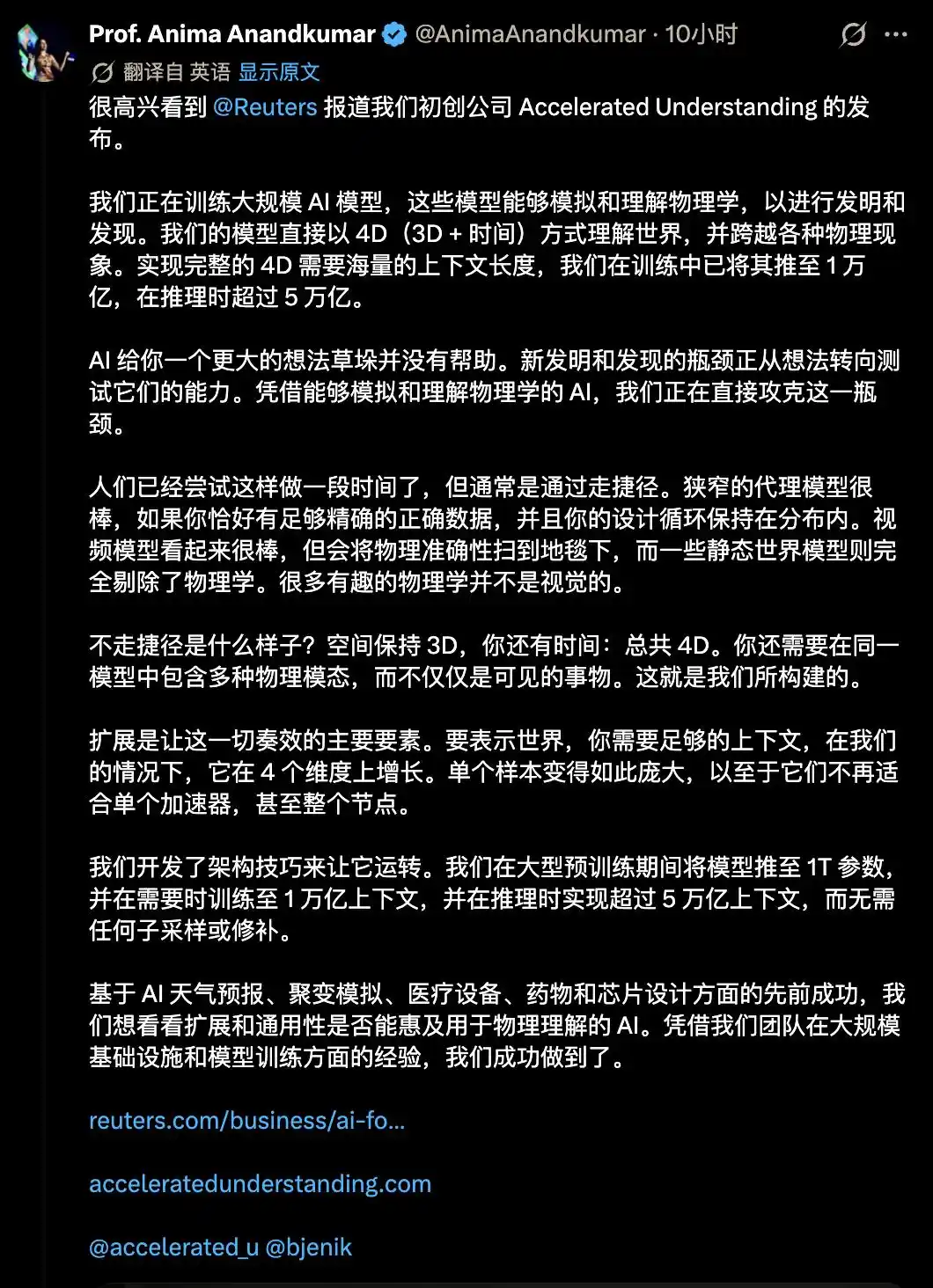
https://x.com/AnimaAnandkumar/status/2092236528898675014
Currently, Kohn-Sham FNO has only learned one step in the calculation pipeline; a post-processing step is still needed for complete energy calculations.
But the path is clear: AI is not replacing physics, but rather the most computationally expensive step of repetitive calculations in physical simulations.
The team's next plan is to fill in the remaining steps, at which point post-processing could also be eliminated. The future looks promising.

Team founders group photo
Reference: https://tensorlab.cms.caltech.edu/users/anima/ks_fno.html
This article is from the WeChat public account "Xin Zhi Yuan" (New Wisdom Source), author: ASI Apocalypse; Editor: Marco