Ethereum Price Slips Below Whale Cost Basis — More Pain For Bulls?

bitcoinistPublished on 2026-02-08Last updated on 2026-02-08

Abstract

Ethereum's price experienced a significant downturn in early February, falling over 30% and briefly dropping below $1,850. A critical development occurred as the price slipped below the realized price (average on-chain acquisition cost) of all investor cohorts, including large holders (whales) with over 100k ETH, whose cost basis is approximately $2,074. Historically, this whale cost level has acted as strong resistance in downtrends and reliable support in uptrends. A break below it suggests two potential outcomes: a sharp rebound if reclaimed as support (as seen in 2020 and 2022), or further capitulation toward multi-year lows (as in 2018-2019). Key resistance for any recovery is seen between $2,534–$2,675 (the realized price of smaller holders). If the $2,074 level is not reclaimed within 30-45 days, ETH could decline further to $1,800 or even $1,300–$1,600. At the time of writing, ETH is trading at $2,030, up over 7% in 24 hours.

In line with its bearish market structure, the Ethereum price struggled significantly in the first week of February. The cryptocurrency’s value fell by more than 30% over the week, crashing to as low as $1,850 on Friday, February 6. Amid the Ethereum market downturn, a significant development has emerged — one which could make or mar the world’s second-largest cryptocurrency.

Ethereum Breaches Realized Price Across All Investor Cohorts

In a recent post on Quicktake, on-chain analyst MorenoDV shared a shocking development within the Ethereum network. The analyst highlighted that the Ethereum price recently slipped below the cost basis of multiple investor groups.

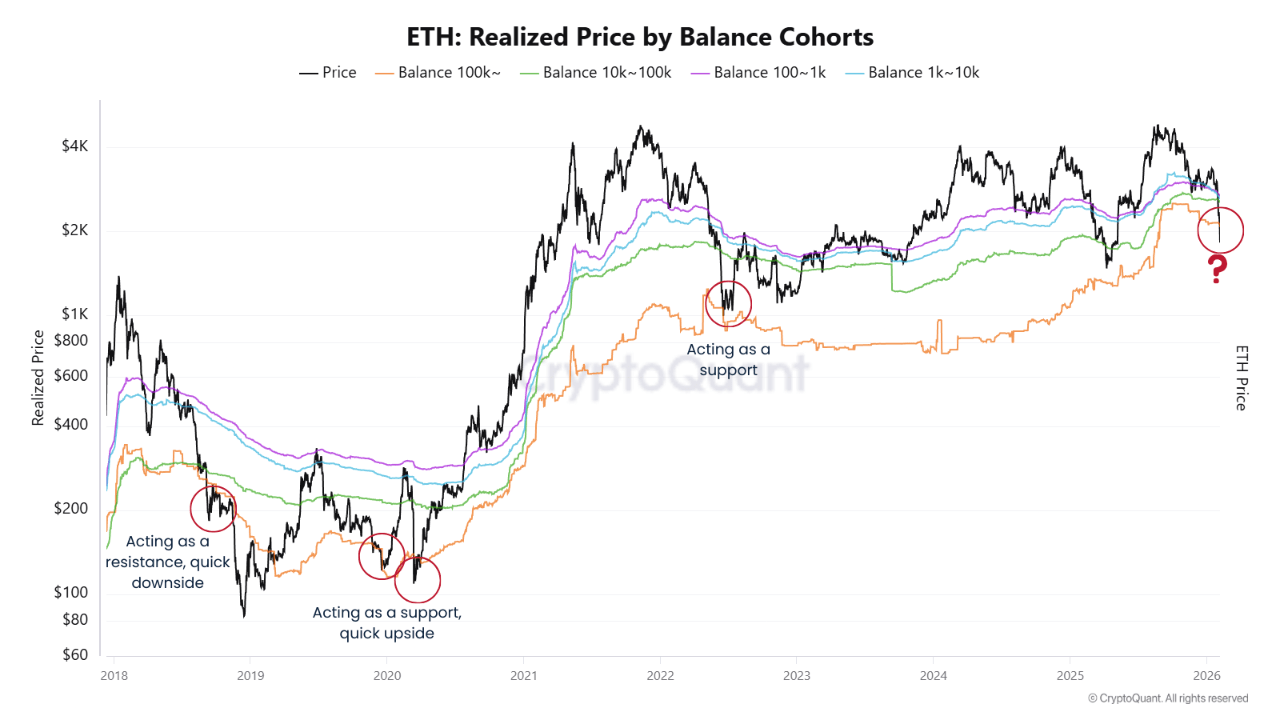
The revelation is based on the Realized Price by Balance Cohorts metric, which monitors the average on-chain cost basis of Ethereum holders. The metric groups these investors by wallet size, showing where these cohorts are holding profitably or running at losses.
Source: CryptoQuant

In the chart above, we see the Ethereum price break beneath multiple cost bases (represented with yellow, green, blue, and purple lines). The most striking, however, is the loss of the realized price of the largest holders (with 100k ETH and above stored), which stands at around $2,074.

Historically, the realized price of this investor class (with more than 100k ETH in holdings) has taken on dual roles for the Ethereum price, depending on its trajectory. According to data from 2019, mid-2020, and late 2022 price actions, whale realized price typically takes on a role of formidably resisting price during downtrends; during uptrends, it interestingly acts as reliable support.

Hence, at periods where the Ethereum price stabs through the whale realized price to the downside, MorenoDV explained that two potential paths typically emerge. In his words: “either a violent snap-back rally as the level flips to support (2020, 2022), or further capitulation into multi-year lows (2018-2019).”

Major ETH Price Levels To Watch

Because the Ethereum price went through all investor cohorts’ realized prices at the same time, there is something worth noting here. MorenoDV pointed out that smaller holders collectively have their realized prices between the $2,534 – $2,675 range.

Thus, should the Ethereum price attempt to recover previous legs, the $2,534–$2,675 price range will pose significant resistance to that effort. However, the aforementioned range is not the most critical one for the Ethereum price.

The analyst highlighted the whale cohort’s realized price, which is approximately $2,074 — to be the most critical for the Ethereum price. Following previous extrapolations, a reclamation of this level would likely follow historical trends and push prices upwards, while failure to retake this level within a period of 30 – 45 days would precede significant drawdowns.

In the event that the latter scenario holds true, the Ethereum price could swiftly fall to $1,800, or even lower. If price breaks beneath $1,800 and is sustained below this level, MorenoDV hypothesizes that this could lead Ethereum to the $1,600–$1,300 levels.

As of this writing, Ethereum stands at a valuation of $2,030, reflecting an over 7% jump in the past 24 hours.
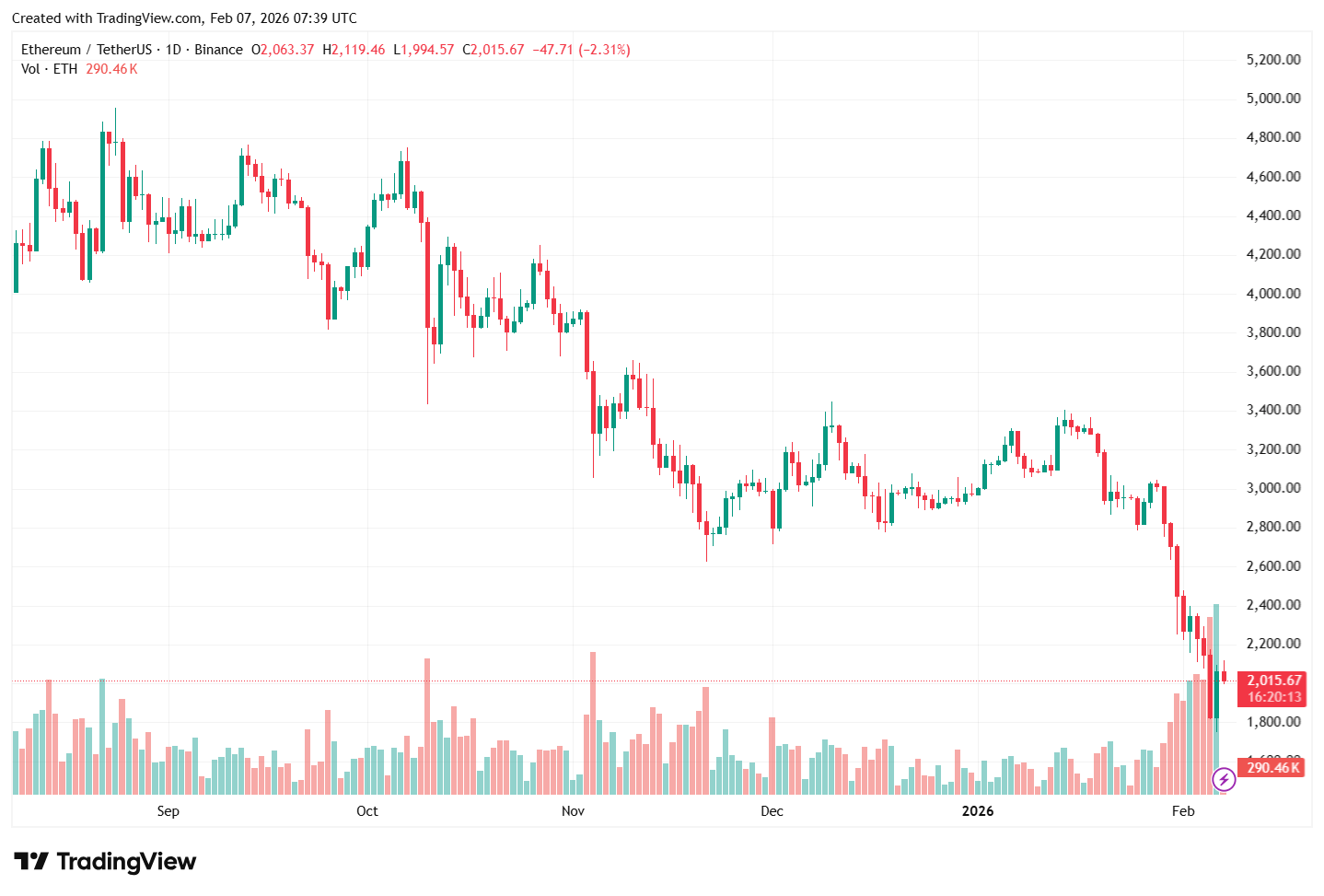
The price of ETH on the daily timeframe | Source: ETHUSDT chart on TradingView


Related Questions

QWhat is the significance of the Ethereum price falling below the whale cost basis?

AThe Ethereum price falling below the whale cost basis (around $2,074) is significant because this level has historically acted as formidable resistance during downtrends and reliable support during uptrends. A break below it could lead to either a violent snap-back rally if reclaimed as support, or further capitulation into multi-year lows.

QAccording to the on-chain metric, what is the realized price range for smaller Ethereum holders?

AAccording to the Realized Price by Balance Cohorts metric, smaller Ethereum holders collectively have their realized prices in the range of $2,534 to $2,675.

QWhat are the two potential outcomes when the Ethereum price breaks below the whale realized price to the downside?

AThe two potential outcomes are: 1) a violent snap-back rally as the level flips to support (as seen in 2020 and 2022), or 2) further capitulation into multi-year lows (as seen in 2018-2019).

QWhat is the most critical price level to watch for the Ethereum price according to the analyst?

AThe most critical price level to watch is the whale cohort's realized price, which is approximately $2,074. Reclaiming this level would likely push prices upward, while failure to retake it within 30-45 days could precede significant drawdowns.

QWhat price levels could Ethereum fall to if it breaks and sustains below $1,800?

AIf the Ethereum price breaks beneath $1,800 and is sustained below that level, the analyst hypothesizes it could lead to a drop to the $1,600–$1,300 levels.

Related Reads

The U.S. Government Blocked the Anthropic Model. It Wasn't About 'Jailbreaking' at All.

Last Friday, the U.S. Commerce Department issued an enforcement letter that forced Anthropic to take its two most advanced AI models, Fable 5 and Mythos 5, offline. The stated reason was unspecified national security concerns, initially linked to potential "jailbreaks" of the models' safeguards. However, new details suggest the action stemmed more from a deteriorating relationship between the Trump administration and Anthropic, rather than a genuine technical threat. According to reports, the government cited a little-known export control regulation, compelling Anthropic to block access for all non-U.S. persons, including its own international employees. The company complied, shutting down the models without a court order or specific technical details from the government. Cybersecurity expert Katie Moussouris revealed she was privately shown a research paper detailing a potential safeguard bypass in Fable 5. She argued the described method was minor and did not warrant an export ban, stating that attempts to "fix" it would only weaken the model's defensive capabilities. Moussouris and other experts have since called for the order to be revoked, warning it dangerously removes advanced cybersecurity tools from U.S. defenders. Analysts like Justin Hendrix suggest the move appears retaliatory and sets a dangerous precedent, signaling that the U.S. government can unilaterally shut down a tech company's products. The incident has raised concerns about the reliability of American AI and the potential for political interference in the tech industry, serving as a warning to the broader sector.

marsbit4m ago

The U.S. Government Blocked the Anthropic Model. It Wasn't About 'Jailbreaking' at All.

marsbit4m ago

Ray Dalio: AI Bull Market Continues to Soar, Should Investors Go All In or Cash Out and Leave the Field?

In his latest notes, Ray Dalio addresses a critical question for investors amid the AI-driven stock market surge: how should one allocate assets during a transformative technological revolution? Dalio emphasizes that technological advancement does not automatically make related stocks attractive. Historical tech cycles—marked by excitement, crowding, volatility, and eventual shakeouts—show that even long-term winners like Microsoft and Apple experienced severe drawdowns. Today's AI sector faces similar uncertainties: overinvestment, intensifying competition, geopolitical tensions (e.g., Taiwan's chip supply), tax policy shifts, anti-AI sentiment, and potential disruption from future technologies like quantum computing. Dalio's core argument focuses on the highly concentrated market structure, where a few tech giants dominate major indices. He warns investors against unknowingly holding concentrated, correlated exposures. Instead of chasing a handful of AI leaders, he advocates for a robust, diversified portfolio of 15 or more high-quality, uncorrelated investments, risk-balanced to match an investor's volatility tolerance. Mathematically, such diversification significantly improves the risk-return ratio—for example, holding 15 uncorrelated assets can boost the ratio by over four times compared to a single concentrated bet. Dalio cautions that future equity returns appear low, with his bubble indicator suggesting real returns could be negative over the next 5-10 years. He stresses that knowing what you don't know is as important as knowing what you do. In an environment of high uncertainty and concentration, avoiding large, concentrated bets on AI stocks is prudent. The optimal strategy is disciplined diversification—the "holy grail" of investing—to navigate this technologically driven cycle with lower risk and comparable or better returns.

marsbit8m ago

Ray Dalio: AI Bull Market Continues to Soar, Should Investors Go All In or Cash Out and Leave the Field?

marsbit8m ago

The World Cup has only been played for a few days, but some AI prediction models have already been crowned as oracles, while others have stumbled badly.

The 2026 FIFA World Cup has sparked significant interest not only on the pitch but also in AI-driven match prediction. Major models like Qwen, Copilot, and ChatGPT are being used to forecast outcomes, scores, upsets, red cards, and key player performances. Qwen gained early attention by accurately predicting Mexico's 2-0 win over South Africa (including a red card risk) and South Korea's 2-1 victory over the Czech Republic in the opening matches. Copilot's pre-tournament predictions had notable successes, such as correctly calling the Mexico 2-0 scoreline, South Korea's 2-1 win, and Brazil's 1-1 draw with Morocco. However, it also had clear misses, failing to predict upsets like Australia's 2-0 win over Turkey or Switzerland's draw with Qatar. ChatGPT provided detailed analytical reasoning, correctly predicting Mexico's 2-0 win, but its full-tournament predictions tended to favor favorites, missing several underdog results and draws. Tests pitting multiple models (ChatGPT, Gemini, Grok, Claude) against the same match, like Mexico vs. South Africa, showed varying predictions, with only some hitting the exact score. In summary, while AI models like Qwen have shown promising early results in specific match details, and others have had isolated successes, they collectively struggle to consistently identify upsets and underdog performances. AI is becoming an additional reference tool for prediction markets but is far from a definitive source.

marsbit8m ago

The World Cup has only been played for a few days, but some AI prediction models have already been crowned as oracles, while others have stumbled badly.

marsbit8m ago

Missed Out on SpaceX's IPO? Take a Look at SpaceX's Complete Supply Chain

SpaceX is now public, but its high valuation and losses may deter some investors. However, the real opportunity, as seen with Apple, Tesla, and Nvidia, may lie in its extensive supply chain. SpaceX, funded primarily by its profitable Starlink service, spends hundreds of billions annually on components for its rockets, satellites, and planned orbital AI data centers, creating significant revenue streams for suppliers. Key suppliers are categorized by their indispensability. The first group includes irreplaceable players like **NVIDIA** (GPUs for AI supercomputers), **Eutelsat (SATS)** (spectrum rights), **Filtronic** (millimeter-wave amplifiers), **Materion (MTRN)** (beryllium alloys), and **STMicroelectronics (STM)** (phased array chips). The second category comprises suppliers costly to replace due to long certification cycles or deep integration, such as **Honeywell (HON)** (flight controls), **Carpenter Technology (CRS)** (specialty steel), **Hexcel (HXL)** (carbon fiber), **Broadcom (AVGO)** (data switching), and **Linde** (industrial gases). The third group involves high-volume, cost-critical manufacturers for mass-produced items like Starlink terminals. Major players here include Taiwanese contract manufacturer **Wistron NeWeb (6285)** and several Chinese-listed firms: **Sunway Communication (300136)**, **Parker Advanced Materials (605123)**, **Western Superconducting (002149)**, and **Yingliu Co., Ltd. (603308)**. Other niche providers include **Tianyin Electromechanical**, **Tongyu Communication**, **Trimble (TRMB)**, **Astronics (ATRO)**, and **CTSH**. The timing is now relevant because: 1) SpaceX's procurement is accelerating with plans for 100 launches in 2026, 30 million Starlink terminals, and orbital data centers. 2) Its IPO has brought unprecedented transparency to its supply chain. 3) This phase mirrors early days of the Tesla supply chain boom. The investment thesis shifts from betting on SpaceX's stock to betting on the steady, order-book-driven revenues of its essential suppliers. Risks remain, such as commodity cycles, geopolitical factors, and technological shifts, but the supply chain offers a potentially less speculative path to participate in SpaceX's growth.

marsbit26m ago

Missed Out on SpaceX's IPO? Take a Look at SpaceX's Complete Supply Chain

marsbit26m ago

Jane Street: The Most Powerful Behind-the-Scenes Operator in the Crypto Industry

Jane Street: Crypto's Most Powerful Behind-the-Scenes Operator A recent 13F filing revealed Jane Street, the secretive Wall Street quant giant, drastically reduced its Bitcoin ETF holdings while increasing stakes in Ethereum ETFs. This move highlights its role not as a directional investor, but as a critical infrastructure player extracting "tolls" from crypto's institutionalization. The firm, founded in 2000 and famously lacking a CEO, has systematically embedded itself across crypto markets. It acts as a key Authorized Participant (AP) and market maker for major Bitcoin and Ethereum ETFs, profiting from arbitrage between ETF shares and underlying assets. Its approach combines quantitative prowess with a willingness to hold positions for structural arbitrage, differing from pure high-frequency traders. Jane Street faces allegations related to the 2022 Terra (LUNA) collapse. A lawsuit claims it used non-public information to withdraw $85 million in UST minutes before a critical withdrawal by Terraform Labs, allegedly exacerbating the crash and avoiding over $200 million in losses. The company denies the claims. Further indicating its reach, a wallet suspected to be operated by Jane Street ("JaneStreetIndia") was identified on the prediction market Polymarket. This bot executed over 11,000 high-frequency trades on short-term crypto price movements with a near-perfect win rate, showcasing a套利 strategy divorced from traditional prediction. Beyond trading, Jane Street holds equity in crypto infrastructure like Kraken, 1inch, and Arbitrum, and mining stocks. Its strategy is clear: avoid betting on winners, but secure a position in the market's essential plumbing. By becoming a ubiquitous part of the liquidity infrastructure—from ETFs to OTC trading and potentially链上 markets—Jane Street operates as a market force itself, raising questions about whether crypto's decentralized,散户-friendly alpha is being permanently eroded by traditional finance's most sophisticated players.

Foresight News29m ago

Jane Street: The Most Powerful Behind-the-Scenes Operator in the Crypto Industry

Foresight News29m ago

Trading

Spot
Futures

Hot Articles

Discussions

Welcome to the HTX Community. Here, you can stay informed about the latest platform developments and gain access to professional market insights. Users' opinions on the price of ETH (ETH) are presented below.

活动图片














