Ethereum Price Is Running The Same Playbook That Led To 10,000% And 4,000% Surges In The Past

bitcoinistPublished on 2026-03-27Last updated on 2026-03-27

Abstract

Ethereum price is holding above $2,000, showing resilience in bearish conditions. Analyst Merlijn The Trader identifies a recurring historical pattern in ETH's price chart that previously led to massive surges of 10,000% (2016-2018) and 4,000% (2018-2021). The pattern consists of three phases: consolidation, trendline retest, and parabolic rally. In the current cycle, ETH is consolidating in a $3,000-$4,000 range with a similar ascending trendline. The analyst suggests the cycle may be poised for another major breakout. If ETH holds above $2,000, a parabolic surge could follow; if not, a brief decline may occur before the anticipated rally.

The Ethereum price continues to hold above $2,000, demonstrating noteworthy resilience amid ongoing bearish market conditions. In light of this resilience, crypto market analyst Merlijn The Trader recently shared a new ETH analysis, identifying a recurring historical pattern that has served as a strong bullish signal for the cryptocurrency. According to the analyst, this pattern previously drove gains of over 10,000% and 4,000%, suggesting that a repeat could spark another major rally in this cycle.

Ethereum Price Chart Repeats Historically Bullish Pattern

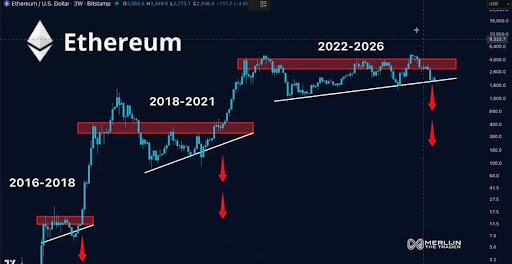
In an X post published on Thursday, March 26, Merlijn The Trader shared a three-week price chart highlighting a unique pattern, which he says Ethereum has repeated almost perfectly three cycles in a row. He noted that during each cycle, the pattern unfolded in three distinct phases: a consolidation, a trendline retest, and a parabolic rally.

In the 2016-2018 cycle highlighted on the chart, the Ethereum price started near the lows of $3-$5. The cryptocurrency consolidated sideways for years in the red box zone between $11.5 and $27.5 while building a rising trendline of higher lows beneath it. When the price finally broke out of that trendline, it went parabolic, rising to roughly $1,400 in 2018, reflecting a massive 10,000% price rally. Following this, Ethereum experienced a major price collapse, wiping out almost 90% of its market value, which dragged its price back down to around $80-$100 by late 2018, completely resetting the cycle.
Source: X

Similarly, in the 2018-2021 cycle, Ethereum started from lows around $80-$100, then recovered and slowly entered a long consolidation within the red box around $300-$400. Again, the cryptocurrency was building a rising trendline of higher lows beneath it. Once the cryptocurrency retested this trendline, the breakout was enormous, sending ETH all the way above $4,800 by late 2021 and marking a new all-time high.

This roughly 4,000% rally was also supported by a surge in DeFi activity and the NFT mania during the cycle. After this jump, Ethereum experienced a similar price collapse to the previous cycle, first dropping hard, then bouncing briefly, before finally crashing again to below $1,000 by mid-2022.

What This Means For The Current Cycle

In the current cycle, Merlijn The Trader’s price chart shows that Ethereum is mirroring past cycle trends exactly. The cryptocurrency has climbed back into a new, much higher red box zone around $3,000-$4,000, with the same ascending trendline forming underneath. The consolidation within this box has been prolonged and choppy, underscoring bearish market conditions and weakness.

Merlijn The Trader’s projection suggests that this cycle has already completed its consolidation and trendline reset and could now be on the verge of an explosive rally. The analyst outlined two possible scenarios for Ethereum’s next move. He predicts that if ETH continues to hold above $2,000, a breakout from the trendline could occur soon, potentially triggering the historical parabolic surge. However, if the cryptocurrency fails to maintain the $2,000 level, its price could decline once more before staging the anticipated rally.

ETH price moves toward $2,000 support | Source: ETHUSDT on Tradingview.com

Trending Cryptos

Related Questions

QWhat historical price pattern is the analyst Merlijn The Trader identifying for Ethereum?

AThe analyst is identifying a recurring pattern that consists of three distinct phases: a consolidation, a trendline retest, and a parabolic rally.

QWhat were the two previous major rallies in Ethereum's price that this pattern preceded, according to the analysis?

AThe pattern preceded a 10,000% rally to roughly $1,400 in the 2016-2018 cycle and a 4,000% rally to above $4,800 in the 2018-2021 cycle.

QIn the current cycle, what price zone is the 'red box' consolidation occurring in?

AIn the current cycle, the consolidation is occurring in a 'red box' zone around $3,000-$4,000.

QWhat is the two possible scenarios for Ethereum's next move, as outlined by the analyst?

AThe two scenarios are: 1) If ETH holds above $2,000, a breakout and parabolic surge could occur soon. 2) If it fails to hold $2,000, the price could decline further before the anticipated rally.

QWhat were the two major factors that supported the 4,000% rally in the 2018-2021 cycle?

AThe rally was supported by a surge in DeFi activity and the NFT mania during that cycle.

Related Reads

IPO Imminent, OpenAI Faces Major Personnel Upheaval

OpenAI, preparing for a potential IPO, is experiencing significant leadership turmoil. In mid-August 2026, longtime "GPU geek" Scott Gray quietly left, and within three days, Chief Operating Officer Brad Lightcap (8-year veteran) and Chief Revenue Officer Denise Dresser (8-month tenure) departed. This follows a broader exodus of at least 10 senior executives in 2026, including heads of product, safety, and ethics. Analysts view this as a strategic "surgery" to transform from a research lab into a sales-driven enterprise company before going public. Revenue now tilts toward enterprise clients, surpassing consumer income sooner than expected, with annualized revenue reaching $40 billion. The new CRO, Dali Rajic, is a veteran enterprise sales leader. Concurrently, OpenAI has disbanded independent safety teams like "Preparedness," which assessed catastrophic risks, integrating their functions into core research. Critics warn this removes dedicated "brakes" on AI development. The leadership vacuum raises questions about who is the clear second-in-command after former apps CEO Fidji Simo moved to an advisory role. Co-founder Greg Brockman appears to be consolidating power. As OpenAI races against rival Anthropic ($47B annualized revenue), it faces the dual challenge of commercial execution while managing the departure of foundational technical talent and ensuring responsible AI development remains a priority.

marsbit48m ago

IPO Imminent, OpenAI Faces Major Personnel Upheaval

marsbit48m ago

AI Can 'Have Moods Too'! New Research from USTC: Confusion and Anxiety Make AI Work Better

The article discusses research from the University of Science and Technology of China and Oxford, revealing that allowing AI to recognize and act upon simulated "internal emotions" can significantly improve its performance. The study demonstrates a coherent pairing between specific emotional states in AI agents and their subsequent skill choices. For instance, an agent feeling curious and desirous will search for products, while one feeling confused and tense will rephrase queries. This mirrors human decision-making influenced by emotions. Statistical validation showed a 76.5% semantic consistency in these pairings. Crucially, the research challenges the traditional view of AI errors as flaws to be eliminated. It found that "bad" emotions like confusion, tension, or frustration serve as useful metacognitive signals, indicating a mismatch between the current strategy and the environment. By responding to these signals, AI can proactively adjust before a failure occurs. This is particularly effective in complex tasks prone to failure. For example, in tasks like "heating an item" and "picking up two items," success rates surged from 9.6% to 56.9% and 4.4% to 31.3%, respectively, when using the emotion-driven skill selection method (EMOTION2SKILL). The AI's "nervous" state about a closed microwave, for instance, prompted it to check and open it first, preventing failure. The article also mentions related work from Tianjin University, which embeds emotional prediction into world models (Large Emotional World Model, LEWM), significantly improving prediction accuracy in human-centric environments. Removing emotional data was found to degrade performance even in unrelated logical reasoning tasks. These studies build on earlier findings, like those from Anthropic, that identifiable emotional representations exist within large language models (LLMs). The focus is shifting from philosophical debate about AI emotion to practically harnessing these internal states as functional signals to enhance AI robustness and capability.

marsbit1h ago

AI Can 'Have Moods Too'! New Research from USTC: Confusion and Anxiety Make AI Work Better

marsbit1h ago

Trading

Spot

Hot Articles

Discussions

Welcome to the HTX Community. Here, you can stay informed about the latest platform developments and gain access to professional market insights. Users' opinions on the price of ETH (ETH) are presented below.

活动图片