Ethereum Price Forecast: Why Does ETH Remain Stable After Five Consecutive Weeks of ETF Inflows?

cryptonews.ruPublished on 2026-08-05Last updated on 2026-08-05

Abstract

Ethereum Price Forecast: Why ETH Stays Stable After Five Consecutive Weeks of ETF Inflows? Ethereum (ETH) is trading around $1,867.68, showing little movement despite five consecutive weeks of net inflows into spot ETFs and a new community-dividing proposal, EIP-8363, that could significantly alter ETH's supply dynamics. Technically, ETH is consolidating between key support at $1,837.76 (0.382 Fibonacci) and resistance around $1,939. A descending trendline from May near $1,900 continues to cap price rallies. The MACD indicator remains bearish, suggesting sideways momentum persists until a breakout occurs. On August 4th, spot ETH ETFs saw a strong $53.75 million daily inflow, led by BlackRock's ETHA. This marks the fifth straight week of positive inflows, with total net inflows reaching $11.25 billion. A major talking point is EIP-8363, the "Tapered Issuance Burn" proposal backed by researchers like Justin Drake. It aims to burn an increasing share of validator rewards as the staked ETH ratio grows, reaching 100% burn when 60.25 million ETH (≈50% of supply) is staked. Proponents see it as a long-term positive supply shock for price. However, opponents warn it could disadvantage small validators and reduce staking yields, potentially dampening institutional demand. **Price Outlook:** * **Bull Case (Target: $2,042):** A daily close above the $1,940 resistance and the descending trendline, fueled by sustained ETF inflows and EIP-8363 supply narrative, could open a path tow...

Five consecutive weeks of ETF inflows and a validator reward burn proposal that could change the supply of $ETH, yet the price is barely moving. $ETH is trading at $1,867.68 on August 5, unchanged on the day, while the $1,900 trend line remains overhead, and the market is still waiting for something to force a decision.

$ETH Holds the 0.382 Fibonacci, But the Downtrend Line Remains Unbroken
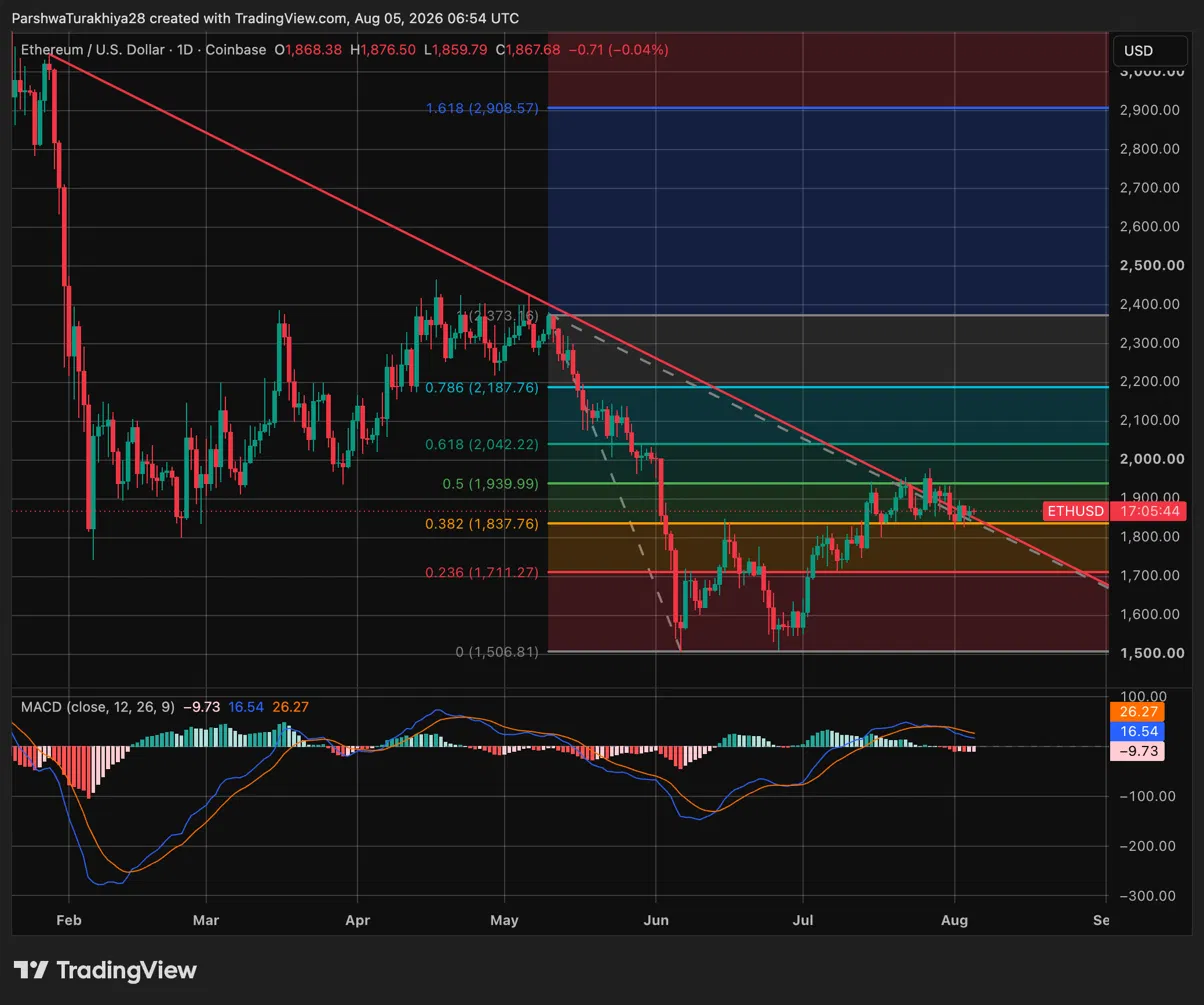
Price Analysis for $ETH (Source: TradingView)

$ETH is trading at $1,867.68, sitting between the key support level at $1,837 below and resistance at $1,939 above. Today's session was tight — ranging from $1,859.79 to $1,876.50 — with no directional conviction on either side.

The descending trend line from the May peak around $2,373 continues to slope around the $1,900 area and has rejected all meaningful recovery attempts since June. It converges with the $1,939 resistance, creating a $1,900–$1,940 zone that price must overcome before $2,000 comes into play.

Related: Pi Network Price Forecast: Can Protocol 26 and RoboPay Lift PI Above $0.10?

The MACD tells the same cautious story. The MACD line at -9.73 is still below the signal line at 16.54, and the histogram has not yet entered bullish territory. Momentum has not confirmed a recovery. Until the MACD crosses over or the trend line is broken, the path of least resistance remains to the side.

Support and Resistance Levels for $ETH, August 5, 2026

Type Price Level
Resistance $1,939.99 0.5 Fibonacci, confluence with descending trend line
Resistance $2,042.22 0.618 Fibonacci
Resistance $2,187.76 0.786 Fibonacci
Resistance $2,908.57 1.618 Fibonacci Extension
Support $1,837.76 0.382 Fibonacci, key floor
Support $1,711.27 0.236 Fibonacci
Support $1,506.81 June low, Fibonacci base

Spot $ETH ETFs Open Fifth Consecutive Week in the Green

Spot Ethereum ETFs recorded a daily net inflow of $53.75 million on August 4, the strongest single-day figure since late July. BlackRock's ETHA led with $42.46 million, followed by Fidelity's FETH with $9.34 million and Bitwise's ETHW with $1.34 million. Morgan Stanley's MSSE added $605.21K. All other products recorded zero flow for the day.

The current week has already gathered $42.33 million in just the first two sessions — Monday and Tuesday — with three days still remaining. This puts the week on track to extend the already fifth consecutive positive week for $ETH ETFs. Total net inflows across all products now stand at $11.25 billion with total net assets of $10.32 billion.

Week Weekly Net Inflow
August 4 (partial, 2 days) $42.33M
July 31 $27.42M
July 24 $103.90M
July 17 $105.44M
July 10 $84.42M

EIP-8363: The Supply Shock Proposal Splitting the Community

🚨 🛠️ ETHEREUM PROPOSAL WATCH

A new proposal backed by Ethereum researchers, including Justin Drake, seeks to lower validator rewards as $ETH staking nears the 50% threshold.

Opponents say the change could disadvantage solo validators and put pressure on DeFi yields.

Could this... pic.twitter.com/QtGzvK7w4r

— Coin Edition: Your Crypto News Edge ️ (@CoinEdition) August 5, 2026

Six Ethereum developers, including Justin Drake, proposed a new issuance policy on August 5 called "Tapered Issuance Burn", previously EIP-8363. This proposal would burn an increasing portion of validator rewards as the amount of staked $ETH grows, with the burn rate reaching 100% once staked $ETH reaches 60.25 million, roughly half of the total supply. Implementation was envisioned to take place over 18 months.

Co-author Jérôme de Tychey described uncontrolled issuance as a "dilution tax" for every $ETH holder, arguing that the plan would hinder large custodians and liquid staking providers from concentrating supply. Analyst Zac Pundle called this development a negative supply shock and argued it is directly positive for the price of $ETH.

Related: $BNB Price Forecast for August 2026: Can $BNB Break $600 Amid Former Employee Scandal Clash and Index Inclusion?

However, the proposal has faced significant pushback. Solo validators, small stakers, and DeFi builders warn that the burn mechanism will squeeze out small participants before large institutions feel the real effect, and that it could lower staking yields in a way that reduces institutional demand for $ETH.

The proposal is in the discussion stage and is not scheduled for an upgrade, yet its supply implications are already being debated within the ecosystem as a potential long-term price catalyst.

EIP-8363 Details Value
Proposal Name Tapered Issuance Burn
Lead Authors Justin Drake and Jérôme de Tychey, among others.
Mechanism Burns an increasing portion of validator rewards as staked $ETH grows
Full Burn Threshold 60.25 million $ETH staked (~50% of total supply)
Launch Timeline 18 months
Bull Argument Negative supply shock positive for $ETH price
Bear Argument Squeezes out solo validators, may reduce institutional staking demand

Ethereum Price Forecast: Upside and Downside Targets

Bull Case, Target: $2,042 (0.618 Fibonacci)

$ETH holds the 0.382 Fibonacci retracement at $1,837.76, and the MACD histogram is beginning to shrink towards a bullish crossover. ETF inflows, continuing for a fifth straight week, are attracting fresh institutional attention, and the EIP-8363 supply shock narrative is gaining traction as a long-term price driver. A break of the downtrend line on a daily close above $1,940 opens the path to the 0.618 Fibonacci at $2,042.22 and the $2,000 level.

Bear Case, Risk Level: $1,711 (0.236 Fibonacci)

The descending trend line continues to reject price, and the MACD fails to crossover bullishly, keeping momentum in sellers' control. The controversy around EIP-8363 dampens staking sentiment, and ETF inflow pace slows in the second half of the week. $ETH loses the 0.382 Fibonacci level at $1,837.76 and slides towards the 0.236 level at $1,711.27, with the June low at $1,506.81 coming into view on accelerating deeper lows on selling pressure.

Related: Biconomy Price Forecast: BICO Surges 126% Weekly as Bulls Target $0.03

end-content

Trending Cryptos

Related Questions

QAfter five consecutive weeks of ETF inflows, what is the current price action of Ethereum (ETH) and its key technical levels according to the article?

AAs of August 5, 2026, ETH is trading at $1,867.68, showing little daily movement. It remains between key support at $1,837 (the 0.382 Fibonacci level) and resistance at $1,939. The market is consolidating below a key descending trendline from the May peak, located around $1,900, and is waiting for a catalyst to break this range.

QWhat is EIP-8363 (Tapered Issuance Burn) and what are the main arguments for and against it?

AEIP-8363, proposed by Ethereum researchers including Justin Drake, is a mechanism that would burn an increasing share of validator rewards as the amount of staked ETH grows, reaching 100% burning when staked ETH hits 60.25 million (approx. 50% of supply). Proponents argue it creates a negative supply shock, which is bullish for ETH's price. Opponents warn it could disadvantage solo/small validators, pressure DeFi yields, and potentially reduce institutional staking demand.

QHow have spot Ethereum ETFs performed recently in terms of fund flows?

ASpot Ethereum ETFs have recorded five consecutive weeks of net inflows. As of the partial week ending August 4 (with 2 days of data), they attracted $42.33 million. This follows weekly inflows of $27.42 million (July 31), $103.90 million (July 24), $105.44 million (July 17), and $84.42 million (July 10). The total net inflows for all products have reached $11.25 billion.

QWhat are the bullish and bearish price targets for ETH outlined in the article's forecast?

AThe bullish case targets $2,042.22 (the 0.618 Fibonacci level), contingent on a daily close above the $1,940 resistance and the descending trendline. The bearish risk level is $1,711.27 (the 0.236 Fibonacci level), which could be tested if ETH loses the $1,837.76 support, potentially leading to a deeper sell-off towards the June low of $1,506.81.

QWhat technical indicator is mentioned as still showing caution and lacking confirmation for an ETH recovery?

AThe Moving Average Convergence Divergence (MACD) indicator. As per the article, the MACD line at -9.73 remains below the signal line at 16.54, and the histogram has not yet crossed into bullish territory. This lack of momentum confirmation suggests the path of least resistance remains sideways until a bullish crossover occurs or the descending trendline is broken.

Related Reads

New Changes in the Clarity Information Act: Eleanor Terrett Shares Her Thoughts!

The U.S. Senate is at a critical juncture in its legislative work on cryptocurrency. At the Rare Evo conference, journalist Eleanor Terrett discussed the latest developments for the long-awaited "CLARITY Act" and its chances of passage this year. Facing the August recess, the bill's fate hangs in the balance, requiring 60 votes to proceed. With 53 Republican senators, support from at least seven Democrats is needed. Terrett suggested a push by Senate leadership could force compromise and even delay the recess to finish the bill. A major hurdle is ethics. Democrats argue the current provisions are insufficient to prevent former President Donald Trump from profiting from his crypto projects and want to empower state attorneys general to sue the DOJ for potential ethics violations, a move opposed by Republicans and the White House. The draft also includes a provision, effective until 2029, banning officials and members of Congress from issuing digital assets while in office. Another key dispute involves provisions from Representative Tom Emmer's Blockchain Regulatory Certainty Act (BRCA), which would grant criminal immunity to programmers whose code is misused by third parties. The crypto sector sees this as necessary, but prosecutors and law enforcement oppose it. While prediction markets estimate roughly a 30% chance of the CLARITY Act passing by the end of 2026, Terrett stated she sees a higher probability of it becoming law this year.

cryptonews.ru5m ago

New Changes in the Clarity Information Act: Eleanor Terrett Shares Her Thoughts!

cryptonews.ru5m ago

Democrats Take Steps to Block the CLARITY Act Due to Protracted Ethics Negotiations

Democratic senators are planning to block a procedural vote to advance the CLARITY Act, a major digital asset bill, due to stalled negotiations on a bipartisan ethics agreement. The Democrats had made this ethics deal a condition for their support. They submitted the agreement text to the White House but have received no response, leading them to withhold the votes needed to proceed. The ethics dispute centers on proposed restrictions for federal officials profiting from digital assets while in office, a measure seen as targeting former President Trump's family crypto ventures. Democrats have rejected the current bill's provisions as insufficient. With time running out before a Friday recess, Senate Majority Leader John Thune insists on holding the vote. However, rules require a one-day delay after filing a cloture motion, making passage this week unlikely without immediate Democratic support. Republicans hold 53 seats and need about seven Democratic votes to reach the 60-vote threshold, which they currently lack. Industry supporters have flooded Congress with over 1 million calls backing the bill. Crypto markets are already reacting; prediction market odds for the CLARITY Act being signed in 2026 have fallen to 23%, and Bitcoin has remained stagnant around $64,000. If the vote fails or is delayed, the bill will be pushed back to at least September, reigniting the ethics fight ahead of the midterm elections.

cryptonews.ru8m ago

Democrats Take Steps to Block the CLARITY Act Due to Protracted Ethics Negotiations

cryptonews.ru8m ago

Bitcoin Price Fluctuates Around $64,000 as Coldcard Losses Exceed $116 Million

Bitcoin's price is holding around $64,000 despite significant negative pressure. Losses from a vulnerability in Coldcard hardware wallets have surpassed $116 million, with thefts continuing in waves. Michael Saylor's MicroStrategy sold another 1,638 BTC (its third sale this year), and wallets linked to the firm moved a further 1,030 BTC, raising fears of a fourth sale. In Washington, the "Clarity Act" bill faces likely failure after Democratic senators blocked negotiations. The Coldcard flaw, stemming from a March 2021 firmware bug, caused some devices to generate seeds with only ~40 bits of entropy instead of 128, exposing long-term holders to brute-force attacks. Developer James O'Beirn launched a public dashboard tracking the ongoing thefts in real-time; a test wallet with no added entropy was drained within an hour. Coinkite has halted shipments and urged affected users to move funds immediately, as firmware updates alone cannot eliminate the risk. For bulls, a potential floor is seen around Bitcoin's production cost, currently estimated at $54,000 (with an energy cost component of ~$40k). Historically, prices have bottomed below this cost in previous cycles. Meanwhile, exchange inflows have spiked as worried Coldcard users transfer coins, and with MicroStrategy still holding $5 billion in approved sales, alongside the potential collapse of the Clarity Act, further downward pressure looms.

cryptonews.ru9m ago

Bitcoin Price Fluctuates Around $64,000 as Coldcard Losses Exceed $116 Million

cryptonews.ru9m ago

Trading

Spot

Hot Articles

Discussions

Welcome to the HTX Community. Here, you can stay informed about the latest platform developments and gain access to professional market insights. Users' opinions on the price of ETH (ETH) are presented below.

活动图片