Ethereum Market Dynamics Stay Bearish As On-Chain Data Points To Capitulation

bitcoinistPublished on 2026-02-25Last updated on 2026-02-25

Abstract

Ethereum's market dynamics remain bearish as on-chain data indicates signs of capitulation. The price fell below the $1,900 support level, reflecting a broader crypto market decline. Analysts note increased realized/unrealized losses, declining demand, and reduced Open Interest, suggesting investors are exiting positions under pressure. Retail investors are taking long positions, while leverage remains high. Metrics like the NUPL and active addresses signal caution. Despite a recent 3% price drop to $1,826, trading volume increased by 29%. Analysts suggest the next decline could form a base for potential accumulation, with Ethereum's movement closely tied to Bitcoin's trajectory.

Ethereum’s price was rocked by the market drawdown on Monday, causing it to lose the $1,900 support level once again, which has triggered speculations about its near-term market outlook. Following the pullback, investors’ sentiment is shifting towards a more cautious state, keeping its market dynamics firmly bearish.

Bearish Momentum Persists in The Ethereum Market

Just as the broader cryptocurrency environment has flipped highly bearish, Ethereum market dynamics remain strongly tilted to the downside. Some of the indications of this scenario include signs of capitulation across the leading altcoin and network.

Joao Wedson, an author and the founder of on-chain data analytics platform Alphractal, has shed light on ETH’s current market state after examining multiple metrics. Key indications, such as realized/unrealized losses and declining demand metrics, point to an increasing number of investors pulling out of positions due to pressure.

Data from Alpha AI shows that there is an increase in long positions while the Coinbase Premium Index is demonstrating a decline. The increase in leveraged longs indicates that traders are wagering that recent weakness will give way to upward momentum and are setting up for a rebound.

At the same time, on-chain data is flashing signs of capitulation. Current flows indicate defensive behavior from investors and waning conviction rather than new accumulation. Wedson also underlined other key areas and metrics that reinforce this idea of bearish market dynamics for ETH.
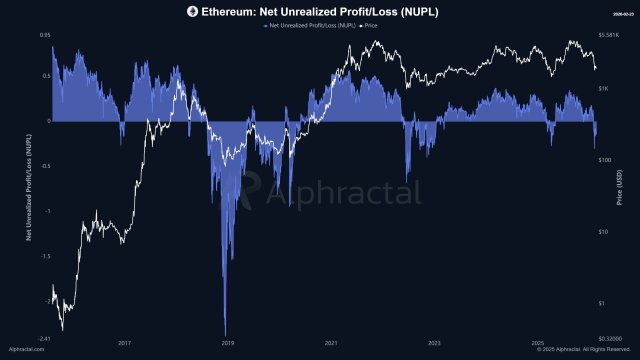
Source: Chart from Joao Wedson on X

The first metric is the Whale vs Retail Delta, which is now showing that the retail investors are positioning heavily on the long side. The Liquidation Level Heatmap is reflecting high leverage in the system. ETH’s Open Interest (OI) has been declining, with active addresses persistently vanishing.

On-chain volume is flashing caution as active drops, and the NUPL is currently exhibiting capitulation signals. Given these bearish signals, Wedson highlighted that the next drop could spur the formation of a base with strong probability. This implies that Ethereum might start its accumulation phase in the short term.

A Move Back To Lower Bollinger Bands

In the current market state, Ethereum’s price appears to be moving in the same direction as Bitcoin’s price. According to market analyst and investor Cantonese Cat, both cryptocurrency assets just hit their lower Bollinger Bands as they contract as support. However, the direction has not yet been determined for the Bollinger Band squeeze.

As a result, Cantonese Cat noted that bulls may want more sideways to turn the 20-day SMA flatter, which would present a better chance to flip it as support. Meanwhile, the bears would be looking for more follow-through of the current price action and for a lower low occurring soon, but it has not yet happened.

At the time of writing, the ETH price was trading at $1,826 after dropping by over 3% in the last 24 hours. Despite the waning price action, its trading volume has turned bullish again, rising by more than 29% within the same period.

ETH trading at $1,825 on the 1D chart | Source: ETHUSDT on Tradingview.com

Trending Cryptos

Related Questions

QWhat key on-chain metrics indicate that Ethereum is experiencing capitulation according to Joao Wedson?

AKey metrics include realized/unrealized losses, declining demand metrics, Whale vs Retail Delta showing retail investors heavily long, high leverage in Liquidation Level Heatmap, declining Open Interest, vanishing active addresses, dropping on-chain volume, and NUPL exhibiting capitulation signals.

QHow did the Coinbase Premium Index behave and what does it suggest about market sentiment?

AThe Coinbase Premium Index demonstrated a decline, indicating waning conviction from investors and defensive behavior rather than new accumulation, reflecting bearish sentiment.

QWhat does the increase in leveraged long positions suggest about trader expectations?

AThe increase in leveraged long positions indicates that traders are betting that recent weakness will give way to upward momentum and are positioning for a potential rebound.

QWhat is the significance of Ethereum's price hitting the lower Bollinger Band according to Cantonese Cat?

AEthereum hitting the lower Bollinger Band as support indicates the bands are contracting, but the direction of the subsequent Bollinger Band squeeze has not yet been determined, leaving the market outlook uncertain.

QWhat are the contrasting expectations of bulls and bears in the current Ethereum market situation?

ABulls want more sideways movement to flatten the 20-day SMA for a better chance to flip it as support, while bears are looking for more follow-through of the current downward price action and for a lower low to occur soon.

Related Reads

The Entire Internet Hails Noam's Joining, But OpenAI's Loss Bill Just Got Thicker

While the AI community celebrates Noam Shazeer, co-author of the "Attention Is All You Need" paper, joining OpenAI as Head of Architectural Research, the company's audited financials reveal a starkly different reality. In 2025, OpenAI reported $13.07 billion in revenue but a massive $20.92 billion operating loss. Even excluding a one-time accounting charge, the cash burn is severe, with $3.7 billion consumed in Q1 2026 alone. This high-profile hiring occurs against a backdrop of significant internal research talent drain, with key founders and researchers departing as the company's focus shifts from exploratory research to product iteration. Meanwhile, OpenAI's fundamental business model faces a deep crisis. It paid Microsoft $10.59 billion for compute in 2025, while its vast user base of 9 billion weekly actives includes only 50 million paying customers, making growth a direct driver of escalating costs. The article argues Shazeer's recruitment is less about technical necessity and more about crafting a compelling narrative for OpenAI's upcoming IPO, aiming to justify a rumored $1 trillion valuation to future public market investors. It contrasts OpenAI's strategy with Anthropic's reported path to profitability, which relies on a strong enterprise customer base and cost control, rather than star-powered narratives. Ultimately, the piece concludes that while Shazeer's architectural work may take 1-2 years to materialize, OpenAI's financial clock is ticking much faster, with its massive losses undercutting the celebratory headlines.

marsbit1h ago

The Entire Internet Hails Noam's Joining, But OpenAI's Loss Bill Just Got Thicker

marsbit1h ago

Market Trend (June 19): US-Iran Deal Drives Out Geopolitical Premium; Chip Stocks Soar to New Highs; Energy Sector Leads Declines

U.S. Market Trends (June 19): U.S.-Iran Deal Eases Tensions, Chip Stocks Soar, Energy Sector Leads Declines. U.S. stocks rallied on Thursday as the signing of a temporary U.S.-Iran deal in Geneva de-escalated Middle East tensions, with Saudi oil tankers transiting the Strait of Hormuz. This geopolitical relief helped markets recover from recent Fed-driven volatility. The S&P 500 rose over 1%, the Nasdaq gained nearly 2%, and the Dow Jones Industrial Average closed at another record high. The Philadelphia Semiconductor Index surged over 6% to a historic peak. Chip stocks were the standout performers. Reports of an Apple-Intel design and foundry deal for certain products, alongside mentions of potential Nvidia and SpaceX collaborations with Intel, propelled the sector. Intel surged ~10.5%, while memory chip makers like Micron also saw significant gains, highlighting sustained confidence in long-term AI capital expenditure. In contrast, the energy sector was the day's sole loser, with the S&P 500 energy sub-index declining as WTI crude fell ~2% to around $74.29/barrel. The reopening of key shipping routes erased prior geopolitical risk premiums. SpaceX extended losses for a second day on news of a potential large bond offering. Market volatility (VIX) dropped sharply, indicating a swift reversal of post-Fed jitters. Treasury yields dipped slightly but remained elevated. The focus now shifts to upcoming economic data, including next week's PCE inflation report and Micron's earnings, which will serve as a key test for the AI trade's durability.

marsbit1h ago

Market Trend (June 19): US-Iran Deal Drives Out Geopolitical Premium; Chip Stocks Soar to New Highs; Energy Sector Leads Declines

marsbit1h ago

Trading

Spot
Futures

Hot Articles

Discussions

Welcome to the HTX Community. Here, you can stay informed about the latest platform developments and gain access to professional market insights. Users' opinions on the price of ETH (ETH) are presented below.

活动图片