Ethereum eyes $2K after Arthur Hayes’ 1293 ETH buy – Will bulls deliver?

ambcryptoPublished on 2026-07-17Last updated on 2026-07-17

Abstract

Arthur Hayes purchased 1,293 ETH (worth ~$2.48M), reinforcing Ethereum's accumulation narrative. Separately, a whale moved 21.3K ETH (~$40.95M) from Fidelity Custody to an on-chain wallet, signaling institutional capital moving to decentralized rails. Despite a single day of net exchange inflows, broader data shows persistent outflows, reducing liquid supply. Large "whale-sized" orders continue dominating spot market activity. ETH traded near $1,920, facing key resistance at $2,000. Technical indicators like the RSI at 66.54 show strengthening buying interest without being overbought. A breakout above $2,000 could target $2,400, while rejection may test $1,800 support. Overall, whale activity and improving market structure support the accumulation thesis.

Arthur Hayes reinforced the Ethereum accumulation narrative after Lookonchain reported that he purchased 1,293 ETH worth approximately $2.48 million.
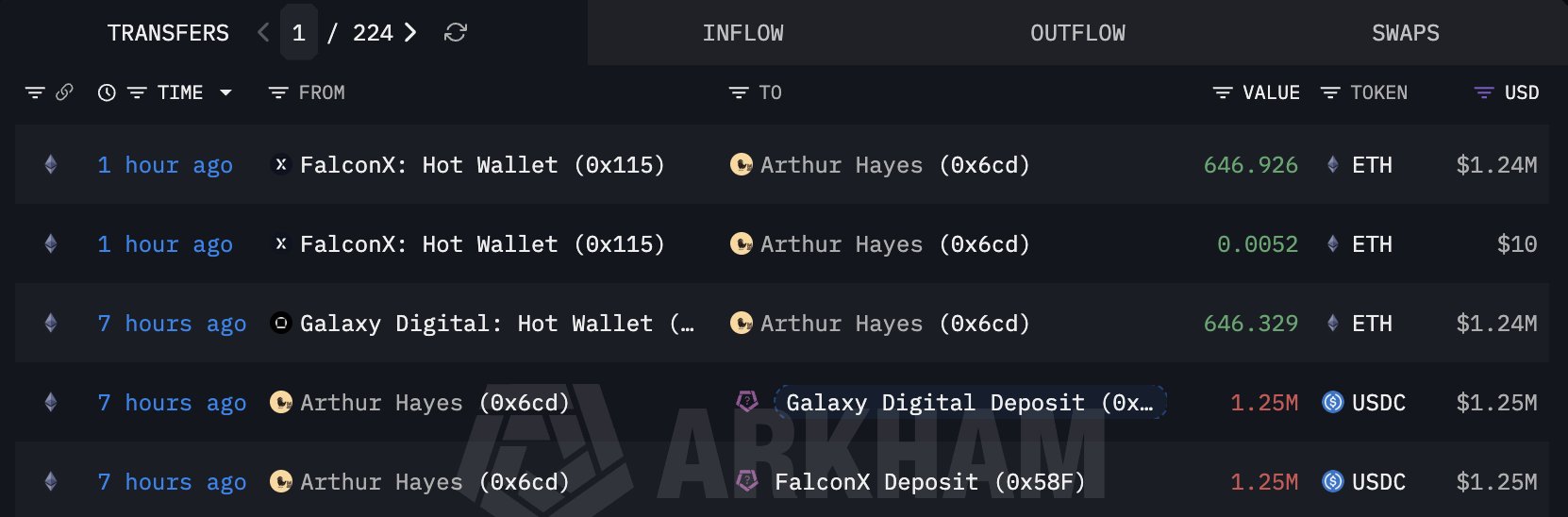
Source: Lookonchain

The transaction followed another notable move, where a separate whale transferred 21.3K ETH valued at about $40.95 million from Fidelity Custody into a newly created on-chain wallet.
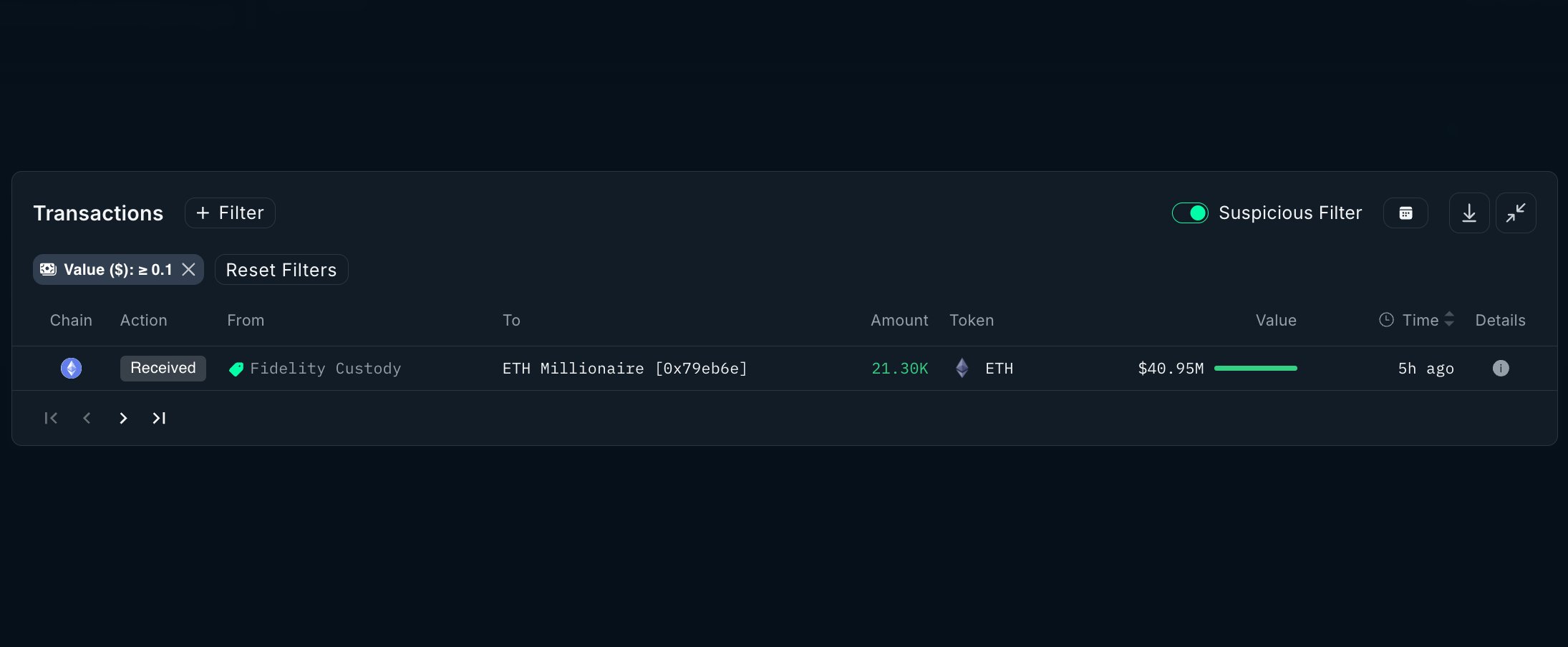
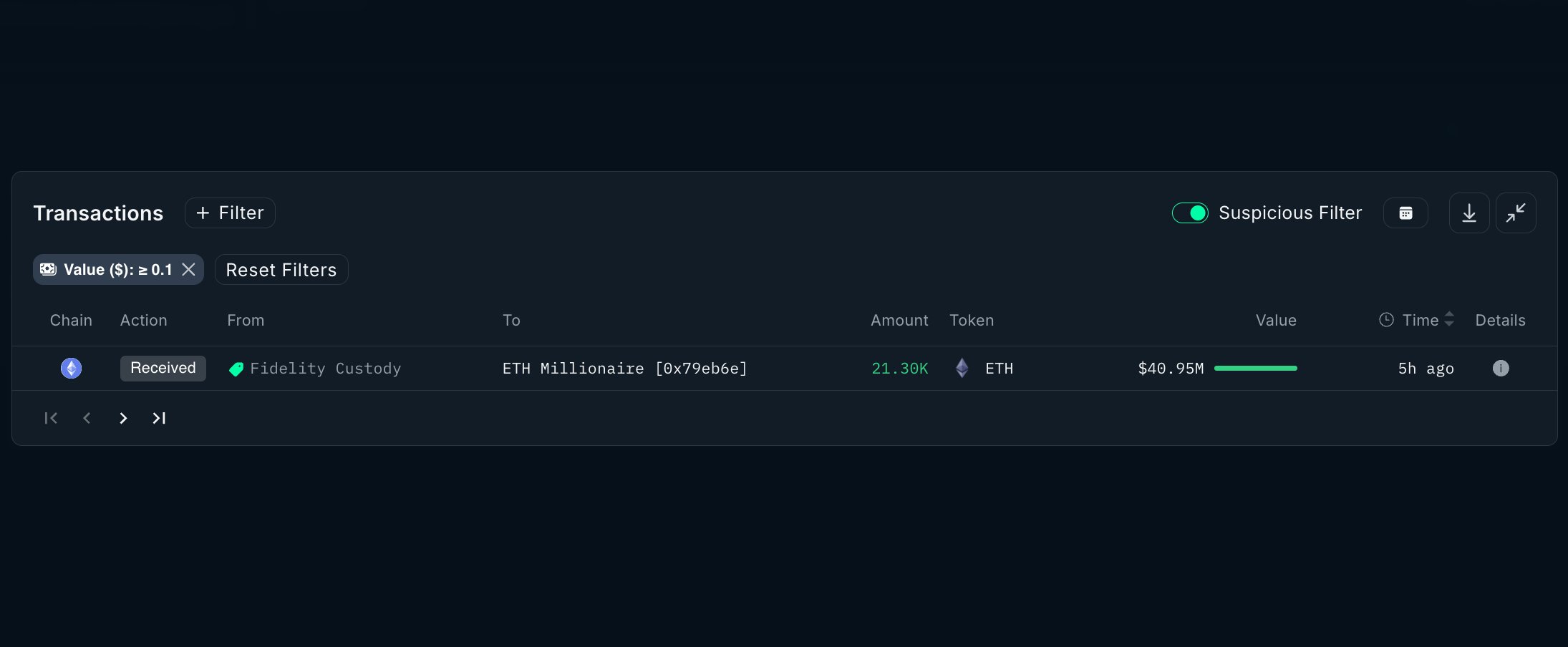
Source: Onchain Lens

Rather than signaling exchange withdrawals, the transfer reflected capital moving from traditional institutional custody onto decentralized rails.

This shift suggested the holder intended to deploy the assets on-chain or maintain direct custody.

Together, both transactions highlighted growing confidence among large investors despite Ethereum trading below the psychological $2,000 barrier.

Exchange flows stayed mixed despite outflow trend

Ethereum’s spot Netflow data painted a mixed short-term picture while preserving a broader accumulation backdrop.

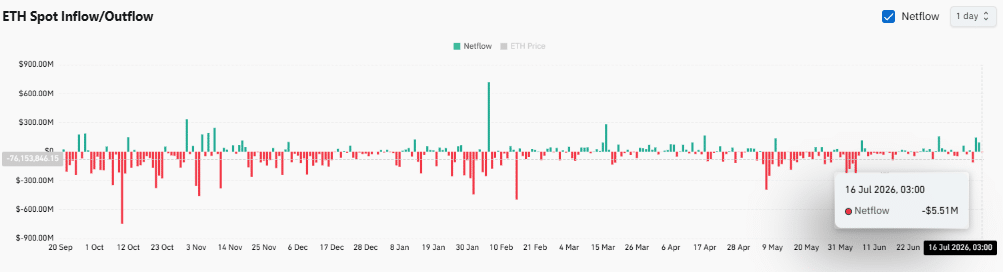
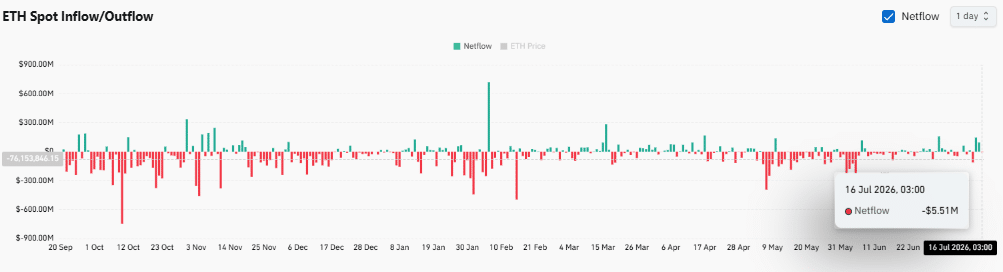
The latest daily reading showed a net inflow of approximately $5.51 million on 16 July, indicating more ETH entered exchanges during that session.

Even so, the wider chart revealed that exchange outflows had dominated across most trading sessions over recent months, with repeated negative netflow spikes outweighing isolated inflow periods.

Those persistent outflows suggested investors had continued removing ETH from trading venues instead of preparing immediate sales.

Recent inflows therefore appeared limited within the broader trend rather than marking a structural shift in market behavior.

If exchange balances continue declining over time, available liquid supply would likely remain constrained, supporting Ethereum’s longer-term supply dynamics.
Source: CoinGlass

Whale-sized trades kept dominating spot activity

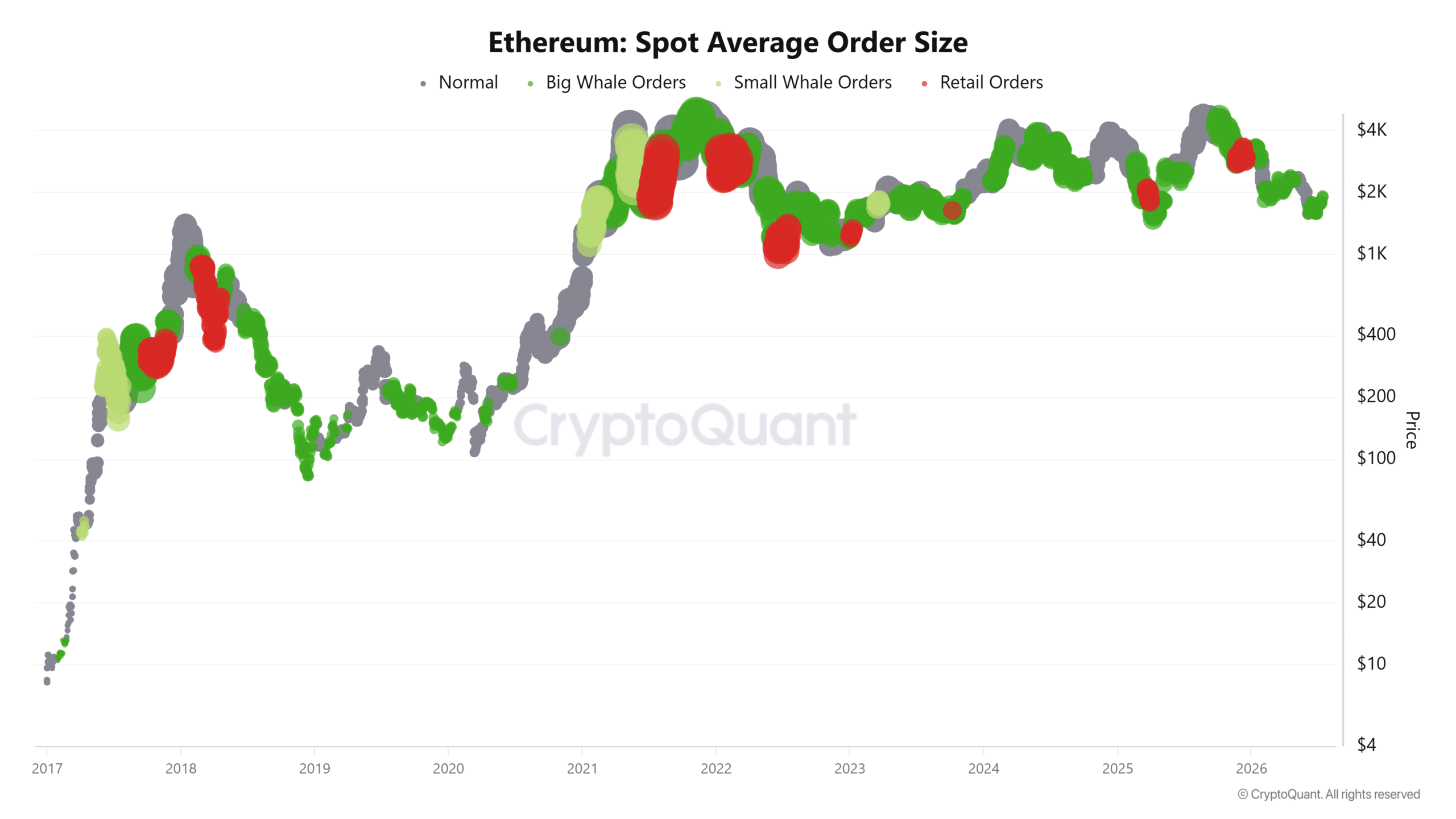
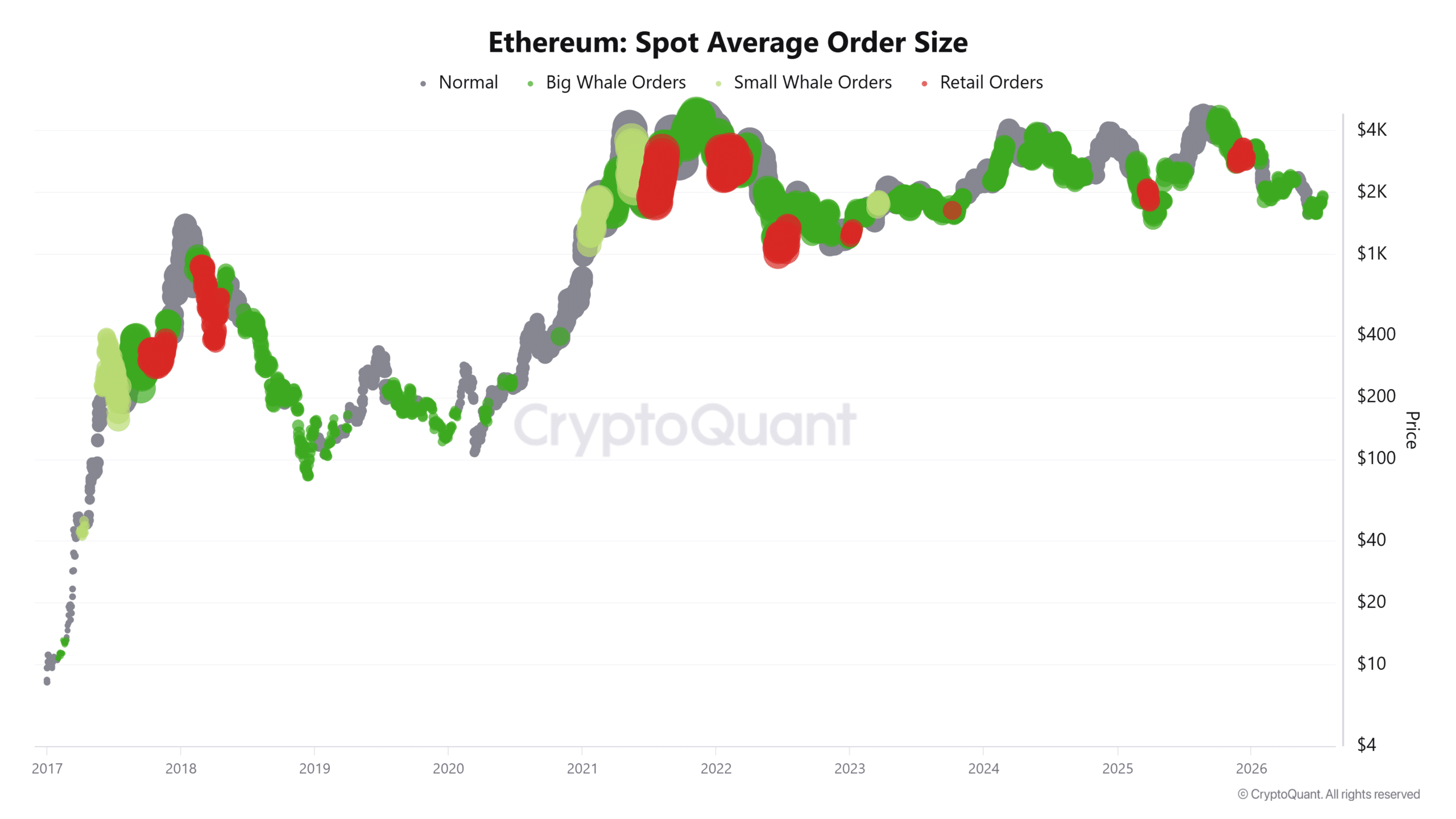
Spot Average Order Size remained inside the “Big Whale Orders” zone, confirming that large transactions continued dominating Ethereum’s spot market activity.

The indicator suggested institutional participants and high-net-worth investors accounted for a significant share of executed trades rather than retail-sized orders.

This reading aligned closely with the latest purchases from Arthur Hayes and the sizeable transfer from Fidelity Custody to a fresh wallet.

Instead of representing isolated transactions, the activity reflected a broader pattern of whale participation across the market.

Growing involvement from large buyers often improves market depth and reinforces confidence during recovery phases.

Even so, sustained accumulation would still require consistent follow-through before translating into a decisive breakout above key resistance levels.
Source: CryptoQuant

Can Ethereum finally reclaim $2,000?

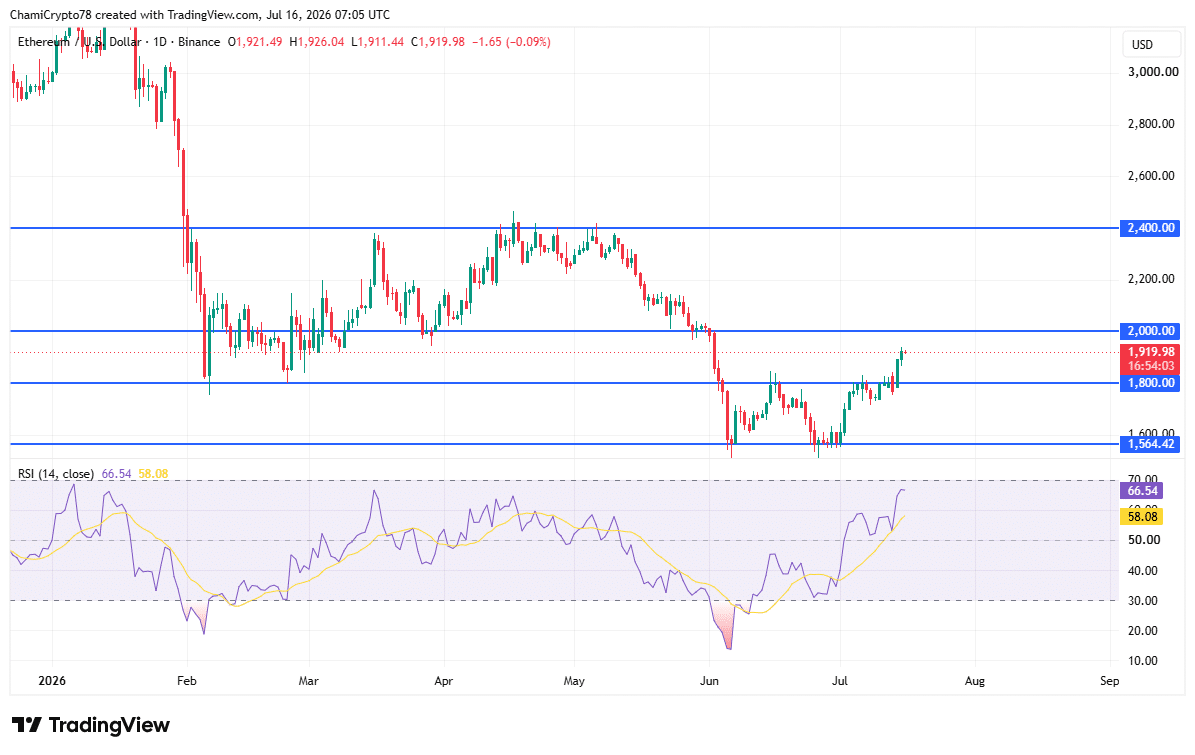
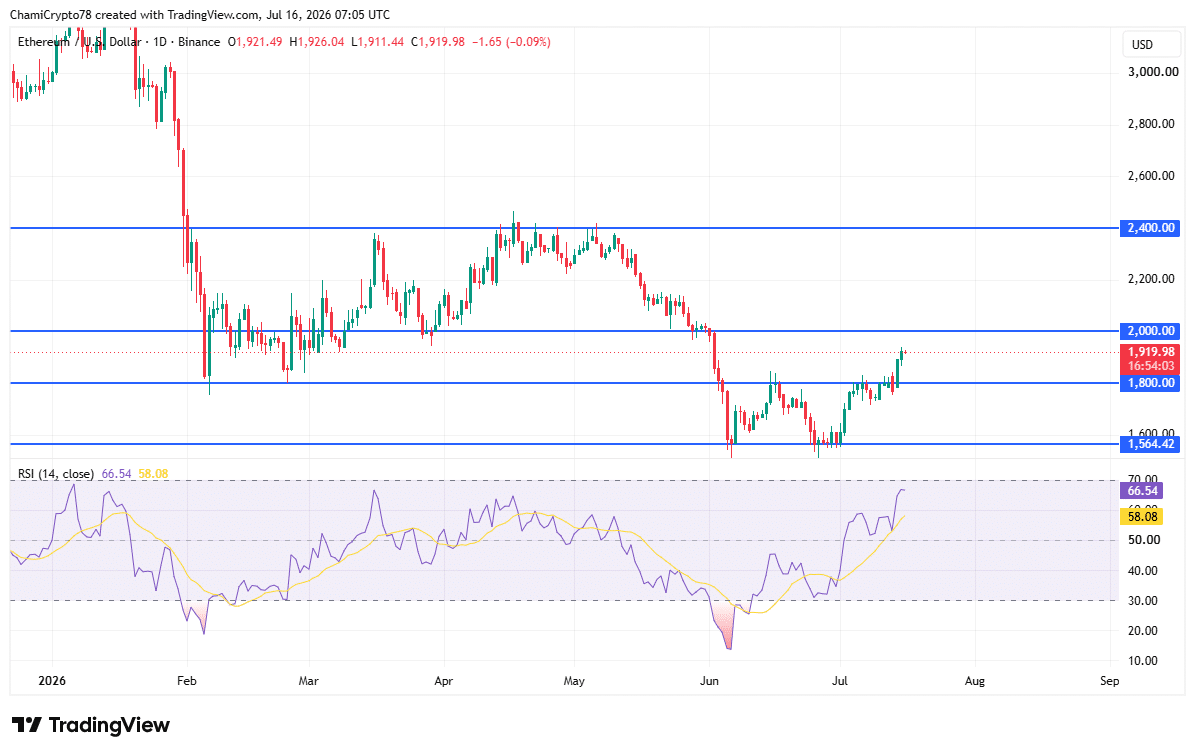
At the time of analysis, Ethereum [ETH] traded near $1,920 after recovering strongly from its early-June low around the $1,564 support level.

Buyers steadily pushed price toward the major $2,000 resistance, although that barrier continued capping advances during the latest session.

The Relative Strength Index climbed to 66.54, while its moving average stood near 58.08. Those readings showed strengthening buying interest without entering overbought territory above 70.

Price also formed higher lows throughout July, reflecting improving market structure after the sharp correction.

Even so, the latest candle closed slightly lower, indicating buyers encountered resistance as ETH approached $2,000.

If bulls reclaimed that level, price could challenge the next resistance near $2,400. Otherwise, another rejection could draw ETH back toward the $1,800 support before another recovery attempt.
Source: TradingView

To sum up, Ethereum’s latest whale activity strengthened the broader accumulation narrative instead of weakening it.

Institutional capital continued shifting onto decentralized rails, while large spot orders remained dominant across the market.

Although the $2,000 resistance still requires confirmation, the improving technical structure suggested buyers could attempt another breakout if accumulation persists and demand continues supporting price.


Final Summary

  • Whale accumulation and institutional wallet activity continued supporting Ethereum’s improving market structure.
  • ETH approached $2,000 as buying strength increased, though resistance remained firmly intact.

Trending Cryptos

Related Reads

1inch Co-founder Anton Bukov Leaves, Launches New Project Second Tier

Anton Bukov, co-founder of the decentralized exchange aggregator protocol 1inch, has announced his departure from the company's daily operations. Bukov, who was instrumental in designing core 1inch architectures like the Router, Fusion, and cross-chain Swap, ceased involvement in November 2025 due to strategic and leadership disagreements, though he retains his co-founder title and 50% equity stake. Concurrently, Bukov unveiled his new venture, Second Tier (tier.xyz), describing it as infrastructure to "shorten the distance between economic intent and on-chain execution." He explicitly stated it is not a DEX or aggregator. The project's public-facing material is currently a manifesto criticizing systemic financial friction and advocating for building new architectural categories rather than competing within existing ones. No product details, team, or funding have been disclosed. The split highlights a strategic divergence within 1inch. While CEO Sergej Kunz has steered the company toward traditional finance integration—evidenced by a 2025 brand refresh and a major Coinbase partnership—Bukov emphasized a commitment to decentralized, permissionless DeFi principles. Bukov's exit coincides with a challenging period for 1inch. Q1 2026 data shows a 60.3% quarterly drop in its daily average trading volume to $97.1 million, underperforming the broader DEX aggregator market decline. Its market share fell from 25.2% to 17.0%, dropping it to fourth place among competitors. Key questions remain regarding Bukov's future role as a major 1inch shareholder, the timeline for Second Tier's product development, and whether 1inch's institutional-focused strategy can reverse its declining trading metrics.

Foresight News6m ago

1inch Co-founder Anton Bukov Leaves, Launches New Project Second Tier

Foresight News6m ago

Meituan Leads Investment, New Unicorn in Dexterous Hands Born

Xynova, a full-stack provider of dexterous hand solutions for embodied intelligence, has officially become a unicorn after securing a 500 million yuan Series A+ round led by Meituan. This marks the company's third major funding in 2024, bringing the total raised in four months to approximately 1.5 billion yuan. The investment lineup features a prominent group of industrial and internet giants, including repeat investors like Xiaomi and new backers such as NIO Capital and China Merchants Capital. With total market capitalization of its industrial shareholders exceeding 5 trillion yuan, the backing represents a strategic positioning across the new energy manufacturing, smart logistics, and last-mile delivery sectors. Founded in 2024 by CEO Xia Yuxuan, Xynova focuses on the critical "last centimeter" of robot interaction—the dexterous hand. Moving beyond traditional technical debates, the company adopts a full-stack, self-developed approach, integrating hardware and algorithms. Its flagship product, the Flex 2, is a hybrid tendon-and-direct-drive hand with 23 degrees of freedom, weighing under 400 grams and boasting a key component lifespan of over 1.5 million cycles. The industry narrative is shifting from robot mobility to practical utility, making reliable, mass-producible components crucial. Xynova has established a 5,400-square-meter factory in Hangzhou, with annual capacity expected to reach 10,000 units by year-end. The company believes embodied robots will see large-scale real-world adoption within three years, potentially as soon as 18 months.

marsbit15m ago

Meituan Leads Investment, New Unicorn in Dexterous Hands Born

marsbit15m ago

Understanding the Stablecoin Industry Chain in One Article: The Real Profits Are Not in the Issuance

Understanding the Stablecoin Industry Value Chain: The Real Profits Are Not in Issuance The article argues that while industry discussion focuses on stablecoin issuers like Tether and Circle, the real profit opportunities lie further down the value chain. It breaks the stablecoin ecosystem into five key segments: issuance, on/off-ramps, on-chain transfers, payments, and yield generation/asset growth. Issuance is dominated by a few giants with massive scale and trust advantages, making direct competition difficult. New entrants are advised to focus on specialized infrastructure roles within this segment instead. The on/off-ramp sector faces intense competition and margin pressure on basic transaction fees, pushing service providers to expand into adjacent services for recurring revenue. The on-chain transfer segment, particularly for cross-border payments and payroll, offers significant cost advantages over traditional systems. Profits are not in the transfer itself but in the surrounding compliance, FX services, and leveraging idle funds. In payments, the core profitability lies not in consumer-facing card brands but in the backend infrastructure for issuing, clearing, and settlement. This allows players to capture reserve interest and improve capital efficiency through real-time, on-chain clearing. Finally, the asset growth/yield segment has evolved into a full-fledged on-chain asset management industry. It features layered models with specialized risk managers and offers products ranging from tokenized treasuries (RWA) to yield-bearing synthetic dollars. The future direction points towards integrating stablecoin advantages (24/7 clearing, low-cost transfers, programmable yield) into existing traditional financial infrastructure, as seen in recent acquisitions. Value is shifting downstream to the clearing/payments layer and towards compliant integration with traditional finance, including the rise of regional non-USD stablecoins.

Foresight News29m ago

Understanding the Stablecoin Industry Chain in One Article: The Real Profits Are Not in the Issuance

Foresight News29m ago

Stock Price Falls Below IPO Price, First Launch After IPO Hits a Snag, Where Will SpaceX Go From Here?

SpaceX Faces Post-IPO Pressure as Starship Launch Aborted, Stock Slumps SpaceX's highly anticipated 13th test flight of its Starship rocket was aborted during the final ignition sequence on July 17th due to issues with some Raptor engines failing to start as expected. CEO Elon Musk stated the company will replace two engines and aims for another launch attempt early next week. This setback comes at a critical time for SpaceX. Following its historic IPO last month, the company's stock (SPCX) has recently fallen below its offering price, down nearly 40% from its peak. The market had hoped a successful test would bolster the declining share price, but the abort triggered further after-hours selling. The article highlights a shift in investor perspective post-IPO. While previous Starship test failures were often viewed within SpaceX's "fail fast, iterate" Silicon Valley engineering culture as valuable data points, public market investors are now more focused on timelines, commercialization prospects, and their impact on valuation and future cash flows. Each delay or issue is now quickly factored into the stock price. While public listing provides crucial capital for ambitious projects like Starlink and Starship, it also brings increased scrutiny and pressure for predictable progress. The upcoming launch attempt is now seen as more than a technical milestone; its success or failure is likely to significantly influence market sentiment and the stock's near-term trajectory as SpaceX navigates the new realities of being a publicly traded company.

Odaily星球日报1h ago

Stock Price Falls Below IPO Price, First Launch After IPO Hits a Snag, Where Will SpaceX Go From Here?

Odaily星球日报1h ago

Trading

Spot

Hot Articles

Discussions

Welcome to the HTX Community. Here, you can stay informed about the latest platform developments and gain access to professional market insights. Users' opinions on the price of ETH (ETH) are presented below.

活动图片