Dexterous hands are getting increasingly hot.
As learned by Investment Community, today (July 17th), Xynova, a full-stack solution provider of dexterous hands, the core component of embodied intelligence, officially announced the completion of an A+ round financing of 500 million yuan. This round was led by Meituan, with NIO Capital, China Merchants Capital, and a major internet company following suit. Existing shareholder Xiaomi Strategic Investment continued to increase its investment. From this point, Xynova officially steps into the ranks of a unicorn.
This is the third investment Xynova has received this year, and again it secured support from top-tier industrial capital—the lead investors in the Pre-A round in March and the A round in May were JD.com and Li Auto, respectively.
Looking back along the timeline, Xynova's financing pace is quite astonishing—three rounds in 4 months, with a total amount of approximately 1.5 billion yuan, vividly illustrating the explosion in popularity of dexterous hands under the wave of embodied intelligence.
Raising 1.5 Billion Yuan in Successive Rounds, Assembling a Team of Industrial Capital
Established for less than two years, Xynova has left a deep impression on the venture capital circle:
In December 2025, it secured over 100 million yuan in Angel round financing, led by Puquan Capital under CATL, with co-investors including Xiaomi Strategic Investment, Zhengxuan Investment (BYD-affiliated), and Orient Jinfu;
In March 2026, it completed a Pre-A round financing of several hundred million yuan, led by JD.com, with Caitong Capital, Yida Capital, and 37 Interactive Entertainment participating, and existing shareholders like Xiaomi Strategic Investment increasing their stakes;
Soon after, it completed another A round financing of several hundred million yuan, jointly led by Li Auto Strategic Investment, CSC Financial Capital, and CSC Investment, with Zhewen Interactive following suit, and existing shareholders like Xiaomi Strategic Investment once again increasing their stakes.
Until the latest round emerged, led by Meituan, with NIO Capital, China Merchants Capital, and a major internet company following suit, and existing shareholders like Xiaomi Strategic Investment continuing to increase their investment. The completion of this 500 million yuan A+ round financing declares Xynova's official status as an embodied intelligence unicorn.
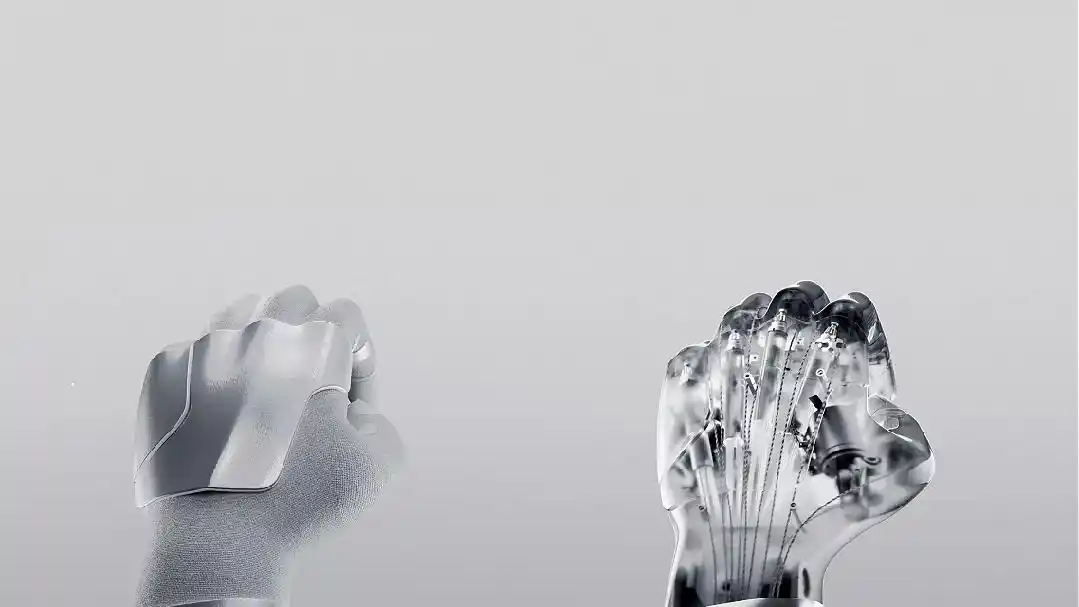
Xynova's World's First Hybrid-Driven Dexterous Hand Flex 2
Looking at Xynova's financing history, several characteristics are not difficult to notice:
First, the list of investors is crowded with internet giants and new energy giants. CATL, Xiaomi, JD.com, Li Auto, Meituan, NIO, and BYD-affiliated (Zhengxuan Investment) have all appeared, mostly in lead investor roles. Such a capital combination is rare even when looking across the entire embodied intelligence sector. So far, the total market value of Xynova's industrial shareholders has exceeded 5 trillion yuan.
Second, many existing shareholders have reinvested, showing strong "stickiness." Among them, Xiaomi, as one of the earliest internet strategic investment parties in Xynova, has followed from the Angel round all the way to the A+ round, increasing its stake continuously over multiple rounds; additionally, several other existing shareholders have participated in successive rounds, setting an example of "firm holding."
In reality, whether it is "high-end manufacturing and automotive ecosystems" or "internet and new economy scenarios," the deep strategic intentions behind the investors are self-evident—this is not merely a financial investment but a collective positioning by the upstream and downstream of the industrial chain for the "industrial foundation of embodied intelligence."
In the current industrial landscape, humanoid robots are moving from showcasing skills to working in factories, and dexterous hands are precisely the key determining whether robots can truly work stably in the physical world and help enterprises and households improve efficiency. For these giants, investing in Xynova essentially means seeking the optimal solution for their core businesses:
On one hand, this is a breakthrough by new energy vehicle companies against the bottleneck of flexible manufacturing. In automobile assembly workshops, stamping and welding have long achieved a high degree of automation. However, in stages involving soft materials and non-standard operations like seat installation, interior assembly, and wiring harness connection, traditional rigid robotic arms are often helpless, relying heavily on manual labor. Automakers like Li Auto urgently need tools that can handle complex curved objects with force control and perception like human hands. Xynova's dexterous hand precisely fills "the last and hardest piece of the puzzle" in the automation of automobile manufacturing.
On the other hand, this is a restructuring of terminal delivery experience by internet giants. For industry players like JD.com, unmanned delivery vehicles solve the problem of "running on the road," but the interaction in the last meter remains a pain point. Robots not only need to deliver goods to the building but also need to precisely take out easily spilled soup and noodles from insulated boxes, gently place them into pick-up ports, and even enter households in the future to organize and store items.
Meituan's lead investment reflects its high recognition of Xynova's product value and large-scale commercial landing capabilities, and also indicates its long-term optimism about the core capability of dexterous operation. The key for robots to ultimately create value lies in whether they can truly enter real-world scenarios and complete complex tasks, and dexterous operation is precisely the important bridge connecting intelligent decision-making with the physical world. Meituan Strategic Investment stated: "We believe high-degree-of-freedom five-finger dexterous hands are a must-have for the endgame of humanoid robots. Xynova is a representative player in the high-degree-of-freedom dexterous hand track. It not only launched a highly competitive tendon-driven hand solution but also insists on vertical integration and full-stack self-development, possessing technological innovation, engineering capabilities, and mass production potential. We look forward to seeing the company's products applied in actual scenarios in the future, promoting the acceleration of robot technology towards large-scale commercial applications."
Looking at it now, this luxurious list of investors has become a "stamp collection map" of China's intelligent manufacturing industrial chain—from new energy manufacturing and smart logistics to last-mile delivery, these top-tier industrial capitals almost cover the most core scenarios of embodied intelligence from production to circulation. Thus, they have also opened up a green channel from the laboratory to the real physical world.
They Specialize in Dexterous Hands, Breaking Through the 'Last Centimeter' for Robots
Rewind to 2024.
The wave of embodied intelligence had just begun, with countless entrepreneurs rushing into humanoid robot body manufacturing. But in Hangzhou, a young post-95s founder made a different decision: not to build robot bodies, but to choose a track known in the industry as the "last centimeter," with complexity not inferior to the robot body itself—dexterous hands.
This is Xinyu (Yuxuan) Xia, founder and CEO of Xynova, an embodied intelligence entrepreneur with both top global academic background and senior investment experience. He possesses a composite professional background in physics and computer science (machine vision) and previously worked at institutions like Morgan Stanley and CDH Investments, focusing long-term on hard technology and high-end manufacturing sectors.
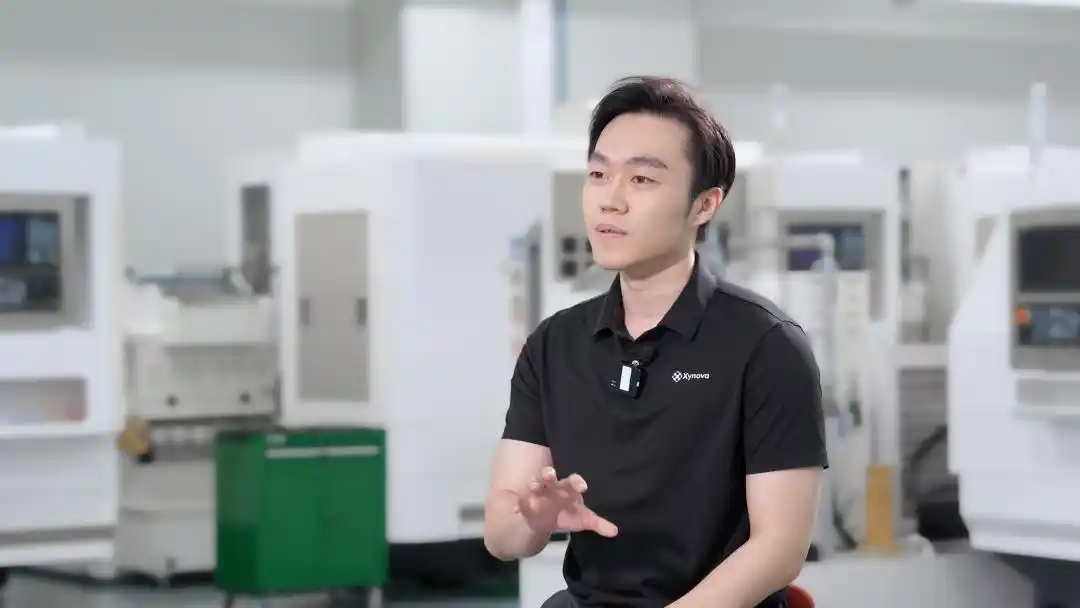
Xinyu (Yuxuan) Xia, Founder and CEO of Xynova
During his time in investment, he focused on the embodied intelligence sector, knowing well that this is a grand narrative not inferior to the previous industrial revolution. But the physical body of robots was far from ready, especially dexterous hands. As the key bottleneck for robots transitioning from "able to move" to "able to work," they were extremely scarce in the market at the time.
Why are human hands so useful? The core lies in the large muscle groups being concentrated in the forearm, allowing the palm to achieve extremely strong grasping capability with very light self-weight. Reasoning backward from this, Xia established the company's initial technical route: move the power source (motor/electric cylinder) up to the forearm and drive the fingers via tendon ropes. This line of thinking directly gave birth to the later hybrid drive solution.
Reality in entrepreneurship was more challenging than imagined. By the end of 2024, the domestic supply chain ecosystem was far from mature. Xynova was forced to tackle many more upstream technological challenges, from miniature lead screws, reducers, motor winding to motor control and motion control algorithms, conquering one tough nut after another—this later became the deepest technological moat, achieving true full-stack self-development and self-production from underlying components to the complete hand.
The company's most difficult moment was before the first-generation product was launched because without a product, there was no market feedback. The turning point was in August 2025, when Xynova released Flex 1, the world's first fully self-developed, high-degree-of-freedom tendon-driven dexterous hand. The palm weighed only 380 grams, with a load capacity exceeding 30 kilograms, and key component lifespan broke through 1.5 million cycles.
After that, Xynova's team rapidly expanded from less than ten people to over 300, with R&D personnel exceeding 150, gathering scientific research strength from top institutions like Tsinghua University, Zhejiang University, HKUST, as well as high-end talents from industry frontlines like DJI, Apple, KUKA, and CATL.
The dexterous hand sector had long been mired in a technical route debate between "linkage," "pure tendon drive," and "pure direct drive." But as the industry moved from laboratories to real physical scenarios, the market gradually realized that merely obsessing over a single transmission method could no longer solve pain points; the real barrier lies in the deep coupling of hardware and software at the underlying level. Now, Xynova has moved beyond this either-or "route debate."
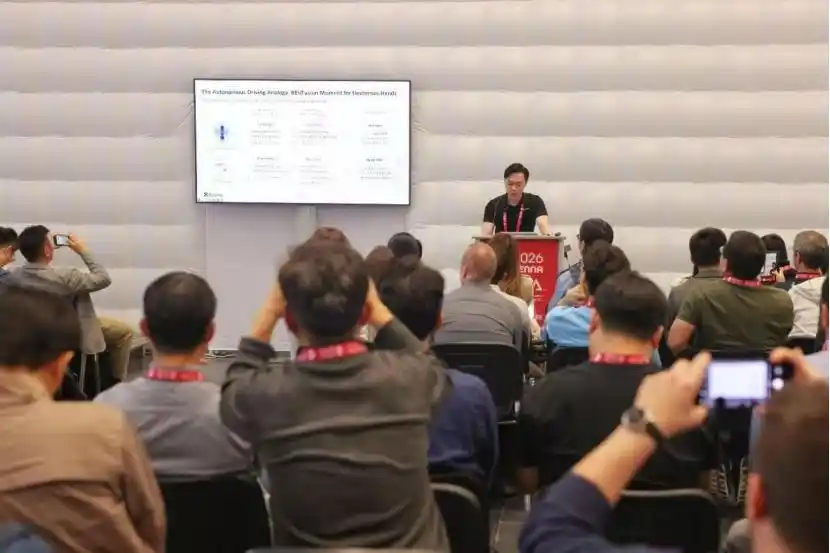
Yuxuan Xia invited to share dexterous hand research at ICRA
The team believes one point: True dexterity originates from the deep integration of hardware and algorithms. Therefore, Xynova does not rely on a single technical path bet but builds a complete closed loop from physical components to intelligent decision-making through full-stack self-development. Based on the reuse and differentiated customization of these underlying capabilities, Xynova accurately covers the core business scenarios of industrial and consumer-grade markets.
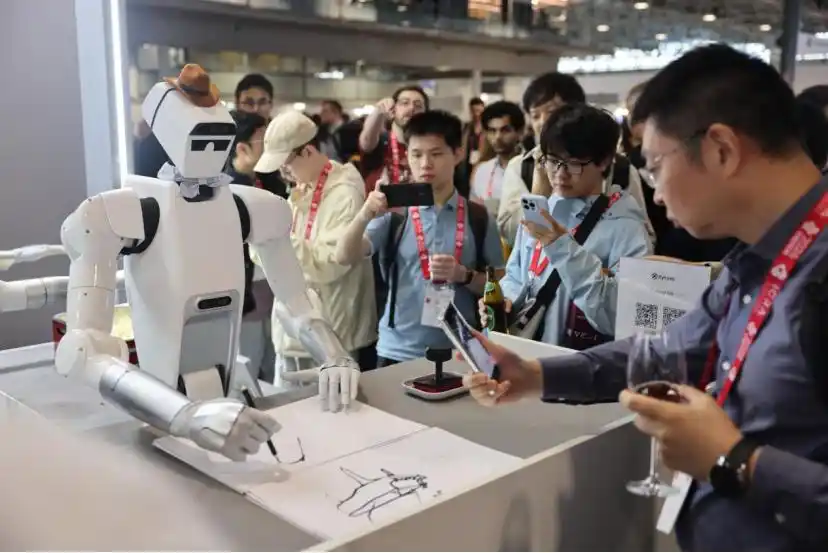
Photo of audience interaction at Xynova's ICRA exhibition
In May 2026, Xynova released Flex 2, the world's first "tendon drive + direct drive" hybrid-driven bionic dexterous hand, offering a universal dexterous operation solution for industrial and consumer-grade markets. This is not merely an evolution in mechanical structure but a qualitative change in software-hardware synergy:
Hardware-wise, it aims to break the "performance, size, lifespan" impossible triangle. With 23 degrees of freedom, a palm weighing less than 400 grams, it achieves ultra-low end inertia close to that of a human hand. Through self-developed breakthroughs in materials science and processes, the tendon rope lifespan is increased to over 1.5 million cycles—meaning dexterous hands have moved from laboratory exhibits to industrial-grade durable components.
If hardware is the skeleton of the hand, then the algorithm is its nerves and cerebellum. The data closed-loop and motion control algorithm system enable Flex 2 to truly understand and execute commands. The developed atomic skill library can decompose complex operations into reusable underlying action units, while high-precision force-position hybrid control algorithms achieve fingertip-level micron-scale motion control.
For clients pursuing large-scale deployment, Flex 2 is undoubtedly that standardized component that can truly "go to work in the factory."
Dexterous Hands Explode in Popularity, Competition Shifts to Mass Production and Landing
If embodied intelligence is the crown of global future industries, then dexterous hands are undoubtedly the brightest pearl among them.
At this moment, the industry narrative has shifted from "how fast can a robot run, how high can it jump" to "how many things can a robot do, how much value can it generate." Dexterous hands are precisely the core component for robots to interact with the physical world—if large models are the robot's brain, then dexterous hands are the "last centimeter" determining whether they can truly land and work.
Dexterous hands, joints, visual perception... whether a robot is ultimately easy to use depends on whether these "physical abilities" are mature enough. In the second half of embodied intelligence, OEMs no longer need to build hands from scratch themselves but need a supplier capable of stable mass production and high reliability.
However, challenges remain. A VC investor told us: The reliability and usage lifespan of dexterous hand products are still far from meeting the demands of production operations; development is still in an early stage of rapid growth.
As the investor worried, many dexterous hands in real-world usage environments have a lifespan of only one to three months, with some even starting to fail after a few weeks.
On this point, Xynova's current products have reached industrial-grade standards in reliability. The core component, tendon ropes, have a lifespan exceeding 1.5 million cycles, and the whole hand open-close cycles exceed 1 million. They have also passed stringent tests like high/low temperature, vibration, and drop, ensuring stable operation in real scenarios.
As embodied intelligence moves from concept to the critical stage of commercialization, mass production capability is key to determining whether a company can succeed. It is reported that within less than two years of its establishment, Xynova has already established mass production and delivery capabilities—it has built its own 5,400 square meter factory in Hangzhou, expected to reach an annual capacity of 10,000 units by the end of this year.
"Dexterous hands don't lack demos; what's lacking are reliable, usable hands that can be stably replicated by the thousands and tens of thousands," emphasized Yuxuan Xia. Relying on full-stack self-development and self-production capabilities, Xynova masters everything from miniature lead screws and motors to control algorithms independently, not only building technological barriers but also controlling costs at a highly competitive level, paving the way for large-scale commercialization.

Screenshot from Xynova Flex 2 Dexterous Hand Live Video
When capital and industry reach a consensus on the "last centimeter," embodied intelligence will truly move towards the tipping point of large-scale landing, perhaps faster than anyone expected—"Within three years, it will definitely be the time point for embodied robots to enter real-world scenarios on a large scale. If more optimistic, perhaps within 18 months."
Everyone firmly believes the watershed moment is coming.
This article is from WeChat public account "Investment Community" (ID: pedaily2012), author: Jiyun Yang